Archive for Daily Graphings

Free Agent Signings That Worked

In yesterday’s chat, I was asked if Jim Thome was the best free agent signing any team made this winter. I’ve actually seen this idea pushed forward several times of late, as he’s continued to pound the baseball and help propel the Twins into first place. Make no mistake, Thome is having an excellent season, running a .412 wOBA that is the seventh highest in baseball among players with at least 250 plate appearances.

But while Thome has been a bargain for the Twins after signing for just $1.5 million this winter, he’s not the best signing of last winter. The contenders for that award:

Colby Lewis: 2 year, $5 million, +3.4 WAR

The Rangers took a small gamble on his success in Japan translating back across the ocean and have hit the jackpot for doing so, as Lewis has been a high quality starting pitcher while earning a paltry $1.75 million this year. Not only do they have his services next year on the cheap as well, but they hold a $3.25 million option for 2012, which will almost certainly be exercised as long as he stays healthy. By the time this contract is over, the Rangers will probably have gotten three years of Lewis’ pitching for a grand total of about $8 million, or less than what Ben Sheets got for 2010 alone.

Kelly Johnson: 1 year, $2.3 million, +4.4 WAR

The Diamondbacks were beneficiaries of the Braves decision to non-tender Johnson rather than go to arbitration with him a second time. Even though they guaranteed him only one year, they still hold his rights for 2011, as he’s arbitration eligible for the final time. He’ll get a big raise after a monster season, but his paycheck will still be far less than what he’d get as a free agent. A no risk move that has paid off big time this year and will continue to provide value again next year.

Aubrey Huff: 1 year, $3 million, +4.4 WAR

One of the main reasons the Giants are still in contention in the NL West, Huff has basically replicated his 2008 season, playing everyday and providing significant offensive value. The Giants got their cleanup hitter for a fraction of what other first baseman were signing for, and have to be thrilled that they missed out on giving Adam LaRoche a multi-year deal.

Adrian Beltre: 1 year, $10 million, +5.7 WAR

The best performer from last winter’s crop, Beltre has been the Red Sox’ best player. His defense is as good as ever, but now he’s hitting the ball well again and easily earning his salary. While he’s more expensive than the rest of the guys on this list, he’s also packing a lot of value into one roster spot, and for a team trying to maximize their wins, that offers a lot of advantages. The Red Sox probably now wish that they could have gotten a team option for 2011 rather than giving Beltre an opt-out, because he’s going to get a big raise this winter.

Alex Gonzalez: 1 year, $2.8 million, +2.9 WAR

It’s hard to imagine this signing working out any better for the Blue Jays. They got a monster April from their shortstop, where he posted a .403 wOBA, and then dumped him a few months later for a better, younger player at the same position in Yunel Escobar. While Gonzalez didn’t provide as much value on the field as some other free agents, he established enough value early in the season to get used as a trade chip in the summer, bringing back a return that could pay off for years to come.

Of these five, I think Lewis still stands out as the best of the bunch. The Rangers solidified their rotation without spending any real money, and they can look forward to two more bargain basement seasons still to come. Thome has had a great year, but there’s no way the Rangers would rather have him than their #2 starter.


2010 Draft Review: AL West

The series continues.

LOS ANGELES ANGELS
Number of Top 10 Picks Signed: 9.
Highest Bonus Awarded: Kaleb Cowart, Georgia HS, 18th overall.
College/HS Breakdown of Top 10 Highest Drafted Signees: 3 college, 6 HS, 1 JC.
Pitcher/Hitter Breakdown: 5/5.

Notable Performances Thus Far: Here’s what happens when you start your draft with five high school picks: you have a talented, but underperforming, team in the complex league. This is certainly no exception with the Angels given the struggles of Chevez Clarke (.325 wOBA), Taylor Lindsey (.299 wOBA), Wendell Soto (.325 wOBA) and Ryan Bolden (.248 wOBA) in their professional debuts … On the good side is second-round pick Daniel Tillman, who is closing for the man that drafted him, Tom Kotchman. Tillman has been dominant in the role, striking out 32 of the 82 batters he’s faced, while allowing just 20 to reach base.

Thoughts: The Angels farm system was pretty good before June, but with five picks in the first 40, this draft offered the opportunity to completely restock the shelves. Los Angeles took a really interesting approach to their multitude of picks: spending $6.2 million on five high school players. The team is clearly willing to take a couple busts in the name of adding a couple star players. While I like the picks to have a more diverse pedigree, it’s certainly a defensible approach. Cowart is certainly one capable of being a star, and after the first round, the team did go with some college pitchers with a little higher floor.

OAKLAND ATHLETICS
Number of Top 10 Picks Signed: 10.
Highest Bonus Awarded: Michael Choice, UT Arlington, of, 10th overall.
College/HS Breakdown of Top 10 Highest Drafted Signees: 5 college, 4 HS, 1 JC.
Pitcher/Hitter Breakdown: 3/7.

Notable Performances Thus Far: Michael Choice is just 11 games into his first stint, in the Northwest League, and he’s been exactly the player he was in college: 17 strikeouts, 8 extra-base hits, 6 walks in 53 plate appearances. Choice is a Three True Outcome player through and through.

Thoughts: I really liked the A’s first two picks this year, and then after, I couldn’t find a lot to get excited about. Choice is athletic, powerful, but also has an understanding for the strike zone. If the team can cut his strikeouts down even a little — he’ll always be a high-K guy — he could absolutely take off. In the second round, the team drafted and signed Florida prep infielder Yordy Cabrera. He’s older than most high school picks at age 19, but his tools are first round caliber. After that, the team spent more than $150,000 on just three players, all high school picks that weren’t considered elite talents. One of them might ultimately be successful, but even that’s optimistic. After Choice and Cabrera, the draft is littered with potential relievers and bench players.

SEATTLE MARINERS
Number of Top 10 Picks Signed: 8.
Highest Bonus Awarded: Marcus Littlewood, Utah HS, ss, 67th overall.
College/HS Breakdown of Top 10 Highest Drafted Signees: 5 college, 4 HS, 1 JC.
Pitcher/Hitter Breakdown: 5/5.

Notable Performances Thus Far: The highest pick with regular playing time so far is fifth-rounder Stephen Pryor, who has 16 relief appearances under his belt between the Northwest and Midwest Leagues. Pryor has been excellent, striking out 37 batters over 24.2 innings. He should move quickly next season … Mickey Wiswall has split his season in the same way as Pryor, and been just as effective through almost 110 plate appearances: .297/.339/.604.

Thoughts: While James Paxton has yet to sign, the Mariners spent more than $200,000 on just three players this season, and didn’t eclipse the $1 million threshold on anyone, which is principally because the team didn’t draft until 43rd overall, and drafted a player there (Taijuan Walker) without a college commitment. In the next round, the team drafted Marcus Littlewood — who some had talked about as a first-round pick — and bought him away from his college commitment. Missing third-round pick Ryne Stanek is a bummer, but mitigated by the fact that 16th rounder Jordan Shipers took $800,000 to sign. Assuming Paxton does sign, this team will likely end up with four solid talents for less than $3.5 million. They got good value, but they don’t have one of the league’s great talent hauls.

TEXAS RANGERS
Number of Top 10 Picks Signed: 10.
Highest Bonus Awarded: Jake Skole, Georgia HS, of, 15th overall.
College/HS Breakdown of Top 10 Highest Drafted Signees: 4/6.
Pitcher/Hitter Breakdown: 4/6.

Notable Performances Thus Far: The team has been pretty aggressive with Skole, sending the 18-year-old to the college-heavy Northwest League. But he’s held his own there, posting a .322 wOBA, but showing a nice 10.1 BB%. … It hasn’t gone as well at that level for Canadian Kellin Deglan, who has a .470 OPS in 10 NWL games. I don’t know why he was promoted from the complex league, where he hit just .286/.355/.357 in 10 games. … Ex-UConn third baseman Mike Olt is a little better fit for the NWL, and it shows: he has a .400 wOBA through 238 plate appearances.

Thoughts: Like the Angels, Texas was busy early in the draft, with four picks in the top 50. Also like LA, the team opted for high school talents early, drafting six of their first 7 players out of high school. But the team did commit money to the college side: Olt was a supplemental first round guy, and the team went above slot to sign enigmatic college pitchers Justin Grimm and Nick Tepesch. The current depth of the Rangers farm system allows them to gamble a little bit on draft day. For a team that was facing such financial questions in June, spending this much on the draft was a welcome surprise.

Favorite AL West Draft: Texas. Least Favorite: Seattle.


Just Octavio Being Octavio

In case you missed it, the Colorado Rockies and the Los Angeles Dodgers played a late night thriller on the west coast. Huroki Kuroda put together a strong start, with seven strikeouts against only one walk, allowing two earned runs in seven innings. His Rockies counterpart, Jason Hammel, worked his way around four walks and four hits to allow only two runs in six innings, striking out four along the way. The bullpens, including freshly-demoted Dodgers setup man, Jonathan Broxton, kept things scoreless until extra innings. Joe Torre, going for the win at home, went with his new closer, Octavio Dotel, to start out the 10th, hoping that a scoreless top half would be enough of an opportunity for the Dodgers.

Dotel was certainly looking to improve on his first attempt to save a game with the Dodgers, where it took all of two batters faced for Dotel to blow the save. In one sense, Dotel did improve. This time, it took four batters, including two walks, a stolen base, and two wild pitches for Dotel to bring in the game winning run for the opposing team.

To be fair, Dotel is usually a serviceable reliever. He has crazy stuff, even at 36, and he’s a mortal lock to strike out a batter per inning – he struck out two of the first three batters he faced last night. His FIP this season, however, is only 4.12 and his ZiPS projection is only around 3.70, mainly because he just has no idea where the ball is going. Dotel has a career walk rate of 4.06 and a projected walk rate of 4.20. He can be prone to outings like last night’s, in which the control is just completely missing, and even though that can bring the strikeouts, it’s also going to bring the walks, and subsequently, the runs.

The Dodgers have two relievers that are capable of striking out just as many batters as Dotel while walking far fewer in their bullpen already. One is, of course, Broxton, who has a far superior ground ball rate to go along with a walk rate about one batter lower per nine innings. The other is Hong-Chih Kuo, who has an 11.1 K/9 and a 3.0 BB/9 this season, the best walk rate of the trio. Kuo likely won’t keep the ball inside the park like he has so far this season, but he has comparable strikeout abilities to Dotel to go with superior control and a superior ability to draw ground balls.

Ned Coletti and Joe Torre are living in a world where James McDonald (20 K, 4 BB, 0 HR in 17.2 IP with Pittsburgh) and Andrew Lambo are an acceptable price to add a middling reliever to a team six games out of the playoffs and then turn him into the relief ace over two superior pitchers. The Dodgers are now 12 games out of the NL West lead and 8 games out of the Wild Card. I don’t know what the Dodgers’ endgame was with Octavio Dotel, but there’s no doubt that Coletti and the Los Angeles front office missed big on this one.


Daily Feature Experiment Thing

In case the reader hasn’t noticed, FanGraphs has a lot more daily content now than it did even last year at this time. Like, a lot more.

It can be overwhelming sometimes — even for those of us who write for the site. Seriously, a guy can leave his computer for a quick nap, wake up an hour or two later, and return to find, like, seven more articles to be read.

To help contend with this bane to our collective nerdom, I’m thinking it might make sense to experiment with a “daily feature” that includes, among other things, a digest of the previous day’s posts.

What else would it include? Well, I don’t entirely know. Probably the One Night Only game previews that critics are calling “a tour-de-force,” for one. Maybe notable tweets? Maybe a graph of the previous day’s most curious game?

One thing it probably won’t be is a link-a-thon to other sites. For two reasons: (1) Rob Neyer, et al., already do that really well, and (2) I can’t read that much about baseball.

In any case, what follows very probably doesn’t represent a final draft, either in terms of content or form. If you have any suggestions as to what you’d like to see, feel free to use the comment section to that end. (Also, if you’re a psychiatrist and have any explanations as to what the frig is up with Pat Misch, please use the comment section for that, too.)

Yesterday at FanGraphs
The Draft That Keeps on Giving
In which computerbot R.J. Anderson looks at the Rangers’ unusually useful 2007 draft.

One Night Only: Yer Darn Tootin’ It’s a Pennant Race
In which yours truly waxes disgusting about the day’s better games.

Expanded Four Factors: Do It Yourself (1.0)
In which Jackie Moore invites you to get all DIY up in this piece.

2010 Draft Review: AL Central
In which prospect maven Bryan Smith talks about boyz to men. Metaphorically speaking.

FanGraphs Chat – 8/18/10
In which our Full-Time Employee wanders among the unwashed.

Derrek Lee to the Braves
In which fellow paesan Pat Andriola considers the relative merits of Derrek Lee and Troy Glaus.

The Reds Are Past the Point of Placating Veterans
In which Joe Pawl is all about Paul Janish.

NPB Prospects You Should Know
In which Patrick Newman quoths the phrase “Fat Ichiro” — but not in the dirty way this time.

2010 Draft Review: NL Central
In which prospect maven Bryan Smith sings a verse very similar to his first.

Jay Bruce and Batted Ball Distance
In which Jeff Zimmerman gets super graphic (with the average distance of Jay Bruce’s batted balls).

The Franchise Player
In which our Full-Time Employee tries to start something with Ryan Zimmerman.

Cubs Bring Back Pitching For Lee
In which Jackie Moore advises you to remember this name: Robinson Lopez.

Another Neglected Red
In which Joe Pawl sings the praises of All-Joyer Chris Heisey.

Carlos Quentin’s Drop Off Continues
In which Matthew Carruth informs you that Quentin’s WAR since 2008 is, like the industry leader of built-in refrigerators, sub-zero.

Notable Tweets
Baseball Division
From jonahkeri: Lance Cormier is the Armando Benitez of Chan Ho Parks.

Open Division
From TheKevinButler: I traded all the way up from a red paper clip into this job.

One Night Only: New York (NL) at Houston | 8:05pm ET
Starting Pitchers
Metropolitans: Pat Misch (N/A)
150.2 IP, 5.91 K/9, 1.43 BB/9, .299 BABIP, 49.1% GB, 4.6% HR/BIA 3.43 FIP (Triple-A)*

Space Team: Bud Norris (10)
99.2 IP, 9.75 K/9, 3.88 BB/9, .350 BABIP, 43.5% GB, 12.9% HR/FB, 3.75 xFIP

*Minor league GB and HR/BIA numbers courtesy of StatCorner. MLB average is 6.5% HR/BIA.

Read the rest of this entry »


First Round Compensation (Part One)

After reading Buster Olney’s column yesterday morning, I had a brief conversation with Jonah Keri about draft slotting and compensation. I half-heartedly threw out the suggestion that perhaps compensation should be altered so that players have to spend a certain amount of time with their last team to qualify for compensation; the thought being that those compensatory matters only exist to help teams replace exiting homegrown talent. I think I threw out a number along the lines of 60% of their plate appearances or innings should come with the team benefiting.

The ramifications of such a move would alter the trade value of those players while also raising the value of the draft picks as the supply dwindled. Curious, I decided to look into just how much time most of the players are spending with the teams being rewarded with draft picks. Beginning with the 2000 draft and ending with the 2010 draft, I went through and noted each player who returned a first round draft pick and/or first round supplemental draft pick. I did not – and this is important to note – include players who returned picks later than that; meaning I focused on Type-A free agents.

From there, I took each of the teams that these players returned draft picks for and figured out the percentage of the player’s career plate appearances or innings pitched (to that point in the player’s career) came with the compensated team. That explanation might be a bit confusing, so let me write through a real life example.

Take the 2007 draft. Carlos Lee brought in two first round picks for the Texas Rangers. Lee had racked up a total of 260 plate appearances with the Rangers the season before out of 5,029 plate appearances for his career. Two sixty divided by 5,029 is roughly 5% of Lee’s total plate appearances through 2006, and yet, the Rangers are the ones who landed those picks.

Now, obviously, it’s not that simple. The Rangers did give up talent in order to secure Lee’s rights and significant talent at that, but the point is: if the compensation rules are designed to replenish teams losing homegrown talent, then examples like this one prove that it doesn’t work. At least, if these examples are in the vast majority, which is what we’ll examine later today.


Carlos Quentin’s Drop Off Continues

Shortly after Arizona traded him to the White Sox before the start 2008 season, Carlos Quentin unleashed a monster season on the American League. Since then, Quentin’s performances have been disappointing to put it mildly. I endeavored to find out what’s different between the All-Star worthy Carlos Quentin of 2008 and below replacement level Carlos Quentin since.

Quentin posted a career best .278 batting average on balls in play during 2008. Coupled with a marked drop in his strikeout rate –what had been 24% the previous season fell to 17%– Quentin saw his batting average spike to up .288. Was there anything systemic that aided the rise in BABIP? It’s difficult to determine. Quentin did hit into fewer pop outs once in Chicago, a feat that dramatically helps to improve one’s BABIP, but we’re not talking about an earth shattering deviation and his other batted ball rates remained fairly consistent.

Furthermore, Quentin repeated the lower infield fly rate in 2009 but saw his BABIP sink all the way to.221. Hitting fewer ground balls in 2009 obviously has an effect but a small one, too small to account for the entire change unless you treat 2008 as an outlier.

Further worsening the drop off from 2008 is a decline in walk rate. It peaked in 2008 at 12% but fell to 8% last season and though it has rebounded to 10% in 2010, his strikeouts are up as well, wiping out the positive growth in walks. Quentin’s newfound penchant for offering more at out of zone pitches is partly a culprit as it has risen from 26% in 2008 to 29% in 2009 and now stands at 31%. It is hard to draw walks when you swing at the pitches that you do get outside the strike zone.

Despite that humongous drop in walk rate and batting average, Quentin still maintains an overall above average hitting line with wRC+s of 104 and 121 after his monstrous 154 in 2008. However his defense, which was never much to write about, has collapsed according to UZR. Without a superstar-level offensive output, the total package is quite lacking and Quentin has totaled up -0.3 WAR since that much heralded Chicago debut year.


Another Neglected Red

Earlier this afternoon I explored the case for Paul Janish, the shortstop who is outperforming Orlando Cabrera while the latter sits on the DL. Janish is one of many Reds bench players who has contributed to the team’s success this year. A few commenters in the post point out a couple of other bench players who might provide an upgrade if given more playing time.

The Reds outfield this year has been not so good. The three players with the most PA — Jonny Gomes, Jay Bruce, and Drew Stubbs — have wOBAs of .330, .322, and .319. Keeping Bruce and Stubbs in the outfield is understandable. They’re struggling, but they’re also young and considered part of the franchise’s future. Gomes might have the best wOBA among them, but he’s a year-to-year player at this point. In any case, his wOBA is heavily influenced by his torrid May, during which he produced a .445 wOBA. In the three months since he’s hit .304, .297, and .318.

Jim Edmonds was brought in to help, at least in a platoon with Gomes. He hasn’t hit too well since his move, but that’s a measly 15 PA sample. Chances are he’ll help fortify the outfield unit once he hits his stride. The Reds do have another guy who could help: rookie Chris Heisey. A 17th-round pick in 2002, Heisey has never been a highly regarded prospect despite quality minor league production. In 133 PA this season he’s produced a .381 wOBA. As in the case of Janish that’s likely unsustainable and could certainly drop when he’s exposed to regular playing time. But considering the way Gomes and Stubbs have hit there seems little risk in going with Edmonds, Heisey, and Bruce in the outfield on most days.

(And, if Dusty wanted to get cute he could platoon Gomes and Bruce.)

There was a mention in the comments, too, about the team’s catching situation. Ryan Hanigan and Ramon Hernandez have nearly identical wOBAs, so it shouldn’t come as much of a surprise that Hanigan has picked up a few more PA, especially of late. His season numbers, especially his .380 OBP, make an argument that he should see more time than Hernandez. But Hernandez has the edge in the power department, and his .359 OBP ranks seventh among NL catchers with at least 200 PA. Hanigan has also slumped since returning from a stint on the DL, producing a .258 wOBA in July and a .189 wOBA in August. Hernandez has a .361 wOBA in August, so if Dusty wants to stay with the hot hand he’ll give Hernandez more playing time.

This brings us to another interesting comment, that Dusty doesn’t want to mess with what’s working. There’s some merit to that, in that it sounds like a bad idea to piss off some key clubhouse guys. But I wonder what the on-field effect would be. That is, how would production suffer if a clubhouse presence like Cabrera were offended by Janish playing more often. Or if Gomes were upset over losing his spot to Heisey. If the aforementioned bench players can maintain their production when pressed into more regular duty, it would seem like they would help the team create more runs. At this point, in the middle of a pennant race, it seems like it’s at least worth a shot.


Cubs Bring Back Pitching For Lee

Although word has been out for much of the day that Derrek Lee was on the way to Atlanta in a waiver deal, the deal wasn’t made official until 5:25 Eastern Time, according to Fox Sports’s Ken Rosenthal. We now know, as well, that the Cubs will be sending cash along with Derrek Lee to the Braves, and the Braves will send back three minor league pitchers. The pitchers are right handers Robinson Lopez and Tyrelle Harris as well as left hander Jeffrey Lorick.

The real get here is Lopez. The 19-year-old from the Dominican Republic just missed out on Baseball America‘s organizational top 10 prospects list for Atlanta and ranked exactly 10th in Baseball Prospectus’s pre-season look at the Braves’ system. Lopez has a fastball that reaches as high as 96, an extremely projectable frame, and at 19, that’s a player with a ton of potential. If his secondary pitches don’t develop, he will probably be limited to the bullpen. To date, he has thrown 110 innings as a starter and 33 as a reliever, and, naturally, Lopez has performed much better in the bullpen. However, I would not limit a player with Lopez’ potential to the bullpen at such an early stage in his career.

Lorick and Harris are exclusively relievers, which inherently makes their value much lower than that of Lopez, as does the fact that both were, at least at some point this season, teammates with Lopez at low-A Rome despite being 22 and 23, respectively. That doesn’t mean that Lorick and Harris don’t have some value, though, as both have performed well in the minors in their careers and have shown the potential to make up the back-end of a bullpen. Harris has struck out 84 batters in 68 minor league innings, and Lorick has struck out 85 in 86 innings. Both have a tendency toward ground balls, as well – Lorick in particular. Both are far enough away from the majors that they are anything but a sure thing, but it’s not like these players are throw-ins. They definitely supplement the value brought in with Lopez.

The Cubs are a team with plenty of money and a large fanbase, so they really shouldn’t need to perform salary dump deals with players like Derrek Lee. Lee was making roughly $3.25 million for the rest of the season, a number that likely has little impact on the Cubs’ finances for this year or in the future. Instead of dumping Lee’s salary and getting little in return, the Cubs were aggressive, and threw cash into the deal to help coax some legitimate value out of this deal. Jim Hendry deserves major credit for this trade, as instead of spending his money on an aging first baseman on a fifth place team, he now has three more solid pitching prospects to load into his system. This is just an excellent overall pickup for Chicago.


The Franchise Player

A few weeks ago, I was asked the popular barstool argument question: if you could start a franchise with just one player – with contracts and dollars being irrelevant – who would it be? I’d guess that a lot of us have had that conversation more than once. It’s a fun topic to talk about.

There are a few names that naturally get mentioned early on. Joe Mauer, Evan Longoria, and Hanley Ramirez are popular choices because they’re established stars and still in the earlier stages of their careers. Albert Pujols and Chase Utley get nominated for their sheer greatness, even though they’re already past their primes. Miguel Cabrera draws a mention from people who want to build around a premier young hitter. And then you’ll have the guy who likes pitching and brings up Tim Lincecum, Josh Johnson, Jon Lester, or Felix Hernandez.

There’s one guy that never gets brought up, though, who might just be the best answer of them all: Ryan Zimmerman. He shares the spotlight with Adam Dunn and Stephen Strasburg in Washington, but given how good he has become at such a young age, his star should shine the brightest.

Last year, Zimmerman had his breakout season, putting up a +6.6 win season that ranked as the ninth best in baseball. This year, he’s followed it up with a +6.0 win season so far, ranking second. Since the beginning of the 2009 season, only Albert Pujols has posted a better WAR than Zimmerman. He has become a complete all-around player, adding patience and power to an already impressive skillset.

Because he came up at an early age and was just a good hitter rather than a great one out of the gates, his reputation has seemingly not yet caught up with his abilities. However, let’s just throw this out there:

Rest-of-season ZiPS projections:

Zimmerman: .289/.366/.526, .388 wOBA
Longoria: .276/.360/.519, .385 wOBA
Ramirez: .307/.384/.509, .393 wOBA

Those are basically an estimate of true talent level, and it sees no discernible differences between the three as hitters. While the other two have significantly better career slash lines, Zimmerman’s performance over his last 1,100 plate appearances has been better than either of the other two.

Defensively, he and Longoria couldn’t be more similar, as they are the two premier young defensive third baseman in the game. Which one you like more is basically a matter of preference – they’re both outstanding. Ramirez does not rate out nearly as well, but of course he’s playing a more difficult position and being compared to better defenders overall. I would still place him a bit behind both of the third baseman in defensive value, but the gap isn’t as large as simply comparing their UZRs would suggest.

Longoria turns 25 in October, while Zimmerman turns 26 a couple of weeks prior to that. Ramirez turns 27 in December. Ramirez has a bit better offensive track record but is the oldest and worst defender of the trio. Longoria is the youngest, but his best season at the plate is not as good as the best season of either of the other two.

It is splitting hairs to pick between them, but gun to my head, I think I’d take Washington’s third baseman. Right now, he’s the perfect blend, combining Ramirez’s offense with Longoria’s defense into one unbelievably good package.

If his teammates were more talented, he’d be have a strong case for the NL MVP right now. Zimmerman has truly become of the game’s great young players, and the guy I’d point to if I could only take one player to begin a franchise.


Jay Bruce and Batted Ball Distance

Yesterday, our own David Golebiewski, looked at how Jay Bruce was progressing at the plate. In the comments, Jason461 noted that Bruce broke his wrist last season on July 12th and the injury could be the cause of some of his problems. Also, Jason461 stated that it takes about a year for a player to return to previous production when recovering from a wrist injury.

I have always followed players with wrist injuries after breaking my own wrist at the ripe old age of 20. Fourteen years later, my wrist is still not right. I, personally, don’t believe players can come back 100% after being off only one month for a broken wrist like Bruce.

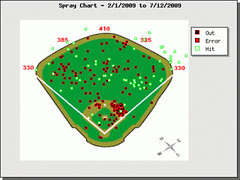
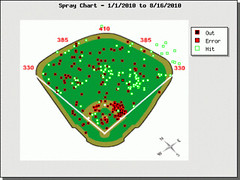
I have previously looked at the effects of wrist injuries on individual players using spray charts. I have extended that analysis to Bruce. Here is a look at Bruce’s 2009 (pre-injury) and 2010 spray charts (images courtesy of texasleaguers.com):

2009 pre-injury:

2009beforeinjury

2010:

2010

One noticeable difference is the lack of of deep power in 2010 to all fields compared to 2009.

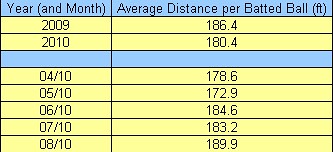
I decided to make sure my eyes weren’t playing tricks on me and look at the average batted ball distance of all his batted balls (excluding bunts). I used a process I documented previously for determining the batted ball distance. The data is from MLB and marks where the fielder gets the ball, not where it lands. Though this data is not perfect, it is the best I have available to me. Here is a chart of the batted ball data for 2009 and 2010, including the monthly data for 2010:

bruce_dist

As it can be seen, Bruce is hitting the ball 6 feet less in 2010, vice in 2009 before the injury. In 2010, the batted ball distance has gone up ~10 feet from the beginning of the season to now. In the month of June, Jay started hitting the ball like he did back in 2009, so the claim of one year recovery time seems to be correct for Jay Bruce..

I am just beginning to look at the effects of injuries on players, but hopefully in the near future I have more information to publish. Please let me know if you have any questions and if there are any other players you want me to examine.