Archive for Daily Graphings

The Qualifying Offer Remains a Problem for Players

Jake Arrieta is one of six unsigned players to have received a qualifying offer.
(Photo: Arturo Pardavila III)

There is growing sentiment this offseason that the MLBPA and players didn’t do so well in the last CBA negotiation. Some have argued the owners have won the last several rounds of negotiations.

Instead of focusing on deep structural issues related to the devaluation of most free agents — the elite free agents, the Bryce Harpers and Yu Darvishes are always going to be paid — the players took home much smaller victories in the last CBA talks, such as improving dining options in the clubhouse.

The union’s primary focus during the last round of CBA negotiations seemed to be eliminating the qualifying offer or at least reducing the punitive nature of it. The Scarlet QO had compromised the markets for a number of players in past winters. And in the current CBA, the players did get a weakened qualifying offer.

It seemed like a small victory at the time, but it is looking less and less like a kind of victory and more like another factor in the historically slow offseason.

Read the rest of this entry »


Rob Manfred Might Have Just Made a Mistake

Editor’s Note: as Ben Lindbergh’s recent piece at The Ringer illustrates, reasonable people can disagree on the proper methodology and calculus for determining the players’ share of baseball revenue. What follows is a view based on one such interpretation.

Before he was commissioner of baseball, before he was even in baseball, Rob Manfred was a lawyer. A Harvard-trained labor lawyer, to be precise, who had a successful stint at the elite law firm of Morgan, Lewis & Bockius. In fact, he’s still a registered lawyer, with an active New York law license.

Yesterday, Commissioner Manfred held a press conference that might have made Labor Lawyer Manfred cringe.

Read the rest of this entry »


Shohei Ohtani and the Angels’ Six-Man Rotation

The Los Angeles Angels struck gold this offseason. The addition of Zack Cozart and Ian Kinsler to a core that already included Justin Upton (re-signed to a five-year deal in November), Andrelton Simmons, and the incomparable Mike Trout has created a collection of position players few other clubs can rival. Nor does this even acknowledge the club’s greatest stroke of fortune this winter — namely, the signing of coveted two-way player Shohei Ohtani.

Understandably, the team wants to protect its new 23-year-old star. Ohtani joins a rotation composed mostly of damaged limbs. Because of the fragility present here, the Angels are going to try something novel — namely, to employ a six-man rotation. Unfortunately, it probably won’t work.

There are good reasons for a six-man rotation, and Angels’ starters meet several of the relevant criteria for experimenting with one. First of all, the club lacks a true ace. Despite having never faced a major-league batter, Ohtani is probably the club’s best pitcher. Given his unique position, however, it makes sense that the Angels wouldn’t expect him to carry the load of a No. 1 starter.

Beyond Ohtani, the Angels don’t possess a pitcher who needs to start every fifth day. Allocating five of Clayton Kershaw‘s or Corey Kluber‘s or Max Scherzer’s to another pitcher would be bad for a team trying to win baseball games. The Angels don’t have a pitcher of that class, though. That makes a six-man rotation more feasible from a competitive standpoint.

Read the rest of this entry »


The Orioles Are Paying Money to Andrew Cashner

So much talk of tanking. So much talk about teams allegedly not trying to win. I don’t really buy into the narrative so much — I think front offices, at least, are more urgently competitive than ever. But I will say there are a few teams in position to think about blowing it up. The Marlins? The Marlins have mostly already blown it up. Their rebuild is underway. I don’t really know exactly where the Tigers are. I know they’re not good. And then there are the Orioles. If there’s a trend, the Orioles have defied it. There’s a strong case to be made that the Orioles should have started selling already. But, dang it, they’re sticking together. And now they’re even adding Andrew Cashner.

The terms: two years, and $16 million guaranteed. There’s a third-year option, and incentives, and some of the money is deferred. We know that, if Cashner passes his Orioles physical, he’s going to start, because before now, the Orioles’ rotation depth chart read as such:

  1. Dylan Bundy
  2. Kevin Gausman

You can plug Cashner in, then. Holes still remain. The Orioles don’t look that good, in particular in a division that already has the Red Sox and Yankees. But if you’re not going to sell, you might as well do something else. Call it optimism or call it stubbornness, but the Orioles are going to give this a try.

Read the rest of this entry »


When Super-Teams Fail

There is no strict definition of what a super-team is. There’s no cutoff at a certain number of wins, no cutoff at a certain number of standard deviations above the mean. We’re objective people with an analytical bent, so we should probably consider working on this, but for the time being, consider it a “feel” thing. Somewhere, there’s a difference between a super-team, and a team that just plain looks good. We mostly know it when we see it.

And it’s been suggested that we’ve entered a super-team era. An era in which there are a number of very clear favorites. This would all be cyclical, and not a permanent state of being, but it’s hard for me to argue with. There are seemingly a number of clear favorites. You know exactly who they are. It’s impressive what they’ve all managed to build, but you could make the case it’s taken some of the thrill out of the offseason, with so many other teams deciding they just can’t keep up. Super-teams have accumulated much of the power.

You’ve seen the various preseason projections. They’re all based on prior data, and projections inform the odds. We already know which teams are going to have strong World Series odds in 2018. In the interest of shining the light on uncertainty, though, I thought it could be instructive to examine a few super-team failures. As a reminder of how baseball could surprise, we can look at a few prior surprises. These are teams that looked extremely good. These are teams that fell short.

Read the rest of this entry »


How Miami Could Still Get Its Money from Jeffrey Loria

Jeffrey Loria found multiple avenues by which to torment the people of Miami.
(Photo: Jared)

In 2009, the City of Miami and County of Miami-Dade agreed to pay for 75% of a new stadium for Jeffrey Loria’s Miami Marlins. The projected stadium cost was $645 million, so Miami and Miami-Dade — or, more technically, Miami and Miami-Dade taxpayers — agreed to cover up to $480 million of stadium-building costs, largely from from hotel taxes. (According to some reports, Miami and Miami-Dade ended up paying about $347 million.) Miami and Miami-Dade also agreed not to receive any of the money from the stadium at all. No money from ticket sales, no money for concessions or naming rights. All Miami and Miami-Dade got in return was a guarantee that, if Jeffrey Loria sold the team, they would get a percentage of the net sale proceeds.

In October 2017, Jeffrey Loria did sell the Miami Marlins — for $1.2 billion. Under the terms of that stadium deal, Miami and Miami-Dade are entitled to 5% of the net sale proceeds. So good news for Miami and Miami-Dade, right? Well, not this time: Loria has told them he actually lost money on the sale of the team. So despite that gaudy list price, Miami and Miami-Dade stand to get nothing at all.

On the surface, Loria’s claim seems pretty implausible. After all, he bought the then-Florida Marlins in 2002 for $158 million, $38 million of which was a loan from Major League Baseball. Even after accounting for paying back the loan, that’s still a difference of over a billion dollars. Remember, though, that according to the stadium deal, Miami and Miami Dade agreed to receive 5% of the net proceeds (i.e. profits), not gross proceeds (i.e. the sale price), in the event of a sale.

Read the rest of this entry »


The Last Time Scott Boras Screwed Up

It’s possible Scott Boras has misread the market. It wouldn’t be the first time.
(Photo: Cathy T)

As has been documented in some depth this offseason, the new collective bargaining agreement is bringing about consequences that might not have been fully understood — by the players, at least — at the time both sides were celebrating labor peace.

These latest developments weren’t entirely unexpected, however. Consider, for example, some previous statements by Scott Boras on the matter.

“The integrity of the game is at hand here,” Boras said. “Clubs are refusing to employ premium free agents for their true market value because of an artificial, collectively bargained process that does not help the game or the fans’ perception of the game. These players earned their free agency and played at very high levels to get it.

“Like any players, they want to play baseball. But they’re also looking at the long-term aspect of their careers. This system has placed them not in free agency, but it’s placed them in a jail.”

“The system they’ve been dealt has basically prevented them from free agency,” Boras said.

Read the rest of this entry »


Trevor Oaks on Bringing His Revitalized Sinker to Kansas City

Trevor Oaks hopes to stand tall on a big-league mound this season. In order to do so, he’ll need to regain his worm-killing ways. The 24-year-old right-hander relies heavily on his sinker, which didn’t do its usual diving last summer. One year after logging a 64.5% ground-ball rate at Double-A Tulsa, Oaks saw that number tumble to 50.8% with Triple-A Oklahoma City.

Oaks is a member of the Royals now, having been acquired by Kansas City from the Los Angeles Dodgers in January’s Scott Alexander deal. He believes that his old bread and butter will be accompanying him to America’s heartland. Not only is he fully recovered from an oblique issue that dogged his 2017 campaign, he was able hit the reset button on his mechanics over the offseason.

And then there are the lessons learned. Despite not having his best stuff, Oaks put up a solid 3.64 ERA in the hitter-friendly Pacific Coast League — and a veteran teammate deserves some of the credit. When words of wisdom were in order, Justin Masterson was there to provide them.

———

Oaks on Masterson’s influence: “Baseball-wise, Masty talked to me a lot about tunneling and making sure that everything comes out on the same plane. Even though we have different arm slots, the same principles apply. His slider is like a Sergio Romo slider, so that wasn’t exactly in my bag of tricks, but with his sinker… he turns the ball over a little bit more.

Read the rest of this entry »


Baseball’s Newest Pitcher-Friendly Park

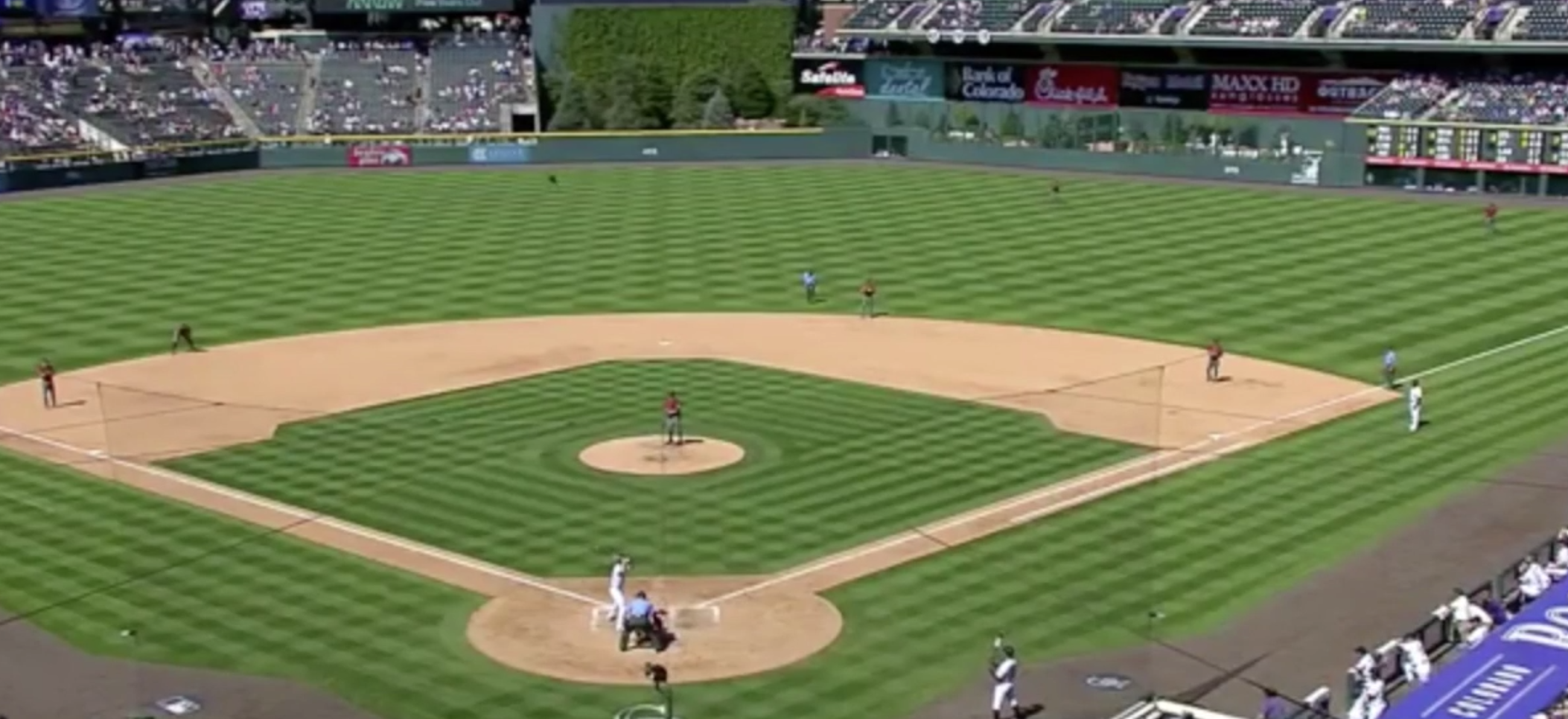
After years of false starts and uncertainty, we’re finally here — the Diamondbacks are going to start storing their baseballs in a Chase Field humidor. The idea itself isn’t particularly new, and of course the Rockies beat the Diamondbacks to the punch by more than a decade and a half. But, well, this isn’t a race. Arizona took its time to get to this point, and Chase does happen to be the second-most hitter-friendly ballpark around. It’s behind only…Coors Field, which the humidor didn’t render neutral, but the humidor there is still serving a purpose.

When the Diamondbacks have talked about this installation, they haven’t so much indicated a desire to drive offense down. Rather, the goal seems to be to make the baseballs more “grippy.” Pitchers have complained about the balls in Arizona being slick, and that has a lot to do with the low relative humidity of the climate. Now, you can’t exactly help pitchers without hurting hitters as a consequence. But there’s also just more going on. A humidor wouldn’t change only the surface of the baseballs. Moving forward, Chase Field might no longer be a hitter-friendly environment.

Read the rest of this entry »


Can Alex Cobb Get “The Thing” Back?

When I met Alex Cobb nearly a year ago, he was searching.

He had just missed most of the previous two seasons, first undergoing and then recovering from Tommy John surgery, when I spoke with him at the Rays’ spring-training facility in Port Charlotte, Fla. Cobb knew what he was searching for. He had all the movement, pitch-location, velocity, and release data that the public has at FanGraphs, Brooks Baseball, and elsewhere.

A data-savvy player, Cobb noted how he was using the pitch-tracking tools available in the Rays’ bullpen and spring complex to evaluate his pitches’ characteristics last spring compared to the benchmarks he had established before surgery. From 2012 to 2014, he produced a 3.41 FIP and 84 ERA-, numbers which ranked 24th and 22nd, respectively, in the game.

Read the rest of this entry »