Archive for Daily Graphings

The Rays Have Innovated Again

Necessity is said to be the primary motivator behind innovation. And no franchise is faced with a more difficult environment in which to compete, is confronted by a greater need for innovation, than the Tampa Bay Rays.

In possession of either the worst or second-worst stadium situation in the majors, with small-market revenues, the Rays also share a division with coastal elites like the Yankees (+76) and Red Sox (+75), who rank second and third in the majors in run differential, respectively, behind only the Astros (+98).

Because of this, the Rays have been more willing to experiment than just about every other club over the last 15 years. They brought defensive shifts to the American League, signed Evan Longoria to a club-friendly deal six days after he debuted in the majors, and have limited starting pitchers to two trips through the order more aggressively than any other club. This spring, they planned to employ a four-man rotation.

Read the rest of this entry »


Yu Darvish and the Good Fastball

Yu Darvish has gotten off to a rocky start with the Cubs, and for the better part of 23 excruciating minutes on Sunday afternoon in Cincinnati, the 31-year-old righty’s struggles appeared to be more of the same. Facing the NL’s worst team, and having failed to last five innings in either of his two previous starts this month, Darvish needed 39 pitches to escape the first inning. Fortunately for the Cubs, he avoided a meltdown and more or less dominated over his final five innings, notching his first win as a Cub and perhaps turning a corner.

Darvish entered the game sporting a 5.56 ERA and 5.12 FIP in his seven previous starts with Chicago, totaling just 33 innings, fewer than five per turn. He had been chased with one out in the fifth inning in his March 31 debut against the Marlins and was pulled from the fifth in three of his next five starts, the exceptions being a pair of six-inning, one-run outings against the Brewers. On May 7, the day before he was to make his first start following a three-homer, six-run outing against the Rockies — a start that drew boos from the Wrigley Field crowd — the Cubs placed him on the disabled list with parainfluenza virus.

The timing of Darvish’s return drew scrutiny from the hot-take-osphere, as manager Joe Maddon could have started him against the Braves at home on May 14, a makeup game for an earlier rainout, but instead opted to give him “one extra day” and start him against the same opponent in Atlanta a day later. Maddon dismissed the notion that the team had a potentially hostile Wrigley Field crowd in mind, but Darvish’s departure after four relatively sharp innings and only 61 pitches added fuel to the fire, at least until the manager revealed that the pitcher departed due to a calf cramp. Nonetheless, the perception of Darvish as mentally soft is in danger of taking root in Chicago, bad news for a pitcher who’s just one-quarter of the way through the first season of a six-year, $126 million deal, even one who owns the kind of career numbers — a 3.50 ERA, 3.38 FIP, 11.0 strikeouts per nine — that testify to his talent and outstanding stuff.

So it felt like a lot was riding on Sunday’s start against the Reds, and it didn’t go well — not to begin, at least. A six-pitch walk to leadoff hitter Alex Blandino was followed by a six-pitch foul out to catcher by Eugenio Suarez and then a single by Joey Votto on the fifth pitch. Seven pitches later, Darvish hit Scooter Gennett in the left foot with a 91 mph cutter, loading the bases. While he tidily ended a four-pitch encounter with Adam Duvall via a strikeout on a high 95 mph fastball, the Reds got on the board when Scott Schebler hit a hot grounder — with an exit velocity of 100 mph, the fastest he allowed all day — to Javier Baez on Darvish’s seventh pitch, a ball that the shortstop could only knock down. Infield single. After a visit from pitching coach Jim Hickey, with the bases still loaded, Darvish managed to put the inning to to rest by inducing Tucker Barnhart to foul out to third baseman Ian Happ, limiting the damage to one run.

Read the rest of this entry »


How I Use xwOBA

If you’ve spent any time observing some of the nerdier battles over baseball statistics in the last decade or two, you’re probably familiar with the arguments made for and against certain metrics. Beginning with the relatively simple matter of batting average versus on-base percentage, these debates tend generally to take the same shape. And generally, one recurring blind spot of such debates is that they tend to dwell on what certain statistics don’t do instead of best identifying what they do do.*

*Author’s note: /Nailed It

The last few years has seen the release, by MLB Advanced Media (MLBAM), of a flurry of new data and statistics, generally referred to as “Statcast data.” We’ve also seen advances in the measurement of catcher-framing by the people at Baseball Prospectus, who have also continued making improvements in the evaluation of pitchers in the form of Deserved Run Average (DRA). When new data and metrics emerge, there is inevitably a period of uncertainty that follows. What does this stat mean? What’s the best way to use this data set? Equally inevitable is the misapplication of new statistics. That aspect of potential statistical innovation is not really new.

Today, what is new is xwOBA — and, in part due to the wide proliferation of Statcast data by means of telecasts and MLB itself, more fans are finding and using stats like xwOBA than might have been in previous generations. As with other new metrics, we are still attempting to identify how xwOBA might best be used.

One such study into the potential utility of xwOBA was recently published by Jonathan Judge at Baseball Prospectus. The study is a good one, with Judge focusing on xwOBA against pitchers. While not ultimately his point, Judge does, along the way, object to the “x” in xwOBA, as he feels that “expected” implies predictive power. While I have always interpreted the “expected” to mean “what might have been expected to happen given neutral park and defense” — that is, without assuming a predictive measure — it does appear that reasonable people can disagree on that interpretation.

Read the rest of this entry »


When Lance McCullers Stops McCullersing

This is Jake Mailhot’s third post as part of his May Residency at FanGraphs. A lifelong Mariners fan, Jake now lives in Bellingham, Washington, just a little too far away from Seattle to make it to games regularly, which is sometimes for the best. He is a staff editor at Mariners blog Lookout Landing. He can be found on Twitter at @jakemailhot.

Earlier this year, Jeff Sullivan wrote a pair of articles, each about a pitcher who appeared to be McCullersing. That term, of course, is a reference to Lance McCullersJr., who in 2016 began throwing his excellent curveball more often than his fastball. He’s led all of baseball in curveball usage since then. He wound up throwing his curveball an astonishing 75% of the time in Game Seven of the ALCS last postseason. That appearance was peak McCullersing.

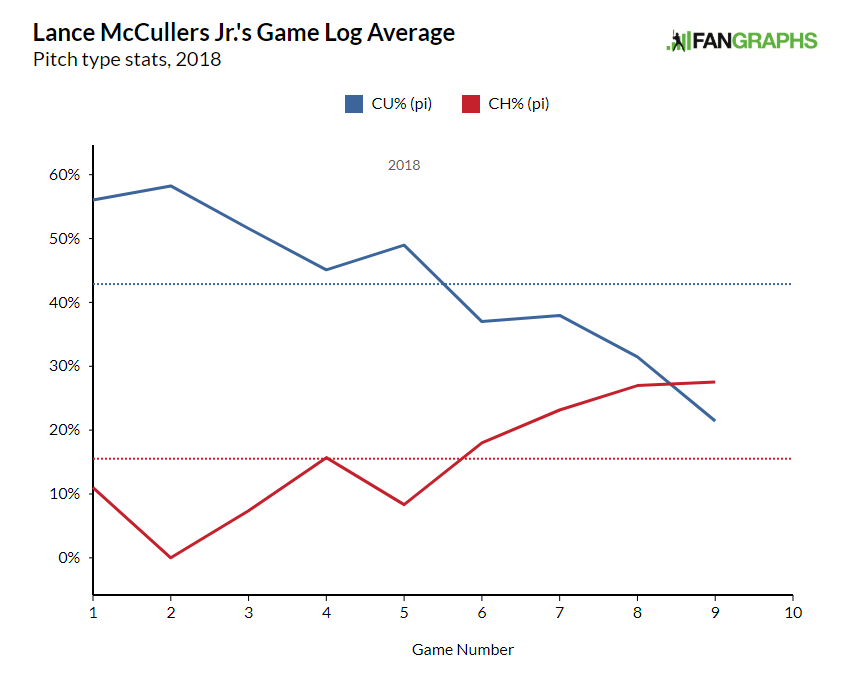
He started off this year throwing his curveball around the same amount as last year, 48% of the time. But when the calendar flipped to May, something changed. Just look at this graph of his secondary pitch usage in 2018.

That’s… interesting. In his start last night (not included here), McCullers threw his curveball around 40% of the time. That’s pretty normal for him. But it’s been less normal for him of late. In his start against the Angels last Monday, McCullers actually threw more changeups than curveballs, the latter pitch representing just 21.4% of his total count for the night. The last time his curveball usage fell below 30% was all the way back on August 3, 2015, during his rookie year.

Read the rest of this entry »


Sunday Notes: Brad Keller, Almost Once a Royal, is Thriving as a Rule 5 Royal

Brad Keller is having an impressive rookie season with the Kansas City Royals. Pumping fastballs with a bulldog mentality, the 22-year-old right-hander has appeared in 18 games and has a 1.96 ERA. He’s not afraid to challenge big-league hitters. Substantiating KC skipper Ned Yost’s assertion that he’s “been able to come in and bang strikes on the attack,” Keller has issued just five free passes in 18-and-a-third innings of work.

His path to the Kansas City bullpen was roundabout. In retrospect, it was also only a matter of time before he got there.

Drafted out of a Flowery Beach, Georgia high school by the Arizona Diamondbacks in 2013, Keller changed addresses twice in a 15-minute stretch during December’s Rule 5 draft.

“My agent called to say, ‘Hey, the Reds picked you up in the Rule 5,’” explained Keller. “I hung up the phone, called my parents, called my brother, and as soon as I hung up my agent called again. ‘Hey, you just got traded to the Royals.’ Then I had to pick up the phone and call everybody back.”

Keller’s next conversation was with the D-Backs — “they told me everything that was going down” — and soon thereafter Royals assistant GM Scott Sharp called to welcome him to his new organization. A similar call almost came four years earlier. Read the rest of this entry »


Diamondbacks Get Permission for New Stadium

Judges love it when litigants reach a settlement. Some judges love it so much that they give each side’s lawyer a token of appreciation for finalizing a deal. I’ve been in front of judges who handed out everything from stickers to candy bars. Last week, the Arizona Diamondbacks settled a lawsuit with Maricopa County. They got themselves a baseball stadium for their efforts.

But first, let’s back up a bit. The Diamondbacks have long wanted a new ballpark. Maricopa County, which owns the current park, wouldn’t let the team leave. So the team sued the county last year.

From Rebekah Sanders of the Arizona Republic:

The Diamondbacks’ lease with the county, which owns the stadium, prevents the team from talking with outside groups until 2024, and requires the team to play in its current home until 2028.

The Maricopa County Superior Court lawsuit is the latest twist in a long-running conflict over which party is responsible for as much as $187 million in repairs and upgrades to Chase Field. The team threatened to sue last year after negotiations with the county broke down.

The county argues that a portion of the upgrades are cosmetic and the team’s financial responsibility, and that the county will have enough money over the long term to meet its share of the obligations. The Diamondbacks counter that the county-run stadium district has not set aside enough money for needed upgrades and is risking safety.

The idea of a new stadium for the Snakes might seem, on the surface, to be ridiculous. After all, Chase Field was only just built in 1998. It’s younger than both Ronald Acuna and Gleyber Torres. That being said, the Team and County have been involved in a protracted legal battle, predating even that lawsuit, over the maintenance of the stadium. That’s because the stadium has had its share of maintenance misadventures in recent history, from burst pipes to failed HVAC systems. And each side blamed the other, with the team saying MLB would require them to move unless the county agreed to pay for repairs, while Maricopa County’s attorney, Cameron Artigue, had a more colorful response.

Read the rest of this entry »


Andrew Heaney Is Effectively Unusual

The Angels rotation is interesting for a number of reasons.

For starters, it houses Shohei Ohtani, who is living up to and even exceeding the unprecedented hype that surrounded his arrival to the major leagues. Then there is the six-man nature of the rotation, an experiment that is working to date — a point explored in some depth by Craig Edwards earlier this week. Angels starting pitchers rank fourth in the American League in WAR (3.5), fourth in ERA (3.77), fourth in FIP (3.90), fourth in xFIP (3.84), third in strikeout percentage (24.6%), and fifth in ERA- (90).

Along with Mike Trout and Andrelton Simmons, that rotation is a big reason why the Angels are just two games behind the Astros in the West and appear to be a Wild Card favorite at the moment, with roughly a 50% chance of reaching the postseason, a mark which trails only the three division leaders and Boston.

Ohtani has been pitching like an ace. Tyler Skaggs is giving us reasons to remember why he was a top prospect. Jaime Barria has a 51 ERA-. Garrett Richards is healthy and averaging 96 mph with his fastball. Nick Tropeano has managed to be effective with a low-strikeout, low-fly-ball approach.

And then there is the curious case of Andrew Heaney.

Read the rest of this entry »


Justin Verlander Finds Another Gear

Justin Verlander had himself a night in Anaheim on Wednesday, throwing his first complete-game shutout since August 26, 2015 and becoming the 33rd pitcher to notch 2,500 strikeouts. What’s more, he did it in a game where the Astros’ sole possession of first place in the AL West was on the line. It’s just the latest chapter of the now 35-year-old righty’s rebirth, one that has returned him to the upper echelon of the game’s starters and positioned him for a run at the Hall of Fame. The pitcher famous for finding another gear with his fastball late in the game has done just that with his career.

Verlander collected his milestone strikeout against none other than Shohei Ohtani, who foul-tipped a 96 mph heater in the ninth inning:

That was one of seven strikeouts Verlander notched on the night, and yes, he was still Bringing It late. He threw his six fastest four-seamers of the night, and nine of his top 11, in the eighth or ninth innings, all 97.5 mph or above according to Brooks Baseball.

Three of his strikeouts came against Ohtani (the second silver sombrero of his brief MLB career), who while avoiding a strikeout in the fourth inning — and even getting the call on this 87 mph slider — nonetheless wound up with his ankles repurposed into a pretzel, with Verlander supplying the mustard:

Read the rest of this entry »


Odubel Herrera Is Chasing Derek Jeter’s Record

When a rebuilding club begins its transformation into playoff contender, one can usually identify certain players who emerged during the team’s lean years and made that transformation possible. In the case of the Cubs, for example, that player is Anthony Rizzo. For the Astros, that player is Jose Altuve. For the Phillies, that player might be Odubel Herrera. The former Rule 5 pick is now in his fourth year with Philadelphia, and he has a contract that could keep him with the team for another five seasons beyond this one. He’s been the best player — averaging 3.5 WAR per year — on Phillies teams averaging 95 losses. He might now be the best player on a team that appears to be reversing its fortune and contending for the first time in a half-dozen years.

It would be fair to call Herrera’s 2017 campaign — despite an average offensive season, solid defense, and three wins at 25 years old — a disappointment. After two seasons during which he flirted with four wins, a drop in what should be his prime might have been slightly concerning. However, Herrera really just had a poor two months to start the year. As the calendar turned to June, Herrera was hitting .218/.262/.326 with a 48 wRC+ in 206 plate appearances. The rest of the way, he slashed .318/.361/.526 with a 130 wRC+ in 357 trips to the plate. Even including a couple rough weeks to end last May, Herrera has a 126 wRC+ over the past calendar year and 4.4 WAR, ranking 28th among position players and including a rolling mark that is likely to rise over the next few weeks.

Read the rest of this entry »


Aaron Judge Is Hitting Better with an Even Worse Strike Zone

We know the Aaron Judge story. He was a prospect whose contact ability was questioned. Would his 80-grade power play in games? After working on a swing adjustment in the winter of 2016-17, however, he dramatically improved his contact rate, posting a remarkable 173 wRC+ last season while nearly winning the AL MVP award.

In the 21st century, there have been only 31 completed or ongoing seasons with a wRC+ better than Judge’s mark. And what’s remarkable is that one of those — though, just a partial season — is Judge’s 2018 campaign, in which he has a wRC+ of 178.

After making one of the most dramatic year-to-year improvements in major-league history, Judge has actually improved through the first quarter of this season, which is amazing in a different way. While making gains is one thing, consolidating them is another, with the wealth of scouting information available.

Read the rest of this entry »