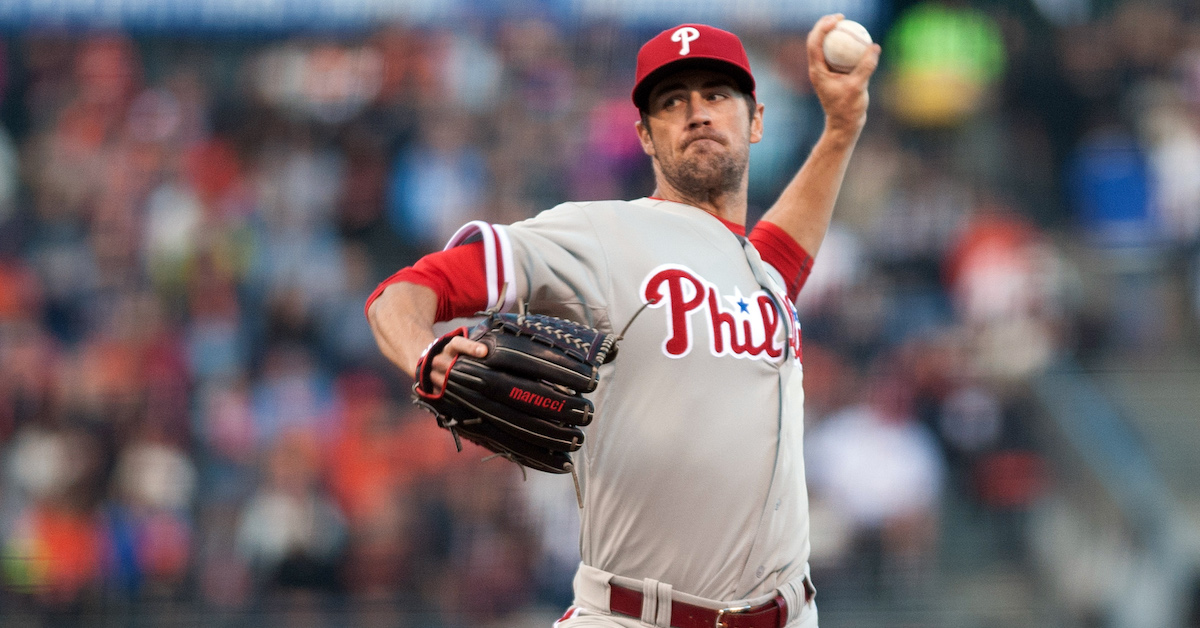
Cole Hamels retired from baseball on Friday, causing significant consternation to people who read that headline and thought they’d been transported back in time to the winter of 2019. (Buy a house now, while you still can, and be sure to stock up on hand sanitizer.)
It’s been four years since Hamels pitched effectively in the major leagues; before the 2020 season, he signed a one-year deal with the Atlanta Braves, and was limited to just 3 1/3 innings by injuries to his triceps and shoulder. Two further comeback attempts, with the Dodgers and his hometown Padres, came to nothing. Hamels never quite recovered from a 2021 surgery to repair a torn rotator cuff, and was still unable to throw without pain when he decided, at age 39, that he’d finally had enough.
Hamels, the 2008 NLCS and World Series MVP, will probably appear on just one Hall of Fame ballot. But few players’ reputations suffered more by comparison to their immediate surroundings than Hamels’ did; he was one or two breaks from giving a speech in Cooperstown someday, even if nobody realized it at the time. Read the rest of this entry »
Jackson Jobe has added a cutter to the power arsenal that helps make him one of the top pitching prospects in the Detroit Tigers system. Every bit as importantly, he’s returned to full health following a back ailment that landed him on the shelf from early April to mid June. The recently-turned 21-year-old right-hander had incurred an L5 (i.e. bottom left vertebra) stress fracture, an injury he attributed to “rotating fast and throwing hard at a young age when I wasn’t really strong enough to support that.”
The pitch now augmenting his fastball/slider/changeup combination was portended in a conversation I had with him last August. As his second full professional season was concluding, Jobe told me that he wanted to develop something new, “probably a cutter,” and he went on to do just that.
“I added it in the offseason, and on paper it’s a really good pitch,” the third-overall pick in the 2021 draft explained prior to his last start, which came on Friday with the High-A West Michigan Whitecaps. “I dive into all the TrackMan stuff — the vertical movement, horizontal movement, the spin efficiency, the tilt — and use the data in pitch-design. The cutter has performed pretty well.”
Asking the analytically-minded hurler about the metrics on his cutter elicited a response that was preceded by a pregnant pause. Read the rest of this entry »
Ranked and briefly analyzed below are the prospects who have been traded during the loosely defined “2023 deadline season,” which for simplicity’s sake I consider all of July. Most of the deals these prospects were part of have been analyzed at length on this site. An index of those pieces can be found here, or by clicking the hyperlink in the “Trade” column below, which will take you to the relevant article. I’ve moved all of the 35+ FV and above players listed here to their new orgs over on The Board, so you can click through to see where they rank among their new teammates and read their full scouting reports. Our Farm System Rankings, which update live, also reflect these changes, so you can see where teams’ systems stack up following the draft and the deadline. Read the rest of this entry »
Well, that’s the end of that. The trade deadline has come and gone, and whatever teams have is, well, whatever they’re going to have for the stretch run. My colleague Ben Clemens has already done the traditional look at the winners and losers of the deadline, so now it’s the turn of ZiPS, as I do every year afterwards. This is a very targeted look, in that ZiPS isn’t really looking at whether teams did a good job on a general level, only how the deadline affects their 2023 chances. So a team like the Mets ranking at the bottom isn’t a reflection on their competence, but how the deadline changed their postseason probability.
The methodology is simple. I project the rest of the season (after the games on August 1) both with the current rosters and if I undid every single trade made in the final two weeks of the trade period. I’ve included the projections for playoffs, division, and World Series for each of the 30 teams, with the default sort being playoff probability. Read the rest of this entry »
When anyone but an absolute superstar gets traded at the deadline, we’ve come to expect that the player’s new team sees something they can improve. Thousands of scouts, data analysts, and coaches across the sport, poring over film and charts, looking for the one player they can point to and say, with total confidence, “I can fix him.” Sometimes it’s as simple as one conversation, one adjustment to a pitch grip or a player’s swing timing or his position on the rubber, and it all clicks. Sometimes in the player’s first game in his new environs.
Predicting and identifying these adjustments can make for a fun metagame around the trade deadline, but I’ve learned the hard way not to trust the headline-making debut. In 2019, the Astros made a deadline move for Aaron Sanchez, the onetime Blue Jays standout whose career had stagnated. Sanchez brought an ERA over 6.00 into his Houston debut, and promptly threw six innings of no-hit ball. You could not ask for a clearer example of a player being remade overnight by an organization that knew what to do with him.
After the no-hit bid, Sanchez made just three more starts for Houston, in which his ERA was 7.11. He pitched for three teams in 2021 and 2022, posting an ERA of 5.29. (But just a 4.32 FIP! I can still fix him!) Two weeks ago, he was released from the Twins’ Triple-A affiliate. Now, when you look Sanchez up on the internet, Wikipedia assumes you’re looking for celebrity chef Aarón Sánchez, who is definitely the best MasterChef judge but has never, to my knowledge, no-hit anything.
I lied, though. I haven’t learned a damn thing, because I’m going to get carried away over Lance Lynn’s first start with the Dodgers. I am ready to believe again. Read the rest of this entry »
The trade deadline was yesterday, which means it’s time for a winners and losers post. I don’t really have a clever introduction for you here; you know what these things are, and you know how they go. I consulted a bit with the FanGraphs staff in compiling these, but these are mostly just my opinions. Want a high-level summary of what you should care about following the deadline? Here it goes.
Winner: Teams Trading Pitchers
The market for pitching of all types was scalding hot this week. Most of the best prospects who moved were shipped out in exchange for pitching, including plenty of rentals. Lucas Giolito and Reynaldo López have been just okay this year, and they merited a 50 FV prospect plus more. Jordan Montgomery and Chris Stratton fetched a similar return. Noted old men Justin Verlander and Max Scherzer got the Mets both quality and quantity in return. Even rental relievers like Jordan Hicks and David Robertson brought back exciting prospects.
Of course, not every rumored move materialized. If teams were willing to offer this much in return for rental pitchers, it’s perhaps unsurprising that some of the big names rumored to be on the market stayed put. Three months of Montgomery is one thing, but what about two years of Dylan Cease or four years of Logan Gilbert? Given how much teams are willing to dole out for a few years of an aging, paid-down ace, you can imagine the sky-high price tag for young, controllable starters.
I think the activity we saw makes a lot of sense. It’s hard to know how many healthy and effective pitchers you’ll have in July, even if you start the season with a full complement of them. It’s also a position that everyone needs; realistically, every playoff contender could use another excellent reliever and another innings-eating starter. Heck, Lance Lynn has the worst ERA in baseball and the Dodgers still traded for him.
I used to think that if you weren’t sure whether your team was playoff bound, it was more effective to wait until July to build a bullpen. Bring in four or five relievers if you’re in the race; trade some guys if you aren’t. But at current valuations, I think that equation has changed. You can add pitching in July, no doubt, but these days, it’ll cost you.
Winner: Teams Acquiring Hitters
As hot as the market was for pitchers of all varieties, even good hitters didn’t fetch much this deadline. Jeimer Candelario has already racked up 3.1 WAR this season, and yet he got dealt for less than either Robertson or Hicks, two rental relievers who have combined for 1.5 WAR and 86.2 innings pitched this year. Mark Canha was dealt for a long-shot starter prospect. Tommy Pham only brought back a DSL lottery ticket.
I don’t think this crop of rental hitters is particularly weak, but there are no standout options. Perhaps that kept bids down. But Candelario, Pham, and Canha are the kinds of solid major leaguers that most teams can use in some capacity or another, in the same way that a fifth starter can chip in even without being particularly good.
Perhaps it’s just a fluke of the way the standings broke; among playoff contenders, only the Marlins, Brewers, Guardians, and Twins have truly dire offenses. The Twins and Guardians both seem to have been moved by the spirit of their division and decided lousy might work just fine, while the Brewers and Marlins both added. That’s a fairly small crop of needy teams overall, though I think at least four other contending clubs could have improved their fortunes markedly by adding Candelario.
The market has been heading this way in recent years; hitters are getting less and less at the deadline unless they’re true stars. Smart teams are surely taking note. If my team has to go into a given season with a weakness, I’d much prefer it to be at a corner offensive spot rather than in the rotation or bullpen. It’s easier to get competent upgrades at those positions at midseason than to restock a bad bullpen or bulk up a wimpy rotation.
Winner: The Mets Farm System
I’ve long thought that Steve Cohen’s financial might would eventually start helping the Mets’ farm system. It turns out, a surprisingly awful season was all the team needed to get going on that front. The equation is simple. Take a star on a market rate contract, then absorb enough of the money that they’re on a below-rate contract. Presto, changeo! You now have a valuable trade chip.
Four of the team’s top 10 prospects weren’t Mets a week ago. They’ve added across the entire scope of the minors; they acquired three players in the Dominican Summer League and several who are already performing well in Double-A. We have them as the 11th-best farm system now, just behind some vaunted organizations (Orioles, Rays, Diamondbacks), and that’s after Francisco Alvarez, Brett Baty, and Kodai Senga all graduated from our preseason list. They did most of that by trading pitchers who are 38, 39, and 40. That’s some kind of pivot.
Look, spending a bunch of money is a good way to get good baseball players. That’s hardly a shocking statement. Traditionally, wallet-flexing is mostly about supplementing your roster with star veterans. There’s nothing wrong with that, and I’m betting that the Mets will keep doing that where appropriate. But real long-term success requires a vibrant farm system that can churn out flexible role players and the occasional star. The Dodgers wouldn’t be such a juggernaut if they weren’t hitting on Will Smith, Bobby Miller, Walker Buehler, Tony Gonsolin, and so on. They wouldn’t have had the prospects to trade for Mookie Betts if they didn’t focus on developing them first.
One move I particularly liked: starting an AL West arms race and then profiting off of it. Sending Scherzer to Texas clearly lit a fire under the Astros. The Rangers already looked like a serious threat for the division title, but Scherzer and Montgomery might have made them the favorites. The Mets turned around and dealt Verlander back to Houston on the back of that, and they got the Astros’ best two prospects for him. That’s clean living.
Winner: Milwaukee Brewers
The Brewers didn’t come into the deadline planning to expend much prospect capital. Their team is hardly a juggernaut, and they could use a minor league talent infusion soon to offset the upcoming losses of Corbin Burnes and Brandon Woodruff. But thanks to the vagaries of the market, they were able to add two meaningful pieces in Canha and Andrew Chafin without doing much to affect their future plans.
That’s not a bad start, but it gets better than that. Luis Urías had turned into a sunk cost; he’s making $4.7 million in arbitration this year, but played poorly enough to get demoted to Triple-A. The budget-conscious Brewers were likely going to DFA him, but they traded him to the Red Sox instead and got Bradley Blalock, a 40+ FV starter who’s been on fire this year. Recouping value when players don’t pan out like you’d hoped is a key part of the Milwaukee strategy, and this is a good example.
And there’s more! The Reds are leading the NL Central, but they essentially sat out the deadline. Their core is made up mostly of rookies, and I’m sure they’re telling themselves that now is too soon to strike, but come on, man. The NL Central probably won’t be this winnable for years to come. The Cubs are on the rise. The Cardinals won’t stay down long. The Pirates… Well, fine, you can’t win them all. But the Reds sat on their hands, which meant the Brewers’ additions went unopposed.
Winner: Miami’s Strategy
Speaking of teams that understand their window, the Marlins were busy this week. They added a closer, a first baseman, a third baseman, and whatever role you want to assign to Ryan Weathers. They badly needed those corner infielders, and their bullpen could use some work too. The plan of “fix all our weaknesses and try to go make the playoffs” makes even more sense when you consider that they’ve only been there once since their 2003 World Series championship, and even that postseason trip was in the pandemic-shortened 2020 season. When you’re the Marlins, you need to take your shots where you can.
Loser: Miami’s Tactics
But, uh, maybe not like this. The Marlins gave up some promising youngsters in the trade for Robertson. Marco Vargas in particular is a buzzy name in scouting circles, the kind of hitter who everyone thinks is the best kept secret to the point where the secret isn’t particularly well kept. The public-side prospect watchers I listen to the most all think the Mets got the better of that deal.
And don’t even get me started on the first base situation. No one would disagree that the Marlins need help there; their first basemen have produced an anemic 96 wRC+ on the year, not exactly what you’d hope for from an offense-first position. Just one problem: Josh Bell, who they acquired from the Guardians, has a 95 wRC+.
That’s harsher to Bell than he deserves, which mirrors his batted ball luck this year. He’s making his customary loud contact and putting up good strikeout and walk numbers, but the power just hasn’t appeared. He also has a pretty horrendous .272 BABIP, especially vexing when you consider how many grounders and line drives he hits. Garrett Cooper, who Bell is replacing, had similar numbers but worse raw measurables; I think Bell is a small upgrade.
To make that small upgrade, the Marlins took on roughly $9 million in salary across the next two years. They also sent out post-hype sleeper Kahlil Watson. Neither of those is a huge loss, but the net of the whole thing is baffling to me. Money and a prospect for a hitter who you’re hoping ends up 15% above average? Just trade for Canha or Pham for way less, or something like that.
In a deadline where bats were there for the taking, the Marlins overpaid. I don’t think their Jake Burger/Jake Eder swap was quite so bad, because they’re getting future years of control from Burger and Eder is a phenomenally risky prospect, but it’s a sign of the same thing that bothered me about the other trades. Sure, Burger will be around for longer than a rental, but you could plug a series of veterans into that role, and there’s no guarantee that Burger will be playable for his entire Miami tenure. The Marlins got half of the equation right – it’s time to go out and get some hitters and relievers – but then they went about it in a bizarre way.
Loser: The Theory of Perpetually Increasing Prospect Hugging
Teams have been getting increasingly attached to their own prospects. Last year, only seven prospects we gave a grade of 50 FV or higher got traded, and three of them were part of the Juan Soto deal. With no one that good on the market this year (RIP, dreams of a Shohei Ohtanirental), I thought there was a chance that roughly zero top 100 prospects would get traded.
That didn’t happen. Six FV 50s got traded this deadline, headlined by Kyle Manzardo and Drew Gilbert. Plenty of interesting prospects just outside the fringes of the top 100 moved as well. That’s a big haul considering how quiet the deadline was; the Mets, White Sox, and Cardinals were the only sellers of note this year. If you weren’t interested in what those teams were offering, there wasn’t much to do.
I’m not ready to say that the tide has changed. Teams are still clinging to prospects in general; the Orioles and Reds, two of this year’s biggest surprises, went small at the deadline despite flourishing farm systems and not enough spaces to play their coterie of exciting young hitters. Both teams might regret that move down the road; give or take service time shenanigans, they’re taking a major disadvantage in one sixth of the team control years for their core.
You’re telling me that Heston Kjerstad is more useful in Baltimore as one of a bevy of might-work-out outfielders than as a trade chip to help this year’s team? I’m skeptical. The same goes for third basemen Noelvi Marte and Cam Collier in Cincinnati – you might have heard, but the team isn’t exactly short on infield prospects.
Prospect hugging isn’t defeated, and it probably never will be. But this year’s mix of deals feels a little closer to rational than the past few years, at least in my mind. I still think it’s a good time to be adding at the deadline, but not to quite the extreme that I feared the market would find equilibrium.
Loser: The Orioles
Let’s break that previous thought out a little bit more. The Orioles are a lock to make the playoffs this year, and yet their rotation is one of the worst in baseball. This deadline had a ton of impact rental arms, and while they would have cost a decent amount in terms of prospects, the Orioles were perfectly positioned to do just that. Kjerstad, Colton Cowser (currently on the big league club but scuffling), Joey Ortiz, Jordan Westburg; they have a surfeit of coveted hitting prospects, easily enough to swing a deal for at least a few impact starters. Somehow, they instead ended up with only Jack Flaherty, who looks like more of what their rotation already had.
That hurts! Adley Rutschman and Gunnar Henderson are going to be around for a long time, but it’s not literally forever. The AL East is consistently one of the toughest divisions in baseball. There’s no guarantee that the Yankees and Red Sox will stay down, and no guarantee that the Orioles will lead the division this late in the season in the immediate future. Their Pythagorean and BaseRuns records suggest that they’ve been playing better than their underlying talent, but that shouldn’t be a reason not to add. This is surely the best shot the O’s will have at a playoff bye in the next few years based on divisional competition alone. It’s criminal to let the deadline pass by without leaning into that chance.
My guess is that Baltimore’s front office is held back by the very thinking that has propelled them to this spot in the first place. They sold at the deadline last year despite being fringe contenders, and it paid off. They try to red paperclip every trade, always building towards a perpetually glorious future. They hoard prospects and work reclamation projects. The system works! Houston used that model to become a juggernaut, and the Orioles might follow in their footsteps one day. But that plan has its limits; it’s designed to build up your farm system while the big league club stinks, not to deal with the exigencies of a playoff contender.
The Orioles are run by a sharp group of people; you’ll get no objection from me on that score. They’re surely aware of the perils of constantly looking to the future; it’s not a deep secret. But subconsciously, I think they might be struggling to change mental models. Constantly dreaming about what players might become in three years leads to systematic mis-evaluations of how important the present is at any given time. Concentrating value into windows of contention by adding at some deadlines and restocking at others is the way that teams with good process convert their farm systems into titles. The Orioles will figure it out, but I don’t think they’ve gotten the math right just yet.
Winner: Midwestern Retools
I’ve already covered the Mets; the two other major sellers this year were the White Sox and Cardinals, both of whom had a truckload of pitchers with expiring contracts, the new coin of the realm. Giolito, Lynn, López, Joe Kelly, Kendall Graveman, Montgomery, Jack Flaherty, Hicks, Stratton… the names just kept on coming.
Out of that laundry list of players, only Graveman has a guaranteed contract next year. These teams expected to contend for the playoffs, and they were going to have to work hard in the offseason. They’ll still need to replace that production if they’re planning on reaching the postseason in 2024, but that was always the case; now, at least, they have a bunch of prospects that they wouldn’t have access to otherwise.
Each team acted according to its expected timeline. I don’t think the White Sox will be great next year, and they seemed to agree; the best prospect they got back in their deals is a 20-year-old catcher. The Cardinals targeted near-majors-ready pitching, which makes sense given their huge need there. It’s win-win to me; a ton of good players who are headed for free agency get to battle for playoff spots down the stretch, and two farm systems in need of rejuvenation got just that.
Loser: Excitement
We can go back and forth about who won and who lost all day, but the bottom line is that the only trades that felt like capital-n News were Verlander and Scherzer decamping to Texas. Big names, big salaries, splashy prospects coming back; those are the kinds of deadline deals that top SportsCenter and get my non-baseball friends buzzing.
No one really went all-in this year, unless you want to count the Rangers. No one did a full teardown. The only sellers who had much to move did so with the intention of competing again soon. The Cardinals and Padres held onto some high impact stars who might have shaken up the deadline, and the White Sox stopped short of trading Dylan Cease. It’s hard to blame any one team for their decision. Taken individually, I can mostly understand the tactics everyone chose, even if I quibble with what the Orioles and Reds did (or didn’t do). But the end result of all those rational decisions was a bit of a snooze.
I’m not sure there’s much of a solution to this. From an entertainment standpoint, it’s dull. From a process standpoint, baseball is big business these days, and risk aversion is on the rise. Taking a risky move or blowing things up on a whim doesn’t sound quite so enticing when you’re making multiple million dollars a year as a GM. It probably doesn’t sound as enticing for an owner, either. The deadline doesn’t have to be exciting, and there are some awesome playoff races to follow down the stretch, but I was hoping all day for some shocking blockbuster, and it never materialized.
The Mets’ losses are the American League West’s gains. Three days after the Rangers landedMax Scherzer, the Astros have reacquired Justin Verlander, who less than nine months ago helped them win the World Series, and soon after pocketed his third Cy Young Award. In exchange for the future Hall of Famer and a whole lot of cash, the Mets are receiving two of the Astros’ top prospects, lefty-swinging outfielders Drew Gilbert and Ryan Clifford.
This is the continuation of a stunning about-face for the Mets, who signed Verlander to a two-year, $86.7 million contract in December and opened the season with a record-setting $352 million payroll. They entered Tuesday at 50-55, 17.5 games out of first place and six back in the Wild Card race, with seven teams above them. Once owner Steve Cohen gave general manager Billy Eppler the green light to trade closer David Robertson to the Marlins last Friday, the dominoes began falling, with Scherzer waiving his no-trade clause to be dealt to Texas, and then Mark Canha being sent to Milwaukee on Monday.
As with the Scherzer deal, the Mets are eating the majority of the remaining money on Verlander’s contract to improve their return. They sent $35.5 million out of the roughly $57.7 million remaining on Scherzer’s two-year, $86.7 million contract to Texas and received middle infielder Luisangel Acuña, a 50-FV prospect who’s currently no. 56 on The Board. Via the New York Post’s Joel Sherman, the Mets will send $52.5 million of the $93 million remaining on Verlander’s pact, assuming his 2025 conditional player option vests. They’ll pay $35 million to help cover this year and next; he’s due around another $14.2 million for 2023 and $43.3 million for ’24. If he pitches 140 innings in 2024 and does not have a right arm injury that would prevent him from being on the active roster for Opening Day ’25, he’ll make $35 million, of which the Mets will pay half. Read the rest of this entry »
The Astros have yet again acquired pitcher Justin Verlander and cash on deadline day, this time from the Mets for outfield prospects Drew Gilbert and Ryan Clifford. Verlander, signed to a two-year, $86.667 million contract before the season, put up a 3.15 ERA and a 3.81 FIP in 16 starts for the Mets. The exact amount of cash being sent along with Verlander is not yet known.
Verlander pitching for a team that wasn’t the Astros just felt kind of odd. While he certainly didn’t spend the bulk of his career in Houston, it’s where he had his personal pitching renaissance, where he clinched his future Hall of Fame membership, and where he got his championship rings. Verlander in blue-and-orange felt like that episode of Star Trek: The Next Generation in which Jean-Luc Picard is kind of a sad-sack 60-year-old ensign because he didn’t get in a bar fight as a youngster. Or maybe it’s like when you’re trying to buy a Coke at some rural gas station, but they’re out, and you end up with some bizarre generic cola that may have been sitting there since the Reagan years. Verlander’s opinion may vary, but from at least this fan, it feels like something that went wrong has been set right by Scott Bakula.
The Astros aren’t just trying to satisfy nostalgia; they needed a starting pitcher, so why not one they have a longstanding relationship with? A rash of injuries has left the rotation thinner than they would like heading into the homestretch, and they have a real dogfight this year with the Rangers, who’ve already addedMax ScherzerandJordan Montgomery; there’s no lapping the division by 15 games. Verlander has shown some clear signs of aging this year, as hitters are less prone to whiffing and are hitting the ball harder, and his control isn’t quite as precise as in the past. But these are normal things for a 40-year-old pitcher, and nearly every pitcher who is still in the league at 40 is going to fall out of it during the ensuing few seasons. Houston isn’t asking Verlander to carry the team, but to be a dependable, healthy arm who keeps the team in games. That he’ll do.
The money has not yet been disclosed — check my colleague Jay Jaffe’s upcoming piece for this and more — but my initial guess is “a bunch.” Verlander’s contract is a hefty one, and both Gilbert and Clifford are legitimate prospects; I can’t imagine the Astros would have parted with them if they were also paying full or near-full freight on Verlander. Our prospect team has already shifted in Gilbert as the new No. 1 prospect on the Mets, and while his stats at Double-A Corpus Christi are far from eye-popping, you have to remember that this is his first full professional season. ZiPS sees him peaking as a near two-win outfielder in the .260/.330/.400 range, though the error bars are quite wide when you’re talking someone with so little professional experience. ZiPS is highly interested in Clifford’s power upside (as is the scouting community), but there are a lot of questions about his plate discipline and defensive value to be answered.
MLB will have to approve any deal where more than $2 million changes hands, as will be the case with Verlander and Houston. That has not happened yet, so the deal will not be official for a little while .
Baseball is a game of uncertainty. Half an inch here or there can be the difference between a strikeout and a home run. Balls bounce strangely. Matchups don’t even out. The wind is blowing just the wrong way one day, or just the right way the next. But two things reoccur like Haley’s comet in the modern game: the Brewers are a few hitters short of a potent lineup and Mark Canha posts an above average but unexciting batting line. Today, those two things are teaming up – the Mets traded Canha to the Brewers in exchange for prospect Justin Jarvis.
It’s not that the Brewers plan on a punchless lineup. They’ve drafted plenty of hitters in recent years, and made trades to secure others besides. In the past few years, they’ve traded for Willy Adames, Jesse Winker, Rowdy Tellez, and William Contreras. They’ve promoted Sal Frelick, Brice Turang, Garrett Mitchell, and Joey Wiemer. Carlos Santana joined the team last week. Through it all, though, they’ve always seemed a few bats short. Someone gets injured. Someone regresses. The end result? An offense scuffling around or below league average, with a few spots providing downright embarrassing production.
This year, the entire infield has failed Milwaukee. Luis Urías hit his way back to the minors; Adames has a .202/.287/.388 line, good for an 82 wRC+. Turang is even worse, hitting .208/.278/.314 (61 wRC+). Brewers first basemen have a decidedly not nice 69 wRC+ in aggregate. Having an extra batter in the lineup hasn’t softened the blow, either: Brewers DHs have hit .205/.301/.308, the second-worst DH production across the majors. Despite a gaping hole at the top of the NL Central where the Cardinals usually feature, the Brewers have fallen out of first place thanks to the upstart Reds. They need more firepower, and the sooner, the better. Read the rest of this entry »
2023 has been a rough year for the St. Louis Cardinals. They’re used to living in the NL Central penthouse, looking askance at whatever team happens to battle them for supremacy in a given season. Sometimes they lose those battles – the Cubs put together a nice run in the mid-2010s, the Reds had their time in the sun before that, and the Brewers have been a thorn in St. Louis’ side in recent years. But this kind of collapse – 47-60 and last place in the division – is unheard of.
The silver lining? The Cardinals had a ton of expiring contracts coming into the season, which means they have a ton of players to trade. With the deadline quickly approaching, they’re starting to turn those players into prospects. In two deals on Sunday, the Cardinals sent out Jordan Montgomery, Jordan Hicks, and Chris Stratton. Montgomery and Stratton are headed to the Rangers; meanwhile, better hope Hicks has a passport, because he’s now a Blue Jay. Eric Longenhagen is covering the prospects who are coming back to the Gateway City in a separate piece. Here, I’m just going to focus on how these three fit with their new teams, and the Cardinals’ general strategy from here on out.
Let’s start with the Rangers. This one is pretty straightforward: Montgomery slots into a hilariously deep Texas rotation. After acquiringMax Scherzer on Saturday, their playoff rotation looked solid. Now it looks even better. Scherzer and Nathan Eovaldi (health permitting) are an above-average top duo, Montgomery is overqualified as a third starter, and after him there’s a whole grab bag of guys I wouldn’t feel either great or terrible about as my last playoff starter. Dane Dunning, Jon Gray, Andrew Heaney, and Martín Pérez are all cromulent options, and the three who don’t draw a rotation assignment might play up out of the bullpen. Read the rest of this entry »