Archive for Research

Nobody Actually Hits Good Pitching

Alex Bregman
John Geliebter-USA TODAY Sports

During Game 3 of the ALCS, Jeff Francoeur noted that 10 of the 12 pitchers who had surrendered postseason home runs to Alex Bregman were All-Stars, eliciting a comment about how Bregman hits well against good pitching. That’s undoubtedly a fun fact, but the notion has been rattling around my brain for the last couple weeks. I’ve definitely heard stories about players who hit good pitching, but I’ve never heard of anyone looking at splits based on the quality of the pitcher on the mound.

The main problem with that idea is a logical one. Break down any batter’s performance into its constituent parts, and you’ve entered a zero sum game. If you’re at your best against great pitchers, that means you’re hitting worse against everyone else. It’s hard for me to imagine that there are many players who fare better against Justin Verlander than they do against, well, anyone on the Nationals.

There could be players who are less bad than average, but if I had my choice of superpowers, I’m not sure that’s the one I’d pick. It would definitely help out in the playoffs, but over the course of the season, batters see a lot more average and poor arms than they do great ones. I’d rather perform well the majority of the time. Read the rest of this entry »

A Nick Castellanos-Inspired Look at Directional Outs Above Average

Nick Castellanos
Dale Zanine-USA TODAY Sports

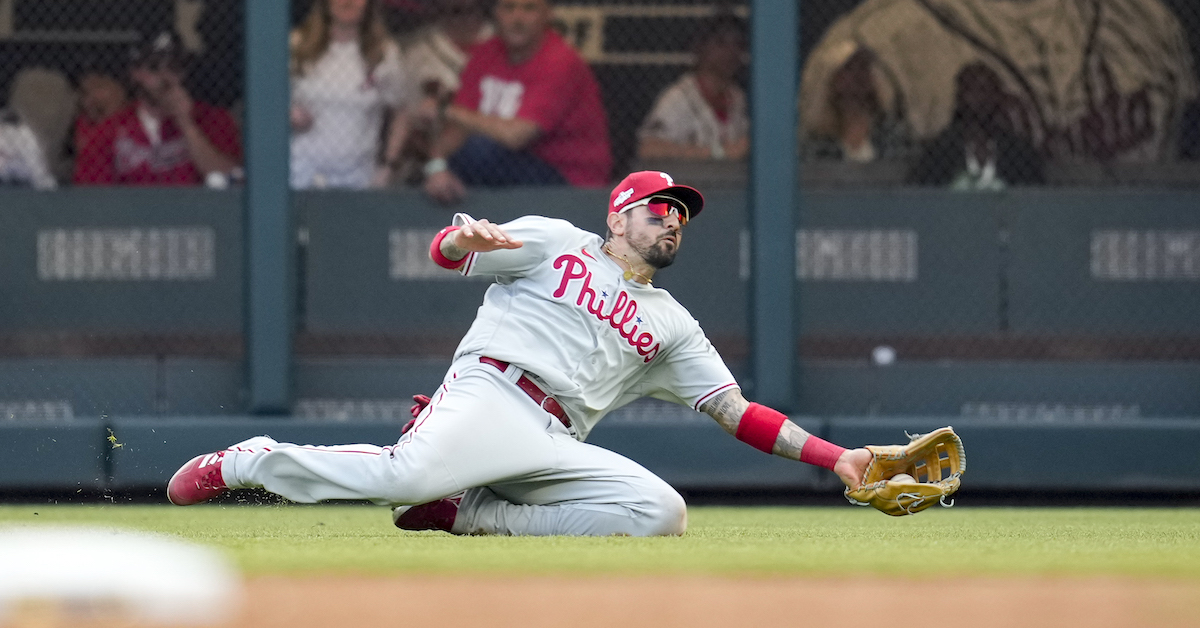
Nick Castellanos was not good during the 2022 regular season. He was especially bad on defense, costing the Phillies an estimated eight runs. In the playoffs, however, he made a few impressive catches. In fact, his four best plays of the season came in the postseason. His October excellence began in Game 1 of the NLDS, when he made this snag in the bottom of the ninth inning to help preserve a one-run Phillies lead:

He would go on to make two similar grabs in the World Series. This one came in Game 1, with two outs and the winning run on second the bottom of the ninth: Read the rest of this entry »


The 2022 Astros Lineup Was Filled With Swing Path Diversity

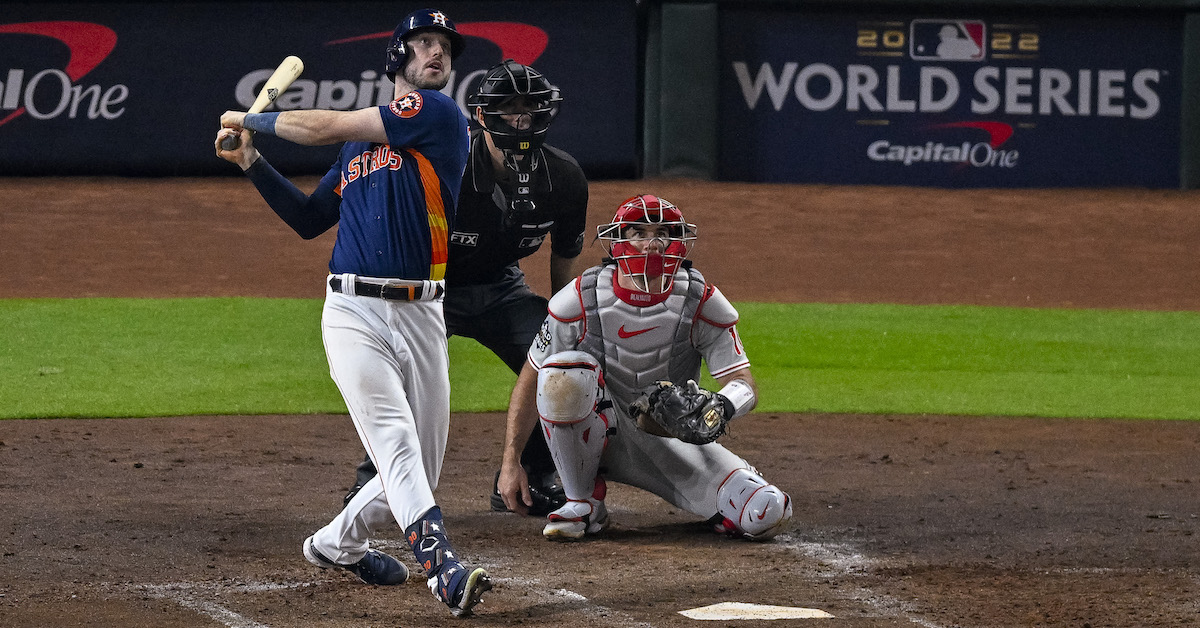
Kyle Tucker
Jerome Miron-USA TODAY Sports

After coming up short in 2021, the Astros are back on top of the sport with their second championship in six years. Come playoff time, Houston consistently executed its gameplan better than any other team. This year, dominance came in the form of historically effective relief pitching and timely hitting. On the whole, the Astros’ hitting wasn’t strikingly better than any other team, but when given the chance to put up enough for their bullpen to hold it down, they did that with no problem.

That last part is what has lingered in my head for the past week or so. Over the last six years, it feels as if Houston’s hitters have figured it out in big moments while other teams have stumbled. Even in this year’s tournament, when there was dominant pitching across the board, Astros hitters made the most of mistakes. And Houston could rely on a large group of guys, including but not limited to Jeremy Peña, Alex Bregman, Yordan Alvarez, and Kyle Tucker. Compare that to teams like the Yankees and Phillies, who had to rely on just a few players throughout.

But why is that? How can Houston get timely production from any guy in the lineup while others can’t overcome their holes? I still haven’t gotten close to a definitive answer, but I think I’m making progress on a reason why. Read the rest of this entry »


Let’s Admire Some of the Strongest Arms in Baseball: Catchers Edition

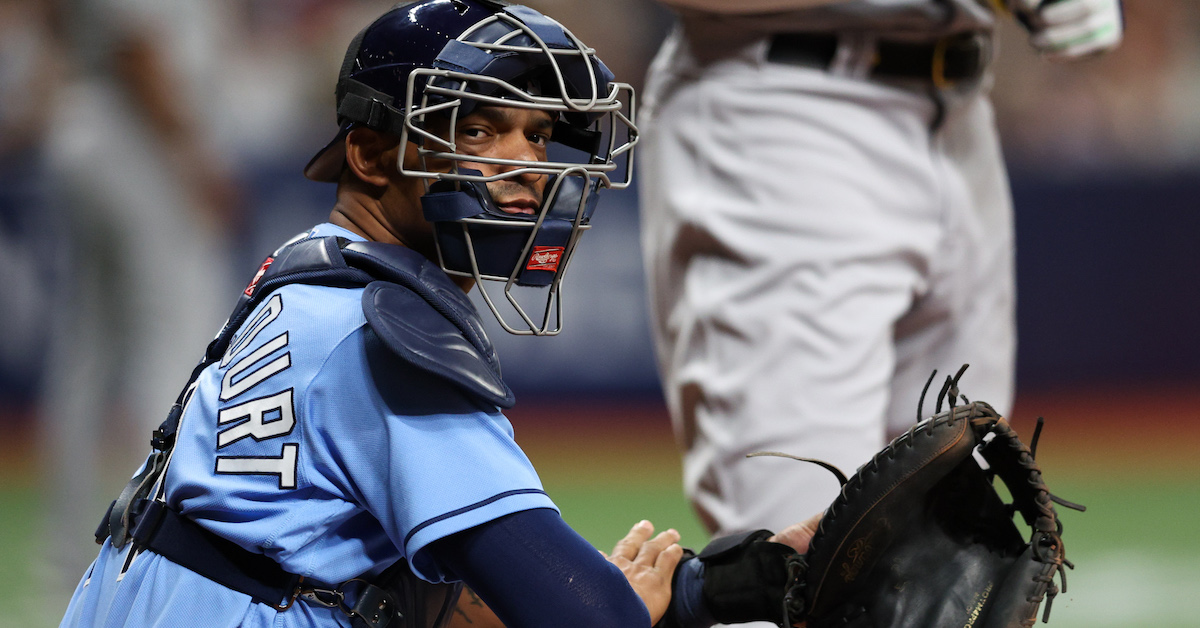
Christian Bethancourt
Nathan Ray Seebeck-USA TODAY Sports

It’s time to conclude the series on position player arm strength with the most impressive of them all: catchers. It was a joy covering infielders and outfielders, but it’s time for backstops to have the spotlight. They might now throw quite as hard as their position player counterparts, but let’s keep in mind that they do what they do out of a squat with no room for error. They can’t bobble, hesitate, or mess up their footwork and need to receive the ball and deliver it to second base in less than two seconds.

Let’s set some ground rules for the next iteration of this exercise. Baseball Savant sets their default minimum number of attempts to qualify on the pop time leaderboard at five, so we’ll stick with that. There’s thorough research that explains arm strength as the main component in pop time; because of this, I put strong value into it. Exchange speed still matters, but in this case, it’s more interesting to see how a player moves his body to take advantage of his arm strength.

Anyway, after sorting through the top of the leaderboard, I searched for clips of plays where the catcher especially needed his arm or just made so perfect of a throw that I couldn’t resist talking about it.

Christian Bethancourt (no. 1 overall, 88.3 mph)

There is a new king on top of the catcher arm strength throne, and his name is Christian Bethancourt. That’s not too shocking; he threw in the mid-90s off the mound.

One thing about this particular caught stealing that I find very cool: we get to see how big of a jump Will Brennan got off Corey Kluber. With that jump and a 78-mph sweeper to handle, Bethancourt had no business making this play. The difference is how he perfectly cheats with a slight quarter turn of his torso as he’s waiting for the pitch to come in. It’s usually difficult to do this move in the heat of the game, but he knew it was the only chance he had to catch the runner.

Typically a catcher would let the ball travel further than this, but Bethancourt’s loopy, pitcher-like arm swing means his low transfer is the most efficient for his body and mechanics. After the smooth transfer, he placed a seed right on top of the bag for Wander Franco. Impeccable mechanics with no room for error. Read the rest of this entry »


This Year’s Gold Glove Winners Leave Behind Snubs, More Criteria Confusion

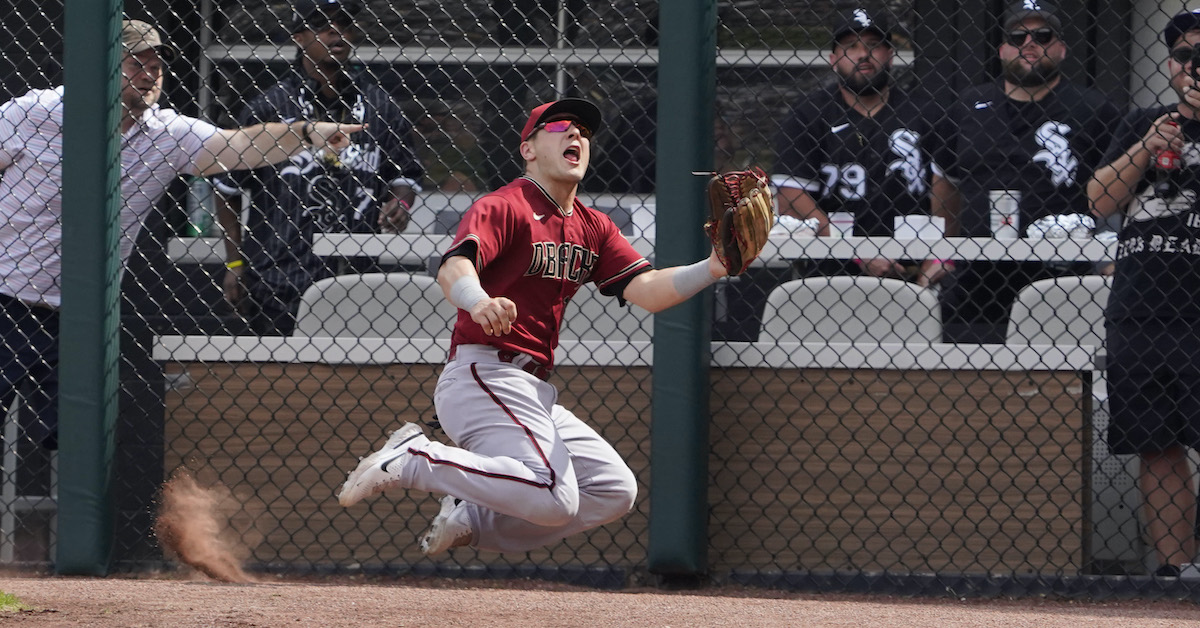
Daulton Varsho
David Banks-USA TODAY Sports

Two weeks ago, Rawlings and MLB announced this year’s Gold Glove finalists. The inclusion of Juan Soto, who posted the worst OAA among qualified outfielders but ran a 145 wRC+, prompted me to examine the link between Gold Glove finalists and offense. I found that Soto’s selection was likely due to the halo effect, a cognitive bias which may have led voters to extend a positive overall impression of him to his fielding.

Fast forward to this week, when Rawlings and MLB announced this year’s Gold Glove winners. While Soto was not among the 20 victors, the 16 non-pitcher, non-utility winners out-hit the other 32 finalists 115 to 107 in wRC+. Last year, the winners out-hit the other finalists 114 to 107 (I excluded this year’s utility finalists/winners to make the comparison). In my previous article on Gold Gloves, I also found that finalists out-hit other qualified fielders 109 to 103 in wRC+ last year and 110 to 102 this year. Read the rest of this entry »


Why Do The Playoffs Have So Many Strikeouts?

© Bill Streicher-USA TODAY Sports

If you’re a fan of balls in play and general athleticism, I’ve got bad news for you: the 2022 playoffs have featured the highest strikeout rate in playoff history, a whopping 26.6% excluding intentional walks heading into last night’s game. More than a quarter of plate appearances have ended without the fielders moving, the runners tearing around the bases, or indeed anyone having reached at all. For what it’s worth, the unintentional walk rate is only 7%; the strikeouts are what’s out of hand, not the non-contact plays.

Why is this the case? I can think of many reasons. Maybe the teams that made the playoffs are jam-packed with the best strikeout pitchers they can find. Perhaps the parade of relievers Jay Jaffe noted last week are just too effective. Maybe that extra velocity from starters is to blame. Hitters shouldn’t escape scrutiny, either; maybe they’re swinging for the fences more with the bright lights of October on them and accepting more strikeouts as a result. It could be matchup-based, or pitchers could be using their best pitches more often. It could be better scouting of hitters’ weaknesses, or just an accident of a few pitchers getting hot, or any number of things. Read the rest of this entry »


Relief in Relief Pitching? Starters Can’t Seem To Find It

Luis Garcia
Troy Taormina-USA TODAY Sports

How much should a team’s postseason strategy differ from its regular-season tactics? Overall, probably not that much; if your club makes it to the postseason, it ain’t broke, so to speak. Further, I generally believe the postseason is not the time to experiment with new gameplans that always carry some heightened risk. But historically, there are myriad ways that teams have shaken things up come October.

This especially seems to be the case when a team is down in a series. Take the Yankees in the ALCS this year — that squad went with three different leadoff hitters in four games, moves that had little to do with platoon splits. They faced one lefty starter during the series, Framber Valdez, and had righty Harrison Bader lead off that game, but Bader also led off in Game 4 against fellow righty Lance McCullers Jr.; lefty Anthony Rizzo and righty Gleyber Torres led off the other two games against right-handers. The Yankees also had three different starting shortstops in the series. Read the rest of this entry »


Gold Gloves Are About Defense… Right?

Juan Soto
Bill Streicher-USA TODAY Sports

When Juan Soto was announced as a finalist for the Gold Glove this year, I was perplexed. To say that the right fielder struggled with his defense this season would be an understatement. As recently as Game 2 of the NLCS, he was still making (or, failing to make) plays like this:

So I turned to Rawlings’ official website to get a better understanding of how Gold Gloves are won. In order to qualify for a Gold Glove, infielders and outfielders must have played in the field for at least 698 innings through their teams’ first 138 games. Maybe Soto grades out better in this subsample. In the absence of custom date ranges for advanced fielding statistics, I compared Soto to the 76 other players who were in the outfield for at least 698 innings on the season. Here is where he ranked:

Juan Soto Qualified Outfielder Ranks
Metric Rank
DRS T-48
UZR T-56
OAA 77

Read the rest of this entry »


Let’s Admire Some of the Strongest Arms in Baseball: Infield Edition

Carlos Correa
Wendell Cruz-USA TODAY Sports

Last week, when I wrote about some of the league’s strongest throwers, I ended up exclusively featuring outfielders. The nature of the position is more suited to making full capacity throws than in the infield, and as a result, only outfielders ended up on the list. Because of that, I feel obligated to acknowledge and highlight some of the strongest throwers in the infield. On average, these throws won’t be quite as fast. The footwork and time required to throw the ball is one reason for that, and that will be the focus of this piece.

Similar to last time, we’ll have to sort through some qualifications on how I came up with this short list of names. The first is at least 100 throws in the infield. One thing I ran into when sorting through the leaderboard was that several players near the top were utility players, rather than just strictly infielders. That led me to using the 2B/SS/3B filter and sorting the list by the overall throws at those positions only. See the full leaderboard here.

After working that out, I wanted to select plays where a player needed their plus arm strength to get an out. For example, a shortstop and/or third baseman needs to fire a rocket when moving multiple steps to use their backhand. A second baseman needs to have the correct footwork to fire a ball when ranging up the middle or quickly spinning a double play. Those are the types of plays I’m looking for, but they were harder to find than you would expect, given how so many plays in the infield are routine. I started with about 15 players from the top 20 on the list and worked my way down to a representative sample of five. Now, let’s get into it. Read the rest of this entry »


Yes, the Playoffs Are Still a Crapshoot

Freddie Freeman
Orlando Ramirez-USA TODAY Sports

We live in an era where every team, to some degree or another, embraces modern analytics when assessing itself and the rest of the league. Wanting to know about the numbers that drive baseball has filtered into fandom as well, which is why you’re here on this very website! But despite all the progress the stathead crowd has made over the last quarter-century, when it comes to the playoffs and playoff results, many fans seem more inclined to defenestrate the numbers and attribute the losses to all sorts of causative elements beyond a surplus or dearth of players just happening to have particularly good games that week.

In the worst case, failing to win two of three games or three of five is attributed to some kind of character flaw. At best, the loss is because of some fundamental flaw in a team’s construction, typically something that sabermetrics is to blame for, no matter whether the team is sabermetrically inclined or not. Here’s one example of very common thinking along these lines just from the last couple of days. It’s from a fan on Reddit, so I’m not specifically attributing them, mainly because I don’t want to risk social media pile-ons:

The postseason is the real season from now on, so the focus shouldn’t be on sabermetrics as much as it has been. With the playoffs being expanded, 111 wins doesn’t mean squat. Shift some of the focus to bringing in guys who play with fire and aggressiveness and will situationally hit rather than live and die by the long ball. If it costs us some wins during the regular season, so what?? It’s the little things that win the most important games.

With three of MLB’s four 100-win teams already out of the playoffs and the 99-win team pushed to the brink but ultimately surviving, these types of incriminations will be common this season. The Dodgers didn’t lose a 60/40 matchup (the ZiPS projection for the series) because they were simply outplayed over four games, but because something was broken in how the team was built. Depending on who you listen to, you can hear the same type of grumbling about the Mets and Braves.

Since questions should be explored rather than dismissed, let’s look at playoff overperformers and underperformers over the Wild Card era (starting in 1995) and examine if there really are consistent patterns behind which teams are overperforming or underperforming in the postseason. And since this is illustrative more than anything, I’m trying to keep it as simple as possible, within reason. Read the rest of this entry »