Let’s Admire Some of the Strongest Arms in Baseball


I’m not sure about you, but I’ve been eagerly awaiting the release of Statcast arm strength data for a while now. At the end of September, the day finally came, inspiring me to dive into the metrics of some of my favorite throwers in the league. Fielding mechanics are an under-appreciated part of the game. So much goes into having the appropriate footwork to direct yourself towards a base in order to make an accurate, strong throw, and some do it better than others. With the help of the Statcast Arm Strength leaderboard, I’m going to show you exactly what sets those players apart from the rest of the pack.
There are a few different ways to sort through the leaderboard. You can change the minimum number of throws if you’re mainly interested in finding who has the highest peak arm strength, regardless of how many total throws they’ve made. I settled on 100 throws, the default on the leaderboard. From there, I set out to find concrete examples of players near the top of leaderboard making accurate throws to nail runners between second base and home. Why? Because throwing isn’t just about arm strength – accuracy also plays a big role when it comes to outfield throws. The time it takes for a fielder to step to a ball or move their glove across their body can be the difference between a runner being called safe or out, while a strong and accurate throw gives their teammates the best chance to make a play. At home plate, throws on a fly or one long hop are crucial for catchers. It’s extremely difficult to make a play on a short hop while trying to get a tag down. After my search, I settled on five players from a sample of 20 to 25 who showcased great footwork and instincts to pair with their strong, accurate throws. Below is a representative play for each. To MLB’s Film Room!
Nate Eaton, Kansas City Royals (no. 1 overall)
Nate Eaton has an absolute cannon for an arm. Of all the players in the league with at least 100 throws in 2022, he ranks first on the arm strength leaderboard with an average throw of 98.1 mph. Statcast calculates this number by averaging the top portion of a player’s throws. Eaton is the only player with a number above 98 mph; he also has the highest maximum throw at 103.3 mph. There are only a few players who make your jaw drop when they make throws and Eaton is one of them.
After Gary Sánchez lined this pitch down the left field line, Eaton had a beat on the ball and immediately knew how to attack it. Knowing Sánchez’s speed, he got to the ball and took a few extra steps to plant on his back foot and push a speeding mack truck’s amount of force into the ground. I sometimes get frustrated watching position players throw because they forget their glove side exists. That isn’t a problem for Eaton. After planting, he creates a perfect angle to use his left arm as a coil to throw off of, leading to a seed right over the bag and a nice outfield assist.
Aristides Aquino, Cincinnati Reds (no. 3 overall)
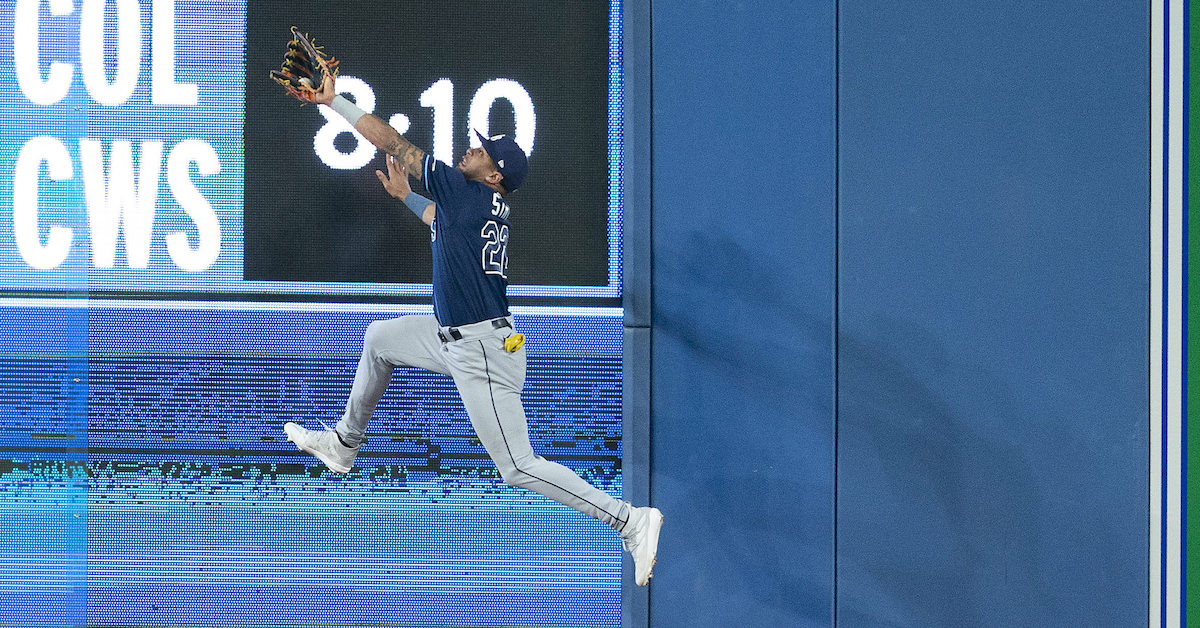
It isn’t hyperbole to say that this is one of the most impressive throws you’ll ever see. Some of the best opportunities for a guy to make a play with his arm come after a misread, when he has overestimated his chances of making a play with his glove. After Aristides Aquino jumped up on the wall to save a few runs, the ball ricocheted off and forced him to scurry after it. After gathering himself and seeing how far Rhys Hoskins was from home, he knew he had a shot.
The two most important parts of this throw are the lead leg block (foot plant) and the crazy sub-scapula adduction (pinching of both scapula). Foot planting like this after running is nothing to bat an eye at. That, on top of his hyper mobile scapula, equated to a beautiful throw. Aquino’s max throw this year was 101.6 mph. I imagine this was pretty close to that.
Michael Harris II, Atlanta Braves (no. 18 overall)
Michael Harris II isn’t quite as large as Eaton or Aquino, making this throw and his maximum throwing velocity of 100.0 mph incredibly impressive. And unlike Aquino and Eaton, this play came on a standard outfield groundball. Harris played the hop perfectly, used a pro step to direct himself, and threw a missile through the would-be cutoff man for a perfect one-hopper to nail Luis Guillorme at the plate.
The pro step is a simple fundamental move where you take your throwing-side leg and swing it right behind your plant foot to properly align yourself toward the ball’s destination. It’s a quick move and the perfect one for attacking a grounder you need to make a throw on. It’s not in this view, but Harris also finishes with a nice little spin after releasing, also known as a janitor throw. It’s a reciprocal movement for the quick rotation that a throw like this requires.
Aaron Judge, New York Yankees (no. 25 overall)
Aaron Judge ranks 25th (92.3 mph) on the arm strength leaderboard. You might expect to see him ranked higher given his size, but if you watch him regularly, you know that he tones it down to make accurate throws like this one. I’m not sure there is a better baiter in the league than Judge. His awareness and feel around the short porch in Yankee Stadium allows him to fool runners into thinking they have a shot at second base.
Tommy Pham is pretty fast! His 64th percentile sprint speed is decently above average, yet, Judge makes him look slow as molasses as he waltzed to this ball in the corner. The fundamentals here are all impeccable. Once Judge knows he can’t get it on the fly, he reorients himself and prepares his hands for a smooth transfer. That part reminded me of a catcher. As a backstop, you’re taught to transfer the ball as deep into your body and as close to your ear as possible when preparing to throw a runner out. It leaves little room for error. Judge did exactly that when reacting to this hop off the wall and made throwing out Pham look easy with a perfect no-hopper. If I had to guess what his hardest throw of the year was, it would be this one.
Julio Rodríguez, Seattle Mariners, (no. 14 overall)
Speaking of baiting, this play by Julio Rodríguez was prime example of the skill. As the ball was lined into center, Rodríguez remained calm and threw up his hands as if he was preparing to catch it on a line. Little did Lourdes Gurriel Jr. know, this ball wasn’t even close to being caught on a fly. This is a combination of lack of awareness and trickery leading to a perfect chance for Rodríguez to nab Gurriel on a force out.
He wouldn’t have been able to do this without his 96th percentile arm strength. Ranked 14th, Rodríguez is a threat to throw out any runner. Typically, a player should have no chance of getting a force out at third base from the outfield, but a slight hesitation due to the hand deke was enough for him to unload a pill. Unlike Harris, Rodríguez opted for a mini crow hop and not a pro step. It’s a slower movement, but my goodness, if you can throw a ball this hard off a crow hop, then I’d say you’ve made the right decision!
I’m going to have a ton of fun with this new leaderboard. To me, a high throwing velocity is just as impressive as a high exit velocity. Seeing arm strength numbers on broadcasts will add interesting insight and context to games. How fast does a throw need to be to turn a double play or nail a runner at home? These are great questions that I’d love to see answered. For now, I’ll leave you with this. Arm strength is the first step in being a great thrower from the outfield, but that doesn’t mean you can discount the importance of accuracy. Each of the throws I highlighted today has something in common in addition to their impressive speeds: they all ended up right over the bag or plate.