Archive for Teams

It’s Time to Pull the Plug on Pablo Sandoval

Last night, the Red Sox started Pablo Sandoval at third base, the first time in four games he’d been in the starting line-up. He responded by singling to lead off the second inning and miraculously drew a walk in the third inning, which should tell you how sharp Jeremy Hellickson was last night. In the 8th inning, he was replaced by Josh Rutledge for defensive purposes, despite the fact that Rutledge has regularly graded out as one of the worst defensive infielders in baseball. But for Sandoval, this was a pretty successful night, reaching base twice and handling all four balls that he fielded.

But the fact that this is what constitutes a successful game for a player on a team trying to win is why the Red Sox should realize it’s time to just move on.

Read the rest of this entry »


Projecting Astros Outfielder Derek Fisher

With Josh Reddick sidelined by a concussion, the Astros summoned 23-year-old center fielder Derek Fisher to the big leagues yesterday. The early returns are good: in his debut, Fisher went 2-for-3 with a homer and two walks.

Fisher had more than earned this opportunity, slashing .335/.401/.608 at Triple-A this year. A power-speed threat, Fisher eclipsed 20 homers and 20 steals in both 2015 and 2016, and Eric Longenhagen gave him raw power and speed grades of 60 and 70, respectively. Fisher had a bit of a strikeout problem in the past, but has managed to slice his strikeout rate from 27% last year to 19% this year without sacrificing any of his power.

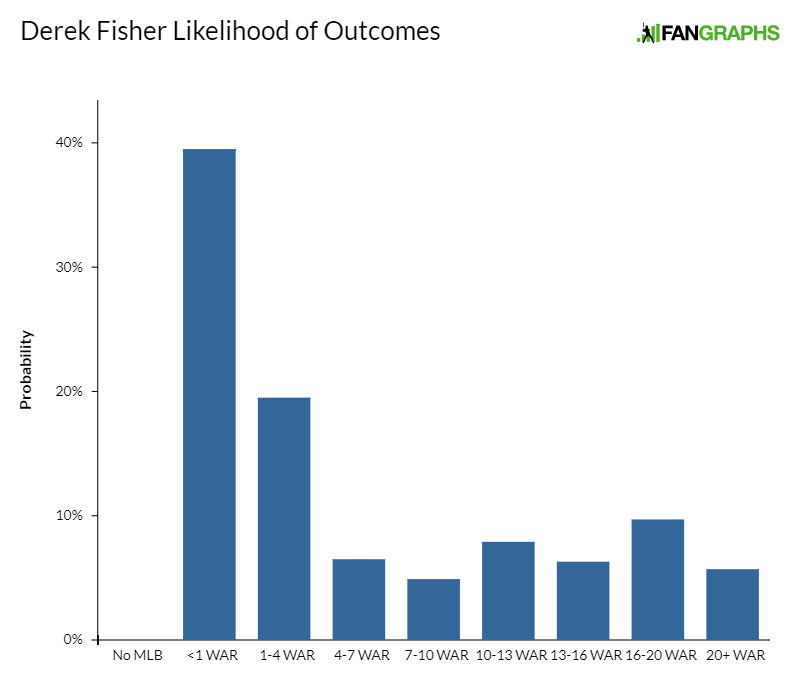
KATOH loves Fisher, which shouldn’t come as much of a surprise given his excellent performance this year. I have him projected for 8.1 WAR over his first six seasons by stats-only KATOH and 6.3 WAR by KATOH+, which incorporates Eric Longenhagen’s relatively modest 45 FV grade. Those projections make him the 18th- and 48th-best prospect in baseball, respectively.

To put some faces to Fisher’s statistical profile, let’s generate some statistical comps for the toolsy center fielder. I calculated a Mahalanobis distance between Fisher’s Double-A and Triple-A performance and every season since 1991. In the table below, you’ll find the 10 most similar seasons, ranked from most to least similar. The WAR totals refer to each player’s first six seasons in the major leagues. A lower “Mah Dist” reading indicates a closer comp.

Please note that the Mahalanobis analysis is separate from KATOH. KATOH relies on macro-level trends, rather than comps. The fates of a few statistically similar players shouldn’t be used to draw sweeping conclusions about a prospect’s future. For this reason, I recommend using a player’s KATOH forecast to assess his future potential. The comps give us some interesting names that sometimes feel spot-on, but they’re mostly just there for fun.

Derek Fisher Mahalanobis Comps
Player Mah Dist KATOH+ Proj. WAR Actual WAR
Jayson Werth 2.9 5.4 12.0
Steve Hosey 3.8 8.6 0.1
Ozzie Timmons 4.6 4.6 0.9
Ray McDavid 4.6 3.8 0.0
Jack Cust 4.7 5.5 5.1
Franklin Gutierrez 5.2 4.0 13.1
TJ Staton 5.4 3.5 0.0
Wladimir Balentien 5.4 5.0 1.0
Trot Nixon 5.5 6.8 17.9
Ryan Ludwick 5.5 3.4 8.8

It’s not immediately clear how, or how often, Houston will work Fisher into their lineup once Reddick is healthy. But Houston would perhaps benefit from shifting some of Nori Aoki’s at-bats to Fisher, giving them an outfield of Fisher, Reddick and George Springer. Regardless, Fisher’s rare combination of power, speed, and contact ability makes his future look incredibly bright. And he made it clear with his 2017 performance that he has nothing left to prove in the minor leagues.


Sonny Gray Is a Mystery

“Grips are meaningless,” Oakland A’s starting pitcher Sonny Gray once told me. Maybe that’s why we haven’t yet had a good talk, despite calling the same clubhouse home half the time. He didn’t quite mean “meaningless,” it occurred to me, when we finally discussed his repertoire. But there’s another reason he’s found it difficult to talk the way pitchers often talk to me: He’s changing things from pitch to pitch, according to what he sees. That includes grips, finger pressure and pitching mix. It’s hard to say he’s been doing something different when he’s always doing something different.

It’s difficult to figure out the righty. His breaking balls, for example: One classifying system says he’s currently throwing more sliders than ever. One says he’s in a three-year high for curveballs. A third says he’s right about where he’s always been, but that his recent good stretch may have coincided with an increased use of his slider.

Is he throwing more sliders now that he’s healthy? Gray shrugs. “Even before I got hurt, I was throwing sliders, and I was throwing them at 88, 89 mph,” he says. No system has him throwing a breaking ball that hard. “Whatever people call the pitch is what they are going to call it. It’s a hard curveball, I guess. The grip is a little bit different, but it does have a curveball action.”

Read the rest of this entry »


The Tony Wolters Experiment: The Making of a Receiver

Near the end of spring training in 2013, just days before the Cleveland Indians were to travel north, then-middle-infield prospect Tony Wolters was called into the manager’s office at the club’s complex in Goodyear, Ariz.

There, Terry Francona and a number of front-office members awaited. They offered Wolters a choice. One option was that he could remain a middle infielder, even though he might be unable to stick at shortstop and even though his .260/.320/.404 line the year earlier at High-A hinted at insufficient offensive production for second base. Furthermore, with Francisco Lindor and Jason Kipnis in the organization, his opportunities would be limited. The other option? He could try his hand at catching.

Wolter’s experience behind the plate, to that point, had been limited to catching one game at Rancho Buena Vista High, from which school the Indians had selected him in the third round of the 2010 draft. He was to turn 21 in June. He had not risen above A-ball.

“They gave me a day to think about it,” Wolters said. “It was kind of the end of spring, so I had to tell them. I couldn’t say ‘No’ to Tito [Francona]… The main thing was, I just wanted to do what they wanted me to do and I felt I could do it.”

Thus, one of the more unusual position changes — at least as measured by successful outcomes — in recent professional baseball began. A reverse Craig Biggio, a move from the middle infield to catcher. The Indians gave Wolters a brief tutorial. He borrowed a glove and caught his first bullpen. Who pitched? Pre-breakout Corey Kluber. “He was pretty good,” Wolters responded. “That day he wasn’t spotting up, so I kind of got messed up a little bit.”

As the Indians’ major- and minor-league teams departed to begin their respective seasons, the club held Wolters back for one week to receive a crash course in catching at their Arizona complex. After a week of experience, he was sent off to High-A ball to become the Carolina Mudcats’ starting catcher. Along the way, he worked with coaches like former major leaguer Sandy Alomar to learn some intricacies of the craft.

Now fast forward three years. Last season, as a member of the Rockies, Wolters ranked as the ninth-best framer and 10th-best overall defensive catcher in the majors, according to Baseball Prospectus’s catching metrics. Ever since Colorado claimed him off waivers on Feb. 16, 2016, Wolters has become one of the better values and under-the-radar additions in the majors. He entered play on Wednesday with a batting line just 10% shy of league average at one of the game’s weakest offensive positions. In 111 career games, he’s accumulated 1.5 fWAR and 2.2 bWARP. He’s helped the Rockies to a 42-26 mark, percentage points behind the Dodgers, entering Thursday.

But what is most interesting about the Wolters story, at least to this author, is how quickly he acquired the skills necessary to become one of the better defensive catchers in the game (even if he’s rated as more of a league-average catcher to date in 2017). Whatever the precise level of his skills, average or better than that, he reached that level quickly. It raises the question of how many other position players could have benefited themselves and their teams by making the move to catcher where the position’s collective wOBA (.307) is above only that of shortstop (.304) this season.

Read the rest of this entry »


2017 Top AL Contact Survivors

Last week, we took a look at the hitters who have been the most productive on balls in play in both leagues, and peeled back a layer or two of batted-ball data to see how much of it was real. This week and next, we’re going to do the same with pitchers. Today, the AL.

Read the rest of this entry »


Brad Ausmus on Analytics, Closer Mentality, and Pitch-Framing

Brad Ausmus is hard to label. Many see him as an old-school manager — and, based on some of his beliefs and actions, that’s perfectly understandable. On the other hand, he’s Ivy League-educated and well versed on most analytic concepts. From a knowledge standpoint, the manager of the Detroit Tigers is far from a troglodyte.

This interview doesn’t add much clarity to Ausmus’s identity. For one thing, it’s narrow in scope. While other subjects are touched upon, closer usage and pitch-framing comprise the bulk of the conversation.

Of note: this material actually comes from three separate conversations. The first two were in group settings with Detroit beat writers (with my questions eliciting most of these responses) on back-to-back days. I then had a shorter, one-on-one conversation with Ausmus to fill in a few blanks. Because of the manner in which these quotes were obtained, some have been resequenced for continuity.

———

Ausmus on analytics (intro): “Analytics are ubiquitous. I think the dangerous mistake people make — some member of the media make — is believing that they can’t be flawed, because they’re based on numbers. That’s absolutely false. Numbers do not always tell us the whole story. And there are certain things in baseball, because it’s played by humans, that numbers will never be able to put a value on.”

On leverage and closer mentality: “A lot of people in the analytics world think you should bring in your best pitcher in the biggest point of the game. Well, excuse my French, but who the (bleep) knows when the biggest point in the game is until the game is over? You don’t know. It may be the sixth. It may be the ninth. The problem is, if it’s the sixth and you use your closer, and all of a sudden you have a one-run lead in the ninth, who is going to close? You don’t have that guy anymore, because you burned him.

“Anyone who says you have to bring your closer in early, or in the biggest point in the game, has a crystal ball. That argument goes out the window for me. I don’t mind second-guessing, but second-guessing the biggest point of the game after the game? It’s easy to tell then. It’s not easy to tell in the seventh inning.

Please excuse Brad Ausmus’s French. (Photo: Keith Allison)

“If you’ve got another guy who is a closer, you’re fine [bringing your closer into a high-leverage situation early and not having him pitch the ninth inning]. But if you don’t have another guy who is a closer… closing a game in the ninth inning is not the same as pitching the eighth inning, or the seventh inning.

Read the rest of this entry »


The Most Patient Hitter in Baseball

It’s quite a title to throw on someone, “most patient.” It’s rewarding someone for not doing instead of doing. And, as a singular skill, unless you’re Eddie Gaedel, “not swinging” isn’t quite enough to make a major-league career. So maybe it’s not that surprising that the name here — Robbie Grossman, an outfielder for the Twins — isn’t particularly well known. And that he’s struggled to scratch out an everyday role. And that some of his good work this year has come from being more aggressive, even.

Nobody reaches at pitches outside the zone less than Grossman. Not this year, at least. And if you relax the requirements (1000 plate appearances minimum), he’s among the five best by out-of-zone swing rate since he entered the league in 2013. He knows the zone.

Let’s call him elite at that fundamental skill and admit that he has it. To the player, it’s no big deal. “A walk is a pitcher’s inability to throw three strikes,” pointed out Grossman. “That’s the biggest thing I’m trying to teach the young guys, that they can stand there and the pitcher couldn’t throw three straight strikes.”

While pictured running, it’s walking for which Grossman has distinguished himself. (Photo: Keith Allison)

But for a guy with an elite skill, it’s taken him a long time to get a regular role. Even on the way up, he wasn’t mentioned as a prospect, even if Carson Cistulli featured him in a series that served as a precursor to the Fringe Five. “I’ve always been that guy on the outside looking in, trying to prove myself,” confirmed the Twins outfielder, “and I’ve always used it as a chip on my shoulder, to kind of prove myself, that I belong among the best baseball players in the world.”

To provide a greater understanding of his approach, he discussed specifically a difficult lefty he’d recently faced, James Paxton. “I had an at-bat against Paxton the other day and I didn’t swing once,” he remembered. “He can’t throw three strikes in… He’s trying to throw the ball in to right-handed hitters, but he can’t consistently do it, so you look for the pitch away and get that pitch, because the one in is a low-percentage play for him and for you.”

Read the rest of this entry »


The Angels Bullpen Is a Minor Miracle

The Angels outlasted the Yankees Tuesday night, walking off 3-2 in the bottom of the 11th. As a result, the Angels moved to 34-34, a record which is the very definition of neither good nor bad. Some people would argue that playing .500 baseball is actually the worst possible path, but the Angels should be counting their blessings. They’re within easy striking distance of a wild-card spot, and, oh, by the way, they’ve won more games than they’ve lost since losing Mike Trout.

It doesn’t hurt that Eric Young has *played like* Mike Trout. That’s just one of those things. There is no explanation. But let’s think about where the Angels are. Before the year, I thought the Angels’ chances of success would come down to Garrett Richards, Matt Shoemaker, and Tyler Skaggs. They were projected for a combined 8.1 WAR. They’ve actually combined for a total of 1.0. So, that’s a bad look, and the rotation has had its predictable problems. What’s really astonishing to me, though, is the bullpen. Like the rotation, the bullpen has been made worse by injury. Unlike the rotation, the bullpen has still found a way.

This isn’t how this was supposed to go. The bullpen was supposed to be the liability, even when intact. A patchwork assortment of journeymen has helped to keep the Angels afloat.

Read the rest of this entry »


Can the Rays Ever Achieve League-Average Attendance?

This is Michael Lortz’ third piece as part of his June residency at FanGraphs. Lortz covers the Tampa Bay baseball market for the appropriately named Tampa Bay Baseball Market and has previously published work in the Community pages, as well. You can find him on Twitter, as well. Read the work of all our residents here.

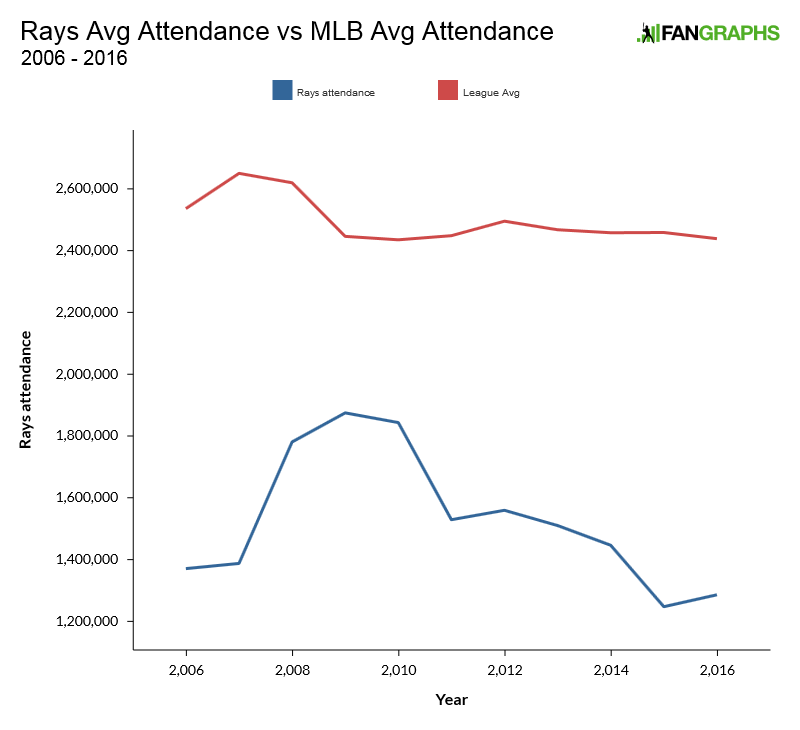
In my recent interview with Rays President Brian Auld, he stated that a goal of the Rays’ front office was to reach a league-average annual attendance mark. Last year, MLB average attendance was approximately 2.4 million per club. Rays attendance was 47% below that mar. Since Stu Sternberg bought the team in 2005, the Rays have never been close to league average. The closest they’ve been is 23% below in 2009.

Here’s the Rays’ attendance compared to league average since 2006:

And the following table illustrates how far the Rays have been from league average since Sternberg bought the team.

Rays Attendance as Percent of League Average
Year % of MLB Average
2006 54%
2007 52%
2008 68%
2009 77%
2010 76%
2011 62%
2012 63%
2013 61%
2014 59%
2015 51%
2016 53%

That’s obviously not encouraging. On the other hand, does it make sence for the Rays to set even the modest goal of “average” in a universe that includes major markets such as Chicago, Los Angeles, and New York? Since 2006, the Dodgers and Yankees, for example, have never been lower than 20% above league average in annual attendance and have been as high as 64% above average. The biggest markets in Major League Baseball skew the average for less populated areas such as Tampa Bay. Those teams would have to severely struggle over an extended amount of time to be anywhere near league average.

Read the rest of this entry »


Aaron Hicks Looks More Legit by the Day

Writers have a tendency to fall all over themselves in their haste to identify the newest breakouts. I do it, myself, because that’s the kind of stuff that’s most exciting, and you always want to be first. So this is why, every April, you’ll see enthusiastic articles about players who seem to be over-achieving. Once April is in the books, then only April is in the books, and surprisingly strong numbers stand out. Potential breakouts make themselves known, and few writers have the willpower to resist.

What’s less common is the eventual follow-up. Absolutely, some of those potential breakouts turn into actual breakouts. Far more often than not, the potential breakouts end up having been just regular players on hot streaks. This specific article — this is a follow-up. The Yankees are in first place in large part because the Aaron Judge breakout seems to be real. And yet Judge isn’t alone in being a major contributor, because there’s also increasing reason to believe in Aaron Hicks. Hicks right now is tied for sixth among position players in WAR, and he started as one of the Yankees’ backups. He is a backup no longer.

Read the rest of this entry »