
Cooperstown Notebook: The 2025 Progress Report, Part III
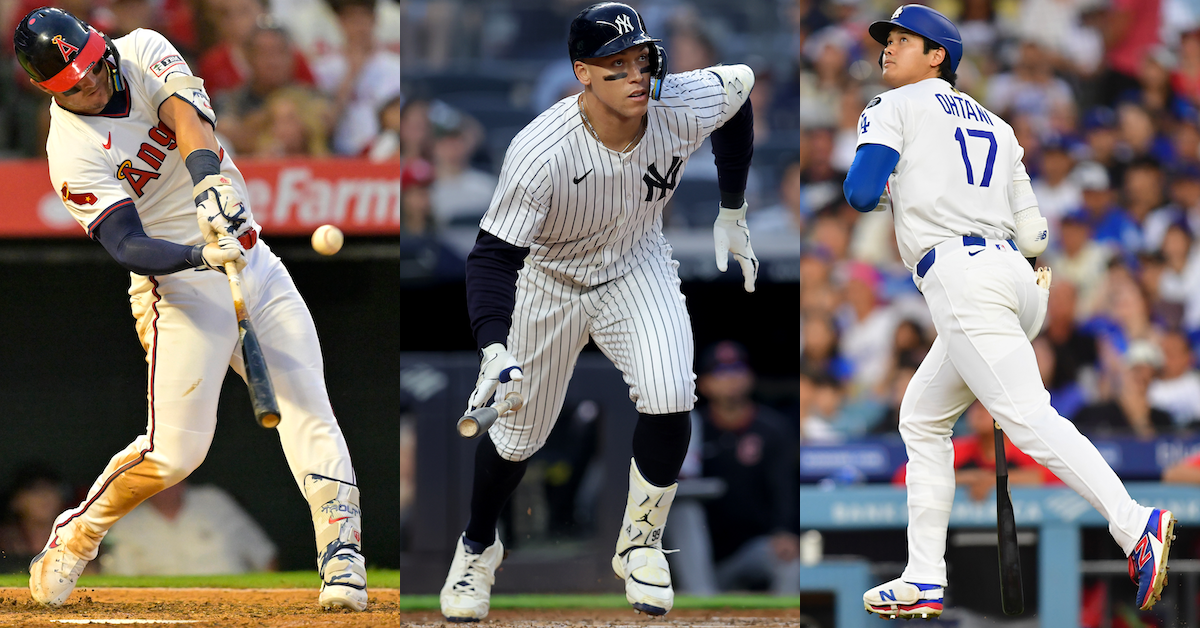
For a good chunk of this season, a third MVP award for Aaron Judge looked inevitable. As late as May 21, he still had a batting average above .400 (.402/.491/.755, good for a 236 wRC+). As late as July 25, he had played every game and was on pace for 58 homers. And as late as August 6, he still had a slugging percentage above .700 (.339/.446/.702).
Unfortunately, a right flexor strain suffered while attempting to throw a runner out at the plate on July 22 sent Judge to the injured list a few day later. While he spent only the minimum 10 days on the IL, his bat cooled off, and now he’s neck-and-neck with Cal Raleigh in the AL MVP race. But even if he doesn’t win, the 33-year-old Judge has done something very impressive. In just his 10th major league season, he’s surpassed the JAWS standard for right fielders, which is to say that he’s got a higher score (58.5) than the average enshrinee at the position (56.0).
With that distinction, Judge joins Mike Trout and Mookie Betts among active players to reach the JAWS standard at their positions by the time they fulfilled the Hall of Fame’s 10-year eligibility requirement (playing in parts of 10 seasons, not accruing 10 years of service time). That’s the province of legends; among position players whose careers crossed into the 21st century, the only others to attain that distinction are Jeff Bagwell, Barry Bonds, Ken Griffey Jr., Rickey Henderson, Mike Piazza, Albert Pujols, Cal Ripken Jr., and Alex Rodriguez. That makes Judge an apt choice to lead off the third and final installment of this year’s annual Hall of Fame progress series (pitchers and catchers are here, infielders here). Note that unless otherwise indicated, all WAR figures within refer to the Baseball Reference version, and all statistics are through September 1.
| Category | Career WAR | Peak WAR | JAWS |
|---|---|---|---|
| Current | 59.9 | 54.6 | 57.3 |
| 2025: 7.4 | ROS: 1.2 | Career WAR | Peak WAR | JAWS |
| Projected End 2025 | 61.1 | 55.8 | 58.5 |
| HOF Standard RF | 69.7 | 42.2 | 56.0 |
Last year, while hitting 58 homers, Judge matched his career high 10.8 WAR, set in 2022, the year he hit 62 homers to break Roger Maris‘ long-standing AL home run record. He entered the season with 52.6 career WAR and 51.8 peak WAR (best seven seasons) for a JAWS of 52.2, good for 18th among right fielders, nestled between Dwight Evans (52.3) and Ichiro Suzuki (51.8). Thanks to his hot start, he didn’t take long to surpass his 4.6 WAR from 2023, his seventh-best season, and so he’s been improving that peak score for months now; with 54.6 WAR in those seven seasons, he’s fifth among right fielders, having just surpassed Roberto Clemente (54.5), with Betts (55.6) in sight before season’s end. If he matches his ZiPS rest-of-season projection of 1.2 WAR, he’ll surpass Shoeless Joe Jackson (57.4) and Sam Crawford (57.5) to move to 13th in JAWS.
What’s remarkable about Judge reaching the JAWS standard before the end of year 10 is that his major league career got the latest start of any of those 21st-century predecessors. He was 24 when he debuted; Bagwell was 22 (early in his age-23 season), while the other players noted above were in their age-18 to age-21 seasons when they reached the majors. Judge is still short in traditional counting stats (1,175 hits, 358 homers), but with his awards and a ton of black ink (including three home run crowns and, possibly, a slash-stat Triple Crown), he’s already at 147 on the Hall of Fame Monitor, a Bill James creation that dishes out credit for things that have tended to sway Hall voters: seasons or careers at .300, awards, league leads in key stats, playoff appearances, and so on. A score of 100 is “a good possibility,” while one of 130 is “a virtual cinch.”
Left Fielders
| Category | Career WAR | Peak WAR | JAWS |
|---|---|---|---|
| Current | 45.4 | 34.0 | 39.7 |
| 2025: 3.3 | ROS: 0.3 | Career WAR | Peak WAR | JAWS |
| Projected End 2024 | 45.7 | 34.0 | 39.9 |
| HOF Standard LF | 65.3 | 41.7 | 53.5 |
With apologies to Kyle Schwarber (19.6/19.0/19.3) and his chances of reaching 500 homers (he has 333), there aren’t any active left fielders who appear to be on a Hall of Fame track based on WAR and JAWS. Christian Yelich is the active leader in both categories, but he ranks just 35th at the position in the latter and has totaled less WAR since the start of 2020 (13.3) than he did in ’18–19 alone (14.5). During that two-year stretch, he clubbed 80 homers and led the NL in batting average, slugging percentage, and wRC+ in both years, winning NL MVP in the former and placing second in the latter. At that point, he was 27 years old and figured to improve his 31.8 JAWS quickly given how top-heavy his career had been, but between the pandemic and recurrent lower back woes, he has rarely approached that level, slugging just .429 over the past six seasons while maxing out at 3.5 WAR in 2023. He’s at 3.3 WAR now while hitting .268/.350/.464 (127 wRC+) in 132 games, but at 33 years old, and with just three All-Star appearances and 231 homers under his belt, time isn’t on his side.
Center Fielders
| Category | Career WAR | Peak WAR | JAWS |
|---|---|---|---|
| Current | 87.0 | 64.8 | 75.9 |
| 2025: 1.1 | ROS: 0.3 | Career WAR | Peak WAR | JAWS |
| Projected End 2025 | 87.3 | 64.8 | 76.1 |
| HOF Standard CF | 71.3 | 44.6 | 58.0 |
After playing just 82 games in 2023 due to a left hamate fracture and just 29 last year due to recurrent tears of the meniscus in his left knee, Trout has played in 108 games this year while making just one IL trip, for a left knee contusion that cost him most of May. He’s been productive, if far less so than in his heyday, hitting .231/.361/.425 (116 wRC+) with 20 homers while mostly serving as a DH with a bit of time in right field; he hasn’t played an inning in center, and probably won’t again unless it’s an emergency. Trout has been a bit shortchanged based on his expected stats, but he’s got bigger problems. He’s struggling mightily against lefties (.218/.292/.333, 67 wRC+) and striking out 31.1% of the time overall, more than eight percentage points above his career norm; against southpaws, that strikeout rate is an unsightly 39.3%.
With 11 All-Star appearances, three MVP awards, and the no. 5 ranking among center fielders in JAWS, Trout doesn’t have to do anything more to wind up in Cooperstown. Still, he’s just 34 years old and has five more years under contract, so it would be nice if he could avoid descending into sub-replacement-level Hell the way Pujols or Miguel Cabrera did as they played out their contracts. Trout does have some upcoming milestones to look forward to; he’s two homers away from 400, and a couple seasons away from 2,000 hits (he’s at 1,736). Here’s hoping that heading into the winter in reasonably good health instead of rehabbing yet another injury allows him time to work on shoring up his game.
| Category | Career WAR | Peak WAR | JAWS |
|---|---|---|---|
| Current | 49.4 | 38.3 | 43.9 |
| 2025: 0.6 | ROS:0.1 | Career WAR | Peak WAR | JAWS |
| Projected End 2025 | 49.5 | 38.3 | 43.9 |
| HOF Standard CF | 71.3 | 44.6 | 58.0 |
Andrew McCutchen’s reunion with the team that drafted and developed him has allowed him to collect his 2,000th hit and 300th home run as a Pirate. That’s not nothing, but he’s not really getting any closer to the Hall in terms of WAR and JAWS. Both his 0.6 WAR and 101 wRC+ (.246/.340/.384) — the latter of which could help save the team from making dubious history — are steps down from last year and 2023, and just about everything I’ve written about him in this space in recent years still applies. While he’s a five-time All-Star, an MVP, and a Gold Glove winner who helped the Pirates to three straight playoff berths after a two-decade absence, his defensive metrics have suppressed his WAR and dampened his case on the JAWS front.
McCutchen would almost certainly have a peak score above 40.0 had he played average defense in center field. As I’ve shown in previous installments, that 40.0 peak score is a strong intermediate indicator of a Hall-bound career, in that about three-quarters of the eligible players to reach that mark have been enshrined. In McCutchen’s seven best offensive seasons by WAR’s batting runs component, he was a combined 27 runs below average according to DRS; overall, he’s been 75 runs below average via that measure. Using a 10-runs-equals-one-win exchange rate for some back-of-the-envelope math, that would translate to a 59.4/41.8/50.6 line if he’d played average defense straight across the board. That’s still 7.4 points below the JAWS standard, just below 15th-ranked Jim Edmonds and above Willie Davis and Jimmy Wynn, Cesar Cedeño, and Vada Pinson, fondly remembered players who are short of legendary. McCutchen fits in well with that group.
Also noteworthy: Currently playing just his fourth major league season, Julio Rodríguez isn’t really on the radar in a JAWS sense, but his 21.3 career WAR already ranks 51st among players through their age-24 seasons, just ahead of Hall of Famer Joe Medwick (21.2) as well as other enshrined outfielders such as Crawford (20.1), Tim Raines (18.7), Richie Ashburn (17.8), Ross Youngs (17.7) and Goose Goslin (17.5).
Right Fielders
| Category | Career WAR | Peak WAR | JAWS |
|---|---|---|---|
| Current | 74.0 | 55.6 | 64.8 |
| 2025: 3.7 | ROS: 0.6 | Career WAR | Peak WAR | JAWS |
| Projected End 2025 | 74.6 | 55.6 | 65.1 |
| HOF Standard RF | 69.7 | 42.2 | 56.0 |
Between the stomach virus that caused him to shed around 20 pounds, a fractured toe on his left foot, and who knows what other ailments, it’s been a trying season for Betts. His .250/.323/.376 (96 wRC+) line represents across-the-board career worsts, and from July 30–August 4, he went five consecutive games without a hit for the first time in his 12 major league seasons.
Nonetheless, the season hasn’t been a total loss for the 32-year-old Betts. In his second attempt, the eight-time All-Star and six-time Gold Glove-winning right fielder has done an impressive job of becoming an outstanding shortstop, a move that at the very least has no recent parallel. In fact, his 16 DRS at the position ranks second in the majors behind only Taylor Walls. Statcast’s evaluation of his defense is less charitable, but even so, his 3 FRV is in the black. At the plate, Betts’ bat has shown signs of life since he snapped that hitless streak, as he put up a 114 wRC+ in August after bottoming out with a 62 wRC+ in July.
Driven by some big DRS totals in right field (including 30 in both 2016 and ’17), Betts has led his league in WAR three times (2018, ’20, and ’23). He already ranks eighth at the position in JAWS, and fourth in seven-year peak, behind only Babe Ruth, Stan Musial, and Hank Aaron, though Judge has a chance to overtake him this season. Betts’ career totals, including his 1,738 hits and 285 homers, still need shoring up, but given his heavy presence in the MVP voting (he has three second-place finishes and two more in the top six to go with his 2018 win) and his reputation as a winner (he’s the only active position player with three championship rings), it seems clear that his heaviest lifting has been done.
| Category | Career WAR | Peak WAR | JAWS |
|---|---|---|---|
| Current | 53.9 | 38.5 | 46.2 |
| 2025: 3.0 | ROS: 0.5 | Career WAR | Peak WAR | JAWS |
| Projected End 2025 | 54.4 | 38.5 | 46.5 |
| HOF Standard RF | 69.7 | 42.2 | 56.0 |
Bryce Harper hasn’t played right field since tearing his ulnar collateral ligament in early 2022 and undergoing Tommy John surgery later that year. Even with his move to first base upon returning from that surgery — returning more quickly than any other position player has done, at that — he still qualifies at his old position for JAWS purposes. Given the team’s current disasterpiece of an outfield, it’s not out of the question he returns to the pasture at some point.
Between his initial elbow injury, a broken thumb, a hamstring strain, and this year’s bout of inflammation in his right wrist, Harper has played in just 480 games since the start of 2022. He wasn’t exactly the second coming of Ripken before that, having played in at least 147 games in back-to-back seasons only in 2015–16 and ’18–19. Still, when available, he’s remained an exceptional hitter; while this year’s 135 wRC+ (.269/.360/.502) is his lowest mark since 2019, he’s hitting the ball harder than last year, with an xSLG that’s 47 points higher and an xwOBA that’s 24 points higher.
All of which is to say that I don’t think the 32-year-old superstar is done being a superstar. Harper has been thriving in the spotlight since gracing the cover of Sports Illustrated at age 16, and his magnetism goes beyond the stats, particularly given that sometimes the numbers have been more solid than stratospheric. Aside from two big MVP-winning seasons — 9.7 WAR in 2015 and then 5.9 in ’21 — he’s topped 5.0 WAR just one other time (5.2 WAR as a rookie in 2012). The rest of his peak score is seasons of 3.7 to 4.8 WAR, leaving him short of a 40-WAR total but giving him room to improve; with a hot September, he could nudge that upward this season. He’s signed through 2031, owns a career 141 wRC+ (sixth among active players with at least 4,000 PA), and appears well on his way to 500 homers (he has 359). What’s more, he’s carved out a reputation as one of this era’s great postseason players, hitting .280/.394/.622 (171 wRC+) with 17 homers in 232 PA, and he’ll almost certainly have chances to add to his highlight reel this fall.
| Category | Career WAR | Peak WAR | JAWS |
|---|---|---|---|
| Current | 46.7 | 35.4 | 41.1 |
| 2025: 1.8 | ROS: 0.2 | Career WAR | Peak WAR | JAWS |
| Projected End 2025 | 46.9 | 35.4 | 41.2 |
| HOF Standard RF | 69.7 | 42.2 | 56.0 |
From 2022–24, Giancarlo Stanton hit 82 homers in 325 games while managing just a 107 wRC+ and a net of 0.7 WAR. Particularly once he missed the first two and a half months of this season due to bilateral epicondylitis — a double case of tennis elbow — it wouldn’t have been a surprise if he’d provided more of the same. Instead, the 35-year-old slugger is on an absolute tear, hitting .295/.374/.624 (173 wRC+) with 17 homers in just 196 plate appearances. He still swings harder than anyone, and still hits it just about harder than anyone when he connects, though with a 30.7% strikeout rate, he doesn’t connect as often as you’d like to see (unless you’re an opponent). Even after so many of his other skills have eroded, his power is absolutely breathtaking.
The litany of injuries that has limited Stanton to playing just 55.6% of the Yankees’ games since the start of 2019 — about 90 per 162-game season — has also cost him a shot at some stratospheric milestones, as well as WAR and JAWS totals that would mark him as a clear Hall of Famer. If he could ever maintain some modicum of what he’s got going right now across a full schedule, he could improve a peak score that includes seasons of 3.1 and 3.8 WAR. Still, his chances at making the Hall are almost certainly reliant upon getting to 500 homers (he has 446). According to colleague Dan Szymborski, this season has improved his ZiPS career projection from 492 to 533. Here’s hoping his legs — and elbows and back and really every other part of his body — are up to the task, because baseball is more fun when Stanton is hitting 118-mph bombs.
| Category | Career WAR | Peak WAR | JAWS |
|---|---|---|---|
| Current | 41.7 | 39.4 | 40.6 |
| 2025: 5.3 | ROS: 0.9 | Career WAR | Peak WAR | JAWS |
| Projected End 2025 | 42.6 | 40.3 | 41.5 |
| HOF Standard LF | 69.7 | 42.2 | 56.0 |
Soto set several career highs in his lone year with the Yankees, including homers (41) and WAR (7.9); his 181 wRC+ was a full-season high as well, though he did have a 202 wRC+ in the pandemic-shortened 2020 season. His monster campaign was well-timed, as he jumped boroughs to ink a record-setting $765 million contract with the Mets, but his first season in his new home has been something of a disappointment by comparison — albeit one with 36 homers, a 155 wRC+, and 5.3 WAR with four weeks left to play. Most of that comes down to a slow start; Soto hit just .231/.357/.413 (118 wRC+) with nine homers through the end of May, but has batted .276/.427/.596 (182 wRC+) with 27 homers in 350 PA since June 1.
With his 0.9-WAR rest-of-season projection, the 26-year-old Soto should surpass the 40-WAR peak threshold in just his eighth season, and he’s got ample room to grow that given that his 3.0 WAR from 2018 is his seventh-best mark. For as much as his otherworldly plate discipline will drive his Hall of Fame case, his declining defense rates as a concern; he’s got -6 DRS for the second year out of three, along with -10 FRV. He’ll need to shore up his work in the field — particularly his reads and his jumps — to avoid becoming a full-time DH by the time he’s 30, suppressing his value.
Also noteworthy: While he’s raked at a .284/.410/.510 (156 wRC+) clip since returning from his second ACL surgery on May 23, Ronald Acuña Jr. has accumulated just 2.0 WAR this year and is at 27.6/27.6/27.6 as he nears the end of his age-27 season, with just two seasons worth 4.0 WAR or more. While there are Hall of Famers who had similar WARs at that juncture, such as Bagwell, Wade Boggs, Rod Carew, and Chipper Jones, those players did a better job of staying on the field after later starts to their major league careers. The story is generally similar for Fernando Tatis Jr., who’s at 26.7/26.7/26.7 as he nears the end of his age-26 season, his sixth; he’s lost the advantage of reaching the majors at 20, and he’s additionally burdened by his PED suspension, since voters have yet to elect anyone who’s been disciplined in such fashion.
Designated Hitters/Pitchers
| Category | Career WAR | Peak WAR | JAWS |
|---|---|---|---|
| Current | 49.5 | 49.9 | 49.7 |
| 2025: 5.6 | ROS: 1.2 | Career WAR | Peak WAR | JAWS |
| Projected End 2025 | 50.7 | 51.1 | 50.9 |
| HOF Standard Unicorn | How do you | measure | unicorns? |
Nearly two years removed from the second reconstruction of his ulnar collateral ligament — a hybrid procedure, not traditional Tommy John surgery — the unicorn isn’t completely unbridled. While Ohtani has returned to the mound, the Dodgers have limited him to 11 short starts totaling 32.1 innings, with a bit of bad luck inflating his ERA to 4.18 and costing him some WAR (he has 0.2 bWAR based on actual runs allowed, but 1.2 fWAR driven by his 2.26 FIP). On the offensive side, he’s in the mix for a fourth MVP award, hitting .276/.386/.600 with 45 homers and 17 steals. That last figure is a far cry from last year’s career-high 59, but given the demands of rehabbing from surgery and remaining available to pitch once a week, Ohtani was always less likely to run amok this season.
As I noted last year, JAWS really wasn’t built to handle a case like Ohtani’s. Given the hybrid nature of his career as a pitcher and hitter, he doesn’t have a career/peak/WAR line directly comparable to anyone except perhaps 19th-century pitcher-turned-infielder (and manager, pioneering labor leader, and executive) John Montgomery “Monte” Ward, who totaled 62.3 career WAR, 40.7 peak WAR and 51.5 JAWS in a 17-year career that featured much shorter schedules. Eight seasons into his career, Ohtani is already at 49.5/49.9/49.7 (his -0.4 WAR in 2020 is no longer his seventh-best season), and could very well join the 50-WAR peak club by the end of the season — or by the end of this week, if he gets hot. Of the 38 players in that club, 32 are enshrined, and four aren’t yet eligible (Betts, Trout, the recently-retired Pujols, and the recently-unbanned Jackson, the last of whom won’t be on a ballot until December 2027 at the earliest), leaving only Bonds and Rodriguez, who are both outside due to PED connections.
Ohtani is still two years away from officially qualifying for Hall eligibility, but particularly with a championship to go with those three MVP awards – to say nothing of his impact upon growing the game globally — I think it’s pretty clear he passes what Szymborski calls “the bus test.” Even if the Dodgers plan to keep him on a shorter leash than the Angels did, pitching-wise, I can’t wait to see where the rest of his career takes him.
Brooklyn-based Jay Jaffe is a senior writer for FanGraphs, the author of The Cooperstown Casebook (Thomas Dunne Books, 2017) and the creator of the JAWS (Jaffe WAR Score) metric for Hall of Fame analysis. He founded the Futility Infielder website (2001), was a columnist for Baseball Prospectus (2005-2012) and a contributing writer for Sports Illustrated (2012-2018). He has been a recurring guest on MLB Network and a member of the BBWAA since 2011, and a Hall of Fame voter since 2021. Follow him on BlueSky @jayjaffe.bsky.social.
I just can’t believe the 40% k galoot from 2016 is at 60 bwar and no longer a pure peak case.
Keep going, Aaron. You’re a legend.
At some point in 2024 the question of “Aaron Judge, Hall of Famer?” became “Aaron Judge, will he get in on the first ballot or have to wait a year or two?”
And if he does anything like he did in 2025 again, the only thing we will have left to ask what his percentage will be. If his year ended today he would have 7.9 fWAR for the season. If he did it again in 2026 he will be within striking distance of Reggie Jackson’s career fWAR, at which point he will definitely get in on the first ballot. (Twice and he’s within striking distance of Ken Griffey Jr)
If Judge isn’t a first ballot guy I don’t know who might be.
So when the whole “should they extend Judge” conversation was happening in early 2022, I made an off-hand comment to my wife that he’s good, but “I wouldn’t give him Trout money”.
She periodically likes to remind me how poorly that statement aged.
That was based on his injury history, which made him miss about 150 games (out of 380) from 2018 – 20. He is a very big man and was 30 years old, so it was reasonable to guess that injuries would continue to be a problem.
In the almost 4 years since, he has played about 530/600 games. I don’t think anybody predicted that.
And most of those missed games were truly not his fault because Dodger stadium
It’s not his fault he ran into the wall?
Dan is going to do a ZiPS time warp for Yelich that starts after the 2019 season someday and we will all get to marvel at his Hall of Fame case. At the end of the day, he is not going to be adding to his peak. His case is going to look like those of Fred Lynn and Curtis Granderson. And his former teammate Giancarlo Stanton, for that matter.
Bryce Harper looks like he’s going to hit for at least the next 3 years. If he stays healthy, which I know is a big if, I think he’ll be very close to 500 homers and have similar career and peak fWAR to Larry Walker.
I was astounded when Judge passed Harper in WAR last year after starting 5 seasons later. He’s gonna be a 60s WAR guy
Judge probably has a better chance to finish with a WAR total in the 80s than in the 60s
I meant Harper
Looks to me like we have three guaranteed Hall of Famers in this section with Trout, Judge, and Betts. And then another two who don’t quite seem to have the career totals but it’s hard to imagine them not getting in (Ohtani and Harper). And then another with a decent shot but he’s a long way off (Soto). I don’t see a lot of borderline cases here, but I expect there to be a contingent of supporters for McCutchen that keep him around. Maybe if Yelich stays healthy through the end of his contract he joins McCutchen.
Among the infielders, we have one lock (Freeman) and three more players who don’t quite have the career totals but it’s hard to imagine them not getting there (Ramirez, Lindor, Machado). And then one more who is probably a lock (Goldschmidt), another who has a good shot (Altuve), and a player who probably hasn’t done enough but will get a spirited debate (Arenado).
There are three guaranteed starters (Verlander, Kershaw, Scherzer), and another who could get there (Sale). And then we will be having conversations about what our standards are going to be in the future.
Greinke for pitcher too.
I assume he’s counting Greinke as retired.
I’m not a huge fan of Greinke relative to the other three because his peak wasn’t as long, but I think the bigger obstacle will be his unique personality. Writers don’t usually like baseball players who don’t give them material to work with. (I also would not be surprised if some writers don’t like that he is smarter than they are, he isn’t as affable as Votto)
Still, I would vote to put him in and the writers will probably do the same. He will probably be helped by the fact that Scherzer, Verlander, and Kershaw will be going on the ballot after him and there probably won’t be any pitcher elected between him and Sabathia. And I am coming around more and more to the idea that we probably need more starters in the Hall, since a lot of these standards were forged in extreme run environments.
I’ve been thinking it may take Greinke 2-3 years to get in & I think if he got on the ballot the same time as JV/MAx/Kershaw it would def take him a couple of years to be voted in. Maybe being before will help him.
Not only what sad mentions, but, he never had that 4-5 year in a row peak of dominance, he pitched for 5 teams in 7 years in what was supposed to be his peak (age 26-32), his best years are spread out among different teams, best year was in KC & he didn’t have a flashy W-L that year due to it coming on a bad team.
He’s one of those guys that due to the above is underrated because it was hard to focus on how great he was.
Now, I truly think he’s deserving, but, my sense is it will take some saber-centric voters clarifying for the non-saber voters how great he truly was.
Y’all are overthinking it.
Sabathia got 85% on the first ballot…and no one in the history of ever would argue for Sabathia over Greinke, who both has a 48.4 WAR7 AND a consecutive 7 season run with 36.6 rWAR – he’s still ahead of Scherzer in JAWS!
The only way to trick yourself into thinking Greinke will have any trouble getting in first ballot is to claim that the career leader in Pitcher DRS outperforming his FIP-WAR by less than his DRS total was random variation.
“Old school” voter may vote Sabathia over Greinke. Sabathia has:
250 wins
3000 K’s
Had a # of big moments- The dominant stint in Milwaukee to drive them to the playoffs, going to Yankees & them winning the WS the next year while he pitched great in the playoffs.
Has the narrative of overcoming alcoholism to finish his career strong.
Overall, he was more well known than Greinke, partly because of the above & only playing for 3 teams And the short one (Milwaukee) he had a famous stint driving them to the postseason.
I am NOT saying I agree with all that, but, someone who uses old school stats & knows the narrative could pick CC over Greinke.
Have you ever read the Athletic’s “Greinke Stories” series?
The guy’s a folk hero to the SABR generation of writers.
He also really won’t be hurt by the Scherzer comparison, because voters savvy enough to know FIP-WAR know better than to use it for these BIP sample sizes…and know that Greinke’s the best defensive pitcher in the history of DRS.
Jay mentioned Greinke in the earlier, pitchers part of this series (in the comments, too — thx, Jay!). My recollection is that the consensus says Greinke’s going in (with which I agree)
In my mind, Ohtani is a lock (absent new gambling scandals). Harper’s fascinating, but he’s gotta be at least 60% to get in from here, maybe more. It’s fascinating to watch the Tatis, J-Rod, Yelich guys go from the “OMG, that’s a HOF career launching!”, to bumps in the road, to (in most cases) HOVG “disappointment” as the ultimate destination.
I don’t know that I have any idea how Ohtani’s candidacy would be viewed if he didn’t get a single more WAR in his career, but I think he is in the mid-to-high 40s on fWAR and he’s already got the peak of a Hall of Famer.
I look at it this way: What’s the worst case scenario for him at this point? He blows out his arm several more times but insists he’s not giving on pitching, so he alternates between being the best DH in the league and not playing? He’s signed for the next 8 or 9 years or something like that. If he only has another 2500 PAs in his career at 2021 levels, he’s going to have an fWAR in the mid-60s, which is way more than he will need to get in. Even if he isn’t already there, it is so hard to imagine a scenario where he falls short.
Sometimes I wonder what would happen if Ohtani retired at the end of the season. To me he would be a lock. He’s got a decent shot of obtaining his 5th consecutive season of 8 fwar or more. Best DH season ever by a mile…. Etc.
Who are some other players with comparable 5 year spans that didn’t get into the Hall?
Of course it’s a silly question on my part because Ohtani is going to continue playing. And, knock on wood, play well.
There are no players that have put up that many 8 WAR seasons that didn’t make the HOF.
(If you had phrased it as “aren’t in the HOF”, the technical answer would be Pujols, Trout, A-Rod and Clemens. Surprisingly, Miggy only had one 8 WAR season.)
Since 1920, there have only been 231 8.0 WAR seasons for hitters and 64 for pitchers.
Hey! Thanks for looking that up!
Bonds also with the technical answer, of course.
D’oh! Brain cramp on missing that one. . . .
If he retired at the end of this season, he wouldn’t actually be eligible for the Hall of Fame, having failed to meet the 10-year minimum requirement.
The worst case scenario is that he suffers a career -ending injury before he can meet the 10-year minimum requirement.
No chance Harper doesn’t get in, barring some sort of scandal. He has always been one of the biggest names in baseball, a face that non baseball fans might even recognize. Not everything is entirely about numbers.
Technically, Ohtani isn’t a lock until he reaches the 10-year minimum requirement. It would take a career ending injury before he reaches that point to keep him out of the Hall of Fame, but the possibility does exist.
IF that happened, I honestly think they would waive the 10 year rule to vote him in anyway.
ESPECIALLY on the pitching side.
Was looking at the active leaders in CG not long ago. Verlander leads with 26, Kershaw has 25, then you drop down to Sale with 16. Alcantara has by far the most of anyone under 30 with 12 but after him you drop down to Cease, Sanchez and Webb with 3 (again, that’s under 30). There are only 9 guys under 30 with 2. And most of those guys are 28 or 29 so we are looking at the under-30 leader having 2 or maybe 3 as of 2027 (probably Lodolo or Bello who are both under 28 and have 2 CG). It’s very likely that no pitcher born after 1995 (the year Alcantara was born) will ever have more than 5 CG in their careers except maybe Skenes who has 1 at age 23 (& is the youngest active pitcher with a CG).
Strikeouts is very similar – Cease has the most of any pitcher under 30 with 1,209. Is he even going to get to 2,000, let alone 3,000? And here’s a remarkable stat – I’m looking at b-ref’s active leader list which goes to 100 which is Ranger Suarez with 678 and there are no pitchers under age 28 on the list. That means there is not a single starter under age 28 with at least 678 career Ks.
I have said this before but I really think it will become clearer how to reevaluate Hall of Fame standards once the players in their early 30s are done. I still think Cole has a shot to make it under current standards if he stays healthy, but once we know what Fried, Nola, and Bieber do we will have a better idea of what the standards are for Skubal, Cease, and Webb (and eventually Skenes).
Not sure Cease belongs on that list
God, that is depressing.
Cutch is 1000% going to stick around for 10 years because everyone loves him, then get in via a Committee filled with folks who love him.
And I am fine with that, because there’s a reason everyone loves Cutch.
From your fingers to the baseball gods ears. I do agree that he will make a good case for many voters with his final counting stats and offensive peak. Hard to say he is any less qualified than Dave Parker in the great player for 5 years category.
Lester–thank you for saying that so I didn’t have to, and glad it’s not just Pirates homers that think so.
(I’d really be curious what happens if someone runs a WOWY-style analysis on McCutchen’s center field defense. Some of the toss-the-raw-putout-numbers-in-a-bucket-and-trust-big-numbers-to-average-out style analyses get weird with the groundball-heavy ’10s Pirates teams, like the Baseball Prospectus stats that had Starling Marte as a terrible fielder and Pedro Alvarez as a great one. But WOWY should take care of that.)
I was thinking that, too.
What if Cutch’s D was “average”, not terrible in CF? All of a sudden his HOF case is not too far fetched. His oWAR alone would make him a viable candidate today. & I have a hard time trusting defensive measurements as the gospel truth.
Add in him being beloved & yeah, I wouldn’t be shocked if he got in on a VC at some point.
He’s pretty much Pedroia with counting stats, right down to the early 30s leg injury.
Trea Turner projects to finish the year with 7.0 WAR and 48 fWAR and 42 bWAR at age 32, so he has a good shot as well even as his hitting has somewhat declined. Unfortunate for him that his best season was the shortened 2020 season, which it doesn’t seem people are giving players appropriate credit for. Also hurt by voters seemingly preferring bWAR to fWAR. I think Seager has a sneaky good HoF chance as well.
I don’t really understand how Harper’s as successful as he is, and I’m not confident in projecting his future performance. His batted ball data has declined somewhat in the last two years. His EV, max EV, and xwOBAcon are all his worst in the last 2 seasons since 2018, and he’s not even in the top 10% in xwOBAcon in either of the last 2 years or max EV this year. No doubter HR % has dropped considerably (43% for his career and 50% through 2022 to 30% the last 3 years). He has both an above average K and BB rate despite awful whiff and chase numbers (like 10th percentile in both). He has the 11th highest swing rate among 152 qualified hitters but an 82nd percentile BB rate. It seems like pitchers pitch around him to a much greater extent than they do other great hitters (3rd lowest zone % among qualified hitters), and I don’t know why b/c his contact numbers aren’t that extraordinary. Maybe his contact numbers have taken a hit because of his lack of selectiveness, but then even his max EV isn’t that impressive. He’s 38th in EV90 too. 20th in run value in the heart of the plate. I’m not familiar enough to speak to whether his zone breakdowns shed more light on his hitting tendencies, and how they compare to others. Could be that he’s mostly chasing close and competitive pitches, but he does poorly against chase pitches (142nd among 182 hitters w/ 1500 pitches). 47th in shadow zone.
So basically 30th in xwOBAcon but 22nd in xwOBA despite brutal whiff and chase numbers. People give Harper credit for having assets in all areas (plate discipline from high BB%, etc) but if you dig under the hood it’s not as obvious as you might expect.
What if after winning the next 2 World Series Ohtani decides to replace Lebron with the Lakers? 9 seasons of incandescent play, but he gives it up to be a 3 and D wing for the Shotime Lakers?
He might have a good two-strike approach (that’s often the case in these situations), but I am going to guess he is doing well because he’s not letting pitches in the zone go unanswered.
He’s swinging at 78% of pitches in the zone (4th in MLB), which means he’s not taking many called strikes. His Swinging Strike + Called Strike percentage is–when ordered from low to high–34th out of 152.
This is probably why teams are “pitching around him” as you put it–they know that if they put in the zone he’s not going to take it. The difference between him and Castellanos, Pete Crow-Armstrong, Yainer Diaz, and Salvador Perez is that he doesn’t swing at quite as many pitches outside of the zone.
So they pitch outside of the zone, he doesn’t swing quite as much as other free-swingers, and that keeps his walks higher. I don’t know if he can keep it up, but here’s something odd: His Fast Swing Rate % went from 55% in 2023 to 41% in 2024, and then back up to 46% this year. His bat speed itself isn’t that different, but either he is losing bat speed and compensating with “old man skills” or he’s not swinging all out as much anymore.
123rd out of 288 hitters in 2 strike WRC+ (58 WRC+). Was 16th last year and 181st the year before.
It’s true that he swings at a bunch of pitches in the zone but he doesn’t generate that much run value in comparison to some other players who aren’t pitched around to the same extent. Brent Rooker has produced more value on pitches in the heart of the plate the last two years and his BB% percentile is in line with his chase percentile.
I think our advanced analytics are being applied asymmetrically to the current generation and it’s harming them both in terms of career value and career compiling. We haven’t seen a 100 WAR / top 25 guy since Pujols and Beltre and despite amazing starts from guys like Trout and Betts and Harper its looking more and more likely we’ll never see one again.
Everything you are saying about Harper is correct and I also assume he’s already started his decline. But this is his 14th major league season with the most advanced scouting and best roster depth the sport has ever seen. He’s never going to stack up with the value of the all time greats but he’s going to be in the same 60-70 buckets as most of the people in this series and will be 10-15 behind the Judge/Ohtani/Trout unicorns who will be 10-15 behind the Pujols/(clean what ifs) ARods of the generation before them.
But I think what we’re missing with Harper is that he’s actually an all time great compiler. He doesn’t look like he’s going to excel in any specific counting stat, but he’s got a chance to check boxes for a whole bunch of them. Freeman does as well, so it will be interesting to have a 3 year buffer to monitor but 600 doubles, 500 homers, 2500 hits, 5000 total bases, 1500 runs, 1500 RBIs, 1500 walks. These are big round numbers that he could achieve with a moderate decline and desire to achieve. He’s stated the latter very emphatically and still has 6 seasons on this current contract. He’s going to be one of those slice and dice criteria people where it will be like him and Musial or him and Hank Aaron etc.
Harper’s always been a big SEAGER guy, which doesn’t necessarily show up in traditional Plate Discipline statlines.
I’m aware that Harper traditionally has done well by that metric. Is it available online? I can’t find it and would be interested to see how well he grades out this year.
Even so I don’t understand how he runs such a high BB %. Seager’s the model’s namesake and has elite swing decisions and has done more damage on contact than Harper the past couple of years, but has typically run BB%’s in line with his chase numbers.
Seager: 2024 55th percentile chase vs 72th BB% 2025 81st percentile chase vs 91st BB%
vs Harper: 2024 19th percentile chase vs 94th percentile BB%, 2025 10th percentile chase vs 84th percentile BB)
That’s a massive discrepancy that doesn’t seem to have any analogues.
Sorted Statcast leaderboards for the last 5 years with out of zone swing % (chase %) and BB%.
Harper 2022 has 99th highest chase % and 10.5 BB%, Harper 2025 has 105th highest chase % and 11.8 BB%, Harper 2023 has 174th highest chase % and 14.7 BB%, Harper 2024 has 175th highest chase % and 12.0 BB%. Out of 988 seasons.
Highest BB%’s besides Harper in top 200:
Pete Alonso 2022 170th and 9.8%
Eric Hosmer 2022 158th and 8.8%
Anthony Santander 2024 192nd and 8.7%
JD Martinez 2021 160th and 8.7%
Jose Altuve 2025 69th and 8.6%
Including Harper’s there are 18 seasons w/ BB% above 8%, 37 with BB% above 7%, median of 5.5%.
Is Harper that much of a unicorn? I don’t get it.
“Not That Bobby Orr” has a website with a sortable table.
Looking at the Statcast breakdown of his swing decisions, it looks like Harper LOVES high cheese on the inner half…and hits it well!
So he’s “chasing” pitches on which he hits .300 with a .600 SLG…which O-Swing% can’t understand!
It looks like he chases low pitches as much as high and inside (both around 40%). His xwOBACon in all 3 zones is about .300. Additionally, he’s pitched out of the zone down more than high and inside (22% down and out 12% down and in vs 7% high and in).
Besides that, even if he was selecting good pitches to swing at it still doesn’t explain how he runs such a high BB%, just how he’s a good hitter period. There are players with high SEAGERs (including higher than Harper’s) but low walk rates. Dude has 10th highest swing rate and 19th highest oswing rate of 150 qualified hitters.
Is Soto that far off? He’s two years from the 10 year eligibility point, at which time there’s a good chance he will have 50+ WAR and 300+ HR at the end of his age 28 season. At that point, unless something tragic happens, the worst case scenario would seem to be the Stanton route, where he grinds out seasons as a DH until he hits 500 HR. His combination of an early start, great rate stats as a hitter, and health and consistency have put him in pretty great shape despite the defense.
Soto really has to fall off not to make it. He’s 23rd in fWAR through age 26, and the only players in the top 30 with serious on-field questions about their HOF cases (so excluding Bonds, A-Rod, Shoeless Joe) are Sherry Magee and Andruw Jones. In the top 35 you have Cesar Cedeno and Vada Pinson, but it seems like Soto would have to have that kind of fall-off not to be a deserving candidate.
Part of this is that Soto has more PA by age 26 than most of the inner-circle guys around him, but those stats count.
He’s probably either 20 WAR or one more 2024-level season away from being a Hall of Famer. It seems nearly guaranteed that he’ll get the former for the reasons you mention, and I think he has another big year in him as well. But I think it might be four more years instead of two before he gets to that.
And as “the Stanton route” goes, he’s 14 WAR and 30 HR ahead of where Stanton was at age 26.
Scwarber is interesting. He has 333 HR and is only 32. He’s got a pretty decent chance at 500 and almost zero chance at the Hall.
He might become the guy with 400 HR with the lowest WAR. I believe that is currently Paul Konerko (439/24.0).
Schwarber in the Hall wouldn’t be as ludicrous as Nick Markakis in the Hall but it would be funny.
The active player with the most home runs age 33+ is Carlos Santana with 137 and then Goldschmidt and Justin Turner at 123 and 122. I think Schwarber getting to 500 would be very surprising.
None of those guys were power hitters like Schwarber and none were hitting for anywhere near Schwarber’s power at age 31-32.
HRs age 31-32:
Goldy 40 HR
Santana 47 HR
Turner 48 HR
Schwarber 87 HR (and counting)
Possible better comps, HRs age 33 and up:
Dunn 56 HR
Bautista 133 HR
Konerko 141 HR
Encarnacion 156 HR
Ortiz 252 HR
Still doesn’t look very good.
He’s about to lock in his playing time for the next 4 to 5 seasons which should raise his floor. In his absolute worst case scenario he’s unplayable before the end of that contract and just retires. But basically any middle ground scenario where he gets a 4 year contract and averages 30/season that’s 450 after his age 36 season.
It’s impossible to assume what his motivations are going to be at that point but there are lots of decreased playing time opportunities for good clubhouse guys who can take a walk and hit some home runs.
On the upside, if he hits 45, 40, 35, 30 that’s 483 plus whatever he hits the rest of this season. He could also age like Nelson Cruz who hit another 300 homers in his age 33+ seasons.
All in all, I wouldn’t bet heavily for or against Schwarber getting 500.
Yeah, a guy like that who is a clubhouse leader can probably play until he can’t hit anymore.
Look at Carlos Santana, he’s played full time until he finally hit the wall this year at age 39..& the Cubs still picked him up this week.
Same with Nelson Cruz- played Full time until he was 41 & still got a contract with San Diego at age 42.
Would not be shocked if Schwarber plays until he’s 40 or more & easily clears 500 HR. The eye/OBP will do a lot of heavy lifting for him.
Kingman (17.3 WAR/442 HR) and Dunn (18.0 WAR/462 HR) both have him “beat.”
I figure Schwarber’s likely to pass Konerko in WAR over the next couple years, in fairness.
I think Altuve is pretty much a lock at this point and J-Ram is probably there too. I’m probably the high man on Arenado too. I think Coors probably impacted his war and adjusted numbers a little too much and believe he should be a lock already.
Do people really think his age 31 2022 was thaaaat much better than when he put up 40+ home runs pre rabbit ball? I’m not so sure.
Yeah Altuve will probably make it though it will take him a couple years to get in due to being on the Astros in 2017 though he reportedly wasn’t part of the sign stealing.
Yeah, the problem with park-adjusted stats for Rockie hitters at Coors Field is that they don’t give them credit back for also dealing with the Coors Hangover Effect.
Besides, all those Platinum and Gold Gloves at 3B are just as valid at Coors Field as any other home ballpark (except the rare ones that still use turf).
Am I the only person who doesn’t see Goldschmidt as a quite so likely? It’s not an absurd consideration, but he’s not Freeman, either, and his tail end years might not help him.
I think it’s an open question whether he should get in, but his career has similarities to both Helton and Votto. One is already in and the other will be. Maybe it will take a few years but he will get there.
Personally I think Votto is clearly the strongest candidate of the three but if Helton and Votto are in, Goldschmidt will get there eventually.
Heck, maybe the veteran’s committee will take up Lance Berkman. His case is likely as good as Helton’s.
Freeman’s putting himself in a different category though. I wouldn’t be surprised if he ended his career with more than 75 fWAR.
Yes, you are. Goldschmidt is actually quite comparable to Freeman both offensively and defensively, while Goldy has been a better baserunner.
Although, Freeman does have an advantage in counting stats due to starting his career three years younger, and it somewhat remains to be seen if Freeman’s decline will be as sharp as Goldy’s has been over the past three years.
Still, saying Goldschmidt is no Freeman is not accurate given how comparable they actually are.
I will be incensed if Andrew McCutchen makes the Hall of Fame. Seems like a great guy and unquestionably a Pirates legend, but his last 2 WAR season was at age-31.
Sure, the same applies to Stanton, but he also has an injury excuse and will probably get to 500 homers, plus the postseason numbers which Cutch doesn’t have. Did anyone watch McCutchen on the Brewers and think “that’s still a Hall of Famer!”
No chance he gets in on the ballot but he feels like such a Veteran’s Committee guy and I will be so upset when that happens in 30-odd years.
Cutch absolutely has an injury excuse – his career effectively ended when he did his knee in 2019…and he did his Achilles at the end of his bounceback season in 2023.
You must get upset a lot because Cutch is right in the range where the various Veteran’s Committees make their selections. They induct a guy just like Cutch (or worse) just about every time they get together.
I can’t bring myself to be incensed about the vet committees inductions and in thirty years I’ll be in the 70’s so I’ll have more things to be worried about. I was annoyed about Baines induction but wasn’t u
Wouldn’t Shohei’s HOF comp be Babe Ruth?
A lot of people make that comp but Ruth didn’t overlap his pitching much with his hitting.
He only had 1 season of over 400 PAs and at last 15 pitching appearances.
Ohtani already has 3 seasons of at least 599 PAs and 23 starts and assuming he is healthy enough to pitch will add more seasons.
Ruth was an incredible 2 way player he just mostly split his career between pitching and hitting and was pretty much done as a pitcher by age 24.
As noted above, Ruth’s pitching and hitting didn’t really overlap.
Further, you just can’t compare baseball in 2025 to baseball in 1925. Just 2 completely different eras.
What Ohtani is doing has no real precedence.
Some comments below are arguing that Ruth isn’t a good comp because he wasn’t a great pitcher and hitter at the same time, and that’s true. But he’s the best we have in MLB (the league, not the level). Otherwise you’re trying to compare him to someone like Wes Ferrell With Ruth and Ohtani, at least you have two guys who will (presumably) have long careers as great hitters and shorter careers as great pitchers.
There is an interesting comp in the Negro Leagues: Bullet Rogan.
Rogan: 1,500 IP, 161 ERA+, 37.8 WAR; 2,345 PA, 152 OPS+, 23.4 WAR.
Ohtani: 514 IP, 139 ERA+, 15.2 WAR; 4,227 PA, 159 OPS+, 34.5 WAR
A shorter career (due in part to shorter seasons) for Rogan, but similar greatness on the mound and at the plate.
Sam Miller’s already on record that he’ll be voting for McCutchen, and at least one or two other writers I’m following on social media (names escape me). Frankly, I am not looking forward to the debate around players like him, Yelich, and Stanton – call it a byproduct of aging, but re-litigating their careers each year for ten to fifteen years sounds horrific to me – particularly given that I’ve always liked McCutchen, both as a player and especially as a person.
(I’m also very much a Big Hall person – it’s for the best of the best, yes, but I think the concept of exclusion is a battle that’s been lost, and I favor giving “marginal cases” the benefit of the doubt. So take my gripes with a grain of salt.)
Pirates fans can’t even have that Hall discussion to look forward to, man.
The question with McCutchen and Yelich will be if they clear the 5% hurdle to hang around the ballot for a few years…as far as clearing 75%, I have roughly as much chance as they do (all that said, they seem like likeable, classy guys! And there is something to be said for that, in a world of shitheels lurking around every corner)
Ya, I don’t hold too many illusions that they’re getting in via the BBWAA ballot. There’s just not enough of an Old School case to be made for either, and there’s definitely not an Advanced Stats case in either corner. At that point, it’s purely about “do you (the voter/writer) want a Hall with X player in it?”
In 15 years the “old school” case will be the people voting today
Wright has stayed on so far so I think at least Cutch will stay on.
It was a different time but Lynn (a good comp on the surface) dropped off after the second ballot.
I was thinking of Parker as a comp for McCutchen for the obvious reasons–great Pirates player just elected into the Hall. But it turns out, Fred Lynn is much better.
Lynn: 50.2 WAR, 38.3 WAR7, 44.3 JAWS
Cutch: 49.6 WAR, 38.3 WAR7, 44.0 JAWS
Same shape to their careers as well:
The voters had no interest in putting Lynn in–he dropped off the ballot on his second try. We’ll see if McCutchen gets treated a little better.
McCutchen and Parker are interesting comparisons for each other because they each had an approximate four year run where they were basically the second best player in major league baseball. George Foster is in that category too.
A weirder candidate for that group is Grady Sizemore, except Sizemore crashed so hard he couldn’t hang around to add to his career total. (He also happened to play at the same time as Utley and Pujols, he was more like the 3rd to 5th best player during that time)
You could also maybe compare him to Dale Murphy. Murphy was another right-handed center fielder who wasn’t really a great defender there, and who had a Hall of Fame peak and a huge crash.
I think Fred Lynn is a cleaner comp for Yelich, where he had two MVP-level years and was a 4-win guy for a while outside of that. Curtis Granderson was like that too.
I don’t know which ranks as the most unlikely thing I’ve seen in baseball but it’s got to be one of these two:
Yeah, it’s one of those.
Fitting that Judge will have essentially the same WAR7 as Betts by the end of the season.
Those are great but what about “one of the best hitters is also one of the best pitchers”?
See, yeah, I thought about that. But it didn’t fit in with my really big guy/really small guy narrative.
It just feels like Harper is in already. He’s got the 2 MVPs, postseason heroics, and 50+ WAR. If he gets hit by a bus tomorrow, he’s a better Kirby Puckett. If he survives the bus and finishes out the contract, he’s going to have all of the above plus 10 or more additional WAR at least 400+ HR, and some other pretty counting stats.
I think Harper is close and all he needs to do is stick around, but I’m not sure his “postseason heroics” are really there on net, especially the narrative, as the Nats won right after he left. I don’t think players get a postseason boost without at least one World Series win.
You’re right about the postseason. He does have the clutch reputation but it would be a lot better if they won.
Does he really need to hang around, though? I mean, he will, and it will help, but if that bus comes along tomorrow, he’s in, right?
I don’t know. There aren’t a lot of good comps. There’s not a multi-MVP winner with his WAR level that isn’t in the hall (roiders excluded) but also all the two time winners with less WAR than him, including Juan Gonzalez, Dale Murphy, and Roger Maris, are outside looking in. Not a lot of bat-first (bat only?) players in the hall with under 400 homers and a non-elite batting average.
Voters are of course always changing and it’s indisputable that he has the “fame” part locked down.
I’ll also add that I would vote for him if he walked away right now. I think he already deserves it.
I think Beltran would be far better off without his WS win, ahaha!
Where is Jose Ramirez?
He’s in one of the other articles in the series. This one is about outfielders.
It’s funny seeing Mookie and McCutchen both listed here with Mookie as the surefire Hall of Famer and McCutchen the edge case. When Mookie was first coming up and then establishing himself in the Majors, McCutchen’s name kept popping up. Cutch was one of Mookie’s top comps in ZIPS a couple times and teammates also noted the resemblance. And it each time the comparison was mentioned, it would be quickly followed by something like, ‘Well, of course Mookie’s not THAT good, but it sure is encouraging.’ And rightly so. By 2014-15, McCutchen was widely considered one of the top players in the league, and Mookie was just getting established.
Here’s a fun 2016 article by Dave Cameron examining how Mookie flipped this script.
https://blogs.fangraphs.com/mookie-betts-needs-some-new-comparisons/
IIRC his teammates gave him the nickname “Baby Cutch,” but I can’t find any record of it on the internet anywhere.
I remember that clearly from the Globe back in the day – maybe a Nick Cafardo “Sunday Notes” piece?
I think we’ll be able to better quantify Ohtani’s value as his career continues and the effects of the universal DH continues to generate data. Pitching is ultimately just another defensive position with much more reliable and established metrics. I’m comfortable adding those two numbers together now to approximate his value but I assume we’ll be able to treat it as a positional adjustment just like we do with with CF/SS/C that ranks ahead of all of those.
Right now he looks a lot like David Ortiz on offense who could very well put up 500 homers and 60 WAR but with the defensive value of Omar Vizquel (albeit on average, no one’s ever put up a 5 WAR season in non pitching defense). I assume those numbers will add up to around the same as we expect but we’ll be able to get a better sense of season over season nuances. I think the precedent will solidify as full time DH guys like Stanton, Schwarber, Alvarez and eventually the Valddy/Soto/Devers continue to occupy full time roster spots for the next decade and we get to see the roster management strategies utilized by their teams.
Of course Ohtani could also learn how to play RF or 1B and make all of this even more insane.
Tbh with the defense Teoscar is putting up out there, Ohtani should be playing RF now.
If he could throw lefty from the outfield I would let him do it.
Not too many switch-throwers, though.
I wonder at what point having him play the OF instead of pitching will be a better option. How good of a RF would he have to be to be more valuable than the amount they’re planning to pitch him?
Springer could actually see a second year on the ballot w this resurgence
Shohei is not a unicorn; he’s unique. Unicorns are mythical creatures; Shohei exists.
You say that, but we didn’t think Ohtani could exist before he showed up either.
So then he’s a coelacanth?
More like a Komodo Dragon, since he’s clearly an apex predator in the baseball world.
Does he? Does he?
Technically every person is unique. Alex Verdugo is unique, too.
Trout is lucky he was as good as he was in his 20s. What a disappointing finish.
The concept that Soto loses value being a DH is odd. He’s a horrible RF. Putting a good one out there and moving him to DH (assuming he hits as well as when he plays the field) doesn’t destroy value, it adds value. We get wrapped up in things like DH penalties but him being a terrible RF doesn’t add value.
Judge ? Wow, just wow.
Yelich ? I actually hope he can do enough to be in the conversation. I’d vote him whereas Stanton, I don’t think I would.
cutch – another guy who was almost a sure thing in his 20s and then disappeared