
Mookie Betts Is a Star Shortstop Now
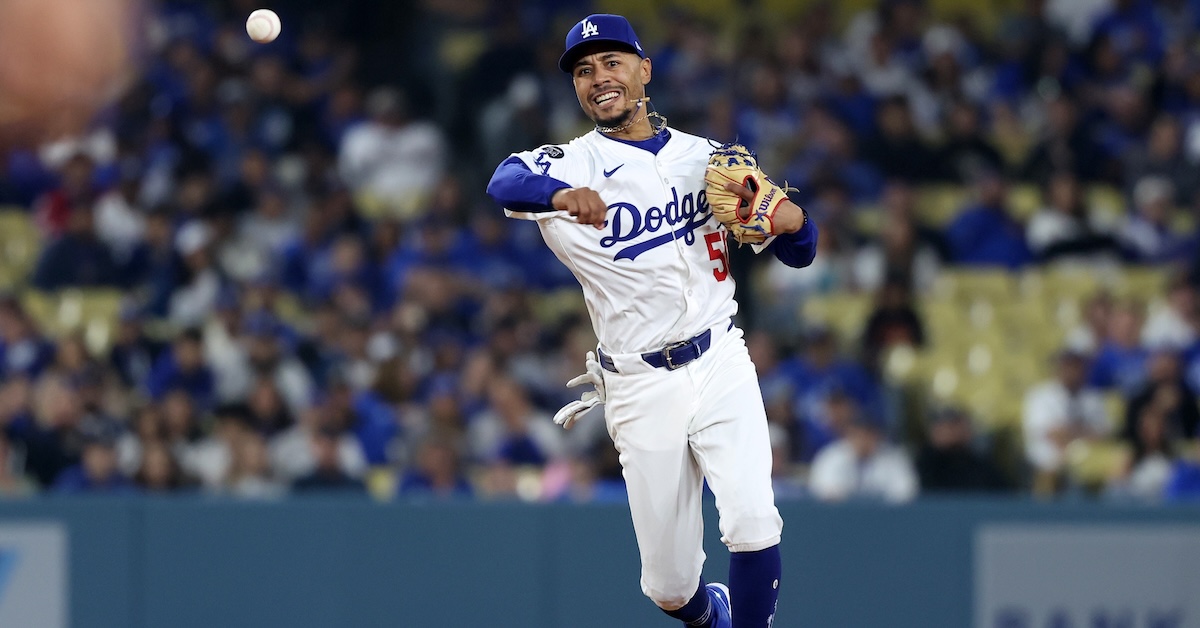
Though he’s only 32 years old and in his 12th major league season, Mookie Betts has already done enough to secure a spot in the Hall of Fame. He’s made eight All-Star teams, won six Gold Gloves as a right fielder, taken home an MVP award while finishing second three times, and helped his teams to three championships. (He’s the only active position player with three rings) He already ranks eighth among right fielders in JAWS, and is fourth in seven-year peak score, behind only Babe Ruth, Stan Musial, and Henry Aaron. Like all the great ones, he’s hardly content to rest on his laurels. Not only is he in the midst of his third straight season making substantial contributions to the Dodgers’ middle infield, but he’s emerged as a star-caliber shortstop in a mid-career move that lacks a modern parallel.
“For me he’s a grade and a half better at that position than he was last year,” said Dodgers manager Dave Roberts over Memorial Day Weekend, during the team’s trip to Citi Field. “He looks like a major league shortstop now, where last year there were times I didn’t feel that way. But I think he’s a guy that loves a challenge and he’s really realized that challenge and keeps getting better each night.”
Asked to elaborate on what has changed for Betts, Roberts said, “Repetitions, confidence, he’s had a lot of different plays that he’s been able to see in games — but I think [the biggest difference] is confidence. He’s just a better defender right now.”
For Roberts, Betts’ first step is where he really shines. “I think his ability to get off on the ball is as good as anybody in baseball,” the manager said late last month.
Betts isn’t a complete newcomer to shortstop. He starred at the position at Overton High School in Nashville and was drafted as a shortstop by the Red Sox in 2011. Professionally, however, his résumé at the position was a thin one until recently. He played six innings at short during his professional debut in the Gulf Coast League in 2011, another 13 games there (as well as 58 at second base) at Low-A Lowell the next season, and made a two-inning cameo in the Arizona Fall League in 2013. But he wasn’t long for the middle infield. He played 46 games at the keystone in the minors in 2014, then 14 for the Red Sox that year after Dustin Pedroia suffered a season-ending injury. While starring for Boston and Los Angeles in right field, Betts added just 15 more appearances at second base from 2015 to ’22, some of them only for a few innings.
Fast-forward to February 2023. After Trea Turner departed the Dodgers via free agency, the team planned for Gavin Lux to take over the position, but Lux tore his right ACL during a February 28 spring training contest. Betts suddenly reentered the middle-infield picture. He dabbled at second base while prospect Miguel Vargas tried to get a foothold, and by the end of April had not only made six starts there, but also four at shortstop when a hamstring strain sidelined Miguel Rojas, Lux’s replacement. By the All-Star break, Betts had started 54 games in right field, 19 at second, and 12 at short, providing impressive defense considering how long it had been since he’d played on the dirt. Vargas’ offensive struggles led the Dodgers to demote him to Triple-A Oklahoma City after the first half of the season. Roberts briefly tried deadline acquisition Amed Rosario at both middle infield spots, but settled on generally using Betts as part of a multi-position platoon. Against lefties, Betts started in right field with Rosario at second, while against righties Betts started at second with the resurgent Jason Heyward in right; Rojas handled short against both. Betts finished with 77 starts in right and 62 at second, plus the 12 at short, a versatility that enhanced his MVP case, though he lost to Ronald Acuña Jr. in the year of his unprecedented combination of 41 homers and 73 steals.
During the 2023 Winter Meetings, Roberts revealed the Dodgers planned to keep Betts as their everyday second baseman in ’24, with Lux at shortstop and Rojas as a backup, but when Lux struggled with his throws early in spring training, the two switched positions. Betts looked like a natural at times, showing off good range, but he was clearly stretched, particularly when it came to his throws. After he landed on the injured list in mid-June due to a fractured left hand, the Dodgers went forward with Rojas and deadline acquisition Tommy Edman at shortstop, returning Betts to right field once his hand healed.
The Dodgers did nothing less than win their second World Series with Betts as their right fielder, but Betts couldn’t let the situation rest. Even when he’d agreed to move back to right field last summer, he told Chris Woodward (at that point a special assistant and roving infield instructor, now a coach) with regards to his attempt to play shortstop. “For now it’s over, but we’re going to win the World Series, and then I’m coming back.”
Betts spent the winter working to improve at shortstop, a luxury he did not have during the winter of 2023–24. From ESPN’s Alden González:
From November to February, Betts visited high school and collegiate infields throughout the L.A. area on an almost daily basis in an effort to solidify the details of a transition he did not have time to truly prepare for last season.
Pedro Montero, one of the Dodgers’ video coordinators, placed an iPad onto a tripod and aimed its camera in Betts’ direction while he repeatedly pelted baseballs into the ground with a fungo bat, then sent Woodward the clips to review from his home in Arizona. The three spoke almost daily.
Betts additionally communicated with and worked out with Rojas, who instilled the need to use different arm slots — plural — from what Betts was used to in right field. “He’s understanding now that you need a slot to throw the ball to first base, you need a slot to throw the ball to second base, you need a slot to throw the ball home and from the side,” Rojas told The Athletic’s Fabian Ardaya in March.
Betts’ season began inauspiciously. Shortly before the Dodgers departed for their season-opening Tokyo Series in Japan, he contracted a mystery illness that not only sidelined him for those two games against the Cubs, but prevented him from eating full meals and caused him to lose 23 pounds, no small matter for a 175-pound athlete. His offense has suffered, with a drop in wRC+ from 141 last year to 110 this year, but he’s shown notable improvement in the field.
Betts has started 68 of the Dodgers’ 76 games at shortstop, playing 583 innings there (52 2/3 more than last year) without logging a single inning at another position. While that still constitutes a modest sample, multiple metrics paint a compelling picture that illustrates his improvement. First, some old-school statistics:
| Season | Inn | PO | A | E | E_field | E_throw | DP | Fld% | RF/9 | lgRF9 |
|---|---|---|---|---|---|---|---|---|---|---|
| 2023 | 98.0 | 16 | 27 | 3 | 1 | 2 | 4 | .935 | 3.95 | 3.85 |
| 2024 | 531.1 | 86 | 150 | 9 | 1 | 8 | 30 | .963 | 4.00 | 3.82 |
| 2025 | 583.0 | 78 | 159 | 3 | 1 | 2 | 29 | .988 | 3.66 | 3.76 |
Once upon a time, all we had to go on for defensive numbers were putouts, assists, errors, and fielding percentage. Those figures are much less useful now, but it’s worth noting the distinction between errors made while fielding the ball (E_field) and those made while throwing (E_throw). Betts has been consistently sure-handed, but after making eight throwing errors last year, he’s cut that down to two thus far, in slightly more playing time. On the other hand, he’s making fewer plays (putouts plus assists) per game, both relative to his own work last year (RF/9, for range factor per nine innings) and to the league (lgRF/9). He’s swung from besting the league average by 0.18 plays per nine to falling short by 0.1 plays per nine.
What’s missing from that comparison is opportunity. According to Baseball Reference, the share of right-handed batters the Dodgers have faced with Betts at shortstop — which is to say batters more inclined to pull the ball to the left side of the infield — has dropped from 59% in 2024 to 54% this year, while the league average has dropped from 59% to 56%. Meanwhile, the share of batters producing groundballs against Dodgers pitchers with Betts at shortstop has dropped from 29% to 27%, while the league average has remained at 29% in both years. Even without a formula to make an exact adjustment for Betts’ comparatively limited opportunities, the difference probably comes out in the wash.
Tuning to advanced stats, while the Defensive Runs Saved values we publish at FanGraphs match those at Baseball Reference and Fielding Bible, those sites offer more detailed breakdowns that are useful when peeking under the hood. For one thing, Fielding Bible offers directional breakdowns à la Statcast’s Outs Above Average system (which I’ll get to next). For another, the system separately accounts for a defender’s runs value in three categories: Air (pretty negligible for infielders, with all but a few within one run of average), Range, and Throwing, as part of what Sports Info Solutions calls the PART system with Positioning (the P in PART) credited to the team and not the individual player. Note that the run values are presented as whole numbers, just as in Statcast, while the decimals are hidden, which explains why the displayed figures don’t appear to add up:
| Season | GFP | DM | To Right (3B) | Straight on | To Left (1B) | Air | Range | Throwing | Total DRS |
|---|---|---|---|---|---|---|---|---|---|
| 2023 | 1 | 0 | 0 | -2 | 2 | 0 | 0 | -1 | 0 |
| 2024 | 5 | 10 | 0 | 0 | 4 | 0 | 6 | -4 | 3 |
| 2025 | 8 | 5 | 6 | 2 | 1 | 0 | 4 | 4 | 7 |
GFP stands for Good Fielding Plays, which Fielding Bible describes as plays “when a fielder does something to record an out or prevent a base advancement that we wouldn’t typically expect from a fielder at the position.” (There are apparently about 30 types.) Betts has already surpassed last year’s total of those while cutting down on Defensive Misplays (DM), any play of roughly 60 types “where the fielder screws up but isn’t actually charged with an error,” resulting in either a batter reaching base or advancing an extra base, such as a bobbled ball on a double play opportunity or a ball hit right past an infielder. According to Sports Info Solutions’ Mark Simon, on grounders Betts has reduced his combined total of DM and errors from six last year to two this year, while on throws he’s cut his DM plus errors from nine to three.
Going by the DRS directional components — which account for both range and throwing — Betts has improved greatly on plays made to his right (toward third base) and straight ahead relative to last year, but hasn’t been as good on plays to his left (toward first base). On throwing alone, he’s improved by eight runs from year to year, which jibes with his reduced number of throwing errors. Adding up all the air, range, and throwing categories, Betts has improved from 3 DRS (tied for 18th in the majors, trailing many players with hundreds more innings) to 7 DRS (tied with Nick Allen and Zach Neto for third in the majors, behind only Taylor Walls and Jeremy Peña).
Finally, Statcast provides another rich trove of data.
| Year | FRV | OAA | In | Lat 3B | Lat 1B | Back | RHB | LHB | Att | Success | Est Success | Success Added |
|---|---|---|---|---|---|---|---|---|---|---|---|---|
| 2023 | -2 | -2 | -3 | 0 | 0 | 0 | -2 | 0 | 46 | 74% | 78% | -4% |
| 2024 | -3 | -4 | -2 | 2 | -5 | 0 | -4 | 0 | 217 | 76% | 78% | -2% |
| 2025 | 4 | 5 | 4 | 3 | -2 | 0 | 2 | 3 | 224 | 79% | 76% | 2% |
The OAA (Outs Above Average) figures are broken into directional components: in, back, lateral toward third base and lateral toward first base. According to Statcast, Betts’ strength last year was his ability to make plays in the shortstop-third base hole. He’s surpassed last year’s OAA in that direction while also posting net improvements of three outs on plays to his left, and six outs on balls in front of him. Those directional measures clash with the DRS ones, but it’s fair to wonder if the discrepancies owe anything to what’s captured by that system’s Positioning component. Based upon Statcast’s estimates, Betts is converting about 2% more plays into outs than the average major league shortstop, compared to 2% fewer than average last year.
Statcast doesn’t break out run values for infielder throwing as it does for outfielders, but it does measure arm strength in the form of average velocity on the top 5% of a player’s throws. By that measure, Betts’ average top-5% throw has improved from 78.3 mph to 81.8 mph. That extra mustard still places him just 24th out of 36 qualifying shortstops, 3.7 mph below the major league average (Gabriel Arias and Elly De La Cruz rank first and second, with 91.9 mph and 91.7 mph, respectively). Looking back, Betts was 59th out of 60 last year, 8.6 mph below average. Progress!
Boiling it down, across similar sample sizes Betts has improved by four runs according to DRS and by seven runs according to FRV. Not only is he tied for third in the majors in the former, he’s tied for fourth in the latter, which would be impressive even if he were a seasoned veteran. Here’s how he stacks up alongside the active Gold Glove winners still playing shortstop:
| Player | Team | Age | GG | Inn | DRS | FRV |
|---|---|---|---|---|---|---|
| Bobby Witt Jr. | KCR | 25 | 2024 | 647.2 | 4 | 12 |
| Mookie Betts | LAD | 32 | — | 583.0 | 7 | 4 |
| Jeremy Peña | HOU | 27 | 2022 | 641.2 | 7 | 4 |
| Carlos Correa | MIN | 30 | 2021 | 503.0 | -1 | 3 |
| Francisco Lindor | NYM | 31 | 2016, 2019 | 627.0 | -2 | 2 |
| Dansby Swanson | CHC | 31 | 2022, 2023 | 654.2 | 6 | 1 |
| Ezequiel Tovar | COL | 23 | 2024 | 271.1 | 1 | 1 |
| Anthony Volpe | NYY | 24 | 2023 | 627.2 | 2 | -1 |
| Javier Báez | DET | 32 | 2020 | 124.1 | 0 | -1 |
This isn’t to suggest Betts is worthy of a Gold Glove, but he’s not out of place with these admittedly noisy partial-season metrics — and that’s as the oldest member of the group! Which brings us back to the uniqueness of this feat. In April, Zach Crizer searched for precedents to what Betts is attempting:
Only 11 players on record have become primary shortstops for the first time in their fifth major-league season or after. And Betts is only the second to make that jump from the outfield. The first was Howie Shanks of the 1917 Washington Senators (aka Grifs). Shanks was less productive in his 14-season career than Betts was in 2023.
A closer parallel, in terms of prominence, might be Gil McDougald. A sterling infielder on the star-studded 1950s New York Yankees, he won AL Rookie of the Year, made an All-Star team and twice received MVP votes playing a mix of second and third base before he was asked to try shortstop to succeed Phil Rizzuto.
… He spent two seasons as the primary shortstop, earning top-10 MVP finishes both years, before pivoting back to second base. More recently, the Baltimore Orioles and Dodgers gave superlative third base defender Manny Machado a season of run at shortstop as he approached free agency. It turned out to be a one-year experiment.
Machado, another player likely to wind up in Cooperstown, played shortstop almost exclusively in the Orioles’ chain, but upon reaching Baltimore, he was bumped to third base by three-time Gold Glove winner J.J. Hardy. He won Gold Gloves at the hot corner in 2013 and ’15, and played short when Hardy was injured in ’15 and ’16. Over a combined 433 innings at shortstop in those two seasons, he netted 3 DRS, and had 2 FRV in 380 innings in 2016, the first season for which that metric is available. The Orioles gave him a longer run at short in 2018 following Hardy’s retirement; in a total of 147 games and 1,261 innings with Orioles and Dodgers (after a deadline blockbuster), he managed 2 FRV but -10 DRS. Filling in for the injured rookie Fernando Tatis Jr. in 2019, both players’ first season with the Padres, Machado again scuffled (-1 FRV and -4 DRS in 299 innings). He hasn’t played shortstop since.
ESPN’s González offered another parallel in the outfield-to-shortstop sweepstakes:
Only 21 players since 1900 have registered 100 career games in right field and 100 career games at shortstop, according to ESPN Research. It’s a list compiled mostly of lifelong utility men. The only one among them who came close to following Betts’ path might have been Tony Womack, an every-day right fielder in his age-29 season and an every-day shortstop in the three years that followed. But Womack had logged plenty of professional shortstop experience before then.
The light-hitting Womack, who debuted in 1993, played shortstop for the Diamondbacks from 2000–02, the last three years before DRS became available. By the less sophisticated Total Zone, he netted out as average across 410 games at shortstop, but so weak was his bat (71 wRC+) that he totaled just 2.1 bWAR and 1.7 fWAR for those three seasons, with highs of 1.4 bWAR and 1.0 fWAR for the 2001 World Series winners.
Even if we only consider players who logged 100 games at both shortstop and in the outfield in their careers, regardless of sequence, Betts is in rarefied air:
100 Games at Shortstop and in Outfield
| Player | Yrs | G | WAR |
|---|---|---|---|
| Honus Wagner* | 1897–1917 | 2794 | 131.0 |
| George Davis* | 1890–1909 | 2372 | 84.9 |
| Robin Yount* | 1974–1993 | 2856 | 77.4 |
| Mookie Betts | 2014–2025 | 1450 | 73.0 |
| Tony Phillips | 1982–1999 | 2161 | 50.9 |
| Ben Zobrist | 2006–2019 | 1651 | 44.7 |
| Freddy Parent | 1899–1911 | 1327 | 35.9 |
| John Ward* | 1878–1894 | 1827 | 34.3 |
| Ketel Marte | 2015–2025 | 1151 | 33.2 |
| Monte Irvin* | 1938–1956 | 1044 | 32.1 |
Wagner and Davis debuted in the 19th Century and starred at shortstop but moved around the diamond a fair bit. Wagner, one of the original five Hall of Fame inductees, played more outfield and third base than shortstop early in his career; he didn’t play more than 61 games at short in a season until 1903, his age-29 campaign. Davis broke in as an outfielder with the Cleveland Spiders (!) at age 19 in 1890 and played mostly third base from 1892-96 before becoming a regular shortstop for the Giants in ’97, beginning an 11-year run at the position. Yount moved from shortstop to center field (with a brief detour to left) in his age-29 season and at age 33 became just the third player to win an MVP award at multiple positions, after Hank Greenberg and Musial, both of whom did so as outfielders and first basemen. Ward was a 19th Century pitcher who played the outfield when he wasn’t on the mound, then after an arm injury moved to shortstop in 1885, at age 25. Irvin was a Negro Leagues star who only played a plurality of games at shortstop in 1941 (at age 22), ’46, and ’47 before becoming an early integration pioneer with the Giants. Phillips was the proto-Zobrist, able to handle any one of several positions on a given day or season. Marte mainly played shortstop in his first three seasons in the majors (2015–17) with the Mariners and Diamondbacks. He’s since made two All-Star teams, one as a center fielder (2019, age 25) and one as a second baseman (2024, age 30).
Those are some great players, but at best they’re distant parallels or imperfect analogues to Betts. By his own account and those of Roberts, Woodward and others, he’s far from a finished product, but he’s doing something we’ve never quite seen, and it’s a sight to behold.
Brooklyn-based Jay Jaffe is a senior writer for FanGraphs, the author of The Cooperstown Casebook (Thomas Dunne Books, 2017) and the creator of the JAWS (Jaffe WAR Score) metric for Hall of Fame analysis. He founded the Futility Infielder website (2001), was a columnist for Baseball Prospectus (2005-2012) and a contributing writer for Sports Illustrated (2012-2018). He has been a recurring guest on MLB Network and a member of the BBWAA since 2011, and a Hall of Fame voter since 2021. Follow him on BlueSky @jayjaffe.bsky.social.
Why can’t we get players like this?
Because only one of them exists
I’d guess there’s one more, and he also plays for the Dodgers.
As a Red Sox fan, this whole week has been a bummer here!!! Devers, Mookie, and the growing stories about how the vaunted front office is filling up with weirdos (the worst part).
What’s interesting is that Breslow did a great job with the Cubs.
It’s all so weird, and it’s too stressful to read into it! Maybe he’s not good at managing people (every GM says it’s a people job at the highest levels of baseball ops) or maybe someone above him has Big Ideas that he has to implement, or idk. Thinking about it too much makes me doomy gloomy because they’ve been a great, respected FO for a while. Maybe they still are?
What’s even weirder is that Theo is so good with the media. I’m don’t remember if their time overlapped with the Cubs, but Theo is back in Boston now. Even Hoyer is pretty good with the players even if he’s not as smooth with the media. I can understand the first time with Dever’s when they signed Bregman, but I’m shocked that Theo did t pull him aside after that and help him through the 1B thing.
He didn’t overlap with Theo in Chicago…and his job there was too many steps removed from his role in Boston to be in line for any mentorship/training on the basics of leading a team of human beings.
But, y’know, no one qualified would take Kennedy’s calls.
So here we are.
As an assistant to their #2.
It’s interesting that Michael Scott did a great job with sales.
I look forward to him becoming an everyday catcher at age 40.
At 48 he develops a knuckleball and finishes ninth in the Cy Young voting.
Great deep dive into this fascinating development. His move leaves me wonder whether he’s just some absolute athletic freaks or if the baseball world has underestimated how well really athletic players can adjust to new positions.
I’ve said this before, but he seems to have a fantastic sense of where he is at all times – he’s an 80 on the kinesthetic scale, while I am a 20 as I walk into things so often.
So while he doesn’t have good raw power, etc, at his peak he’s had ISOs over .250 – well above average for major league hitters. But he’s great a bowling, can dunk a basketball while being listed as 5′ 10″ (I don’t know how impressive that is, but as a non-Basketball playing Brit that seems impressive).
I’m not surprised that he’s able to play as a Major League shortstop after an off season to prepare. I am surprised he’s able to do it after losing so much weight at the start of the season, and now having a broken toe after going to the bathroom at night (though that is absolutely relatable).
I’m sorry, we have to drop him at least to a 79 for breaking his toe going to the bathroom.
I think this is a great way of putting it, and it’s the sort of thing that’s very hard to measure
I just want to add that “great” undersells Mookie’s bowling ability.
He’s professional caliber.
I have a theory that Mookie Betts is just a superhumanly competent person (the 300 bowling games, etc). Like, say I was a carpenter and spent decades making cabinets, perfecting my craft. I bet Mookie could walk up to me one day one day and ask “Hey bud, what’re you doing?” and in about 15 minutes make a better cabinet than I could ever make in my life.
I don’t have a better theory. He’s so disgustingly good at things that when he fucks up, you’re kind of taken aback by it, it feels slightly scandalous.
He is an absolute athletic freak. Apparently any sport he’s ever taken an interest in, he’s mastered pretty much immediately. He’s a world class bowler. He could have been drafted by the NBA.
Steve Kerr likes to talk about “ball and stick athleticism.”
He’s talking about Mookie Betts.
I believe Monte Irvin is also the player with the most fWAR of any player whose last name begins with I. Even if you restrict him to his AL/NL stats, he edges out Raul Ibanez.
Kudos to Betts for putting in the work to improve defensively, but the substantial reduction in power still makes this a net loss for the Dodgers. His wRC+, ISO, exit velocity, HR/FB%, and hard hit% are all telling the same story: he isn’t a special hitter anymore.
Probably too soon to tell whether that is permanent or whether those metrics, like his weight, just went down with the sickness.
Given that those numbers started declining last year, no, it isn’t too soon. Playing shortstop has negatively affected his performance at the plate.
Betts in 2024 as a SS: 157 wRC+
Betts in 2024 as a RF: 127 wRC+
Betts in 2024 as a 2B: 112 wRC+
(He did though start off 2024 insanely hot – and was then a bit above average the rest of the season)
Betts started the season at SS, got hit by a pitch and broke his hand, and when he came back mostly didn’t play SS and played the other two, which is a much simpler and more logical explanation for why he hit worse when he played the other positions.
Yeah – though if I remember correctly he wasn’t great in May, while playing SS, then got the broken hand by a HBP and then came back and was very good by 90% of baseball player’s standards – just not by his typical play.
But the idea that his bat isn’t as good in 2024-25 BECAUSE he was trying to play shortstop is just silly.
IDK, if he hadn’t been super sick before the season I would think there was something to it. But I think it’s probably that.
You have exactly nothing to support this other than a correlation.
Yeah, even if the change is permanent, it’s much more likely to be due to his age than his position. And I do think getting sick and losing weight at the beginning of the season can throw a player off for a while even after he puts the weight back on (see David Bednar last year, perhaps).
Catcher and shortstop are the most physically demanding positions.
Is shortstop really that much more demanding than second?
Just using a little common sense here, while it is absolutely demanding in that it requires great skill, in terms of how tiring/draining it is we are not usually looking at a huge quantity of super strenuous movements
Certain harder but yeah in terms of taxing the difference seems negligible. It’s hard for me to see fielding as likely to be very draining, period. The most taxing inning a fielder could have seems like an outfielder having to run several short all-out sprints.
I keep seeing this take and it’s hogwash. He played SS last year, remember? When doing so, he mashed. His hitting is not due to the positional change. It’s probably a combination of him just getting older, his massive weight loss to start the season, and perhaps some randomness. If anything, this move to SS has saved the Dodgers from having his average bat at a corner outfield spot (where they already have 3 players with above average offensive output), and instead have it where he’s a massive upgrade over their backup (Rojas).
Actually, Miguel Rojas was better last year than Betts this year
He had a 2.8fWAR with a 111wRC+ in 337PA last year while primarily playing SS. Baseball is just going to baseball (Rojas is slightly below replacement level this season with a 64wRC+)
Yeah, I did mean this year where Rojas is not only anemic with the bat, but now doesn’t even have the defense to buoy his value. Statcast has him in the 45th percentile in fielding, which is contributing to his -0.1 fWAR this year. Mookie has given the Dodgers 2.1 fWAR at short. Big upgrade.
I was trying to do a “lol, baseball is random” comment. And now Rojas just hit a home run! And Riley Adams, of the -19wRC+ (though it now all the way up to 7) hit a home run off a first ballot hall of famer.
It probably doesn’t happen often because anyone who can play a good shortstop at 32 could likely play an excellent shortstop at a much earlier age, and, would be playing shortstop at that age. While this is an incredibly testament to Betts otherworldly athletic abilities, it also raises the question of why he wasn’t already a shortstop?
I think the only reasonable thing to do here is to continue to pile on the Red Sox.
I think it works out something like this:
Mookie *was* a shortstop when he was drafted. The Red Sox drafted him as a 2b because they didn’t think he would have the range to play SS in the majors. Then, as a 2b, he was blocked by Pedroia, so they tried him in the outfield where he was a Gold-Glove caliber defender.
They never revisited their ‘range for SS’ assessment, and for that matter, it may still be true: the Dodgers have consistently allowed below-average rates of hits on balls in play despite running out a lot of people regarded as iffy defenders for their positions (Muncy, Lux, Justin Turner, Corey Seager for that matter). They are really good at what I think of as micro-shifting – the little per-pitch/per batter adjustments of a few steps here and there that help mitigate that sort of thing.
I think Betts is also a testament, in part, to this, as well as his incredible work ethic and learning capacity.
I thought his arm was also a concern when they moved him to 2B. Of course, he improved that too, like he improved every single thing about himself.
Bogaerts took over shortstop for the RedSox the year Betts came up.
They probably looked at his range and his arm (seriously, go watch a YouTube highlights compilation of him throwing dudes out) and said “this might solve our CF problem”.
Eagerly awaiting the trombone comment.
I wasn’t going to comment at all unless someone mentioned it.
So far my prediction that he couldn’t make it at shortstop looks pretty bad, but let’s see whether he is still in positive OAA territory at the end of the year. He probably will be; he’s banked a lot of good defense so far, but I have a sneaking suspicion he’s going to wear down.
Another good use case for a rolling OAA graph.
Even if he falls below average, it’s not replacement level. A slightly below average SS isn’t what pitchers dream about, but it’s ok
That Zach Crizer article mentioned in passing that the Dodgers were rostering 4 of the 91 guys who have ever played 100 games at both OF and SS. Could only come up with Betts and Edman. Forgot about Hernandez and then realized the article was written in April before they released Chris Taylor.
They have also employed a couple of the others in the not too distant past – notably Trea Turner.
Completely forgot that Trea Turner was once an outfielder.
Same here. Actually, looking it up, he was moved to the OF in deference to Danny Espinosa and his .294 wOBA being the entrenched veteran SS. However, Turner did not get in 100 games in the OF so he’s not on the list of 91.
I’ve always wondered how seriously the Yankees were considering moving Jeter to CF when they got A-Rod.
Oneil Cruz will hit that mark with 14 more outfield games and he was originally a Dodgers signee, though he didn’t stay with them for long.
Fun thing: The 2024 “Oops! all shortstops” Padres had three players who have played 100 major league games at both OF and SS: Fernando Tatis, Jr., Jurickson Profar… and Tyler Wade.
It’s so sad that the Angels don’t have Wade anymore. I miss Taylor Ward and Tyler Wade being on the same team. . .
While not a modern baseball parallel, Bety’s accomplishment here partly reminds me of the year LeBron switched to point guard for the Lakers only to lead the league in assists and help the team to its most recent championship.
I kind of think that one isn’t even a good parallel because LeBron has always been a ball-dominant player who ran his teams’ offenses a lot. Remember when he was young and his top player comp was Magic Johnson?
It was completely unsurprising that switching LeBron from bringing the ball up the floor 40% of the time to like 80% was effective; the only reason it didn’t happen earlier in his career was fatigue. He has effectively been a point forward most of the time. Listing him on the lineup sheet as a PG is just a clerical concern, not a practical one.
Yeah, positions in basketball just generally mean a lot less
More to the point of LeBron’s versatility though, there’s a story I love from when he first joined the Heat.
As NBA coaches often do, Miami coach Erik Spoelstra was looking through a rival team’s playbook looking for actions he could add to his own offense, in this case the famous Seven Seconds or Less Phoenix Suns team. He saw a play that looked particularly juicy and envisioned LeBron in the Shawn Marion role as a rangy, versatile wing. Then he thought about it a little more and realized he could also put LeBron in the Amare’ Stoudemire role as a powerful, hyper-athletic big man. Then he realized he could also put LeBron in the Steve Nash role as a genius passer, ball-handler, and decision maker. That’s three different all-stars at three different positions in what was to that point the most potent, revolutionary offense in basketball. At that point it dawned on him what a ridiculous basketball player he’d just received.
Bety?
It was an obvious typo… he/she meant Betts.
Credit to Mookie for figuring out you get 2 WAR for free to stand at shortstop. Not that he needs it to help his HOF case but if you ever needed more proof that half the guys playing 3B, 2B and apparently now corner OF could play the position if so asked
There’s insane takes, then there’s this: “if Mookie Betts can do it, anyone can”
Shortstop is incredibly easy; tell ’em, Mookie
The thing is, last year he wasn’t going to get 2 free WAR by standing at SS – because he really wasn’t very good at it.
This year, he has improved dramatically – by working very hard to be a playable Major League SS. So it doesn’t really seem like “free” WAR – he’s earnt it.
This is some pro-level haterade.
sounds like a padres fan take
Sounds like AI BS
The SS gold glove table is a little off, Lindor’s second gold glove was in 2019, the 2020 winner in the AL was JP Crawford. Which just reinforces the overall conclusion of how unique it is what Betts is doing, since Crawford would be at the bottom of the table by either defensive metric.
I had no idea Phillips had such a high WAR.
Phillips was the comp guy I thought of. Glad Jay included him. Super utility good hitters are incredible. Maybe the only underrated thing about Pete Rose.
And for some reason dodger fans are convinced him playing short is why he isn’t hitting as well. Not the fact that he lost 20 pounds before the season just that hes aging. It’s infuriating.
And unlike with Wilyer Abreu, Betts couldn’t afford to lose the pounds.