
Five Things I Liked (Or Didn’t Like) This Week, April 18

Welcome to another edition of Five Things I Liked (Or Didn’t Like) This Week. There must have been something in the water across the league over the past seven days, because while this column always highlights delightful oddities that I caught, they aren’t often so delightful or so odd. This week, rarities abounded. There were runners getting hit by throws, wild acrobatics, no-look passes, and even a pitchout. Hot teams and cold teams clashed, errors got compounded, and situations that felt in hand rapidly got away. So keep an eye on the runner at first base, and let’s get started – after my customary thanks to Zach Lowe of The Ringer, who popularized this column format for basketball.
1. Not-Quite-Free Bases
Jarren Duran is off to a slow start to the 2025 season. And while the problems have mostly come at the plate, everything seems a little off. Take this misadventure on the basepaths last Thursday. Duran led off the bottom of the 10th inning with a game-tying single. That made him the winning run, and he immediately started plotting a theft of second base to get into scoring position. Nick Sandlin checked on him:
Then he checked on him again:
That’s two disengagements; Sandlin wasn’t likely to try again. Duran stole 34 bases last year. He’s blazing fast. He was 5-for-5 on the season and had already swiped one in this game. Second base was as good as his. And so the Blue Jays took extreme measures, calling for one of the least-used plays in modern baseball, a pitchout:
OK, now this was getting comical. Two throws over and a pitchout before even throwing Rafael Devers a competitive pitch? The Jays couldn’t afford to pay any more attention to Duran. And you know the classic wisdom – after they try a pitchout, you can steal. So of course, Duran got on his horse on the next pitch. This is as good of a situation as you can imagine for a steal. No disengagements left, righty on the mound, key run in a tie game, elite base stealer on first. Just one problem:
Yeah, “basically uncontested” isn’t quite the same as “uncontested.” Sure, the Jays were limited in what they could do, but it’s not as though they were just going to concede the base. The lack of available disengagements meant that Duran got a huge jump, but Tyler Heineman is still allowed to throw down, and that was a beauty. It wasn’t so much the velocity on the throw – Statcast has Heineman as a solid but not excellent arm, and that throw was right around his average velo. But what a beautiful transfer:
You can see the technique at work here. When Heineman saw Duran on the move, he started rising from his crouch. He caught the ball with both feet already moving to a throwing position, which let him transfer and fire in one motion. And while his throw was to the right of the base, all that did was move Bo Bichette into perfect position to apply a tag:
As far as I’m concerned, Duran did nothing wrong here. But when you’re in a slump, things like this always seem to happen. The other team has perfect execution at the moment where you needed anything less than 100%. The situation that almost always works out in your favor runs into the “almost.” Duran will figure things out – but right now, luck is not on his side.
2. Dodgeball Moves
You’ve seen a play like this a thousand times. A batter – Jorge Polanco, in this case – hits a weak tapper toward first, then gets tagged out:
Of course, I didn’t put the tag in that clip, and that’s because things were about to get a little bit wild. Polanco didn’t want to make an out there, and he quickly noticed a few things. One, Jake Burger was in fair territory rather than straddling the basepath. Two, Burger was a little distracted, checking the runner at second as he closed on Polanco. Three, there’s no penalty for trying and failing. And so he hit the spin button:
This really shouldn’t work. Fielders make that play all the time. But the combination of a tiny bit of distraction, a perfectly coordinated spin, and more than a little luck made it work. Burger never quite appreciated the importance of securing the tag, so he looked back over to second at an inopportune time, and bam:
So many things had to go right for Polanco to be safe there. Burger had to try to make the tag outside his body rather than keeping his torso between Polanco and first. He had to look away before Polanco started spinning; otherwise, he’d be able to adjust. The spin wasn’t an automatic success anyway. Look again at how close that came to getting him:
The Rangers challenged, and Bruce Bochy grumped to the umpires a bit, but the outcome was never in doubt. Polanco didn’t leave the basepath to avoid a tag; he avoided a tag right on the basepath. You have to tag the man or the base to make an out there, and the Rangers did neither. Just because it looks different from your average play doesn’t mean it’s not legal.
Why don’t we see spin moves more often? Because they wouldn’t work. Start doing it frequently, and first basemen would never fall for it. This is the kind of trick that only works because no one expects it. The next time Polanco tries a spin, he’s probably going to get a glove in the chest and a “c’mon bro” for his efforts. But this one happened, and it led to a run. Two batters later, a bases-loaded hit-by-pitch scored him to give the Mariners a 3-1 edge. Not exactly how Polanco wanted to reach base, I’m sure, but he’ll take what he can get.
3. Giving 110%
Oh, you like spin moves? You want more basketball-style plays in baseball? I’m with you. So how about a through-the-legs pass?
With Tyler Wade running, that would have been a tough play regardless, but Nico Hoerner didn’t have the luxury of a straightforward play. He charged the ball from his initial position, trying for a standard barehanded snag, but with all of his momentum heading toward home plate, he was at an impossible angle for a throw when he reached the ball:
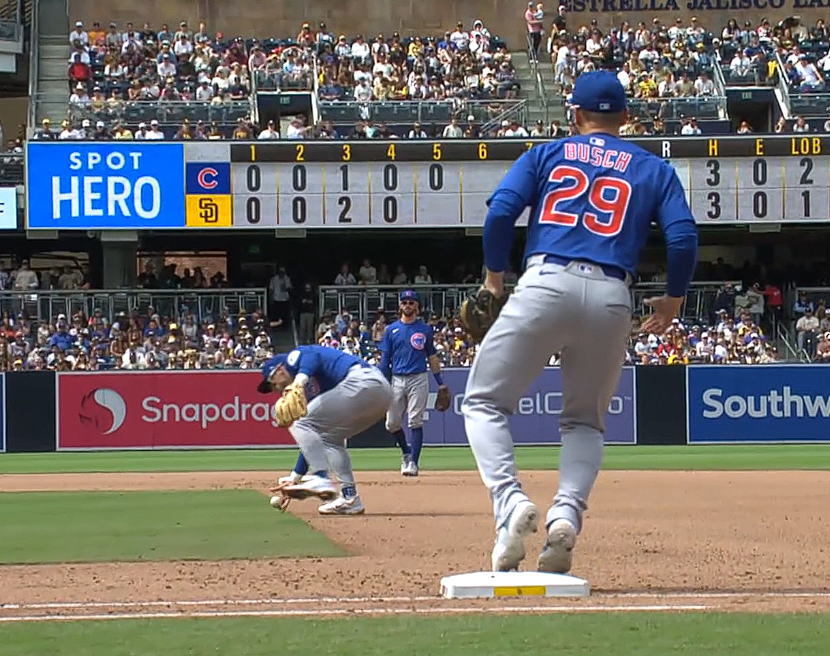
For most fielders, the play would be over right then. Too bad, so sad, can’t make the throw but at least the runner stays on first. But Hoerner could smell an out, and he’s a phenomenal defender, so he improvised:
Too late? Yeah, as it turns out it’s hard to get much force on a through-the-legs throw. Wade was booking it down the line. There’s no way to get your legs into a throw when you’re tossing it through your legs, so Hoerner’s throw was late. But that didn’t make the coordination any less impressive:
If a catcher were running there, this would be one of the defensive plays of the year. Instead, it’s just another line item: “Tyler Wade singles on a ground ball to second baseman Nico Hoerner.” But you have to respect the effort. Hoerner is one of the best second base defenders in the game, and his creativity is second to none.
4. Pitcher Fielding Practice
For whatever reason, my early-season baseball viewing has over-indexed on the Minnesota Twins. They’ve played a few divisional series, and I’ve been keeping an eye on AL Central tilts after last year’s free-for-all. They’ve played the Mets, and I like listening to the Mets booth. And they unveiled a Joe Mauer statue – how was I not going to watch that game? But every time I tune into a Twins game, I see a pitcher sailing a throw:
That’s the first throwing error I remember seeing a Twins pitcher make this year, and it was a howler. I get that Bobby Witt Jr. is fast, but Griffin Jax didn’t need to hurry there. He knew it; he babied the throw to first rather than go all out. He just flat out missed. Witt made it all the way to third on the error, scored on the next play, and provided the decisive run in a 2-1 Royals victory.
After you’ve seen one throwing error, you can’t stop seeing them. Louis Varland pulled a pickoff throw wide (side note, I love his reaction here):
In the next series, chaos reigned. Justin Topa airmailed one of the easiest throws he’ll attempt all year:
The very next inning, Jorge Alcala tried to do too much when faced with an excellent bunt:
That’s six throwing errors charged to Twins pitchers so far this year; no other team has more than three pitcher errors, period. And the sloppiness has even crept over to the actual fielders. Ever seen a second baseman forget that he’s playing baseball and not dodgeball? Now you have:
It’s been a tough start to the season for the Twins. After a late-season collapse in 2024, they’re picking up where they left off, five games below .500 already. To be clear, the season’s far from over. We give the Twins nearly 40% odds of reaching the playoffs, second best in the AL Central. It’s April! There’s plenty of time to turn it around. But it’s been a sloppy, sloppy start to the year in Minneapolis, and the strange pitcher-fielding contagion sweeping the team isn’t helping.
5. Houston’s Strike Zone Box
I have a love/hate relationship with strike zone boxes on TV broadcasts. It makes the game more accessible, no doubt, and it’s a lot easier to follow the cat and mouse game of locations and pitch types when you can see where specifically the ball crosses the plate. But they break immersion and take away from my appreciation of the beauty of a breaking ball in flight. Where’d the ball end up? I stopped looking because my eyes were focused on the white box.
Through the years, broadcasts have tried different methods of making the strike zone less distracting. They’ve made the lines thinner, fainter, or even gently shaded the area of the zone rather than draw lines at all. But I like the Astros broadcast’s efforts to find a happy medium in strike zone boxes, and I hope more teams will emulate this method. Here’s the Angels broadcast from a Josh Hader slider last Sunday:
That was a nice pitch, right on the outside edge, but I lost track of it when the dot came up, intersecting with the strike zone line. That’s just the deal we’ve made with baseball broadcasts – you’ll see where the pitch is, but it’ll be a bit distracting. But look at how Houston’s broadcast showed it:
Removing some of the box completely changes how I perceive the pitch. Now I can still see the edges of the strike zone, but that jarring dot-on-line overlay doesn’t take me out of the action the same way. Less visual clutter means an easier time following the pitch, and there’s still enough strike zone demarcation to understand that the pitch was right around the edge, a close one with tons of left-right movement.
The muted color scheme of the minimalist zone also helps keep me in the game. This sweeper to Mike Trout clipped one of the (drawn on) corners, but with fewer and thinner lines, there’s just less distraction even when the ball intersects with the on-screen graphics. The superimposed box breaks immersion; making it less obvious does wonders for the presentation of the game, at least for me:
I’m sure that everyone’s taste is different. I know fans who love the strike zone box and couldn’t imagine going to a world without one. I’m sympathetic to their arguments, because baseball with no strike zone box is a much tougher sport to follow for casual observers who aren’t deeply in tune with the nuances of the game and the shapes of each pitch. But I hope more broadcasts opt for this less-intrusive box. I come away from every Astros game thinking about it, which is the highest compliment I can think of for their broadcast team. Great work, Space City Home Network.
Ben is a writer at FanGraphs. He can be found on Bluesky @benclemens.
As someone with vision and attention issues, the “corners-only” box would drive me bonkers. It took me multiple attempts to coordinate the ball, the ball location “dot”, the corners, and how they all resolve relative to each other. I imagine it’s somewhat easier to do on a TV screen than through a small GIF, and with time, I’d likely adjust (or learn how to ignore it), but I’d likely rather have no box at all than that.
I’ll make a note to at least check out one of the Astros’ broadcasts to see how it looks on my usual setup.
I had not seen the Astros strike zone box; it seems great (like this article)
The Polanco-Burger play was (1) incredibly exciting and (2) a really poor tag attempt by Burger. But it’s tough to argue that Polanco didn’t move more than three feet to avoid the tag attempt. A reminder to all the basepath is a straight line from where the runner is when the tag attempt starts (as opposed to the running lane for interference which doesn’t ever change). But the Rangers were going to lose anyway and we got an exciting play, so all’s well that ends well.
Aye. Given his feet landed on the foul side grass distinctly outside the chalk base path, it’s bizarre to argue he didn’t exit the bathpath.The rangers were unable to challenge the base path concern, only if he was out at first. Needs to be addressed in the off-season.
It’s not that hard to argue.
As you point out, this is governed by 5.09(b)(1): He runs more than three feet away from his base path to avoid being tagged unless his action is to avoid interference with a fielder fielding a batted ball. A runner’s base path is established when the tag attempt occurs and is a straight line from the runner to the base he is attempting to reach safely.
The tag attempt “occurs” wording is very different from “starts”. When does the tag attempt occur? When does it end? While it sounds overly philosophical/pedantic, it is necessary to adjudicate when the base path is established.
If the tag attempt occurs when Burger’s arm is extended, Polanco is already airborne and has moved about 2 feet, in which case his base path is way different then if it occurs at the moment Burger moves his arm.
Also he did avoid the tag in a single motion, instead of actively running away from the fielder, which does feel like it matters when interpreting the rule.
You all are, of course, correct, but it was a whole lot more fun seeing the runner escape and made a great 1/5th of this fabulous column – my favorite baseball column every week.
I’m glad the safe call stood even if the rules said otherwise. Sometimes baseball is more fun when the call isn’t perfect.
I’d agree with this.
As Polanco was inches away from the tag, he never moved 3 feet from the tag attempt.
Agreed. He’s evading the tag, he’s not running out of the baseline to do so. We all know what that looks like.
My enjoyment of the box is directly contingent on whether I’m getting a view that’s closer to a true angle or one that is heavily offset. The more offset, the more I need the box to follow what’s going on.
My enjoyment of the box is mostly related to whether it agrees with what I just yelled at the tv. If I say that #*(& pitch was outside, you need to back me up, stupid box. What am I even paying you for?
Yeah, a true centerfield angle is the best thing for viewing, undoubtedly. Sadly I feel like that ship has sailed; if more broadcasts were going to use it, they would have switched by now.
Isn’t that dependent on stadium construction? Just watched the Nats in Pittsburgh (ugh). Camera angle was great.
Mets also had a nifty little play yesterday, on 2 out 2nd,3rd Lindor singled and went for 2nd on the throw, once the throw was cut off he waved Tyrone Taylor home from 3rd and then stayed alive in the pickle long enough for the run to count.
Even with Bobby Witt Jr, the Royals have the lowest wRC+ in MLB. Witt has 1.1 WAR, the rest of the hitters have -1.8. Only two players other than Witt are above replacement level.
And that’s with Garcia’s annual post-first-week swoon just getting started.
The last week was seriously entertaining if you were watching the Yanks. There was a first career hit (C. Koss), RBI (J.C. Escarra), win (Will Warren) and save (Fernando Cruz). Aaron Judge spent the week masquerading as the World’s Tallest Singles Hitter until hitting a go ahead dinger. Jasson Dominguez damn near decapitated himself hitting a bases-clearing double and looked like a competent fielder. Maikel Garcia took a glove to the face trying to steal second. Jung Hoo Lee beat the Yankees by himself on Sunday. There was the rain-shortened madness last Friday where Austin Wells doinked one off the top of wall. An ejection, a balk, a catcher’s interference, an outfield assist, a game featuring the two pitchers with the lowest arm angles in baseball, wild pitches. Ben Rice just keeps raking. The Yankees no-hitting the Royals, except for that pesky Bobby Witt Jr.
I know what I liked today!!! I am sitting in front of my TV watching the most incredible, unbelievable inning of baseball that has ever been played. After 6 1/2 the Cubs led the D-Backs 2-1. ho hum, then the Cubs put it away (ha-ha-ha) with 5 in their half of the 7th. Well, it is now in the bottom of the 8th and the Cubs have just scored 6 to retake the lead after the snakes put a 10 spot on the board in the top and the they have the bases loaded again with 1 out. Truly no words can describe it.
And so it ends, just your normal 13-11 game at Wrigley.
I wonder how many times a team has scored 10 runs in an inning and lost the game? I would appreciate some help.
The scroll on the MLB channel didn’t day how often but said the last time a team scored 10 in an inning and lost was the Royals in 2006. From digging through the 2006 box scores, looks like it was Aug 23, 2006. The Royals scored 10 in the bottom of the 1st to take a 10-1 lead but the Indians kept chipping away and tied it at 13 with 4 runs in the 9th capped by a Shin Soo-Choo triple to tie it. The Indians went ahead in the 10th with a couple run scoring singles and shut down the Royals in the bottom of the inning for the W.
Figures that a 100 loss team was the last to do this. . . .
That happened in the Jim Rooker walks home game (on June 8, 1989). Jon Bois in his video said that it had never happened before but I think that refers specifically to jumping out to a 10-0 lead and losing.
(I don’t have time to watch the video again right now, but anyone who reads this comment and hasn’t seen the video should watch it!)
Thought #3 Giving 100% was going to be about walking Juan Soto walking to first on grounders.
The funny thing is hoerner had a awful defensive series with multiple game changing defensive mistakes
Jacob Wilson still hasn’t walked.
Amazingly he is only 6th in swing percentage.
And he’s only struck out 3 times in 82 PA’s!
The Twins pitchers’ errors brought to mind the 2006 world series, when the Tigers pitchers probably deserved series MVP for gifting so many runs to the Cardinals.
I’m still trying to forget that happened
The KBO does it right. No strikezone box by the plate but instead off to the side corner, so you get a clean look and can see where the ball is realtive the zone in a different part of the screen. Makes a huge difference in enjoying the game while still giving you in the info if you need it.
NPB does the same. It’s like the one benefit of Japan being addicted to TV feeds with a bunch of shit all over the screen.