
How Quickly Should You Change Your Mind About Elite Pitching Prospects?
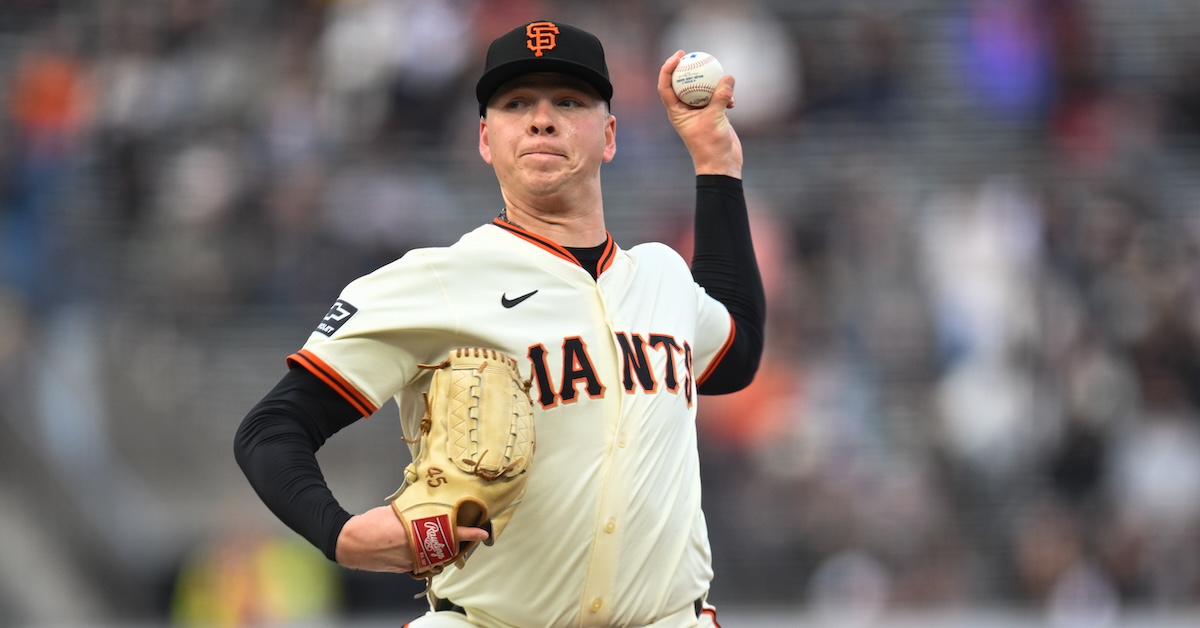
As you might have heard, the Red Sox traded Rafael Devers to the Giants earlier this week. In my breakdown of the deal, I ranked the players headed to Boston in the order of my interest in them: James Tibbs III, Kyle Harrison, Jose Bello, and lastly Jordan Hicks, though that’s contract-related, as I think he’s probably the best current player of the four. The next day, someone in my chat asked me why I preferred Tibbs to Harrison – was I particularly high on Tibbs, or particularly low on Harrison? After all, Harrison was a consensus top 50 prospect only a year ago, while Tibbs took his first Double-A at-bats this week.
My initial answer was that I saw Harrison several times last year, and he didn’t really do it for me. Combine that with his uninspiring results and the fact that other prospects had squeezed him out of the Giants rotation, and I preferred Tibbs. Since neither guy is clearly ready to dominate the major leagues right now, give me the higher-variance unknown quantity.
When I stopped to think about it later, though, I decided that my answer wasn’t good enough. Right now, I’m knee-deep in spreadsheets, linear regressions, non-linear regressions, projections, scouting reports, basically every type of baseball data out there as I do some initial work on our annual Trade Value Series, which will run next month. I have tons of prospect data stored up. I even looked into how prospect grades translate into major league players earlier this year. Rather than try to re-evaluate Harrison based more or less on vibes and ERA, I decided to apply a bit of analytical rigor now that I wasn’t writing for a deadline.
First, I tried to find a cohort of prospects like Harrison. Initially, I wanted to use his Future Value grade – he merited a 55 FV, a mark that our prospect team gives out only sparingly to pitchers, on the 2024 Top 100. But a 55 FV hasn’t always meant the same thing at FanGraphs, as the team frequently mentions. On the 2025 Top 100, there were 32 players with a 55 FV or higher; on the 2017 Top 100, there were 72. I didn’t feel good about using those as a pool of comparables, because, well, they’re not all that comparable. Instead, I settled for a numeric cutoff. I limited my list to pitchers who were in the top half of the Top 100. I considered being even stricter (those in the top 25), but this study is going to be working with a small sample to begin with, so shrinking it even more felt counterproductive.
Next, I needed to define what I was searching for. Here’s how I had it in my head: How a pitcher performs in their rookie year is a huge data point, and how they’ve performed after two years is even more useful to know. If you re-ranked prospects after seeing all of them play against major league competition for a year, you’d do much better when assessing them. To give an extremely lazy example, most outlets (us included) had Dylan Crews and Paul Skenes, LSU teammates who went 1-2 in the draft in 2023, very close to each other coming into 2024. That’s not how it has worked out so far.
I grouped pitchers into three buckets based on rookie year performance. Given the small-ish samples, I thought it would be a nice way to get an overview without trying to imply there’s mathematical rigor that I simply can’t provide here. Next, I set a requirement that the pitcher exhausted rookie eligibility either the year a prospect list came out or the next year. That got rid of strange cases like Forrest Whitley, who ranked highly on several lists in the late 2010s before a long litany of injuries. He debuted in 2024, and I don’t think his performance tells us a lot about Kyle Harrison.
Next, I set a rookie season cutoff of 2022 or earlier. The reason for this is simple: I was trying to look at how valuable pitching prospects are during their team control years, which means that I needed some values for rest-of-season 2025, 2026, and so on. Those have to be projections, of course. A pitcher who exceeded rookie eligibility in 2022 will have three full years of major league stats (unless they got hurt or demoted, itself a bad sign) and another half-year in 2025, more or less. Their projections are going to be heavily based on their actual major league production.
Take MacKenzie Gore, for example. He put up 0.8 WAR in 2022, 1.2 WAR in 2023, and 3.2 WAR in 2024. He has another 2.7 WAR in 2025 so far, and he’s projected for 1.9 more this year. That’s a real track record, one that makes me feel a bit better about using projections for his final two years of team control (2026 and 2027). Compare him to Grayson Rodriguez, who debuted in 2023. He posted 1.8 WAR in 2023, 2.0 WAR in 2024, and hasn’t pitched yet in 2025. I didn’t feel great about calculating “team control WAR” for players like Rodriguez, where more than half of the sum is a projection.
With those constraints – former top 50 prospect, rookie season within a year of the time they were a top 50 prospect, and rookie season before 2023 – I then made one final pass to remove duplicates. Gore and Rodriguez are both good examples – they were top prospects for a while, but I don’t want to double-count anyone. That gave me a sample of 27 pitchers, which isn’t a lot. But the whole point of top pitching prospects is that there aren’t a lot of them, and I’m not trying to prove anything beyond a reasonable doubt here, just come up with a rule of thumb for how to treat early-career performance. Onward!
I decided on WAR as the method of evaluation. I did this not because I think it’s the perfect way to evaluate pitchers, but because it’s less bad than all the other ways I was considering. Volume matters – but only using innings pitched to evaluate success rates would make no sense. Run prevention matters – but it’s both noisy and incomplete. I don’t want to reward someone for throwing 50 unsustainably hot innings and then getting hurt. WAR ties those together. I settled on FIP-based WAR because FIP is already more regressed towards the mean than ERA, and I’m working with tiny samples to begin with, but I’m not strongly tied to that; again, this is just a framework.
With that in mind, I came up with some cutoffs in my head. What’s a good rookie year? Two or more WAR. There were only three pitchers who fit that bill, believe it or not: Logan Gilbert, Walker Buehler, and Michael Soroka. It’s possible that I missed someone because of improperly marking down when they exhausted rookie eligibility, but the point is, most rookie pitchers don’t get a full complement of starts, and this isn’t a list of all rookie pitchers, only top prospects, so you don’t get the surprise Mitchell Parkers and Tobias Myerses of the world (both exceeded 2.0 WAR in their rookie year).
What’s an acceptable rookie year? Between 1.0 and 2.0 WAR. Another eight pitchers fell into that camp. That left 16 top prospect debuts who finished the year with less than 1.0 WAR by our accounting. This group is all over the place. You’ve got players who got hurt, slow starters, and the odd reliever conversion, though since this group is all elite prospects, there are very few of those. You can think of Lucas Giolito (an aggregate -0.3 WAR in a brief 2016 cameo and then his 2017 rookie season) as an example of this group, or Gore. In other words, there are stars — Corbin Burnes started very slow, he’s in there — but there are also plenty of guys who scuffled and then kept scuffling.
I also did a second pass based on the first two years of performance. This feels closer to what I want: less focus on whether the player had his service time manipulated or got squeezed out of playing time in his rookie year, more time for talent to shine through. This time, I set the cutoffs at 3.5 WAR for “good” and 2.0 WAR for “acceptable.” The same three guys – Gilbert, Buehler, and Soroka – were the only ones in the good category, and somehow only five top pitching prospects were “acceptable.” The rest were in the muddled bottom – oft-injured, banished to the ‘pen, riding the minor league shuttle, or simply ineffective. For this cut, the “subsequent WAR” in question is all WAR accrued after those first two years, so it should be slightly lower on average, all else equal.
Here’s how those cohorts shook out over their years of team control (including projections for remaining team control where relevant):
| Performance | Pitchers | Team Control WAR | Pitchers (Y2) | Team Control WAR |
|---|---|---|---|---|
| Great | 3 | 9.63 | 3 | 6.83 |
| Solid | 8 | 4.09 | 5 | 9.40 |
| The Rest | 16 | 4.56 | 19 | 2.49 |
I have to say, this data is noisy. Like, noisier than most baseball data, which is already quite noisy. Gore alone moves the bottom tier by more than 1.0 WAR. Soroka’s injury issues make the top bucket look meaningfully worse. But just because it’s noisy doesn’t mean it’s not true; part of the reason this data is so tough to work with is because baseball teams are in search of outliers. Prospects mostly don’t pan out. Do you see how many dudes we evaluate every year? Most of them don’t turn into star pitchers.
I came up with one additional method because I was quite frustrated with all the noise. Instead of looking at total team control WAR, I looked at peak single-season WAR. That mostly excludes projections, which I like. It also does a better job of controlling for injury – we all know that pitching prospects get injured sometimes, and that early-career playing time isn’t always a guarantee. I set a cutoff for pitchers who posted a peak WAR of 3.5 or higher. To me, that’s someone who at least had a star-ish season. That tracks, at least kind of, with observed results: There were 23 “star” pitchers last season by that definition, 18 in 2023, 29 in 2022, and 30 in 2021.
Here’s a slightly different table, then, looking at “star season percentage,” or the percent of starters who turned in at least one excellent season, based on early-career results:
| Performance | Count | Star Season% | Pitchers (Y2) | Star Season% |
|---|---|---|---|---|
| Great | 3 | 67% | 3 | 67% |
| Solid | 8 | 13% | 5 | 40% |
| The Rest | 16 | 25% | 19 | 16% |
What do these results tell us? One thing they tell us is that dealing with arbitrary endpoints sucks. I initially set the “star” cutoff at 3.0 WAR instead of 3.5 before deciding that was a bit too broad, and by weird random chance, there were zero players in that “bad first season” bucket with WAR between 3.0 and 3.4, so their odds of producing a star didn’t change. Meanwhile, the “acceptable first season” bucket surged, thanks to multiple players in the 3.0-3.4 WAR range.
More importantly, they say this to me: After one season of a top prospect’s major league career, there’s still plenty of noise. The more I messed around with cutoffs and eligibility criteria and the like, the more results I got. I could manipulate the endpoints and cutoffs, all of which seem reasonable on their face, and change the results meaningfully. One thing is clear: Pitchers with true standout first seasons are a cut above the rest. After that, it’s all kind of a muddle.
Two seasons starts to give you a better picture, though. If a pitcher hasn’t gotten things into gear after two years in the majors, they’re probably not going to. Maybe they’re oft-injured. Maybe they’re just not that good. Maybe they are good, but their playing time gets squeezed because of those two seasons of “meh” at the start of their career. I’m not here to tell you why, just that that effect looks fairly real to me.
Hoping for a larger sample, I re-ran the data with relaxed restrictions. I added players whose rookie season was two years after they were on in the top 50; that added exactly one player. That wasn’t enough, so I also added the 2023 debuts; that added an additional five players. The results aren’t particularly different, though. Here’s the rest-of-career WAR table for the larger group:
(Larger Cohort)
| Performance | Pitchers | Team Control WAR | Pitchers (Y2) | Team Control WAR |
|---|---|---|---|---|
| Great | 3 | 9.63 | 5 | 6.90 |
| Good | 12 | 5.25 | 6 | 9.12 |
| Not Good | 18 | 4.74 | 22 | 2.83 |
And the star season rate table for the larger group, as well:
(Larger Cohort)
| Performance | Count | Star Season% | Pitchers (Y2) | Star Season% |
|---|---|---|---|---|
| Great | 3 | 67% | 5 | 40% |
| Good | 12 | 8% | 6 | 33% |
| Not Good | 18 | 22% | 22 | 14% |
I don’t think adding the extra data was worth it. The 2023 debuts just don’t have much major league data, particularly since we’re using 2023 to rank them; those guys have only had one full season since then, which means the vast majority of their “team control WAR” is made up of projections, and they haven’t had a ton of chances to spike a star season. I’m including it just to show you how difficult it is to bulk up the sample; “incredibly highly rated overall prospects who are starting pitchers” just isn’t a big cohort these days.
I also considered trying to account for pitchers whose first few seasons were interrupted by injury. The problem with that is that pitchers get hurt a lot. I’d lose more than half the sample if I excluded guys who have had multiple meaningful IL stints. In the end, I just left them in; we’re talking about pitchers, so you have to account for injury. That’s just how it is.
Where does that leave me vis-à-vis Kyle Harrison? He’s squarely in the lowest tier of performance so far, of course, but he’s only 182 innings into his career. The aggregate data are so mixed after one year that I’m willing to give guys some more time to click without too much consternation. It’s hard to be a superstar if you don’t break out early – a different way to present this data would be that players who exceed 1.0 WAR in their first year have much better careers than players who don’t, but again, that’s just an arbitrary cutoff. Early breakouts are good, but the rest of the group feels fairly undifferentiated even after a year.
After two years, things start to tilt. If you’re looking for a transcendent talent, well, they’ve probably transcended, at least a little bit, after two full years of major league play. More and more things start to stack up against the types of pitchers who debut, kick around for two seasons, and haven’t produced much at the end of that. Maybe they’re so inconsistent that they drift on and off the big league roster. Maybe they’re dealing with injury issues that keep them from handling a full workload. Maybe they’ve ended up in the bullpen thanks to their team’s roster composition. Maybe they just weren’t as good as we thought.
Whatever the reason, those things matter. If you’re in the bullpen after two years, you’re probably not going to turn into an elite starter, and if you do, it’ll probably still take you years to get ramped up to a full starter’s workload. If your team can’t find a spot for you in the rotation after two years, your leash will surely be short in the third year, too. Heck, if your team trusts you, but your results just aren’t there, that’s also a problem. In other words, by two years in, you should care more about major league results than pedigree. I don’t feel confident saying it with any more certainty than that – you’ve seen my reservations with sample size throughout the article – but if you’re looking for a broad rule of thumb, that’s a pretty good one.
For Harrison, that means that I’ll be watching the rest of his season very closely. His brief 2023 debut? Not great. His longer 2024 opportunity? Not much better. His 2025? Squeezed out of the rotation to the bullpen. The writing was on the wall, but now he’s in a new room, with a fresh coat of paint. There’s still time to turn it around, no doubt. Harrison is currently in Triple-A, but he’ll be back in the majors this year. A change of scenery is just what the doctor ordered. But daylight is fading fast – at least, probabilistically speaking. So, 2,500 or so words later, yes, I’d still rank Tibbs ahead of Harrison in terms of difference makers. Maybe I’ll be wrong. Maybe Harrison is the next Corbin Burnes or Lucas Giolito. But I’m an odds guy, as you almost have to be when you think about prospects, and I don’t like his odds.
Ben is a writer at FanGraphs. He can be found on Bluesky @benclemens.
I think the biggest issue with Harrison is his offspeed stuff for whatever reason was misevaluated. His curve isn’t as good as scouting reports suggested. I guess if you want to be optimistic you can look at his increased velo and work off that
Harrison was absolutely misevaluated, not just because of the offspeed but because of the command.
He was labeled as having a 55 command when he graduated. If you just looked at his cup of coffee in 2023, then I guess you could go with that since he walked less than 3 batters per inning. But his walk rate in the minors that same year over a much larger sample was like walking 6.5 batters per inning. Before that he was walking about 4 per inning in the low minors.
I’m guessing what happened was that he had to trade throwing strikes for some of his “stuff”. His writeup says:
That sounds awesome, but he couldn’t actually throw his fastball for strikes. Whatever he is doing in the majors is not that description, because he’s not fooling nearly as many batters as the scouting report predicted while also walking half as many batters.
IOW Harrison was just overrated as a prospect. That’s okay. And he still might turn out okay! The new organization has a decent track record with pitchers, they might find something the Giants missed. Maybe they can get him to throw strikes while also maintaining the deception. Maybe they can find him a better secondary pitch.
6.5 batters per inning?
Probably meant BB/9, but mistyped a few times.
Yeah that was it, I don’t think I woke up yet when i wrote that
That was it! Thanks.
Shame. I’d be most interested in the guy with the bb/9 of almost 60, he sounds lie he could be the title character, Nuke LaWhoops, in Bull Ballspam.
I’m skeptical given that apparently his bio-mechanic spin preferences and slot mean it’s going to be really hard for him to develop any breaking ball that’s any good, and he hasn’t seemed to be able to get a working offspeed pitch, but we’ll see!
The evaluation systems seem to be consistently misevaluating command.
Well, Harrison having good command over his terrible offspeed pitches is still going to hit a wall. Harrison then has to figure out how to proceed. A lot of guys who don’t have a good way to get hitters out end up relying on less precise strategies. It leads to throwing pitches out of the zone for two reasons. One to avoid hits in two strike counts and secondly, it is attempting to get chases out of the zone. However, this increase of out of the zone pitches means hitters can be more passive. Thus walks go up.
Harrison is a classic case where his command isn’t an issue. It probably even isn’t his control. It is his stuff which is preventing him from reaching the prospect expectations set for him.
The most optimistic hope is the Red Sox can help get those offspeed offerings working.
Burnes and Sherzer didn’t click until >25. Cease, Hunter Brown same. Joe Ryan, Ober same. I’m sure there’s more. Harrison is 23. I’ll bet on the guy once an FV 55 guy and led AAA in K% over the FV 45 dude. Check back in 2 years!
Yeah my knee-jerk reaction to the headline was “not until they’re 30”.
Best username haha!
What matters for Harrison, with respect to the Red Sox and this trade, is his baseball age, not his real age.
All of the guys you mentioned clicked by their first third year in the majors, and from that point forward, their teams knew that they were major-league caliber starting pitchers and could manage them accordingly.
The longer it takes for Harrison to click, the harder it will be for the Red Sox to find him opportunities. At a certain point, they’re going to have to cut him loose. And the same logic mostly applies to any other team that acquires him, unless he lands with a rebuilding team who can afford to be really patient until he figures it out.
What about Carlos Rodon, Kevin Gausman, Seth Lugo, ZacK Eflin, etc. soemtimes it takes a starter many seasons to click
Gausman’s early career was better than I remember it. 2 WAR, 3.4 FIP and a similar ERA in his second season. He was always frustrating because it seemed like he should be much better, but he was rarely bad.
The other pitchers might fit the description more, but as an orioles fan who has been retrospectively surprised by his early career before, I don’t think Gausman really does.
Plus the point of the article is that the probability of a pitcher turning into a star goes down after a couple of bad years, not that it never happens.
Exactly. There are so many other examples, those I mentioned just top of head.
You can add Gausman to that list too.
I did some research on ages of top players in the MLB recently and a LARGE percentage of the pitchers, much larger even than position players, are 26 to 29. They also last a lot longer – the commonly accepted analytical belief that players fall off a cliff after their early 30s appeared true for position players but there’s plenty of pitchers still capable of performing well all the way up until 40
I’d say there are a couple reasons for this. One, you have to survive injury. In some cases, this might even mean degraded performance before going down with an arm surgery and coming back stronger than before – if you lose a year+ in your early 20s and still have to make the leap to being established ML pitcher, that might not happen until youre past 25.
Two, you need to learn to pitch. If all you have is “stuff” it’ll last you a couple times through the league at most. But once youve learned how to pitch, you’re set. Just keep the arm healthy and you can pitch at a high level into your late 30s
The highly regarded Mets rotation last decade was a good example of this. I recall after deGrom’s ROY, there was a lot of talk about Syndergaard being the more valuable pitcher longer term because he had better “stuff.” I was always skeptical of this because deGrom was very obviously the superior pitcher while Syndergaard was just a thrower (I believe Syndergaard’s stuff also ended up overrated, he had a fairly straight fastball)
Syndergaard never really improved much as a pitcher and he couldnt survive arm injuries as a result. deGrom, ironically, improved his stuff to a level where it broke his arm. He hasnt until this year dialed it back enough for his pitching talent to take over
Meanwhile, the guy who may end up with the best career was injured during this whole time in his early 20s. Zack Wheeler. He’s kind of the synthesis. Always a highly regarded thrower with great stuff, he flashed but was not quite dominant early in his career. After the injuries he finally started to put things together in his last seasons with the Mets at 28 and 29, then took off in his 30s with the Phillies because he had learned how to pitch. He’s still great now at 35
Of course, all this requires the stuff estimates to have been correct in the first place. If you were never a particularly special talent to begin with and you learn how to pitch, well, maybe you can be Steven Matz
Normally you give up on a starting pitcher when their strikeout-walk ratio is bad. But I think there is one more piece of information that’s important: If they are getting swinging strikes (or not). I think we might be able to make an exception for players who pitch at altitude, because everything is different there, but otherwise I think this is important.
For Kyle Harrison, he only had a 9.5% swinging strike rate in 2024, his first season. It’s not just that he wasn’t striking people out so much, it’s that he wasn’t fooling that many batters.
Maybe some people buying Casey Mize’s shiny ERA, and the xERA says that he is getting weak contact. But I think we could have called that he wasn’t going to be anything like an ace when he had a 9.4% swinging strike rate in 2021.
Interestingly, Mize and Harrison are both getting more swinging strikes this year. It’s only showing up in the results for Mize but I think this is promising for Harrison. The version of Harison in 2024 was a 5th starter, and so maybe being a 4th starter is on the table.
Meanwhile, Logan Gilbert only put up 2.2 fWAR in 2021 (and his ERA makes him look worse), but his swinging strike % was 12.5%, something like 3 percentage points higher than either Harrison or Mize. Tarik Skubal put up 0.6 fWAR in 2021, but his swinging strike % was about 2 points higher than either Harrison or Mize.
Obviously if someone is striking out a ton of batters in their rookie year like Hunter Greene you don’t want to give up on them no matter what their results are. Homers are unpredictable, BABIP even more so. But if the player is fooling batters then I think it’s time to wait it out a bit longer.
Really appreciate you even attempting this…noisy yes, but almost an impossible task. I think what makes it tough to ever give up on a pitcher with at least one good pitch is all the recent success stories over the past 5 years. Driveline adding velocity, new staffs helping them develop a new pitch, tweaking their own pitch mix to be more effective…it seems like we have several late breakouts every year. Hell…look at Liberatore. Pretty much given up on after three pretty dismal seasons then pitching wonderfully this year. I feel we have more of those late breakouts than ever before given how much new pitching data we have.
I was going to mention liberatore as well since there was an article on him earlier this year. It seems some guys just take a while.
This analysis is super hard. If I was trying to do an angle on it I might also try to approach in terms of number of years of professional play, number of innings of professional pitching, and normal age. Might get the same results of course….
Liberatore is an unfortunate comparison if your goal is to make readers higher on Harrison. It’s more accurate to say that Liberatore was “sort of” pitching like the 50 FV pitcher he was graded as…for about six weeks to start the season. But that doesn’t paint the whole picture, nor do his overall season stats. He’s been a hot mess during his last nine starts, with only a 9.3% whiff rate (worse than Harrison’s, per sadtrombone’s comment above), 4.66 ERA, and a FIP in line with 2023 and 2024.
And Harrison was graded as a better pitcher as a prospect.
Huh? I just went to look at his last 5 starts.
6/17: 6 ip, 2 er, 5 hits, 0 walks, 4ks
6/11: 5 IP 5 er, 9 hits, 1 walk, 4k
6/5: 4 IP, 7 er, 8 hits, 1 walk, 2k
5/30: 5 IP, 4 ER, 7 hits, 1 walk, 5k
5/24: 7 IP, 1 ER, 6 hits, 0 walks, 4ks
I stopped looking after that. I see 3 bad starts and 2 good ones. And maintaining a great K:BB ratio. To be clear I don’t think he is a #1 starter / ace in any iteration and is not as good as his first 6 weeks, but he’s showing continued signs of being above average per 180 IP. His 2025 FIP is 3.04; xFIP 3.59, xERA 3.6
And he took a while to get there (now his 4th MLB season, 25 years and 7 months old) is more my point.
So back to Harrison, I agree the low wiff rate is a primary concern. But personally I would pick him over Tibbs, because I think as he gets older / more experienced / keeps developing he has a chance to lower the walk rate or find other combinations of pitch mixes to help with the K rate. I’d rather work with that. I can see the other side though; and maybe boston is not the ideal spot vs a rebuilding club because they can’t give him a longer leash.
This is really interesting! It would be fascinating to see what this looks like for hitting prospects too…. (I say on the very off-chance that Ben Clemens is taking requests, and with full appreciation of all the work involved here!)
Pitchers develop differently than hitters. That’s the first consideration I would weigh in this kind of analysis. To me, using the 55FV as the limiting factor might create too much of a constraint. Why not simply look at all pitchers who debuted since whatever year you like as a cutoff? After all, for every Steve Avery or Ian Anderson you’ll find a Randy Johnson or Mark Langston who took a while to get cranking.
I don’t personally care much for Harrison and think Boston was on the wrong end of this deal, since they’re the kind of team and market that should leverage an ability to have larger salaries to buy elite talent like Devers for middling prospects. But I will grant them the fact that Harrison seems overall to be healthy and all it takes is for him to add one pitch a la Giolito or Candiotti to be a strong starter. Boston could well help him develop an offspeed pitch or refine his curveball and have themselves a horse, The prospect rating seems a bit beside the point when looking at the value Boston could expect to get from Harrison.
All of which is to say that his 55FV indicates that folks saw something in him and should merit a deeper look. But why not leave it at that and look at the broader dataset of SP of all sorts of FV ratings to see what can happen more generally?
Harrison is going to be a knuckleballer! Amazing!
I mean, he could, yes. Candiotti showed no indication that it would turn him into a late career beast. That’s the thing with SP: they seem like hot garbage and then make a small shift to arm angle, or add a pitch, or later a pitch grip slightly, and bam you have a Cole Ragans.
I somewhat agree, but since most of us focus on / get excited about prospects that are say, 45+ FV or better, and they are often the legs of a trade stool, I personally am more interested in them vs the entire data set. I do agree that doing it at say 50 or 45+ and above would be interesting.
“legs of a trade stool” is a great phrase
Agreed.
I think it would be helpful to look only at prospects who have already played out their entire careers and then run an analysis based on their early career performance, age at debut, and handedness using a regression model to determine whether that early career performance had a significant relationship with final career total WAR output/peak season(s) WAR output. That way you would account for late bloomers, early spikes that didn’t sustain, etc and could really say for certain “if they don’t succeed within their first ## years, the likelihood they end up having a great/good career are XYZ% and the likelihood they blossom into a great prime are XYZ%”
Sometimes pitchers can turn it around w tweaks and/or increased velo or a new pitch
Seems pretty often we seen an iffy pitcher turn into a good pitcher
Seth Lugo and Zack Eflin are the poster boys of this. Nathan Eovaldi went from an okay starter to a stud. Garrett Crochet and Clay Holmes have converted from reliever. Look at Shane Smith. Or last season w Houck. Carlos Rodon took a while to reach his upside
I think with Harrison, the Sox likely targeted him with some tweaks in mind. FWIW, two of their pitching guys have publicity stated they think he has front rotation upside. Whether he gets there who knows, but I wouldn’t use his to-date numbers as a barometer for his upside.
I think this happens more often simply because the rash of serious arm injuries means teams cycle through more potential options. I don’t think many of these guys would have kept getting chances if everyone wasn’t getting TJ. Usually someone has to eat 3-5 innings in a game so guys get more chances as the pool of functional pitchers shrinks.
If you want some cause for optimism, it’s that his whiff% is up across the board on all of his pitches. It’s a really small sample and so who knows, it could be as simple as him wearing down later in the year, but in particular his four-seamer and his changeup both seem to be fooling more hitters than it did last year.
Of course he’s also getting hammered on contact–a crazy .434 xwOBAcon with like first percentile exit velocity (or 99th percentile, depending on which way you look at it). But I’m not sure I’d give up on him entirely because of that, to me that’s what a buy-low candidate looks like.
Yeah to be fair, I really haven’t looked into Harrison much- but more as a broader point
I feel like pitching eval is so hard because guys are always tinkering and can completely change their profile with only a few tweaks, a new pitch, different training that leads to more velo, etc
A lot of the guys I mentioned were later breakouts, but even evaluating rookies is tough. Ragans, Webb, Valdez, etc were not great prospects. Whether they were under-evaluated or a small tweak lead to improvements (ex Ragans velo boost) they became much better than people thought
Even a guy like Skubal. Stuggled to start. Then was okay. Then, the best arm in the game.
Pretty sure you accidentally excluded George Kirby. 2.9 WAR rookie season in 2022.
Yep, you’re correct, looks like I had the 2022 update prospect list pulled and Kirby was an early graduate so wasn’t in the set as a result. If anything, that would make the top bucket look even better. Still a long way from anything definitive, of course.
Thought for sure Mitch Keller would be in here. Former 55 FV who took a bit to click, but he doesn’t fit the criteria.
He is! Didn’t note him specifically but: 2018 Top 50, 2019 debut, 1.1/1.1 WAR in his first two full seasons (he pitched 70 innings between 2019 and 2020 so I folded them together into his ‘rookie’ season, 2020 was weird). So he’s in the middle bucket for both years and I’d say a success case overall; he never hit my 3.5 WAR “star” mark but he’s right on the cusp this year, in what would have been his last year of team control if he hadn’t signed an extension, and he’s tracking for around 13 WAR in those years. Definite success story.
Terrific If Noisy Sample To Articulate A Proven Principle
It’s funny, but I always thought of TINSTAAPP as being an injury thing, but what Ben’s work shows is that, even for top 50 pitching prospects who managed to make it through minor league injuries to debut with their high ranks, there’s still a high chance of derailing.
I actually expect it’s only going to get noisier in the future. As pitching labs become more and more prevelant, you’re going to see even more late bloomers, guys who were written off, or never big prospects to begin with, suddenly getting velocity spikes, or changing pitch mixes,or arm slots, etc.
There’s so much more tinkering now, just because someone isn’t succeeding in situation A, they might need a different organization, or different pitching coach, to unlock something new.
Matthew Liberatore looks at your two-year rule of thumb and laughs! Then, in the middle of laughing he realizes his shoulder is tired and he needs a nap. But he still laughed for a little while!
It’s certainly possible with a change of scenery and a new pitching coach they might unlock something.
Late to the party, but I was going to add: I wonder how many pitchers in this sample changed teams this early in their career. I bet it’s very few. This is not to say that Bailey has some magic juice or anything, just that the new team will be doing *something* differently in a new setting. It’s an opportunity to kick himself out of the rut. Someone who was previously such a high ranked prospect presumably has the talent to take advantage. We’ll see of course.
It’s all about the postseason.
Gore? Zero playoff appearances.
Luis Patiño is poised for a 4th. Checkmate.
Gore’s not getting a playoff appearance before the Nats trade him for prospects at the deadline in 2026.
With just 27 or so names in the data set, it would be great if you’d publish the names in a table or list. How far did you look back? I wondered if Strasburg and Cole made the list. Cole had 19 and 22 starts and a lot more innings, with 2.4 and 2.1 fWAR, so I’m guess the data set didn’t go back to 2013 debuts. As for Strasburg, he was 2010, but it’s still fun to look at his 12 start debut in 2010 – just 68 innings and 2.3 fWAR. Followed by a tail end of 2011 -just 24 innings, 1.1 fWAR. My goodness was he awesome. 3.5 WAR in 92 innings.
TINSTAAPP: There’s no such thing as a pitching prospect. All due respect to Eric and all the other evaluators, predicting future pitching performance (especially with prospects) is more often than not a failure. Evaluating current things like command vs. control is virtually impossible, let alone predicting the future of those skills.
That just means you want as many bites of the apple as you can get. Maybe Harrison turns into an amazing closer. Maybe he’s out of baseball in 3 years. Who the F knows.