
InstaGraphs: Intentionally Walking Cal Raleigh
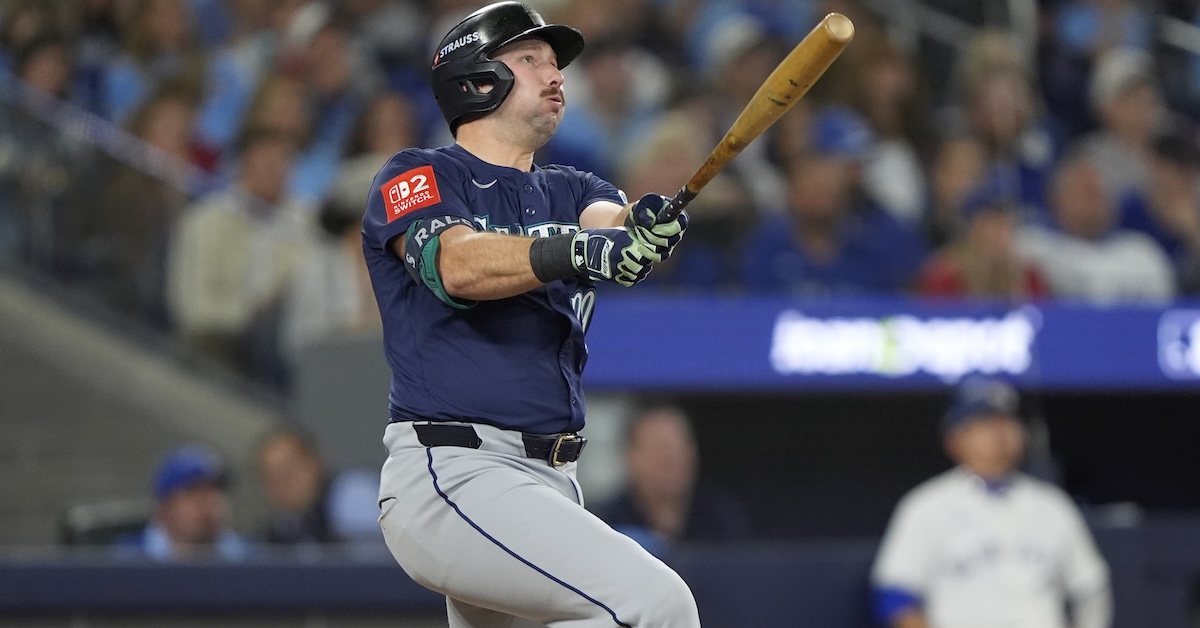
In Game 7 of the ALCS on Monday night, John Schneider’s Blue Jays pulled off a dramatic comeback in the bottom of the seventh inning that sent them to their first World Series in 32 years. The heroics came courtesy of George Springer, who hit a go-ahead three-run home run. But first, Schneider himself made a big decision in the top of the inning. With two outs and no one on base, Cal Raleigh stepped up. Two innings earlier, he had smashed a solo shot to give Seattle a 3-1 lead. Schneider wasn’t interested in facing him; he put up four fingers and called for the intentional walk.
Intentionally walking someone with the bases empty is a statement of strong fact: We absolutely cannot allow this person to hit a home run. To be fair, that’s definitely how Schneider felt in that moment; a home run would have been backbreaking for his team’s chances. Raleigh hit 60 of them in the regular season, so he’s obviously a pretty reasonable guy to fear when you’re specifically afraid of homers. But Josh Naylor, due up next, is a good hitter, too. And baserunners are bad in general. What did the math say about this move?
I threw projections for Raleigh, Naylor, and pitcher Kevin Gausman into my matchup model to find out. Splits are less of an issue here than normal because Raleigh is a switch-hitter, Naylor is a lefty, and Gausman is a righty with strong reverse splits in his career. In other words, it was a reasonable matchup for pretty much everybody. My model says that Raleigh would hit a home run off of Gausman just over 6% of the time. That’s a ton! League average for lefties facing righties is a mere 3.4%. It spit out similar projections for other outcomes – 4.4% chance of a double, 23% chance of a fly out, and so on – and by summing them all up and working out the win probability, I get a 20.5% chance of the Blue Jays winning the game with Raleigh coming to the plate against Gausman. Those homers are the big downside; the rest of Raleigh’s range of outcomes features a lot of strikeouts, and his projected OBP is around .290. This fits with Raleigh’s general game; he might get you, but if he doesn’t, you have a decent shot of striking him out. He’s a boom/bust player, in other words.
Raleigh didn’t get to bat, of course, so I also ran a second simulation of Naylor against Gausman. Naylor is much less of a power hitter than Raleigh (so is almost everyone), but he does project for a higher on-base percentage. Additionally, he got to bat with a runner on first base, which makes all of his hits more threatening. A single for Raleigh, with no one on base, has essentially no value. A single for Naylor puts a runner in scoring position, a much bigger deal. In math terms, a Raleigh single would have cost the Blue Jays around half a percentage point of win expectancy relative to “neutral.” A Naylor single (or walk) would be worth more like 1.5 percentage points. Likewise, all of Naylor’s positive outcomes would become better with a runner on base to juice them up, while his outs wouldn’t get any worse.
Stack all of his projected outcomes together (I project Naylor for a .311 OBP against Gausman, who is really good against lefties), and the model says that when Naylor faced Gausman with a runner on base, the Blue Jays projected to win only 20.2% of the time. That’s narrowly worse than the 20.5% chance they had against Raleigh, but honestly, it’s within the margin of error given how many approximations have to be used to populate my model. The official FanGraphs conclusion: Schneider probably shouldn’t have walked Raleigh there, but it was close enough that I would be uncomfortable saying it was a bad decision. It certainly didn’t help Toronto’s chances of winning, though. Credit goes to Gausman — who walked Naylor but then retired Jorge Polanco to escape the jam — and Springer that it all worked out.
Ben is a writer at FanGraphs. He can be found on Bluesky @benclemens.
If I recall correctly, Raleigh has also had a fair bit of success against Gausman. I suspect that doesn’t factor into the Instragraph calculations, and fair enough. But I’m sure it was on Schneider’s mind.
The walk guaranteed to get Raleigh one spot closer to coming up again in the 9th (oh so close…). Is that baked into the win probability projections?
Schneider loves himself some intentional walks. I was completely unshocked to see that he called for the IBB with Raleigh and nobody on. In the 2+ seasons managing the Blue Jays, he’s walked Judge intentionally 5 times with nobody on.
My favorite was last year on August 3rd, when he did so in the second inning because, to quote Schneider, “I honestly didn’t feel like seeing him swing”
Good article. I’m either way on this but understand that Naylor is less likely to create a run than Raleigh despite also having a good series and even a single or walk still means Polanco has to avoid an out, too.
If Naylor goes deep it would suck to be Schneider.
Isn’t that exactly the calculation you were after? Why complicate this instead of just comparing the win probabilities? Later you describe the difference as 0.3% (20.5% – 20.2%). Or is there something different about a single versus a walk (possibility of an error on the play?).