
Isiah Kiner-Falefa Is Doing Everything He Can
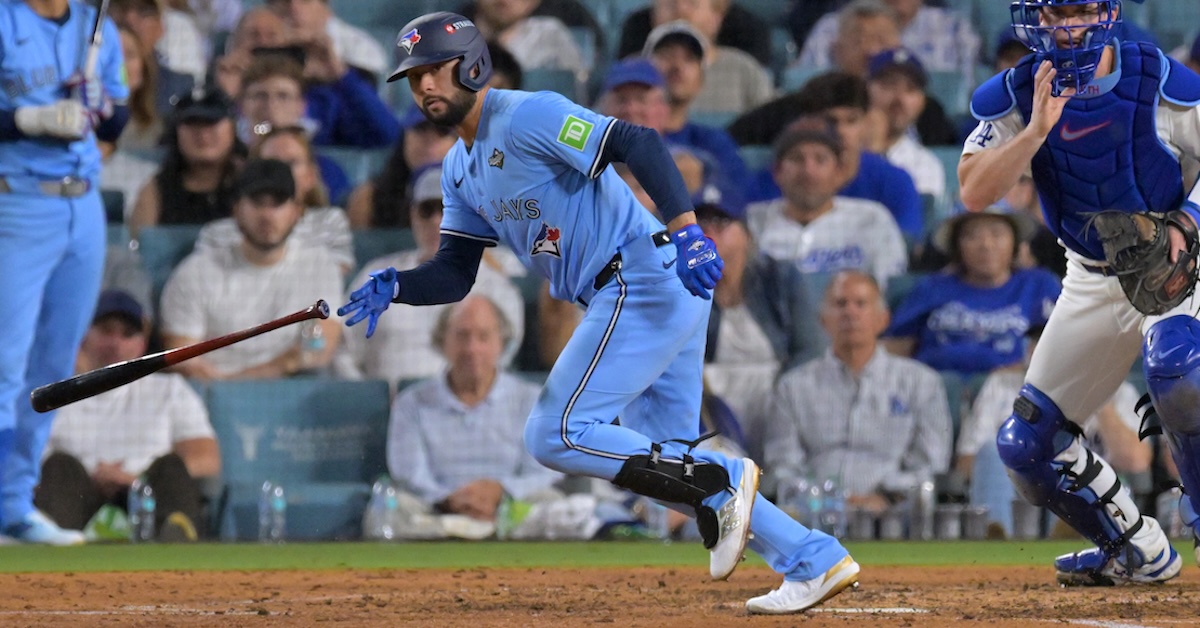
In the aftermath of Monday’s Game 3 loss (well, really it ended up being almost as much Tuesday’s Game 3 loss, at least on the East Coast), I encountered an unexpected sentiment floating around on the internet, and I’d like to unpack it.
Somewhere around the 32nd inning of that game, I noted that Toronto’s lineup had been shortened quite dramatically by a series of in-game substitutions.
I am amazed the Jays have lasted this long after taking out their second-, third-, fourth- and fifth-best hitters, in two cases for guys who absolutely cannot hit even a little. The Dodgers should've been walking Guerrero every time up too
— Michael Baumann (@baumann.bsky.social) October 28, 2025 at 2:35 AM
I meant this as nothing more than a statement of fact; George Springer got hurt mid-game, and Bo Bichette had to be removed because he came pre-injured and is currently running like the “before” clip in a commercial for a physical therapy practice. Toronto manager John Schneider’s options were quite limited.
Nevertheless, I did see some criticism of Schneider’s game management. Me? I’ll never blame a major league manager for coaching under the assumption that the game will end before inning no. 18. I might not have pinch-run so aggressively, but Schneider didn’t do anything too outside the mainstream, in my opinion.
Regardless, I’m not here to get mad at random internet posters two days later, because one of the moves Schneider had to make — pinch-running for Bichette with Isiah Kiner-Falefa — represents a fascinating ongoing challenge for both the Toronto skipper and his fifth infielder.
If this were the regular season, I doubt very much that Bichette would be active given his current physical state. But the Blue Jays need all the offensive help they can get, and Bichette is somewhere between their second- and fourth-best hitter. He’s a contact monster with 20-homer, 40-double power, and Toronto’s other middle infield options are not so much defense-first as defense-only.
Specifically, Kiner-Falefa, who deputized for Bichette during the earlier rounds of the postseason. Kiner-Falefa has superb defensive versatility, and has a reputation as a terrific clubhouse guy, but the gap between his bat and Bichette’s is hard to overstate.
| Name | BB% | K% | AVG | OBP | SLG | wRC+ | Contact% (Statcast) | HardHit% | EV90 |
|---|---|---|---|---|---|---|---|---|---|
| Bo Bichette | 6.4% | 14.5% | .311 | .357 | .483 | 133 | 83.1% | 48.8% | 105.5 |
| Isiah Kiner-Falefa | 3.7% | 16.8% | .262 | .297 | .334 | 74 | 87.8% | 27.5% | 100.1 |
The embattled Kiner-Falefa has not been any better in the playoffs. He’s hitting .162/.184/.216 this postseason, and only got his first hit of the World Series in garbage time of Game 5. The only other position player on either team with fewer than three hits in 10 or more at-bats this World Series is Andy Pages, whose lack of offensive production was a major talking point until it finally got him yanked from the Dodgers lineup for Game 5.
Obviously, this would not be an issue if not for the injury to Bichette, and latterly to Springer. Schneider has started Bichette four times this postseason, twice at second base and twice at DH. Both times he started at second base, he was relieved by Kiner-Falefa when the Blue Jays needed either speed or defense. In Game 2, Kiner-Falefa started at second base and was lifted for Bichette with Toronto trailing late.
Kiner-Falefa isn’t actually an ideal runner; he’s a career 77% basestealer, and came in at the 47th percentile for sprint speed this season. But at this moment in time, he can get around the bases in less time than it takes for Bichette to fire up his mobility scooter.
Basically, the idea was that Bichette would play when the Blue Jays needed offense, and Kiner-Falefa would play when they needed defense. In the first three games of the World Series, Schneider played that pretty well, even considering that his defensive replacement had to take an unexpected game’s worth of at-bats.
| Game State | Leading | Tied | Trailing | |||
|---|---|---|---|---|---|---|
| Player | PA | Def. Innings | PA | Def. Innings | PA | Def. Innings |
| Isiah Kiner-Falefa | 2 | 4 | 6 | 16 | 1 | 2 |
| Bo Bichette | 1 | 2 | 4 | 7 | 3 | 5 |
I do think there’s room for the Blue Jays to get more creative with their non-Bichette defensive alignments; earlier in the postseason, they were playing Ernie Clement at second and bringing Addison Barger in from the outfield to play third. Davis Schneider can also theoretically play third base, not that you’d want him to.
But if you’re going for defense, Kiner-Falefa at second, Clement at third, and Barger in right is clearly the way to go. Either way, Jay Jaffe just wrote about Bichette and Toronto’s second base situation, and discussing it in too much detail here would be redundant. Moreover, this puzzle got much less interesting when Springer’s injury opened up DH for Bichette full-time.
Nevertheless, Kiner-Falefa has come to the plate 12 times this postseason in what one might call crunch time: The fifth inning or later, in a game with a margin of two runs or fewer.
| Series | Game | Inning | LI | Score | Base/Out State | Result | Pitches |
|---|---|---|---|---|---|---|---|
| ALCS | 5 | Top 5 | 2.24 | Behind, 1-0 | 1__, 0 Out | Fly Out | 3 |
| ALCS | 5 | Top 6 | 1.56 | Ahead, 2-1 | __3, 2 Out | Groundout | 5 |
| ALCS | 7 | Bottom 7 | 2.66 | Behind, 3-1 | 1__, 0 Out | Single | 3 |
| ALCS | 7 | Bottom 8 | 0.93 | Ahead, 4-3 | __3, 2 Out | Groundout | 5 |
| WS | 3 | Top 9 | 1.80 | Tied, 5-5 | Empty, 1 Out | Walk | 5 |
| WS | 3 | Top 11 | 1.80 | Tied, 5-5 | Empty, 1 Out | Groundout | 3 |
| WS | 3 | Top 13 | 1.80 | Tied, 5-5 | Empty, 1 Out | Strikeout | 4 |
| WS | 3 | Top 15 | 2.32 | Tied, 5-5 | 1__, 2 Out | Strikeout | 6 |
| WS | 3 | Top 18 | 3.04 | Tied, 5-5 | 1__, 1 Out | Fielder’s Choice | 3 |
| WS | 4 | Top 5 | 0.69 | Ahead, 2-1 | Empty, 1 Out | Fly Out | 3 |
| WS | 4 | Top 7 | 0.80 | Ahead, 3-1 | 1_3, 0 Out | Line Out | 5 |
| WS | 5 | Top 7 | 1.12 | Ahead, 3-1 | _2_, 0 Out | Groundout | 6 |
This was not by design. Half of these plate appearances came in Game 3’s conjoined twin, after anyone with any sense would’ve assumed the game would’ve been over. It wasn’t until Kiner-Falefa’s sixth game and 12th plate appearance of this postseason that he would bat in a high-leverage (i.e., leverage index of 1.50 or greater) situation. Schneider’s been keeping his weakest semi-regular hitter out of these situations, and for good reason.
Kiner-Falefa makes a lot of contact; his 16.8% strikeout rate is 5.4 percentage points below league average, and he’s in the top 10% of the league in contact rate. But he’s in the fifth percentile or below in the following categories: Walk rate, ISO, xSLG, HardHit%, xwOBACON, EV50, and EV90. Kiner-Falefa homered just twice in 459 regular-season plate appearances this regular season, which is the seventh-worst ratio among hitters with at least 200 plate appearances. (That includes the Chandler Simpson Division: The five players who batted 200 times and hit zero homers.)
He just doesn’t hit the ball hard. In Game 4, he put a great swing on the ball and hit what could’ve easily been a white-hot line drive double. I went to check the exit velo, thinking he’d crushed the ball: 90.3 mph. Not even hard hit, by Baseball Savant’s definition.
Kiner-Falefa isn’t going to do damage when he comes up in these key spots, at least not to the other team. So what, if anything, can he do to help his own cause?
In these situations, Kiner-Falefa is 1-for-11 with a walk and two strikeouts. So at least he’s (mostly) putting the ball in play. Another hit or two every 10 plate appearances would be nice, but if I’m Schneider, I want two things from a guy for whom expectations are this low: Competitive at-bats and no double plays. If you can’t damage the other team, at least don’t damage us.
In that respect, Kiner-Falefa’s doing everything he can. He’s trying stuff. He’s squared to bunt in four of these 12 plate appearances. He hasn’t swung at the first pitch otherwise, and in six of the remaining eight plate appearances he made the opposing pitcher put a strike on the board before he took his bat off his shoulder.
This has come in handy, most notably in the ninth inning of Game 3 against Roki Sasaki. The Dodgers’ unhittable wunderkind has occasionally left his command in the bullpen. The Dodgers have a few high-leverage relievers who suffer from a periodic inability to locate unhittable stuff, including Blake Treinen and Emmet Sheehan.
When these pitchers get away with it, it’s with the hitter’s help. A wildly uncontrolled breaking ball often looks like a wildly uncontrolled fastball out of the hand — this is, after all, the point of a breaking pitch in the first place — and a hitter will come out of his shoes trying to drive a belt-high fastball into the ocean, only to discover after the fact that it was a sweeper.
Kiner-Falefa had no illusions about driving anything anywhere. Instead, he dared Sasaki to throw him three strikes, and Sasaki couldn’t. Had Tommy Edman not pulled a rabbit out of his glove minutes later, the result could well have been Kiner-Falefa trotting home as the go-ahead run.
Kiner-Falefa saw 21 pitches in Game 3, and only made one swing decision I really hated: He chased a slider from Sheehan off the plate in the 11th, and tapped it back to the mound.
Unfortunately, making good decisions is only going to get Kiner-Falefa so far. Across all situations this postseason, he’s put 32 balls in play, only one of which has had an expected batting average over .500. Would you like to see it?
It was only in the seventh inning of Game 5 that Kiner-Falefa posted his first triple-digit exit velocity of the playoffs. That lack of punch gives pitchers an obvious angle from which to approach him.
When we talk about how a team is going to pitch a hitter, it’s usually someone dangerous like Vladimir Guerrero Jr. or Shohei Ohtani. A hitter who will swing the series if you’re not careful. But I’ll tell you this. If I lost the World Series and Vladito or Ohtani or Freddie Freeman or Bichette went berserk, I would not lose a wink of sleep. Those guys are stars; losing to them is part of the game.
You know what would bug me for the rest of my life? Losing a World Series game because my closer couldn’t or wouldn’t throw a strike to a hitter who isn’t a threat to do much of anything.
Ohtani figured this out in Game 4. The first time he faced Kiner-Falefa, he showed him two different breaking balls, and on the 1-2 pitch he made a huge mistake. Ohtani’s fastball was still almost 99 mph, but it was straight and directly down the middle. Bichette would’ve parked it on the concourse. Kiner-Falefa beat it straight into the dirt for a routine groundout.
The next time up, Ohtani threw Kiner-Falefa three straight strikes and induced a harmless fly out to left.
Kiner-Falefa isn’t going to beat himself. But he’s usually not going to beat the pitcher either.
Michael is a writer at FanGraphs. Previously, he was a staff writer at The Ringer and D1Baseball, and his work has appeared at Grantland, Baseball Prospectus, The Atlantic, ESPN.com, and various ill-remembered Phillies blogs. Follow him on Twitter, if you must, @MichaelBaumann.
IKF was being blamed by Pittsburgh fans early this season for the Pirates being bad. Personally I think that was wrong. IkF is a glove first guy, but he hits well enough that he is not preventing any team from going to the playoffs. He is not really helping to score a ton of runs, but you don’t need a SS that is an amazing hitter if the glove is there. The Pirates offense sucked at Dh, LF, Rf, and the decent 1B spent much of the season on the DL. That’s where the teams scoring ineptitude was most present when compared to other clubs. Apparently some excellent run MLB teams agreed. Cause IkF is playing in the World Series. At least one anyways.
If you’re relying on IKF to hit, the problem is you, not him.
Maybe some hotheads were blaming IKF, but I think most Pittsburgh fans were properly assigning blame to Nutting and Cherington.
(Also IKF was the Pirates’ third best hitter for the first two months, before going ice cold the rest of the season. Tommy Pham, he got some blame.)
Pham deserved SOME blame
I see IKF as a solid backup infielder. He plays decent defense, has decent speed, and can lay down a bunt when needed. Guys who do more than that will probably be starting. He also is, as mentioned above, a good clubhouse guy. He also can literally play anywhere on the diamond with 1B being the only position he hasn’t played, all other positions (including P & C) he has 7+ games at (well, other than DH with just 4 for good reason). As a Jays fan I’d be good with him returning in ’26 as a backup. Every team needs a 26th man who can cover for any injury that happens during the game, who the manager can count on for almost any purpose.
He’s been horrific at bunting
Pulling back last night and taking the 97MPH fastball in the zone for strike 2 was absolutely terrible.
It didn’t ultimately matter.
And, as others have noted, he is who he is, and if you’re counting on him to hit, that’s a roster construction / role assignment problem.
Agree but be nice if he could bunt a bit, poster said he was good at it , wasn’t sure if I’m missing something but he looked horrible on Yankees too trying to bunt. He’s got value for sure but I wouldn’t start him next game , barger is fine at 3rd even if bichette can’t play field rather have Schneider at least work the count. I find IKF annoying because he swings at everything and can’t bunt, fine he’s glove first player but can’t you get better at bunting, not like he needs a lot of time in batting cages or on machines.
What makes baseball enjoyable is that articles like this tend to preface a player like IKF going yard in a game 7, 5th inning AB.
I want to see IKF and Nick Allen have a place in MLB
I agree, as long as they’re not on my team. They’re fun players until you’re watching Allen maintain a SLG below .300 into August.
Batting is not in their skill sets
The Jays have been reluctant to play Davis Schneider all season against RHP. But he’d be an upgrade over IKF to start the game at 2B. Schneider can’t play 3B, he’s awful there, but he is fine at 2B. I’d love for the Jays to start Schneider over IKF at 2B. When they have a lead they can bring in IKF for defence. I mean they’re a game away from winning the WS so you could argue what they’re doing is working, but I think it’s a lot easier to win if you can get a bigger lead earlier in the game, and Davis Schneider would help more than IKF at doing that.
Considering IKF has a 7 wRC+ this post season, and Schneider is at 119 wRC+, it seems like the obvious move to start Schneider when Bichette is at DH and Springer is unavailable. Even if you regress IKF’s bat a bit, I still would argue Schneider brings a lot more upside to the team, and that IKF would be far more valuable late in the game with a lead to play D. Much rather shift those high leverage opportunities to Davis Schneider, especially since the Dodgers bizarrely consider him less of a threat than Gimenez offensively.
Thank you for reminding me of this exchange from the greatest movie ever made, Cannonball Run II
Charles Nelson Reilly: “Hymie, I’m doing the best that I can!”
Telly Savalas : “That’s what’s so tragic.”
Two absolute legends.
He was great in the ALCS. 5 for 15 with 2 doubles and an 800 OPS. He and Gimenez (842 OPS) won that series for the Jays, while the M’s 7-9 hitters (#3 in 2025 regular season by wRC+) turned into pumpkins. Playoff (small sample theater!) baseball is nutty, and nuttier still is that we try so hard to draw meaningful conclusions from it.