FanGraphs Baseball

NERD Game Scores for Sunday, July 31, 2016

Devised originally in response to a challenge issued by sabermetric nobleman Rob Neyer, and expanded at the request of nobody, NERD scores represent an attempt to summarize in one number (and on a scale of 0-10) the likely aesthetic appeal or watchability, for the learned fan, of a player or team or game. Read more about the components of and formulae for NERD scores here.

***

Most Highly Rated Game
Baltimore at Toronto | 13:07 ET
Tillman (132.1 IP, 103 xFIP-) vs. Sanchez (132.1 IP, 80 xFIP-)
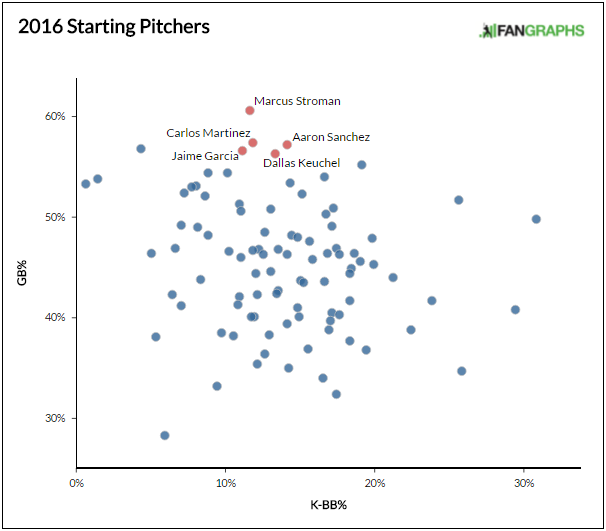
The purpose of this brief entry is twofold: first, to note that Aaron Sanchez continues to produce excellent strikeout and walk numbers relative to his ground-ball rate and, second, to experiment with a graph-making utility created by FanGraphs employee Sean Dolinar. The following visual, which illustrates the former, is the fruit of the latter:

Sanchez 2

Readers’ Preferred Broadcast: Baltimore Television or Toronto Radio.

Read the rest of this entry »


The Yankees Have Been Impressively Rebuilt

You’ll have to forgive me if I think of Andrew Miller as the travellin man. Now in his 11th major league season, Miller is headed to his sixth major league team, all east of the Mississippi. But unlike most journeymen, for the most part the teams acquiring Miller have been quite excited about the possibility. The latest team to celebrate getting the lanky lefty are the Cleveland Indians, who are now looking quite formidable. But they’re not the only team looking formidable. The Yankees may no longer be in 2016 contention, but they’re setting up well for 2017 and beyond.
Read the rest of this entry »


Sunday Notes: Cards Bowman, Kinsler, Span, SABR Miami, Moore, more

Matt Bowman isn’t your stereotypical baseball player. The St. Louis Cardinals rookie right-hander majored in economics at Princeton, and his senior thesis looked at how much a win is worth in free agency. He doesn’t fit the physical profile, either. A slender 6-foot-even, he looks more like… well, an Ivy League economist.

Last year he pitched like one. In 140 innings for Triple-A Las Vegas, Bowman went 7-16 with a 5.53 ERA and a 4.95 K/9. To little surprise, he was left unprotected by the Mets, who had selected him in the 13th round of the 2012 draft. The last thing he expected was for a team to gamble on him in the Rule 5.

“I was surprised that I got picked up,” admitted Bowman. “I didn’t feel that I deserved a 40-man spot with the Mets and I certainly didn’t think that any team would be looking at me as someone who could contribute, or even hide, on a major league roster. When my agent said the Cardinals picked me up, not a whole lot of it made sense. These guys are perennial contenders and I was coming off a terrible year in Triple-A.”

The 25-year-old’s level of honesty and humility are also atypical. When I asked if he’s surprised at how well he’s pitching, I received an answer I wasn’t expecting. Read the rest of this entry »


Padres, Braves Exchange Toxic Assets

Note: this is all pending physicals, so

Follow-up note: physicals complete! Trade official. Update included at the very bottom.

Usually, we’re at least able to focus on the baseball side of things. Even though we all recognize that baseball is a business, we’ve gotten good at ignoring that part, focusing on the more baseball-y parts of player transactions. Business matters some in the Mark Melancon trade, but it seems mostly about the Nationals getting a good closer, and the Pirates getting some longer-term pieces. You know, baseball stuff. We’re all in it for the baseball stuff, after all, because the business part is seldom entertaining.

The Padres and Braves have made a business move. Oh, sure, there’s a baseball side, kind of. The Braves must see something in Matt Kemp, something they didn’t see in Hector Olivera. To help cover some of Kemp’s remaining cost, the Padres are reportedly including $10 – 12 million. It would be possible to look at this and think only about the roster implications. But this is mostly just a money move, and from where I sit, the Padres are coming out ahead.

Read the rest of this entry »


Nationals Acquire Elite Reliever for Relative Bargain

The Washington Nationals started with their sights on Aroldis Chapman. They’d deemed their bullpen to be in need of an upgrade, and Chapman was the most obvious candidate. Obviously, that didn’t happen. And not only did it not happen, but the return for Chapman was so high that clubs still interested in Andrew Miller could be seen as effectively priced out. From Washington, the Yankees reportedly asked for top prospect Lucas Giolito in exchange for Miller, and no matter what the tweets say, that was never going to happen.

So the Nationals had to lower their sights a bit. But they didn’t have to lower them far, because after Chapman and Miller, they might have gone out and gotten the next-best thing:

It’s a trade that makes sense for both teams, as they all should. The Pirates may not be strong current contenders, but they remain future contenders, if that makes sense. We’ve got their playoff odds at 16%, which is still very much in the race, but makes them a longshot. What the Pirates have beyond this year, though, is a strong core coupled with a handful of promising, near-ready prospects that ought to keep the club’s contention window open for years to come. They’re not going away anytime soon, but they’ve been largely done in this season by uncharacteristically poor starting pitching.

So they moved an expiring piece. Mark Melancon’s been a fixture of Pittsburgh’s recent revival, but he’s gotten expensive, and he’ll be a free agent at year’s end. Teams like the Pirates typically don’t retain relievers like Melancon when they hit the market, so they got what they could. That means Felipe Rivero, a lefty reliever who touches the high-90’s in the majors right now, and that means Taylor Hearn, a lefty (future) reliever who stands 6-foot-5 and touches the high-90’s in the minors right now. They’ve got Rivero for five more years. They’ve got complete control of Hearns. The Pirates sold, but not really. They made this year’s team slightly worse in going from Melancon from Rivero, but they’ve made future year’s teams better by adding Rivero (and Hearns) for a player who was set to be gone anyway. It’s the perfect kind of retooling move for a small-market team operating within a window of contention.

And yet, it’s hard not to view this return as relatively light, at least up against what the Yankees just received for Chapman. The Yankees got a top-25 prospect in Gleyber Torres, a fringe-100 prospect in Billy McKinney, a pitcher capable of starting with major league success under his belt in Adam Warren, and then some. Speculation around a Melancon-to-Washington trade invoked names like right-handed starter Erick Fedde, who ranked 61st in Baseball America’s midseason update. The actual return featured a pair of lefty relievers. Exciting lefty relievers, but lefty relievers nonetheless; one of whom has already had his clock started, the other of whom didn’t crack top-10 prospect lists in the Nationals’ system at the start of the season.

Of course, Chapman throws 105 and because of that, is Aroldis Chapman. Melancon isn’t that. But he’s closer than one might think! Like, for instance, since joining the Pirates in 2013, Melancon’s 1.80 ERA is the lowest among all 255 pitchers with at least 200 innings thrown. He’s been better at preventing runs than literally everyone over the last three-plus years. And while he might not do it with the sort of eye-popping stuff to which we’re accustomed from seeing of the game’s top relievers, there’s no arguing with the results:

Most Valuable Relievers, 2013-Present
Name IP K% BB% K-BB% GB% HR/9 ERA FIP WAR RA9-WAR tWAR
Aroldis Chapman 218 44.2% 10.9% 33.3% 37.8% 0.54 2.03 1.81 8.5 8.2 8.4
Dellin Betances 229 40.7% 9.0% 31.7% 48.2% 0.55 1.88 1.89 8.0 8.5 8.3
Kenley Jansen 240 37.8% 5.6% 32.2% 35.2% 0.71 2.13 1.95 8.4 8.1 8.3
Mark Melancon 260 23.8% 4.2% 19.7% 56.8% 0.31 1.80 2.27 6.9 8.7 7.8
Wade Davis 183 32.2% 8.8% 23.4% 45.3% 0.15 1.08 1.97 6.0 9.3 7.7
tWAR: 50/50 split of RA9-WAR and FIP-WAR

Again, the style is a bit different, but when we’ve talked about the Chapman’s and Jansen’s and Davis’ of the world, Melancon’s been right there all along. Here’s another way to view things, if you’re not as keen on using WAR to evaluate relievers:

Win Probability Added, all relievers, 2013-Present

  1. Mark Melancon, +11.74
  2. Tony Watson, +10.63
  3. Zach Britton, +10.55
  4. Wade Davis, +10.42
  5. Dellin Betances, +10.07

By WPA, no reliever’s been more valuable than Melancon during his time in Pittsburgh. By WAR, it’s only Chapman, Betances, and Jansen. You see the second name there on the WPA leaderboard also plays for the Pirates, so it’s not like they’re suddenly hurting for high-leverage relief options, and Watson will still be there next year, too. But the Nationals just added one of the game’s elite to an already great bullpen.

Not that there aren’t flags with Melancon. I’m hesitant to call them red flags, but they’re orange or maroon, maybe. His walk rate is still great, but it’s also the highest it’s been during his Pittsburgh tenure. The curveball’s being spotted less often at the bottom edge of the zone, and is more often winding up in the dirt, and batters are laying off:

Brooksbaseball-Chart

Fewer swings against the curve explains the slight uptick in walks, and it explains the downtick in ground balls — the curve has always been Melancon’s big ground ball pitch. Melancon doesn’t possess top-shelf raw stuff, so he’s thrived by limiting walks and homers. Limiting walks and homers are predicated on elite command, and there’s some evidence that the command could be starting to slip. For now, though, the command still looks great. And those maroon flags can be the next team’s concern, anyway; the Nationals only care about the next three months.

Funny thing about the Nationals bullpen is, before the Melancon trade, they were projected for 1.8 rest-of-season WAR, and after  they’re Melancon trade, they’re projected for… 1.8 rest-of-season WAR. But what they’ve done is shift their leverage, the sort of thing that a WAR projection might struggle to grasp. Melancon is now clearly the best option in Washington’s bullpen, and he’ll receive the most important innings. Less important innings are to follow for Jonathon Papelbon, as should be the case. Shawn Kelley remains elite. It’s the kind of 1-2-3 punch we’ve become accustomed to seeing in the late innings of playoff games.

And while I’ve referred to the cost as a bargain within this post, it’s really only a bargain relative to Chapman. Really, it’s the kind of return we should expect for three-plus months of an elite reliever. The kind of return we might’ve expected, say, a week ago. The Chapman move was just an outlier, for whatever reason. Take that how you will. The Pirates retooled, as they should have. The Nationals improved their high-leverage innings for the stretch run by acquiring one of the game’s best run preventers. It looks like a win for both clubs, and yet somehow it also feels like something of a steal by Washington, based on what we’ve recently seen. Maybe the Pirates could have done better for Melancon. Or maybe the Cubs just gave up a ton for Chapman.


Royals Get the Other Jarrod Dyson

Look, I know why you’re here. You want to read about deadline trades, and, more specifically, you want to read about impactful deadline trades. This is a post about the A’s trading Billy Burns to the Royals in exchange for Brett Eibner. I know exactly what we’re dealing with, so I won’t take up too much of your time. I’ll just leave some information and get out of here.

Why might the Royals like Burns? He’s under team control forever, he makes a ton of contact, he’s fast, and he’s a proven center fielder. Pretty solid foundation, all things considered. Why might the A’s like Eibner? He’s under team control forever, he has some power, he’s not unathletic, and he’s mostly played center in the minors. I’m not going to say this trade fell along party lines, since neither the Royals nor the A’s are actually caricatures of real front offices, but Burns and Eibner are probably both now in friendlier homes.

Burns is the one with the big-league track record. What’s interesting — last year he was a league-average hitter, and this year his wRC+ has gone down by literally half. Yet his overall profile has been pretty similar. He puts the ball in play, and he runs. Last year there were better outcomes. I want to show you something somewhat discouraging. In this plot are all the hitters who have batted at least 500 times over the past three calendar years. I’ve plotted them by pop-up rate and rate of home runs per fly ball:

burns

For Burns, that’s bad. In the sample, he has the game’s highest pop-up rate, but one of the game’s lowest rates of homers per fly. It’s not just a product of playing in Oakland, either, based on his splits. Billy Burns hasn’t shown good enough bat control, and with these balls in play it would be tremendously difficult for him to produce at all, long-term. Another point that isn’t exactly in his favor: here are the five lowest hard-hit rates from the sample.

Burns isn’t just in last — he’s in last by a few percentage points, which is a bad look. He simply doesn’t hit the baseball very hard. Borrowing from Baseball Savant: last year, in average exit velocity on flies and liners, Burns was tied for fourth-lowest. This year, he’s second-lowest. He doesn’t hit the ball hard, so he doesn’t flash much power, and because he doesn’t flash much power, pitchers challenge him, so he’s mostly unable to draw walks. He’s a ball-in-play sort, and that can make it hard to succeed.

But! It’s not impossible. Last year happened. Dee Gordon put together two productive years. Burns has a career wRC+ of 85, which makes him a lot like Dyson, his new teammate. Dyson might be the superior defender, but Burns is versatile, and he runs the bases well. Dyson isn’t controlled for too much longer; Burns is controlled for a while. Maybe he’s just a useful fourth outfielder, but he shouldn’t be useless, assuming he’s a better hitter than his 2016 statistics.

With Eibner, the A’s are betting on a bat. That he’s manned center in the minors shows he’s got some defensive skill, but mostly, his appeal is the consecutive productive years in Triple-A. He’s already 27, so he’s almost a Quadruple-A player, yet many believe those don’t exist. Count the A’s among them. In the high minors, Eibner has shown some discipline without having big contact problems. And, over a brief spell this year in the majors, Eibner ranked in the 85th percentile in average exit velocity on flies and liners. The pop in his bat is real. He just needs to be able to translate his eye. If he does that, he’s already an average player.

It’s an unsexy move, made between two teams currently going nowhere. A couple days from now, no one’s going to remember this ever happened. Every trade, though, is interesting if you dig into it. Here we have the Royals betting on athleticism, and the A’s betting on results. Sounds like the Royals. Sounds like the A’s.


NERD Game Scores for Saturday, July 30, 2016

Devised originally in response to a challenge issued by sabermetric nobleman Rob Neyer, and expanded at the request of nobody, NERD scores represent an attempt to summarize in one number (and on a scale of 0-10) the likely aesthetic appeal or watchability, for the learned fan, of a player or team or game. Read more about the components of and formulae for NERD scores here.

***

Most Highly Rated Game
Washington at San Francisco | 16:05 ET
Lopez (4.2 IP, 25 xFIP-) vs. Peavy (104.2 IP, 120 xFIP-)
With the exception of all the “runs” he allowed, right-hander Reynaldo Lopez’s major-league debut last week was more or less an exercise in best-case scenarios. Regard: he exhibited elite arm speed while recording an equally elite strikeout- and walk-rate differential. He also neutralized left-handers completely by means of his curveball. Regard, more: of the 20 curves he threw to them, 14 were strikes (70%) and zero were put into play.

Here’s an example of that curveball and those lefties:

Readers’ Preferred Broadcast: San Francisco Radio or Television.

Read the rest of this entry »


The Best of FanGraphs: July 25-29, 2016

Each week, we publish north of 100 posts on our various blogs. With this post, we hope to highlight 10 to 15 of them. You can read more on it here. The links below are color coded — green for FanGraphs, brown for RotoGraphs, dark red for The Hardball Times and blue for Community Research.
Read the rest of this entry »


Effectively Wild Episode 933: Your Most Elite Emails

Ben and Sam answer listener emails about player development what-ifs, Aroldis Chapman and elite relievers, a team that could control the weather, Mike Trout and Barry Bonds, and more.


NERD Game Scores for Friday, July 29, 2016

Devised originally in response to a challenge issued by sabermetric nobleman Rob Neyer, and expanded at the request of nobody, NERD scores represent an attempt to summarize in one number (and on a scale of 0-10) the likely aesthetic appeal or watchability, for the learned fan, of a player or team or game. Read more about the components of and formulae for NERD scores here.

***

Most Highly Rated Game
Washington at San Francisco | 22:15 ET
Scherzer (141.2 IP, 78 xFIP-) vs. Samardzija (128.0 IP, 101 xFIP-)
Thought experiment: imagine a universe in which everything is exactly the same except that, during the opening credits of TV’s Laverne & Shirley, the title characters chant “1, 2, 3, 4, 5, 6, 7, 8. Scherzer! Samardzija! Hasenpfeffer Incorporated!” — instead of Schlemiel and Schlimazel, like in this present universe we all occupy. What are the implications? Support your answer with evidence. Or, alternatively, ignore this paragraph altogether.

Readers’ Preferred Broadcast: San Francisco Radio or Television.

Read the rest of this entry »

