JABO: Alex Gordon Proves Jeurys Familia Is Human

When Eric Hosmer misplayed an eighth inning chopper down the line, giving the Mets a 4-3 lead, the Mets had exactly what they wanted; the chance to watch Jeurys Familia finish off the final three outs of the game to preserve a lead. Given what they’ve seen from their closer over the last few months, having him hold a lead seemed like just about the surest thing in baseball.

As Jeff Sullivan noted two weeks ago, the recent version of Familia has been even better than his season numbers suggest. In mid-August, Familia added a split-finger to his repertoire after basically not throwing the pitch at all for the first four months of the year.

FamiliaUsage

Familia didn’t throw a single splitter from May 21st through August 7th, then started working the pitch in pretty regularly starting with his August 10th appearance. His numbers since that date, including the postseason:

Familia Since August 10th
IP H HR BB K ERA
34 21 1 8 39 1.06

In the equivalent of about half a season’s worth of work, Familia had been as good as any reliever in baseball, racking up five strikeouts for every walk while also inducing groundballs on 60% of his batted balls. With the splitter, he’d been the Mets version of Wade Davis, the kind of guy you just expect to blow every hitter away as soon as he steps on the mound. And after Salvador Perez grounded weakly to shortstop, a Mets victory felt inevitable.

Read the rest on Just a Bit Outside.


Alcides Escobar and a Bat and a Ball

Alcides Escobar is not a good hitter. I don’t say that to be mean — I say that to be honest. Even the Royals don’t really know how to explain Esky Magic. There’s no getting around his regular-season numbers, and when you mix in what he’s done in the playoffs, it doesn’t make that much of a difference. He’s the kind of hitter that, if you saw him in a community park, you’d think, that guy ought to play in the majors. But he’s the kind of hitter that, when he’s in the majors, you think, that guy plays a hell of a shortstop. In his best year, Escobar was a bit below average. He followed that year with a year where he hit like a good-hitting pitcher.

Escobar doesn’t walk, and Escobar doesn’t hit for power. The thing he has going for him is he’s tremendously difficult to strike out. In that sense he blends in with the Royals, although even on that roster he’s one of the standouts. Escobar, in short, is good at taking the bat to the baseball. From there, things will sort themselves out. The most charitable way to describe Escobar’s offense is that, with his speed and his contact ability, he’s usually capable of making something happen. Better a ball in play than a whiff, right? You never know, with a ball in play.

In the World Series opener, Escobar’s contact allowed for things to happen. After days of talking about the Royals’ ability to avoid the whiff, Escobar put contact to good use. Two examples were and are obvious. A third was subtle, but without it, Escobar doesn’t score the winning run on the Eric Hosmer sac fly.

Read the rest of this entry »


FanGraphs Audio: Dave Cameron Analyzes You-Know-What

Episode 605
Dave Cameron is both (a) the managing editor of FanGraphs and (b) the guest on this particular edition of FanGraphs Audio, during which edition he discusses not only the World Series but also the most notable personnel changes announced during the brief respite between series.

This edition of the program is sponsored by Draft, the first truly mobile fantasy sports app. Compete directly against idiot host Carson Cistulli by clicking here.

Don’t hesitate to direct pod-related correspondence to @cistulli on Twitter.

You can subscribe to the podcast via iTunes or other feeder things.

Audio after the jump. (Approximately 42 min play time.)

Read the rest of this entry »


2015 World Series Game One Live Blog

7:33
Dave Cameron: Hey all, August Fagerstrom and I will be here to cover the first game of the 2015 World Series.

7:34
Dave Cameron: For those of you who haven’t been part of one of our live blogs before, we’ll mostly focus on game reaction stuff, so it’s less of a Q&A than our normal chats, but we do our best to make sure you guys are involved as well.

7:35
Dave Cameron: So come hang out with us as we watch the Mets and Royals, or maybe the grounds crew. Either way, it should be fun.

7:44
August Fagerstrom: hey, y’all! I’ve got a freshly-broken big toe and I’m ready to watch some World Series

7:46
August Fagerstrom: only you can decide whether that’s a euphemism

7:57
Dave Cameron: Well, this is terrible news. Source close to the Volquez family confirms to @Enrique_Rojas1 and @ESPNDeportes that Edinson Volquez’s father died today in the DR

Read the rest of this entry »


Contract Crowdsourcing 2015-16: Day 12 of 15

Free agency begins five days after the end of the World Series. As in other recent offseasons, FanGraphs is once again facilitating this offseason a contract-crowdsourcing project, the idea being to harness the wisdom of the crowds to the end of better understanding the giant and large 2015-16 free-agent market.

Below are links to ballots for five of this year’s free agents, all of them starting pitchers once again.

Other Players: Brett Anderson / Nori Aoki / Alex Avila / Mark Buehrle / Marlon Byrd / Asdrubal Cabrera / Yoenis Cespedes / Wei-Yin Chen / Bartolo Colon / Johnny Cueto / Chris Davis / Rajai Davis / Alejandro De Aza / Ian Desmond / R.A. Dickey / Stephen Drew / Marco Estrada / Doug Fister / Dexter Fowler / David Freese / Yovani Gallardo / Jaime Garcia / Alex Gordon / Zack Greinke / Jeremy Guthrie / J.A. Happ / Jason Heyward / Rich Hill / Torii Hunter / Chris Iannetta / Hisashi Iwakuma / Austin Jackson / John Jaso / Kelly Johnson / Matt Joyce / Howie Kendrick / Justin Morneau / Daniel Murphy / David Murphy / Mike Napoli / Dioner Navarro / Gerardo Parra / Steve Pearce / Alexei Ramirez / Colby Rasmus / Alex Rios / Jimmy Rollins / Geovany Soto / Denard Span / Justin Upton / Juan Uribe / Chase Utley / Will Venable / Shane Victorino / Matt Wieters / Chris Young the Outfielder / Ben Zobrist.

***

Scott Kazmir (Profile)
Some relevant information regarding Kazmir:

  • Has averaged 177 IP and 2.8 WAR over last three seasons.
  • Has averaged 3.1 WAR per 200 IP* over last three seasons.
  • Recorded a 2.4 WAR in 183.0 IP in 2015.
  • Is projected to record 2.8 WAR per 200 IP**.
  • Is entering his age-32 season.
  • Made $11.0M in 2015, as part of deal signed in December 2013.

*That is, a roughly average number of innings for a starting pitcher.
**Prorated version of 2016 Steamer projections available here.

Click here to estimate years and dollars for Kazmir.

Read the rest of this entry »


How the Mets Have Fared Against Contact Hitting

You can’t always feel original, even when you want to. Yesterday I wrote about the Royals going up against the Mets’ power pitching. I wrote about it because I think it’s interesting, but then, everyone thinks it’s interesting, so everyone has been writing about it. Lots of people have observed that the Royals have hit fastballs well. Lots of people have observed that the Royals have hit fast fastballs well. It’s been demonstrated now that good contact hitters have a slight advantage against power pitchers, relative to worse contact hitters. So much, coming from the Royals’ perspective. It’s all over the place.

A frequent counter-point: the Royals won’t just be facing hard-throwers. They’ll be facing Jacob deGrom, Matt Harvey, Noah Syndergaard, and Steven Matz. These are hard-throwers with other pitches; these are hard-throwers with instincts and command. They’re not just 98-mile-per-hour fastball machines, so maybe it’s not fair to mix them in with everyone else. I think that’s totally valid. So it’s worth running through these exercises from the Mets’ perspective. We’ve looked at the Royals against power pitchers. How about the Mets against contact hitters?

Read the rest of this entry »


The FanGraphs World Series Gift Guide to World Series Gifts

The World Series is here! Well, not here. This is the internet. But the World Series is happening now, or soon, or… I refuse to continue covering up for how literally you are reading this opening. Point is, this is the time when baseball has the collective attention of the baseball-watching world and, possibly not coincidentally, this is also the time when fans of the teams that are still alive in the playoffs are cajoled into compelled to purchase World-Series-inspired items to World Series-ize themselves for the big games. Can a Royals fan really truly enjoy the Series without American League Champion beverage coasters? Can a Mets fan feel the tension without a World Series-themed oven mitt? I double-dog dare you!

It is in this vein that I present, here, now, to you, the internet baseball reader, the FanGraphs World Series Gift Guide to World Series Gifts.

The first item any self-respecting fan requires is a t-shirt. And boy does baseball have you covered there! Of course there are shirts for fans of the Royals and fans of the Mets, but that mere fact highlights a small problem with this sort of thing. As the World Series has yet to be played, we don’t yet know who the winner is. Thus, any fan who purchases a 2015 World Series t-shirt now is taking a chance. Who among us wants to wear a t-shirt commemorating that time our favorite baseball team lost the World Series? Or, even worse, blew the Series in horrific and excessively painful fashion! All you Rangers fans wear your 2011 World Series shirts to parties all the time, I’m sure. An even more recent example can be found here:

Read the rest of this entry »


What Sets the Mets Apart?

The last week of October is here; the clocks are about to be turned back, autumn is in full swing, and there are two teams left standing in pursuit of the World Series title. This week, let’s take a look at the defining characteristics that have delivered the New York Mets and Kansas City Royals to the brink of the game’s ultimate goals. Today, it’s the National League champion Mets.

On the last day of July, the Mets ranked 30th and last in the majors in runs scored. Just a couple of days before, shortstop Wilmer Flores was nearly traded in a deal that would have delivered outfielder Carlos Gomez to the Mets, and he stood in tears at his shortstop position as news of the trade swept through his home stadium. October glory seemed far away indeed in those seemingly long-ago days.

We all know what has happened since. The Flores-Gomez deal fell through, and the Mets’ big trade-deadline move eventually netted them Yoenis Cespedes. He ignited the offense almost immediately, and Curtis Granderson and especially Daniel Murphy joined him to catalyze a stretch run in which their bats nearly kept pace with their ever-present young arms. The Nationals imploded, and the NL East belonged to the Metropolitans.

They outlasted the Dodgers, and outclassed the previously explosive Cubs, never trailing for even a single moment in the NLCS. For all of the ups and downs this club has endured in recent months, their heart and soul has been easily identifiable all along.

The Lethal 1-2-3 Punch at the Top of the Rotation
The Mets have won two World Series titles in their history, and both were built on the backs of young, dominant starting pitchers. The 1969 Miracle Mets rode Tom Seaver, Jerry Koosman, Gary Gentry and Nolan Ryan, who started 112 of their 162 games. Koosman was the oldest of the group at age 26. Two more youngsters, Jim McAndrew and co-closer Tug McGraw, aged 25 and 24, started half of the remaining contests. They outdid themselves in 1986, when Dwight Gooden, Ron Darling, Sid Fernandez and Rick Aguilera, all 25 and under, started 118 of the club’s 162 games. Ace Gooden was all of 21 years old.

Read the rest of this entry »


Yoenis Cespedes and the Mike Trout Treatment

We all learned something about Mike Trout last year. If you didn’t, that means you weren’t reading enough Jeff Sullivan, and that’s your first mistake. Trout’s natural swing plane carries through the bottom of the zone, making him one of the game’s best low-ball hitters. No swing is without holes, though, and so what we learned is that Trout had something of a vulnerability against the high heat. When the league began to figure this out, the league began to adjust, as it’s wont to do. Sullivan covered this league-wide adjustment to Trout at length last season. The nuts and bolts are as follows: at the beginning of 2014, Trout was getting high fastballs about 29% percent of the time — an entirely unexceptional rate. By the end of the season, he was seeing them around 40% of the time, by far the highest in the league. First came the information, and then came the subsequent approach. Pitchers were able to gain a bit of an edge against Trout, and any edge against the best player in the world is welcome, from the pitcher’s standpoint.

Here is a heatmap similar to one Sullivan used in the original Trout piece, from 2014:

Screen Shot 2015-10-27 at 10.39.10 AM

Now here’s a heatmap of Yoenis Cespedes, from this season:

Screen Shot 2015-10-27 at 8.58.02 AM

Read the rest of this entry »


Mets-Royals Team Comparison Dashboard

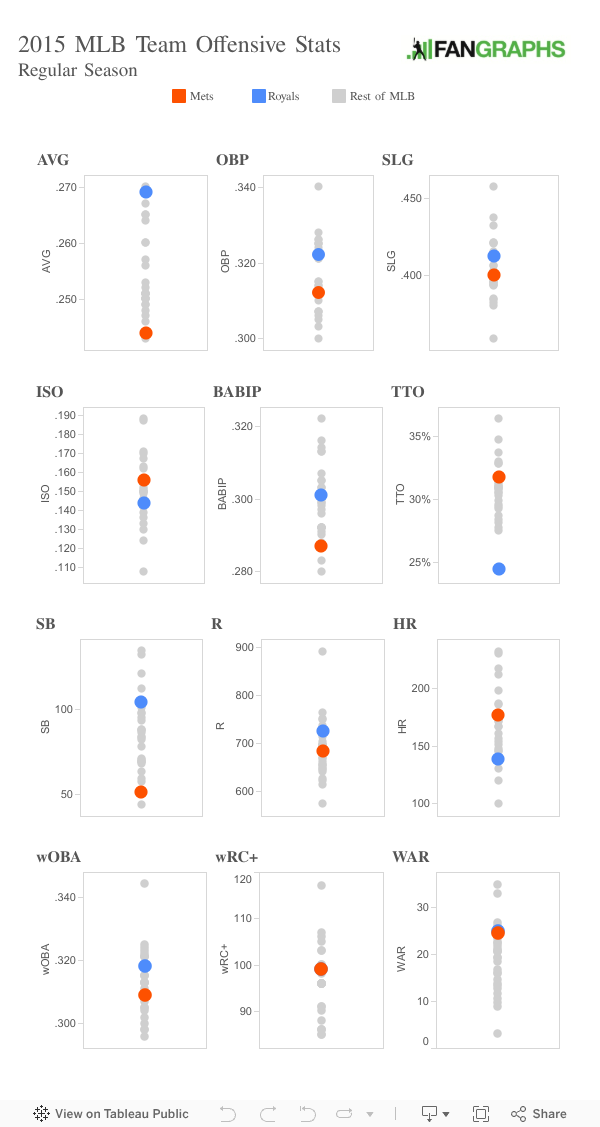
Building off of Eno’s comparison between the Mets and Royals, I built a quick dashboard that shows team offensive and pitching stats for all 30 teams, calling out the two World Series participants. This is just a visual representation of some of the most popular stats on our leaderboards. There are a few interesting extremes such as the three true outcomes (TTO), which Eno looked at yesterday, and batting average.

These plots are box plots without the boxes, so the location of the dot on the y-axis represents the team’s stat in that particular category. A dot’s size and color are just for call out purposes. They are also interactive so you can explore where other teams fall.

Read the rest of this entry »