Touki Toussaint and Prospect Valuation

On late Saturday night, the Diamondbacks and Braves made a trade, but while players were sent in both directions, this was really more of just a sale. Sure, the Braves did give up a player — replacement-level utility guy Phil Gosselin, currently on the DL — in the swap, but they traded Gosselin for a legitimate prospect and a Major League pitcher, which only makes sense when you add in the financial aspects of the deal. In taking on the remainder of Bronson Arroyo’s salary — roughly $10 million, including the buy-out of his 2016 option — the Braves essentially bought pitching prospect Touki Toussaint from the Diamondbacks for that $10 million figure.

While this isn’t an entirely new type of trade — the Dodgers essentially did this same thing a few months ago when they bought a draft pick from the Orioles by taking Ryan Webb off their hands — it’s still a little unusual to see a team make a trade that can so clearly be broken down as a legitimate asset for just straight cash. And in this case, it’s made even more unusual because the team selling the prospect is in rebuilding mode, so we have an organization focused on the future selling an asset with future value in exchange for short-term financial relief.

But it shouldn’t be a big surprise that the team doing the unexpected is the Diamondbacks, who have been marching to the beat of their own drum ever since Tony La Russa and Dave Stewart took over. The D’Backs don’t operate like the other 29 franchises do, and they don’t see things like everyone else, so they make moves that cause a lot of heads to be scratched. This move is no different, with the trade drawing near total criticism from Arizona’s perspective. At its heart, though, this is simply a question of how to value an A-ball pitching prospect, so let’s break this down and see if the D’Backs really did get fleeced on this deal.

Read the rest of this entry »


Dan Szymborski FanGraphs Chat – 6/22/15

11:59
Dan Szymborski: The Szymborski Chat of Sadness and Depression has started. Get your Crying Hats on.

11:59
Dan Szymborski: Not really, but there’s something to be said for setting low expectations and then exceeding them.

12:00
Dan Szymborski: And if the chat sucks, well, I WARNED you.

12:00
:

12:00
Dan Szymborski: But first off, we have other, strangely unrelated to baseball business

12:00
:

Read the rest of this entry »


What If Boston Traded Hanley Ramirez and Pablo Sandoval?

On Friday, Ken Rosenthal of Fox Sports wrote an article titled “Red Sox need to dump Sandoval, Ramirez, like, now.” He states, in essence, that the Red Sox need to dump Pablo Sandoval and Hanley Ramirez, like, now. He states that they’re bad fits for Boston and that the Red Sox should have known that and the only way forward for Boston is to send both elsewhere and pay whatever it costs to do so. Suppose the Red Sox did trade Sandoval and Ramirez. Suppose they followed Rosenthal’s plan and got rid of both. What would happen then? Would Boston be better off? Let’s find out!

Read the rest of this entry »


NERD Game Scores for Monday, June 22, 2015

Devised originally in response to a challenge issued by viscount of the internet Rob Neyer, and expanded at the request of nobody, NERD scores represent an attempt to summarize in one number (and on a scale of 0-10) the likely aesthetic appeal or watchability, for the learned fan, of a player or team or game. Read more about the components of and formulae for NERD scores here.

***

Most Highly Rated Game
Los Angeles NL at Chicago NL | 20:05 ET
Kershaw (93.0 IP, 57 xFIP-) vs. Wada (29.1 IP, 94 xFIP-)
In his collection of aphorisms The Trouble with Being Born, the spiritually embattled and now also dead Romanian philosopher Emil Cioran writes “The more gifted a man is, the less progress he makes on the spiritual level. Talent is an obstacle to the inner life.” Granting, for a moment, the truth of Cioran’s utterance, one is compelled to reason that left-hander Clayton Kershaw lacks much in the way of said inner life — owing, that is, to the flagrancy of his talents. This season, for example, he’s produced thus far both the highest swinging-strike and also overall strikeout rate of his career. Also, somehow, his average fastball velocity remains largely identical to the figures he recorded over each of the past seven years — this, despite the fact that pitchers as a population tend to lose about 0.3 to 0.5 mph each year. Empty, is what he must be on the inside. Empty and hollow. Like a big human kettledrum.

Readers’ Preferred Broadcast: Chicago NL Television.

Read the rest of this entry »


A New Way to Look at Sample Size: Math Supplement

This article is co-authored by Jonah Pemstein and Sean Dolinar.

For the introductory, less math-y post that explains more about what this project is, click here.

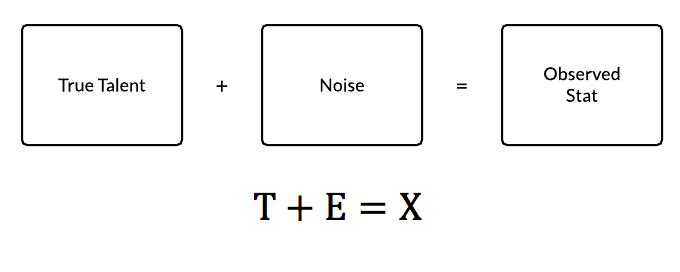
The concept of reliability comes from the classical test theory designed for psychological, research, and educational tests. The classical test theory uses the model of a true score, error (or noise) and observed score. [2]

CTT_EQUATION_diagram

To adapt this to baseball, the true “score” would be the true talent level we are seeking to find, and observed “score” is the actual production of a player. Unfortunately, the true talent level can’t be directly measured. There are several methods to estimate true talent by accounting for different factors. This is, to an extent, what projection systems try to do. For our purposes we are defining the true talent level as the actual talent level and not the value the player provides adjusted to park, competition, etc. The observed score is easy to measure, of course — it’s the recorded outcomes from the games the player in question has played. It’s the stat you see on our leaderboards.

The error term contains everything that can affect cause a discrepancy between the true score and the observed score. It contains almost everything that affects the observed outcome in the stat: weather, pitcher, defenses, park factors, injuries, and so on. This analysis isn’t interested in accounting for those factors but rather measuring the noise those factors in aggregate impart to our observed stat.

Read the rest of this entry »


A New Way to Look at Sample Size

Jonah Pemstein and Sean Dolinar co-authored this article.

Due to the math-intensive nature of this research, we have included a supplemental post focused entirely on the math. It will be referenced throughout this post; detailed information and discussion about the research can be found there.

INTRODUCTION

“Small sample size” is a phrase often used throughout the baseball season when analysts and fans alike discuss player’s statistics. Every fan, to some extent, has an idea of what a small sample size is, even if they don’t know it by name: a player who goes 2-for-4 in a game is not a .500 hitter; a reliever who hasn’t allowed a run by April 10 is not a zero-ERA pitcher. Knowing what small sample size means is easy. The question is, though, when do samples stop becoming small and start becoming useful and meaningful?

Read the rest of this entry »


FanGraphs Audio: The Totally Powerless Dayn Perry

Episode 574
Dayn Perry is a contributor to CBS Sports’ Eye on Baseball and the author of three books — one of them not very miserable. He’s also the guest on this edition of FanGraphs Audio.

Don’t hesitate to direct pod-related correspondence to @cistulli on Twitter.

You can subscribe to the podcast via iTunes or other feeder things.

Audio after the jump. (Approximately 1 hr 2 min play time.)

Read the rest of this entry »


NERD Game Scores for Sunday, June 21, 2015

Devised originally in response to a challenge issued by viscount of the internet Rob Neyer, and expanded at the request of nobody, NERD scores represent an attempt to summarize in one number (and on a scale of 0-10) the likely aesthetic appeal or watchability, for the learned fan, of a player or team or game. Read more about the components of and formulae for NERD scores here.

***

Most Highly Rated Game
Detroit at New York AL | 13:05 ET
Sanchez (91.0 IP, 95 xFIP-) vs. Tanaka (43.1 IP, 71 xFIP-)
Research by the Washington Post’s Christopher Ingraham — summarized in the graph below — reveals that Google searches for the term “hangover cure” are most frequent on Sundays.

Hungover

Insofar as today is Sunday, it follows that a certain percentage of this site’s readers are experiencing la gueule de bois. While this afternoon’s encounter between the Tigers and Yankees doesn’t represent an actual hangover cure, it ought to serve — more than any other of the day’s games, according to the haphazard methodology utilized by the author — as a reasonable means of passing the time.

Readers’ Preferred Broadcast: Detroit Radio.

Read the rest of this entry »


Sunday Notes: Braves, Billy Burns, 3B Coaches, more

Nick Markakis isn’t clearing fences. In his first season in Atlanta, the erstwhile Oriole is without a home run in 294 plate appearances. Despite the paucity of power, he’s been the Braves cleanup hitter in 31 games. Don’t scoff. Markakis has a .314./.404/.407 slash line batting out of the four-hole, Overall, he’s slashing .298/.393/.361.

Even so, he wouldn’t be hitting fourth in a perfect world. Manager Fredi Gonzalez has limited options when he fills out his lineup card. Going into last night, only the Phillies (40) had homered fewer times than the Braves (41) this season. Freddie Freeman has a dozen dingers, and after that it’s basically banjo city.

“Other than Freddie Freeman, he’s our best hitter,” Gonzalez told me earlier this week. “When I first put him there, it was to put a good hitter behind Freddie to protect him a little bit. We want someone who’s going to give us a good at bat, no matter if it’s a home run or a double. I think he’s our best option.”

Markakis used to provide more punch. In nine seasons with the Orioles, he had 141 circuit clouts. Part of that was homer-happy Camden Yards, but it’s not as though Turner Field is a graveyard for fly balls. Off-season immobility is likely contributing to his power outage. Read the rest of this entry »


NERD Game Scores for Saturday, June 20, 2015

Devised originally in response to a challenge issued by viscount of the internet Rob Neyer, and expanded at the request of nobody, NERD scores represent an attempt to summarize in one number (and on a scale of 0-10) the likely aesthetic appeal or watchability, for the learned fan, of a player or team or game. Read more about the components of and formulae for NERD scores here.

***

Most Highly Rated Game
Pittsburgh at Washington | 16:05 ET
Liriano (82.2 IP, 68 xFIP-) vs. Scherzer (93.1 IP, 73 xFIP-)
In the Book of Luke, Jesus of Nazareth relates a parable about a traveler who’s beaten and robbed but then ultimately cared for by a passerby. It’s from this passage that we derive the term Good Samaritan, after the ethnicity of that compassionate citizen. What one extracts from the parable is a working definition of the word neighbor (or plésion, it seems, in the Greek). What else one learns, however, is that two other men had seen the beaten traveler and ignored him entirely. Asshole (or something like malakas in the Greek, it seems), is the word most immediately applicable their particular behavoir.

How’s this relevant to this afternoon’s encounter between the Pirates and Nationals? This is how: instead merely of noting that Francisco Liriano and Max Scherzer have both recorded strikeout rates among the top five by that measure in all the major leagues — instead merely of nothing that and perhaps inserting a link such as this one — what that same author has done, in a fit of neighborly love, is to create an illustrative table for the reader’s benefit and publish it here:

# Name Team IP K%
1 Chris Sale White Sox 88.2 34.3%
2 Clayton Kershaw Dodgers 93.0 32.8%
3 Chris Archer Rays 95.0 31.1%
4 Max Scherzer Nationals 93.1 30.9%
5 Francisco Liriano Pirates 82.2 30.5%

Readers’ Preferred Broadcast: Washington Radio.

Read the rest of this entry »