FanGraphs Baseball

Effectively Wild Episode 688: Success Without Strikeouts, Strange-Looking Lineups, and Other Emails

Ben and Sam discuss their schedule and answer emails about rebellious players, pitching to contact, coaching catchers, and more.


Kyle Seager and the Weaponized Bunt

When I first started getting into sabermetrics, there were a lot of people writing about the stupidity of the bunt. That’s one of the first lessons everyone learns, and, not coincidentally, we’re seeing bunts on the decline, league-wide. More recently, analysts have come to celebrate the bunt. But not the sacrifice bunt — what we want to see more of are bunts against the shift. You could say the play itself is fine; it just requires a certain set of circumstances. Bunting against the shift inspired a whole recurring column at Baseball Prospectus by Ben Lindbergh. It’s a seemingly obvious tactic, that’s also seemingly under-utilized. For now.

So, there are times when it’s smart to bunt. The bunt shouldn’t be eliminated from the game entirely. Sometimes, it’s smart to bunt against the shift. Sometimes, it’s smart to bunt not against the shift, if you’re quick. Sometimes, yes, it’s smart to drop down a sacrifice. And Tuesday night, Kyle Seager demonstrated another sort of intelligent bunt. It didn’t work, but since when do we get wrapped up in the results?

Read the rest of this entry »


Contact Quality: Just a Part of the Puzzle, 2014 NL Pitchers

In the recent past, we’ve discussed many of the various aspects of the emerging granular batted-ball velocity/exit angle data that is becoming more pervasive in the game today. It’s now the starting pitchers’ turn, as we look at the best and worst contact managers in the game in 2014. Last week, we looked at the American League; today, it’s the National League’s turn. There weren’t many surprises among the AL leaders and laggards, but there appear to have been a couple in the senior circuit.

Read the rest of this entry »


On Rotation, Part 2: The Effects of Spin on Pitch Outcomes

On Monday, I looked at how different spin rates for different pitches affect the way those pitches move through the air towards a batter. That post was useful for understanding the relationship between spin and velocity and movement. What it didn’t tell us, however, is too much about what the spin actually does for the pitcher: does more spin make pitches harder or easier to make contact with? Does more spin induce weaker contact? To answer those questions (as well as others), we can look at the actual production from hitters on these pitches. That’s the goal of this post.

The first such stat we’ll consider is contact rate (Contact%), or times made contact (balls in play or foul balls) per swing.

Read the rest of this entry »


How Strong Is Joc Pederson?

Do you like pornography? You don’t have to answer that. Just, here’s some pornography, only of the type that…well, you’re still not supposed to watch at work, but you could at least get away with watching it with your parents:

That’s Joc Pederson, either befriending Coors Field or trying to assault it. According to the ESPN Home Run Tracker, it’s the longest home run of the year, although there is that Coors-related asterisk. Also yesterday, Pederson hit a different mammoth dinger. The day before, he hit a different mammoth dinger. Among those with at least six homers, Pederson has the greatest average distance. Strong hitter. Good rookie.

These are indicators of strength. And there are some other familiar ones. For example, Pederson is tied for second in isolated power, behind only Bryce Harper. He’s barely a percentage point off the lead in home runs per fly ball. The comparisons to Adam Dunn are being made for a reason — lots of walks, lots of strikeouts, lots of power. We know that Pederson has pop. But how else might we be able to think about this? Enter Statcast. Glorious Statcast!

Read the rest of this entry »


Yankees Now the AL East Favorite

The New York Yankees haven’t been to the playoffs since 2012. In itself that’s not all that noteworthy: a two-year playoff drought when the team won 84 and 85 games over the previous two years seems more like bad luck than fundamental organizational error. Over the last two seasons, however, more teams have made the playoffs than haven’t, and the Yankees are in the minority despite their $200 million payrolls. After first planning to cut salaries and then abandoning that plan following a disappointing 2013 season, the Yankees’ spending spree couldn’t quite push them to the playoffs last year. Surprisingly, though, it’s the same collection of injury-prone, aging players from last year who have led to the club’s success over the first two months of the 2015 season.

In 2014, newcomer Jacoby Ellsbury played well, but Brian McCann disappointed on offense, and Carlos Beltran never got things going. Injuries to Michael Pineda, CC Sabathia and Masahiro Tanaka — plus the complete absence of Alex Rodriguez, a compromised Mark Teixeira, and a disappointing farewell for Derek Jeter — meant a second straight season without the playoffs. Hiroki Kuroda played well, but he didn’t return for 2015. During the offseason, the Yankees did more tinkering than make wholesale changes. They brought in Didi Gregorius to play shortstop, retained trade-acquisition Chase Headley, and signed Andrew Miller to replace the departed David Robertson. The Yankees current record of 28-25 is only one game better than their expected winning percentage at the start of the season, but their playoff odds have increased immensely, as the following graph illustrates.

Read the rest of this entry »


Reading Jeff Sullivan to Arquimedes Caminero

First, Jeff Sullivan on Arquimedes Caminero:

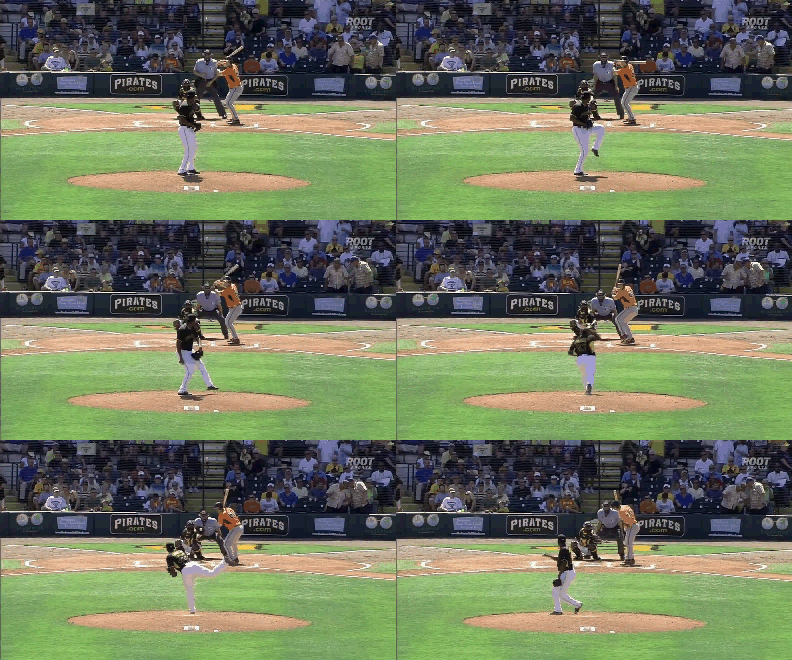
If you just look at the .gifs quickly, they look similar. They are similar — nothing here was overhauled. But, in 2015, Caminero has a higher leg lift, and as his leg comes up, he’s more vertical, eliminating last year’s slight hunch. It also appears he’s reduced his drop on his back leg, and as he comes around, he remains more straight-up. Finally, at release, a year ago, Caminero had some tilt toward the first-base side, with his left knee at an awkward angle. This year, there’s less tilt, and less of that angle, with Caminero’s body aiming him toward the catcher, which channels his energy. His arm, hip, and legs are working together, improving his mechanical efficiency. In this way, a simplified delivery can also squeeze more speed out of all the connective bits.

Then, his GIFS.

caminero-2014

caminero-2015

Finally, Arquimedes Caminero, in response to my reading Jeff Sullivan’s paragraph to him.

“Slowing down to speed it up. Lifting the leg higher, that’s one of the points why my delivery is slower. Staying under control. Everything is combined. Stay taller to get slower. It was very simple. I had that velocity before in Triple-A, but when I came up to the big leagues last year I wasn’t so confident in my fastball, and I was trying throw more strikes than throw for speed. This year, I am just very confident and I’m letting it go. Now I throw the splitter as much as the cutter, they’re not very different, but one is slower and lower and goes to the arm side and the cutter is up here. 89-92 for both. Nothing soft.”

Nothing soft, indeed.


Joey Gallo Arrives in Texas

With Adrian Beltre set to miss the next few weeks with a thumb injury, the Texas Rangers did something a little unexpected. To fill Beltre’s void, they called up top prospect Joey Gallo from Double-A, who ranked 16th on our top-200 list heading into the season. Gallo made his big-league debut last night, and went 3-for-4 with a home run, a double and a walk. The one out he made came via the strikeout.

Gallo’s first big-league homer was a majestic one… Read the rest of this entry »


JABO: Hacking the Draft

Baseball’s Rule 4 Draft commences next Monday, and this year, the Arizona Diamondbacks will have the pick of the litter. While this particular crop might not be as exciting as some others, there are a handful of interesting prospects, including the usual assortment of hard-throwing pitchers and toolsy high school kids who might be useful in five years. These are the guys who are going to draw the most attention and likely go at the top of the draft, as most of the focus remains on identifying and developing potential franchise players.

However, not every draft pick is going to be oozing with upside, especially once you get out of the top half of the first round. After the top handful of players are off the board, teams have to start picking and choosing between guys with pretty notable flaws; maybe the hard-throwing guy only has a fastball at this point, or that impressive athlete hasn’t yet figured out how to hit. Or, as is the case for a large handful of draftees every summer, a lack of size and an inability to hit for power create the sense that a player is “low upside”, profiling as a future utility player or bench guy. A lot of college middle infielders fit this profile, especially the ones who get picked after the first round.

Only there’s something interesting going on in MLB right now; if you look at the majority of the best second baseman in baseball, they almost all were tagged with this “low upside” label in the draft. For example, here are a few of the draft profiles of some of the best middle infielders in baseball right now, courtesy of Baseball America.

Read the rest on Just a Bit Outside.


Dan Szymborski FanGraphs Chat – 6/3/15

12:03
Dan Szymborski: Here we are, face to face, a couple of Silver Spoons.

12:03
Dan Szymborski: Hoping to find, we’re to of a kind, making a go, making it grow

12:03
Dan Szymborski: Together, we’re going to find a way.

12:04
Dan Szymborski: Also, I misspelled two.

12:04
Comment From Professor Ross Eforp
Who might be the next Wade Davis? Is there any way to identify these guys ahead of time?

12:05
Dan Szymborski: To this degree, not really. He always had a good strikeout rate in relief, but his velocity has improved in an off the charts way in relief

Read the rest of this entry »