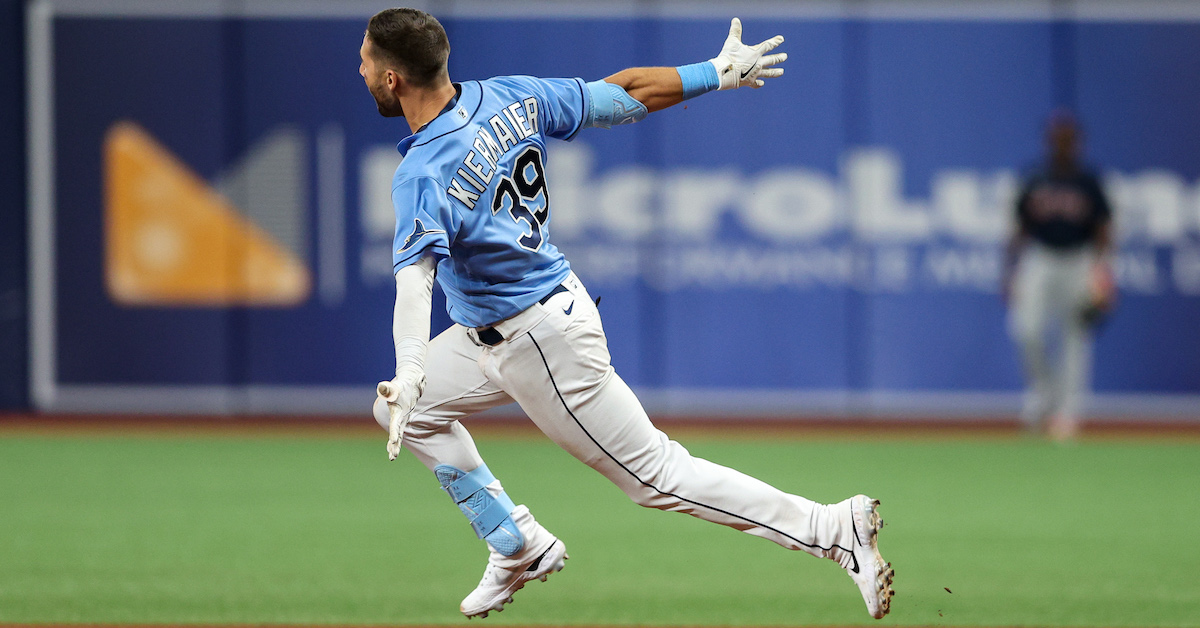
If you were looking for fast-paced, high-stakes baseball action, the tenth inning of Saturday’s Rays-Red Sox clash had everything you could ask for. Scoring? Five runs crossed the plate. Drama? There was a walk-off hit. Balls in play? The Red Sox hit a triple, and the Rays scored a run by combining a balk and a throwing error. Like home runs? It had one of them too.
If you were looking for grind-it-out, low-scoring, perfectly pitched baseball, the other nine innings would have been more your speed. Boston and Tampa Bay combined for two hits and seventeen strikeouts. They used ten pitchers. Runs? Only four runners so much as reached second base.
Which one is modern baseball? They both are. If you wish baseball had more balls in play, with more bunts and steals and plays at the plate, I can’t blame you. If you wish it had more dominant starting pitchers and more seven-inning starts that end with a mound conference and a manager talked into leaving his ace out there for just one more batter, I can’t blame you. But the game being played today is just as captivating, the performances just as impressive. They just come in different shapes and sizes. Read the rest of this entry »
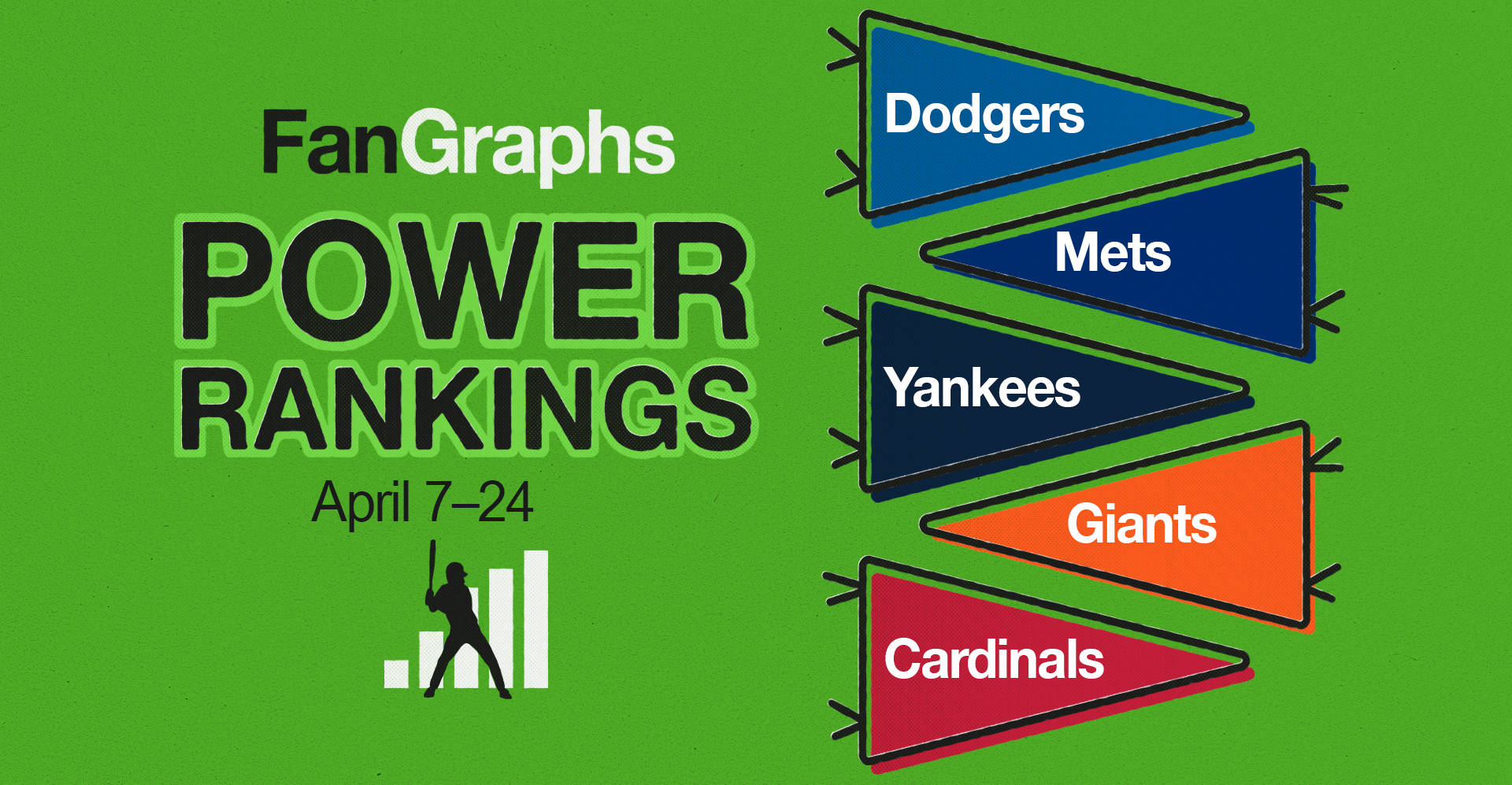
We’re a little over two weeks into the 2022 season, which means it’s time to start assessing the teams that have gotten off to a hot start and those that have struggled. It’s way too early to draw any meaningful conclusions yet, but there are some teams who have shown real improvements so far, and others that have fallen flat despite lofty expectations.
A reminder for how these rankings are calculated. First, we take three most important components of a team — offense (wRC+) and starting rotation and bullpen (a 50/50 blend of FIP- and RA9-, weighted by innings) — and combine them to create an overall team quality metric. New for this year, I’ve opted to include defense as a component, though it’s weighted less than offense and pitching. Some element of team defense is captured by RA9-, but now that FanGraphs has OAA/RAA from Statcast available on our leaderboards, I’ve chosen to include that as the defensive component for each team. I also add in a factor for “luck” — adjusting a team’s win percentage based on their expected win-loss record. The result is a power ranking which is then presented in tiers below.
Tier 1 – The Dodgers
Team
Record
“Luck”
wRC+
SP-
RP-
RAA
Team Quality
Playoff Odds
Dodgers
11-4
-1
119
77
63
0
160
95.7%
No one can really compete with the Dodgers. They possess the best record and the best run differential in baseball, and their Pythagorean win percentage says they “should have” won an extra game too. Their offense has gotten off to a bit of a slow start with Mookie Betts and Justin Turner both mired in early slumps. Luckily, Cody Bellinger’s bat is finally showing signs of life after taking the last two seasons off; he blasted two home runs on Sunday afternoon in a 10–2 drubbing of the Padres. Los Angeles’ pitching staff, meanwhile, has allowed the fewest runs in baseball thus far, with a revitalizedClayton Kershaw leading the way. Read the rest of this entry »
Miguel Cabrera had to wait a couple of extra days to make history, thanks to a hitless afternoon capped by a controversial managerial decision and then a rainout. Nonetheless, on Saturday afternoon he collected his 3,000th career hit with a single off the Rockies’ Antonio Senzatela. In doing so, he joined some elite company as not only the 33rd player to reach 3,000 hits, but also the seventh to do so as a member of the 500-homer club and the third to reach both of those round numbers with a career batting average of .300 or better. The other two? Hank Aaron and Willie Mays. You may have heard of them, and even if you don’t put much stock in batting average, you have to admit that’s about as cool as company gets.
What’s more, Cabrera actually owns the highest batting average and on-base percentage of the seven players who have both milestones, with a wRC+ that trails only Mays and Aaron:
For all of his struggles over the past half-decade, Cabrera would still have to go 0-for-352 to drop his batting average to .299. Even with those struggles and his lack of defensive value (he’s 102 runs below average in terms of Defensive Runs Saved, inlcluding 11 below in just 847.1 innings at first base since 2018), he ranks 11th in JAWS among first basemen (68.8/44.8/56.8), in no danger of slipping below Palmeiro (13th at 71.9/38.9/55.4) or Murray (16th at 68.7/39.2/53.9). And while he may be the last to reach 3,000 hits for some time given the dearth of candidates (Dan Szymborski put Jose Altuve, who has 1,783 hits, at 34% and Freddie Freeman, who has 1,723 hits, at 28% last September), he’s hardly the least. Read the rest of this entry »
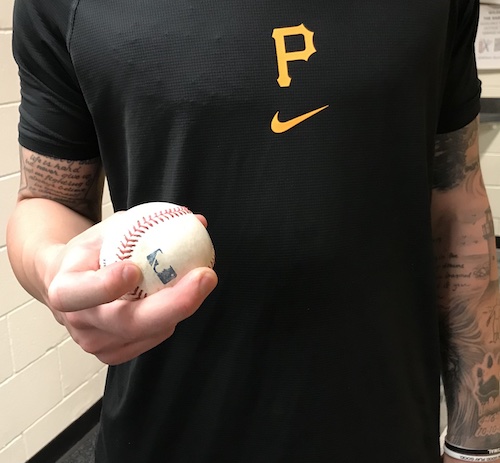
The Learning and Developing a Pitch series is back for another season, and once again we’re hearing from pitchers on a notable weapon in their arsenal. Today’s installment features a pair of Pittsburgh Pirates on their quality curveballs; Chris Stratton is one of the club’s back-end relievers, and prospect Mike Burrows is rated by Baseball America as having the best breaker in the system.
———
Michael Burrows, Pittsburgh Pirates
“My dad said I couldn’t even try to throw a curveball until I had hair under my armpits; that was the saying for him. But yeah, I really started as soon as I could, maybe at 13 or 14, and then just developed feel for it. As I got older — as I continued to progress — I had to change the shape of it, because as hitters got better I couldn’t have a curveball that was popping out. So it’s really been an evolution of a curveball that was in the low-to-mid 70s and has creeped up into the low 80s. It’s sharper now.
“I would say it [improved the most] over COVID, and then as I got into the 2021 season. That spring training, I really started working on building intent and throwing it harder. Metrically, when you look at a curveball that’s over 80 mph, it’s significantly harder to hit — hitters’ numbers go down — and I think that was the biggest turning point for me. Throwing it harder, there’s not a huge decrease in break, but a better shape to where it tunnels my fastball better.
“[Prior to 2020], I didn’t have Rapsodo, TrackMan, or anything like that. Right before COVID hit, about a month until that spring training, I went out and got a Rapsodo. I started diving into the metrics of pitches — why some are better than others, what spin direction was going to do for me. That’s when I really started developing my curveball. I was also throwing with a guy from the Dodgers, Nolan Long — he’s since signed with Athletics — and they have endless amounts of information over there. Another thing I did was take the Rapsodo course, so I could better understand all of the numbers.
“In terms of adjustments, it wasn’t really mechanics; it was more so thinking about that last five percent, rather than the entire motion. It’s about keeping my body under control, and then in that explosion, when I’m really throwing the baseball, is when the effort happens. It’s like a karate-chop motion, where your hand is staying neutral through the throw. It’s that last bit, where the hand is coming through and it rolls over top.
“The curveball was always there for me. It’s not like it had bad spin or anything like that. Everything was there. All I needed was to find a better shape that was going to tunnel my fastball. I still want that 12–6; I still want that vertical break to it. Again, I want to be able to tunnel it, not have it pop out.” Read the rest of this entry »
Peter Gammons didn’t invent the Sunday notes column, but few would dispute that he perfected it. The 77-year-old sportswriter-turned-TV-analyst did so at The Boston Globe, where he began a career that has seen him become the world’s most-influential baseball columnist. To say that Gammons has been an influence on the column you are currently reading would be an understatement.
I’ve had the pleasure of knowing Gammons for years, yet had never asked him about the genesis of his own Sunday column. Chatting with him at Fenway Park earlier this week, I decided to change that.
“I loved the notion of the notes column, and how Dick Young used it,” Gammons said of the late New York-based sportswriter. “I always thought there should be one for every sport. Bob Ryan and I talked about it when we were both interns, in 1968. I’ve always loved the minor leagues, and in 1970 — 1969 was my first full year with the Globe —I asked, ‘Can I write a notes column on the minor leagues?’ The Globe people said fine. This was for the Sunday paper.”
Gammons recalled writing about Bob Montgomery, who came up through the Boston system before catching for them for 10 big-league seasons. (Later a TV analyst on Red Sox games, Montgomery has the distinction of being the last player for any team to come to the plate without a batting helmet.)
In typical Gammons fashion, the other player he mentioned having covered in his nascent notes days was equal parts obscure and interesting. Calling him “a minor league legend as a hitter,” and citing his .300 big-league batting average, Gammons name-checked Chris Coletta. Read the rest of this entry »
Ben Lindbergh and Meg Rowley banter about the reaction to and tactical underpinnings of the Yankees’ controversial decision to walk Miguel Cabrera, the balance between win expectancy and entertainment, and whether analytically-driven changes have hurt baseball as a spectator experience more so than other sports, then (15:19) meet major leaguers Simón Muzziotti of the Phillies and Gosuke Katoh of the Blue Jays, Stat Blast (30:31) about whether increased time between pitches or rising pitch counts has contributed more to longer game times, and answer listener emails about critiquing umpires’ grammar, tool grades for big leaguers, whether the pitch clock could kill the zombie runner, whether young hitters (such as Julio Rodríguez) have ball/strike calls go against them more often, whether surpassing Joe DiMaggio’s hitting streak could propel a player into the Hall of Fame, why free agents tend to take the most lucrative contract offers, wearing the jersey of a player who’s switched teams, the Marlins rostering every major leaguer named Jesús, team games with no outfield outs, and the most unassisted putouts by a player in a game.
As you may already know, I’m something of an intentional walk connoisseur here at FanGraphs. When questionable ones occur, particularly in the playoffs, I like to delve into the specifics to figure out which ones are good decisions, which ones are close calls, and which ones are just plain silly.
Earlier this week, I wrote about Joe Maddon’s bases-loaded intentional walk, which was about as far on the silly end of the spectrum as you can get. Today, I’m going to cover the other notable intentional walk of the week: the Yankees giving Miguel Cabrera a free pass on Thursday. Then, as a bonus, I want to talk about Cardinals manager Oli Marmol and a clever thing he did that might escape notice if you aren’t watching closely. Read the rest of this entry »
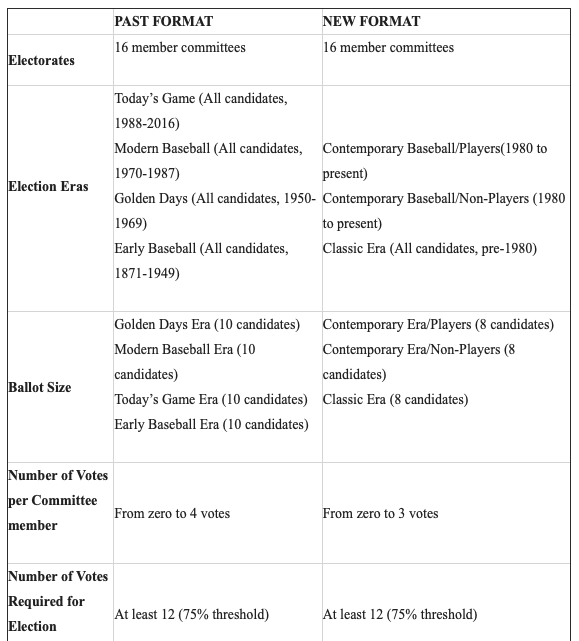
The Hall of Fame has restructured its Era Committees again. Here’s the new structure …
22 Apr 2022
2:03
Jay Jaffe: I will cover this early next week, but for the moment it’s worth sharing that I confirmed with the Hall that yes, the four candidates who aged off this year’s ballot — Bonds, Clemens, Schilling, and Sosa — will be eligible for the 2023 Contemporary Players ballot.
2:05
Jay Jaffe: Finally, I’m going to go see some baseball nerd friends who are in a band — including Mike Petriello and Michael Clair — play a show in Brooklyn tonight. if you’re local, check it out
By his own definition, Max Scherzer had a shot at a no-hitter. In the nightcap of Tuesday’s doubleheader against the Giants at Citi Field, in his first home start since signing with the Mets, he held San Francisco hitless for 5.2 innings before Darin Ruf lined a single to left field, ending the 37-year-old righty’s quest for his third career no-no. “My rule of thumb is when you get one time through the order, you got something going. You get two times through the order, you got a shot,” said Scherzer afterwards. He had turned the lineup over for the second time earlier in that inning; Ruf was the 21st batter he faced.
Scherzer wasn’t the only pitcher to make a run at a no-hitter this week. In the span of just over 24 hours on Tuesday and Wednesday, five starters made it through at least five innings without yielding a hit. Just hours after Scherzer’s effort, the Braves’ Max Fried retired the first 15 hitters he faced at Dodger Stadium before Hanser Alberto lined a single to right field. The next day, the Brewers’ Brandon Woodruff, the Dodgers’ Tony Gonsolin, and the Angels’ Shohei Ohtani all found the holes in opponents’ bats. While none of them made it as far as the nail-biting time in the eighth or ninth innings, the conditions appear primed for the 2022 season to pick up where last year — a season that featured a record nine no-hitters — left off.
Through the first two weeks of the season, starters have taken no-hitters into the sixth inning 10 times:
Even before the controversy involving Kershaw — who became just the second pitcher pulled from a perfect game in the seventh inning or later — and Dodgers manager Dave Roberts, Padres manager Bob Melvin pulled starters with no-hitters in progress in back-to-back games. What’s more, they were his first two regular-season contests with his new team! Like Roberts, Melvin made his moves in light of the fact that his starters hadn’t fully built up their pitch counts after shorter-than-normal spring trainings, and like Kershaw, both Darvish and Manaea publicly supported their manager’s decision. Read the rest of this entry »






 Sponsor Us on Patreon
 Subscribe to Stathead
 Facebook Group
 Effectively Wild Wiki
 Twitter Account
 iTunes Feed
 Get Our Merch!

 Jay Jaffe