Jayne Kamin-Oncea-USA TODAY SportsI have a baseball pet peeve. It’s not the ongoing lockout, though that’s annoying. It’s not batters who endlessly step out of the box to adjust the velcro on their batting gloves. It’s not even my team failing to get a run home from third with less than two outs. My pet peeve is when broadcasts come up with team record statistics that are less than useless.
Today, I’m doing my part to fight back. This article isn’t about analyzing which of those stats are real and which aren’t; it isn’t even about analysis at all. It’s just some dumb statistics of my own that I made up to counter that trope that annoys me more than anything else: “When (basically any event in baseball) happens, the team has an incredible record!” I’ll also give you a baseline, so that when you hear one of these cherry-picked statistics in the future, you can put it into context. Let’s start with home runs. Read the rest of this entry »
Before the lockout froze the offseason, the Rangers were in the middle of an incredibly active winter. They signed Corey Seager and Marcus Semien to massive contracts, and added Jon Gray and Kole Calhoun as well. That was a good start to addressing the needs of a team that lost 102 games in 2021, but per Dan Szymborski’s mid-lockout ZiPS projections, those moves only got Texas to around 73 wins. If the Rangers have designs on competing for a playoff spot in 2022, they’ll need to continue adding to their roster once the owner’s lockout is lifted.
One of those potential additions could come via trade. Back in September, the Rangers were one of the many teams that checked in with the Oakland A’s about a potential deal involving Matt Olson. The Athletics seem likely to tear down their current roster at some point in the near future, possibly as soon as teams are able to trade with each other again. Just last week, Evan Grant of the Dallas Morning Newswrote that the Rangers were “absolutely” planning on revisiting their earlier talks with Oakland.
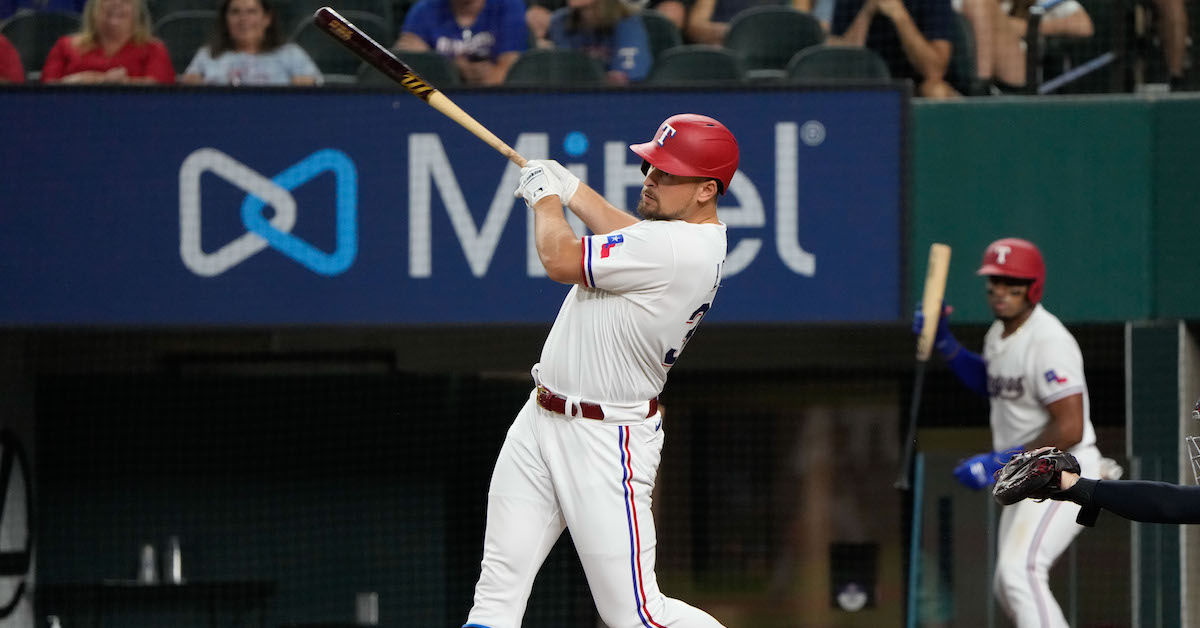
Olson would be a massive addition to Texas’s roster, as he’s coming off a year in which he set career bests in strikeout rate, home runs, wRC+, WAR, and a number of other offensive categories. Of course, the Rangers already have an incumbent first baseman whom they traded for just a year ago. If it came down to it, though, Nathaniel Lowe shouldn’t be much of a barrier to adding Olson to their lineup; Olson is one of the premiere first basemen in the game and only has a year and change on Lowe age-wise. But the Rangers shouldn’t write off Lowe just yet either. He had his ups and downs during his first full season in the majors, but he showed some promise as a potential middle-of-the-order bat in 2021. Read the rest of this entry »
Kody Clemens’s game is built around pop. Playing almost exclusively with Triple-A Toledo, the 25-year-old second baseman went deep 18 times last year in just 424 plate appearances. He knows what he brings to the table. Asked for a self-scouting report, Clemens began by saying he’s “grown to learn that a good part of my game is power.”
Born to a baseball family — his father is the seven-time Cy Young Award winner who shares his surname — Clemens grew up swinging from the left side. That was a matter of happenstance, not of design.
“It just came out that way,” explained Clemens, who is No. 21 on our Detroit Tigers Top Prospects list. “When I was young, my dad put a little bat in my hand and said, ‘Hey, hit the ball.’ I guess I stood up from the left side of the plate. It felt comfortable, so I kept swinging that way.”
The tutelage that followed was predictably based on the perspective of a pitcher. “The Rocket” primarily taught his three sons — Kacy and Koby have also played professionally — about attack plans and how to approach at bats. Mechanics were never much of a focus. Read the rest of this entry »
Ben Lindbergh, Meg Rowley, and Joe Sheehan of the Joe Sheehan Baseball Newsletter discuss MLB’s approach to promoting sports betting and concerns about the integrity of games, then go over some of the most common misconceptions and flawed arguments about MLB labor relations, economics, and competitive balance (plus a postscript about listener nominations for potential MLB multisport players).
We’ve griped enough about the struggle to create baseball content in these troubling times, so the long-form show returns with over 150 minutes of baseball talk, good tunes, and other stuff. This week, I’m joined by Sahadev Sharma of The Athletic. We begin by talking about opioids in baseball before getting into the Cubs and their roster plans for the next few years, as well as their goal to try to set up a streaming service against the wishes of Major League Baseball. Then it’s special guest time as I am joined by Joel Sherman of The New York Post for a 40-minute conversation on the state of the labor negotiations. From there, it’s your emails on evaluating coaches, projecting hit tools, and the best of ballpark food, followed by some talk on listening to movies and the memoir Good Talk by Mira Jacob. As always, we hope you enjoy, and thank you for listening.
Our story so far: At the end of every Hall of Fame election cycle, I have a set of spreadsheets that I update that help me track voting patterns and other long-term trends, as well as some demographics regarding any honorees. Because the 2021 election cycle yielded no honorees — BBWAA voters pitched a shutout, and the two Era Committee votes were postponed — I realized while going through this year’s post-election exercise that I had yet to reckon with the impact of Major League Baseball’s 2020 decision to recognize seven Negro Leagues that operated from 1920 to ’48 as major leagues. Not that I haven’t coveredvariousangles of that decision, particularly as they pertain to the Hall; just that my tools of the trade haven’t kept pace.
I concluded my previous installment with a timeline illustrating the number of active Hall of Famers per team per season, using the Hall’s definition of one game being enough to represent one season played. It’s a display that illustrates the saturation of the immediate pre-World War II era via a very generous Veterans Committee and the extent to which voters haven’t kept pace with the later waves of expansion.
As previously noted, the above version does not include the 28 Hall of Famers elected for their playing careers in the Negro Leagues, a few of whom (Willard Brown, Monte Irvin, and Satchel Paige) had stints in the American and/or National League once they integrated, but not the 10 years needed to wind up on a BBWAA ballot. Adding those players compresses the pre-war peak, quite noticeably:
The scales are the same on the two graphs, but the broad peak in the middle is lower, with the space in the 2.5–3.0 range nearly empty. I did away with the BBWAA/committee distinction on this one, because I can’t stack the values if the denominators are different; the white Hall of Famers are coming from one player pool that for the 1920–48 period was constant at 32 teams, and the Negro Leagues Hall of Famers are coming from another that for the period in question ranged between six and 19 teams.
(Note that I’ve counted every team, even though some were very short-lived, loosely affiliated, and/or lacking in data that’s up to the Seamheads/Baseball Reference standard. I did draw the line by excluding the 1933 Cleveland Giants, who have data for just Negro National League games on B-Ref; they were apparently the replacement for the Columbus Blue Birds, who dropped out, and all 10 of their players appeared with other teams in the league during the same year, so leaving them out seems appropriate. Within the 49 Negro League-seasons now counted as majors, there might be a few other such instances of teams that shouldn’t be double-counted for the purposes of this exercise, but that will require closer study.) Read the rest of this entry »
Remember that one time Lance McCullers Jr. threw 24 curveballs in a row? It was great, and it’s part of Astros (and Lance McCullers Jr.) lore. You’re supposed to intersperse breaking balls with fastballs, to make each play off of the other. Going against that – throwing the same thing over and over again and daring the other team to hit it – is delightful.
What’s so delightful about it? Throwing the same pitch a ton of times isn’t really it. Would you care if peak Mariano Rivera threw 24 cutters in a row, or Jake McGee threw 24 fastballs in a row? Probably not. Fastballs – and for this article, I’m treating a cutter as a fastball – are the default pitch, and if batters aren’t hitting them, why throw something else?
I’d argue that when you’re feeling it, curves and sliders can behave similarly, at least when it comes to the feasibility of throwing them over and over again. McCullers didn’t bounce 24 curves in a row – he commanded plenty of them in the strike zone. His curve isn’t just hard to hit because batters are looking for a sinker. It’s hard to hit because it moves like a hummingbird hunting nectar. It’s definitely cool seeing all those curveballs in a row, but it’s not as though he was relying on the deception of curveball versus fastball to sneak it past batters. They knew what was coming; they just couldn’t do anything with it.
That’s fine, I guess, if you’re into excellent, borderline-unhittable pitches. For truly impressive streaks of identical pitches, though, I’m partial to changeups. The reason for the pitch is right in the name – it’s a change from what the batter is expecting. In Spanish, it’s even more straightforward: cambio. There’s something magical about seeing a batter gear up for a fastball, only to flail awkwardly at something 10 mph slower.
Do it twice, and you’re using the hitter’s expectations against them in a different way, betting that with the changeup out of the way, they’ll go back and look for a fastball. Do it three times, and I’m not sure what you’re looking for. In unrelated news, let’s talk about César Valdez. Read the rest of this entry »
This week on the show, David Laurila is joined by Brian Garman, pitching coach for the Dayton Dragons, High-A affiliate of the Cincinnati Reds.
Garman shares the story of how visiting Driveline back in his playing days — thanks to a recommendation from teammate and friend Caleb Thielbar — led not only to a change of philosophy, but eventually a change of career. Now focused on teaching instead of throwing, he shares his thoughts on how the challenge of increasing velocity can vary player to player, the relationship between command and improved velocity, and how important stuff continues to be in pitching development. We also hear about his experience with players like Bryce Bonnin, Stevie Branche, Carson Spiers, Vincent Timpanelli, Braxton Roxby, and more.
To purchase a FanGraphs membership for yourself or as a gift, click here.
To donate to FanGraphs and help us keep things running, click here.
Don’t hesitate to direct pod-related correspondence to @dhhiggins on Twitter.
Summary of Responsibilities:
The role of the Data Engineer will be to design, develop, and maintain modern, scalable baseball data processing systems for the St. Louis Cardinals. This person will collaborate with the Baseball Systems group to ensure that quality data, analytics, and visualizations are accessible in a timely fashion to front office members, scouts, coaches, players, and others in Baseball Operations. This person should be detail-oriented, enjoy collaborating with others, communicate effectively both verbally and in writing, keep up with the latest tools and technologies, and have strong interest in the game of baseball.
The St. Louis Cardinals are committed to building an inclusive organization where we have a diverse workforce as well as a culture where employees feel they belong and can contribute their unique qualities to the team. The Cardinals are dedicated to continuously building a diverse staff, and we strongly encourage candidates who are members of historically marginalized groups which may include, but are not limited to persons of color, LGBTQIA, gender, veterans, and persons with disabilities, to apply. If you meet any of the qualifications listed below we welcome you to apply, or to reach out to us at hrinfo@cardinals.com for more information. Read the rest of this entry »



 iTunes Feed
 Sponsor Us on Patreon
 Facebook Group
 Effectively Wild Wiki
 Twitter Account
 Get Our Merch!


