FanGraphs Baseball

The State of FanGraphs 2026
Mark J. Rebilas-Imagn Images

Hello! This year marks 21 seasons of FanGraphs, and as we look ahead to the August 5 anniversary of our launch, I wanted to thank you for reading and visiting the site. And, as has become an annual tradition, I also wanted to provide you with an update on the state of FanGraphs.

I started last year’s version of this piece by listing all of our new features and site improvements. As this year’s list is even longer, instead of detailing everything up front, I’ve included a Feature Appendix at the bottom of this post. Take a look – it’s quite a scroll. What I was struck by as I was compiling that list is just how much we’ve been able to accomplish with our Members’ support, support that has translated into new features, voices, data, and other random fun stuff you didn’t even know you wanted. From the written work of our dedicated team of baseball experts to all the stats and leaderboards, the data and fantasy tools to the prospect analysis, the projections, RosterResource, the mobile app, the podcasts, the chats — the depth and breadth of the site is very special. Plus, we do it all without private equity funding or sports betting partnerships, allowing us to produce the independent analysis and high-quality tools you’ve come to rely on.

And while I think the future of FanGraphs is bright, I also think it’s worth talking about the realities of running a sports media site in 2026, the challenges we see looming, and why your support matters more now than it ever has before.

First, if you are a FanGraphs Member, thank you so much for your continued support. Membership is set to account for about 80% of our revenue this year. Six years ago, that number was about 25%. Still, our Members only make up about 2% of what we believe to be the real-life human visitors to the site. We want our work and data to be accessible, but we’re up against a number of challenges.

Data Is More Expensive

FanGraphs isn’t free to operate. We don’t scrape data, opting instead to maintain agreements with all our data providers. This has been our model from day one, both because I wanted FanGraphs to be sustainable and for our data to be reliable, and because people deserve to be paid for their work. This strategy seems to have worked out, but it comes at a cost. Our data costs have nearly doubled over the past five years. At the same time…

Advertising Revenue Is Down, While Bots and Scraping Cost Us More

Our advertising revenue has decreased 50% since 2024. There are multiple factors at work here, some of which are good. We’ve decreased the number of ads on some pages, and our Members enjoy a fully ad-free experience as one of their Member benefits. But as I mentioned, even with the growth we’ve seen, Members only account for about 2% of our total users, and there is a massive discrepancy between the ads served to non-Members and the number of pageviews we’ve served. This May, multiple site analytics tools we use claim we served about 12 million pageviews to non-Members; ads were served on just 2.1 million of those pageviews. That’s only about 18% of pageviews, compared to 51% two years ago. That’s a staggering amount of missing ad revenue.

Non-Member Pageviews/Pageviews With Ads
Time Frame Total Pages Pages with Ads % With Ads
May 2024 6.9M 3.5M 51%
May 2025 7.5M 2.5M 33%
May 2026 12M 2.1M 18%

Two things are likely happening here. First, we’re seeing a lot more bot traffic, which often doesn’t register as the sort of browser session that advertisers care about. We estimate that at least 60% of all traffic coming to FanGraphs is from non-human sources, including web crawlers, AI bots, and scrapers. In addition to the decline in ad revenue, this has led to increased server costs and us spending valuable time figuring out where the offending traffic is coming from in order to keep the site operational.

Second, folks are much more apt to use ad blockers these days, so while our overall site traffic hasn’t declined, our non-Member users are seeing ads at much lower rates. This creates the untenable situation where we’re serving up more content, but also serving up fewer ads because those ads are either being blocked, or the thing using our resources isn’t even a person.

Those are some of the challenges we face right now, but the landscape we operate in also has some big potential shocks on the horizon, one likely to affect digital publishing more generally, the other specific to baseball.

The Impact of AI

First, I’ll take this opportunity to share our editorial policy around the use of AI. All of the editorial content at FanGraphs is written entirely by the members of our staff, without any assistance from generative AI models, and that will remain our policy going forward. You don’t come to FanGraphs to read ChatGPT’s analysis, and there’s no way it could come up with the headlines Michael Baumann does.

And while the development team has found AI to be a useful coding tool, we don’t use it to create stats or metrics, or ask it to source the data displayed on the site. I have no interest in Claude hallucinating Jacob Misiorowski’s strikeout rate or average fastball velocity (though you’d be forgiven for wondering if either is real).

Of course, AI’s impact goes beyond the need for code checks or an editorial policy. Put simply, AI is taking our content and repurposing it in a way that could make it so that there’s no need to actually visit the site. Indeed, changes to many popular search engines mean many people unfamiliar with FanGraphs might not even discover the site in the first place. Just think about the AI results you see on Google. How many people are going to click through to our Brewers Top Prospect list, a piece that took days to write and edit, when Gemini will serve up much of Jesús Made’s scouting report, tool grades and all? If there’s ever been an existential crisis for online publishers, it’s this. Whether it’s Membership or advertising revenue, our business model depends on visiting the site, and AI seems poised to keep people away, eroding the link between writers and readers.

Baseball’s Looming Lockout

The precise impact of this winter’s seemingly inevitable lockout is tough to gauge, as it will greatly depend on how long it takes MLB and the Players Association to reach an agreement. But if the pandemic and the last lockout taught us anything, it’s that not having major league baseball isn’t great for a baseball media site. We saw our traffic dip 50% during the 2021-22 lockout. The support of our Members helped us weather it, but it was a challenge, and if we were to lose an entire season, I’m not sure what it would mean for FanGraphs without significant Membership growth.

So what should you take from all of this? Well first, become a FanGraphs Member! Membership allows us to continue to grow and improve the site, providing a source of revenue that’s immune from macro forces like AI or baseball’s labor dispute, and that’s more stable than advertising. We’re in a moment where it’s incumbent upon all of us to support the writers, artists and publications we love, or risk losing them. Obviously I hope FanGraphs is on that list for you, but this isn’t just a FanGraphs thing. Unfortunately, the era of good free content is over. Ultimately, the advertising model syphoned a shocking amount of money away from publishers to middlemen and tech giants, and AI is threatening to destroy one of the most reliable ways for us to surface our work to new readers. But your direct support puts you in the driver’s seat. It’s not what SEO wants, or AI wants, or what the advertisers want. It’s what you want.

Our pledge to you is that if you support us, we’ll keep producing all the great baseball analysis you’ve come to rely on, and continue to grow the site in new and interesting ways, just like we have for the past 21 years.

New Feature Appendix

More Voices

  • Four New Full-Times Hires
  • Six New Contributors

FanGraphs Lab

New App Features

  • Greater Customization
  • RosterResource Integration
  • Prospect Integration, including The Board
  • Score and Game Status Push Notifications
  • Article Push Notifications
  • College Leaderboards
  • KBO Leaderboards
  • NPB Leaderboards

Over 100 New Metrics, Including…

RosterResource

Site Enhancements

Projections

Other Cool Stuff

  • Spring Training and Holiday Headers
  • WBC Flag Banners and Opening Day Bunting
  • Additional FanGraphs Walk-Off Metrics
  • Trade Value ELO
  • New Merchandise

Effectively Wild Episode 2495: Rank Amateurs

EWFI
Ben Lindbergh and Meg Rowley banter about Joey Meneses and John Brebbia being back in the big leagues, Mike Trout’s hamstring strain, Dillon Dingler’s dominance, a Blue Jays All-Star voting update, the latest Home Run Derby format change, MLB’s radical amateur drafts proposal, the DOJ’s MLB investigation and the York Revolution’s Pride event, Rafael Devers vs. Tony Vitello, and the struggle-bus swan songs of Max Scherzer and Justin Verlander, plus (1:40:06) a postscript.

Audio intro: Xavier LeBlanc, “Effectively Wild Theme”
Audio outro: Garrett Krohn, “Effectively Wild Theme”

Link to MLB.com on Meneses
Link to MLBTR on Meneses
Link to MLBTR on Brebbia
Link to Ben on Meneses
Link to Brebbia on EW
Link to “Cecilia”
Link to MLB.com on Trout
Link to latest All-Star tallies
Link to AL “as 2B” leaders
Link to “primary 2B” leaders
Link to team OF rankings
Link to AL WAR leaders
Link to FG framing leaders
Link to Savant framing leaders
Link to on-pace leaders
Link to catcher batting leaders
Link to Derby report
Link to Derby format wiki
Link to The Athletic on MLB’s proposal
Link to ESPN on MLB’s proposal
Link to Cohen tweet
Link to BA on MLB’s proposal
Link to Dan S. on MLB’s proposal
Link to DOJ investigation story
Link to DOJ investigation story 2
Link to player reaction to investigation
Link to York Revolution statement
Link to York Revolution news story
Link to York Revolution wiki
Link to York Revolution news segment
Link to Teter clip
Link to story on Treinen
Link to Manfred letter
Link to York County voting results
Link to York County voting story
Link to Devers/Vitello interaction
Link to Devers/Vitello story 1
Link to Devers/Vitello story 2
Link to MLB.com on Scherzer
Link to Verlander quotes
Link to Verlander’s 25 things
Link to Upton story
Link to Verlander’s pitching splits
Link to Fleisig paper
Link to “tree of liberty” quote
Link to “rigor mortis” quote
Link to Worthington obit
Link to Episode 1505
Link to Shreiber obit
Link to Draft No. 4
Link to One Writer’s Beginnings
Link to Red McDermott at B-Ref
Link to Maximum Pleasure Guaranteed

 Sponsor Us on Patreon
 Give a Gift Subscription
 Email Us: podcast@fangraphs.com
 Effectively Wild Subreddit
 Effectively Wild Wiki
 Apple Podcasts Feed 
 Spotify Feed
 YouTube Playlist
 Facebook Group
 Bluesky Account
 Twitter Account
 Get Our Merch!
1:52:54

How Much Would MLB’s Draft Proposal Cost the Best Players?

Brett Davis-Imagn Images

Late last week, Major League Baseball proposed to drastically change the game’s player developmental system. Beginning in 2028, the domestic draft would be cut from 20 rounds to 12, and eliminate eligibility for high schoolers — players would need to be at least 20 years old and two years removed from high school to be drafted. Players who choose to play for a JUCO school would need to do so for both seasons, rather than the one-year requirement currently in place. Most players at a four-year college would become draft eligible a year earlier under MLB’s new proposal; right now, they are not eligible for the draft unless they turn 21 by August 1 of their draft year or until after their third year a four-year college. MLB’s proposal would move the age cutoff date back to September 1. More than 40% of the dollars would be pared from the draft pool, with the most recent $358.7 million available slashed to $200 million.

On the international side, MLB proposed instituting a new draft, an idea originally discussed during the last set of CBA negotiations. The draft, which would begin in 2027, would require players to be at least 18 years old by September 1 of their draft year. The draft pool would stay mainly intact otherwise, with the same $200 million available for international draftees as domestic ones, pretty close to the nearly $199 million that was in the final draft bonus pool in 2025.

We don’t need to do any detective work to figure out where the savings go. As was the case with the league’s parallel salary cap proposal, which management disingenuously promoted as a way to improve competitive balance, this proposal is part of the ever-continuing quest of owners to transfer money from the players’ pockets to their own. Based on pretty much every example ever, the money saved will not offset consumer costs, and I’d be shocked if it was redirected to improve the pay of team staffers, who tend to take in reduced salaries for the privilege of working in baseball, or minor leaguers.

J.J. Cooper covered the proposal in greater detail over at Baseball America, so I won’t go too in the weeds on it here today. Instead, I want to spotlight how much money the proposal would cost the game’s top players. Read the rest of this entry »


FanGraphs Power Rankings: June 15–21

Most teams hit the halfway mark in their seasons last week, and the standings are no closer to resolving themselves. It’s a wide open Wild Card field in both leagues, with surprise contenders like the Nationals and Marlins sticking around in the race.

Our power rankings use a modified Elo rating system. If you’re familiar with chess rankings, you’ll know that Elo is an elegant ranking format that measures teams’ relative strength and is very reactive to recent performance. To avoid overweighting recent results during the season, we weigh each team’s raw Elo rank using our coin flip playoff odds (specifically, we regress the playoff odds by 50% and weigh those against the raw Elo ranking, increasing in weight as the season progresses to a maximum of 25%). The weighted Elo ranks are then displayed as “Power Score” in the tables below. As the best and worst teams sort themselves out between now and October, they’ll filter to the top and bottom of the rankings, while the exercise remains reactive to hot streaks and cold snaps. If you’re looking for a visual representation of the ups and downs of your team throughout the season, look no further than the brand new Power Rankings Board in the FanGraphs Lab.

First up are the full rankings, presented in a sortable table. Below that, I’ve grouped the teams into tiers with comments on a handful of clubs. You’ll notice that the official ordinal rankings don’t always match the tiers — there are times where I take editorial liberties when grouping teams together — but generally, the ordering is consistent. One thing to note: The playoff odds listed in the tables below are our standard Depth Charts odds, not the coin flip odds that are used in the ranking formula.

FanGraphs Power Rankings
Rank Team W-L Hot/Cold Elo Opp Elo Playoff% Power Score Δ
1 LAD 49-29 — 1586 1492 99.9% 1603 0
2 MIL 46-29 🛣️ 1571 1498 95.4% 1584 1
3 ATL 48-28 ❄️ 1565 1495 97.8% 1583 -1
4 NYY 46-30 — 1557 1491 99.3% 1577 0
5 PHI 42-35 — 1567 1508 81.0% 1562 0
6 TBR 43-31 ❄️ 1512 1485 85.5% 1533 0
7 MIA 40-38 🔥 1533 1506 18.6% 1519 4
8 TOR 38-39 — 1520 1502 53.9% 1514 7
9 CLE 41-37 — 1500 1504 60.2% 1510 -1
10 SEA 40-39 — 1508 1490 82.2% 1509 0
11 STL 41-34 ⛵ 1507 1497 46.5% 1509 -2
12 CHW 39-37 🛣️ 1499 1501 20.3% 1504 -5
13 WSN 40-38 — 1502 1505 5.9% 1492 -1
14 BAL 37-42 🛣️ 1499 1507 28.0% 1484 6
15 MIN 38-41 🔥 1492 1492 32.2% 1484 9
16 CHC 40-37 ⛵ 1488 1495 46.2% 1483 3
17 ARI 39-38 ⛵ 1494 1502 27.8% 1482 -1
18 HOU 37-42 ⛵ 1494 1489 27.1% 1481 4
19 PIT 39-39 — 1493 1502 38.6% 1479 -1
20 TEX 37-40 ❄️ 1484 1503 38.0% 1477 -7
21 SDP 39-37 — 1485 1500 17.5% 1477 -7
22 ATH 38-40 ⛵ 1477 1497 36.6% 1475 -5
23 NYM 34-43 🛣️ 1487 1497 15.2% 1462 -2
24 CIN 37-39 — 1478 1503 8.2% 1462 1
25 BOS 31-44 — 1467 1513 10.1% 1446 -2
26 DET 33-44 — 1465 1496 22.7% 1446 1
27 SFG 31-46 — 1458 1515 2.2% 1434 -1
28 KCR 32-46 — 1450 1496 4.6% 1429 1
29 LAA 32-47 — 1444 1499 0.6% 1423 -1
30 COL 30-48 — 1420 1513 0.0% 1400 0
🔥 Elo up >20 pts (last 10) | ❄️ Elo down >20 pts (last 10)
🛣️ Avg opp Elo >1525 (last 10) | ⛵ Avg opp Elo <1475 (last 10)

…

Tier 1 – The Dodgers
Team Record Elo Opponent Elo Playoff Odds Power Score
Dodgers 49-29 1586 1492 99.9% 1603

After beginning the week with a three-game sweep of the Rays, the Dodgers dropped two of three to the Orioles over the weekend. Still, with the Padres floundering, Los Angeles has opened up the largest division lead in baseball, at nine games. Thanks to an excellent starting rotation and a potent lineup, the Dodgers shouldn’t have any trouble locking up their 13th division title in the last 14 years.

Tier 2 – On the Cusp of Greatness
Team Record Elo Opponent Elo Playoff Odds Power Score
Brewers 46-29 1571 1498 95.4% 1584
Braves 48-28 1565 1495 97.8% 1583
Yankees 46-30 1557 1491 99.3% 1577
Phillies 42-35 1567 1508 81.0% 1562

In what could be a postseason preview, the Brewers and Braves met over the weekend, with Milwaukee avoiding a sweep with a big win on Sunday. The Brewers lost a game that Jacob Misiorowski started for the first time since May 13 and a game that Kyle Harrison started for the first time since April 11. With Brandon Woodruff on the verge of returning from the IL, this team could have a formidable trio anchoring the rotation down the stretch this season.

As for the Braves, their worst stretch of their season continued into last week, with their two losses to the Giants in a rain-shortened series dropping them to 1-6 in their previous seven games. Atlanta got things back on track with that big series win over the Brewers this past weekend. Drake Baldwin was activated off the IL last week, providing some needed reinforcements for the injury-depleted roster.

The Yankees have fared well since placing Aaron Judge on the IL at the beginning of the month. They’re 10-7 without him and have wrestled control over the AL East away from the Rays. Even so, New York scored only three runs across the final two games of its weekend series against the Reds, both losses. Ben Rice has done his best to make up for the missing Judge; he blasted three home runs last week.

The lopsided nature of the Phillies lineup was on full display over the weekend against the Mets. Bryce Harper hit for the cycle on Saturday and added three more hits and a home run on Sunday, while Kyle Schwarber hit four home runs, three of them on Saturday. On the season, the non-Harper/Schwarber hitters on the Phillies have combined for an ugly .226/.279/.353 slash line, a 73 wRC+. Impact position players have to be high on Philadelphia’s wish list as the trade deadline approaches next month.

Tier 3 – Solid Contenders
Team Record Elo Opponent Elo Playoff Odds Power Score
Rays 43-31 1512 1485 85.5% 1533
Marlins 40-38 1533 1506 18.6% 1519
Blue Jays 38-39 1520 1502 53.9% 1514
Guardians 41-37 1500 1504 60.2% 1510
Mariners 40-39 1508 1490 82.2% 1509
Cardinals 41-34 1507 1497 46.5% 1509
White Sox 39-37 1499 1501 20.3% 1504

The Rays’ early-season success in one-run games has quickly turned sour; they went 1-4 in one-run contests last week alone, and have gone 2-7 in those close games since the beginning of June. Elsewhere in the AL East, the Blue Jays have looked a lot stronger recently. Toronto swept the Red Sox last week before splitting a rain-shortened series against the Cubs over the weekend. George Springer collected seven hits and two home runs last week, and the team is planning on activating Shane Bieber off the IL on Monday.

Over in the AL Central, the Guardians and White Sox meet for a huge series this week in Chicago. These two rivals will play each other seven times over the next two weeks, a massive opportunity for either of them to take control of the division. After playing so well against the Braves and Dodgers a few weeks ago, Chicago stumbled against the Yankees and Tigers last week, losing five of six. Meanwhile, the Guardians limped along without both José Ramírez, who underwent surgery on Tuesday for a fractured hamate bone, and Chase DeLauter, who landed on the injured list on Wednesday with a right side rib fracture, going 2-4 against the Brewers and Astros last week.

The Mariners activated Cal Raleigh and J.P. Crawford off the IL last week — and Randy Arozarena shouldn’t be too far behind them. Even with that duo’s return, Seattle scored no more than three runs in any of its games last week, but still wound up with a 3-3 record thanks to some strong pitching. Logan Gilbert had a pair of brilliant starts, tossing 13 1/3 innings with 18 strikeouts and just two runs allowed. The Mariners have managed to barely stay ahead in the AL West over these last few weeks, but they are also one of just three teams in the AL with a positive run differential. Eventually, the offense should start to click now that it’s mostly healthy.

Tier 4 – The Melee
Team Record Elo Opponent Elo Playoff Odds Power Score
Nationals 40-38 1502 1505 5.9% 1492
Orioles 37-42 1499 1507 28.0% 1484
Twins 38-41 1492 1492 32.2% 1484
Cubs 40-37 1488 1495 46.2% 1483
Diamondbacks 39-38 1494 1502 27.8% 1482
Astros 37-42 1494 1489 27.1% 1481

The Twins have gone 8-3 over their last 11 games and are suddenly in the mix in the very crowded AL Wild Card picture. Byron Buxton has been crushing the ball recently. He’s up to a .317/.368/.698 slash line in June (189 wRC+) with seven home runs, and on the season, he’s now one homer behind Yordan Alvarez for the AL lead. It’s not just Buxton either; the entire offense is humming along, scoring 6.9 runs per game during this stretch. I’m not sure Minnesota has the pitching to stick around in the playoff race, but it’s certainly been a promising season so soon after the team’s big sell-off last summer.

The Cubs’ up-and-down season has sort of calmed down over the last three weeks; they’re 8-9 in June, and their longest winning or losing streak has been three games during this stretch. Pete Crow-Armstrong has been on fire this month, running a gaudy .437/.481/.930 slash line (281 wRC+) with nine home runs. He’s done his best to lead the offense, but the pitching staff is still dealing with a bunch of injuries. Last week, Daniel Palencia hit the IL for the second time this season, though Matthew Boyd is on a rehab assignment now and on track to return soon.

The Diamondbacks have managed to hang around in the NL Wild Card race, but their season took a turn for the worse last week when they placed Michael Soroka, Ryne Nelson, and Jordan Lawlar on the IL. It’s unfortunate timing for Lawlar, who had just returned from a wrist injury a week ago, but losing the pitchers — Soroka to a left glute strain and Nelson to a right elbow strain — is of greater concern. Soroka’s absence is the biggest blow; he has been the team’s best pitcher and one of the lone bright spots in a starting rotation that has been shaky all season long. With Corbin Burnes suffering a setback in his rehab from Tommy John surgery that pushes his recovery timeline back a couple of months, it doesn’t seem like reinforcements are arriving anytime soon for this beleaguered pitching staff.

Tier 5 – The Muddy Middle
Team Record Elo Opponent Elo Playoff Odds Power Score
Pirates 39-39 1493 1502 38.6% 1479
Rangers 37-40 1484 1503 38.0% 1477
Padres 39-37 1485 1500 17.5% 1477
Athletics 38-40 1477 1497 36.6% 1475
Mets 34-43 1487 1497 15.2% 1462
Reds 37-39 1478 1503 8.2% 1462

It was two steps back, one step forward for the Rangers last week. They got swept by the Twins before turning around to win their weekend series against the Padres. Wyatt Langford has been excellent since being activated off the IL on June 5, collecting 19 hits and five home runs in 15 games. Still, with Corey Seager sidelined again and Jack Leiter placed on the IL with an ankle issue last week, Texas is struggling to gain ground in the AL West standings.

The Mets finished May with a 16-12 record that helped them climb to seven games under .500. They haven’t been able to make any progress past that point in June, and a 2-4 week against the Reds and Phillies certainly didn’t help. Juan Soto is trying to carry the team on his back — he’s slashing .415/.529/.780 (258 wRC+) with four home runs over the last two weeks — but the rest of the roster isn’t giving him much support. Francisco Lindor is on the mend and should be activated off the IL sometime this week, but it feels like it’s already too little, too late.

Tier 6 – No Man’s Land
Team Record Elo Opponent Elo Playoff Odds Power Score
Red Sox 31-44 1467 1513 10.1% 1446
Tigers 33-44 1465 1496 22.7% 1446
Giants 31-46 1458 1515 2.2% 1434

These next three weeks have the potential to define the Tigers’ season. With a sweep of the White Sox over the weekend providing some momentum, they’re entering a critical part of their schedule; they’ll face the Yankees, Astros, and Yankees again, followed by the Rangers, Athletics, and Phillies before heading into the All-Star break. If they can emerge from this gauntlet with a positive record, they could gain some ground in both the AL Central and Wild Card standings. Any further stumbles during this stretch, and they’re probably looking at selling at the trade deadline.

Tier 7 – Hope Deferred
Team Record Elo Opponent Elo Playoff Odds Power Score
Royals 32-46 1450 1496 4.6% 1429
Angels 32-47 1444 1499 0.6% 1423
Rockies 30-48 1420 1513 0.0% 1400

Even after a series win against the Cardinals over the weekend, it might be time to start looking toward next year for the Royals. Bobby Witt Jr. sprained his MCL on Thursday, and while he hasn’t been placed on the IL yet, he sat out the team’s last two games. Losing the AL MVP frontrunner for any amount of time would be devastating. Salvador Perez has limped to a 58 wRC+ in his age-36 season, and Maikel Garcia has struggled to replicate his breakout from last year. You can’t count anyone out in such a mediocre AL playoff field, but the Royals desperately need to turn things around soon if they want to make a run.

The Angels placed Mike Trout on the IL last week with a hamstring injury. He had slowed down just a bit after his torrid start to the season, but he was still the beating heart of this ball club and enjoying a bit of a renaissance year. It was obvious to everyone except the Angels, but this organization desperately needs to turn toward the future. That’s why it was encouraging to see Denzer Guzman, the team’s sixth-ranked prospect entering the season, blast home runs in three straight games over the weekend. He probably won’t be a star, but any positive developments from the pipeline have to be taken as wins at this point.


The Early Shift: In a Blender

Gerry Angus-Imagn Images

Hello. While on paternity leave, I kept a journal about baseball and my daughter, who is not named Derek Jr., but who will henceforth be referred to as Derek Jr. You can read all of the entries here.

May 9
We have a delightful new tradition in our apartment called Family Nap. When Derek Jr. goes down to sleep in the middle of the day, my wife and I do the same. The whole family naps. It’s a Family Nap. We really need it today. I didn’t get much sleep during the early shift, then at 6:30 AM, I handed Derek Jr. off to my wife, who didn’t get all that much more sleep than I did because she was up twice pumping. Something in your body rebels at going to bed — not as a nap, but as a regular part of your sleep — as the sun is rising. I wake up three hours later and Derek Jr. is already down for her first nap of the day, so my wife encourages me to try for a little more sleep. I give it my best shot, but when I get back into bed, something is wrong with my equilibrium. Every time I close my eyes, it feels like I’m rocking in the rocking chair. It strikes me as a worrisome development.

In the afternoon, Derek Jr. blows out two diapers as violently as anyone has ever blown out a diaper — she’s a hurricane; they’re the roof of the Trop. At some point in the last couple weeks, I wrote down a note for this journal that says, “Blowing out a diaper is like a ringing double.” However, after checking with some friends, it turns out that I didn’t actually know what the definition of a ringing double was. Maybe I’ll write about that later and leave the shredded diapers out of it.

Maxar Technologies USA Today Network via Imagn Images

The blowouts have depleted our supply of onesies. We’re down to our last one, a tie-dye number of indeterminate origin. Hurricane Derek Jr. doesn’t seem to mind it, and after all her hard work, she decides she’s earned some sleep. As she drifts off in my arms, my wife and I make the momentous decision to follow suit. It’s a genuinely exciting prospect. When I said earlier that Family Nap was a tradition, I may have been overstating things a bit. It’s more of a vision at this point. It’s a dream of a better future.

When you have a baby, people tell you all the time that you have to sleep when the baby sleeps. That’s what they say: “You have to sleep when the baby sleeps.” And they’re right. You have to sleep when the baby sleeps. But you also have to do the laundry. And the dishes. And you have to boil water for formula and sterilize the baby bottles and pacifiers. You have to cook and eat and shower and go to the pharmacy and get groceries, and wow, we’re way behind on thank-you notes, and pay the bills, when’s the last time you shaved, and get on the phone to dispute another denial from Goddamned UnitedHealthcare, and try to do at least a bare minimum of tidying up if only so that you don’t feel like you live in a Babies “R” Us that just got hit by a tornado, and then, after all that, maybe, just maybe, you can unwind by taking a nice, calming, deep breat – nope, the baby is awake and crying. Deep breaths will have to wait.

Today, though, we’re doing it. I transfer Derek Jr. to the crib, we get a load of laundry going, and, whispering so as not to wake the baby, my wife starts a chant: “Fam-ly Nap! Fam-ly Nap! Fam-ly Nap!” I suppose this one shouldn’t technically count because we’re not all going to sleep in the same room, but the spirit of Family Nap blazes in our hearts. I sleep in Derek Jr.’s room so that if she wakes up early and needs attention, my wife can keep sleeping. It’s a good call. Derek Jr. got around 20 minutes of sleep in my arms, but she only gets about 20 or 30 more in the crib, so the family portion of Family Nap is very short. I lift her out of the crib, rock her back to sleep, and pull up the Angels-Blue Jays game on my phone with the volume turned all the way down.

It’s the bottom of the second inning, and I’m just in time to catch a rarity: back-to-back infield singles very nearly hit to the same spot. I tend to think infield singles don’t get enough credit for all the excitement they provide. During an infield single, the entire infield buzzes with action. The batter is sprinting to first as hard as they can, the fielder is getting everything they possibly can on the throw, and the first baseman is stretching as far as their meaty legs will allow. But those are just the main characters. The action around them spins on: The catcher hauls it up the line in full gear to back up the play, the other fielders rotate over to cover their own bags, the umpire gets in position to make the call, the outfielders (occasionally) back up the play. And with the whole infield awhirl, it usually comes down to a bang-bang play at first, at which point the stadium explodes with opinions because everybody is 100% sure they know whether the runner was safe or out.

The first infield single does not exactly prove my point. Daulton Varsho chops one up the middle, about 10 feet to the right of second base. Second baseman Vaughn Grissom is shifted over towards first base for the pull-happy Varsho, so he has to race to his right. Varsho isn’t a burner, but he’s fast enough and he has a head start by virtue of his left-handed swing, so Grissom has to attempt a more difficult play, a sliding catch that will allow him to pop up, plant hard, and fire toward first with a lot on the throw. But he botches the catch part, and as it turns out, that was a load-bearing part of the plan. I don’t mean to make it sound like Grissom really messed up here. He didn’t have the luxury of reading the ball and picking a convenient intercept point; he just had to run to the spot, and he got stuck with a tricky in-between hop. That makes the play more difficult than it looks. Still, in an earlier time, the play probably would’ve gone down as an error.

Righty Ernie Clement is up next, so Grissom is playing about 15 feet farther over toward his right than he was for Varsho. Unfortunately for him, Clement hits a worm-burner about 15 feet farther to Grissom’s right than Varsho’s ball was. This one skids off the third base side of the mound, and once again Grissom races over for a sliding stop. He gloves the ball and glances toward second base to force Varsho out, but shortstop Zach Neto was playing deep in the hole and Varsho is going to beat him to the bag. Playing to pull has really hurt the Angels this inning. Grissom gets his left knee under him, pops up, and digs deep, turning his body into a trebuchet in order to get as much as he can on the long throw to first, but it’s not enough. Clement stomps on the bag with the ball still a yard away – I’m sorry; as we’re playing in Rogers Centre, I should have said a meter – his arms spread wide. He’s not all that sure that he actually beat the throw, though. As he chops his steps to slow down, he looks toward the umpire and lowers the angle of his arms slightly. It’s the body language version of replacing the exclamation point after his original “Safe!” signal with a question mark:

More importantly, Dylan Cease is still letting the hair grow. He’s no longer Drabecking. Comparisons are honestly failing me. He’s got so much hair and his mustache is so very thick. I can’t decide whether he looks more like he’s in some sort of 1970s disguise, like he’s an extra from the fight scene in Anchorman, or like he’s one of Alexandre Dumas’ musketeers:

I missed the first inning, when Trey Yesavage struck out Mike Trout on a splitter. But I get to see him whiff Trout again in the third, and it’s cold-blooded. Trout came into the game ranked in the top 10 in WAR and wRC+, but Yesavage has him in a blender. The first pitch is a splitter on the outside edge for a called strike. The second is a fastball six inches lower, right on the corner of the zone, and Trout fouls it off for strike two. The third pitch is a slider six inches below that one, dropping down and out of the zone for a swinging strike three. Called strike, foul, whiff. Three perfect pitches in three perfect spots. It’s ruthlessly efficient, maybe the most impressive thing I’ve seen this season (aside from Cease’s hair):

At that point, Derek Jr. has been asleep for awhile, so I figure maybe I can deposit her back in the crib. She’ll get some more sleep, and I’ll head into the family room and watch the game on an actual television screen for once. We’re taking big swings today. My read of the situation is that her sleep is in a tenuous place. I don’t think I’ll be able to keep her asleep during re-swaddling and resettlement in the crib, so I try something I’ve never tried before: I just put her in the crib with no swaddle. I don’t even pull the tie-dyed onesie back down over her belly. I just get her in the crib, still asleep, her limbs splayed willy-nilly. I don’t think she’s going to sleep that much longer anyway, so what’s the worst that could happen?

Approximately two seconds after I get the game up on the TV, I find out. I glance over at the monitor, and her crib looks like it’s full of thrashing eels. Her pacifier has fallen out, waking her up, and with no swaddle to keep her calm and motionless, she’s kicking her legs and waving her arms at warp speed. She looks like she has about eight limbs and they’re moving so fast you could make a smoothie in the crib. I’ve never seen anything like it. It would be mesmerizing if it weren’t my job to keep her from turning into a tiny human blender. I pick her up and soothe her, then bring her out to watch the game. We take in a couple more minutes before my wife wakes up. Family Nap is officially dead, and it’s time to feed Derek Jr. and start the cycle all over again.


Never Use an ABS Challenge in This One Weird Count

Steven Bisig-Imagn Images

If you clicked through to read this post, you’ve probably visited the ABS Challenge Leaderboard on Baseball Savant at some point this season. While you were there, you may have sorted by Won% to see which players have been the most successful with their challenges. And if you, like me, are a bit of hater, you also reverse sorted to see which players are now considered a fire hazard because of how rapidly they burn through challenges. In that case, you know that James Wood has won just 20% of his 15 challenges, that Josh Naylor owns a 25% success rate on 12 challenges, and that Jazz Chisholm Jr. has a 27% hit rate on his 15 challenges. Players this bad at picking their spots probably shouldn’t be allowed to challenge at all, right? Well the truth is, those samples probably aren’t large enough to definitively signal an inability to consistently win ABS challenges. Or maybe they are large enough, but it’s tough to say for sure because the ABS challenge system hasn’t been in place long enough to generate the volume of data needed to determine an appropriate sample size.

But even if there were absolute certainty about which players lack the eye for challenging ball/strike calls, sitting a player down and telling him he’s not allowed to challenge anymore because he sucks at it isn’t exactly the best strategy. It runs the risk of damaging the relationship between the player and the team and it shuts down the opportunity to improve with additional reps. And let’s say that player is in the box for a pitch that absolutely should be challenged — given the short window to challenge following a call, a batter paralyzed by self-doubt or concern over potential reprimand is set up to fail. It’s also much easier to communicate and get buy-in on a single, team-wide philosophy than it is to devise a bunch of player-specific exceptions to the rule.

The good news is that there’s a straightforward method for eliminating many of the most infuriating failed challenges, a method independent of any given player’s ability to judge whether a pitch was in the zone. Because there’s more to challenging than assessing whether a ball/strike call is correct and then assigning a level of certainty to that assessment. If you’ve ever watched a batter on your favorite team spend a challenge on an 0-0 count in the first inning, you know that it’s vexing on multiple levels. Even a successful challenge in that scenario doesn’t offer a significant swing in advantage, since it’s just flipping an 0-1 count to a 1-0 count (a swing in run expectancy of about a tenth of a run, depending on the base-out state). And to make things even more maddening, it also tightens the calculus around future challenges, since an additional failed challenge risks leaving the team unable to act on a potential missed call in a late-and-close situation. Read the rest of this entry »


Sunday Notes: George Lombard Jr. is Dialing In His Mindset and Swing

George Lombard Jr. is bound for The Bronx — or maybe Motown? According to the New York Post’s Jon Heyman, the Yankees’ top-rated prospect is being targeted by the Tigers in a potential trade for Tarik Skubal. Swap or not, the 21-year-old shortstop has a bright future. A first-round pick in 2023, Lombard Jr. has come to the plate 287 times this season between Double-A Somerset and Triple-A Scranton Wilkes-Barre and is slashing .258/.387/.446 with eight home runs and a 124 wRC+. Moreover, he was scorching the ball prior to being placed on the IL with sprained fingers on his glove hand this past Thursday. Over his previous eight games he had gone 11-for-30 with seven doubles and a pair of round-trippers.

How has the son of former MLB outfielder, and current Detroit Tigers bench coach, George Lombard changed since I interviewed him late in the 2024 season?

“From a physical standpoint, the stance and setup are a little different,” Lombard Jr. told me last month. “But it’s more the mental side. Compared to then, I have a more complete understanding of my swing, how my body moves, my tendencies, and what I need to do to stay in a good place. Most of the change has been mental maturity.”

Asked to elaborate on the physical, he replied that he has changed his hand positioning in an effort to get to ”the firing spot” more efficiently. That adjustment came over the offseason. Read the rest of this entry »


FanGraphs Weekly Mailbag: June 20, 2026

Eric Hartline-Imagn Images

Last season, despite his team’s struggles, Byron Buxton set career highs in plate appearances (542), home runs (35), runs (97), RBI (83), hits (129), and WAR (5.0). He only played in 126 games, his second-highest single-season total, because he made two separate trips to the injured list. We saw enough of him in 2025 to appreciate his astonishing abilities, yet at the same time, his presence was a reminder of the career that might’ve been if only he hadn’t gotten hurt so much.

Fortunately, Buxton is healthy again this season. As of Friday morning, he has played in 64 of the Twins’ 76 games this year. That might not seem like a lot, but that works out to a pace of 136 games. Crucially, despite dealing with a few minor injuries, he has avoided the IL so far in 2026. He’s on track to hit 49 home runs and accumulate just shy of 6 WAR. ZiPS and our Depth Charts both project him to slow down a little bit, but they still peg him for at least 45 homers and right around 5 WAR. That would be an impressive season for anybody, but especially for an injury-prone 32-year-old center fielder.

That bit on Buxton is all you’ll hear from me this weekend. I’m on vacation as you’re reading this, and Meg Rowley is handling mailbag editing duties while I’m gone. This week, we’re answering your questions on Juan Soto’s slower swing speed, the teams that have the greatest all-time differences between player WAR and franchise wins, and whether an American League team will make the playoffs with a losing record. But first, I’d like to remind you that this mailbag is exclusive to FanGraphs Members. If you aren’t yet a Member and would like to keep reading, you can sign up for a Membership here. It’s the best way to both experience the site and support our staff, and it comes with a bunch of other great benefits. Also, if you’d like to ask a question for an upcoming mailbag, send me an email at mailbag@fangraphs.com. Read the rest of this entry »


Jackson Chourio’s Big Step Forward

Jeff Hanisch-Imagn Images

Jackson Chourio got a late start to his season. A fractured metacarpal in his left hand, suffered during the run-up to the World Baseball Classic but not definitively diagnosed until three weeks later, knocked him onto the injured list just hours before the Brewers’ Opening Day game, and he didn’t make his season debut until May 4. Since then, the 22-year-old outfielder has not only been one of the majors’ top hitters, he’s shown notable improvements in a few key areas while helping to propel the Brewers into first place in the NL Central. He’s becoming the star the Brewers hoped he would when they signed him to an eight-year, $82 million extension in December 2023, before he’d even debuted in the majors.

On Wednesday night against the Guardians, Chourio hit his 10th home run of the season, turning a high cutter from Gavin Williams into a two-run opposite-field shot that helped the Brewers to a 9-4 win:

Read the rest of this entry »


The Early Shift: Wobbly Is the Head That Wears the Hat

Mark Hoffman/Milwaukee Journal Sentinel/USA Today Network via Imagn Images

Hello. While on paternity leave, I kept a journal about baseball and my daughter, who is not named Derek Jr., but who will henceforth be referred to as Derek Jr. You can read all of the entries here.

May 8
I’ve spent so much time writing about burping here that I feel I owe some context to anyone who hasn’t spent much time feeding babies. I’m sure you know the basics of the exercise. You raise the baby to your shoulder and pat them on the back until they burp or spit up. Voilà: You have burped a baby. That’s not wrong, but I never really understood the whys and wherefores until the last couple weeks.

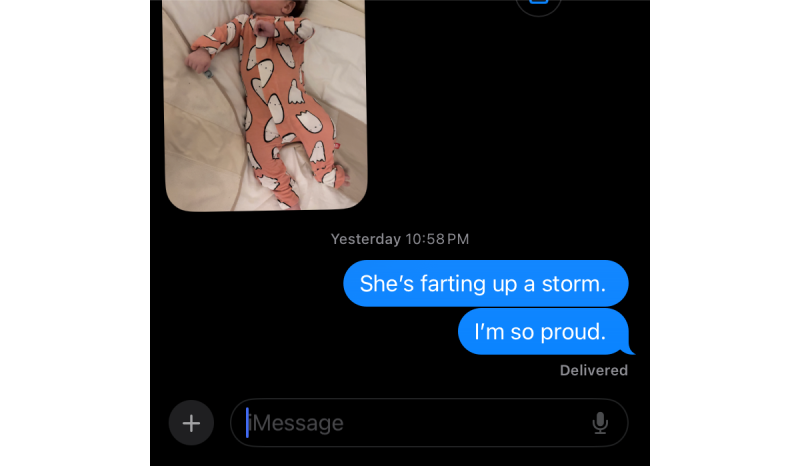
Before I get into it, I feel like I should apologize. I’ve always been staunchly opposed to public discourse about bodily functions. When I was a kid, I tended to define myself in opposition to my older brother, and that was his thing. I was a voracious reader; he could burp the alphabet. I mimicked Ken Griffey Jr.’s stance and Cal Ripken Jr.’s sidearm throwing motion; he learned to spit like a big leaguer. Now, of course, my life is sometimes exclusively focused on bodily fluids and diaper drama and coaxing monster burps out of the sweetest little baby you ever saw, then exclaiming “Oh-ho-ho!” and congratulating her on their grandeur. Somehow, I have turned into the guy who texts this to his wife:

Screenshot of two text messages dated Yesterday 10:58 PM.
Text 1: She's farting up a storm.
Text 2: I'm so proud.

So. Babies are born with immature digestive systems. Everything is difficult. They choke easily, things often don’t sit right in their stomachs, they get the hiccups constantly, and they tend to go to the bathroom while they’re eating. All of these issues are distracting and uncomfortable. In order to avoid pouring more milk on those already dicey situations, evolution developed a simple fail-safe: If something’s wrong, the baby just won’t swallow the milk. Sometimes they’ll stop pulling it into their mouth in the first place, but even if they’re ravenous and they’re sucking aggressively, they’ll then just let it pour right out of their mouths and down their round faces.

When you’re feeding a baby, you have to listen carefully for the adorable little piglet grunts that indicate that they’re swallowing. You learn to appreciate the nuances of those teeny-tiny gasps and grunts and harrumphs, all of which tell you whether and how well they’re getting the milk down. When a baby is eating successfully, it should sound a bit like a Rich Hill start — wait, no, that’s way too intense — rather, it should sound like Rich Hill having a gentle game of catch. Here’s an audio recording of Derek Jr. during a particularly aggressive mealtime. It’s…a lot:

You can hear her grunting and swallowing and gulping for air. You can hear the wind whistling through the vent in the bottle. At one point, you can hear the milk tumbling down into her stomach. And if you listen really closely, you can hear my wife and me trying not to giggle so loudly at her ferocity that we ruin the recording.

When you’re feeding a baby, you’re listening and you’re constantly keeping an eye out for milk pooling at the corner of their mouth or dribbling down their chin. Whenever you sense that the milk is no longer flowing into the tummy, it’s burp time. A nice, big burp will resolve whatever buildup of gas is causing their distress, or at the very least, give them some time to reset themselves and get ready to resume the meal. Essentially, there’s something in the way, and your job is to shake it loose.

You put the bottle down, lift the baby by the armpits and sling them over your shoulder, and pound them on their tiny back as hard as your conscience will allow. (No matter how hard that may be, it’s be a butterfly kiss compared to the thwacks of the nurses at the hospital, who could slap a burp out of a cinder block.) You rock back and forth, because aligning the alimentary canal so that it’s leaning slightly forward can encourage a burp. You alternate between patting on the back and rubbing firmly from the lumbar region up toward the shoulders. (It’s unclear to me whether this actually induces a burp, but it seems like it would feel nice, and that makes you feel better about all the back whacking.) You walk around and bounce the baby on your shoulder as you go. I sometimes do a little shuttle run across the apartment, or put on a song and dance around just for fun.

As you do all this, you can’t help but verbally encourage the baby to burp. Often, the baby is very hungry and therefore very upset that you’re interrupting their (unsuccessful) alimentation, so you end up simultaneously whacking them on the back, explaining why you’re denying them food, and pleading for a burp. I often find myself emphasizing the transactional nature of the relationship like a kid attempting to prize away a friend’s prize rookie card. “Look, you and I both know what you want, and we both know there’s only one way to get it,” I’ll cajole. “If you can think of another way to get food in your belly, by all means, have at it. You scratch my back, I’ll stop whaling on yours.”

Eventually you’re rewarded with a big burp, which is your signal that the baby is ready to eat again. The burps always come suddenly, which means they often elicit from you a cry of surprise and joy, at which point you congratulate the baby like she just won the Super Bowl. I used to despise the very idea of wasting my precious attention on something as crass as burping. Now here I am 30 years later, telling my daughter how proud I am every time she emits a window-rattling burp.

Bottle feeding tends to require much more burping than breastfeeding. [Note from the future: We have also discovered that Derek Jr. needs significantly fewer burps if we feed her bottles that are closer to room temperature rather than from the fridge. She doesn’t mind the cold bottles, but she has a lot more trouble with them. We’re still learning here.] As a result, I’ve spent more time burping Derek Jr. than my wife has. I’m more comfortable with it. Compounding that is the fact that burping can be more challenging when you’re breastfeeding. My wife likes to have a whole pillow situation set up around her, along with her water bottle (because breastfeeding dehydrates you) and her phone to track how long Derek Jr. is eating. That’s no big deal for standard issue burps, but if you need to stand up and dance around the apartment to dislodge a particularly stubborn one, you have to reconfigure the whole nest when you sit back down. I’m desperate to find ways to lighten the huge load my wife is bearing as she recovers from the physical trauma of the birth, deals with massive postpartum hormone shifts, and gives over so much of her time to nursing and pumping, so I often volunteer to jump in and do the burping in order to preserve the nest. I’m now the designated burper.

Once the baby is finished eating, she’s usually adorably drowsy, but you can’t put her down to sleep right away. She needs time to process all the milk she just ingested, which means staying at least somewhat upright. If you put her on her back right away, she’ll be extremely uncomfortable. Even if she does fall asleep that way, she’ll likely get the hiccups or spit up, which is both scary and uncomfortable. The spit-up will run down her cheek and spread in a wet circle on the sheets beneath her face.

When things go well, burping leads right into this upright period, and she’s sleepy putty in your hands. She’s adorable and calm, and your job is to sit there and admire this warm little bundle who has dropped into your life. It’s a special time, and I feel certain that it’s what I will remember most about these last several weeks. It’s also the time when I’ve done most of the writing in this journal and the reason that so much of what I’ve written has been so lovey-dovey. If you were sitting with your drowsy baby’s warm body pressed against your chest and your cheek, you’d be mawkish too.

I tend to give Derek Jr. 20 or 25 minutes to digest, during which time I sing or play music or hold my phone out of her line of sight and watch baseball. It’s nearly four in the morning right now, long after all the games are over, so in between songs, I’m watching highlights of Jacob Misiorowski mowing down the Yankees. He struck out 11 while throwing harder than any starter has ever thrown. I wish I’d seen the whole game, because I’m genuinely curious about how Les Miz is progressing as a pitcher. PitcherList gave his location a B- tonight and Stuff+ gave it a 141, both the best grades he’s gotten all year. That’s exciting. When you’re sitting 101 mph with the fastball and — good Lord — 96 with the slider, B- command should work out just fine. The curveball is the pitch that jumps out the most, because there’s just no way for a hitter to be ready for such an extreme change of pace:

The most important thing I glean from the highlights, though, is that Misiorowski is still locked in a fierce battle against his own hat. The topic for today is shaking things loose, and it definitely applies to him. Watch him closely and you’ll notice that he has to adjust his hat after every single pitch. Clad in the new Brewers City Connects — with “Wisco” across the chest in script, they look more than anything like a product placement for a chain of off-brand gas stations — he still sports the stiffest brim in the league. I swear you could use that thing as a ruler.

Speaking of rulers, the 6-foot-7 Misiorowski is long and narrow everywhere, including his head. The hat doesn’t quite reach his ears. No wonder the thing never gets broken in; he’s barely even wearing it! This is actually something I noticed last year, when Eric Longenhagen posted slow motion footage of Misiorowski’s delivery. Combine a significant head whack with the fact that the stiff hat is basically resting atop his dome like a yarmulke, and you’ve got a recipe for a hat that bounces all over the place every time Misiorowski throws: