No, the Mets Do Not Have a Good Designated Hitter Situation

Last week, I discussed the significant disadvantage NL teams will have if the universal designated hitter is adopted for this season and NL teams were then forced to compete with AL teams for playoff spots. I did the best I could to estimated which players might be the greatest beneficiaries of playing time and then looked at how their teams might be impacted. One team jumped out in a negative way — the Mets finished dead last, receiving no benefit at all from Dominic Smith’s increased playing time at designated hitter. I did note that putting Yoenis Céspedes at the designated hitter spot would put the Mets in the middle of the pack in the NL, though that’s still hardly what one might consider a good situation. Still, it’s probably worth a deeper look.

Before we start moving playing time around to potentially maximize designated hitter production for the Mets, let’s take a look at the team’s projections. Below is every player projected to take at least 100 plate appearances in the field (over a full season), how those players project in their expected playing time, and their projections based on 600 plate appearances. Note that the fielding column is at their position and a positional adjustment has not been applied; only their time in the field is accounted for:

Mets Depth Chart Projections
Name PA wRC+ WAR WAR/600 PA
Jeff McNeil 616 119 3.6 3.5
Pete Alonso 658 131 3.5 3.2
Michael Conforto 560 124 3.1 3.3
Amed Rosario 644 95 2.2 2.0
Brandon Nimmo 497 110 1.9 2.3
Wilson Ramos 422 102 1.4 2.0
J.D. Davis 504 108 1.3 1.5
Robinson Canó 504 98 1.3 1.5
Yoenis Céspedes 238 110 0.8 2.0
Jake Marisnick 238 80 0.3 0.8
Jed Lowrie 105 90 0.2 1.1
Dominic Smith 168 92 0.1 0.4
Tomás Nido 166 61 0.1 0.4

Read the rest of this entry »


An Encyclopedia of Pitcher-on-Pitcher Crime

Should baseball return in 2020, it will likely do so with a DH in both leagues. That makes sense — given shorter training times and an increased prevalence of interleague play, getting pitchers ready to bat wouldn’t be easy. Losing sacrifice bunts is no great sacrifice, either; no one is tuning into the game to watch Johnny Cueto try to get a bunt down against Zac Gallen.

But there’s one thing I’ll greatly miss about pitchers hitting: the moments where the opposing pitcher decides to play a little unfair. Pitchers are terrible hitters — terrible! The standard way to pitch to them is generally by throwing them fastballs until they take a seat in the dugout. But sometimes, that’s not how it goes. Sometimes the pitcher on the mound is a little cruel. Sometimes, they throw a pitch that moves.

The results of throwing a tough-to-hit pitch to a bad hitter should be pretty obvious — they don’t hit it. That’s not to say there are no downsides; breaking balls and offspeed pitches miss the zone more often than fastballs, and batters are less likely to put them in play, which means longer at-bats. No one wants long at-bats against the opposing pitcher. Leashes are short enough these days without a six-pitch battle against a guy who might as well be up there holding a ham sandwich instead of a bat.

Still, it happens more often than you’d think. Pitchers saw 18,502 pitches last year as batters. Exactly 6,200 were some variety of funky; curves, sliders, cutters, splitters, change-ups, and even eephuses. That’s a low proportion, even taking into account that Statcast couldn’t classify every pitch; only 33.5%, as compared to 47.3% for hitters as a whole. But it’s noticeably higher than zero. Read the rest of this entry »


Eric Hacker Still Feels the KBO’s Pull

On Tuesday morning in Southlake, Texas, a Dallas suburb nearly 7,000 miles away from Changwon, South Korea, Eric Hacker 해커 celebrated the NC Dinos’ Sok Min Park 박석민’s game-winning home run against the KT Wiz. “Walk off by the most interesting teammate I have ever played with,” he tweeted. “#18 Awesome teammate and most definitely has his own style.”

Park’s home run, his second of the game and third of the young KBO season, capped an impressive comeback. Down 6-3 in the eighth inning against the Wiz, the Dinos’ star third baseman hit a solo shot to trim the lead to 6-4. In the ninth inning, with the Dinos down to their final strike, designated hitter Sung-bum Na 나성범 launched a 425-foot two-run homer to tie the game, setting up Park’s walk-off shot. The win lifted the Dinos — arguably the league’s most entertaining team for the flair players like Park, Na, catcher Euiji Yang 양의지 and others bring to the game — to 5-1. At this writing they’re a KBO-best 7-1, one game ahead of the resurgent Lotte Giants.

Hacker, now 37 years old and selling residential real estate in the Dallas-Fort Worth area, spent 2013-17 as a rotation mainstay for the Dinos, starting from the time they joined the KBO as an expansion team. He helped the team to postseason appearances in the last four of those seasons, including a trip to the best-of-seven championship Korean Series in 2016, when the team was swept by the powerhouse Doosan Bears. Including a half-season spent with the Nexen Heroes (now the Kiwoom Heroes) in 2018, he ranked second only to the KIA Tigers’ Hyeon-Jong Yang, the league’s 2017 MVP, in pitching WAR (24.1, all advanced stats via Statiz), and fifth in innings (935.1). Read the rest of this entry »


Craig Edwards FanGraphs Chat – 5/14/2020

Read the rest of this entry »


Buried in the LG Twins’ Lineup, a Korean Baseball Great

On the mound is Ricardo Pinto. He’s 26 years old. At 6-feet and 195 pounds, he has a muscular build that immediately makes him look like an athlete. He’s struggling through this particular appearance, thanks to command issues and some iffy defense behind him, but he hasn’t really been hit hard. His low-to-mid 90s heat is on the faster side of what Korean Baseball Organization hitters typically see, and he leans on it heavily.

At the plate, with the bases loaded and two outs, is Yong Taik Park 박용택. He’s 41 years old. He wears glasses in the batter’s box. As he awaits each pitch, he stands with his front foot resting nearly on the edge of the box behind him. At 6-foot-1, 185 pounds, he doesn’t differ dramatically from Pinto in size, but his baggier uniform makes him look tall and thin.

Pinto begins his violent delivery, and Park brings his front foot square with the plate. As the ball approaches, he twitches it slightly, perhaps as a way to subtly maintain his timing. Finally, at the last moment, his bat explodes through the baseball as Park uncorks his whole body to turn on a pitch high and tight. It’s a gorgeous left-handed swing, and it produces a bases-clearing double.

Read the rest of this entry »


Another Day, Another New Plan Projected

As owners and the players discuss ways to start up the 2020 season, we’ve started to see the outline of a possible plan for play become less foggy. 162 games has, of course, long been impossible; now, the owners are proposing roughly a half-season rather than the expected 100-110 games. 82 games starting in early July gives us less baseball than usual, but it could also result in the “baseball year” following its same basic schedule rather than ending in late November. After all, teams normally play about that many games after early July! This likely represents the desire of the owners to play as many games as possible in the home parks rather than the considerably more exotic Super Spring Training plans that have been floated over the last six weeks.

But a shorter schedule isn’t the only proposed change coming for 2020 baseball. Forecasting how the Players v. Owners fight over revenue-sharing shakes out is beyond my abilities as a projectionista, but there are many other new tidbits that do fall within my scope. For one, while the league standings are still likely to be organized along the usual lines, teams would only play their regional division “partners” and the corresponding geographical division of the other league. This has the rather odd result of the Wild Card standings consisting of a lot of teams that would never play each other. But as ugly as that sounds, the main concern is playing the season rather than maximizing its fairness. For the purposes of these projections, I’ve assumed teams will play 52 games, or 63% of the schedule, in their division with 30 games out of division.

The designated hitter is also expected to become universal this year. I’ve long been of the opinion that as soon as interleague play became a daily activity, pitcher-hitting was on borrowed time. When interleague play consisted of special chunks of the season, NL teams could design their rosters to call up a Wily Mo Pena, a competent DH type without a full-time spot on the team, large pitching staffs having mostly killed off the designated pinch-hitter job. Once DH games became sprinkled throughout the system, it put NL teams at a slight disadvantage when planning to have an extra bat on the roster. Read the rest of this entry »


Dan Szymborski FanGraphs Chat – 5/14/20

12:03
Avatar Dan Szymborski: AND GOT HERE

12:03
Avatar Dan Szymborski: I was finishing an article and it was a race against the clock!

12:04
Danny Almonte’s fastball: If you could make a chimera of any 2 current pitchers, who would they be for: the best, the most fun to watch, the most unique?

12:04
Avatar Dan Szymborski: A Bartolo Colon who pitches like Gerrit Cole!

12:05
Avatar Dan Szymborski: AND HE WOULD BE ALL OF THOSE THINGS

12:05
Danny Almonte’s fastball: Player you love who has a surprisingly low WAR?

Read the rest of this entry »


Snowstorms, Lies, and the Best Game of Baseball Ever Played

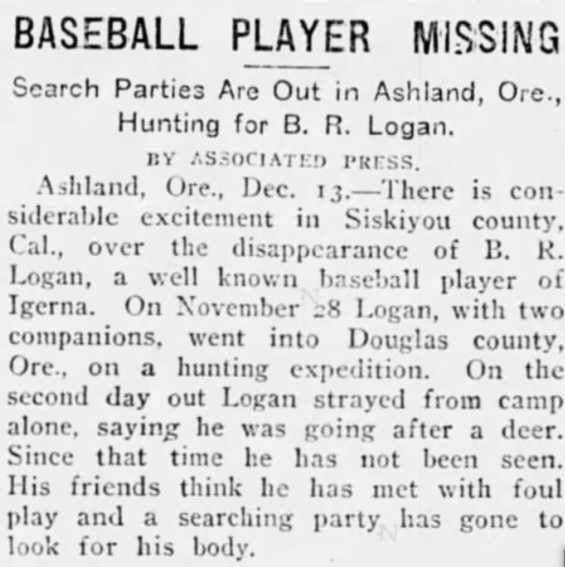
On November 28, 1902, a young man from Igerna, California, headed north with two friends on a hunting trip into the wilderness of southern Oregon. It was an area he would have known fairly well: He often traveled this way on his way to face the baseball nines of various small towns. The young man’s name was B.R. Logan, and he was a baseball player.

On December 1, Logan, outside the cabin where he and his companions were staying, thought he saw a deer. He bade his friends farewell and headed off in pursuit. A day passed. Then another. Then another. His friends began to worry. After two weeks, they began to despair. It was the winter, in the middle of the forest, and there was no sign of their friend.

On December 13, the Associated Press published an item about Logan’s disappearance. “MISSING BASEBALL PLAYER,” it read. By this point, the search party wasn’t looking for Logan. They were looking for his body.


Read the rest of this entry »


Effectively Wild Episode 1541: Taken Out of Context

EWFI
Ben Lindbergh and Sam Miller banter about the difficulty of interpreting the context of old articles about baseball and a man obsessed with smashing certain plate glass windows, then answer listener emails about what qualifies as hitting a ball out of the ballpark and eliminating force outs, plus Stat Blasts about the all-time defensive indifference leaders (inspired by Armando Galarraga’s lobbying for a retroactive perfect game), winning pitchers with more earned runs allowed than the losing pitchers, and players who batted 1.000 in their first and last games, as well as a concluding discussion of the new TNT TV adaptation of EW favorite Snowpiercer.

Audio intro: Field Music, "In Context"
Audio outro: Nick Lowe, "I Love the Sound of Breaking Glass"

Link to video of Stanton homer
Link to Sam on umpires’ personal strike zones
Link to Stat Blast song covers thread
Link to Jonathan Crymes’s Stat Blast song cover
Link to Galarraga article
Link to defensive indifference data
Link to defensive indifference article
Link to “good-luck winners” data
Link to “good-luck winners” historical trends
Link to players with perfect debuts and finales
Link to order The MVP Machine

 iTunes Feed (Please rate and review us!)
 Sponsor Us on Patreon
 Facebook Group
 Effectively Wild Wiki
 Twitter Account
 Get Our Merch!
 Email Us: podcast@fangraphs.com


Wild(-ish) World Series Tactics: 2007-2009

I’ll level with you. The World Series tactics series has been getting less and less wild as time goes on. That’s not to say it’s getting less and less fun — I’m actually having more fun writing it, because we’ve passed into an era where I remember the games.

It’s a lot more interesting to look for hidden gems when it’s games you’ve already seen, because they’re truly shocking. I’m not surprised that managers were calling for weird bunts in 1990 — the internet barely existed in 1990! A weird bunt or baffling pitching decision is more fun to me in 2005 than 1995, even if there are fewer true howlers. So while these three series might seem dry, remember: these weren’t that long ago! Managers really should have known better.

2007

The Red Sox assembled a lineup that would look right at home in 2020. Two on-base machines, Dustin Pedroia and Kevin Youkilis, occupied the top two spots, feeding David Ortiz, Manny Ramirez, and Mike Lowell. The Rockies weren’t quite with the times — they batted Kaz Matsui, one of their worst hitters, second. But the rest of the lineup was stacked, with Matt Holliday and Todd Helton hitting 3-4.

The last act of Rocktober was nasty and short. Did Colorado leave starter Jeff Francis in too long in the first game? Maybe! But he gave up three runs in the first, trusted reliever Franklin Morales gave up seven in the fifth, and the offense only put up a single run. Maybe you can argue with intentionally walking Manny Ramirez (man on second, two outs, down three in the second), but it hardly matters when you lose by 12 runs.

Okay, fine, maybe the intentional walks were bad. In the fourth, still down three runs, the Rockies intentionally walked Mike Lowell — the man they’d walked Ramirez to face earlier in the contest. Jason Varitek doubled in two runs in the next at-bat. The walks didn’t make the difference in the game, and they weren’t even hugely consequential, but don’t intentionally walk people to face other batters you’re willing to intentionally walk! Read the rest of this entry »