
Ben Clemens FanGraphs Chat – 7/6/20
by Ben Clemens

July 6, 2020
You can’t make the postseason in a single day in July. You can’t be eliminated either, of course, even if you’re the valiant Brewers and your opponents are your perennial rivals, those darn St. Louis Cardinals. This past Friday, however, something momentous happened in our OOTP simulation.
Here, take a look at the box score:
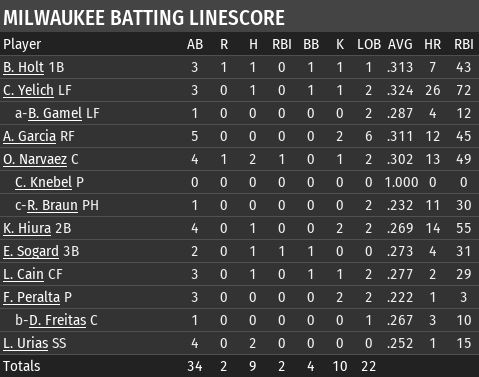
So no, it wasn’t a spectacular performance, on either side, that makes this game the rare ultra-meaningful July clash. The 3-2 loss featured more squandered opportunities than you’d generally like to see, including two runners on third left stranded with less than two outs. That’s not really worth a column, though.
The scary part (and there is a scary part) probably jumps right out at you. But just in case, here’s the next day’s box score to drive the point home:
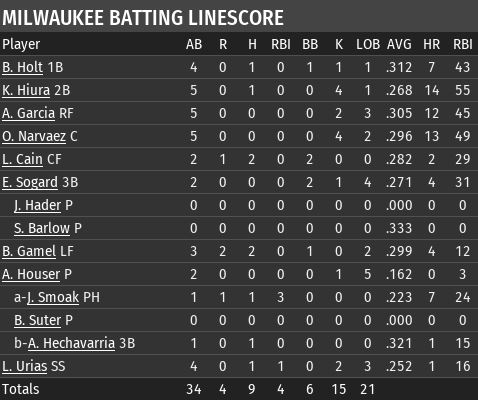
This one was a 4-2 win, keyed by a pinch hit home run from Justin Smoak — first and third, two outs in the top of the sixth, and excellent time to pinch hit. It dropped Jack Flaherty to a woeful 2-11 simulated record — oof. But the key to this game isn’t any of that. It’s Ben Gamel, batting seventh, with a quietly effective day. Read the rest of this entry »
July 3, 2019 was a pretty typical day for major league baseball. Cody Bellinger hit a walk-off home run in the 10th inning against Arizona to give the Dodgers their league-leading 59th win of the season in their 88th game. Last-place Cincinnati defeated first-place Milwaukee to bring all five NL Central teams within 4.5 games of each other. Stephen Strasburg struck out 14 Marlins without allowing a run. Mike Trout hit two dingers, because of course he did. There were close games and there were clunkers, thrilling displays and frustrating setbacks. You probably forgot about all of it.
This July 3 was, well, different. Temperatures notwithstanding, it might as well have been mid-February, as players from all 30 organizations gathered in their respective ballparks for their first official team workouts in months, after the global COVID-19 pandemic suspended the major league season. Players and staff rejoined their teammates only after first undergoing intake tests for the virus, with several wondering even as they took the field whether they were doing the right thing by attempting to play at all. Those circumstances made for a strange and chaotic first weekend of camp.
Longtime star pitchers David Price and Felix Hernandez announced on Saturday that they would opt out of the 2020 season, one day after veteran catcher Welington Castillo was also reported to have opted out. On Monday morning, Nick Markakis also informed his team he would opt out of the season. Their decisions bring the total number of major league players known to have decided against playing this season to nine. Read the rest of this entry »
No sooner had the Yankees opened their summer camp — or spring training 2.0, or whatever we’re calling this tense and perhaps tenuous ramp-up to the long-delayed 2020 season — on Saturday than they got their first scare: the sight of pitcher Masahiro Tanaka being drilled in the head by a line drive hot off the bat of Giancarlo Stanton. The 31-year-old righty never lost consciousness but was taken to the hospital for testing and further evaluation, and while he was released, on Sunday he was diagnosed with a concussion. The terrifying sequence was a reminder that the coronavirus isn’t the only thing for players to fear during this abbreviated build-up to the regular season, but all things considered, both he and the Yankees look quite lucky right now.
At Yankee Stadium, in a simulated game that marked their first formal workout of the restart, Tanaka had faced Aaron Judge and Gleyber Torres before Stanton stepped in. The slugger smoked a line-drive comebacker that struck the pitcher on the right side of the head and ricocheted high in the air (I’ll leave it to you to find the video). Keep in mind that since the advent of Statcast in 2015, only Judge and Nelson Cruz have higher average exit velocities than Stanton’s 93.4 mph — he is emphatically not the guy you want pounding a ball off your noggin. According to James Paxton, the ball came off the bat at a sizzling 112 mph. Tanaka fell to the ground, writhing in pain, and stayed down for about five minutes before sitting up and eventually being helped off the field with the assistance of two trainers. Read the rest of this entry »
Back in early 2013, I wrote a guest article for Baseball Prospectus entitled “How Far Did That Fly Ball Travel?” In that article, I posed a seemingly simple question: Can we predict the landing point of a fly ball just after it leaves the bat? A more precise way to ask the question is as follows: Suppose the velocity vector of a fly ball just after leaving the bat is known, so that the exit velocity, launch angle, and spray angle are all known. How well does that information determine the landing point? I then proceeded to investigate the question, at least for home runs, with the aid of HITf/x data for the initial velocity vector and the ESPN Home Run Tracker for the landing point and hang time. Using a technique described in the article, that information was used along with a trajectory model to reconstruct the full trajectory and extrapolate it to ground level to determine the fly ball distance. The answer to the question was immediately obvious: The initial velocity vector poorly determines the fly ball distance.
This conclusion led naturally to the next question: Why? One obvious reason is variation in atmospheric conditions, especially wind. However, the data revealed that the variation in home run distance for given initial velocity was as large in Tropicana Field, where the atmospheric conditions are expected to be constant, as in the rest of the league. So that was eliminated, at least as the primary culprit.
The article then went on to consider variation in two other parameters that play a role in fly ball distance: backspin ωb and drag coefficient CD. Neither of these parameters were directly measured. Rather they were inferred, along with the sidespin ωs, in the procedure used to recreate the full trajectory. The analysis showed the following:
The Cincinnati Reds have been eagerly awaiting Hunter Greene’s return from Tommy John surgery. And for good reason. Prior to going under the knife 15 months ago he was hitting triple digits with his heater. Drafted second overall by the Reds in 2017 out of a Sherman Oaks, California high school, Greene is No. 77 on our 2020 Top 100 Prospects list.
According to Kyle Boddy, his return is nigh. Cincinnati’s pitching coordinator recently spent time with Greene in California, and he deemed the 20-year-old’s rehab “basically done.” Throwing in front of a Rapsoto, Greene was “an easy 97-plus [mph], reaching 100-101 when he was rearing back.”
More than a return to health is buoying the return to form. With the help of technology — “he’s really getting into the metrics and analytics” — and a former Chicago White Sox pitcher, Greene has made a meaningful change to his delivery. What had been “long arm action with a big wrap in the back” is now a shorter-and-cleaner stroke.
“That’s a credit to people like James Baldwin, who was the rehab coach and is now our Triple-A coach,” Boddy told me. “JB has worked with Hunter extensively, leaning on materials from Driveline Plus. Hunter has had a tendency to cut his fastball, so we’ve relied on a lot of video to show him how to fix that and get more carry.” Read the rest of this entry »

Ben Lindbergh and Meg Rowley banter about the difficulties of disclosing or obscuring the identities of players who hit the injured list after contracting COVID-19, dissect a few new analogies from Scott Boras’s brain, and discuss resuming their season preview series, then (35:47) conclude their week-long celebration of the Negro Leagues by bringing on esteemed Negro Leagues historian Larry Lester to discuss the origins of scholarship about the Negro Leagues, co-founding the Negro Leagues Baseball Museum, collecting Negro Leagues artifacts, his relationships with former Negro League players, helping select the Negro Leaguers inducted into the hall of Fame, his efforts to find Negro Leagues box scores and the status of the project to complete the statistical record, the greatest writers who covered the Negro Leagues, his favorite unsung players, the Negro Leagues Baseball Grave Marker Project, how he researched Negro Leagues uniforms and helped obtain pensions for Negro Leaguers, and more (plus a postscript about reading recommendations).
Audio intro: Bob Dylan, "One More Cup of Coffee"
Audio interstitial: Natural Resource, "Negro Baseball League"
Audio outro: Blind Lemon Jefferson, "See That My Grave is Kept Clean"
Link to stream Stove League on Viki
Link to Lindsey on COVID and the IL
Link to Larry Lester’s website
Link to NLBM website
Link to Only the Ball Was White
Link to Larry’s Henry Chadwick Award page
Link to Larry’s Bob Davids Award page
Link to Hall of Fame Screening Committee press release
Link to Grave Marker Project page
Link to Jerry Malloy Conference info
Link to info on Cannonball Dick Redding
Link to Seamheads Negro Leagues Database
Link to SABR’s guide to researching the Negro Leagues
Link to Rob Arthur on systemic racism in baseball
Link to Rob on racial bias in player promotions
Link to Shakeia Taylor on Effa Manley
Link to Shakeia on the Negro Leagues centennial
Link to Shakeia on the Negro Leagues Grave Marker Project
 iTunes Feed (Please rate and review us!)
 Sponsor Us on Patreon
 Facebook Group
 Effectively Wild Wiki
 Twitter Account
 Get Our Merch!
 Email Us: podcast@fangraphs.com
Podcast (effectively-wild): Play in new window | Download
Subscribe: RSS
Ryan O’Rourke experienced life in the big leagues. The recently-retired left-hander appeared in 54 games with the Minnesota Twins between the 2015 -2016 seasons, and in two with the New York Mets last year. But the bulk of his career was spent in the minors. A 13th-round pick by the Twins in 2010 out of Merrimack College, O’Rourke toiled down on the farm in each of his 10 professional campaigns.
He experienced a lot. The minor leagues are an adventure, and while often fun, they are by no means a bed of roses. The pay is bad, the travel and accommodations are arduous, and for the vast majority of players, crushed dreams are inevitable. Moreover, success and failure aren’t always dictated by talent alone.
———
David Laurila: How would you describe professional baseball at the minor-league level?
Ryan O’Rourke: “Now that I can look at it from a helicopter point of view, I’d say that it’s a crapshoot in the truest sense of that word. If you don’t end up with the right organization, and your development isn’t a priority, your path to the big leagues is so much more difficult than it already is.
“I was fortunate to be with the Twins, who were very good about taking care of people, but I’ve heard horror stories from other teams. If you’re a nobody — anyone outside the 10th round is probably a nobody — and don’t show promise right away… let’s just say that guys who get big money in rounds one through 10 are given countless opportunities over someone who may have deserved it more.
“That’s the sad nature of the minor leagues, which, from a business standpoint, I do understand. If you gave one guy $400,000 and another guy $4,000, it’s obvious who you’re keeping. And sometimes it’s a matter of a coach liking you or not. Sometimes you’re cut because you didn’t impress one guy.”
Laurila: How much jealousy and resentment is there of high-round guys? For instance, Byron Buxton is a talented player but he also got a $6 million signing bonus. Read the rest of this entry »
| 12:02 |
 Dan Szymborski: SORRY I’M LATE I WAS MAKING MITCH HANIGER JOKES ON TWITTER Dan Szymborski: SORRY I’M LATE I WAS MAKING MITCH HANIGER JOKES ON TWITTER
|
| 12:02 |
: I tried to make a model to project break outs and I had zero luck. Any suggestions for a beginner?
|
| 12:03 |
Dan Szymborski: Project Arkanoid, it was a more successful Break Out!
|
| 12:03 |
Dan Szymborski: Sorry.
|
| 12:03 |
Dan Szymborski: It may be that you don’t have sufficient variables in your model to identify breakouts.
|
| 12:03 |
: What do you make of manfreds comments about never intending to play more than 60 games? Seems like a dumb thing for a lawyer facing a grievance to say
|