Archive for Blue Jays

Lifting Could Be the Key to Liftoff for Daulton Varsho

Denny Medley-USA TODAY Sports

If you look atop the groundball rate leaderboard, you’ll see some of the usual suspects. Josh Bell and Masataka Yoshida have hit more than two-thirds of their batted balls on the ground this year, while Eric Hosmer and Jean Segura aren’t far behind. Bell, Hosmer, and Segura have been some of the most notable groundball hitters in the majors for years, while Yoshida was a groundball menace in Japan. Even at such an early point in the season, the groundball cream is rising to the top.

At the bottom of the leaderboard, the names are a little more surprising. Noted fly ball hitters Adam Duvall and Brandon Lowe are among the bottom 10, but there are also a handful of players you wouldn’t expect to see. One such player is Daulton Varsho.

Varsho has hit five groundballs this year, good for a 20% groundball rate. Only one qualified batter, Carlos Correa, has hit fewer balls on the ground. However, it was Varsho, and not Correa, who caught my eye, because of his extreme groundball numbers at the very beginning of the season. Over his first eight games, Varsho came to the plate 32 times and put 19 balls in play. Only one was a groundball. Read the rest of this entry »


Whit Merrifield, King of Stealing Third

Whit Merrifield
Joe Nicholson-USA TODAY Sports

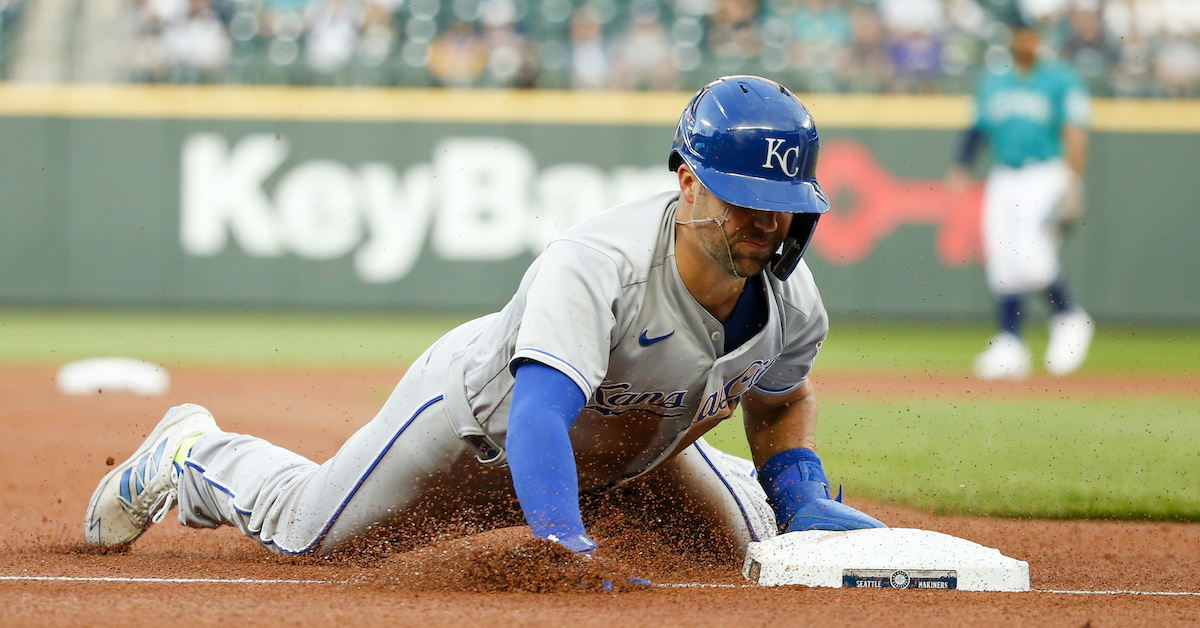
If I asked you to visualize the prototypical stolen base, you’d probably picture a runner taking off for second. Conversely, if I asked you to conjure up the most thrilling stolen base you could imagine, you’d pick a play at the plate. Stolen bases at third, then, are the neglected middle child — too infrequent to warrant much conversation or analysis, but not unusual enough to drum up excitement. But third is more than just the base between second and home, and stealing third regularly and efficiently is a distinct skill.

For one thing, steals of third base make for a faster showdown between catcher and runner. The average pop time on a throw to second last season was 1.97 seconds; on a throw to third, it was 1.55 seconds — nearly half a second quicker. The distance between bases, however, is the same all around the diamond, which means a runner needs a much better jump when he’s going for third. Thus, stealing third is less of a race and more of a mind game. Pure speed is less important, but the perfect lead and a well-timed jump are invaluable. Read the rest of this entry »


Alejandro Kirk and Alek Manoah Boldly Go Towards the Shadow Zone

© John E. Sokolowski-USA TODAY Sports

The “shadow zone” is one of my favorite new bits of lingo from the Statcast era, and I’m sure I’m not alone. In actual fact, the term describes a pretty simple concept – the area in and around the edges of the strike zone – but it sounds more like a hidden world from Star Trek or Stranger Things. The title for a FanGraphs piece about the shadow zone practically writes itself.

But I’m not here to talk about sonically pleasing sports terminology. Sure, I like the shadow zone because it sounds like it’s from a straight-to-video B-movie, but I am just as partial to what happens within it. It’s an area of ambiguity around the strike zone’s edges. It’s where plate discipline matters most, where control matters most, where umpiring matters most, and, as I’d like to focus on today, where pitch framing matters most.

Pitch framing takes place almost exclusively around the borders of the zone. Every so often a catcher successfully frames a pitch from beyond the shadows (a potential sequel to The Shadow Zone), but at that point, it’s just as much about bad umpiring as it is about good framing. Read the rest of this entry »


The Adjustment to Revive the Final Boss

This post begins with a friendly reminder — specifically, that there are five teams in each of baseball’s six divisions. Given the noise around baseball for much of the offseason, one could be forgiven for thinking there were only four clubs in the American League East. Much of the chatter regarding the AL East this winter has centered around the formidability of the Yankees’ roster, the Red Sox’ (now successful) pursuit of J.D. Martinez, the imminent close of Baltimore’s competitive window, and the Rays’ sort of, kind of, not really teardown. It isn’t that the Blue Jays have done nothing — they’ve made several good trades and taken low-cost risks — it’s just that there have been a few more prominent stories and louder fanbases.

The most recent move out of Toronto continues the club’s offseason trend of reasonable, low-cost acquisitions. For a price of just $2.5 million, the signing of Seung-Hwan Oh — a player who, in 2016, recorded nearly three wins out of the bullpen — seems like a potential bargain.

Of course, he would not be available at this time of the offseason and at this price if he didn’t have some warts. He is coming off of a mediocre 2017 campaign, falling from one of the leauge’s top-10 relievers to barely replacement level. Of possibly greater concern is the fact that the Rangers nixed a potential deal after expressing concerns with Oh’s physical. Despite these warning signs, there is reasonable optimism for an Oh turnaround, one that would benefit the Blue Jays in either a playoff chase or as a deadline trade chip.

Read the rest of this entry »


Is the New Turf at the Rogers Centre Really a Problem?

The Blue Jays finished their first home stand of the season at the Rogers Centre yesterday, and the discussion surrounding the games has been a little strange so far. The talk has been about the performance of the team, who have started well, but it’s also been about the artificial turf that was installed this past offseason. Is it bouncy? Is it not bouncy enough? Are the balls always rolling foul off of the first and third base lines? These are questions we end up asking when baseball is played on a surface other than grass.

That’s not to say that playing on turf is an inherently terrible thing, it’s just different, and if the choice is between playing baseball or not playing baseball in a climate that might not support grass, the choice is obvious. Still, with the news that Toronto hopes to move to an all-grass field by 2018, and with the continuing talk that seems to arise every year from playing in stadiums with artificial turf, we should look into it further.

First, the fuel for the fire. This was the play that started everyone talking about the new surface, a swinging bunt in a game from Monday of last week that took a very strange bounce in front of the plate:

Rogers_Centre_Groundout_Angle_1

Here’s a closer angle:

Rogers_Centre_Groundout_Angle_2

Read the rest of this entry »


Devon Travis Gets His Shot in Toronto

For the second year in a row, the Blue Jays headed into spring training with no clear second baseman. Last year, their second base competition featured Ryan Goins, Maicer Izturis, Munenori Kawasaki, Chris Getz and Steve Tolleson. Unsurprisingly, this quintet ranked last in our preseason, second base positional power rankings with a collective projection of 0.1 WAR. Nonetheless, the Jays rolled with this group all season, and things got ugly. Real ugly. Blue Jays second basemen combined for 0.3 WAR last year, and 0.7 of that WAR came from Brett Lawrie, who was supposed to be the team’s third baseman, but filled at second for 32 games.

A year later, not much has changed. Goins, Izturis, Kawasaki and Tolleson are all still on the team’s depth chart, and once again, the Blue Jays checked in at number 30 in our second base power rankings. For the second consecutive year, Toronto’s outlook at at the keystone looks pretty dismal. But unlike last year, there’s reason for hope for Blue Jays fans. While last year’s cast of characters is still around, the team’s opening day second baseman will be someone new: 24-year-old rookie Devon Travis, who secured the job by hitting .352/.397/.463 this spring. Read the rest of this entry »


Jose Bautista’s Strange Season

Jose Bautista is once again performing at a very high level after a slow start to the season. He has produced 2.4 WAR in 72 games, and ranks 11th in the American League with a .381 wOBA. He is tied for the league lead with 23 home runs and is currently on pace to pass the 40 HR plateau for the third straight year. Despite his homer-happy ways, however, Bautista only ranks ninth in the league in slugging percentage at .533.

The major culprit is his batting average on balls in play. At a ridiculously low .201, Bautista has not had much success turning balls in play into hits. A greater percentage of his hits are home runs, which are excluded from the BABIP calculation, and his rate of singles and doubles is below the norm. In other words, while a .381 wOBA is fine for anyone to hang his head on, Bautista has actually been held back this season.

It seems strange for someone to produce so effectively with such a low BABIP, which got me thinking: has anyone ever finished a season with a wOBA as strong as Bautista’s current .381 mark with as extremely suppressed a batting average on balls in play?

Read the rest of this entry »


Is Acquiring Hill Wise for the Diamondbacks?

The Diamondbacks traded Kelly Johnson to the Blue Jays on Tuesday, getting Aaron Hill and John McDonald in return. Arizona’s motives for the trade are questionable, as the deal could actually hurt their playoff odds.

Eno Sarris covered the deal from the Jays point of view, noting that free-agent-to-be Johnson will likely be used to extract compensatory draft picks this offseason. Johnson is mere percentage points from attaining Type A status — and prior to the trade, he was the highest-ranked non-Type A middle infielder. The Jays employed this tactic last season when it traded for Miguel Olivo on the day before free agency started and allowed him to walk. The Jays again are shrewdly exploiting the compensation system.

Add to that the idea that Johnson is a better player than Hill and the deal makes plenty of sense for Toronto. But does it make any sense for the Diamondbacks, who are in the thick of a divisional race?

Read the rest of this entry »


Is Jose Bautista’s Leap Unprecedented?

As long as Jose Bautista continues to hit like this it is our duty to write articles in his honor. Earlier in the week Dave Cameron analyzed how much of a bargain Bautista’s 5 yr/$65 mil extension with the Blue Jays will represent even if he sustains just a semblance of his current performance. Dave also offered up a pu pu platter of statistical nuggets summarizing Jose’s nutty season. Today I’ll look at where Bautista’s rise to superstardom ranks historically to answer the titular question.

We all know the man can hit. In just 35 games he has 4.0 WAR to his name, slashing .360/.509/.816 and with 16 home runs in the process. His rest of season ZiPS projection is .267/.388/.567, which is better than most players are hitting right now. Seriously, his regression-riddled wOBA for the rest of the season is .419 — only six players currently boast a mark greater than that.

Everything about his turnaround defies logic. This isn’t the case of an upper echelon prospect like Brandon Wood figuring something out. Bautista was always patient at the plate and played decent defense, but he was the epitome of a player whose value was linked directly to his team-controlled status. He was a stopgap solution, a non-tender candidate, not a stud in the making. He wasn’t going to make $65 million in his entire career, and now that amount over five years is considered a massive bargain. But is his drastic improvement unprecedented? In the annals of baseball history, has anyone ever improved as much and as quickly?

Read the rest of this entry »


Toronto’s Catcher Bonanza: Buck, Castro, Chavez

It’s been a big week for Toronto Blue Jays General Manager Alex Anthopolous. Obviously, I’m referring to the bonanza earlier in the week in which Anthopolous filled out his 2010 catcher corps by signing John Buck for one year and two million dollars moments after he was non-tendered by the Kansas City Royals (all set with Jason Kendall), veteran Ramon Castro for one year and one million dollars, and Raul Chavez to a minor league deal.

[NB: I usually prefer referring to multiple projections, but since I’m discussing more than one player, I’ll keep things simple by sticking with CHONE for both offense and defense. When I averaged various different projections, the overall values I came up with were about the same, anyway.]

On CHONE’s original list of free agents, Ramon Castro rated as the best catcher per 150 games. His projected offensive line is .230/.292/.412, or 10 runs below average per 150 games. His defensive projection is two runs above average. Adding in the positional adjustment, per 150 games Castro projects as a 2.4 WAR catcher. However, Castro also comes cheaply because not only do catchers almost never play 150 games, but the 34-year-old Castro has never played 100 games, and has only played more than 2009’s 57 once, in 2005.

Although I’m personally excited that I might get to see John Buck play in-person, many Royals fans hate him for being part of the return in the 2004 Carlos Beltran trade as much as for his numerous strikeouts and poor defense. The latter is reflected in his -5 defensive projection. As for the former, his offense looks a lot like Castro’s — low average, decent walk rate, above-average power. CHONE projects Buck at .227/.296/.398, or -9/150 for 2010. Together, this puts Buck just below average at 1.8 WAR. Again, catchers typically play much less than that, and Buck spent time on the DL in 2009.

Raul Chavez is a veteran defensive catcher who actually lives up to his reputation with the glove. Offensively, CHONE projects him at .226/.262/.319; -37/150. However, Chavez avoids being replacement level due to his glove (+9). He projects at 0.4 WAR per 150.

The Blue Jays are at the beginning of a rebuild. Before Buck signed, Toronto had zero catchers on their 40-man roster. Someone has to play catcher, and according to CHONE, the only free agent catcher in the same league with Castro and Buck is departing Blue Jay Rod Barajas, who’s seeking a much bigger deal. While neither Buck nor Castro is an iron man, if they each play half of the season, that still projects as around a league average player (2 WAR). Given that the cost of one marginal win on the open market is likely at least four million dollars, the Jays are paying three million for at least eight million dollars worth of (projected) production. Well done by the Jays.

In a way, Chavez’s contract is the most interesting, and not because he’s good. Rather, it’s because Toronto, unlike other clubs this winter, gave a near-replacement level catcher a contract appropriate to his likely contribution rather than six million dollars over two years. It’s a Festivus Miracle!

If you want to enter your own projection for Toronto’s 2010 catchers, click here.