The role of the closer is diminishing every year, but it seems like no one told the Tigers. Only five different Detroit relievers recorded a save last season, tied for the lowest total among all 30 teams. Over the past five years, only 13 Tigers have earned a save. No other team has had fewer than 17 different pitchers save a game in that time; the Rays have had 35. In the last ten years, the Tigers have had only 28 players save a game, still the lowest total in the sport. The Rays, for comparison, have had 57 different pitchers record a save since 2013.
In part, this is because Detroit hasn’t been very good. When save situations are few and far between, there is less need to spread around the closing opportunities. Yet it’s not all about the wins and losses. For the past decade, the Tigers have had a go-to closer nearly every year. From veteran relievers like Joaquín Benoit, Joe Nathan, Joakim Soria, and Francisco Rodríguez to younger arms like Shane Greene and Bryan Garcia, the Tigers have shown a tendency to name a singular closer and hand him the ball in the ninth.
It seemed like this trend might finally have come to an end when A.J. Hinch took over as manager, but Gregory Soto recorded the majority of his team’s saves in 2021 and prompted Hinch to name him the closer that October. In 2022, the Tigers had one of the deepest bullpens in baseball and easily could have opted for a closer-by-committee, but Hinch stayed true to his word. Soto earned 30 of their 38 saves and took the mound in the majority of save situations. Read the rest of this entry »
Stop me if you’ve heard this one before: the Detroit Tigers signed a veteran starting pitcher with (a) experience as a reliever and (b) a troubling injury history to a single-year deal worth (up to) $10 million. Two weeks after signing 31-year-old Matthew Boyd to such a contract, the Tigers came to terms with soon-to-be 31-year-old Michael Lorenzen on a similar deal. Lorenzen will make $8.5 million guaranteed, with the chance to earn an additional $1.5 million in performance incentives.
One year and $8.5 to $10 million is just what you’d expect for Lorenzen, who was worth 1.0 WAR last season and projects to be worth another 1.0 WAR (per Steamer) in 2023. When he was on the mound, he was a league-average starter in 2022, with a 4.24 ERA and a 4.31 FIP. Unfortunately, a shoulder strain kept him out for two months in the middle of the year. He has yet to prove he can last a full season in a starting role.
Lorenzen was a closer in college, but the Cincinnati Reds saw his potential as a starter and stretched him out as such. Then he struggled in the role in his rookie season, and after an elbow injury kept him out for much of his sophomore campaign, he returned to the bullpen. Not one to be easily discouraged, Lorenzen advertised his services as a starting pitcher when he reached free agency last winter. The Angels took him up on his offer and invited him to join their six-man rotation for the 2022 season. It was a good landing spot for a pitcher who had barely worked as a starter since 2015:
Michael Lorenzen’s Workload 2015-21
Season
Games
Games Starts
IP
2015
27
21
113.1
2016
35
0
50.0
2017
70
0
83.0
2018
45
3
81.0
2019
73
0
83.1
2020
18
2
33.2
2021
27
0
29.0
The Angels did not, however, take Lorenzen up on his other offer: in addition to starting ballgames, he wanted regular plate appearances and reps in the outfield. He had not been a two-way player since 2019, when he played 89 innings in the outfield and hit .208/.283/.313. One might have thought the Angels were the perfect team to give him that opportunity, but in hindsight, it was a bit of a pipe dream. The Angels entered the season with a strong outfield alignment of Mike Trout, Taylor Ward, and Brandon Marsh, and they certainly didn’t have any at-bats to spare at DH. By the time Trout was injured and Marsh was traded, Lorenzen was wasting away on the injured list.
As it turns out, focusing on one aspect of his game was the smartest choice for Lorenzen, and the man himself seems to agree. “Now that I am a starter, I’m pretty happy about that,” he told the Orange County Register in April. “Of course, if they want me to hit, I’m willing to do it, but it’s not something that I’m fighting for.”
After years spent mainly in the bullpen, Lorenzen made 18 starts in 2022 and looked more than capable while doing so. By WAR, it was the second-best season of his career. Any time he might have spent training at the plate would only have taken away from time spent refining his pitch repertoire.
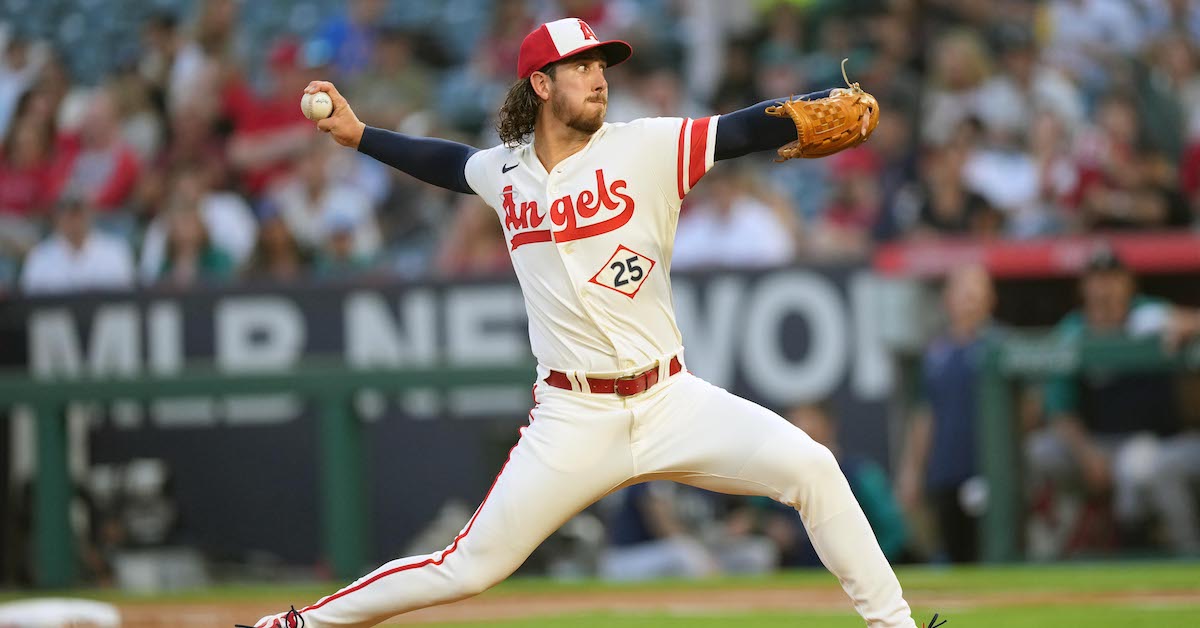
To that point, Lorenzen clearly put a great deal of work into his pitches this season. Back in April, Jake Mailhot wrote about Lorenzen’s return to the starting rotation and how he was adjusting his repertoire to find success. Yet Lorenzen wasn’t done making changes – not even close. His pitch mix morphed as the season continued, and many of the adjustments Jake wrote about completely disappeared. The sinker, Lorenzen’s most-thrown pitch in April, became less and less of a factor. By the end of the year, he was using it only 8% of the time. His slider, meanwhile, lost about four inches of horizontal movement from April to September. The first clip here is from April 18, while the second is from September 9:
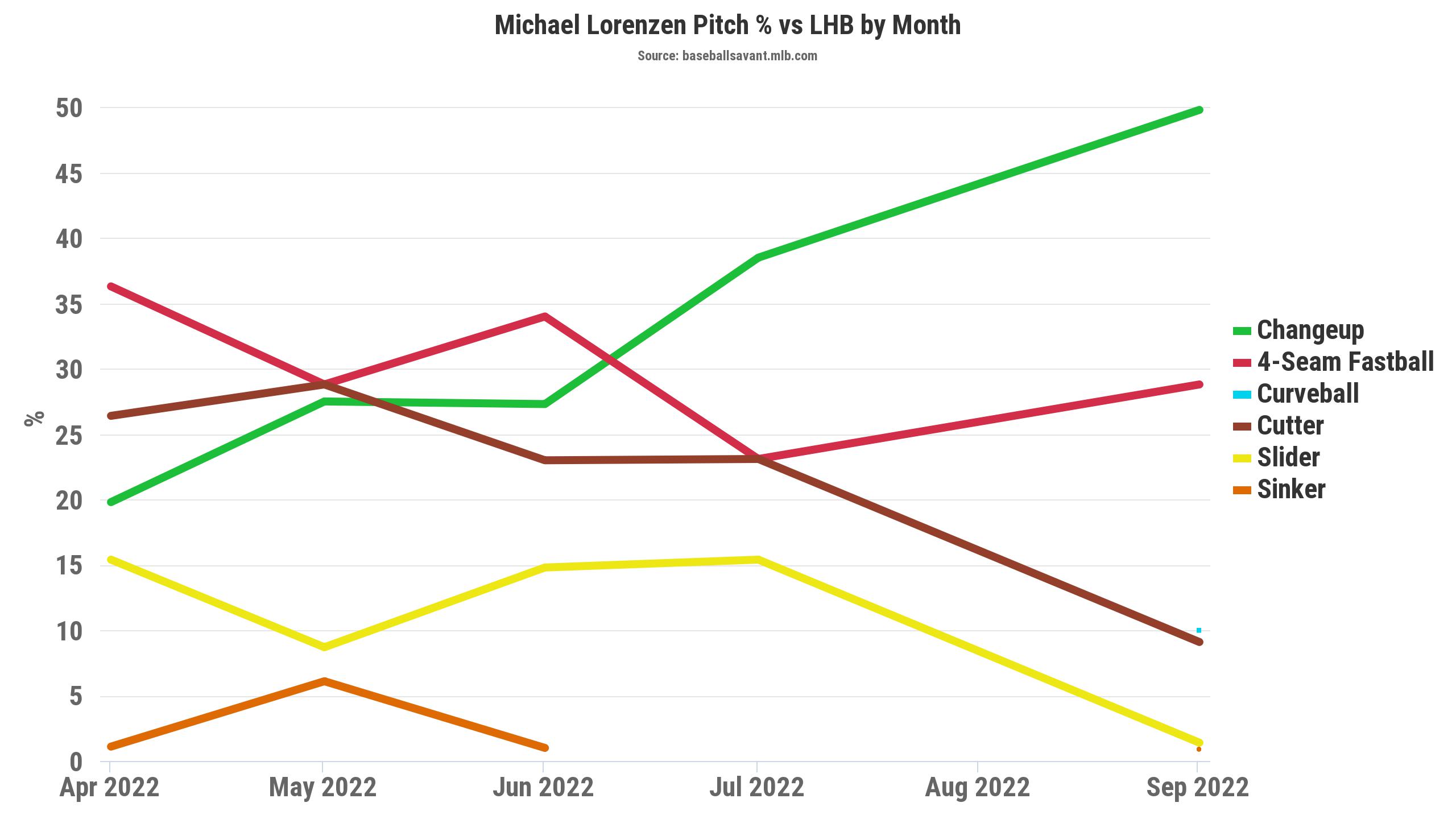
Lorenzen’s primary pitches also changed throughout the year. From April to June, his go-to offering against left-handed batters was the four-seam fastball, but his changeup earned a bigger role as the year progressed. By September, he was throwing the change to lefties nearly half the time:
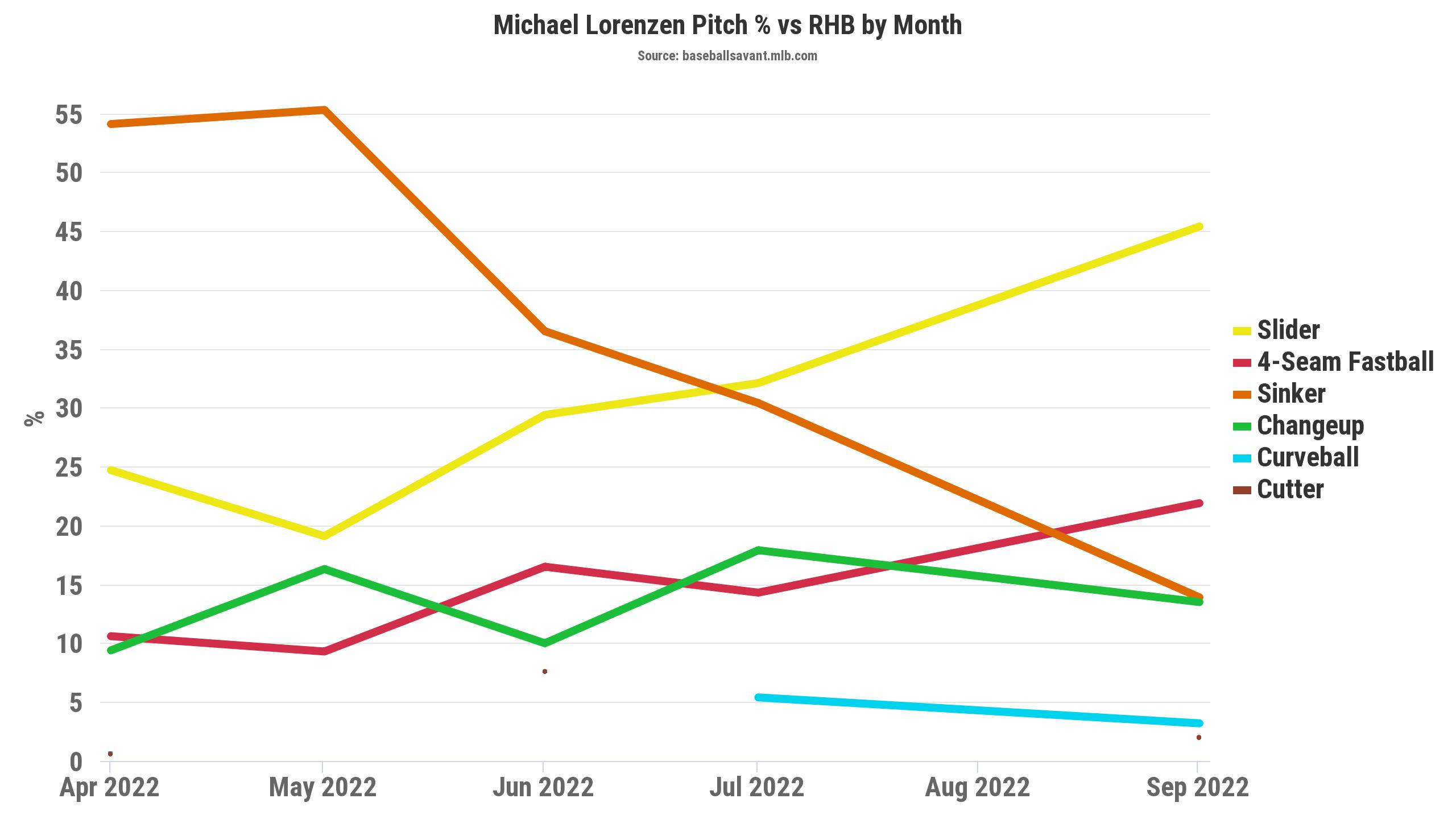
Similarly, his sinker was his primary pitch against righties early on, but his slider overtook it by season’s end:
Lorenzen also vastly reduced his cutter usage and adding in a curveball. Until September, he had thrown just five curveballs all year. Over his final five starts, he threw 30. As for his individual pitches, Lorenzen added spin to every one of his offerings throughout the season, and he also started throwing a noticeably slower changeup. All this to say, late-season Lorenzen was a vastly different pitcher than his early-season counterpart. He changed his approach, and he had better outings as a result:
Michael Lorenzen by Month
Months
GS
IP
K/BB
ERA
FIP
xFIP
April-July
13
71.0
1.83
4.94
4.46
4.42
Sept/Oct
5
26.2
2.14
2.36
3.90
3.60
Lorenzen did well to concentrate on his pitching in 2022. He saw especially positive results in September, and he’ll look to build upon that success in a healthy 2023 season. It’s probably best if he continues to resist the call of the bat – even if he has a much better chance of cracking the lineup with his new team. Lorenzen’s career OPS (small sample size warning) is higher than the Steamer projections for half of Detroit’s starting lineup:
It’s funny that I find myself advocating against Lorenzen, the two-way player. I promise I’m not anti-fun! In fact, I was inspired to write about him in the first place precisely because of his experience on both sides of the ball. A little part of me was hoping to find an argument that might compel him to pick up the bat once again. However, the more I learned about his 2022 season, the more invested I became in Lorenzen, the one-way player. He spent the year altering his approach and refining his individual pitches, and the season ended before we could tell if he found a pitch mix to stick with.
That being the case, I look forward to watching his development continue into 2023. With the Tigers, Lorenzen should have a low-stress environment to tinker, adjust, and grow as a starting pitcher. If he’s happy with the approach he took in September, I’m interested to see how it plays out over a full season. And if he isn’t done adjusting, I’m excited to keep up with whatever changes he makes next.
Two summers ago, I asked Greg Mroz — then a radio broadcaster for the Clinton Lumber Kings — which of their players I should interview and write about. He recommended Zack Littell. I proceeded to do so for a Sunday Notes column, despite never having heard of him. Not too many people had. At the time, Seattle’s selection in the 11th round of the 2013 draft barely registered a blip on prospect radar.
Mroz deserves some props, because Littell is now living large. Playing for two different organizations, at two different levels and for three different teams, Littell finished this season with a record of 20-1. The most recent of his victories came on Wednesday with Minnesota’s Double-A affiliate, the Chattanooga Lookouts, in the Southern League playoffs.
No one saw it coming — you can’t predict 20-1 — and the same could probably be said of his multiple changes of address. Seattle swapped Littell for James Pazos last November, and the Yankees subsequently traded him to the Twins as part of July’s Jaime Garcia deal.
“The first one was out of nowhere,” Littell told me. “I was at home, hanging out in the offseason, and got a call — one minute I was a Mariner, and the next minute I was a Yankee. Coming to the Twins… I got scratched from a start the night before, so I kind of knew something was up, but I thought I was going to the A’s because of all the Sonny-Gray-to-the-Yankees rumors. But when I got the call from (New York GM Brian) Cashman, he told me I was going to the Twins.”
The 21-year-old North Carolina native is smart enough to know that W-L records are to be taken with a grain of salt. Read the rest of this entry »
Mikie Mahtook is healthy and riding his old swing to a resurgent campaign with the Detroit Tigers. Acquired from the Tampa Bay Rays in January for a PTBNL (Drew Smith), the 27-year-old outfielder is slashing a robust .288/.338/.464, with nine home runs in just 267 at-bats. Following a sluggish start that included limited playing time, he’s emerged as one of the few bright spots on what has turned into a moribund Motown ball club.
Last year was tough sledding for the Louisiana State University product. Coming off an impressive 41-game cameo with the club that drafted him 31st overall in 2011, he logged a .525 OPS over 196 plate appearance. Physical issues played a role — oblique and hand injuries were the primary bugaboos — but thanks to an offseason of healing and hard work, Mahtook is once again at full strength.
The change of scenery isn’t hurting. The Tigers are in team in transition, which means Mahtook is getting an opportunity to show what he can do. His body is giving him that opportunity, as well. Mahtook talked about his 2016 maladies, and the return of his swing, in the middle of this month.
———
Mikie Mahtook: “I’m healthy. Last year I wasn’t. I hurt my oblique at the beginning of the season and it really affected my swing, which in turn affected my approach at the plate. Instead of being linear and allowing the ball to travel — staying extended and getting through the ball — I was basically cheating toward it to mask the pain in my oblique. I was going forward and everything was rotating toward left field.
Anthony Castro is emerging as one of the top pitching prospects in the Detroit Tigers organization. Two years removed from Tommy John surgery and armed with plus stuff, the 22-year-old right-hander is 9-4 with a 2.70 ERA in 18 starts for the Low-A West Michigan Whitecaps.
Following his last outing, a coach for the opposing team was highly complimentary of Castro’s cutter, which is actually a mid-90s four-seam fastball that has natural cutting action. As the native of Caracas, Venezuela, explained, “It just comes out that way. That’s crazy.”
It’s not crazy to believe he’s ready to prove himself at the next level. As the aforementioned coach told me, “I’m not sure why the kid is still in the Midwest League.”
Castro has taken his family out of their homeland, and for perfectly understandable reasons: with the situation in Venezuela growing increasingly worse, the youngster feared for their safety and well-being.
Justin Wilson used to throw more than a modicum of curveballs, but that was when he was a starter. The Detroit Tigers closer largely shelved the pitch a few years ago, as it had been serving primarily as a get-me-over option. He didn’t feel it was beneficial out of the bullpen. As Wilson explained to me in June, “it was kind of loopy — the action just wasn’t there — so it definitely wasn’t a put-away pitch.”
The 29-year-old southpaw came into 2017 wanting to resurrect it — sort of. Mostly, he wanted a lower-octane offering to augment his bread-and-butter. Since becoming a reliever, Wilson has relied almost exclusively on a fastball and a cutter.
“I wanted something to slow guys down,” explained Wilson, whose days in Motown — if trade rumors are to be believed — are numbered. “When a hitter saw a scouting report on me, everything was hard. My fastball. My cutter is hard. There was nothing with a speed change. I worked on that over the winter, and kept it going into the spring.”
Over the course of the current campaign, Wilson’s breaking ball has been inconsistent and somewhat difficult to define. Pitch data suggests it’s a slider, the lefty considers it more of a curve, and depending on the day, either could be more accurate than the other. Read the rest of this entry »
Let’s start with a comp, courtesy of Connecticut Tigers pitching coach Ace Adams:
“He reminds me of Jonathan Papelbon, who I had for a couple of years with the Red Sox. The same type of arm action, the same type of delivery; the stature, the arm strength. There’s a lot of life on the four-seamer.”
The “he” in question is pitcher Matt Manning, whom Detroit drafted ninth-overall last year out of a Sacramento, California, high school. The 19-year-old right-hander — all six feet, six inches of him — is being tutored by the longtime pitching coach in short-season ball.
Papelbon was a starter before becoming a reliever, and if all goes as planned, Manning will remain in a rotation for the duration of his career. Adams feels he has a chance to be “pretty special,” and the scouting world pretty much agrees. Baseball America, MLB.com, and our own Eric Longenhagen all rank Manning as the top prospect in the Tigers’ system. Read the rest of this entry »
Last year, Eno Sarris wrote that Shane Greene “features a cutter and a slider, but where one begins and the other ends is tough to decide.” Sarris concluded his article by opining that the Detroit Tigers right-hander “has four breaking balls.”
PITCHf/x shows something different. They don’t have the 28-year-old reliever throwing a cutter at all. What they have is a combination of sliders and curveballs, with a notable flip-flopping of usage. Per PITCHf/x, Greene threw 46.6% sliders and 7.9% curveballs last year. This season, the pitch-tracking algorithm has him at 13.3% sliders and 30.1% curveballs.
And then there’s his heater. Greene has been two-seam heavy since moving to the bullpen last year, but while PITCHf/x has him throwing just 1.8% four-seamers this season, the system indicates he threw 19.6% four-seams (versus 25.2% two-seams) in 2016.
Intrigued by these conundrums, I went directly to the source. Greene, who has a 1.71 ERA and a 10.2 strikeout rate per nine innings over 33 appearances, broke down his repertoire when the Tigers visited Fenway Park last weekend.
———
Greene on his repertoire: “The pitch that’s 88 to 91 [mph] and is moving like a slider, I call it a cutter. I call it that because when I earned the pitch, I already had something I called a slider. It’s harder, so I try to use it more as a cutter — not so much as a swing-and-miss pitch, but to miss barrels with. And sometimes it gets big, and sometimes it stays smaller.
“The pitch that is 82 to 84-ish, sometimes 85, is what I call my slider. A lot of people think it’s a curveball, but that’s been my slider since I was in high school. Same pitch.
Kevin Gregg didn’t follow in his father’s footsteps. Eric Gregg — one of the first African-American umpires to work in the major leagues — called balls and strikes in the National League from 1975-1999. Kevin graduated from James Madison University with a degree in Sports Management, and is now the Senior Director of Media Relations for the Boston Red Sox.
While his late father plays a big role, he wasn’t the initial impetus when I approached Gregg for this story. Rather, I’d been thinking about how different people follow baseball in different ways. Not everyone has the same relationship with the game, nor the same perspectives on it.
When you’re in Gregg’s position, you watch a lot of baseball, and you do so studiously, through a unique lens.
“I’m at about 130 of the regular-season games, and I’m watching every single pitch,” explained Gregg. “I’m scoring the game, literally writing everything down. Being into every pitch is part of my job. I need to know what issues may come up for the players, or for the manager, who meets with the media on a daily basis. What were the strategies that worked and didn’t work? There’s also the baseball information side — getting game notes ready.” Read the rest of this entry »
Brad Ausmus is hard to label. Many see him as an old-school manager — and, based on some of his beliefs and actions, that’s perfectly understandable. On the other hand, he’s Ivy League-educated and well versed on most analytic concepts. From a knowledge standpoint, the manager of the Detroit Tigers is far from a troglodyte.
This interview doesn’t add much clarity to Ausmus’s identity. For one thing, it’s narrow in scope. While other subjects are touched upon, closer usage and pitch-framing comprise the bulk of the conversation.
Of note: this material actually comes from three separate conversations. The first two were in group settings with Detroit beat writers (with my questions eliciting most of these responses) on back-to-back days. I then had a shorter, one-on-one conversation with Ausmus to fill in a few blanks. Because of the manner in which these quotes were obtained, some have been resequenced for continuity.
———
Ausmus on analytics (intro): “Analytics are ubiquitous. I think the dangerous mistake people make — some member of the media make — is believing that they can’t be flawed, because they’re based on numbers. That’s absolutely false. Numbers do not always tell us the whole story. And there are certain things in baseball, because it’s played by humans, that numbers will never be able to put a value on.”
On leverage and closer mentality: “A lot of people in the analytics world think you should bring in your best pitcher in the biggest point of the game. Well, excuse my French, but who the (bleep) knows when the biggest point in the game is until the game is over? You don’t know. It may be the sixth. It may be the ninth. The problem is, if it’s the sixth and you use your closer, and all of a sudden you have a one-run lead in the ninth, who is going to close? You don’t have that guy anymore, because you burned him.
“Anyone who says you have to bring your closer in early, or in the biggest point in the game, has a crystal ball. That argument goes out the window for me. I don’t mind second-guessing, but second-guessing the biggest point of the game after the game? It’s easy to tell then. It’s not easy to tell in the seventh inning.
Please excuse Brad Ausmus’s French. (Photo: Keith Allison)
“If you’ve got another guy who is a closer, you’re fine [bringing your closer into a high-leverage situation early and not having him pitch the ninth inning]. But if you don’t have another guy who is a closer… closing a game in the ninth inning is not the same as pitching the eighth inning, or the seventh inning.