Archive for Washington Nationals

Mariners Swap a Ford for a Ferrer(i)
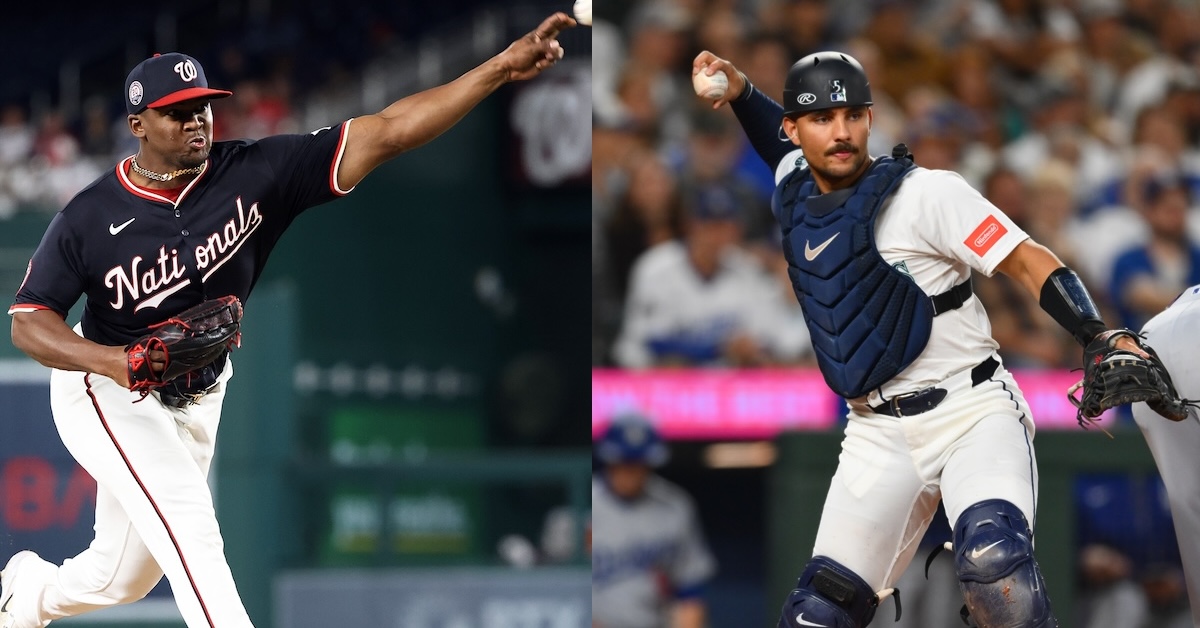
Daniel Kucin Jr. and Steven Bisig Imagn Images

On Saturday afternoon, the Mariners traded catching prospect Harry Ford to the Nationals in exchange for Jose A. Ferrer; the Mariners also sent right-handed pitcher Isaac Lyon, their 10th-round pick from this year’s draft, to Washington. Robert Murray of FanSided had the news first.

This is a trade that raises a few eyebrows. While Ford moved through the minor leagues slowly by modern standards, he’s been a consensus Top 100 prospect for nearly three years now. It’s a little jarring to see someone of that caliber dealt for a reliever, particularly one with pedestrian surface-level numbers and good but not sterling peripherals. My initial reaction was that Seattle sold low on Ford, though further review has changed my thinking a little. Let’s dive in.

The Mariners’ side of this takes a little more nuance to work through, so we’ll start with their situation. Ford is a good, if not great prospect. He’s been on our Top 100 list for a couple seasons now on the strength of a well-rounded game, finishing the 2025 season ranked 43rd overall as a 50 FV. He can hit a little bit, there’s average power that he’s learning to tap into, and he’s growing into a reliable, if unspectacular defender behind the plate. There isn’t much star potential here, and I’ll say more on why that is in a bit, but he does project as a regular.

But Ford was also as blocked as any prospect in the minors, stuck behind MVP runner up Cal Raleigh. Raleigh is durable, excellent, and thoroughly entrenched after inking a six-year extension this past March. The Mariners had experimented with Ford in the outfield to see if they could find something else for him to do, as it’s been clear for a while now that his future would not be behind the plate in Seattle. He’s been an obvious trade candidate for at least a year, and the only surprise is that it took so long for the M’s to move him. They’ve reportedly been shopping him for impact relievers elsewhere; frankly, this is a swap that would have made a ton of sense four months ago, when Ford was just as blocked and the Mariners could have used more relief depth in front of Andrés Muñoz and Matt Brash for their playoff push. Oh well, not like it bit them in the butt during October.

So, trading Ford makes sense. But for Ferrer? A guy with a 4.36 career ERA? Don’t they have holes around the infield, ones they may need to fill via trade since it seems like their off-season budget is pretty modest? What gives?

As readers likely know, Ferrer’s numbers under the hood are much better than his ERA. His FIP over the last two years is under 3.00, thanks to tiny walk and home run rates. He’s also one of the league’s foremost groundball generators. His groundball rate is just over 60% for his career, and of the pitchers who threw at least 50 innings in 2025, only José Soriano, Jhoan Duran, and Tim Hill topped Ferrer’s 62.6% mark. As you’d expect, it’s really hard to drive the ball against him, and he only allowed five long balls in 76.1 innings of work in 2025. He takes full advantage of his ability to dampen damage on contact, pounding the zone to the tune of a 2.21 career BB/9 rate and an in-zone pitch rate of nearly 60% (roughly the 90th percentile for the league).

And of course, the Mariners aren’t just acquiring those numbers. They’re trading for the chance to unlock more, and you can see compelling paths forward here.

This season, Ferrer mostly just pounded the zone with his sinker while mixing in a changeup about 20% of the time and a slider once or twice an outing. His sinker is quite good, as it sits in the upper 90s, touches 100, and features plus tail. It’s a quick and reliable way for him to generate outs, and you can see why he leans on it. But like most pitchers who spam the fastball, there’s an argument for a usage adjustment here. The changeup performed very well in 2025, generating big whiff and chase rates, and hitters didn’t do much with it even on contact. He could probably stand to use it more.

The real path forward may be the slider, though. Ferrer’s sits in the low 90s and has tight, two-plane movement, not quite cutterish but in the neighborhood. His command of it isn’t great, generally in the dirt to the glove side, but whether it’s because guys don’t expect the Spanish Inquisition or they’re just not seeing his spin very well, opponents did absolutely nothing with it and whiffed more than half the times they swung. The Mariners have had a lot of success getting fastball-heavy arms to diversify their arsenal — Logan Gilbert and Bryce Miller are two obvious examples — and it would come as no surprise if they have Ferrer lean on the bender a lot more going forward.

Put everything together, and you can imagine why Seattle sees Ferrer as an impact reliever, the kind worth parting with a top prospect for. Sources from around the game like Ferrer as an upside play. He throws hard, he pounds the zone, he has three pitches that flash plus, and there’s a relatively straightforward adjustment that could unlock more. With four years of team control left, he’s not even expensive. He lengthens the bullpen and gives the Mariners a left-handed weapon of a magnitude they didn’t have last season. There’s always risk in acquiring relief pitching, but this looks like a safe way to add 1-1.5 WAR to the bullpen, and with his skills, a nutty, sub-2.00 ERA season is not outside the realm of possibility.

On Washington’s side, this also makes plenty of sense. Ferrer’s a tough guy to lose, but good relievers are a luxury on a rebuilding club and swapping bullpen arms for bats with everyday upside is a sound idea. That’s especially true behind the plate. Nationals catchers produced -1.4 WAR in 2025, last in the majors, and were awful on both sides of the ball. Led mostly by Riley Adams and Keibert Ruiz, the club’s backstops hit .225/.270/.322, good for a 65 wRC+ that was 29th in baseball. Thanks in part to Ruiz’s horrible framing numbers (his mark of -5.3 runs prevented was third from the bottom among all catchers, in 65 games no less), Washington’s catchers were also the league’s worst collective on defense as well. Ruiz was once a top prospect, but he’s now 27, has no approach, and is not exactly an asset defensively. It’s time to move on.

Enter Ford. A first round pick in 2021, Ford progressed slowly and steadily toward the big leagues before making his debut in September. His approach has been awesome: He has a very good eye, he recognizes soft stuff out of the hand, and while he doesn’t swing a ton, he reliably turns it loose on pitches he can drive. If you put a ton of stock in swing decisions, this is your guy.

Statistically, all is well. His production has been strikingly consistent, with Ford notching a wRC+ between 125 and 135 at each full-season level. He’s also posted very small deviations in his walk, strikeout, and — aside from 2024, which he spent in a huge, homer-suppressing yard — ISO numbers, all of which were encouraging. If you value consistent minor league production, this is your guy.

Scouts and evaluators are not universally sold on Ford’s ability to translate that production to the big leagues, though. His bat speed is average and he’s periodically struggled getting his bat to fastballs up in the zone. In his most recent prospect write-up, Eric covered an adjustment Ford made with his feet and timing that seems to have helped this season, but obviously the big leagues will provide a different stress test. I see an average bat with a chance to grow into average game power, but there are scouts who would take the under on both.

Ford’s defensive growth has mirrored his ascent through the minors. His framing has improved but is still fringy, and he may benefit from an ABS assist (though he was actually pretty bad at challenging pitches this season). He shines more in spots where his athleticism takes center stage. He’s quick on plays where the ball is tapped out in front of the plate, and he’s going to catch his share of baserunners. He has an above-average arm, his throwing accuracy has improved, and he caught nearly 25% of would-be-thieves in 2025. Early-career reports questioned whether he had too much trouble simply catching the ball, but his passed-ball figures have plummeted since 2023. I’m projecting an average defender, though again, there are evaluators who will take the under.

It all adds up to a 50 FV report, albeit one where there isn’t a lot of wiggle room if one of the tools doesn’t reach its projection or Ford’s approach buckles against better stuff. In truth, part of that projection is a reflection of the state of catching throughout the league; the bar for being an average regular isn’t very high right now. Still, if he’s average on both sides of the ball, that’s a good player, and he’s the kind of risk Washington should be taking at this stage. Ford could be part of the next good Nationals team, and even if he falls a little short of where we have him here, he’s likely steady enough to be a real upgrade over what they’ve trotted out in recent seasons.

Let’s quickly touch on the other player in the deal. Lyon, the son of former big leaguer Brandon Lyon, signed for nearly $200,000 this summer. He’s a good strike thrower with a bad fastball, a slider and change that flash average, and a delivery with some deception in it. He sat in the low 90s in short starts with Low-A Modesto, and could have another gear as he fills out. He projects as an up-down type and has a low-leverage relief ceiling if he can find a way to throw harder in shorter stints.

One other thing to note: With Ford now in Washington, Seattle will be in the market for a backup catcher. The club is reportedly open to a reunion with Mitch Garver, who hit 24 homers amidst otherwise disappointing production over the past two years as the club’s primary backup catcher; he also started at DH 22 times this season. While Raleigh plays nearly every day, he does DH fairly often, so whoever Seattle signs will probably start about 25% of the time behind the plate.

Ultimately, the deal helps both parties, and one exec I spoke with called it a “win win” move. The more I look at Ferrer, the more he seems like a reliever with another gear, a guy with closer stuff who is a plenty good fit for Seattle’s bullpen as is. Still, I think Washington did well here, getting a high-floor position player at an area of desperate need. The Paul Toboni era is here now, and Nationals fans should be enthused about his first big trade as president of baseball operations with the club.


Speedy Andrew Stevenson Slows Down and Reaches DC

Andrew Stevenson made his big league debut with the Washington Nationals on Sunday. His call-up came in a time of need — injuries and a bereavement leave had left the Nats short of outfielders — but the call-up wasn’t without merit. The 23-year-old former LSU Tiger had put himself back on the fast track after a slow start in Triple-A.

It was a dogged climb for the speedy 2015 second-round pick. Promoted to Syracuse on May 1 after hitting a heady .350 with Double-A Harrisburg, Stevenson found himself straddling the Mendoza Line six weeks later. Then he picked up the pace. From June 10 onward, he went 48 for 159 (.301), hitting safely in 30 of 40 games.

His modus operandi is slash and burn. Stevenson’s stroke is geared toward the gaps — he has just six home runs in 1,216 professional plate appearances — and he’s a running threat once he gets on. The native of Lafayette, Louisiana swiped 39 bags a year ago, and he was 9 for 10 in stolen base attempts after joining the Triple-A Chiefs.

His Double-A manager sees some raw power lurking in Stevenson’s lanky frame, but he largely concurs with the slash-and-burn label. Read the rest of this entry »


Danny Espinosa’s Bat Path: An Angel Battles to Erase Eight-Hole Woes

The conversation began a bit clunky, then it turned a little nerdy. Not in a numbers-crunching way, but rather in a bat-path way. Danny Espinosa, it turns out, wasn’t too loopy after all.

I’d never formally met the Angels infielder prior to approaching him in Tempe earlier this spring. We had interacted, albeit briefly. That was last September, when he was in Pittsburgh as a member of the Washington Nationals, and I was interviewing Trea Turner. Sidling up from the adjoining locker, Espinosa raised an imaginary microphone and asked his then teammate: “Are you the best player in the National League?” He then walked away, bemused, as I claimed that was going to be my next question. (It wasn’t.)

Fast forward to our recent, and more expansive, exchange. The first thing I asked Espinosa, who was acquired by Anaheim over the offseason, was why he was so inconsistent with the bat as a Nat. After a quizzical look that led me to rephrase my question, he suggested he’s happy to be in the American League.

Read the rest of this entry »


Trea Turner on Hitting

Trea Turner is squaring up a lot of baseballs. He’s also flying around the bases. The 23-year-old Washington Nationals rookie has a dozen home runs, seven triples, and 29 stolen bases in just 68 games. His slash line is a sexy .340/.362/.560. In a nutshell, he’s been very, very good.

He’s also thoughtful when the subject turns to hitting. The North Carolina State product likes to keep thing simple, but at same time, he has a nuanced feel for his craft. Launch angle is a familiar term, and he understands that what works for Daniel Murphy isn’t necessarily going to work for him. He isn’t going to tailor his swing for pull-side home runs. Nor is he going to take advantage of his plus-plus wheels by slapping and burning like a young Juan Pierre. Turner is going to be himself, and based on early returns, that’s an All-Star-caliber player.

Turner — currently manning center field after reaching Washington as a second baseman — talked about his hitting philosophy when the Nationals visited Pittsburgh over the weekend.

———

Turner on his approach: “For me, it’s really situational. It depends on different things. Am I leading off the inning? Are there are runners in scoring position? Does the pitcher on the mound have good command or bad command? Am I going good or going bad? There are a lot of questions I ask myself. Based on the answers to those questions, I’ll have an approach. You have to play it by ear.

Read the rest of this entry »


Evaluating the 2016 Prospects: Washington Nationals

EVALUATING THE PROSPECTS 2016
Angels
Astros
Athletics
Blue Jays
Braves
Brewers
Cardinals
Cubs
Diamondbacks
Dodgers
Giants
Indians
Mariners
Marlins
Mets
Nationals
Orioles
Padres
Phillies
Pirates
Rangers
Rays
Red Sox
Reds
Rockies
Royals
Tigers
Twins
White Sox
Yankees

The Nationals have an extremely interesting system, highlighted by a handful of consensus big-upside prospects in Lucas Giolito, Trea Turner, Victor Robles, and Reynaldo Lopez. Though it doesn’t have the name recognition throughout that some of the top-rated teams have, this is one of the more exciting organizations to cover as a prospector (prospectator?). The Auburn and Hagerstown affiliates may end up being the most exciting groups to watch by mid-season.

In general, the Nationals seem to have found a niche bringing in a ton of underrated hit-tool-heavy guys that are hitting their stride at the same time. Expect a lot of turnover with this list by next year, as the top guys are due for full-time gigs in Washington, and the upside prospects start to separate themselves a bit more. If you could criticize any part of the system, there are a few less high-upside arms in the lower minors than many teams like to stockpile. In terms of total value, however, this group doesn’t have a problem stacking up against the rest of the league.

Following the top four are a sizable number of 50+ prospects who provide the big-league club with sufficient low-cost resources to hold them over until their talented crop of players in the lower levels have time to sort themselves out. Though I find myself lower on a few popular prospects like Pedro Severino, Juan Soto and Rafael Bautista, I am equally more enthusiastic than most on less established players like Telmito Agustin, Kelvin Gutierrez and Taylor Hearn.

Read the rest of this entry »


The Inning That Ended the Nationals’ Season

I went to a baseball game in Oakland last night. This wouldn’t have any bearing on this article if not for this: I drove to the game, and in that 30-minute drive to the stadium, the Washington Nationals went from clawing their way back into some sort of contention in the NL East by beating the Mets to looking up October beachfront condo rentals. When I got in the car, there was the prospect of an interesting September division race. When I got out of the car, poof — that was all but gone. One inning, three pitchers, six walks, and six runs after the start of the top of the seventh, the score of the game was tied at 7-7, and all it took was a home run off the bat of Kirk Nieuwenhuis in the eighth to finally sink the Nationals.

If you follow either or both of these teams, yesterday’s seventh inning was an encapsulation of how the season has unfolded. The Mets have been one of the best stories in baseball; the Nats have been 2015’s poster child for the biggest gap between performance and preseason expectations. One of the most alluring things about baseball is how large season trends can play out in the microcosm of a single inning, and so the seventh inning saw a shift in win expectancy inline with the arc of the Nationals’ season, from spring training to today:

At one point, with two out and one on in the top of the seventh, the Nationals had a 99.2% expectation of winning the game. And, while late 7-1 leads are blown in games many times during the course of an entire baseball season, when they happen in this sort of context and with this kind of futility, it’s our responsibility to break them down.

Read the rest of this entry »


Struggling Nationals Call on Trea Turner

It’s no secret that the Washington Nationals have fallen short of expectations this season. At 62-61, the unanimous NL East favorites from the preseason sit 5.5 games behind the Mets with a discouraging 19% chance of winning the NL East. Things have been particularly ugly of late, as the Nats have won just 11 of their last 30 games.

As Dave Cameron pointed out last week, several of the biggest culprits for the team’s struggles are members of the team’s offensive core. Anthony Rendon and Ryan Zimmerman have been bad. Jayson Werth’s been worse than that. But perhaps the biggest disappointment has been the team’s shortstop, Ian Desmond, who was projected for the second-highest WAR among Nationals hitters by ZiPS. Desmond’s .229/.279/.384 batting line has put him within spitting distance of replacement level — a far cry from his preseason ZiPS forecast of 4.0 WAR.

Despite his struggles, the Nationals stuck with Desmond over the season’s first four-and-a-half months, trotting him out there in 119 of their 123 games this season. But on Friday, the team began to diverge from the status quo. After weeks of speculation, the Nats finally summoned prospect Trea Turner to the big leagues to help solidify the shortstop position from here on out.

Read the rest of this entry »


Sunday Notes: Saber Seminar, Backup Sliders, Gose, more

Jason Bere had an interesting observation about Joe Borowski, who saved 45 games for the Indians in 2007. According to Bere – currently Cleveland’s bullpen coach – Borowski threw a lot of backup sliders. Contrary to what you might think, that was a good thing.

“A lot of times when he got a guy to swing and miss, it was with the one that just kind of stayed,” Bere told me. “They would react to what they were seeing out of the hand, the spin, but while it had the tightness of a true slider, it didn’t break like one.

“Hitters will tell you that something that backs up on them is hard to hit. A hanger, they’ll crush. But something that backs up – that last second it’s not going where they thought it was going to go – they”ll have trouble with it. You can see it from the swings they take.”

Intrigued by what Bere told me, I set out in search of further opinions on the effective, yet almost always unintentional, backup slider.

Alan Nathan, the man behind The Physics of Baseball, shared a scientific perspective. Read the rest of this entry »


Sunday Notes: Funky Lefties Holiday Edition

Bruce Chen retired on Monday, which makes this a good time to talk about Michael Roth. Chen closed out his career with the Indians, and Roth, a fellow southpaw, signed with Cleveland this past off-season. That’s not their only connection.

A few days before Chen made his announcement, I suggested to the 25-year-old former Angel that he’s similar to the crafty 37-year-old. It turns out I wasn’t the first to do so.

“Bruce told me that after I finished throwing my second bullpen of the year,” explained Roth, who is 5-1 with a 2.39 ERA in eight starts for Triple-A Columbus. “He looked at me and said, ‘Wow, we’re exactly the same; we throw exactly the same way.’

“There are things in his repertoire I like to use. He drops down with his fastball, and throws a drop-down slider. He’ll flip his curveball in, 0-0, and I’m throwing my curveball more this year – a slow curveball. I mix and match angles and throw four different pitches, so I really enjoy talking to Bruce about how he approaches hitters.”

Charles Nagy, who took over as the Columbus pitching coach when Carl Willis left for Boston, agreed there are similarities. He also sees differences, one of which is in Roth’s favor. Read the rest of this entry »


Sunday Notes: Bryce Harper on Stats; Storen, Gausman, Eflin, Almora, more

When I first met Drew Storen, his train had yet to reach Big League Station. The Stanford product was 22 years old and pitching in the Arizona Fall League, his Nationals debut still six months away. Since that time he’s ridden a roller coaster.

The 27-year-old right-hander has a 43-save season on his resume, but also an elbow injury and a crushing post-season loss. Briefly demoted to the minors in 2013, he bounced back to the tune of a 1.12 ERA in 65 games last year. With everything that’s transpired since our initial conversation, a glimpse in the mirror was in order.

“You try not to reflect when you play,” said Storen. “It’s human nature to do so, but you try to go day-to-day – every cliché possible – in baseball. You have to go forward, because the train is moving.

“But it’s been a good journey. There have been challenges, and good times as well. I feel I’ve grown as a pitcher. Trying harder is not always trying better, and I’m not as pedal-to-the-metal as I used to be, When I came up, I was more of a bar-fighter than a boxer. I’ve learned that you need to be a tactician; you can’t just go out there and out-stuff people.”

Analogy aside, Storen has never possessed a troglodyte mentality. He was already familiar with PITCHf/x when I interviewed him five-and-a-half years ago. He still utilizes the tool, typically to review his release point, and relies heavily on video to “make sure everything is in tune.”

Monitoring his mechanics and the depth he’s getting on his deliveries is an off-the-field endeavor. His mind’s eye is equally attentive on the mound. Read the rest of this entry »