
The Mets Search for the Right Choice(s) in Their New-Look Outfield
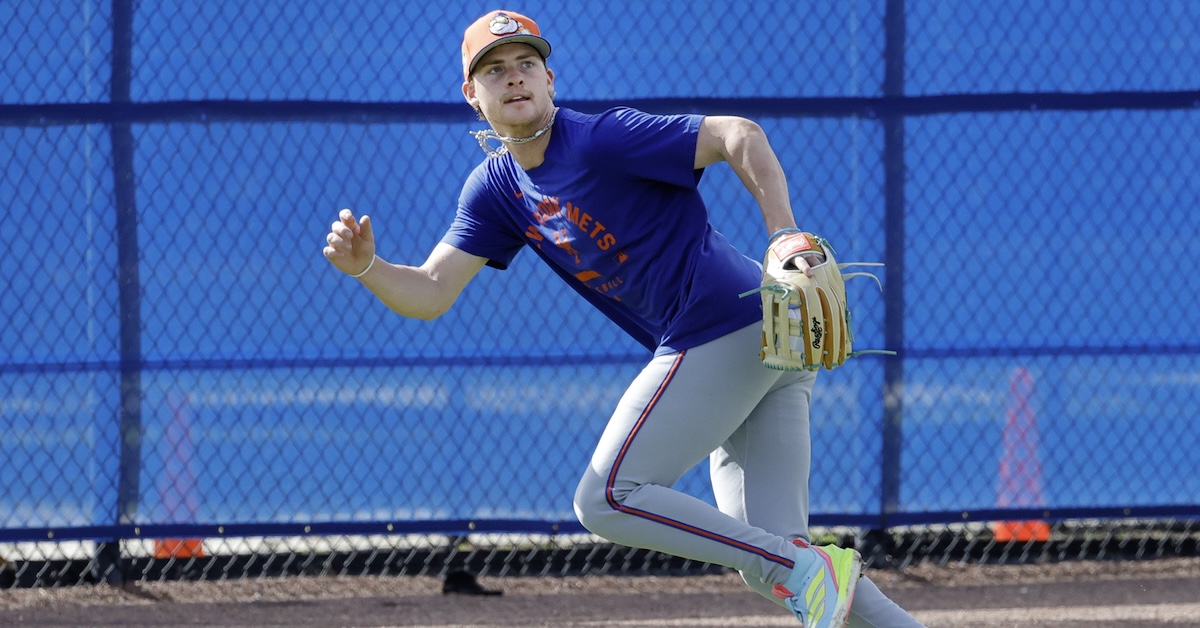
After slipping from 89 wins and a trip to the National League Championship Series in 2024 to 83 wins and the short straw in a tiebreaker for a Wild Card berth in 2025, the Mets have a new look to their outfield thanks to an active offseason, some position changes, and an astute draft pick. While the right field job has yet to be settled, several players battling for time at the position have put their best foot forward during the first two weeks of exhibition season, with the two who figure most prominently in the team’s plans homering earlier this week. On Wednesday, top prospect Carson Benge hit his first home run of the spring in an exhibition game against Team Israel, and on Thursday, Brett Baty went deep against the Nationals while making his debut in right field, a continuation of his effort to expand his defensive repertoire.
Meanwhile, MLB.com beat reporter Anthony DiComo summarized last week’s highlights:
It's been quite the week for the Mets' right-field competition.
Tuesday: Mike Tauchman homered in his first Grapefruit League at-bat.
Thursday: Carson Benge went 3-for-3, and Tyrone Taylor hit a three-run homer.
Friday: MJ Melendez hit a pair of opposite-field homers. pic.twitter.com/Tnti901ZLa
— Anthony DiComo (@AnthonyDiComo) February 27, 2026
No spring training result should be taken at face value given the varying levels of competition, and that’s especially true before people have been warned about the Ides of March, but the whole situation is worth a closer look.
Last year’s primary Mets outfield featured Brandon Nimmo in left, Tyrone Taylor in center, and Juan Soto in right. The two corners were both stable, with Nimmo starting 146 games and producing 3.0 WAR, and Soto starting 157 games, overcoming a slow start to his 15-year, $765 million contract, and producing 5.8 WAR. Center field was a mess, however, with the plan for Taylor and Jose Siri to share the job quickly breaking down after the latter fractured his tibia in mid-April. While Taylor ended up starting 85 games there, he hit a meager .223/.279/.319 (70 wRC+) overall; Carlos Mendoza additionally mixed in Jeff McNeil and deadline acquisition Cedric Mullins, but in the end, the team’s center fielders netted just 0.7 WAR while hitting for a 71 wRC+, numbers that respectively ranked 26th and 27th in the majors.
Nimmo is now a Ranger, traded straight up for second baseman Marcus Semien in late November. Siri, who didn’t return until September and then played just six games, is with the Angels now after being outrighted off the roster at the end of the season. Mullins signed with the Rays in December after reaching free agency, and McNeil was traded to the A’s for 17-year-old pitching prospect Yordan Rodriguez just before Christmas. In late January, the Mets traded infielder Luisangel Acuña and pitching prospect Truman Pauley to the White Sox for Luis Robert Jr., their new center fielder, and just before camp opened, president of baseball operations David Stearns announced that Soto would shift from right field to left.
Hence the opening in right, where the 23-year-old Benge, the 19th overall pick in the 2024 draft out of Oklahoma State, could be the solution. He’s a 55-FV prospect who placed 21st on our Top 100 Prospects list last month and second on the freshly-published Mets list, behind only righty Nolan McLean. Though he lacks any standout tool, Benge projects to be above average everywhere except his game power (45 PV/50 FV). The majority of his professional experience is in center field — and he may yet wind up there given that Robert is only signed through this season, with a club option for 2027 — but right field is an option thanks to his plus arm. Pulling from his updated prospect profile:
It’s on defense that Benge’s profile has taken the biggest step forward. He played right field at Oklahoma State but has taken to center field in pro ball, and now projects as an above-average glove there. He runs well, takes good routes into the gaps, and has comfort at the catch point. Considering he was recently a two-way guy and has only focused on playing center field for about a year, he might even have another half grade more in the tank than we’ve projected here.
Last year, Benge rocketed across three levels, playing 60 games at High-A Brooklyn, 32 at Double-A Binghamton, and 24 at Triple-A Syracuse, hitting a combined .281/.385/.472 (150 wRC+) with 15 homers and 22 steals. Given that he scuffled during his brief stay at Syracuse, batting just .178/.272/.311 with three homers in 103 plate appearances, the logical assumption is that Benge will start the season there, but Stearns has left the door open for him to make the team out of camp, as he said in February in the wake of announcing Soto’s move (more on which below). Per SNY:
“We’ve been consistent throughout the offseason that Carson’s gonna come to camp with a chance to make our team — that remains the same,” Stearns said. “He’s played a lot of right field during his time in the minor leagues. We’re confident with him out there.”
…”I think evaluations in spring are always a little bit fraught, and we know that,” Stearns noted. “We want to see quality at-bats, we want to see him handle the outfield. It’s also gonna depend on what some other guys do, right? It’s not all going to be dependent on how Carson looks.
“We’re not gonna get too preoccupied with surface line results one way or the other, and we’ll make the best decision that we can on Opening Day — recognizing that Opening Day is one day, and rosters can change pretty quickly.”
In Wednesday’s game against Team Israel, Benge connected on a 1-2 fastball from Ryan Prager, a 23-year-old lefty chosen in the ninth round out of Texas A&M by the Guardians last year:
The opposite-field homer traveled an estimated 350 feet according to Statcast, but it was Benge’s approach rather than the distance that impressed Mendoza, who said, “Two strikes, he stays in there, and he’s not only able to put the ball in play, but he drives the ball with authority… I’ve been impressed with the quality of the bats as far as left-on-left, fouling off pitches, putting the ball in play, his ability to drive the baseball to all fields.”
One homer off a player with even less professional experience than Benge — Prager made just two A-level appearances after signing — won’t decide who gets the Opening Day assignment or who gets the most reps throughout the season. If Benge makes the team, he figures to play most days, though he may need a platoon complement given last year’s .232/.407/.326 line in 123 plate appearances against lefties. Taylor is the most prominent reserve righty in the outfield picture, though he hit just .211/.297/.256 (62 wRC+) in 102 plate appearances against lefties in 2025, and .232/.290/.369 (84 wRC+) against them over the past three seasons.
Baty and Tauchman both bat lefty as well, but offer better fits, both with Benge and if he starts the season in the minors. The 26-year-old Baty is coming off a breakout after numerous ups and downs from 2022–24. A 2019 first-round pick out of Lake Travis High School in Austin, Texas, he ranked as high as no. 19 on our 2023 Top 100 Prospects list, but from ’22 — when his late-season call-up was curtailed by a torn ligament in his right thumb — to ’24, he hit just .215/.282/.325 (71 wRC+) with 15 homers in 602 plate appearances. While he had good months and bad in 2025, he hit a respectable .254/.313/.435 (111 wRC+) overall, including a comparatively promising .247/.301/.377 (94 wRC+) in 83 plate appearances against lefties after batting just .173/.214/.256 (30 wRC+) in 143 plate appearances against them from 2022–24.
As Davy Andrews detailed last August, Baty made a slew of adjustments last year. He opened his stance by a few degrees, quieted his pre-pitch movement, moved deeper in the box, let the ball travel a bit farther, swung a bit harder, and made much better contact — using the whole field — than he’d previously done at the major league level. Here’s a comparison of his bat-tracking numbers, plus his pulled and pulled air rates:
| Season | Depth in Box | Stance | Avg. Swing Speed | Fast % | Intercept | Sq. Up% | Blast% | Pull% | Pull Air% |
|---|---|---|---|---|---|---|---|---|---|
| 2023 | 27.1 | 0° | 75.8 | 58.1% | 0.4 | 17.7% | 11.3% | 37.4% | 12.6% |
| 2024 | 26.4 | 4° OPEN | 73.5 | 38.0% | 3.4 | 14.4% | 6.5% | 42.9% | 18.8% |
| 2025 | 30.0 | 8° OPEN | 74.8 | 48.5% | -3.4 | 22.7% | 12.8% | 35.4% | 14.9% |
Baty’s average point of contact moved back almost seven inches, from 3.4 inches in front of the plate to 3.4 inches past the front. Meeting the ball later, he pulled it less but became more productive, with his blast rate nearly doubling. Meanwhile, his average exit velocity shot up four ticks, his barrel rate more than doubled, his expected slugging percentage increased by 110 points, and his xwOBA increased by 50 points:
| Season | BBE | EV | maxEV | LA | Brl% | HH% | AVG | xBA | SLG | xSLG | wOBA | xwOBA |
|---|---|---|---|---|---|---|---|---|---|---|---|---|
| 2023 | 249 | 89.5 | 113.7 | 6.6 | 7.6% | 44.2% | .212 | .235 | .323 | .383 | .266 | .300 |
| 2024 | 112 | 86.6 | 112.0 | 10.3 | 5.4% | 33.0% | .229 | .208 | .327 | .347 | .282 | .284 |
| 2025 | 289 | 90.7 | 115.6 | 5.8 | 12.8% | 46.7% | .254 | .252 | .435 | .457 | .324 | .330 |
With rookie Ronny Mauricio recalled in June and with McNeil pulled into the center field mix, Baty added second base — a position he hadn’t played professionally to that point — to his repertoire last year. He played 57 games there with 3 DRS and -2 FRV, as well as 87 games at third with 4 DRS and 1 FRV. With Bo Bichette signed to play third base, second now in the hands of Semien, and Pete Alonso now an Oriole, the Mets have had Baty try some new gloves on for size in an effort to turn him into a superutility player. Last week, he debuted at first base, a position he hadn’t played since high school. The Mets signed Jorge Polanco to spend time at first base despite his lack of experience there, though with the DH spot open as well, there’s room for both Polanco and Baty in the lineup if Mendoza so desires.
Thursday marked Baty’s debut in the outfield, where he’s never played professionally, though he’s shagged balls during batting practice; his only defensive action against the Nationals was fielding a single in the fourth inning. He’ll remain in the mix. “There are going to be at-bats for him in a lot of different positions,” said Mendoza. “He could play third, second and first, and now the outfield is in play.”
As for his homer, Baty went oppo off Nationals righty Miles Mikolas:
Meanwhile, the 35-year-old Tauchman, whom the Mets signed to a minor league deal in mid-February, is fighting for a roster spot. Tauchman spent last year with the White Sox, hitting .263/.356/.400 with 1.4 WAR; his nine homers (in 385 plate appearances) and 115 wRC+ were his highest marks since his 2019 breakout performance with the Yankees. His season ended on a down note, as a torn meniscus in his right knee — likely sustained in late July — shut him down in late September and led to surgery.
While Tauchman doesn’t hit the ball all that hard, he’s an exceptionally disciplined hitter with a career chase rate of just 20.5%, and he’s basically platoon-neutral. Last year, he had a 121 wRC+ against lefties and 114 against righties, and for the past three seasons — the first two of which were with the Cubs — he’s got a 111 wRC+ against each. He’s a solid defender at the corners, but his days of spotting in center field are behind him, which puts him at a disadvantage relative to Taylor when it comes to a roster spot; he hasn’t played the position since 2019. Still, he makes more sense for the roster than the 27-year-old MJ Melendez, another NRI; the lefty-swinging ex-Royal owns an 88 wRC+ for his career and made just 65 plate appearances in the majors last year.
As for moving Soto, when he informed Mendoza that he’d be playing left field on the Dominican Republic team during the World Baseball Classic — yielding to right fielder Fernando Tatis Jr. just as he did when the two played together with the Padres in 2023 — it sparked a conversation with Mendoza about his comfort level at the position for the Mets. Soto relayed to Mendoza that he was comfortable in either spot. “He was like, ‘I’m willing to do whatever. If you want me to pitch, Mendy, I’ll pitch,’ kind of with that smile,” said Mendoza. Statistically, it’s a split decision, in that he’s fared better there according to Statcast, but better in right according to DRS:
| Left Field | Team | Inn | rARM | rGFP | rPM | DRS | Range | Arm | FRV | |
|---|---|---|---|---|---|---|---|---|---|---|
| 2018 | WSN | 987.0 | 2 | -3 | -3 | -4 | -5 | 0 | -5 | |
| 2019 | WSN | 1327.1 | -6 | -1 | 10 | 3 | 5 | -6 | 0 | |
| 2020 | WSN | 289.1 | -2 | 0 | -7 | -9 | -2 | -1 | -3 | |
| 2023 | SDP | 1345.0 | 2 | 1 | -8 | -5 | -6 | 2 | -4 | |
| 2024 | NYY | 52.0 | 1 | 1 | -1 | 1 | 0 | 0 | 1 | |
| Total | – – – | 4000.2 | -3 | -2 | -9 | -14 | -7 | -4 | -12 | |
| Right Field | Team | Inn | rARM | rGFP | rPM | DRS | Range | Arm | FRV | |
| 2020 | WSN | 43.0 | 0 | 0 | -1 | -1 | 0 | 0 | 0 | |
| 2021 | WSN | 1226.0 | -1 | -2 | 9 | 6 | 4 | -3 | 1 | |
| 2022 | WSN/SDP | 1298.1 | -2 | -1 | 1 | -2 | -12 | -5 | -17 | |
| 2024 | NYY | 1277.2 | 3 | 2 | -6 | -1 | -3 | 2 | -1 | |
| 2025 | NYM | 1374.0 | 0 | 1 | -8 | -7 | -11 | -2 | -13 | |
| Total | – – – | 5219.0 | 0 | 0 | -5 | -5 | -22 | -8 | -29 | |
| LF Prorated | 1350.0 | -1 | -1 | -3 | -5 | -2 | -1 | -4 | ||
| RF Profated | 1350.0 | 0 | 0 | -1 | -1 | -6 | -2 | -8 |
I’ve maintained the component run values for each system’s metrics, which break out arm value from range, with DRS also adding a category for Good Fielding Plays (rGFP) above and beyond the usual fare, including great throws and catches. Note that the figures might not add up because of rounding.
Not shown above are Statcast’s directional numbers, which suggest that Soto’s biggest issue is ranging toward the foul line of whichever corner he’s playing. None of the four ballparks he’s called home has much in the way of foul territory in the corners, so he’s understandably wall-averse, and the issue seems to be magnified in right field, where as a lefty he has to backhand a ball that’s close to the wall. As a right fielder, he has accumulated -14 Outs Above Average going towards the first base side and -8 OAA going towards the third base side, whereas as a left fielder, he’s totaled -5 OAA going toward the third base side and -3 OAA going towards the first base side. The difference doesn’t amount to much, but if it works for the rest of the outfielders and keeps Soto’s bat in the lineup — really, the most important thing — it’s fine.
As for the 28-year-old Robert, on paper, he may only look like a modest upgrade, as he’s coming off back-to-back seasons with an 84 wRC+; he hit a meager .223/.297/.364 with 14 home runs and 1.3 WAR in 2025 while spending a month and a half on the injured list for a recurrent left hamstring strain. The real question is whether freeing him from the Dark Ages of the White Sox can help him recover the form he showed previously. From 2020–23, he hit for a 125 wRC+ while totaling 11.8 WAR and 74 homers in 367 games, winning a Gold Glove as a rookie and capping that stretch with a 38-homer, 4.9-WAR season in ’23, when he set a career high with 145 games and made his lone All-Star team. Amid his down seasons, teams have been trying to pry Roberts loose because that upside is so tantalizing.
It’s too early to tell how all of this will shake out in right field. Even so, the incoming talent has given the Mets a lot to dream on when it comes to their new-look outfield.
Brooklyn-based Jay Jaffe is a senior writer for FanGraphs, the author of The Cooperstown Casebook (Thomas Dunne Books, 2017) and the creator of the JAWS (Jaffe WAR Score) metric for Hall of Fame analysis. He founded the Futility Infielder website (2001), was a columnist for Baseball Prospectus (2005-2012) and a contributing writer for Sports Illustrated (2012-2018). He has been a recurring guest on MLB Network and a member of the BBWAA since 2011, and a Hall of Fame voter since 2021. Follow him on BlueSky @jayjaffe.bsky.social.
The trade market in MLB is inefficient, part 944:
The Pirates are playing Jared Triolo as their third baseman, the Tigers praying that Colt Keith won’t embarass them if they run him out at the hot corner, and Brewers are going to go with a Luis Rengifo / David Hamilton platoon. These are teams that actually want to win games in 2026.
And the Mets are stuck hoping that their prospect who has walked zero times and struck out a quarter of the time in Spring Training doesn’t need any more seasoning in AAA. Their backup plans are (1) a third baseman who has never played the outfield, (2) a guy who would be a totally reasonable backup if he wasn’t coming off knee surgery at age 35, and (3) a guy who is -12 FRV in the outfield corners in about two seasons worth of work and has a career wRC+ of 88.
But if you don’t make a trade no one can criticize you if it goes wrong!
They didn’t wanna block Benge and he was more unlucky than bad in AAA as his metrics per prospect savant show as did his babip.
I agree with the first half — the Mets absolutely ought to move Baty (and Vientos and Mauricio) at this point and I don’t understand why the league doesn’t seem to want to offer sufficient value in return. But I don’t know if I agree that the backup plans are so bad. I think they’re adequately supplied in depth to get replacement-to-average-ish production from RF for a year, and that’s basically fine, given what the rest of the lineup looks like. The plan is obviously to just sit on this pile of extra players who don’t quite fit for now, and wait for injuries (either your own or others’) to find them a home.
Why would you move Baty when Bichette is likely gonna opt out and there’s plenty of runway for Baty to play all over the field. Baty also killed it in the second half of last year, so he may have unlocked something.
If you believe in Baty as a future major-league starter, then this plan makes sense. But if the Mets believe in Baty, then they certainly have a weird way of showing it.
Yeah this is a truly weird way to treat your future third baseman. If that’s what they want they just need to let him be at one position rather than loading him up with new responsibilities.
The truth is Plan A was never to get Bichette and move him to 3B, the plan was to pay what it took to get Tucker. But when the Dodgers go to $60M per year over 4 years (and they’re the Dodgers) you just have to move on to Plan B, and there was no other OF out there to dream on. And as good as Baty was in 2025, it wasn’t Austin-Riley-in-2021 good, so you can’t stand pat and say we have enough. I liked the quick pivot to Bichette, but I think we’d all agree it wasn’t a perfect fit.
You beat me to it great post.
Skepticism about Triolo as a starting third baseman is very reasonable. But he’s a very good fielder and generally hits well in the second half. He seems to have less power than would be ideal, but he brings some real positives. Someone who fields third nearly as well and hits for more power would be a great addition, but would be too expensive. Discussions of the Pirates need to understand how devastated the area was at the start of the century.
“But if you don’t make a trade no one can criticize you if it goes wrong!”
I hadn’t quite thought of it this way, but I guess I can imagine a world in which they want to both bring in Bichette and keep Baty.
I mentioned on the Bichette trade thread that Baty would be largely wasted this year unless he can actually play LF at a major league level, and if he cannot that LF had a good chance of becoming a black hole.
My opinion is that they need to stop moving him around so much. They seem to be treating him as an afterthought. Let’s see if he can play second base! Right field! How about a super utility role! He’s clearly not one of those elite defenders who can just seamlessly step into a role, but they also don’t seem to put a high enough priority on him to give him stability.
If they think he’s the long term answer at third base then they need to pick a single spot where he can contribute and he can give them reps at that position and third this year and nowhere else so they can shift him back later with a minimum of fuss. And if he’s not they need to trade him for someone who will help them somewhere else. He might be able to make it in right field but I sincerely doubt it if they have decided he’s going to be Brock Holt.
Great point.
I can only think teams are squeezing the Mets or the Mets are over asking.
With that said…..what should the return for Vientos or Baty look like from those 3 teams?
Vientos is not a third baseman, so the return from those three teams should be nothing. Unless they’re planning on making Baty the everyday first baseman that’s where Vientos should be playing.
Baty is in a weird spot because he’s clearly talented enough to start but the Mets would definitely be selling low on him because he has no obvious role.
Let’s see what we can do even with that restriction. I assume the Mets want guys who can provide position player depth and maybe some reliever candidates too. Here are some plausible candidates for Baty, although I think they would need some more depth in addition to these guys.
Brewers: Garrett Mitchell. I don’t think the Mets should do this because Mitchell is semi permanently hurt. But the Mets already traded for Luis Robert so they might not care about that, plus maybe he and Robert might not be hurt at the same time? He’s been good when he plays. Possible secondary pieces include Tyler Black and Craig Yoho. Maybe all three would work.
Tigers: I think Torkelson would be of interest, although he is sort of redundant with Vientos. I would also assume that the Tigers would be very interested in Matt Vierling as someone who can cover the corner outfield and third base but he wouldn’t be enough for Baty, so maybe both of them for Baty would work. Eduardo Valencia and Hao Yu Lee might also be of interest.
Pirates: Nope, got nothing here. The Pirates are in a weird place.
Honestly…Baty for Campbell?
Baty seems to now be a legit, MLB-caliber 3B.
He also has four years of team control.
Why would the Mets do that?
This would be a great deal for everyone involved but the Red Sox are so obsessed with not having any more left handed hitters that I doubt it was ever seriously considered.
Of course the *other* deal that would have made sense for the Red Sox would be to trade one of their many outfielders for Paredes. And it could still happen! But Campbell is probably too little and Duran is probably too much. And of course the trade market is wildly inefficient.
Baty and a few 40s for one of the Red Sox outfielders is one of those obvious trades that never happened