
The Runner-on-Second in Extras Rule Has Worn Out Its Welcome
If it feels as though you’re seeing more extra-innings games than usual this year, it’s not just your imagination. Nor is it your confirmation bias — assuming, that is, that you’re not a fan of the new-fangled rule that starts every inning after the ninth with a runner on second and thus regard every instance of such games as a seed between the teeth. Not only are more games going past nine innings this year than last, but the rate of extra-innings games is higher than it’s been in more than half a century. Unfortunately, with scoring at its lowest level since 2015, we’re probably in for more of the same over the remainder of this season.
The extra-innings rule, which was introduced in the minor leagues for the 2018 season and had previously been used in international play, was adopted last year as part of the COVID-19 health and safety protocols. The goal was to end extra-innings games more quickly, thereby reducing players’ time in proximity to each other and their risk of spreading COVID-19, as well as reducing their amount of wear and tear via marathon games. The hope was that the rule would add some excitement as well as a layer of strategy by creating an immediate level of urgency given the automatic placement of a runner in scoring position.
The rule did what it was supposed to do last year in terms of shortening games, at least as measured by innings. Extra-inning games — and here I’m excluding the ones attached to seven-inning doubleheader games — averaged 10.42 innings in 2020, down from 11.26 in ’19 and 11.17 in ’18. The percentage of games going past 11 innings dropped to 0.7%, down from 2.3% in 2019 and 2.8% in ’18. Only two games lasted into the 13th inning, compared to 37 in 2019 and 39 in ’18.
As for “excitement,” that’s subjective, but the rule gained a surprising amount of acceptance within the game once people saw it in action. In November, Major League Baseball Players Association executive director Tony Clark told Sportico’s Barry Bloom that the players were interested in continuing with the rule in order to cut down the stress on pitchers’ arms and position players’ legs, and commissioner Rob Manfred loved it, of course, crowing, “It was obviously adopted as a health and safety rule so games wouldn’t go on too long. But I just think it had appeal even to some traditional members of the media.”
In writing about the rule, I conceded that while I expected to hate it, I found myself simultaneously entertained by its novelty and annoyed by the imbalance it created in baseball’s eternally reliable system of accounting. FanGraphs readers were emphatically against retaining the rule. When I polled them in November, 76.4% of those responding did not want to see the rule retained for 2021, the most lopsided result in either direction from among the six rule changes I polled, including one about retaining some type of expanded playoff format. The share of FanGraphs readers against the runner-on-second rule was more than 12 percentage points higher than it was when Jeff Sullivan polled readers about it and other hypothetical changes in February 2019. What’s more, the readers I polled felt more passionately about the rule (pro or con) than any of the others besides expanded playoffs; it fired them up in either direction to a greater degree than the universal DH or seven-inning doubleheader games. Alas, even with the MLBPA hiring the stalwart Craig Edwards away from our ranks in late January, the union voted to retain the rule as part of this year’s health and safety protocols.
While I have not yet re-polled our readers as to their feelings about the rule this year, I can report that my own tolerance for it has quickly drained. Kill it with fire! Put the rule on a rocket into the sun! (No, that’s not my solution to everything.)
For starters, I really, really, really don’t like the un-earned baserunner to begin with. Throw in the bunting and the intentional walks — sacrifice bunt attempts are over six times more likely to happen in an extra inning than in a regulation inning, and intentional walks are nearly 21 times more likely — and this just isn’t a brand of baseball I care for, nor do I think the higher frequency of those plays adds excitement.
Perhaps my growing distaste for the runner-on-second is due to overexposure induced by my own viewing tendencies, which tilt towards (but are hardly confined to) Yankees games and Dodgers games; the former entered Monday tied for fourth in the majors with five extra-innings games thus far, while the latter is tied for the lead with seven. Here’s a league-wide look:
| Team | Extra G | W | L | W-L% | Tot G | Extra% |
|---|---|---|---|---|---|---|
| Reds | 7 | 5 | 2 | .714 | 24 | 29.2% |
| Twins | 7 | 0 | 7 | .000 | 25 | 28.0% |
| Dodgers | 7 | 1 | 6 | .143 | 28 | 25.0% |
| Marlins | 5 | 3 | 2 | .600 | 28 | 17.9% |
| Diamondbacks | 5 | 3 | 2 | .600 | 29 | 17.2% |
| Cubs | 5 | 3 | 2 | .600 | 29 | 17.2% |
| Orioles | 5 | 2 | 3 | .400 | 29 | 17.2% |
| Yankees | 5 | 2 | 3 | .400 | 29 | 17.2% |
| Braves | 5 | 1 | 4 | .200 | 29 | 17.2% |
| Brewers | 5 | 4 | 1 | .800 | 30 | 16.7% |
| Giants | 4 | 1 | 3 | .250 | 30 | 13.3% |
| Mariners | 4 | 4 | 0 | 1.000 | 31 | 12.9% |
| Red Sox | 4 | 2 | 2 | .500 | 31 | 12.9% |
| Phillies | 4 | 1 | 3 | .250 | 31 | 12.9% |
| Rangers | 4 | 4 | 0 | 1.000 | 32 | 12.5% |
| Mets | 3 | 2 | 1 | .667 | 26 | 11.5% |
| Indians | 3 | 2 | 1 | .667 | 29 | 10.3% |
| White Sox | 3 | 0 | 3 | .000 | 29 | 10.3% |
| Blue Jays | 3 | 2 | 1 | .667 | 30 | 10.0% |
| Padres | 3 | 1 | 2 | .333 | 32 | 9.4% |
| Rays | 3 | 0 | 3 | .000 | 33 | 9.1% |
| Nationals | 2 | 1 | 1 | .500 | 28 | 7.1% |
| Angels | 2 | 1 | 1 | .500 | 31 | 6.5% |
| Tigers | 2 | 2 | 0 | 1.000 | 32 | 6.3% |
| Rockies | 2 | 1 | 1 | .500 | 32 | 6.3% |
| A’s | 2 | 2 | 0 | 1.000 | 34 | 5.9% |
| Royals | 1 | 1 | 0 | 1.000 | 32 | 3.1% |
| Pirates | 1 | 1 | 0 | 1.000 | 32 | 3.1% |
| Astros | 1 | 1 | 0 | 1.000 | 33 | 3.0% |
| Cardinals | 1 | 1 | 0 | 1.000 | 34 | 2.9% |
Three teams have gone into extras in more than a quarter of their games, and two of them rank among the season’s bigger disappointments to at least some degree. The Dodgers were supposed to be the best team in baseball, but they’ve been hit by injuries that have not only cut into their offense but thinned out their pitching staff, which has been further exposed by working late so often. The Twins? Woof, they can’t buy a win in extras. As I noted on Monday, by both Pythagenpat and BaseRuns, they’re the furthest off their projected win total, and the results in extra innings are part of what’s affecting that. Relative to our preseason projections, their Playoff Odds have fallen by a greater margin than any other team.
Between the Yankees and Dodgers, 17.4% of their games have gone into extras and while I haven’t seen all of those games, I find myself paying less attention when they occur, not more; as I’m on the East Coast, an extra-innings Dodgers game usually means that it’s time for bed rather than another trip through the dregs of their bullpen. That 17.4% figure between the two teams is double last year’s rate of extra innings games (8.7%) and well ahead of this year’s overall mark of 10.7%, which in turn is higher than any season since 1965, when 11.1% of games needed extra innings.

If you’re noticing a slight tilt in that graph, with higher percentages of extra-innings games in days of yore, pandemic notwithstanding, you’re not wrong. Before this year, just once since 1992 had the percentage of extra-inning games reached 10%, a level that was far more common in the 1960s and ’70s; that happened in 2013, when teams scored a comparatively meager 4.17 runs per game. As scoring levels drop, the percentage of extra-innings games tends to rise; the lower scoring means a compressed distribution where lower run totals occur more frequently, and fewer teams erupt for run totals that almost never lead to ties after nine innings. The correlation between scoring levels and extra-innings rates from 1961-2020 is -.63, which is pretty solid but hardly perfect. In the 10 post-expansion seasons with the highest rates of extra innings games (10.1% or higher), teams scored just 4.17 runs per game, while in the 10 seasons with the lowest rates (8.3% or lower), teams averaged 4.72 runs per game. Here’s another look at the trend, this time with scoring levels:
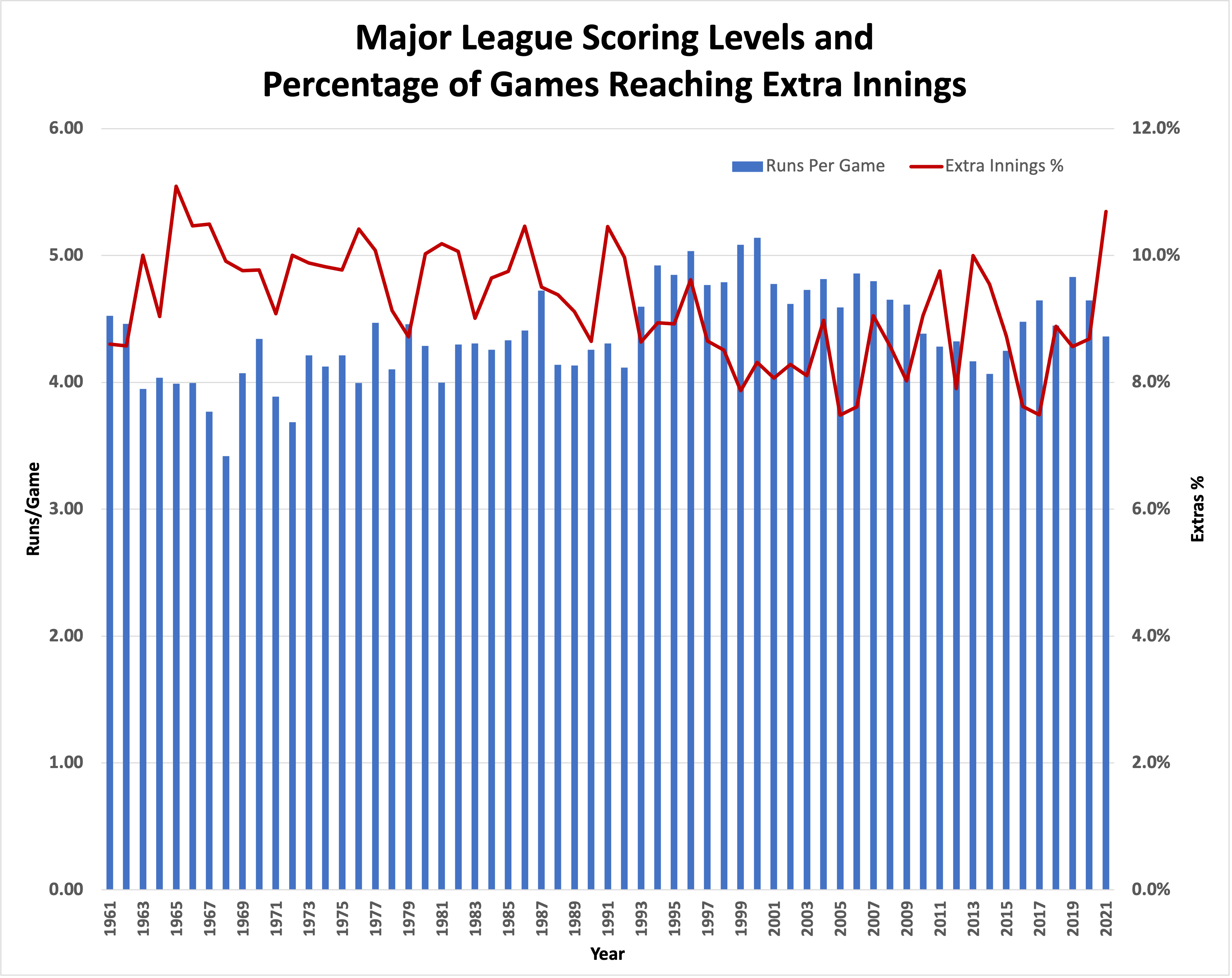
If there’s good news, it’s that the current scoring level of 4.36 runs per game is on the high side in terms of maintaining a 10% rate of extra innings games, and if scoring rises just a bit when the weather warms up, the likelihood of extras should go down:

Only twice have we seen teams average 4.40 runs per game in seasons where at least 10% of those games go into extras. Not that there’s a huge difference between a more normal rate rate of, say, 8% than 10%; over the course of a full season, that’s about two more such games per week, and for a single team, it’s the difference between 13 and 16 games per season. Even so, the combination of the proliferation of such games with their jarring break from one of the game’s most basic tenets — every inning starts with a clean slate of no baserunners — is as grating as nails on the blackboard to at least some ears.
And here’s the kicker: as for the actual time saved, it doesn’t amount to much. The average extra-innings game in 2018 clocked in at 239.7 minutes (four hours, basically) and fell to 229.3 minutes in ’19. With the runner on second rule in place, that shrank all the way to 224.5 minutes last year, a drop of just under five minutes. This year? They’re back up to 226.3 minutes. In other words, we’re talking about a savings of somewhere between five and 10 minutes for a slice of games that’s in the ballpark of 10%, all in exchange for a major disruption of baseball’s rules and accounting that produces far more bunts and intentional walks.
With players getting vaccinated to the point that a dozen teams either have reached or will soon reach the threshold to relax the health and safety protocols, and with no new positive tests among players in the past week, concerns about them spending extra time at the ballpark are significantly reduced. But even with the claims of extra wear and tear on players amounting only to a few extra minutes per team per week over the course of the season, the fear from us purists (the first time I’ve ever used that term to describe myself) is that players like this rule enough anyway that it gets lumped into the upcoming Collective Bargaining Agreement as a minor concession once the two sides pull their respective forks out of each other’s eyes.
To hell with that entirely. Give us the old way back, with the once-a-year 17-inning epic that runs until 2 AM. Or give us ties after 12 innings of normal play, as they do in the KBO without any kind of aesthetic crisis, and a frequency of about one to three times per team per season. Give us a home run derby or a dizzy bat race. Anything but this dumb rule, please.
Brooklyn-based Jay Jaffe is a senior writer for FanGraphs, the author of The Cooperstown Casebook (Thomas Dunne Books, 2017) and the creator of the JAWS (Jaffe WAR Score) metric for Hall of Fame analysis. He founded the Futility Infielder website (2001), was a columnist for Baseball Prospectus (2005-2012) and a contributing writer for Sports Illustrated (2012-2018). He has been a recurring guest on MLB Network and a member of the BBWAA since 2011, and a Hall of Fame voter since 2021. Follow him on BlueSky @jayjaffe.bsky.social.
Hear, hear!
I know I’m in the small minority here, but I like the rule.
And it is having its intended effect of shortening extra-inning games (more important than ever bc of the low run-scoring environment and lots of deep flame-throwing bullpens). Plus, this does keep a pitching staff from getting burned out, reduces wear and tear on catchers, especially, and reduces the number of position-players pitching.
I’m an east-coaster, too, and like going to bed before midnight.
I’m with you. Those 18 inning games are fun from a curiosity standpoint but they are nightmares for teams and players. After burning through the pen, the teams end up running out the next day’s starter (often on short rest) for 3-5 innings so it just kills them the next day or two. Nothing worse than watching some poor overmatched AAA kid (or scrub veteran who wasn’t good enough to make an actual MLB roster) get blown up the next day when the manager leaves him out there for at least 4 innings even if he’s given up 10 runs because he needs to save the pen (all of whom pitched the night before)
I have no objection to wanting extra inning games to end without becoming marathons. There’s an easy way to do this. The game ends after 11 innings, if it is still tied, then the game is a tie.
They used to have ties. There was a tie in the world series once. Ties are allowed.
Don’t start a runner on second.
Hear, hear!
Or, you could compromise between the two and play straight up baseball through the 11th and add the runner on 2nd for the 12th. Then it will almost NEVER happen but the game will resolve usually within 3 extra innings.
Or start the runner on 1st, which is much less distorting. Or on 1st for the 10th and 11th and 2nd thereafter
Agree that ties would be preferable to this awful gimmick. One twist that I like would be instead of automatically tying after a certain inning: before the bottom of any extra inning, give the home team the option of conceding the tie (or loss, if they’re trailing) rather than batting in the bottom of the inning.
why would they choose to lose instead of bat????
This isn’t soccer or hockey. No ties.
And it’s still football over here in Europe and the rest of the world 🙂 No offense. Regards from Germany
Exposes depth
Agree with both of you. I’m pretty astounded at the number of people who dislike the rule for the reasons you both cite. The objection that baseball in extras is more predictable now is nonsense. The rule adds variability and chaos and therefore more run-scoring. More run-scoring is inherently less predictable. What’s predictable is an endless string of bullpen arms getting putouts, inning after inning. What’s also predictable is, under the old rules, the game is pretty much over if the away teams gets a lead. Not so with the ghost runner rule.
In his historical abstract, Bill James lamented that so many hold baseball up as a “perfect machine” that can never be changed, despite the needs to do so. He also noted the frequent changes to football, basketball and hockey, implemented in recognition of how the sport is changing and what might be of interest to their fans.
No such luck in reactionary baseball- even among the “enlightened” fans here on FG.
I’m ok with change (yes please universal DH). I just think that this particular change makes the game worse.
I think there’s plenty of interest in rule changes. Just not this one, because it sucks.
I don’t know whether I would be considered “enlightened” or not, but I don’t like the rule.
If games are too long, perhaps forcing batters to stay in the batters box in between pitches would be a start? 20 seconds between each pitch starts to add up quickly.
Amen!!!
The majority of fans are probably fine or kind of indifferent to change (universal DH, limiting active pitchers per game, three batter minimum, etc.). Some or most of those are ok.
But this completely changes the way a game operates after nine innings. Would you decide football games that are tied after 60 minutes with a field goal contest? How about a three point shooting contest for NBA games? The NHL already has the shootout and while that was fun at first, the majority of fans think it’s outlived it’s usefulness.
The extra inning ghost runner was always a solution in search of a problem. A couple of 18 inning games per year are no reason for pearl clutching. If needed, why not adapt to those by allowing roster manipulations for those teams for the next week? They’re allowed to carry 2-3 extra pitchers for a week after the marathon.
If baseball is really serious about the time or pace of play crisis, come down hard on the time between pitches. I think Sawchik posted an article here years ago that there is roughly 40 mins of dead time between pitches: step offs, step outs, time outs, mound visits. If you cut that by half or even a bit more, that’s real progress. And that should be the goal.
If you’re comparing this rule to other sports, it is quite similar to football, hockey and soccer actually.
NFL rules change in overtime with the first team scoring a TD ending a game versus a FG resulting in the other team getting the ball. They don’t play a full quarter or even a shortened quarter. Neither does the NCAA.
The NHL has the shootout in the regular season after 5 minutes of 3on3.
Most soccer leagues tie in regular season play, but use a 30 minute period than penalty kicks for tournament games (UCL, Europa, World Cup, Euro, FA Cup, etc…).
The NBA is the league that mimics overtime the closest to regular gameplay with the only change being a 5 minute quarter versus 12 regardless of the overtime score.
So if anything, the MLB used to be similar to the NBA. Whereas now they are more similar to many other leagues. Not saying I prefer one over the other. Just adding context when comparing the MLB to other leagues.
Technically, they do alter the very structure of the rules in college football overtime, but it sucks there, too.
Positive change is one thing. Changing the most fundamental rules of the game because players can’t execute fundamentals just to placate lazy, fair-weather fans isn’t progress.
tbf bill james also sucks
Agreed.
From what I can tell, Mr. Jaffe doesn’t like the extra inning rule because he doesn’t like bunts. And he doesn’t like bunts because… he doesn’t like bunts.
With offense sharply trending down, it has to be counteracted. It starts with the health and safety of the players. Hitters obviously hit better with runners on base and these position players have now been playing for that day for over three hours, so they are more tired (while facing a fresh arm who hits the high 90s).
Without this adjustment, we’d get longer and longer games, and with no minor league season and a much shortened 2020, pitchers are much, much more vulnerable to injuries.
Just as much as the practicality of the players’ safety, I was really converted after watching these extra innings games and seeing the sense of urgency for everyone involved. Rather than brace for a possible nearly endless slog, players approach these games knowing something dramatic has to happen because they’re often one bloop hit from winning the game. And that’s another thing that adds to baseball’s uniqueness in that the home team has a true advantage in being able to take their turn at bat knowing exactly what they need. If the home pitcher threw a zero up in the top of the extra inning, it puts massive pressure on the road team. There’s no true built in structural advantage for the home in team in overtime in football, basketball, or soccer. I don’t mind the shootouts they have in the hockey regular season but transferring the equivalent of a home run derby would again be a safety issue for the hitters. Can you imagine having Mike Trout and all of Orange County holding their breath that he doesn’t pull his 30 year old oblique after playing center field all night to try and hit as many home runs as possible?
For the previous several seasons, if the first guy didn’t get on, the players would naturally try and swing for the fences to try and end it because everyone knows how hard it is to string several base hits against MLB relievers in this day and age. MLB did the right thing and adapted for the sake of the players and for the sake of adding more urgency and excitement. For the 162 game regular season marathon, this is a no brainer.
One of the problems with bunting and other fundamentals that we grew-up seeing on a regular basis is that players can’t execute. A generation of players have grown-up with launch-angle and exit velo as their almighty gods. Hitters are facing more pitchers than ever, facing harder velocity than ever.
Tommy Herr or Craig Counsell would have a hard time bunting against Josh Hader or Aroldis Chapman. Your average player today, who never learned to bunt, even in youth baseball, isn’t going to have much of a chance against 97 MPH four-seamers.
Thing is, it is still random. Teams are still going to have their bullpen hurt in blowouts as well. It is just part of the game. I can get behind the runner on 2nd rule if it started at the 12th inning, then, I guess, it makes sense. And I don’t want ties. I understand it doesn’t matter as much during the regular season, but, why?
One of the beauties of baseball is that games don’t end in ties, but I too would happily accept 12 inning ties if it meant getting rid of this fake extra inning ghost runner bullsh*t.
Yes! What is so bad about ties?! The NFL only plays 16 games and allows ties. MLB plays 162 games. If it goes 12 innings just call it a tie!
Runner on second is horrible. It would be exciting to know you are down to the last out of the game in the 12th.
It would be! I’d love to see what kinds of decisions a manager would make in the bottom of the 12th if there was no risk of him losing.
Ties make reading and analyzing the standings a nightmare. It’s okay in the NFL where it’s just a 16 game season and they rarely ever tie in the first place, but otherwise tie games suck. This is especially true in the NHL with its ridiculous point system that they stupidly kept around in a modified fashion even after they got rid of tie games.
MLB teams would “rarely ever tie in the first place” too. From 2012-2017, 1200 out of 14580 (8.2%) went to extra innings. Only 219 of those 1200 lasted longer than 12 innings. That’s 219 of 14580 total games that would result in a tie, or 1.5% of all games.
In the NFL, there have been 4 ties since the NFL modified their tie rules in 2017. In that period 1008 games have been played, resulting in 0.4% of games ending in a tie. Is that really the difference between “a nightmare” and “okay”?
Exactly. Ties would be rare. So if only 1.5% of games result in a tie after 12 historically, that would mean on average teams would have 2-3 ties a year in a 162 game season. Why is that a big deal? Is it worth changing the fundamental rules of the game to avoid 2-3 ties a year?
I’m not a huge fan of ties, but they would reduce the risk of “game 163.” I love those games in principle, but even the risk of them now extends the postseason and baseball played in 35 degrees is often a little wonky, even though the best teams are playing it.
They leave the day after the regular season open for potential Game 163s. The only way the postseason gets extended is in the very rare case of a 3-way-tie for (a) playoff spot(s) that is/are not just decided by tiebreakers.
I’ve thought for a while that the game should end in a tie after 9 in the regular season. I think it would incentivize teams to do more pinch hitting. Over a 162-game season, it seems totally reasonable that there would be 12-15 ties per team. But apparently this is somehow anathema to a lot of people.
One way to look at this is to ask exactly how many people stay at baseball games after the 9th inning (or did, before COVID). This would answer for me how important it is that the game not end in a tie. If you have the whole stadium emptying out in the 9th inning then I’m not sure what the point is; if you have a lot of people sticking around then I think it’s fine to play until there’s a winner.
Although that might differ depending on whether it’s a night or day game.
If they stop selling beer after the seventh inning, the teams are probably losing money due to people are sticking around for an extra-inning game…
Back in 2000, had tickets to a Mariners game but couldn’t break free. Couple hours after the game started I asked the wife if she want to go catch the end of the game. Sure, why not. Got there moments before beer sales ended in the 7th (dodged a bullet on that one) and ended up watching the final 12 innings of a 19 inning marathon. Had a blast. Mike Cameron for the win! Not sure how fun it would have been if I had been there for all 19 though.
This rule is nothing more than a silly gimmick. There’s a reason it’s taken off the table for postseason games, because it’s something that has nothing to do with the game itself.
It really is a gimmick. And every bit as tired and predictable as the NHL shoot-out, which is so transparently just a means to an end, and not in itself any kind of skill or relevant part of the game.
Fortunately the 5 minute 3-on-3 period has drastically cut down on the number of shootouts, and tends to be wildly entertaining to boot. When they went to the 3-on-3 rule, I thought I’d hate it and was thrilled to be wrong.
Probably because anything is better than the shootout! It took a bit for fans to catch on but I think it’s fairly clear the shootout is here (and will remain) to goose the illusion of parity. If they’re insistent on keeping a shootout, I think two points for a win in SO, one point for SO loss, three points for regulation or overtime win (but that would be four on four). They should be worth more.
I still like it, and a lot of this article seems to be trying to scrape for a reason to not like it. The 5-10 minutes saved on average does seem pretty significant, but also there being fewer innings once a game goes into extras is a big part of the appeal (fewer pitchers, etc.). Also, since the instances of extra innings games occurring is going up, that’s all the more reason to encourage extra innings games to end sooner rather than later. All of this is good IMO.
And the actual game play in extras is dramatic. I love to watch how teams are going to either wiggle out of it or scratch a run across, whether that includes bunting or not (I haven’t seen much bunting in the games I’ve watched FWIW, but it’s not like it’s a bad strategy like it often is during other parts of a game).
But in fact, it is completely boring and predictable. Bunt. Intentional walk if a good hitter is up (and maybe not even — double play is in order). Then the whole game comes down to 1 AB, hit or no hit. That is so dull. And it shows almost no skill or relevance to any other part of the game.
How often does that happen? Nobody is doing it in the top of the inning, because playing for 1 run isn’t enough. In the bottom of the inning where you just need 1 run is where I’m guessing it happens the most. In that situation though, I’m fine with it. The home team has earned the right to walk it off with a little small ball and we all get to go to bed earlier.
Also, why is it not exciting when a team pulls off a double play in that situation? That just adds to the drama.
Give me three extra innings and then end it in a tie if no one has won it. Go a head and down vote all you want. I’m not apologizing for this take.
my priority goes
1. what it used to be
2. ties
3
4
5
6
7
8
9
99999999. ghost runner bullshit
99999990. home run derby
99999991. team with fewer strikeouts wins
99999992. coin flip
99999992. 7-on-7
99999993. mascot boxing match
99999994. trivia contest
99999995. four-out innings
99999996. drinking contest
99999997. ghost runner, but there’s more of them every inning, so if you get to the 16th inning it starts with the bases loaded
99999998. winner decided by social media poll
99999999. ghost runner
I hate the ghost runner, but ending in ties would be even worse.
Ties after 12 would be so much better than this garbage.
Or even 11 innings, or 10.
I’ll take a 7th inning tie to get rid of this ridiculous gimmick
Why? Sport is supposed to be entertaining. It is the sole purpose. It’s not entertaining to end a game in a tie. I don’t really understand how trying to stop a runner scoring from 2b is not entertaining
I don’t mind seeing more bunts. My expectation would be the first batter in extras would bunt every time with a man on 2nd. Get that guy on 3rd with 1 out every time should be the goal. But overall the rule is just dumb. Change it up and call it a Tie after 12 innings, but play 10-12 with the same rules as the first 9.
Even if it’s gimmicky, baseball has to do something to generate more contact and scoring. Eliminating the force out rule (run can score from 3rd, even if there’s a force out at 1st) would help both. And I think it would generate a ton of exciting plays. But man people would hate it
From my seat the best that can be said about the extra inning rule is that it is not as stupid a gimmick as college football’s overtime rule.
I’ve found myself tuning out a bit as well when games go to extras. I feel like it adds too much dumb luck to the effort. You have, presumably, a pretty good ball game through nine innings and then you can win with nothing more than a bloop single or a dribbler in just the right place. I know you still need to record three outs in the other half, but it doesn’t feel 100% earned. Maybe a runner on first would at least make it seem like you had to do at least something right before luck kicks in. I’d be OK with a tie after some number of extra innings, too.
I don’t know how it would be received (probably very poorly), but perhaps the way MLB’s standings work could be adjusted without changing the on-field rules, to incentivize bolder risks in the 8th and 9th innings? Hockey’s last 5 min of regulation are some of the most exciting in sports (imo) because there is 1 point in the standings in play. Preventing your opponent from getting 1 point by going to OT is plenty of reason to take some risks at the end of the game, and if there was a small but real advantage to winning in 9 innings, I have to believe teams would jump at that rather than use the runner-on-second gimmick as a means to shorten the game. And that’s all it really is: a means to an end. The extra-innings runner rule is nothing but an “easy off” button for long games, with no skill or anything interesting about it.
No, the NHL’s point system for their standings is even stupider than both the current extra-inning rule and tie games.
I hate to admit it, but I like this rule and the immediate level of excitement that it brings to a tie ballgame. I even find myself tuning into more ballgames that are tied just to see the different strategies employed by teams. With the increase in tied ballgames this year who knows what the average length of ballgames would be without this rule in place. I think this rule is having the desired effect of shortening games while also increasing viewership at large.
I completely agree. Personally, it’s changed my mlb.tv viewing habits.
I totally cheapens extra-inning wins. It doesn’t add pressure at all. One wild pitch and a sac fly, and a team can walk it off without even getting a baserunner. It’s a total vibe-killer
19 inning games are bad, but I’d even prefer them to this.
How does that not add pressure? Or make it cheap? Watching 3 guys come up to swing for the fence inning after inning until somebody hits a home run is way cheaper. And way less pressure on everybody
I agree 7 innings of watching guys swing for the fences and miss is boring, but these new rules eliminate the need for an extra-inning rally, which I DO like to watch. A walkoff on a groundout to second and a sac fly (which I have watched) just feels so hollow. And the pressure of preventing a run IS lessened (in my experience as a viewer) because if the home team gives up a run in the top of the inning, they can very trivially earn that back in the bottom of the inning.
I agree that the marathon games need to stop (except in the playoffs). But I’d much rather them just call it a tie after three extra innings than lessen the work that a team needs to do to get a run.
So instead of baseball being played differently than it has been for the last 100 years, you’d rather there be no baseball.
This is exactly what purists are going to get if MLB doesn’t figure out something to make the game more exciting.
You call yourself a purist and simultaneously call for a Home Run Derby? No. No! NO!!! I don’t particularly like it, and I don’t care about a few minutes saved, but I do care about what a 17 inning game can do to a pitcher’s arm or to a team’s roster. No ties, no dizzy bats. Reluctantly, keep it.
Whoosh!
Not your usual laser-like analysis, Jay. Your scattered objections are pretty weak ( you’re worried about unearned runs? Really?)
I like the rule, makes for immediate excitement and a heightened level of risk-taking. If you were trying to invent baseball for the 21st century, this might be what it would look like every inning.
Give teams the 10th and 11th to try to allow a more natural win. Start the bonus runner in the 12th inning, and start him on first base. In the 13th inning, start him on 2nd base as the “unlucky #13” penalty.
It’s maddening to see one hit win a game in extras, but it’s even more maddening to see a team’s bullpen depleted by a marathon.
The MLBPA should be in favor of marathons since it helps expand union membership; option-eligible call-ups are a routine occurrence following marathon games.
This is the first I’ve heard of delaying the extra-inning runner and I like the idea at first consideration. I don’t think they’ll ever adopt the runner on 1st because of the double play risk that poses. But I like the runner being employed after a few extra innings in the traditional format.
The problem with starting with a runner on 1st is that a leadoff man could hit into a double play and that is truly an aesthetic nightmare. Imagine teams only getting 2 batters in an inning in a huge September extra inning game.
I personally don’t mind it, nor would I mind ties. I do mind 19 inning games. Plus anymore it would only take until about the 13th for teams to have to use position players pitching and none of us really want that.
Most of those Dodger extra inning games this year the Dodgers were down to their last pitcher already in the 11th. (I think Roberts is having a truly rotten year managing this year).
This rule is pretty transparently an attempt to shorten the length of the average game by completely eliminating the random 12+ inning marathons. Players like it because they get to play less and rest more during their grueling schedule and Manfred likes it because he can cite a metric that says the average game is now shorter, but most fans hate it. I think for most fans, the length of the games isn’t the real issue; I will gladly watch an 18 inning game that’s exciting and suspenseful. To get a shorter average game they should really continue to address pace of play.
This was my thought as well. It’s all about eliminating the outlier marathon games that only make the bottom line averages look a little worse.
It’s also funny, as it was last year, to pass this rule off as a measure to, as Jay writes: reduce “players’ time in proximity to each other and their risk of spreading COVID-19.” That seems pretty clearly not the primary objective here. They play nine every day but suddenly, when we get to a 10th inning, we’re worried about keeping COVID at bay?
This kind of makes sense, but also how could 4-5 super-long games meaningfully affect the average duration of 2,430 games?
I mean I don’t think it shaves 5+ minutes off the average duration but if each team has one or two of these super long games per year, and you entirely eliminate them, it probably saves a minute or two in aggregate. It definitely doesn’t make a meaningful difference overall but Manfred is such a dunce that I think he’d consider this a big win.
I don’t think each team does have one or two super long games per year, though. Although it probably depends on what one means by “super long.” I guess my rough benchmark is 15+ innings. The only team I care about has only had two of those since 2013. Last time they had an epically long game (19 innings, in this case) was 2011.
Maybe that’s unrepresentative, but it feels about right–you can expect to see one every 3-4 years. If that’s correct, then I think those games must have a negligible effect on average time of game.
I am really excited for / dreading the day when a no-hit bid goes to the 10th inning, when the score is 0-0. The ghost runner is on second. Ground ball to third base. The third baseman scoops it up and screws up, throwing the ball into the stands. Runner on 2nd goes all the way to home. And you get a no-hit loss.
Probably won’t happen anytime soon. But if the ball is still dead and the ghost runner rule remains, it’s only a matter of time. I don’t think I will like it when it happens, but I will find it hilarious anyway.
This will certainly never happen, but I do wonder how it would be considered if a pitcher has a perfect game through 9 and then loses on a groundball and a sac fly in the 10th. Or does the game lose its perfection by operation of rule as soon as the 10th opens and the runner is placed on second, through no fault of the team’s run prevention unit?
From the MLB rules:
“An official perfect game occurs when a pitcher (or pitchers) retires each batter on the opposing team during the entire course of a game, which consists of at least nine innings. In a perfect game, no batter reaches any base during the course of the game.”
If a pitcher has a perfect game through 9, then in the top of the tenth gives up a groundout to second (advancing the runner to third), a sac fly (scoring the runner), and then strikes out the third batter, and his team fails to score in the bottom of the ninth, he will have thrown a 10-inning perfect game (he retired every batter on the opposing team, and did not allow any *batter* to reach base) that he lost 1-0.
Given the number of no-hitters and extra-innings games we’re seeing, I wouldn’t be too sure. To be fair, the chances of it happening in any single game is pretty much zero. You keep carrying out decimal places and it still will look like zero. Based on the numbers this year, it looks like we’ve got about a 0.007 chance of a no-hitter and about a 10% chance of extra innings, so you’ve got a 0.0007 chance of both happening at the same time.
But there are 2,430 games in a season. That is a looooot of games. So the chances that a no-hitter goes to extras has a decent shot of happening once in a season. Then you’d need the guy on 2nd to score without the opposing team getting a hit. A bunt, a couple of sac flies, an error…the right combination would do it. This is also very unlikely, but you can start calculating it out. If teams regularly start bunting in extras, and we average one error every 20 innings or so…let’s say there’s a 1 in 20 chance of a team winning that way.
So, no, not anytime soon. But if you want a long enough time–say, 20-30 years, in this case–you will see a lot of crazy stuff, even the thing that doesn’t make sense.
How about a stolen base with a bad throw. That’s Even worse. He could lose without an out or a hit.
I have watched a no hit loss in mlb. That’s possible under traditional rules. 3 walks and a sac fly.
I was in a no hit no walk one hit by pitch loss in little league. Hbp, passed ball, runner to second. Pickoff throw bounces well before bag then bounces past secondbasemen. No one covered (I was in deep center and threw the ball in to I think the shortstop). Play at the plate called safe. We lost 1 nothing.
I’ll never understand the logic. They seem to be under the impression that the biggest problem for keeping/bringing in new fans is that the game is too long.
How many people are watching an exciting (likely, as it’s a tie game) 9 inning game… and then think “alright, that’s enough… just put some guys on base and end this thing”? How many people who think like that do you think are going to turn into long time fans??
What they really need to do to shorten games is shorten commercial breaks, implement a pitch clock, and stop allowing batters to call timeouts 50 times in an at bat to take a stroll halfway around the infield.
Of course, the league will never do the first one and the PA will never agree to the second two, so they’ll just keep coming up with contrived, gamebreaking solutions like this rule that don’t actually address the problem.
They already did get rid of a commercial from each break a couple years ago.
The only “fix” is to stop thinking of it as a “problem” in the first place. It’s a leisurely game. You’re never going to please the people who want nonstop action. Just accept that and stop obsessing about pace of play.
They have shortened commercial breaks, and limiting the mound visits also cut down the game time.
A pitch clock would help further, and I don’t know if it will ever happen, but you can’t say they aren’t cutting out some of these intermittent breaks.
The problem is that the powers that be in MLB seem to have conflated “length of game” with “pace of play”. The problem isn’t that the average game length is over three hours – the problem is that the average game length is over three hours *because* there’s more dead time between pitches (due to both batters routinely stepping out and pitchers taking longer), longer PAs (pitches/PA has increased by ~10% since 1988), and longer breaks between innings.
There is an arbitrary factor to the current rule that should be eliminated as we get to the 10th with the runner on 2B but the runner is the non-pitcher that made the last out (got that, Tony?) so one team could have a slow runner and the other a fast runner. Also, one team might be in the middle of the order while the other is at the bottom. If you’re going to have a gimmick, go further: put the runner on 1B, each team starts at the top of the order, and the runner can be EITHER as per the current rule OR anyone on the bench that hasn’t played (and that runner doesn’t have to enter the game as a substitute–he is only there to run). A team might stash a very fast player on their bench just for this purpose.
The we want more Billy Hamilton running rule.
I think the extra innings rule is here to stay. Hear me out: in other major American sports (think hockey and football) the “extra” part of the sport isn’t the sport itself. It’s some bastardized version of the regulation game. NFL has the stupid “sudden death” drive, and NHL had their shootouts (although the 3-on-3 is vastly superior)
The way professional football is played/strategized is wildly different from it’s amateur counterpart, by way of the rules that govern on-field play. And for those who don’t like the NFL? They’ll say “go watch college”.
As a die-hard baseball fan myself, I’d still say the same thing: don’t like the extra-innings rule? Prefer the “old school” way the game is played? Then watch college or high school baseball.
Do i think the way MLB is approaching rule changes is flagrant and flies in the face of the core sport? Absolutely. I think 7-inning doubleheaders need to go, I think they need to stop screwing with the baseball. And I’d prefer they bump the runner on 2nd to the 12th inning or later.
But I don’t see them getting rid of it any time soon. And i don’t think this is the last time MLB introduces radical changes to the Major-League product.
A-FREAKING-MEN!
It “saves” almost no time at all and almost completely neuters any extra-inning excitement. It’s such mind-numbingly boring baseball to watch when you know it’s time for a steady stream of bunting and intentional walks.
Would people really be more open to baseball game ending in a tie rather than the extra-inning runner rule? As a non-purist, I feel this decision would be much more opposed than the runner on 2nd for baseball purists.
Yup!
I’ve always thought that whenever you reach the point where, for whatever reason (health, safety, etc.), you aren’t comfortable continuing to *play baseball* to determine the outcome of the baseball game—and the thing they do in extra innings now is *not* playing baseball—at that point you should just call the game tied. That has far more integrity than this nonsense. I like the one-a-year 18-inning epic, as you say, but if we don’t want that then the only good solution is ties.
A tie after 12 sounds like a reasonable compromise.
Rare as they are, expecting an employee (well paid as they are) to work from 4pm through till 2am and possibly have to travel next day sounds pretty unreasonable.
Ties? There’s nothing worse than a tie. Even in coed slowpitch softball a tie feels worse than a loss. People can disagree about the runner on second, but we should all agree it’s better than a tie. Even the home run derby would be better than a tie. Runner on second gives some weird accounting and more chance, but it’s fair and team records stay a lot prettier.
A game ending because the MLB puts a random runner on second sounds worse than a tie.
But you both get that runner?
If you’re that super worried about ties and losses in slow pitch softball, I don’t want you on my team. The whole point of those leagues is to get outside and get drunk with friends, not win games.
Could not agree more. Keeping this rule but letting pitchers bat is nuts.
Ties are better than the free runner on 2nd. If you want the game to be shorter, just call it a damn tie after 9 and be done with it.
A groundout and a sac fly should not be enough to beat a closer. It’s a joke.
I’m genuinely astounded at the number of people who are vehemently against the automatic runner rule. It doesn’t change the game that much – it’s nothing at all like the NHL’s shootout. It’s no more gimmicky than the NFL changing the overtime rules so the kicking team gets a chance to match the receiving team in OT and miles better than college football’s OT solution. It’s still baseball. I do agree that it sets up a lot of “bunt the guy over, IBB the next guy” which is unfortunate but . . . .it’s still baseball. You still have to put the ball in play to score that runner and if you’re the visiting team you have to know that merely pushing 1 run across might not be enough.
One of my observations that I would be interested in seeing a study on is I feel like there have been a LOT of extra inning games so far where visiting team scores 3+ runs. To me that is the downside to IBB walking a guy to set up the double play. Now you bring in the possibility of a multiple run inning which just kills your chances of tying or winning in the bottom of the inning.
BTW, there are no ties in baseball.
Just because something is less stupid than what most of the competition does doesn’t mean it’s not still stupid.
Also, I think the rules change less in NFL overtime than currently in MLB extra innings, although at least MLB still doesn’t have any ties.
I like the rule, as long as it never happens in the playoffs.
Did anyone ever give them a welcome? If so, give them a distasteful goodbye
I know this article is supposed to persuade me that the runner at the start of extras is some kind horrible evil that needs to be removed from the game. All I took from this is that the real evil in the game is the new ball that is suppressing offense across the league. More runs scored>fewer extra inning games>less exposure to it>less importance placed on it by fans. Out of sight, out of mind. I could really care less but as a White Sox fan, I’ve only seen 6 of them since the new rule took effect. We’ve won all of 1 of those games and we’ve been the home team in a few of those losses.
I would still rather start reducing the number of defenders on the field every inning after the 10th than put an arbitrary runner on second. I’d be fine with normal baseball through 12 and then ending in a tie.
As a baseball fan, I hate the stupid runner on second. As a Twins fan I REALLY hate it.
Reading the article and most of the comments leads me to one conclusion. People are opinionated. I was fine with the old rules, understand the reasoning behind the new rules and am fine with those as well.
I’m fine with it as a temporary health and safety measure like the 7-inning doubleheaders, it’s just not something I’d ever want to become permanent.
I’ve been mulling over this for a bit and am curious for the board’s reactions. My starting place seems to be where many fans here are–I don’t much like this rule, which is too gimmicky. But I think the problem it’s trying to solve is a real one–very long extra inning games aren’t actually that fun, they risk injury, they wear a team’s bullpen out for a week through no fault of their own, and if they go long enough they turn into a gimmick anyway. I know not everyone agrees with that, but it seems many do.
So what if baseball extra innings were sudden death? That is, if the visiting team scores, game over, no opportunity for the home team to match. You’d get fewer long games, and more walk-offs–and walk-offs are fun and exciting. You’d still need a cap at which point the game is simply a tie, but it would happen less often if either team could end the game by scoring, and it would up the tension of extras even more.
Thoughts?
Just give me ties rather than this dumb rule.
Baseball is a beautiful game, but Manfred has his claws hell bent in destroying its structural integrity for the sake of $$$. That’s what it’s all about. Manfred the mercenary. If young fans clamored for longer games, he’d bend over backwards to add time.
7-inning double headers feel like softball and little league, as does man on second no outs in extra innings. There should be no distinction between innings played after a 9 inning tie, and all innings prior. An inning is an inning. A scoreless 9 inning perfect game ends in the 10th, the moment the first base runner stands on second. Baseball and bullpens, pitching staffs have survived extra innings since the time extra innings were implemented. They can and would survive today under same circumstances.
It’s telling that some of these crazy rule changes do not apply to the postseason. This tells all of us that those who implement these rule changes know they’re awful decisions that tarnish outcomes.
As with many other problems devouring baseball, the problem is that there’s no one at the bargaining table to speak for the fans. Players prefer not to have to sometimes stay at the ballpark until 2am and the owners don’t care one way or the other, so we get this dumb rule. Players prefer to take 30+ seconds to deliver each pitch and step out of the box multiple times per at bat, and the owners haven’t yet seen any hit to their revenue, so nothing is done to address the pace of game problem.
This all works until it doesn’t, until the bad things drive enough fans away to affect the game’s economic future.
I’m fine with the rule, but would modify it to put the runner on 2nd beginning the 11th inning.
I do not like the 7-inning doubleheaders. That changes the game much more than the 10th inning rule.
That rule is terrible, too. What’s really terrible is a double-header tied after seven, so now we’re having little league games with fake rules in the “extra innings,” which aren’t extra innings at all.
It’s so sad the way people who don’t care about the game get to make up stuff purely out of thin air that impacts the enjoyment of actual fans of the game.
Play the 10th and 11th innings under normal rules. If the game is still tied, each team begins its half of the 12th with the bases loaded, so you maximize the chance of one team out scoring the other in the inning. If that doesn’t break the tie, call it a tie.
I think it cheapens the game – it was a lame rule from Day 1. Just one more reason for Rob Manfred to go. To retain this rule, while ignoring the need for a universal DH shows his incompetence.
Don’t forget that Manfred works for the owners — not for the players, not for the fans, not for the game. Not to use the DH as a bargaining chip could be construed as incompetence, though it’s a disaster for the players, for the fans, and for the game.
A reduced threat of a very long game may also encourage managers to use more relievers in the first 9, and I’m quite firmly opposed to endless strings of relievers.
That’s easy, just limit the number of pitchers who can be carried on the roster or active for any given series.
So I see opposition to the runner on second and to ties after 12.
Instead of either, how about one 6-out inning for each team, and a tie if no one takes the lead?
Just spitballing here, I haven’t really thought it out.
i agree. but the argumentation that extra inning games haven’t gotten much quicker is sort of specious. all games are getting longer, so saving “only” 5-10 minutes is really saving more than that.
Worn out its welcome? I stepped on that rule’s toes and threw a drink in its face the second it showed-up at my door.
The main reason Jay seems to dislike the rule is that it results in more bunts and intentional walks. If baseball wants more “small-ball” and less 3-outcome baseball (HR/K/BB), then this gives you a small sample of key situations that warrant “small-ball”.
I’m not sure if Jay wants more “small-ball” in the MLB, so if not than this makes sense. This rule feels like the perfect experiment to test whether the players should keep swinging for the fences or use small-ball in important moments to win game. I’m all for it this year to see where this goes.
I hear ya Jay. There’s a negative connotation with the word “purist” but I think a lot of us are purists to some degree.
Aside from the wrench it throws into stats, I also don’t like that making it easier to score a run makes it easier for the road team to take the lead. I know that both teams technically have the same scoring opportunity, but it just feels like it puts the home team’s backs against the wall.
Oddly enough, last season I absolutely hated this rule.
Now, as I’ve watched some wildly entertaining games that were amplified because of it (think of that Phillies/Braves game last week) it is growing on me. It adds an element of strategy combined with keeping things more interesting in a shorter time frame. Being down 3 runs in extras used to be “not gonna happen” territory- now, get a guy on and hit a bomb, game on.
I would still never want to see it in the playoffs, much like you’d never want to see NHL shootouts in the playoffs. I think it does serve a purpose in the regular season.
7-inning doubleheader games feel more cheeseball to me.
One of my favorite pastimes used to be checking scores for late-inning games that were tied or within a run or two, and then watch them and root for them to go as long as possible. Now I can’t do that anymore and extra innings feel completely meaningless because they’re not playing real baseball. I could care less about an 11th inning walk off if the runner on second got there for free. I really hope they change this soon because it sucks.
There is at least one thing in this world on which I agree with Jay Jaffe. It might be the only thing.
I love Jay’s stuff, but this entire article (and most of the comments section) is “I give myself permission to be an old man that yells at clouds”.
I think the rule is fine, but it shouldn’t start right in the 10th inning. Let’s have an inning or two of normal baseball, then in the 11th or 12th we can start putting runners on base and moving it along. To me far more egregious is the 7 inning double headers rule.
I originally was against the rule, but have grown to like it. I’m more likely to keep watching a random game (one not involving my favorite team) or turn to a random game that’s going into extra innings than I was before the rule change. Before the rule change it seemed like most batters were trying to end the game with a home run and usually making an out.
Plus with all of the pitcher injuries I don’t think it’d be prudent to get rid of the rule. There is good reasons that MLB and the MLBPA both agree on the rule, when they can’t agree on what to have for lunch.
So you wrote an article about how extra inning games happen more often, & book-ended it with your dislike of the extra inning rule because …. it makes teams do the same things they’d do if they got a lead-off double, & otherwise it basically does what it is expected to do (shortens games, cuts off outlier games).
It’s such an aberration to traditional baseball that … you’d prefer a home run contest or a dizzy bat race.
Far from your best work.
Too bad you don’t identify any actual problems with the rule.
It’s a joke and a degradation of the game. Just suspend all games after 12 innings and finish them the next time the teams meet.
In my opinion, so much of baseball since they made three “divisions” and added the Wild Card has been a joke and a degradation of the game.
They just keep taking a game that was awesome and they keep ruining it. THERE WAS NOTHING WRONG WITH BASEBALL IN 1992!
Here’s the process: they make one stupid, unnecessary change, then another, then, another. Fewer and fewer people watch. “I know,” say the brilliant execs, often not baseball fans or baseball players. “Let’s make MORE CHANGES! Let your imaginations run wild.”
It’s SO STUPID. We have gone through SO MANY DUMB CHANGES for thirty years, and the game isn’t better.
Somehow, it never seems to hit people, “Hey, since we’ve been making all these dumb changes, few people watch baseball. Why don’t we cut the BS and go back to the sport that people loved for decades.
Nope. It’s always, “Let’s make even more dumb changes, and hey, maybe seven-inning baseball games and starting with runners at second will REALLY bring-in the fans.”
It’s BROCKMIRE imitating life imitating BROCKMIRE.
My interest in extra inning games is basically zero now thanks to the ghost runner. If the game I’m watching goes into extra innings I find myself turning it off most days. It just doesn’t feel like baseball to me at that point. At the very least the rule shouldn’t be implemented in the 10th inning. And like many people here, the more I think about it, the more I would be okay with ending in a tie after 12 innings. It’s not my first choice, but if the choice is between a tie or a ghost runner, just call it a tie and move on.
This whole thing is a case of BROCKMIRE imitating life imitating BROCKMIRE.
You know what would be a great gimmick? Take away EVERY STUPID GIMMICK we’ve added since 1993… including Florida baseball.
Somehow, it never crosses people’s minds, “Gee, if we PLAYED BASEBALL BETTER, more people would want to watch.”
The best times of my life were extra-inning games. “What? Free, extra baseball for fans of the game? We can’t have that!”
The runner at second is possibly the worst idea since The French decided to attack at Agincourt
I’m curious if the new ball has also had an impact in reducing the number of blowout innings which would also making extra inning games more likely. Also if the ball isn’t travelling as well, it’s less likely the home team would win the game with a walk off home run. It’s the kind of thing where it’s just one more run of scoring, so might not affect overall scoring levels, but may be another reason games go a bit longer.
If they plan on keeping this rule (which sucks) – I think the home team, much like in the NHL for its shootouts, should be able to decide if they want to hit first or second. Especially in a low-scoring affair, it changes the whole feel of the game by having a runner at second with no one out. Breaking a 0-0 tie in the top of the 10th because of that extra runner might give that team the momentum to finish things off – and it gives them enough time to warm up their closer.
People advocating ties (and I would also prefer them over the added runner rule) need to resolve standings issues. Is an 81-81 record better than an 80-80-2 record? 78-84 vs 77-77-8? Loss column, win column, win-loss percentage can all lead to different answers.
Setting aside the BS reasons, why would someone who truly enjoyed baseball lobby for playing less of it?