
Trevor Bauer Might Have Conducted Another Experiment
In April of 2018, Trevor Bauer conducted an experiment. While he never admitted it, he mysteriously threw the ball with significantly more spin for an inning. Given Bauer’s repeated insistence that adding pine tar or some other equivalent foreign substance could increase his spin rate by 200-300 rpm, and the fact that his spin rate was almost exactly 300 rpm higher in the first inning as compared to the rest, he might as well have winked.
So, uh, let’s talk about last September. The following graph is Bauer’s average four-seam fastball spin rate by game:
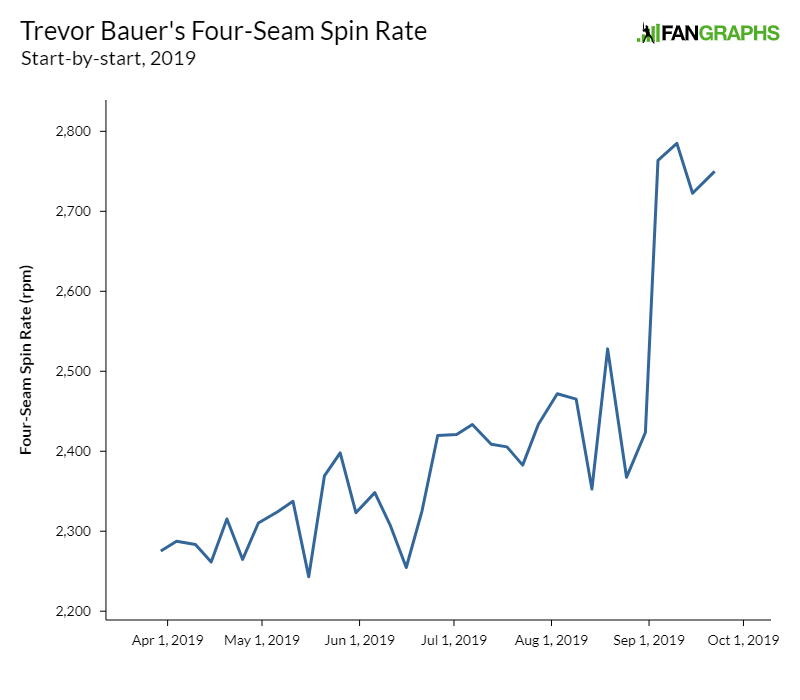
Now, I’m not a baseball scientist. But short of Alan Nathan and Meredith Wills and David Kagan, those are in short supply. So I thought I’d conduct a non-rigorous but still curious investigation of these September starts to see if I could get to the bottom of what happened.
Let’s get something out of the way first: my base case, before I started investigating, is that Bauer got back into the sticky stuff. The jump is just so clean, so consistent within each game, that it doesn’t look at all accidental. In a single earlier game, on August 19, Bauer seemingly discovered some spin, posting his then-highest single game average spin rate, just over 2500 rpm. For the rest of 2019, however, he lived between 2250 and 2500 rpm. Then, like magic, every single pitch Bauer threw in September had a spin rate higher than 2500 rpm.
What could cause this, if it isn’t some type of sticky substance? It’s a long shot, but maybe Bauer started cutting the pitch. What does that mean? If you already know, you can skip this section, but I’ll go over it quickly. Picture a tire rolling down the road. Now, picture that same motion by a ball in air, with no road in the way. That’s transverse spin. Picture the baseball with that tire-style spin, with the car in reverse, and you have a 100% spin efficiency fastball.
The ball tumbles “backwards” towards the plate, and that backspin creates ride, which makes the pitch fall less than gravity would imply. That type of spin can be oriented in any direction — you can tilt the direction the spin moves to, say, make the ball break right and up at a 45 degree angle. When you hear pitch angles referred to by a time on a clock face, this is what they’re talking about.
Next, consider a football thrown with a perfect spiral. That’s gyroscopic spin — the ball is spinning, but not in a way that alters its trajectory. It’s also called bullet spin, and it’s no coincidence that bullets and perfectly thrown footballs fly true, with no unexpected break. You don’t often see a baseball thrown like a football, but sliders and cutters are generally thrown with some mixture of transverse and gyroscopic spin. Some of their spin imparts a curve onto the ball, but some is gyroscopic and doesn’t create break.
Want an example of this? Look at Corbin Burnes. He spiked his fastball spin rate to great heights last year, and I erroneously saw a breakout. What happened here was that he added gyroscopic spin by giving the fastball some natural cut. Take a look at how his spin efficiency (the percentage of a pitch’s spin that is transverse, or “useful”) declined as his spin rate increased:
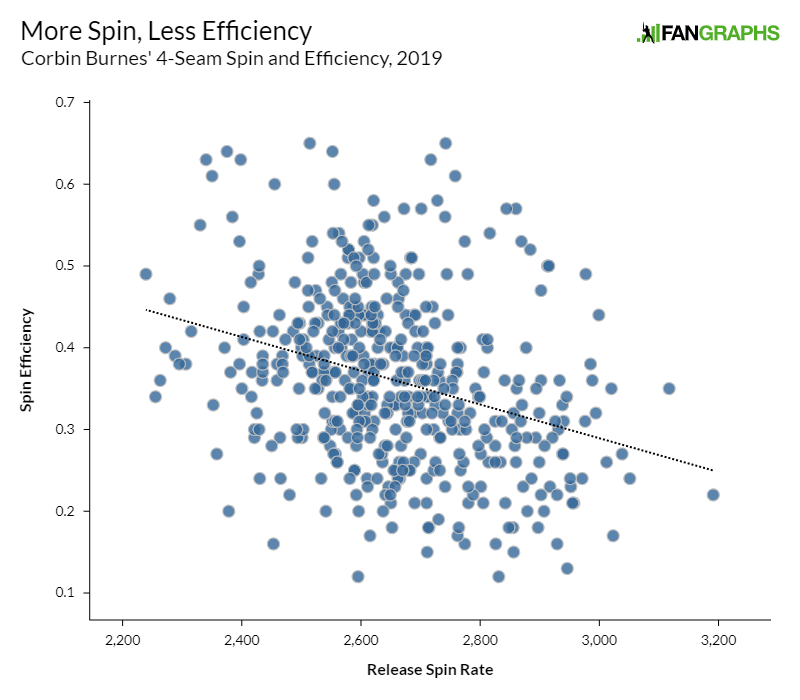
In fact, there was a slight relationship between Burnes’ overall spin rate and his transverse spin rate:
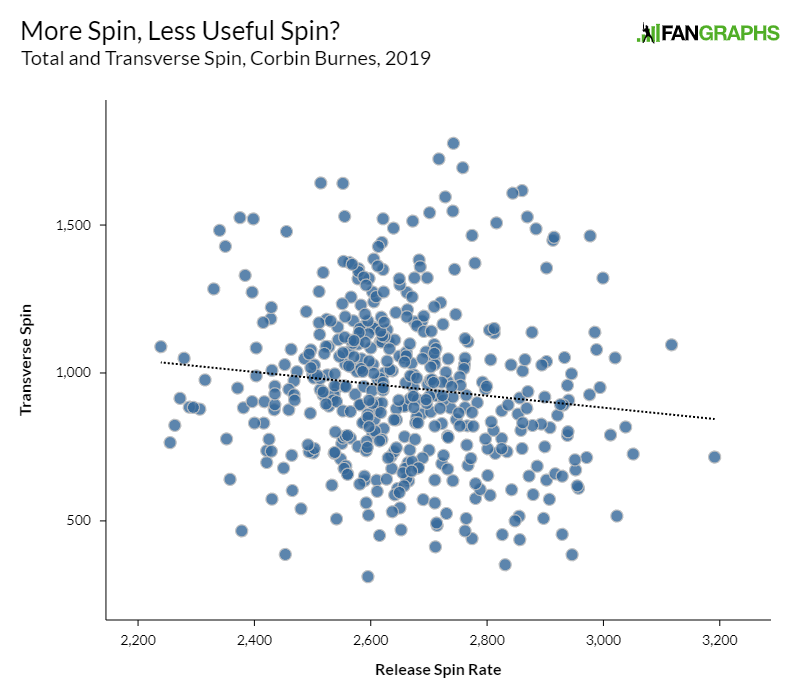
In other words, when he added spin, he was more or less exclusively adding gyroscopic spin. Every extra rpm of total spin decreased his transverse spin by 0.2 rpm. There’s not a straightforward relationship between spin rate and movement. Throwing a pitch harder will generally impart more spin on it, but it will also give the pitch less time to break. But one relationship isn’t confusing: for a pitch thrown at the same velocity, more transverse spin means more break. More spin and more transverse spin aren’t the same thing, though, as Burnes demonstrates.
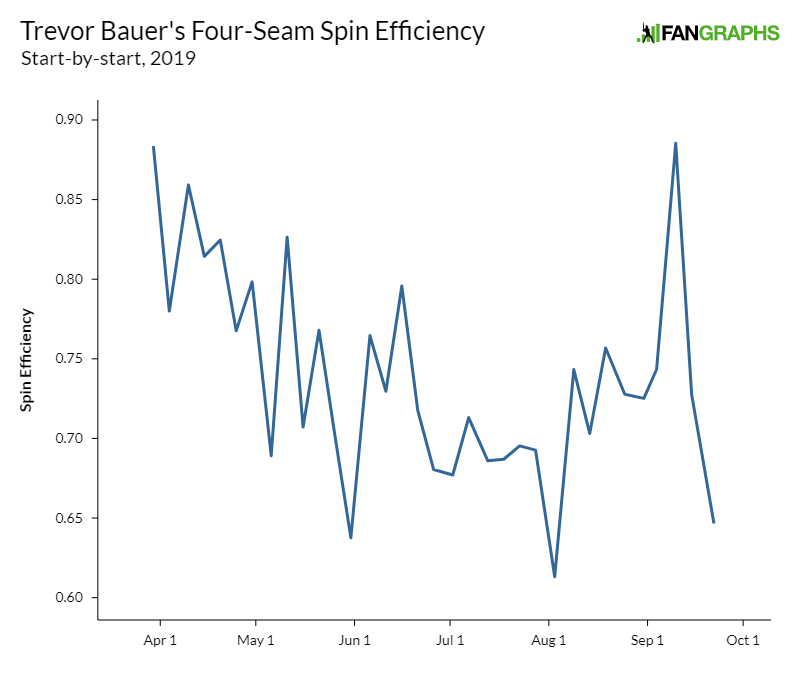
There’s just one problem with this theory: Bauer wasn’t cutting the ball. With the exception of his last start of the season, his spin efficiency hardly changed — and in one start, it spiked higher:
In fact, if you look at all the pitches he threw last season, the relationship looks wholly different to Burnes’ (note that as our graphing tool accepts only 1000 events, I’ve removed the first 429 fastballs of the year):
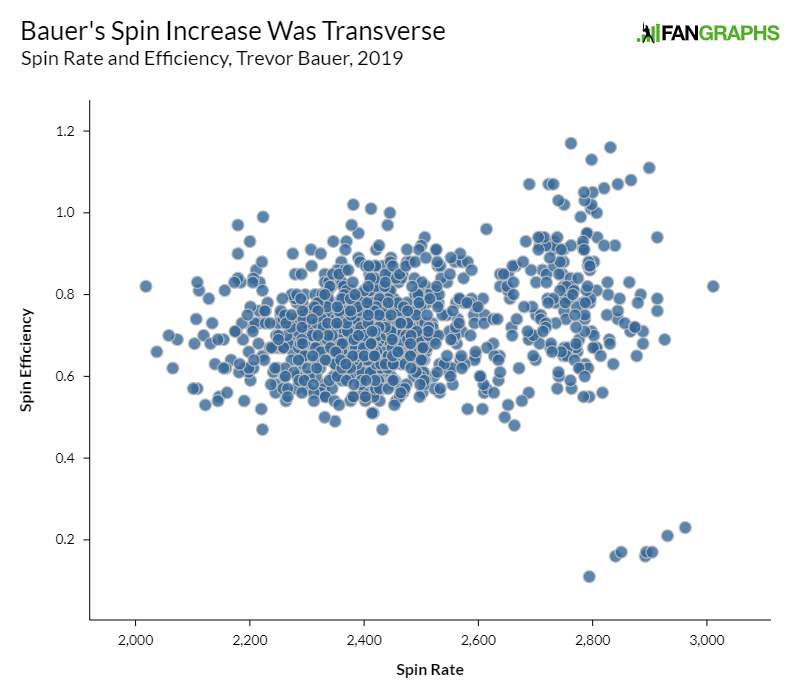
Don’t mind those dots above 100% spin efficiency; I calculated transverse spin using this excellent guide from Dr. Alan Nathan, and as he notes, measurement error in either the initial 9-parameter fit or the listed spin rate can create efficiency numbers above 100%. Measurement errors are inevitable, but over time the process works. There was a cluster of over 100% efficient pitches on September 10, for any enterprising investigators out there, but I’m just going to accept the measurements in service of finishing this article.
In any case, Bauer didn’t display the same relationship as Burnes. A very useful study by Driveline Baseball showed that adding cut can increase total spin output at the expense of efficiency, but we don’t see the telltale decline in spin efficiency, so that’s not what’s happening here.
If it’s not a cutter, what else could it be? As I mentioned above, spin and speed have a linear relationship. That’s intuitive — to throw something harder, you need to increase the force you apply to it. That force is also creating spin, though, so the two end up linked. Driveline came up with a concept called Bauer units that is simply spin divided by velocity that lets us compare spin rates at unlike velocities. Did Bauer just start throwing harder?
Nope! He actually averaged one mile an hour less in September than he did the rest of the year. Perhaps he was tiring, or perhaps he was using some hitherto unseen tactic that added spin at the expense of velocity, but you certainly can’t explain his increased spin rate with Bauer units. His rpms per mph (an ugly way of writing out Bauer units) spiked from roughly 25 to 29.5 in September.
I find it unlikely that we’ll ever get to the bottom of what caused this sharp spin increase. Bauer has always been quick to explain himself, quick to walk through the nitty-gritty details of pitching, but this feels different. If he was unwilling to conclusively admit that he’d goofed around with pine tar for an inning in 2018, I hardly think he’d admit to using it for a month in 2019.
But that 2018 start can still be instructive. The end goal of spin isn’t spin itself; it’s movement. That’s why we care about spin efficiency and transverse spin. In that fateful inning in 2018, Bauer got a ton of extra movement on his fastball. In the first inning, the ball broke an average of 21.7 inches from the time it left his hand to the time it crossed the plate. Note that this is from the point of release — Brooks Baseball, where you can see similar numbers, normalizes break at 40 feet so that all pitchers can be compared regardless of release point, but I’m skipping that step here since we’re only looking at one pitcher.
For the rest of that game, with the tar rinsed off, Bauer averaged 19.7 inches of break. He had created two inches of movement out of whole cloth. This relationship doesn’t exist in a vacuum — again, velo matters — but his velocity was nearly unchanged between the first inning and the rest of the game. It was simply the pine tar.
Did we see the same increase in movement in the September starts? More or less:
| Time Frame | Velocity (mph) | Spin Rate (rpm) | Total Break (in) | Spin Efficiency |
|---|---|---|---|---|
| Pre-September | 94.6 | 2358 | 19.4 | 0.74 |
| September | 93.5 | 2755 | 20.8 | 0.75 |
In the end, maybe the Bauer story isn’t so interesting. He did something in 2018 that made the ball spin and move more. In 2019, the same pattern repeated itself over more games. It’s not clear what changed, and it didn’t even have much effect on his starts — his swinging strike and whiff per swing rates barely budged in the month, though that anomalous September 10 start merits further investigation.
That doesn’t mean it had no effect, however. Maybe Bauer’s numbers would have been worse without the spin boost. Maybe he really did get that extra spin by sacrificing velocity through use of some technique that isn’t yet publicly known, and the decline in velocity offset the increase in movement. He has been known to experiment, after all. But for the most part, it’ll simply remain unexplained. We won’t know whether it’s a new normal or just a one-month experiment until we get some 2020 data.
Was this article really about Trevor Bauer? Was it just an excuse to show off some fancy math and talk about my longtime pitcher crush Corbin Burnes? I leave that determination to the reader. But either way, Bauer, as he is wont to do, did something interesting last September. All we can do now is puzzle at the results and wonder what the causes were.
Ben is a writer at FanGraphs. He can be found on Bluesky @benclemens.
Ben and Corbin, sittin in a tree…
I thought this was fun (especially given Bauer’s invitations to be interrogated about pitching, other things) and perfect for that “waiting for the Red Sox report/inevitable Manfrailure” pre-opening day lull
On the basis of two seasons with an significnatly higher spin rate than he had ever demonstrated earlier in his career, Gerrit Cole signed the biggest contract ever given to a pitcher. Even after Bauer explicitly accused Cole of using a banned substance, no umpire or league official ever investigated during a game, even though it would have taken only 20 seconds to walk out to the mound and examine his fingers.
Why wouldn’t Bauer start doing the same thing after he saw that even a public accusation from a current player supported strongly by publicly available Statcast data wouldn’t be taken seriously or investigated at all? Use of pine tar or sticky substances might be against the rules, but as long as no one is going to check for fire no matter how much smoke is billowing from a player’s BaseballSavant page, then there’s a big financial incentive for pitchers to break that rule.
Bauer’s claims against the Astros was nothing but hearsay.
Based on not much more than the fact that Cole’s spin rate increased after moving to the Astros.
And yes, Cole dramatically increased his spin rate by 215 in 2018,
but guess what? He increased it again by 151 next year.
So unless the theory is that the Astros are working on some secret substance that increases Cole’s (but only his) spin rate year by year, it makes no sense.
None of the other pitchers who moved to the Astros showed a spin rate increase of several hundred like Bauer claimed.
… Which is why he discussed Cole alone, and not the entire Houston organization
“If only there was just a really quick way to increase spin rate. Like what if you could trade for a player knowing that you could bump his spin rate a couple hundred rpm overnight…imagine the steals you could get on the trade market! If only that existed…”
Yup, that certainly sounds like he discussed Cole alone.
Also, no other pitcher was forced to avoid throwing high fastballs with his previous team (Pirates).
You must not be upset at the Astros.
Outstanding! Knowing Bauer’s tweets, I would be very surprised if it wasn’t an experiment to back up what he has been saying about spin rates and the magical Astros pitcher development. Looking at you Ryan Pressly.
The Astros did an experiment too. I am not sure it was outstanding.
who cares
If you’re gonna troll at least be creative
Bauer’s needing to use tar to get to that level of spin in his ‘test’ game, and the immediate reversion when he got rid of the tar, suggests to me that he’s not capable of simply changing his mechanics on a dime to get 300 more RPM. What was the point of the experiment and the twitter outrage in the first place if pitchers are capable of, in mid-season, just deciding to throw the ball with more spin? And if he were capable of it, why sit on that until late 2019, since he clearly felt it gives people a competitive advantage?
Put me in the “guy going through a shitty season starts using sticky, tells himself it’s ok because ‘everyone’s doing it'” camp.
He’s been pretty open about the “everyone is doing it thing”. His main point in bringing it up was that he just wanted the league to explicitly allow it.
Interesting article. It is related to something Bart Smith posted on Twitter recently: “As far as my RPM claim, I am comparing @pobguy
‘s trajectory calculator at 90 mph and 2000 and 3500 RPM for a 12:00 fastball. That change gives you less that 5″ VB.” The observation is that a large increase in spin rate produces only a small increase in the movement. Your analysis shows the same thing for Trevor Bauer in your last table, which shows a 17% increase in spin rate (and spin efficiency and velocity essentially unchanged) but only a 7% increase in movement. And why is that the case? It is because the relationship between spin and movement is nonlinear (e.g., see Fig. 1 here: http://baseball.physics.illinois.edu/trackman/SpinAxis.pdf). This nonlinear behavior has important implications both for pitches and for batted balls. I’ll be writing about that soon.
Can’t wait to read it!
Thanks for the light reading lol. I imagine that whatever you had to do to increase spin probably cancels itself in terms of efficacy with decreased command whch is highly likely. This community pretended that Nathan’s research did not exists for years. I would consider myself above this community which acts primarily in its own interests if I were that author.
Not sure exactly what you are saying here. I don’t know if I actually invented the concept of spin efficiency, but I was almost certainly the first one to write about it publicly . It now seems to be part of the vocabulary of baseball. But I’m pretty sure some smart analysts for MLB clubs knew about this before I wrote about it.
Regarding one of your later comments, one reason to focus on spin axis (rather than just movement) is that it is a useful diagnostic, especially when employing Rapsodo (for whom I consult) or Yakkertech (which is similar to Rapsodo) together with high-speed video. Example: Suppose one desires to increase movement on one’s curveball. One way to do that is to try to increase the overall spin rate without changing the spin axis. Another way is to change the spin axis, to reduce the amount of gyrospin without changing the total spin. Increasing the spin rate might not be so easy without using something like pine tar. However, I think that there is a growing evidence that pitchers can change the spin axis if they have the appropriate feedback from devices like Rapsodo and high-speed video.
This is just a bit over my head so instead I’ll ask a question for clarification. Back in the day when I threw a football 70 plus yards (with the occassional perfect spiral) I could always throw a perfect spiral by throwing it underhand like a softall pitcher. Which also invariably put a tremendous hook on the throw, I would estimate a fifty yard throw curved ten yards (to the left from a right-hander).
I’m not a physicist, but this is my observation from throwing footballs (and slow pitch softball):
When a major league pitcher throws a pitch, he’s basically throwing it on a line (ie, without arc). The spin axis is always the same in relation to the path of the ball.
Throwing on an arc, as you do with a football, the ball isn’t always flying with its nose directly along the path it’s traveling. This puts the spin axis slightly across the path of the ball like a slider.
The spin axis is always measured in relation to the path of the ball. Think of a bullet if it helps. Whether you fire a bullet with the barrel pointed horizontally or with it angled up slightly, the bullet is still coming out with nothing but bullet (or gyrospopic) spin, and therefore the spin from the bullet won’t affect the trajectory.
You were imparting spin other than just gyroscopic spin to the ball — sidespin.
The only reason you would have a hook is if it was windy or it was pointing in a different direction than intended. You can throw a spiral that doesn’t point straight ahead. It sounds like your underhand spiral was pointing sideways.
He’s bauered by drone batteries and pure blood
Even though he is not a National, I’m a Bauer Fan!
Bauer was a longtime disciple of Ron Woolworth and Brent Strom (who is now the pitching coach for Houston) (Cole?). I had the pleasure of doing some work with Strom, and he explicitly talked about normal baseball substances (tar, rock rosin, sunscreen, etc.) that would increase spin rate and therefore effectiveness. This doesn’t surprise me at all.
In the cheating era of baseball I don’t think you should call it goofing around with pine tar. I think anyone who has ever pitched knows that you can focus on spin or velocity – its kind of relevant to the idea of breaking balls. I find it telling that we have been flailing around in spin rate for years now and the idea of effective spin came a bit later and we are still struggling to make meaning from it. There were years wasted on what amounts to close to nothing. Why not just use pitch movement? That seems like what we are attempting to reverse-engineer.
There are few things I find more consistently tiresome than hearing about Bauer’s scientific approach to pitching. Personally, I think the guy can’t get out of his own way. I am reasonably confident that if Bauer had an old-school mentality he would be a better pitcher. Is there a player with more talent and less consistency than Bauer? Bauer is the poster-boy for the idea that drills don’t translate to on-field success. Drills are an important part of development but when the drills become more important than the actual pitching to hitters you get yourself a Bauer.
Love this stuff!!! Great article. I love Trevor Bauer. I’d love to hear what he says about your article after he retires. Trevor is SUCH a personality!
The article highlights the importance of gyroscopic spin. It seems to me from a physics point of view adding perfectly gyroscopic spin would make the ball break less, but go faster. Just as a football with perfect gyro spin will travel straighter and further than one with imperfect spin. Ben, next you gotta weave quantum entanglement or at least Maxwell’s equations into one of your articles. Keep rocking the multiverse!
I used to experiment with partially washing my hands with lava soap before attempting to throwing a curveball. Lava soap has some sand-like, abrasive substance embedded in the soap. My theory was semi-washed lava soap was like legal pine tar. I convinced myself that it increased my spin rate. I would love to experiment with similar substances. Trevor is the guy to try it!
Whoa, I wonder if the Coronavirus sticks to pine tar and partially-washed lava hands! Maybe drinking water in Wuhan has harder or more viscous than most?
Just sayin…
Lester Hayes has to wash his hands with lava soap AFTER every game – to wash off the stickum he used to smother his hands with. (Needless to say, the NFL didn’t let him get away with that furlong).
Just neighing.
Have there been studies on grip strength/effort and spin? What about a ‘natural’ coarseness in fingers developing over the year? Anecdotally, I have baby smooth hands, throw a low-spin two-seamer, and can’t ride a fastball up in the zone to save my life.
Why don’t you just ask him, I’m sure he’d tell ya
If every pitcher managed to increase their spin rate on the fastball, that would negate the advantage, right? Getting more movement/rise on pitches is good because those pitches then look different from what hitters are used to, or at least that’s the story I tell myself.
As a Jays fan, I think of Marco Estrada, of all people, who lived up in the zone with below average velocity for several years. He seemed like one of the early adopters of the “work up in the zone” strategy, and I think he thrived for a while because it was different from what hitters were used to. Once a significant percentage of the league switched to the high spin/location strategy and hitters got used to it, he was pretty much done, despite no obvious change to velocity/spin rates for him. That’s too neat of a story, I’m sure, since the ball change also happened and he struggled with injuries…
So the question is – in a league where spin rate is king, could a low spin rate end up ruling them all?
Back in 2013 when Koji Uehara was the Red Sox closer, he had two very effective pitches: a fastball with greater-than-typical backspin and a splitter with lower-than-typical backspin. His ability to mix these two pitches made him very effective.