
Where Has the Old Ozzie Albies Gone?
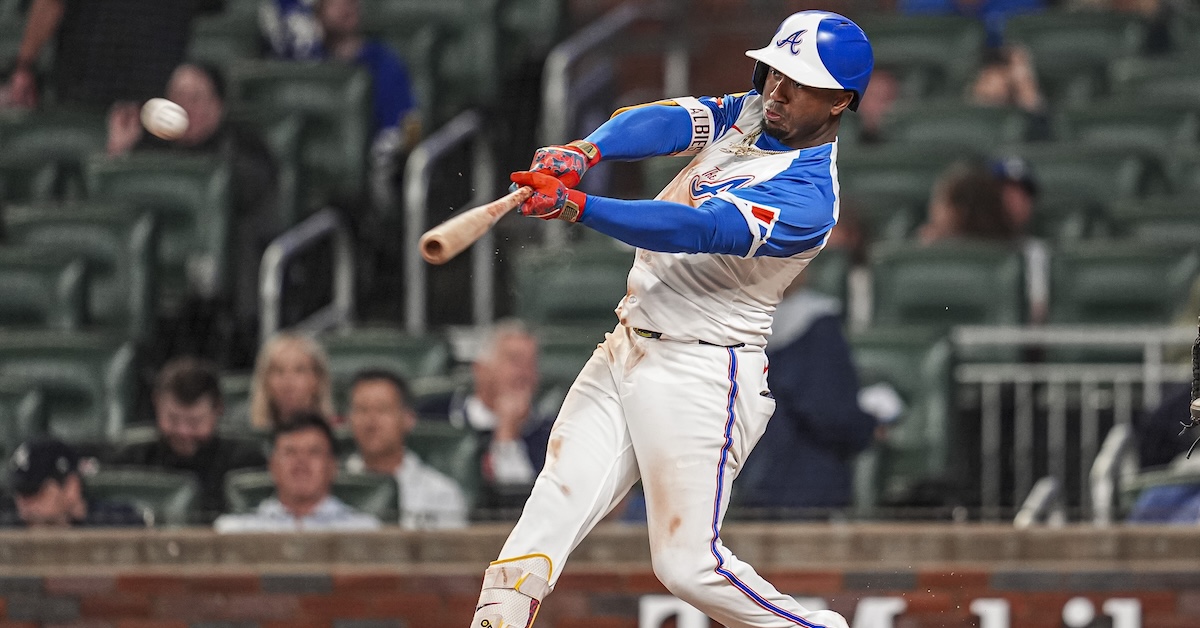
When Ozzie Albies signed his current contract, I decried it in such terms that, well, “decried” was an accurate description. This 22-year-old middle infielder, coming off a season of 24 home runs and 4.0 WAR, had signed away his prime earning years to the Braves for seven years at an average of $5 million per. Two option years could keep him in Atlanta through 2027 without increasing the contract’s AAV. It was an all-time swindle, I wrote. Esau got a better deal when he sold his inheritance for a bowl of stew.
Six years later, I sit here contemplating a question that once would’ve seemed unfathomable: Should the Braves pick up those option years?
Through his first 83 games, Albies is hitting .223/.297/.321, which is a wRC+ of 74. He has never before hit under .259, nor slugged under .450, nor posted a wRC+ under 100 in any previous healthy season. There’s probably a little bad batted ball luck in there, and some malaise from Atlanta’s comprehensively frustrating, injury-riddled season to date.
But Albies is only underperforming his xwOBA by nine points, and his hard-hit rate, 28.1%, is in the seventh percentile among major league hitters. For a player who’s profited so immensely from the right combination of contact quality and launch angle, here’s a troubling number: His barrel rate is just 3.4%, a 10th-percentile figure relative to the league and Albies’ lowest figure in that category since his rookie year. In 2023, when he hit 33 home runs, Albies ran a barrel rate of 8.2%. In 2021, his other 30-homer season, Albies’ barrel rate was a career-high 9.3%.
Denuded of his potent bat, Albies is just barely keeping his head above replacement level. But as to the question I posed above the break — might the Braves cut him loose after this season? — that’s one of those deliberately inflammatory rhetorical questions people like me let loose in order to get you to read.
As poorly as Albies has hit this year, it would be the shock of a lifetime if Atlanta didn’t pick up his option, even if he gets to September and his wRC+ is still in the Ford administration. There are two reasons.
First, it’d take a pretty ruthless bastard to fire Albies after all he’s done for the Braves. Part of the reason I was so outraged on Albies’ behalf when he signed this extension had to do with his immense potential. This tiny little man had already played more than 200 games in the majors before he turned 22, and not only survived but performed. It was not unreasonable then to expect Albies to turn into something like a switch-hitting Mookie Betts.
That didn’t happen, of course, but over the first six seasons of that extension, he played 656 games with a 110 wRC+, and even with the pandemic and various injuries, he produced 15.0 WAR over that time. But numbers don’t really do justice to a franchise stalwart. He’s made three All-Star teams, won a World Series, sold God knows how many jerseys and t-shits. Not to generalize off one data point, but my mother-in-law is a huge Braves fan, and Albies is her favorite player.
This isn’t some itinerant middle reliever; this is a lifer. There probably are front offices out there ruthless enough to ditch Albies after one really bad season, but Alex Anthopoulos and the Braves keep getting players to sign long-term under-market extensions because it’s supposedly a good place to play.
Second, like everything else about Albies’ contract, his first option year is unbelievably cheap: just $7 million. Moreover, while his 2027 team option has no buyout, if the Braves wanted to cut Albies this offseason, they’d have to pay $4 million to get rid of him. In essence, that makes this a $3 million decision.
For a guy entering his age-29 season who was an All-Star and got MVP votes two years ago, $3 million is nothing. Here’s a sampling of infielders who are either way older than Albies, or way more washed than Albies, or both, and what they got last winter on the open market from teams to which they (for the most part) had little or no emotional attachment:
| Player | Team | Contract | Age | 2024 PA | 2024 wRC+ | 2024 WAR |
|---|---|---|---|---|---|---|
| Amed Rosario | WSN | 1 yr./$2M | 29 | 346 | 96 | 0.2 |
| Donovan Solano | SEA | 1 yr./$3.5M | 37 | 309 | 117 | 0.8 |
| Enrique Hernández | LAD | 1 yr/$6.5M | 33 | 393 | 82 | 0.6 |
| Gio Urshela | ATH | 1 yr/$2.15M | 33 | 461 | 81 | 0.7 |
| Justin Turner | CHC | 1 yr./$6M | 40 | 539 | 116 | 1.1 |
| Kyle Farmer | COL | 1 yr./$3.25M | 34 | 242 | 84 | 0.5 |
| Yoán Moncada | LAA | 1 yr./$5M | 30 | 45 | 117 | 0.3 |
Albies is just flat-out worth $3 million next year. If he’s this bad again in 2026, then we can talk about his 2027 option, but that’s another blog post for another day.
Having established that the answer to a question nobody was asking is, “No,” let’s get to the scary part.
Albies was never a massive bat speed guy. It’s not his fault; he’s little. This might seem a bit weird to say, because it feels like a million years ago and he’s still only 28, but Albies was one of the first players who developed as a prospect post-swing plane revolution. Players who had good hit tools were taught to swing harder and put the ball in the air, and Albies was great at it.
Even now, he’s in the top quartile of the league in ideal attack angle percentage. He’s 18th in air-pull rate among 281 batters with at least 100 balls in play this season.
But he’s not hitting the ball as hard as he used to:
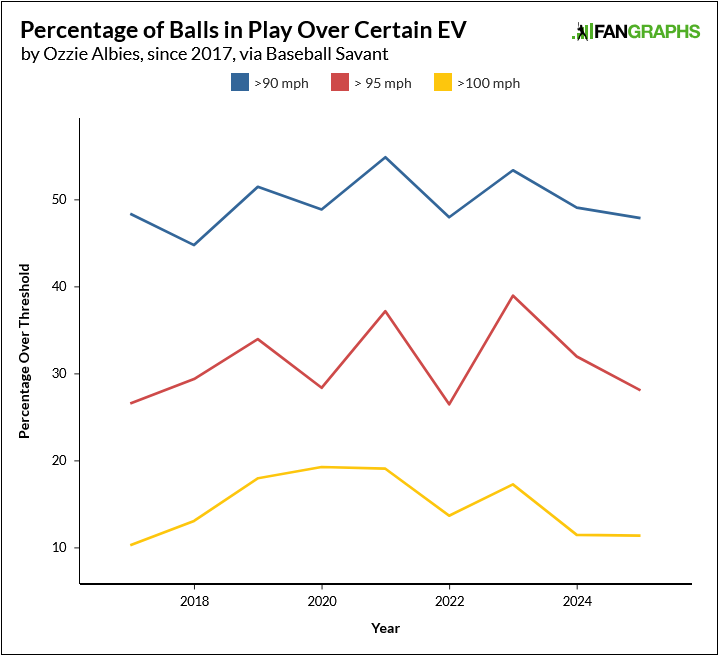
The thing that makes Albies tricky to evaluate is that he, more than almost any other hitter, is actually two hitters. He’s a switch-hitter with two extremely different swings. I actually asked him about this a couple years ago when I was kicking around an article on the decline of the switch-hitter. (The Athletic published a similar article while I was it kicking around, so I never used the quotes.)
Albies learned how to switch-hit in the minors; he’s naturally right-handed (obviously, given where he plays), but when you try to mirror your natural swing, he said, there were always differences. And he’s toyed with different stances and swing types over the years; he’s extremely open from both sides, but that quality has gotten more extreme with his left-handed swing and less extreme with his right-handed swing. Here’s what he’s been doing in 2025. First, from the left side:
And then from the right:
The tweaks he made — he started going slightly less extremely open in 2024 — have actually helped Albies put better swings on the ball. Even as Albies’ bat speed has suffered quite a bit from the left side, his losses have been minimal from the right, where he’s squared the ball up much more frequently over the past two seasons:
| Year | Batting | Avg. Bat Speed (mph) | Fast Swing Rate | Squared Up/Contact% |
|---|---|---|---|---|
| 2023 | L | 70.1 | 10.7 | 30.8 |
| 2024 | L | 68.9 | 6.5 | 30.2 |
| 2025 | L | 68.3 | 4.5 | 30.8 |
| 2023 | R | 69.9 | 11.7 | 30.1 |
| 2024 | R | 69.4 | 10.0 | 39.8 |
| 2025 | R | 69.4 | 12.7 | 40.9 |
Albies’ performance as a switch-hitter is one of my greatest baseball fixations. I’ve come to realize that many of my fixations come from traumatic arguments I had about the early 2010s Phillies as a young blogger, and this is no different. Back then, Shane Victorino was a switch-hitter with two distinct swings, just as Albies is now. From the left side, Victorino had a slappy swing; from the right side, he looked like Albert Pujols, and with not-much-worse results. Victorino had a career wRC+ of 93 batting left-handed, and a career wRC+ of 130 batting right-handed.
This is relevant to Albies because he is (or at least has been) a monster against lefties hitting right-handed: .326/.351/.537, a wRC+ of 135. Against right-handed pitching batting left-handed, he’s OK at best: .245/.309/.428, for a 95 wRC+.
The problem for Albies now, as it was for Victorino then, is that way more pitchers throw right-handed than left-handed. For his career, Albies has seen almost three right-handed pitchers for every lefty. For every plate appearance he takes as Manny Machado, he takes 2.8 as Ceddanne Rafaela.
Victorino eventually gave up switch-hitting at the end of his career, and I put that example to Albies when we spoke, as gently as I could: Would he ever consider hitting right-handed exclusively?
“We’ve talked about it before, but it’s not a thing I think I would do.”
Why not?
“Because I’m a switch-hitter,” he said, with a weighty silence afterward to indicate that he’d prefer to drop the subject.
Nevertheless, Albies tried going right-on-right at the end of last season. He’d broken his left wrist in July, and was racing to get back on the field in time to help the Braves make the playoffs. It wasn’t a big sample — nine games, 33 PA — but neither was it a rousing success. He hit .226/.273/.452.
This slump, which is quickly turning into a bad season, full stop, would ordinarily be a perfect opportunity to try something new. To reinvent oneself, even. But Albies can no longer count on crushing left-handed pitching.
He’s maintaining his bat speed, he’s hitting the ball in the right places, and the power is just gone:
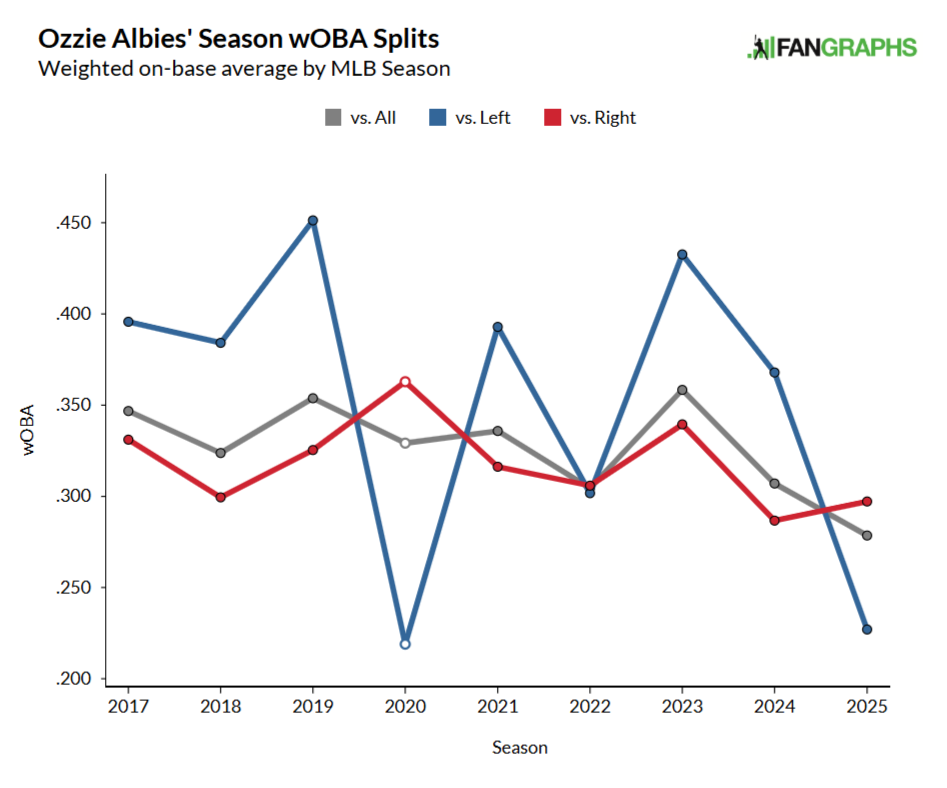
In 90 plate appearances from the right side this season, Albies has just three walks and four extra-base hits, all doubles, leading to a wRC+ of 39. For the first time in his career (pandemic season notwithstanding; he only played 29 games that year), Albies is doing significantly worse against left-handed pitching.
What I don’t know is where the bleeding is coming from or how to stop it. Albies is chasing more from the right side than in any season except 2022, but he ran a 43.0% chase rate in 2023, when he hit .391 as a righty and set a career high in home runs. He’s on pace to set a new career high in walk rate, but if there are glaring signs of overall passivity, I don’t see them. His SEAGER is below his career average, but he was never among the league leaders, and it’s not much lower than it was in 2023 anyway.
Albies’ decline is mysterious enough to tempt one to look for outside explanations: changes to the baseball, maybe, or lingering effects from that broken wrist. Albies wouldn’t be the first star player — or even the first extremely short second baseman of his generation — to get suddenly and inexplicably lost for a season. Jose Altuve was dreadful in 2020, his age-30 season, then popped back and made the All-Star team in 2021. He finished fifth in MVP voting in 2022. Only now, in his age-35 season and amid a position change (in my opinion, an ill-advised one) is he well and truly slowing down.
If Albies is in line for a similar bounce back, picking up that $7 million option will be the smartest decision Anthopoulos ever made. But one of the most reliable skills in baseball has evaporated, practically overnight, and I’m starting to worry.
Michael is a writer at FanGraphs. Previously, he was a staff writer at The Ringer and D1Baseball, and his work has appeared at Grantland, Baseball Prospectus, The Atlantic, ESPN.com, and various ill-remembered Phillies blogs. Follow him on Twitter, if you must, @MichaelBaumann.
Cool article! I know you brought up Victorino and Albies as examples of switch hitters who have drastically different hitting styles…. are there any switch hitters out there now (or in recent history) that are more balanced from both sides mechanically and statistically?
Chipper Jones is one that comes to my mind, he hit .303 career from the left side and .294 from the right side. Pretty swing both ways too
That’s a good one. Chipper definitely hit well from both sides, but he too had pretty dramatic splits (128 wRC+ vs Lefties, 145 wRC+ vs Righties), hitting for more home-run power as a LHH.
Even the more balanced switch-hitters (or non-switch-hitters for that matter) often find productivity in different ways. Jose Ramirez is an extremely balanced switch-hitter (131 vs 128 wRC+), but he draws more walks as a LHH and derives his OBP as a RHH more through his batting average.
Part of the explanation is that the pitcher talent pool is very different — the average velocity of a LHP is considerably lower than that of a RHP (right-handed SPs average 94.4 on their four-seam this year, vs 93 mph from lefty SPs), and you’re more likely to find “crafty lefty” types who throw the kitchen sink. There are very few “crafty righties.”
So even if you were a carbon copy switch-hitter, you would expect different statistics from both sides of the plate given your competition.
A career 128 wRC+ (spanning almost 20 years) from your weaker side is unreal. But as good as he was from the right, his lefty swing was on a different level, aesthetically and statistically
I don’t think Fangraphs goes far enough back on the splits page for handedness. It looks like it only goes back to 2002. That would miss his major years. I always thought he was better as a righty. It would be interesting to see his 90s handedness stats.
Good catch! Baseball-Reference has his full career splits, and his tOPS+ across his 2499 career games is 103 tOPS+ as a lefty and 92 tOPS+ as a RHH. It’s a similar story across this larger sample — he had a bit more power when batting from the left side.
Beltran always struck me as consistent in swing, and his performance from both sides was quite similar.
I thought of Beltran as well — and his batting lines from each side of the plate are virtual carbon copies — but he looked very different while doing it, at least to me. Seemed to stand more upright and have a shorter stroke as a RHB, which I think is his naturally dominant hand.
Jimmy Rollins is the first that comes to mind for me. Eddie Murray. Ted Simmons. Terry Pendleton maybe. Melky Cabrera. Ken Caminiti. Erick Aybar.
I don’t think there’s many before you’re into that Chipper territory which actually isn’t too bad, but definitely stronger from one side. Teixeira, Swisher, Bernie Willams, Bobby Bonilla, etc. And by “etc.”, I mean I’m out of names..
I’ve caught just a handful of Braves games this season, but in each one Albies has scooped under a middle pitch and popped out to the pull side. He’s 38% “under” quality of contact, which is third highest in league. Bottom 10 in barrels, bottom 20 in pop up percent. Really wondering if it is too late for Ozzie to reinvent himself as a slap hitter and live in the Arraez/Wilson mold.
He will get a chance with his age and his affordable contract. The other item that i didnt see the article mention or any comments is he broke his wrist last year over the summer and came back (only for 2 weeks but was very bad .184/.244/.368 for a 69wRC+).
one has to wonder if that wrist injury zapped him a little and he is not at the same strength as before.
The bat thing is also easy low hanging fruit. He has some of the slowest swings on the team while using one of the heaving bats.
This adjustment should be his way forward. Stop trying to lift anything by design and go to a line drive and contact approach.
Albies seems like another example of a hitter who was very dependent on his hit tool being strong enough to buoy a lack of raw power and/or plate discipline that then falls off a cliff after aging-related decline in that formerly superlative hit tool. Tim Anderson, David Fletcher, Javy Baez, Yuli Gurriel, Adam Frazier, et. al. have suffered the same fate, and Mookie is really the only guy in that mold to buck the trend.
I think it’s subtler than typical degradation of the hit tool like a decline in Z-Con%, but more like being a hair later on a fastball that’s now a pop up instead of a pulled fly ball. It really does seem like this particular profile lives on a razor thin margin now and a steep decline can happen at pretty much any time
Yea I came to say something similar. Guys with 5-6% walk rates really don’t have any room to decline, and when the decline hits hard
He’s even running a career high walk rate, but I think that’s mostly due to a misguided team-wide approach to just swing less.
Assuming this is a thing, we should be able to quantify it at this point, yes? So for example, come up with a sample of ~20 players that are “successful” now but will decline at a faster than normal rate, or faster than the average aging curve, because of this attribute? Maybe its already been addressed, I’m not aware. Anyway, I’m interested.
This is just back of the bar napkin level of effort and very arbitrary way to quantify it but building off of Dmjn53’s 5-6% walk rate comment.
Looking at 2025 season, qualified hitters with wRC+ greater than 120 and walk rate below 6%:
Zach Neto
Andy Pages
Pete Crow-Armstrong
Jacob Wilson
Jeremy Peña
As a Cubs fan, PCA was first player that I thought of while reading this thread.
Just thinking about aging and this skill set, here are the players 29 or over with a walk rate <5% and wRC+>120 since 2000 (min 400 PAs):
Juan Uribe 2014
Alex Rios 2012
Salvador Perez 2021
Rondell White 2005
Garret Anderson 2002
Garret Anderson 2003
Ichiro Suzuki 2009
Yoenis Cespedes 2015
Ivan Rodriguez 2001
Trea Turner 2024
Alfonso Soriano 2007
…at this point I gave up and changed the threshold to 5% from 6% because there were going to be a lot more pages to click through. Don’t know if it tells us much other than, it’s hard to have a wRC+ over 120 when you walk that rarely! Albies sure hasn’t done it (in his only season with a wRC+ over 120, he walked 7% of the time).
Trea Turner seems kind of comparable to Albies–same career BB%, very similar career K% and ISO, middle infielder (at the more valuable spot), but a much better hitter thanks to almost 50 points of BABIP. Which I guess is because Turner hits a lot of ground balls and is faster? Looking at Turner through age 28 only doesn’t change things that much, though his BB% is 7.4% instead of 6.8%; maybe that’s the margin where once it starts to slip, everything goes.
Good point. Really makes you appreciate just how good Mookie is
Huge difference between Betts and those guys is that he always ran a good walk rate.
Once we have more bat speed data, these types of trends may be easier to pick up. One thing I’ve been curious about is how age-related decline may affect players differently. It’s not just bat speed, but also reaction times and hand-eye coordination. Do some players have no initial decline in bat speed, but take longer to decide to swing? Or does bat-to-ball skill deteriorate slightly so that mis-hits happen more? Do certain types of players experience decline in stereotypical ways? Or is it more randomly?
What they’ll eventually find is that players lose first trigger quickness as they age. It’s why guys that age well shorten their swings as they get older.
At least initially it’s not that they take longer to decide to swing, it’s that the bat doesn’t launch as fast when they do.
Contract looks even more like an all-time swindle, though. Albies would have made more than its value through his arbitration years, and hit the free agent market coming off a career year and surely would’ve been able to swing an eight-figure deal or close.
I mean he’s still “comfortable for the rest of his life” rich and I would have been happy to lock that down for certain, but the extension cost him a lot of money.
He would have been a FA last offseason, correct? Is his profile significantly different from Gleyber Torres, who only got a 1 year deal?
2Bs are generally viewed with long term suspicion for the exact reason Albies’ career has taken a turn – theyre lacking in high end tools
Wouldn’t he have been a free agent after 2023, coming off a 33-HR season?
You are correct – he would have hit FA as a 4 fWAR/5 rWAR player, entering his age-27 season.
Yep and that would have resulted in a nine figure deal. Interesting his option years are could be viewed though the lens of pillow contracts and even then their amount and how they are structured is heavily weighted in the teams favor. Most two year pillow contacts have the second year as a player option.
I don’t see enough appreciation in the comments for the quality of the writing itself. I enjoyed the heck out of reading this, even though I hate that Albies is struggling enough to prompt this article.
Amazingly well-written, and a fun read.
I think a Sean Murphy for Cronenworth swap would make sense for both sides. 2 contracts that aren’t ideal, addressing an area of significant weakness for both teams. Cronenworth can platoon with Albies and then learn some outfield next season and shift into a super utility role once we hire a manager who understands what versatility is.
Murphy has significantly more value than Cronenworth. Does Cronenworth have positive trade value? Murphy certainly does
I’ve seen a couple people suggest that he may need to try a lighter bat. I don’t know how much that would impact the slug he has left, but he isn’t getting around on fastballs. Might be an easier thing to try than convincing him he isn’t a switch hitter.
An additional problem is that Ozzie isn’t even really a second baseman anymore. HIs arm strength has always been poor and his range seems to have been heavily impacted by shift restrictions. I agree that the option will be picked up for $3 million but if Nacho Alvarez is knocking on the door next season, I’m not sure how long they can keep running Ozzie out there.
Nacho Alvarez is an 80 grade name and sounds like someone you’d see in the 2073 season in OOTP
Lighter bat and level off the swing.
Regression comes in two forms. There is the “in game” regression, where a pitcher or hitter has some batted ball bad luck (running a weird BABIP or a big disconnect between their wOBA and xwOBA) or maybe weird strand rate or uncommon HR stretch.
But then there is the, let’s call it, “ability regression,” where a player is completely out of form and they don’t look like themselves anymore. Sometimes, yes, like others have mentioned with regards to Tim Anderson and Javy Baez (maybe you could add Chone Figgins to that list), the player is just cooked and the critical skill they once had is decayed beyond possibility of recovery.
However, more often than not, the safer bet — the bet most of the projection systems are doing inherently with Albies — is that player, the body, the adaptability all still exists within the player (even if the metrics don’t suggest it outwardly).
For me, I would be very willing to suspect that a player with this kind of career trajectory:
…Is far more likely to rebound to the original arc he was traveling on. I think Altuve is an astute example in that regard. Yes, bat speed, exit velo, and contact metrics are all very meaningful and predictive — but the current season is only a slice of a much larger sample in this instance.
So I think Ozzie will be fine. But I’ve been wrong before, lol!
Observationally, second basemen traditionally don’t age as well as players at other positions. Altuve is a HOF and a unicorn. I wouldn’t comp anyone to him.
What exactly has Ozzie sold God knows how many of?
Yeah I caught that too- a rare blip that made it past the edits. Fangraphs team may want to revise that eighth paragraph!
Puppies. Miniature Schnauzers if I’m not mistaken. It’s his side hustle since his MLB contract underpaid him so severely
I have been curious since the 2nd base slide rule (tejada rule) changes whether 2B men would have longer careers. Albies started (in the majors at least) right after that so single sample size so far not bearing it out.
RIP Ruben Tejada
It’s possible. A lot will depend on how much accidental contact there is which is a product of the number of plays at the bag. Someone would need to do an analysis. There are more stollen base attempts, but there is also fewer doubles and obps about average, double plays are down. Put outs are down compared to where they were in the 2010s.
How does one sell a T-shit? Asking for a friend
There’s definitely a poop knife involved, and you’ll want some gloves
Just make sure they’re *some* gloves and not *de* gloves.
Now do Michael Harris.
So perplexing.
A lot of Braves fans believe that Albies and Harris are both suffering under an enforced hitting approach the Braves are using that just doesn’t suit them well. With Harris, there’s just almost zero argument to be made that it is “decline” since he is 24 years old and appears to be in excellent shape. Harris’ struggles provide some hope that Ozzie is also just mechanically and mentally messed up and could recover if the Braves do a better job with adjusting his approach.
Jorge Posada, too.
.846 OPS vs. RHP
.852 OPS vs. LHP