Archive for 2017

Before You Vote, Some Other Things to Consider

With less than a week remaining in the regular season, a number of end-of-year player awards appear to lack a decisive winner. With so few games left, a decisive winner is unlikely to emerge.

In the American League MVP race, for example, you couldn’t have a greater contrast between the top two candidates. Jose Altuve is the smallest position player in the majors, Aaron Judge the largest. They possess different offensive skills and different defensive homes. Yet these two very different players had produced exactly 7.3 WAR entering play Monday. Lurking behind Altuve and Judge is the game’s best position player, Mike Trout. After losing time to injury, Trout isn’t the favorite. He’s been excellent when healthy, however.

The American League Cy Young race might be even more fascinating. After Chris Sale seemed to have run away with the award by the end of July, Corey Kluber has made it very much a contested race thanks to a remarkable series of performances since he returned from the disabled list in June. How one chooses between the two might depend on which version of pitcher WAR one consults: either the FIP-based version (denoted at the site just as WAR) or the one calculated by runs allowed (RA9-WAR).

Read the rest of this entry »


What If the Twins Won the World Series?

As I write this, six teams have already reached 90 wins. Another three teams still could. Four teams have won at least 60% of their games, which is the highest total for the league in more than a decade, and that doesn’t include the Yankees, who have baseball’s second-highest run differential. It also doesn’t include the Cubs, who last year were one of the better teams in recent memory, and who this year picked up Jose Quintana, among a few others. The Dodgers, who are great, added Yu Darvish. The Astros, who are great, added Justin Verlander. The Nationals, who are great, added Sean Doolittle, Ryan Madson, and Brandon Kintzler. And so on. The top of the league is always good, by definition, but this year the best teams seem particularly strong. Particularly talented, and particularly deep. This year has marked a step away from what had been a trend toward greater parity. Now the parity is simply among the elite.

The great teams are going to the playoffs. That’s what’s supposed to happen. The Twins, also, look like they’re going to the playoffs. It’s not yet locked up, but it’s just about there, with the Twins looking ahead to a date in New York. Playoff entry, of course, is everything, because each of the final 10 teams gets a chance to win it all. It’s inarguably true that the 2017 Twins could win the World Series in a month. The question is, would that be a good thing or a bad thing? It’s a question I’m actually posing to you, but not before I go over each side.

Read the rest of this entry »


FanGraphs Audio: Dayn Perry Elevates the Conversation

Episode 770
Dayn Perry is a contributor to CBS Sports’ Eye on Baseball and the author of three books — one of them not very miserable. He’s also the serious guest on this edition of FanGraphs Audio.

A reminder: FanGraphs’ Ad Free Membership exists. Click here to learn more about it and share some of your disposable income with FanGraphs.

Don’t hesitate to direct pod-related correspondence to @cistulli on Twitter.

You can subscribe to the podcast via iTunes or other feeder things.

Audio after the jump. (Approximately 77 min play time.)

Read the rest of this entry »

01:17:22

Effectively Wild Episode 1115: Has The 2017 Season Been Bad?

EWFI

Ben Lindbergh and Jeff Sullivan follow up on their Glory Hole Recreation Area discussion and banter about a Brandon Crawford bunt attempt, an Andrelton Simmons deke, Oakland catcher Bruce Maxwell’s decision to kneel during the National Anthem, whether the 2017 season has been bad, and how one would even decide such a thing.

Read the rest of this entry »

00:49:40

Aaron Judge’s All-Time Rookie Season

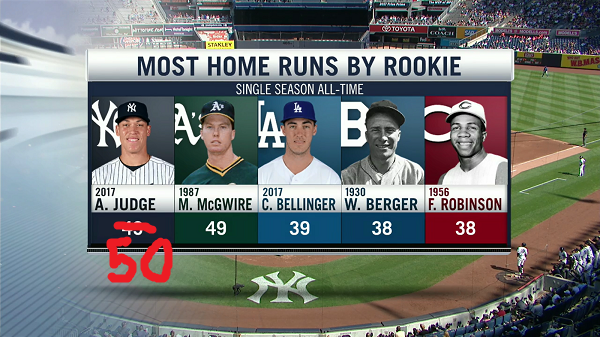
Compelling articles frequently begin with an anecdote. Let me therefore begin with one of my own. Aaron Judge annoyed me on Monday. See, Judge hit a home run, and after the ball left the yard, I started working on this post about the details of his full rookie season. Heck of a rookie season! Just as I was really getting into it, though, I had to stop and re-work a few things, because then Judge hit another home run. New data. New tables. New images. Here’s one of them.

At first, on Monday, Judge hit his 49th home run, tying Mark McGwire’s record for a rookie. You can tell it’s a remarkable record, too, because of the gap between McGwire and the next guy on the list. Well, the record is split no longer. Judge and McGwire shared the spotlight for a handful of innings, but the record now belongs to Judge and Judge only. Judge is the first rookie to ever reach the 50-homer plateau. Although, perhaps plateau is an incorrect word, because Judge could continue to climb ever higher in this season’s final week.

Read the rest of this entry »


Will Teams Need a LOOGY to Win the American League Pennant?

Quick: who’s the best left-handed hitter likely to appear in the American League playoffs this October? If you took more than three seconds to come up with an answer, don’t worry, that’s perfectly normal. The National League contenders have plenty of high-profile left-handed hitters: Charlie Blackmon, Cody Bellinger, Bryce Harper, Daniel Murphy, and Anthony Rizzo immediately stand out. Not so in the American League.

Postseason roster construction can have a lot of consequences. Once rosters are set, there are only so many machinations that can or will surprise us, but in a lot of cases, series can be won or lost by the selection of the the last five guys on the roster. I focused on some interesting roster-construction decisions last week. In the meantime, the possible configurations of the Astros bullpen have remained with me. If Houston utilizes a tandem-starter approach, it will lessen their flexibility for their bullpen; as such, they might not have room for LOOGYs. Of course, a LOOGY is only necessary to the extent that there are dangerous left-handed batters to face. The potential absence of a LOOGY from the Houston bullpen led me to a larger question about the batters whom that pitcher might face — specifically, whether any of the AL teams need a LOOGY to navigate October?

Read the rest of this entry »


The Weirdest Thing About Jon Lester’s Season

Jon Lester pitches tonight against the Cardinals in St. Louis, and how he performs in that start may have some impact on his postseason rotation spot. The 33-year-old lefty is in the middle of his worst season by most metrics, and he’s had an ERA over 5.00 in the second half, so it’s only gotten worse. There are plenty of reasons to be worried about the pitches the Cubs starter is throwing right now. Even more worrisome might be the pitches he’s not throwing anymore, though.

Read the rest of this entry »


What Strikeouts Have Taken from Baseball

It shouldn’t be news that strikeouts have increased at a pretty alarming pace over the last decade. From the end of the last strike through 2007, the league-wide strikeout rate was pretty steady, averaging 16.7%. That is, roughly one in every six plate appearances ended in a strikeout. Over the last decade, the average has reached nearly 20%, including a high of 21.6% this year. Now, more than one in every five plate appearances ends in a strikeout. A strikeout is now 30% more likely than it was a little over a decade ago.

This is a problem with many possible solutions: raising the bottom of the strike zone; lowering the mound; or, my personal favorite, expanding the league. This piece isn’t prescriptive, however. The focus of this piece is to show exactly what the strikeout has replaced, and it isn’t actually all bad.

Because I started this piece by doing some research on the home-run record, we will focus here on the year 2000 as it compares to the present. That season represents what was probably the height of the PED era; it was also the season responsible for the league-wide high in home runs until this year. Because the power numbers between the two periods are similar, a comparison of the seasons creates an interesting vantage point from which to view the role of the strikeout.

Generally, we imagine that players have to sacrifice contact for power. It’s notable, then, that the power numbers of today are equivalent those of the 2000 season even though players are striking out 30% more often now than they did back then. To provide some background, here are some standard numbers from 2000 and 2017.

Comparing 2000 and 2017
Season G PA HR BB% K% ISO BABIP AVG OBP SLG wOBA
2000 62083 190261 5693 9.6 % 16.5 % .167 .300 .270 .345 .437 .341
2017 54957 173900 5753 8.5 % 21.6 % .172 .300 .255 .325 .427 .321

As the 20-point difference in wOBA illustrates, overall offensive levels were higher back in 2000. The ISO and BABIP figures are all roughly similar. When a batter hits a ball in play, that batted ball is just as likely to become a hit as it was before. When it lands fair, it’s leading to roughly the same amount of extra bases. All that’s basically the same.

In terms of differences, one finds that this year’s walk rate is a bit lower than in 2000. That has some influence on run scoring, but not at all to the same degree that the increase in strikeout rate has. In effect, 5% of potentially positive plate appearances have been turned into strikeouts. That’s significant. However, while the main complaint about strikeouts is that they lead to fewer balls in play, it isn’t accurate to suggest that every extra strikeout has actually had that effect.

Read the rest of this entry »


Travis Sawchik FanGraphs Chat

12:01
Travis Sawchik: Howdy, folks

12:02
Travis Sawchik: Looks like a great afternoon for a baseball chat (at least from the location of Bay Village, Ohio)

12:02
Travis Sawchik: Last week of the regular season …. Harper coming back … And interesting AL Cy Young race … Let’s get to it

12:02
PF: Will you miss Jose Bautista?

12:03
Travis Sawchik: I will. I know he was polarizing but he was really the first guy to break from the conventional mold of hitting … and began pulling everything to find great success. Smart dude

12:03
Prince S. Leia Fielder: Miguel Cabrera or CarGo for this last week? Both have been mostly terrible all season, both are nursing injuries, Tigers have nothing to play for so may bench Cabrera but the Rockies are facing basically all left handers. Am I just screwed?

Read the rest of this entry »


For How Long Can Hitters Keep Pace?

In spring of 2016, during batting practice before a game, I was speaking with a front-office executive. Our conversation had turned to the increasing velocity in the sport. The official wondered aloud when the trend would subside or, if it were to continue increasing, at what point hitters would really struggle to react. Or, he added, were hitters somehow adapting?

There has to be some limit. After all, if a pitcher could reach Mach 1 with his fastball, it would be impossible for a batter to react. But what is that limit?

It’s possible that an event from last week might help provide a clue. Facing Boston’s Chris Sale in the seventh inning of a 6-0 game, Mark Trumbo fouled off a 99 mph pitch at his eyes, a pitch with an even greater effective velocity because of his height. Read the rest of this entry »