
Aroldis Chapman Re-Ups With the Red Sox
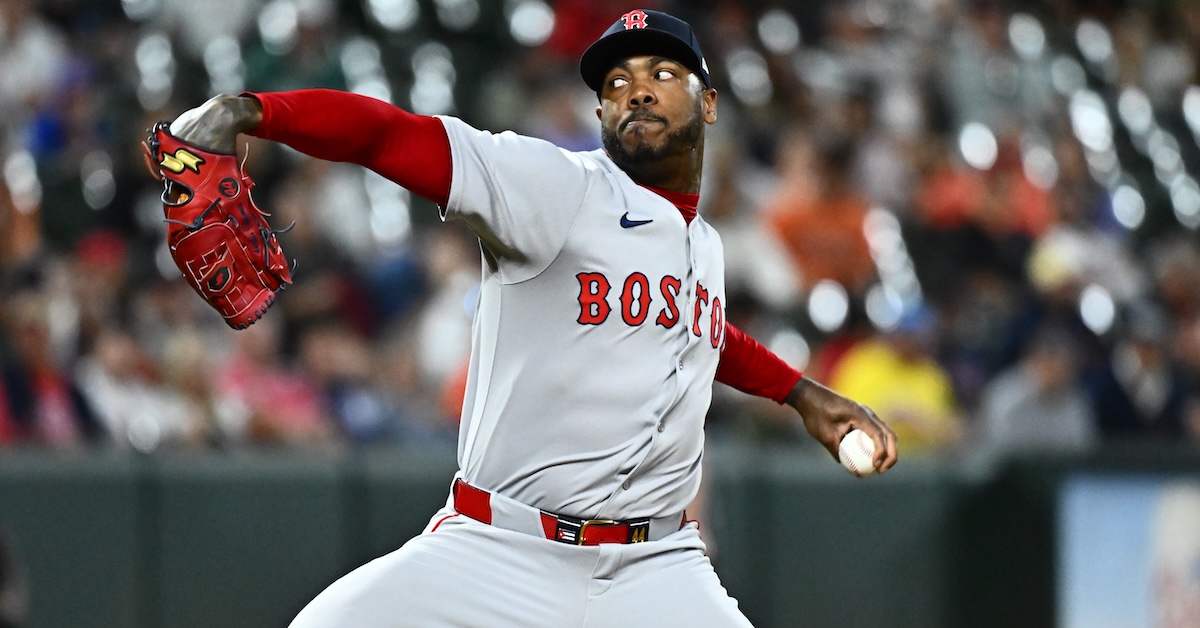
The Red Sox got to work on their 2026 bullpen over the holiday weekend, signing closer Aroldis Chapman to a contract extension that keeps him in Boston for at least one more season. Chapman’s one-year, $13.3 million deal comes in the form of a $12 million salary for next season, a $1 million signing bonus, and a $300,000 buyout if a $13 million mutual option for 2027 is not exercised. That option becomes guaranteed if he pitches 40 innings in 2026 and passes a physical exam after the season.
After appearing to be in decline for at least a few years and falling out of the conversation of baseball’s top closers — and at times losing the closer’s role altogether — Chapman is dominating in his first season with the Red Sox. Entering play Tuesday, he has a 1.00 ERA and a 1.78 FIP over 54 innings with 77 strikeouts and 14 walks. No, you didn’t misread that last part: Chapman has issued only 14 free passes this season across 54 innings, which works out to a rate of 7.1% and 2.33 BB/9 — by far the lowest marks of his career. Even at his absolute best, Chapman would walk three or four batters per nine innings, a reasonable trade-off for the rest of his skillset. However, as he aged, that control degraded, and from 2021 through 2024, he walked 15% of the batters he faced. So, for him to suddenly put up the best control season of his career, at age 37, is an impressive feat.
ESPN’s Buster Olney talked a bit about how Chapman’s approach changed in the spring, but the basic explanation for what we’re seeing is he has stopped throwing his fastball down the middle. Instead, on the advice of Boston catcher Connor Wong and with the assistance of PitchCom, Chapman is now actually trying to spot his heater. While this is the type of anecdote that sometimes sounds like folklore, the data do suggest that Chapman is suddenly locating his fastball with dramatically more competence than in the past. According to Stuff+, Chapman’s Location+ of 179 for his fastball is the fifth-best number ever tallied (min. 40 innings), compared to the 94 he ran over his past four seasons. His sinker, once a sideshow in his repertoire, has become its focal point in the way the slider once was. This isn’t a sinker thrown to induce a groundball but to be an out pitch, a 100-mph sinker high and outside against righties, high and hard on the hands of lefties. Only one player in Statcast history has ever finished with a better whiff rate on his sinker than Chapman’s 38.9% this season: Josh Hader in 2019 (40.7%) and 2021 (40.5%).
Chapman has also simplified his approach. In recent years, he had been mucking around with the slider in early counts more than in the past, but this year, he’s throwing first-pitch fastballs or sinkers about 85% of the time. That has resulted in a 71.1% first-pitch strike percentage this season, nearly 10 percentage points above his previous high of 61.9% in 2017.
By all reports, Chapman has enjoyed playing with the Red Sox, and this appears to ring true in that despite his elite season, he’s only getting a minor bump in yearly salary for this extension, and only a one-year guarantee at signing. Even at his age, I suspect he would have done better in free agency. If this were three or four decades ago, Chapman would be a serious Cy Young contender, but as relief outings have gotten shorter, it’s become more difficult for closers to win the award. Last year, Emmanuel Clase became the first reliever to finish top three in the Cy Young voting since Francisco Rodríguez in 2008. Eric Gagne is the most recent reliever to win a Cy Young, all the way back in 2003. This is one of the reasons why the BBWAA recently voted to create a new Reliever of the Year award, starting next season.
| Year | W | L | ERA | G | GS | IP | H | ER | HR | BB | SO | ERA+ | WAR |
|---|---|---|---|---|---|---|---|---|---|---|---|---|---|
| 2026 | 5 | 2 | 2.96 | 55 | 0 | 48.7 | 35 | 16 | 4 | 21 | 73 | 145 | 1.0 |
| 2027 | 4 | 3 | 3.42 | 55 | 0 | 47.3 | 37 | 18 | 5 | 22 | 68 | 126 | 0.7 |
ZiPS sees no particular reason to worry about Chapman. Even with the walk rate not projected to stay this low and the impossibility of any pitcher maintaining a .175 BABIP in the majors, Chapman still projects as an excellent closer in 2026, far better than he was from 2021-2024. There is some downside risk here, with Chapman approaching 40 and relievers being volatile — ZiPS gives him a 23% chance of posting an ERA of 4.50 or worse — but the Red Sox accounted for that possibility in this deal. ZiPS also projects Chapman to have a 70% chance at becoming the ninth player in major league history to notch 400 saves.
There’s been a lot of player movement in and out of Boston in recent years, but the 2026 squad already looks quite a lot like the current roster, and with Chapman now signed, Justin Wilson and Rob Refsnyder are the only two players who started the season with the Red Sox that are slated to hit free agency this winter. Their bullpen this season ranks third in baseball in ERA, fifth in FIP, and second in WAR. With this signing, the Red Sox have now secured the return of the pitcher most responsible for making that happen.
Dan Szymborski is a senior writer for FanGraphs and the developer of the ZiPS projection system. He was a writer for ESPN.com from 2010-2018, a regular guest on a number of radio shows and podcasts, and a voting BBWAA member. He also maintains a terrible Twitter account at @DSzymborski.
The hitless streak he is on is remarkable – 16g – 13.2 IP now, he hasnt allowed a hit since July 23rd!
Exactly 1 baserunner during that span.
“If I were Aroldis Chapman, I would simply aim the ball instead of only throwing as hard as I can”
As great as Chapman has been nothing can compare to the incredible run of Koji Uehara during the joyous season of 2013. After the Marathon bombing an indescribable feeling fell over the area and nothing exemplified it more than the almost mystical pitching of Uehara. Koji Time was a happening every time he entered the game and his performance matched what Chapman has done this season.
It is one of those stranger than fiction things. I mean I realize if your fastball is 100+ right down the middle will probably work, especially w his stride, how he hides the ball, etc. But no one ever said to him hey 100+ dotted is even better? That just seems crazy to even think. Wong was like hey let’s try aiming and it was this foreign thing to him? Sometimes these little things get out and you are like “what?” Same w Bradley saying Tampa never showed him a scouting report. Now obv Tampa knows what they are doing, and clearly catchers had the report, but so many things just seem odd
Connor Wong you may not get much credit for you .193 BA and -0.5 WAR, but that advice to Chapman was golden! Shows that many players are much more multifaceted than you think.
My dad & I were talking a week ago about Wong, and how surprised we were he was still on the team, settling on “but it sounds like the pitching staff really likes him, I guess.” Then the story about Chapman finally locating his pitches came up. One player’s intangibles becomes another players tangible!
Everything changes everything in baseball, but 2026 season, AL East, is shaping up to be a 2 to 4 team dogfight – Boston and Baltimore (a healthy rotation of Rogers, Bradish, Well, Rodriguez, Kremer could be stellar) seem to be future best 2 (if Orioles are active in free agency) with Toronto also strong and you can never count out the Yankees with their $$$$.
And, the Rays always seem to be at least relevant….
It will be interesting to see how it plays out….and what the surprises will be.
Wow! I actually theorized something like this eight years ago:
https://blogs.fangraphs.com/instagraphs/how-could-aroldis-chapmans-future-look/
“Is it reasonable to think that, as he loses fastball velocity, he could gain something else? . . . His fastball has always been so good that he has never needed much of anything else.”
But I never could have imagined that he trusted his fastball so much that he never seriously attempted to locate it. That’s such an extreme version of what I was suggesting.