Author Archive

Sunday Notes: Joe Maddon is Optimistic About His Future, Shelf Life in Chicago Aside

Joe Maddon has managed for 14 MLB seasons, and in nine of them his team has won 90 or more games. He captured a pennant in Tampa Bay, and most notably a World Series title with the Cubs. Four of his five years in Chicago have included October baseball.

Not this year: not after a September swoon that saw the Cubs lose nine straight down the stretch. Despite having a plus-106 run differential — by comparison, the playoff-bound Brewers and Cardinals are plus-one, and plus-93, respectively — Maddon’s club is heading home after today’s game.

The bespectacled and thoughtfully-loquacious denizen of Hazelton, PA was to meet with Theo Epstein last night, and not simply for a cold frosty. Speculation has been swirling about Maddon’s future — this is the final year of his contract — and in all likelihood there was some solemnity to the Saturday evening sit-down. It will come as a surprise if we don’t soon learn that the Joe Maddon era is over in Chicago.

Earlier this week Maddon was asked about having used the word “optimistic” when addressing his tenuous-at-best situation. His response suggested something other than an expected return engagement at the Friendly Confines. Read the rest of this entry »
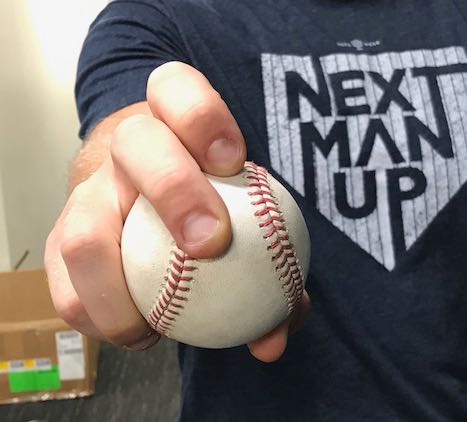
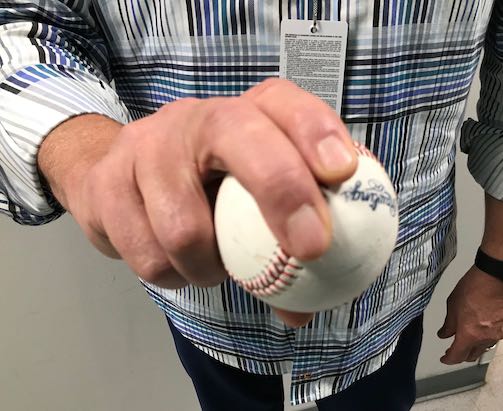
Dylan Cease, Tyler Duffey, and Buck Farmer on How They Crafted Their Curveballs

Pitchers learn and develop different pitches, and they do so at varying stages of their lives. It might be a curveball in high school, a cutter in college, or a changeup in A-ball. Sometimes the addition or refinement is a natural progression — graduating from Pitching 101 to advanced course work — and often it’s a matter of necessity. In order to get hitters out as the quality of competition improves, a pitcher needs to optimize his repertoire.

In this installment of the series, we’ll hear from three pitchers — Dylan Cease, Tyler Duffey, and Buck Farmer— on how they learned and developed their curveballs.

——

Dylan Cease, Chicago White Sox

“I first learned a curveball when I was 12 or 13 years old. I think a coach probably taught me, but it’s tough to say that far back. I do know that I didn’t throw a whole lot of curveballs back in the day; it was mostly fastballs.

“When I got to pro ball, it took me… I really didn’t know anything about how to throw one. I had to figure out how to throw it like a fastball, how to get it to stay on a fastball plane, how to throw it with arm speed. At first I wanted to baby it. It kind of had a loop in it. I needed to work on things like the shape, and how it came out of my hand.

“It was a regular curveball until last year when I got to Double-A and changed to a knuckle curve. I was talking to Dane Dunning. I liked the shape of his curveball. I said, ‘I feel like mine is a little loopy; how do you do that?’ He showed me his knuckle curve grip, which I’m pretty sure he got from James Shields — indirectly from James Shields — and throwing it like that added a bunch of extra spin and drop. Read the rest of this entry »


Sunday Notes: Luke Carlin Caught Greg Maddux and Trevor Hoffman

Luke Carlin learned a lot in his rookie season, and the lessons began in full force when he made his MLB debut on May 10, 2008. Adorned in the tools of ignorance and a San Diego Padres uniform, Carlin caught both “The Professor” and a closer who entered to the sound of “Hell’s Bells.”

An orientation session with the former preceded his first game. It was then that the Northeastern University graduate discovered that being familiar with Greg Maddux is one thing; understanding how he went about schooling big-league hitters is another.

“When I got called up, Buddy Black was like, ‘Hey, make sure you talk to Greg, because you’re going to catch him on Saturday,’” recalled Carlin. “So I had a day or two to get with Greg, but the funny thing was, everything I’d learned about game-calling and reading swings was basically useless until I started watching video with him. He had a simple, deliberate process. Greg was patient with me, making sure that I was on his page as much as possible.”

Carlin, who now manages in the Cleveland Indians system, used military and football analogies to describe Maddux’s tactical-planning acumen. And going into a game with nuanced knowledge of his opponent’s strengths and weaknesses was only part of his M.O. Read the rest of this entry »


Madison Bumgarner, Emilio Pagan, and Jacob Waguespack on Cultivating Their Cutter/Sliders

Pitchers learn and develop different pitches, and they do so at varying stages of their lives. It might be a curveball in high school, a cutter in college, or a changeup in A-ball. Sometimes the addition or refinement is a natural progression — graduating from Pitching 101 to advanced course work — and often it’s a matter of necessity. In order to get hitters out as the quality of competition improves, a pitcher needs to optimize his repertoire.

In this installment of the series, we’ll hear from three pitchers — Madison Bumgarner, Emilio Pagan, and Jacob Waguespack— on how they learned and developed their cutter/sliders.

———

Madison Bumgarner, San Francisco Giants

“I pretty much find myself saying ‘cutter-slider,’ just so there’s no confusion. I originally wanted to call it a slider, but it ended up with most people calling it a cutter. Movement-wise… in relation to my fastball it’s kind of like the speed of a cutter, but it moves a little more like a slider. Sometimes it will be a little shorter, though.

“I started throwing it 2010. I’d just got sent down from spring training and there was a guy named Horacio Ramirez, a left-hander from Mexico. He was there. He was an older guy who knew how to pitch, and he threw a cutter. I didn’t really have any off-speed pitches at that time; I basically didn’t throw anything all through the minor leagues, and then … I threw an actual slider, but it was no good at all. When I got to the big leagues in 2009 I threw it some, but it wasn’t no good. Read the rest of this entry »


Sunday Notes: Tigers First-Rounder Riley Greene Does What Comes Naturally

Hitting a baseball comes naturally to Riley Greene. That’s not to say the fifth-overall pick in this year’s draft doesn’t work on his craft — he does— but at the same time he likes to keep any tinkering to a minimum. As the saying goes, “If it ain’t broke, don’t fix it.” Prior to the Detroit Tigers’ calling his name on June 3, Greene had been labeled “the best pure hitter in the prep class” by Baseball America.

He hit the road running in pro ball. Greene scorched the Gulf Coast League to the tune of a 1.039 OPS in nine games, quickly earning a promotion to short-season Connecticut. While not nearly as prolific against New York-Penn League pitching — a .766 OPS in 24 games — he did show enough to get moved up to low-A West Michigan in early August. Playing against much-older competition in the Midwest League, Greene slashed .219/.278/.344 in 118 plate appearances.

When I talked to the 18-year-old Oviedo, Florida native in mid-August, he made it clear that his swing is already well-established.

“My dad has been doing baseball and softball lessons for 24 or 25 years, and he taught me to hit,” said Greene. “Growing up, most of my coaches never touched my swing. It was just my dad. He’s a simple A-to-B guy, not much movement, and that’s how I try to be.”

Greene told me his front foot is his timing mechanism, and that his setup at the plate has remained essentially the same. He “might be an inch taller with his body,” but that’s a matter of feel and comfort, not because of a calculated adjustment. He’ll maybe spread out at times, but “only by a centimeter or two.” Read the rest of this entry »


Cleveland’s Luke Carlin on Organizational Leadership and Collaborative Culture

The Cleveland Indians front office places a high value on organizational culture. From the lowest rungs of the minors to the big leagues, they want their managers, coaches, and players to embrace both a collaborative process and a forward-thinking mindset. For that reason, they also highly value leadership skills. Luke Carlin, a 38-year-old former big-league catcher with a Bachelor of Science degree from Northeastern University, possesses those attributes in spades.

Carlin has managed in the Cleveland system for each of the past four seasons, most recently the Lake County Captains in the Low-A Midwest League. He’s viewed by many as a future major league coach or manager, and his interpersonal skills, paired with an unquenchable thirst for knowledge — analytics-based and otherwise — is a big reasons why. In a nutshell, he exemplifies what one might dub, “The Cleveland Way.”

Carlin shared his thoughts on leadership and teaching following the conclusion of the Captains’ season.

———

Luke Carlin: “To me, managing and player development go hand in hand. I’m passionate about teaching, and it’s an awesome feeling when you have a clubhouse firing on all cylinders and pulling in the same direction. When you’re trying to earn the trust of the team, it’s not just interpersonal skills; it’s also a bunch of content-based stuff. Can you get the guys better? Can you help them develop? I think that really clicks within the information-rich environment that players today are coming up in.

“I’m finishing my master’s right now, at Northeastern, in organizational leadership. And it’s not just leadership theory, but also organizational-behavior theory and team dynamics. Piggyback that with what I’m learning here with the Indians. There are biomechanics, motor learning, teaching-and-coaching pedagogy… we’re basically trying to create a recipe to where we can interact with the people around us, and do a better job of developing high-performance than everyone else. Read the rest of this entry »


Chance Adams, Domingo German, and Nick Pivetta on Developing Their Curveballs

Pitchers learn and develop different pitches, and they do so at varying stages of their lives. It might be a curveball in high school, a cutter in college, or a changeup in A-ball. Sometimes the addition or refinement is a natural progression — graduating from Pitching 101 to advanced course work — and often it’s a matter of necessity. In order to get hitters out as the quality of competition improves, a pitcher needs to optimize his repertoire.

In this installment of the series, we’ll hear from three pitchers — Chance Adams, Domingo German, and Nick Pivetta — on how they learned and developed their curveballs.

———

Chance Adams, New York Yankees

“When I was in college my pitching coach was Wes Johnson, who is now with the Twins. He taught me my curve. For awhile it was kind of slurve-slider, then it went to a curveball, and now it’s kind of slurvy again. But it’s interesting, because when I got [to Dallas Baptist University] it was, ‘OK, I throw it like this,’ and he was like, ‘Well, have you tried spiking it?’ My curve was moving, but it wasn’t sharp, and I was like, ‘No, not really.’ Spiking it was uncomfortable at first, but after I got used to it, it was pretty interesting. It started moving better.

Chance Adam’s curveball grip.

“My pointer finger is off the seam, with just a little pressure on the ball. Wes said to try spiking it and see what feels good, so I worked on it with this much spike, that much spike. Even now, the spike kind of varies for me; I’ll move it back or forward for comfortability, but also movement-wise. Sometimes it’s sharper when it’s more spiked. It kind of depends on the day, and if I’m controlling it or not. Read the rest of this entry »


The Red Sox and Dave Dombrowski Have Parted Ways. Now What?

The Red Sox parting ways with Dave Dombrowski — last night’s announcement came at the bewitching hour — is somewhat surprising. Then again, it really isn’t. Questions about his future have been circulating for a few months, and while a death knell has yet to sound on Boston’s season, any hopes of a postseason berth are now on life support. Last October is but a memory, and as the saying goes, “What have you done for me lately?”

To say it’s been a disappointing season for the defending World Series champions would be an understatement. But that’s only part of the reason Dombrowski, the team’s president of baseball operations since August 2015, was let go. What matters is the future, and much as when Ben Cherington was jettisoned four years ago, the time had come for new leadership. For now, assistant GMs Brian O’Halloran, Eddie Romero Jr., and Zack Scott, along with Senior Vice President Raquel Ferreira, are expected to fill that role on an interim basis.

The extent to which Dombrowski and Red Sox ownership were no longer on the same page is unknown as of this moment. More may be learned when the involved parties address the media (though the team has elected not to hold a press conference regarding the decision), but even then questions will remain unanswered. In all likelihood, we’ll be left to speculate as to whether loggerheads had been reached with the important near-term personnel decisions that will shape the team’s future. Based on his track record, Dombrowski would presumably be averse to anything resembling a rebuild, while his two predecessors — Cherington and Theo Epstein — placed a high premium on player development and building from within. That divergence is reflected in Boston’s farm system rankings; the Red Sox system is currently dead last. Read the rest of this entry »


Sunday Notes: Nestor Cortes Jr. Brings Lefty Funk Out of the Yankees’ Bullpen

In terms of notoriety, Nestor Cortes Jr. barely registers a blip on the national radar. That’s not meant as a slight to the 24-year-old lefty. It’s just that when you play for a star-studded team — in baseball’s largest market, no less — it’s hard to make a name for yourself as a rookie reliever. More specifically, a soft-tossing rookie reliever who lasted until the 36th round of the 2013 draft.

He’s probably the most unique member of the 2019 New York Yankees. Born in Surgidero de Batabano, Cuba, and raised in Hialeah, Florida, Cortes has a little Luis Tiant in his windup — Oliver Perez would be a contemporary comp — and his lack of giddy-up is more of a wrinkle than a scar. He’s averaging better than a strikeout per inning with a heater that lives south of 90.

“I’m more of a deception pitcher,” said Cortes, whose 5.13 ERA is accompanied by an unblemished 5-0 record. “The cliche is that everybody throws 95 now, but what I do is try to mess up timing. The multiple windups I use, the spin rate on my fastball, hiding the ball well before I go to home plate… I try to abide by all of that. I cherish that I can use those things to my advantage.”

Those attributes are on display in The Bronx because the Orioles opted not to keep him. Cortes was a Rule 5 pick by Baltimore in December 2017, but after appearing in just four games last April he was returned to his original club. He spent the remainder of the season in Triple-A with the Scranton/Wilkes-Barre RoughRiders. Read the rest of this entry »


Larry Andersen, Durbin Feltman, and Trevor May on Crafting Their Sliders

Pitchers learn and develop different pitches, and they do so at varying stages of their lives. It might be a curveball in high school, a cutter in college, or a changeup in A-ball. Sometimes the addition or refinement is a natural progression — graduating from Pitching 101 to advanced course work — and often it’s a matter of necessity. In order to get hitters out as the quality of competition improves, a pitcher needs to optimize his repertoire.

In this installment of the series, we’ll hear from three pitchers — Larry Andersen, Durbin Feltman, and Trevor May— on how they learned and developed their sliders.

———

Larry Andersen, Philadelphia Phillies (broadcaster)

“I was a sophomore in high school, and we had a senior pitcher named Don Beckwith who had a slider. At the time, I just had a fastball and a curveball. He showed me his grip and I was like, ‘Let me try this.’ From there I implemented it into my repertoire. It was a pitch I picked up right away. It felt comfortable. It’s almost like holding a fastball off-center a little bit.

“Of course, then there was the pressure on my fingertips and how far back I held it in my hand. That type of thing. I played with those over the years to the point where I felt I had three different pitches with essentially the same grip Don Beckwith showed me in high school.

Larry Andersen’s regular slider grip.

Read the rest of this entry »