Author Archive

2019 ZiPS Projections – Kansas City Royals

After having typically appeared in the hallowed pages of Baseball Think Factory, Dan Szymborski’s ZiPS projections have now been released at FanGraphs for more than half a decade. The exercise continues this offseason. Below are the projections for the Kansas City Royals.

Batters

The Royals have an extremely bifurcated offense, with three players projected to be solidly above league-average in Adalberto Mondesi, Salvador Perez, and Whit Merrifield, and a fairly large gulf before the next tier of KC hitters. If the Royals were really going the full rebuild route, you’d see Perez and Merrifield — entering their age-29 and -30 seasons respectively — on other teams’ lists, but the Royals seem content to go the “sorta” rebuild route.

Given how thin their talent is, it’s hard to see them having much success going this route and as such, Perez and Merrifield are likely to be either in their declines or in other organizations by the time the performance matters. Winning 72 games instead of 64 in 2019 isn’t going to jumpstart anything.

I’m sure there will be some gnashed teeth about O’Hearn’s projection, given that he hit .262/.353/.597 in the majors in 170 plate appearances in 2018. He also had a .713 OPS in 406 PA in the Pacific Coast League, which is abysmal for an offensive prospect.

Pitchers

This group won’t be as bad as some people think in 2019, and it wouldn’t take a lot of breaks for the team to achieve their pointless Quest for 75 Wins, which is a little like bragging to your drinking buddies that you can deadlift 125 pounds. Danny Duffy isn’t a lost cause and Brad Keller was good enough in 2018 that it couldn’t all have been a fluke. ZiPS absolutely loves Richard Lovelady, but the rest of the bullpen is a big digital yawn. The Trevor Oaks projection isn’t exactly impressive, but I can’t remember the last time ZiPS didn’t actually hate a pitcher with as low a strikeout rate as he is projected to have.

Bench and Prospects

Troubling and not seen in full here is that ZiPS simply projects very few of the hitting prospects in the upper levels of the organization as good bets to be relevant by the time the Royals are good again. It’s essentially Adalberto Mondesi and Nicky Lopez. Khalil Lee and Emmanuel Rivera are the only two other offensive prospects on this list for whom ZiPS gives even an over/under of three WAR over their major league careers. Now, it’s not quite as bad as that considering a couple of the names I’m not yet projecting are Seuly Matias and Nick Pratto, but it’s certainly less than ideal for a team that really ought to be 2 1/2 years into a rebuild by now.

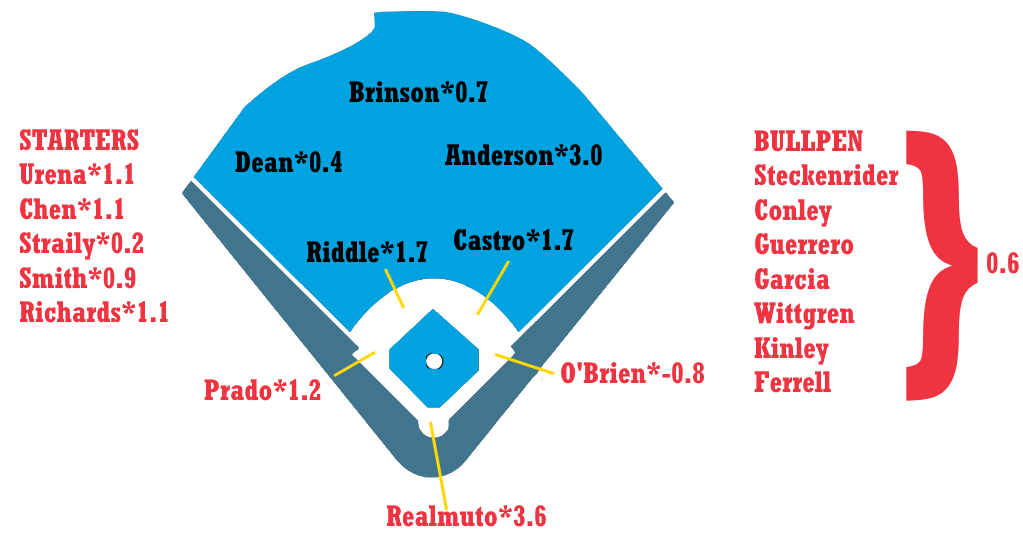
One pedantic note for 2019: for the WAR graphic, I’m using FanGraphs’ depth chart playing time, not the playing time ZiPS spits out, so there will be occasional differences in WAR totals.
Ballpark graphic courtesy Eephus League. Depth charts constructed by way of those listed here at site.

Batters – Counting Stats
Player B Age PO G AB R H 2B 3B HR RBI BB SO SB CS
Whit Merrifield R 30 2B 153 614 81 172 36 4 13 61 44 108 35 9
Adalberto Mondesi B 23 SS 118 437 62 114 22 6 18 58 20 118 39 7
Salvador Perez R 29 C 136 513 55 130 26 1 24 77 18 104 1 1
Nicky Lopez L 24 SS 127 511 60 133 15 5 6 40 43 61 12 6
Billy Hamilton R 28 CF 139 500 74 121 18 7 4 27 42 117 45 10
Alex Gordon L 35 LF 128 443 50 102 19 1 11 44 47 120 9 2
Xavier Fernandez R 23 C 88 318 34 79 17 1 6 30 18 56 3 3
Jorge Soler R 27 RF 90 307 38 76 15 0 13 37 40 107 3 1
Meibrys Viloria L 22 C 113 409 41 91 19 1 7 38 27 104 2 2
Emmanuel Rivera R 23 3B 120 466 50 120 23 5 7 49 23 92 3 6
Ryan O’Hearn L 25 1B 144 509 64 115 29 3 20 67 57 152 2 0
Jecksson Flores R 25 2B 126 460 47 110 22 3 5 37 22 92 16 6
Cheslor Cuthbert R 26 3B 109 377 41 91 18 1 11 40 30 84 1 1
Brian Goodwin L 28 CF 107 340 41 76 17 1 11 40 30 112 9 3
Cam Gallagher R 26 C 97 329 33 74 14 0 5 31 24 54 1 0
Donnie Dewees L 25 CF 132 518 54 119 22 7 7 45 30 111 15 6
Frank Schwindel R 27 1B 136 524 58 134 32 1 17 65 19 92 1 2
Jorge Bonifacio R 26 RF 110 401 51 93 19 2 12 43 38 124 1 1
Brett Phillips L 25 RF 124 439 52 88 15 6 12 46 43 186 10 3
Kelvin Gutierrez R 24 3B 118 460 48 107 16 5 7 39 28 125 12 4
Chris Owings R 27 SS 125 419 49 101 23 4 7 40 24 104 15 5
Kort Peterson L 25 RF 101 365 41 82 19 3 9 39 20 129 7 4
Nick Dini R 25 C 90 317 33 73 14 0 6 28 13 68 6 1
Bubba Starling R 26 CF 86 306 32 61 16 1 7 27 20 106 5 3
Hunter Dozier R 27 3B 135 499 58 113 29 2 15 51 41 160 4 3
Khalil Lee L 21 CF 113 426 51 90 19 4 10 43 46 164 14 13
Erick Mejia B 24 2B 134 530 57 123 22 6 5 42 35 128 22 12
Alex Liddi R 30 1B 107 406 48 89 19 3 17 53 25 146 5 2
Blake Perkins R 22 CF 131 514 63 104 21 2 5 33 64 162 20 11
Chris Owings R 27 RF 123 412 48 99 22 4 7 39 24 103 14 4
Brewer Hicklen R 23 LF 100 384 43 79 16 2 11 39 20 150 21 7
Corey Toups R 26 3B 103 374 42 76 17 2 7 31 33 140 12 3
Humberto Arteaga R 25 3B 125 465 41 108 15 2 4 32 16 88 5 6
Jack Lopez R 26 2B 110 399 38 86 11 2 7 30 15 113 11 6
Taylor Featherston R 29 2B 108 337 36 64 12 3 7 31 23 129 8 2
Ramon Torres B 26 2B 113 431 44 103 17 2 4 31 20 69 10 6
Sebastian Rivero R 20 C 76 287 27 62 12 0 5 24 11 77 0 1
Samir Duenez L 23 1B 112 429 49 98 20 2 12 50 32 113 6 1
Anderson Miller L 25 LF 115 437 43 97 18 3 8 39 27 120 9 5
MJ Melendez L 20 C 106 410 41 76 17 4 13 46 32 184 4 7
Parker Morin L 27 C 58 179 16 35 7 1 2 13 9 49 1 0
D.J. Burt R 23 2B 113 434 47 92 15 5 3 32 43 121 21 11
Terrance Gore R 28 CF 94 216 24 43 3 1 0 9 16 61 26 5
Nick Heath L 25 CF 84 303 30 59 8 2 2 18 27 112 22 9
Manny Olloque R 23 3B 92 332 32 69 14 2 6 30 15 121 4 4
Elier Hernandez R 24 RF 126 481 43 103 23 3 4 38 21 132 6 7

Batters – Rate Stats
Player BA OBP SLG OPS+ ISO BABIP RC/27 Def WAR No. 1 Comp
Whit Merrifield .280 .331 .415 105 .135 .323 5.5 6 3.4 Gene Alley
Adalberto Mondesi .261 .295 .462 105 .201 .319 5.6 2 2.7 Cristian Guzman
Salvador Perez .253 .289 .448 100 .195 .275 4.7 6 2.6 Ramon Hernandez
Nicky Lopez .260 .321 .344 85 .084 .286 4.0 4 1.5 Jeff Huson
Billy Hamilton .242 .300 .330 75 .088 .309 4.1 9 1.4 Freddy Guzman
Alex Gordon .230 .317 .352 85 .122 .292 4.0 10 1.1 Derek Bell
Xavier Fernandez .248 .291 .365 80 .116 .285 3.7 2 0.6 Richard Suomi
Jorge Soler .248 .340 .423 110 .176 .337 5.2 -5 0.6 Jeremy Giambi
Meibrys Viloria .222 .277 .325 66 .103 .282 3.1 6 0.5 John Mizerock
Emmanuel Rivera .258 .296 .373 84 .116 .308 3.8 2 0.5 Greg LaRocca
Ryan O’Hearn .226 .307 .413 97 .187 .282 4.5 -2 0.4 Eric Valent
Jecksson Flores .239 .279 .333 68 .093 .289 3.4 7 0.4 Kenny Perez
Cheslor Cuthbert .241 .299 .382 87 .141 .284 4.0 -3 0.3 Bobby Holley
Brian Goodwin .224 .288 .376 82 .153 .300 3.9 -1 0.3 Orsino Hill
Cam Gallagher .225 .279 .313 64 .088 .256 3.1 4 0.3 Drew Butera
Donnie Dewees .230 .276 .340 69 .110 .280 3.3 5 0.2 Joe Mathis
Frank Schwindel .256 .286 .418 91 .162 .282 4.3 1 0.1 Leo Hernandez
Jorge Bonifacio .232 .302 .379 87 .147 .306 4.0 0 0.1 Bill McCarthy
Brett Phillips .200 .275 .344 70 .144 .315 3.3 10 0.1 Brad Snyder
Kelvin Gutierrez .233 .279 .335 69 .102 .305 3.4 4 0.0 Edwin Rodriguez
Chris Owings .241 .283 .365 78 .124 .305 3.8 -5 -0.1 Thomas Manzella
Kort Peterson .225 .285 .367 79 .142 .322 3.6 3 -0.1 Brian Brady
Nick Dini .230 .274 .331 67 .101 .276 3.3 -2 -0.1 Omir Santos
Bubba Starling .199 .255 .327 59 .127 .280 2.8 4 -0.2 John Giudice
Hunter Dozier .226 .285 .383 83 .156 .302 3.8 -7 -0.2 Rey Palacios
Khalil Lee .211 .298 .345 78 .134 .317 3.2 -4 -0.3 Mel Hall
Erick Mejia .232 .281 .325 67 .092 .297 3.2 2 -0.4 Ramon Caraballo
Alex Liddi .219 .267 .406 82 .187 .296 3.8 0 -0.4 John Cotton
Blake Perkins .202 .294 .280 60 .078 .285 2.7 3 -0.6 Tony Miller
Chris Owings .240 .283 .364 78 .124 .305 3.8 -1 -0.6 Drew Anderson
Brewer Hicklen .206 .261 .344 66 .138 .305 3.2 3 -0.6 Wilkin Ramirez
Corey Toups .203 .275 .316 63 .112 .304 3.1 -2 -0.6 Sean Berry
Humberto Arteaga .232 .259 .299 54 .067 .279 2.6 9 -0.6 Jim Scranton
Jack Lopez .216 .250 .306 53 .090 .283 2.6 5 -0.7 Wade Robinson
Taylor Featherston .190 .251 .306 53 .116 .284 2.7 2 -0.7 Chris Petersen
Ramon Torres .239 .273 .316 63 .077 .277 3.0 1 -0.7 Dave Myers
Sebastian Rivero .216 .245 .310 52 .094 .278 2.5 -1 -0.7 Kurt Brown
Samir Duenez .228 .281 .368 78 .140 .283 3.7 -1 -0.8 Alex Hernandez
Anderson Miller .222 .269 .332 65 .110 .288 3.1 4 -0.9 Jonathan Johnson
MJ Melendez .185 .249 .341 61 .156 .296 2.6 -3 -0.9 Brandon Yarbrough
Parker Morin .196 .240 .279 43 .084 .258 2.3 -3 -1.0 Dave Ullery
D.J. Burt .212 .284 .290 60 .078 .287 2.8 -2 -1.1 Adam Davis
Terrance Gore .199 .264 .222 37 .023 .277 2.7 -4 -1.1 Craig Griffey
Nick Heath .195 .261 .254 44 .059 .302 2.4 0 -1.2 Jeff Conger
Manny Olloque .208 .245 .316 54 .108 .307 2.5 -2 -1.3 Mario Ramirez
Elier Hernandez .214 .254 .299 53 .085 .287 2.4 2 -2.1 Rick Bernardo

Pitchers – Counting Stats
Player T Age W L ERA G GS IP H ER HR BB SO
Jake Junis R 26 10 10 4.37 29 28 164.7 172 80 26 38 143
Brad Keller R 23 9 9 4.20 43 24 156.3 168 73 15 46 97
Danny Duffy L 30 10 9 4.37 26 26 148.3 151 72 19 51 129
Trevor Oaks R 26 9 9 4.41 25 24 136.7 158 67 13 38 72
Ben Lively R 27 7 8 4.35 25 21 120.0 128 58 14 38 88
Richard Lovelady L 23 4 3 3.52 54 0 71.7 68 28 4 26 59
Jesse Hahn R 29 5 5 4.52 18 17 87.7 92 44 8 38 60
Glenn Sparkman R 27 6 7 4.79 29 19 118.3 139 63 17 27 70
Sam McWilliams R 23 6 8 4.74 23 20 108.3 123 57 12 42 71
Arnaldo Hernandez R 23 7 8 4.95 26 22 120.0 137 66 16 41 69
Nate Karns R 31 3 3 4.57 14 12 69.0 69 35 10 29 65
Jonathan Dziedzic L 28 7 8 4.98 22 22 115.7 132 64 14 44 66
Jason Hammel R 36 7 9 4.83 30 20 123.0 140 66 18 35 91
Heath Fillmyer R 25 6 8 5.09 28 26 138.0 152 78 18 58 85
Brian Flynn L 29 4 4 4.19 42 1 68.7 72 32 6 27 44
Pedro Fernandez R 25 4 4 4.52 33 4 65.7 70 33 6 29 41
Ian Kennedy R 34 7 9 4.99 24 24 128.0 132 71 24 44 106
Jake Kalish L 27 4 5 4.93 30 11 95.0 108 52 12 31 57
Gabe Speier L 24 1 1 4.39 45 1 65.7 71 32 4 28 37
Jake Newberry R 24 4 4 4.33 56 0 62.3 63 30 6 29 46
Tim Hill L 29 2 2 4.33 57 0 54.0 55 26 6 21 45
Wily Peralta R 30 4 5 4.82 40 11 89.7 96 48 11 44 75
Jason Adam R 27 3 3 4.35 46 0 51.7 47 25 7 27 56
Kevin McCarthy R 27 4 5 4.56 64 0 73.0 81 37 9 24 44
Foster Griffin L 23 9 12 5.31 27 26 142.3 168 84 22 52 84
Eric Skoglund L 26 4 6 5.24 21 20 99.7 114 58 17 30 68
Josh Staumont R 25 5 7 5.18 35 14 92.0 84 53 9 80 97
Kyle Zimmer R 27 1 1 4.94 11 4 31.0 32 17 4 16 27
Kevin Lenik R 27 1 1 4.66 31 0 46.3 47 24 4 26 36
Sam Selman L 28 3 3 4.73 37 0 45.7 40 24 4 38 49
Jorge Lopez R 26 6 8 5.11 37 13 98.7 107 56 14 42 77
Scott Barlow R 25 5 8 5.31 25 25 120.3 124 71 20 68 118
Seth Maness R 30 2 2 4.64 33 0 42.7 51 22 6 8 23
Enny Romero L 28 2 3 4.91 44 0 44.0 45 24 6 22 41
Conner Greene R 24 5 6 5.40 36 15 95.0 100 57 6 80 61
Zach Lovvorn R 25 6 9 5.50 27 22 126.0 153 77 17 50 62
Walker Sheller R 24 3 4 5.01 40 0 55.7 63 31 6 25 30
Scott Blewett R 23 6 8 5.55 25 25 136.3 161 84 19 58 73
Michael Ynoa R 27 1 1 5.13 27 0 33.3 34 19 3 22 25
Grant Gavin R 23 1 2 5.05 36 0 51.7 52 29 6 32 46
Yunior Marte R 24 4 4 5.01 42 0 73.7 75 41 8 44 58
Brandon Maurer R 28 4 4 4.91 60 0 58.7 62 32 7 28 49
Blaine Boyer R 37 2 2 5.18 35 0 41.7 47 24 5 18 27
Chris Ellis R 26 4 7 5.62 20 15 81.7 92 51 14 41 64
Burch Smith R 29 3 4 5.58 32 7 69.3 74 43 11 38 60
Kyle Lohse R 40 5 9 5.62 23 18 112.0 132 70 21 35 67
Andres Machado R 26 4 6 5.82 33 13 85.0 100 55 14 40 56
Ofreidy Gomez R 23 6 10 5.82 27 21 123.7 148 80 18 65 67
Gerson Garabito R 23 5 8 6.12 24 24 114.7 131 78 19 72 70

Pitchers – Rate Stats
Player TBF K/9 BB/9 HR/9 BABIP ERA+ ERA- FIP WAR No. 1 Comp
Jake Junis 704 7.82 2.08 1.42 .301 98 102 4.38 2.0 Ed Lynch
Brad Keller 675 5.58 2.65 0.86 .299 99 101 4.14 1.9 Lindy McDaniel
Danny Duffy 642 7.83 3.09 1.15 .302 98 102 4.23 1.8 Kent Mercker
Trevor Oaks 602 4.74 2.50 0.86 .307 94 106 4.32 1.4 Jack Russell
Ben Lively 524 6.60 2.85 1.05 .302 96 104 4.33 1.3 Howie Fox
Richard Lovelady 308 7.41 3.27 0.50 .298 122 82 3.48 1.1 Pat Clements
Jesse Hahn 390 6.16 3.90 0.82 .300 95 105 4.40 0.9 Don Schwall
Glenn Sparkman 517 5.32 2.05 1.29 .307 90 111 4.67 0.9 John Doherty
Sam McWilliams 488 5.90 3.49 1.00 .312 88 114 4.64 0.8 Mark Cahill
Arnaldo Hernandez 535 5.18 3.08 1.20 .301 87 115 4.93 0.7 Michael Macdonald
Nate Karns 302 8.48 3.78 1.30 .301 94 106 4.50 0.7 Ryan Glynn
Jonathan Dziedzic 519 5.14 3.42 1.09 .303 86 116 4.88 0.7 Jimmy Anderson
Jason Hammel 540 6.66 2.56 1.32 .312 86 116 4.55 0.6 Mickey Weston
Heath Fillmyer 620 5.54 3.78 1.17 .296 85 118 5.03 0.6 Steve Falteisek
Brian Flynn 302 5.77 3.54 0.79 .297 103 97 4.32 0.6 Tom Burgmeier
Pedro Fernandez 295 5.62 3.97 0.82 .298 95 105 4.60 0.5 Jim McDonald
Ian Kennedy 556 7.45 3.09 1.69 .286 83 120 5.08 0.5 Dennis Springer
Jake Kalish 422 5.40 2.94 1.14 .304 87 115 4.76 0.5 Pat Clements
Gabe Speier 295 5.07 3.84 0.55 .302 98 102 4.28 0.4 Mike Cosgrove
Jake Newberry 277 6.64 4.19 0.87 .295 99 101 4.47 0.4 Hal Reniff
Tim Hill 237 7.50 3.50 1.00 .302 99 101 4.26 0.4 Todd Rizzo
Wily Peralta 405 7.53 4.42 1.10 .313 86 116 4.64 0.3 Blue Moon Odom
Jason Adam 230 9.75 4.70 1.22 .294 99 101 4.54 0.3 Bryce Florie
Kevin McCarthy 321 5.42 2.96 1.11 .299 94 106 4.66 0.3 Lew Burdette
Foster Griffin 643 5.31 3.29 1.39 .306 81 123 5.24 0.3 Jason Dickson
Eric Skoglund 441 6.14 2.71 1.54 .303 82 122 5.09 0.3 Eric Knott
Josh Staumont 440 9.49 7.83 0.88 .302 83 121 5.12 0.2 Chad Reineke
Kyle Zimmer 141 7.84 4.65 1.16 .304 87 115 4.83 0.1 Lou Kretlow
Kevin Lenik 211 6.99 5.05 0.78 .303 92 108 4.60 0.1 Ken Wright
Sam Selman 215 9.66 7.49 0.79 .298 91 110 4.84 0.1 Mike Kinnunen
Jorge Lopez 443 7.02 3.83 1.28 .305 82 123 4.86 0.1 Tim Crabtree
Scott Barlow 552 8.83 5.09 1.50 .307 79 127 5.22 0.1 Elvin Nina
Seth Maness 184 4.85 1.69 1.27 .308 90 111 4.53 0.1 Tony Arnold
Enny Romero 197 8.39 4.50 1.23 .307 88 114 4.63 0.0 Joey Long
Conner Greene 463 5.78 7.58 0.57 .303 80 126 5.40 0.0 Walt Masterson
Zach Lovvorn 577 4.43 3.57 1.21 .308 78 128 5.28 0.0 Mark Cahill
Walker Sheller 253 4.85 4.04 0.97 .302 86 117 4.98 -0.1 Bob Miller
Scott Blewett 625 4.82 3.83 1.25 .304 78 129 5.34 -0.1 Frank Castillo
Michael Ynoa 157 6.75 5.94 0.81 .301 84 119 5.16 -0.1 Ken Wright
Grant Gavin 238 8.01 5.57 1.05 .305 85 117 4.91 -0.1 Pete Sikaras
Yunior Marte 338 7.09 5.38 0.98 .299 86 116 4.94 -0.1 Joe Hudson
Brandon Maurer 264 7.52 4.30 1.07 .309 85 118 4.56 -0.1 Jose Segura
Blaine Boyer 188 5.83 3.89 1.08 .307 83 121 4.78 -0.1 Bob Scanlan
Chris Ellis 379 7.05 4.52 1.54 .308 76 132 5.57 -0.1 Mark Woodyard
Burch Smith 318 7.79 4.93 1.43 .306 75 134 5.26 -0.3 Marty McLeary
Kyle Lohse 498 5.38 2.81 1.69 .299 74 135 5.44 -0.4 Ed Riley
Andres Machado 393 5.93 4.24 1.48 .309 74 135 5.56 -0.4 Mark Woodyard
Ofreidy Gomez 582 4.88 4.73 1.31 .307 74 135 5.73 -0.5 Clint Sodowsky
Gerson Garabito 545 5.49 5.65 1.49 .297 70 142 6.15 -0.8 Jake Robbins

Disclaimer: ZiPS projections are computer-based projections of performance. Performances have not been allocated to predicted playing time in the majors — many of the players listed above are unlikely to play in the majors at all in 2019. ZiPS is projecting equivalent production — a .240 ZiPS projection may end up being .280 in AAA or .300 in AA, for example. Whether or not a player will play is one of many non-statistical factors one has to take into account when predicting the future.

Players are listed with their most recent teams, unless I have made a mistake. This is very possible, as a lot of minor-league signings go generally unreported in the offseason.

ZiPS’ projections are based on the American League having a 4.29 ERA and the National League having a 4.15 ERA.

Players who are expected to be out due to injury are still projected. More information is always better than less information, and a computer isn’t the tool that should project the injury status of, for example, a pitcher who has had Tommy John surgery.

Both hitters and pitchers are ranked by projected zWAR — which is to say, WAR values as calculated by me, Dan Szymborski, whose surname is spelled with a z. WAR values might differ slightly from those which appear in full release of ZiPS. Finally, I will advise anyone against — and might karate chop anyone guilty of — merely adding up WAR totals on a depth chart to produce projected team WAR.


2019 ZiPS Projections – Texas Rangers

After having typically appeared in the hallowed pages of Baseball Think Factory, Dan Szymborski’s ZiPS projections have now been released at FanGraphs for more than half a decade. The exercise continues this offseason. Below are the projections for the Texas Rangers.

Batters

Perhaps the biggest disappointment in last year’s projections (and in 2018, really) was the several steps taken backward by Willie Calhoun. Originally, it was believed he would only be in the minors temporarily to beat up minor league pitchers while some service time shenanigans resolved themselves. Problem was, Calhoun never really earned a callup, struggling to hit Triple-A pitchers and only besting an .800 OPS in a single month of the season, a July that was driven by a .364 batting average. The Rangers brought him up when there was obvious playing time for him, but hitting .222/.269/.333 in 108 plate appearances was hardly a strong push for a full-time job. Even ignoring the cameo role in the majors, Calhoun’s power was mostly gone in the minors, which is not good. To be a decent starting left fielder in the majors, you have to be a batting average/on-base percentage deity or be a legitimate all-world talent on defense. Calhoun is neither. I wouldn’t write him off yet, but I’m very worried.

I’m a little surprised that Texas either couldn’t or wouldn’t close a deal with another team for Shin-Soo Choo, a player whose presence required a losing Rangers team to carry a significant salary after Choo turned in a solid little year and had some trade value. Choo is quickly approaching age 40, and until Nomar Mazara actually turns his impressive raw power into actual counting numbers, Joey Gallo is the only really dependable Rangers hitter. Gallo is what he is, and will likely always have an abysmal batting average. He’s fortunate to not have been born 30 years earlier.

One projection that intrigues me is Christian Lopes’, who was a third-tier prospect for the Blue Jays a very long time ago with a fairly mature approach at the plate coming out of high school. It never really manifested itself in the stats, however, and the knock was that he didn’t have a standout tool otherwise. But he’s made great strides the last couple years and has gotten to the point where he may be a pretty interesting role player, with Texas using him at a lot of positions in the minors.

Pitchers

You can see the skinny rebuild in progress in the Rangers’ rotation. You have a number of OK-ish starters (excluding Yohander Mendez, who ZiPS hates with the fire of a thousand suns), probably none of whom will be part of the next good Rangers team. Drew Smyly, Edinson Volquez, and Shelby Miller are essentially reclamation projects, and at three years and $30 million, Lance Lynn may be the last of the quintet “out” of Texas (Mike Minor is there, too), but if the recovery in his peripherals in 2018 isn’t a fluke, Texas may get a real prospect for him.

ZiPS is a believer in Jose Leclerc at the front of the bullpen, and sees the rest of the group as a fairly boring but quite adequate relief corps, which is fine with the Rangers not seriously contending yet.

Bench and Prospects

One of the most interesting Rangers projections is that of Brock Burke, a former Rays third-rounder who the Rays brought around very slowly out of high school. 2018 was the year in which everything clicked, with Burke seeing a 30% bump in his strikeout rate while also being promoted, striking out almost 12 batters a game for Montgomery. ZiPS doesn’t give him a huge ceiling, but is surprisingly confident in Burke being a mid-rotation starter despite only him only having limited playing time in Double-A.

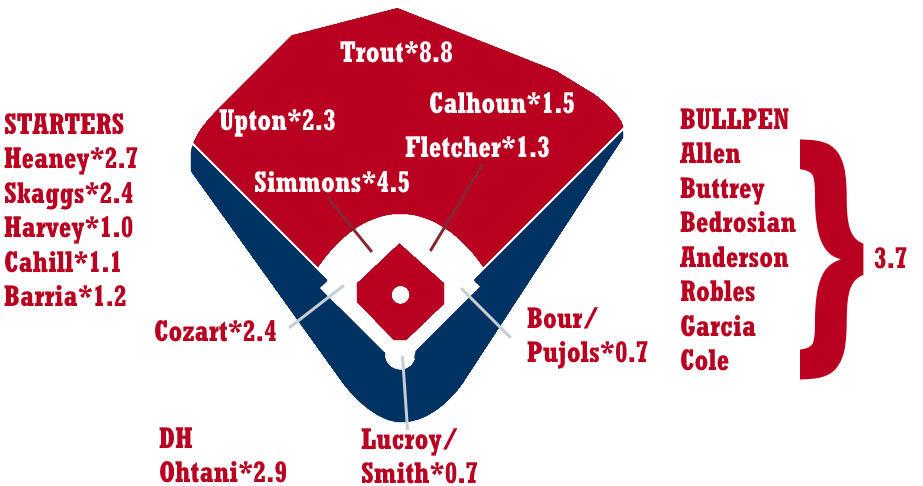
One pedantic note for 2019: for the WAR graphic, I’m using FanGraphs’ depth chart playing time, not the playing time ZiPS spits out, so there will be occasional differences in WAR totals.

Ballpark graphic courtesy Eephus League. Depth charts constructed by way of those listed here at site.

Batters – Counting Stats
Player B Age PO G AB R H 2B 3B HR RBI BB SO SB CS
Joey Gallo L 25 LF 142 436 85 93 19 3 40 84 78 202 7 2
Adrian Beltre R 40 3B 101 369 40 98 18 1 12 55 30 76 1 0
Elvis Andrus R 30 SS 132 511 69 139 29 4 10 54 37 81 13 7
Rougned Odor L 25 2B 148 551 82 137 28 4 24 77 38 141 13 10
Shin-Soo Choo L 36 DH 123 464 71 116 21 1 17 55 68 129 6 2
Nomar Mazara L 24 RF 144 536 65 140 25 3 23 88 46 129 1 1
Christian Lopes R 26 2B 120 434 55 111 23 2 9 45 46 85 12 5
Patrick Wisdom R 27 3B 125 418 56 96 21 2 16 60 37 145 8 3
Nolan Fontana L 28 SS 92 299 40 62 15 2 6 29 50 99 6 3
Tommy Joseph R 27 1B 117 411 52 107 23 0 21 69 26 99 0 0
Willie Calhoun L 24 LF 145 545 71 146 31 2 22 74 37 81 3 1
Ronald Guzman L 24 1B 131 454 56 112 20 3 15 58 39 127 2 1
Danny Santana B 28 CF 103 324 43 79 18 4 10 40 15 89 12 6
Chase d’Arnaud R 32 2B 106 340 44 82 15 3 9 39 29 90 13 4
Delino DeShields R 26 CF 118 380 66 90 16 3 4 26 48 104 25 7
Andy Ibanez R 26 3B 122 466 53 116 22 2 11 46 32 82 4 5
Carlos Perez R 28 C 76 250 27 58 14 1 7 32 17 52 2 1
Jett Bandy R 29 C 82 263 30 58 14 0 9 32 14 61 2 0
Isiah Kiner-Falefa R 24 C 122 441 50 111 20 2 4 35 34 81 9 6
Anderson Tejeda L 21 SS 125 476 59 109 19 4 15 54 36 171 8 6
Jack Reinheimer R 26 SS 114 417 49 98 16 2 5 34 35 104 14 6
Hunter Cole R 26 RF 107 404 47 96 19 3 13 48 31 128 2 3
Ryan Rua R 29 LF 89 247 32 54 9 1 9 26 17 88 6 1
Leody Taveras B 20 CF 138 551 61 132 18 6 8 43 41 121 15 12
Jeff Mathis R 36 C 56 166 13 32 7 1 2 15 14 58 0 0
Tony Sanchez R 31 C 67 233 27 54 11 1 5 25 20 64 1 1
Josh Morgan R 23 C 95 363 39 87 16 2 4 29 23 64 2 1
Jose Trevino R 26 C 89 347 35 76 13 1 6 31 14 58 1 2
Charles Leblanc R 23 2B 126 464 52 110 21 3 9 45 38 121 5 3
Carlos Tocci R 23 CF 130 382 40 98 14 6 1 28 23 93 4 7
Nick Noonan L 30 SS 89 304 30 69 14 1 4 28 16 80 2 2
Jose Cardona R 25 CF 111 425 47 101 15 1 8 35 26 82 11 9
Cliff Pennington B 35 SS 91 234 24 48 8 1 2 16 25 67 2 1
Scott Heineman R 26 RF 118 479 59 118 22 3 11 46 34 128 12 8
Michael De Leon R 22 SS 140 515 46 124 21 1 4 37 18 80 2 2
Destin Hood R 29 RF 108 384 44 86 18 2 14 48 24 130 5 3
Yonny Hernandez B 21 SS 116 390 46 86 13 2 2 26 48 95 31 16
Eliezer Alvarez B 24 LF 108 408 50 92 20 4 9 41 34 141 20 5
Eli White R 25 2B 122 484 55 113 24 4 6 40 40 146 10 6
Yanio Perez R 23 1B 96 365 39 84 12 1 8 32 25 105 2 1
Michael O’Neill R 27 CF 122 439 46 92 19 2 10 39 29 157 18 6
Preston Beck L 28 1B 109 404 43 92 17 3 7 37 29 104 2 3
Correlle Prime R 25 1B 86 292 27 56 11 1 6 23 17 129 3 4

Batters – Rate Stats
Player BA OBP SLG OPS+ ISO BABIP RC/27 Def WAR No. 1 Comp
Joey Gallo .213 .343 .546 127 .333 .273 6.5 -7 2.2 Adam Dunn
Adrian Beltre .266 .324 .417 92 .152 .306 5.0 6 1.5 Mike Lowell
Elvis Andrus .272 .322 .403 88 .131 .307 4.8 -2 1.2 Marco Scutaro
Rougned Odor .249 .307 .445 93 .196 .293 4.8 -2 1.2 Steve Buechele
Shin-Soo Choo .250 .355 .409 100 .159 .311 5.3 0 1.1 Bill White
Nomar Mazara .261 .323 .448 99 .187 .305 5.3 -1 1.0 Adam Lind
Christian Lopes .256 .330 .380 86 .124 .300 4.6 -1 0.8 Tim Dulin
Patrick Wisdom .230 .297 .404 81 .175 .311 4.3 3 0.8 Jim Chamblee
Nolan Fontana .207 .322 .331 72 .124 .289 3.6 1 0.5 Lauro Felix
Tommy Joseph .260 .309 .470 100 .209 .296 5.3 -3 0.4 Nate Gold
Willie Calhoun .268 .317 .453 99 .185 .281 5.3 -7 0.4 Mike Greenwell
Ronald Guzman .247 .314 .403 86 .156 .311 4.5 4 0.4 Juan Tejeda
Danny Santana .244 .279 .417 79 .173 .307 4.1 1 0.3 Randy Kutcher
Chase d’Arnaud .241 .306 .382 79 .141 .303 4.3 -2 0.2 Royce Clayton
Delino DeShields .237 .325 .326 72 .089 .316 4.1 -1 0.2 Deron McCue
Andy Ibanez .249 .300 .376 75 .127 .282 3.9 1 0.2 Pete Rose Jr.
Carlos Perez .232 .281 .380 71 .148 .267 3.8 0 0.2 Jim Horner
Jett Bandy .221 .283 .376 71 .156 .254 3.8 -1 0.1 Scott Servais
Isiah Kiner-Falefa .252 .315 .333 71 .082 .301 3.7 -4 0.0 Rafael Pujols
Anderson Tejeda .229 .284 .380 72 .151 .324 3.7 -2 0.0 Bert Pena
Jack Reinheimer .235 .296 .319 62 .084 .302 3.4 2 -0.1 Drew Meyer
Hunter Cole .238 .293 .396 78 .158 .316 4.0 3 -0.1 Mike Diaz
Ryan Rua .219 .276 .372 68 .154 .300 3.7 3 -0.1 Cory Aldridge
Leody Taveras .240 .292 .338 64 .098 .294 3.3 6 -0.2 Julio Peguero
Jeff Mathis .193 .258 .283 42 .090 .283 2.4 4 -0.2 Frank Charles
Tony Sanchez .232 .298 .352 70 .120 .299 3.6 -4 -0.3 Mike DiFelice
Josh Morgan .240 .291 .328 62 .088 .281 3.4 -2 -0.3 Chad Strickland
Jose Trevino .219 .250 .314 47 .095 .247 2.6 6 -0.4 Rogelio Arias
Charles Leblanc .237 .295 .353 69 .116 .302 3.7 -2 -0.4 Brad Harman
Carlos Tocci .257 .306 .332 68 .076 .337 3.4 0 -0.4 Darren Lewis
Nick Noonan .227 .266 .319 53 .092 .295 2.9 1 -0.6 Kevin Baez
Jose Cardona .238 .285 .334 62 .096 .278 3.2 1 -0.6 Joey Aragon
Cliff Pennington .205 .281 .274 47 .068 .279 2.6 0 -0.6 Rabbit Warstler
Scott Heineman .246 .305 .374 77 .127 .315 4.0 -2 -0.6 Mike Berger
Michael De Leon .241 .268 .309 51 .068 .278 2.9 6 -0.7 Mario Diaz
Destin Hood .224 .271 .391 70 .167 .300 3.6 0 -0.7 Scott Wade
Yonny Hernandez .221 .312 .279 57 .059 .287 3.0 -4 -0.8 Nick Punto
Eliezer Alvarez .225 .290 .360 69 .135 .322 3.9 -3 -0.8 Thomas Howard
Eli White .233 .298 .337 66 .103 .322 3.5 -5 -0.9 Caonabo Cosme
Yanio Perez .230 .286 .334 62 .104 .302 3.4 0 -1.2 Jason Restko
Michael O’Neill .210 .266 .330 55 .121 .301 3.1 -7 -1.6 Jamie Sykes
Preston Beck .228 .283 .337 62 .109 .290 3.2 -3 -1.7 Greg Creek
Correlle Prime .192 .240 .298 40 .106 .318 2.2 2 -1.7 Eli Tintor

Pitchers – Counting Stats
Player T Age W L ERA G GS IP H ER HR BB SO
Lance Lynn R 32 10 9 4.50 28 27 146.0 154 73 19 65 126
Mike Minor L 31 9 8 4.49 24 24 132.3 133 66 20 37 108
Jose Leclerc R 25 4 2 3.13 61 0 63.3 45 22 3 39 85
Brock Burke L 22 8 7 4.77 25 23 128.3 143 68 16 54 99
Martin Perez L 28 8 7 4.76 26 22 128.7 146 68 14 46 77
Drew Smyly L 30 6 5 4.73 20 20 99.0 105 52 19 32 97
Jesse Chavez R 35 4 2 3.99 57 0 76.7 76 34 11 20 71
Brett Martin L 24 6 6 4.92 26 15 89.7 99 49 10 39 66
Yovani Gallardo R 33 8 8 5.22 26 24 122.3 139 71 16 54 77
Adrian Sampson R 27 7 7 5.12 32 21 128.3 155 73 21 26 74
Shelby Miller R 28 6 6 5.08 17 16 83.3 92 47 13 31 70
Chris Martin R 33 3 2 3.74 44 0 43.3 46 18 4 11 35
Tony Barnette R 35 2 1 3.59 38 0 42.7 41 17 3 13 39
Phillips Valdez R 27 6 6 5.08 29 18 111.7 129 63 14 47 73
Matt Bush R 33 3 2 3.83 44 0 44.7 42 19 5 18 43
Doug Fister R 35 6 6 5.00 17 15 86.3 98 48 13 29 56
Clayton Blackburn R 26 5 5 5.03 18 16 87.7 103 49 13 26 58
Kyle Bird L 26 3 3 4.72 45 4 68.7 72 36 8 35 57
Jeffrey Springs L 26 5 5 4.98 44 6 86.7 87 48 15 42 92
Deolis Guerra R 30 3 2 4.31 42 2 54.3 55 26 8 16 50
Jeanmar Gomez R 31 4 3 4.32 54 0 58.3 64 28 6 20 42
Ariel Jurado R 23 8 10 5.57 28 25 145.3 183 90 23 38 65
Edinson Volquez R 35 4 4 5.14 12 12 63.0 70 36 8 32 44
Luke Farrell R 28 6 6 5.34 29 16 91.0 99 54 16 46 81
Nick Gardewine R 25 2 2 4.08 30 0 35.3 34 16 3 15 33
Taylor Hearn L 24 5 6 5.37 23 23 107.3 113 64 18 57 98
Drew Hutchison R 28 6 7 5.52 26 19 109.3 124 67 19 47 85
Joe Palumbo L 24 3 3 5.14 12 11 49.0 54 28 8 20 36
Jonathan Hernandez R 22 7 8 5.57 22 22 103.3 113 64 15 62 83
Michael Tonkin R 29 2 2 4.62 43 0 50.7 52 26 8 20 52
Ricardo Rodriguez R 26 3 3 4.87 45 2 57.3 62 31 8 20 46
Ronald Herrera R 24 5 6 5.42 17 17 91.3 110 55 13 36 46
Connor Sadzeck R 27 3 3 4.74 57 0 49.3 48 26 5 31 47
Tim Dillard R 35 3 3 4.78 25 2 43.3 47 23 5 21 29
Jordan Romano R 26 4 6 5.38 14 14 68.0 71 41 11 32 52
Wei-Chieh Huang R 25 4 5 5.14 38 2 70.0 71 40 11 38 68
Eddie Butler R 28 5 6 5.49 30 14 95.0 114 58 14 38 52
Miguel Del Pozo L 26 3 3 4.97 34 0 41.7 45 23 4 22 32
C.D. Pelham L 24 2 2 5.17 54 0 55.7 57 32 5 39 45
Chris Rowley R 28 7 9 5.85 26 20 120.0 143 78 22 50 72
Wes Benjamin L 25 5 7 6.00 20 19 87.0 106 58 18 34 58
Richelson Pena R 25 6 8 5.96 23 18 108.7 135 72 24 30 65
Jack Leathersich L 28 1 2 5.34 38 0 32.0 28 19 3 31 37
Adam Parks R 26 3 3 5.48 34 0 46.0 51 28 9 19 39
Zac Curtis L 26 3 3 5.28 56 0 59.7 59 35 9 40 60
Tim Lincecum R 35 1 2 5.55 24 0 24.3 27 15 4 15 19
Adam Loewen L 35 3 3 5.40 42 0 45.0 41 27 5 40 47
Kevin Jepsen R 34 2 2 5.81 36 0 31.0 33 20 6 16 23
Chris Tillman R 31 6 8 6.12 22 21 100.0 118 68 17 50 59
Brandon Mann L 35 3 4 5.80 36 3 54.3 59 35 9 32 41
Austin Bibens-Dirkx R 34 5 6 6.16 25 16 99.3 120 68 23 34 69
Ariel Hernandez R 27 3 4 5.74 47 0 53.3 51 34 5 56 50
Rafael Montero R 28 5 7 6.04 26 17 98.3 117 66 18 55 79
Locke St. John L 26 4 5 5.93 37 0 54.7 60 36 12 28 49
Collin Wiles R 25 6 8 6.31 21 20 107.0 135 75 26 28 65
Yohander Mendez L 24 6 9 6.63 30 26 130.3 158 96 33 55 92
Yoel Espinal R 26 3 5 7.29 42 2 54.3 59 44 12 55 52

Pitchers – Rate Stats
Player TBF K/9 BB/9 HR/9 BABIP ERA+ ERA- FIP WAR No. 1 Comp
Lance Lynn 652 7.77 4.01 1.17 .310 100 100 4.57 1.8 Bill Singer
Mike Minor 561 7.35 2.52 1.36 .288 100 100 4.41 1.7 Jarrod Washburn
Jose Leclerc 273 12.08 5.54 0.43 .294 148 67 3.07 1.6 Jose Valverde
Brock Burke 580 6.94 3.79 1.12 .315 97 103 4.68 1.5 Jake Chapman
Martin Perez 570 5.39 3.22 0.98 .307 98 103 4.51 1.5 Jim O’Toole
Drew Smyly 429 8.82 2.91 1.73 .308 98 102 4.72 1.2 Cliff Lee
Jesse Chavez 322 8.33 2.35 1.29 .297 116 86 3.98 1.0 Terry Leach
Brett Martin 405 6.62 3.91 1.00 .312 94 106 4.60 0.9 Josh Shortslef
Yovani Gallardo 552 5.66 3.97 1.18 .305 89 113 4.96 0.9 Spec Shea
Adrian Sampson 562 5.19 1.82 1.47 .309 88 114 4.90 0.8 John Doherty
Shelby Miller 369 7.56 3.35 1.40 .312 91 109 4.69 0.7 Jay Tibbs
Chris Martin 186 7.27 2.28 0.83 .313 124 81 3.63 0.7 Bobby Tiefenauer
Tony Barnette 181 8.23 2.74 0.63 .306 129 77 3.29 0.7 Barney Schultz
Phillips Valdez 509 5.88 3.79 1.13 .313 89 113 4.92 0.7 Bill Swift
Matt Bush 193 8.66 3.63 1.01 .296 121 83 4.02 0.7 Jim Hughes
Doug Fister 384 5.84 3.02 1.36 .302 90 111 4.99 0.6 Freddie Fitzsimmons
Clayton Blackburn 389 5.95 2.67 1.33 .313 89 112 4.78 0.6 Lary Sorensen
Kyle Bird 312 7.47 4.59 1.05 .308 98 102 4.71 0.6 Pete Cappadona
Jeffrey Springs 388 9.55 4.36 1.56 .308 93 107 4.90 0.5 J.C. Romero
Deolis Guerra 232 8.28 2.65 1.33 .301 104 96 4.22 0.5 Jay Tessmer
Jeanmar Gomez 256 6.48 3.09 0.93 .312 104 96 4.18 0.5 Frank Linzy
Ariel Jurado 650 4.03 2.35 1.42 .309 83 120 5.22 0.5 Bill King
Edinson Volquez 288 6.29 4.57 1.14 .307 90 111 5.02 0.5 Tommy Byrne
Luke Farrell 416 8.01 4.55 1.58 .310 87 115 5.34 0.5 Mike Buddie
Nick Gardewine 155 8.41 3.82 0.76 .304 114 88 3.83 0.4 Mike Hansen
Taylor Hearn 490 8.22 4.78 1.51 .305 84 119 5.26 0.4 Phil Dumatrait
Drew Hutchison 498 7.00 3.87 1.56 .309 84 119 5.34 0.4 Kevin Hodges
Joe Palumbo 220 6.61 3.67 1.47 .301 90 111 5.21 0.4 Kason Gabbard
Jonathan Hernandez 483 7.23 5.40 1.31 .309 83 120 5.40 0.4 Ben Hendrickson
Michael Tonkin 223 9.24 3.55 1.42 .312 100 100 4.45 0.3 Mark Small
Ricardo Rodriguez 253 7.22 3.14 1.26 .307 95 105 4.56 0.3 Robert Tenenini
Ronald Herrera 417 4.53 3.55 1.28 .306 83 121 5.34 0.3 Joe Coleman
Connor Sadzeck 227 8.57 5.66 0.91 .305 98 102 4.63 0.3 Joe Hudson
Tim Dillard 197 6.02 4.36 1.04 .300 94 106 4.90 0.3 Hal White
Jordan Romano 309 6.88 4.24 1.46 .290 82 122 5.44 0.2 Ken Pumphrey
Wei-Chieh Huang 318 8.74 4.89 1.41 .305 90 111 5.05 0.2 Marc Pisciotta
Eddie Butler 433 4.93 3.60 1.33 .308 82 122 5.30 0.1 Marino Pieretti
Miguel Del Pozo 192 6.91 4.75 0.86 .313 90 111 4.66 0.1 Brian Adams
C.D. Pelham 263 7.28 6.31 0.81 .306 90 112 5.02 0.1 Mike Venafro
Chris Rowley 550 5.40 3.75 1.65 .303 79 126 5.76 0.1 Dana Kiecker
Wes Benjamin 399 6.00 3.52 1.86 .310 77 129 5.85 -0.1 Jason Cromer
Richelson Pena 488 5.38 2.48 1.99 .306 78 129 5.82 -0.1 Ryan Cox
Jack Leathersich 155 10.41 8.72 0.84 .305 84 119 5.15 -0.1 Mike Kinnunen
Adam Parks 208 7.63 3.72 1.76 .304 85 118 5.43 -0.1 Brian Wolfe
Zac Curtis 279 9.05 6.03 1.36 .303 85 117 5.36 -0.1 Scott Wiggins
Tim Lincecum 114 7.03 5.55 1.48 .307 81 123 5.70 -0.1 Jerry Johnson
Adam Loewen 216 9.40 8.00 1.00 .298 83 120 5.37 -0.1 Marshall Bridges
Kevin Jepsen 140 6.68 4.65 1.74 .284 80 125 5.73 -0.2 Ray Moore
Chris Tillman 464 5.31 4.50 1.53 .302 76 132 5.80 -0.2 Dick Fowler
Brandon Mann 254 6.79 5.30 1.49 .298 78 129 5.78 -0.3 Johnny Klippstein
Austin Bibens-Dirkx 450 6.25 3.08 2.08 .305 75 133 5.98 -0.3 Jared Fernandez
Ariel Hernandez 266 8.44 9.45 0.84 .303 78 128 5.81 -0.3 Hal Reniff
Rafael Montero 464 7.23 5.03 1.65 .321 74 134 5.72 -0.3 Ben Ford
Locke St. John 251 8.07 4.61 1.98 .302 78 128 5.91 -0.4 Chad Miles
Collin Wiles 481 5.47 2.36 2.19 .306 74 136 6.05 -0.4 John Gardner
Yohander Mendez 601 6.35 3.80 2.28 .302 70 143 6.46 -1.0 Doug Lindsey
Yoel Espinal 277 8.61 9.11 1.99 .305 64 157 7.36 -1.1 Earl Sanders

Disclaimer: ZiPS projections are computer-based projections of performance. Performances have not been allocated to predicted playing time in the majors — many of the players listed above are unlikely to play in the majors at all in 2019. ZiPS is projecting equivalent production — a .240 ZiPS projection may end up being .280 in AAA or .300 in AA, for example. Whether or not a player will play is one of many non-statistical factors one has to take into account when predicting the future.

Players are listed with their most recent teams, unless I have made a mistake. This is very possible, as a lot of minor-league signings go generally unreported in the offseason.

ZiPS’ projections are based on the American League having a 4.29 ERA and the National League having a 4.15 ERA.

Players who are expected to be out due to injury are still projected. More information is always better than less information, and a computer isn’t the tool that should project the injury status of, for example, a pitcher who has had Tommy John surgery.

Both hitters and pitchers are ranked by projected zWAR — which is to say, WAR values as calculated by me, Dan Szymborski, whose surname is spelled with a z. WAR values might differ slightly from those which appear in full release of ZiPS. Finally, I will advise anyone against — and might karate chop anyone guilty of — merely adding up WAR totals on a depth chart to produce projected team WAR.


2019 ZiPS Projections – Toronto Blue Jays

After having typically appeared in the hallowed pages of Baseball Think Factory, Dan Szymborski’s ZiPS projections have now been released at FanGraphs for more than half a decade. The exercise continues this offseason. Below are the projections for the Toronto Blue Jays.

Batters

This is a bit awkward, as the most interesting Blue Jays batters essentially sit in the Bench and Prospects section. Probably the starkest difference between ZiPS and Steamer comes in the form of Lourdes Gurriel, Jr., who has such an unhappy projection from ZiPS that I went back and ran it a second time to make sure I hadn’t goofed anything. From his minor league hit data, ZiPS doesn’t think Gurriel will be able to maintain his minor-league BABIP. And the poor defensive projection isn’t just ZiPS overreacting to Gurriel’s fairly poor BIS and UZR defensive numbers; as rudimentary as even play-by-play minor league defensive measures are, Gurriel’s estimates come in below-average there as well.

The larger problem with the Blue Jay offense is that ZiPS essentially sees little upside remaining among the established players. Tulowitzki and Donaldson were both gone, and while they weren’t stars in 2018 by any stretch of the imagination (and Tulo didn’t even get in a game), they at least represented the possibility of star-level performance going into 2018. Smoak’s 2017 was probably his high-water mark and he’s now a designated hitter on the wrong side of 30, while Devon Travis is another year further away from when he looked like he could be a borderline star. Toronto was 10th in the AL in runs scored in 2018, but outside of the admittedly super-exciting addition of Vladimir Guerrero Jr., I just don’t see much of a hope for this unit doing much more than last year. Read the rest of this entry »


Elegy for ’18 – Boston Red Sox

It seemed silly to think Mookie Betts would be as good as Mike Trout in 2018, but then he was.
(Photo: Keith Allison)

Now with their fourth World Series ring since 2004, we can safely say that any remaining curse on the Boston Red Sox has been exorcised with extreme prejudice. Surprisingly, their 108-win, 2018 season was the first hundred-win season for the franchise since 1946, back when Julio Franco was about 35.

The Setup

This World Series-winning Red Sox team should probably considered part of a new dynasty, rather than as the final installment of the one that won three World Series championships in the 21st century. Obviously, the players are different; 14 years have passed, and even awesome players are subject to the ravages of time. But the front office also has a very different look.

Theo Epstein has now been gone for nearly a decade, but in the years after his departure — and the brief interregnum featuring a dashing escape from Fenway Park dressed in a gorilla suit — the front office had a distinct flavor of the Epsteinian dynasty, with Ben Cherington, Jed Hoyer, and Mike Hazen all having ties to Epstein.

When Dave Dombrowski took over as President of Baseball Operations at the end of 2015, the ultimate responsibility for the day-to-day decision-making shifted for the first time to someone without ties to the 2004 champions. The Epsteinians ended with less bloodshed than a lot of great dynasties; Hazen getting a job in Arizona is hardly comparable to the violent end of Andronikos I Komnenos. (I swear I’ll stop now before the rest of the article is just me comparing Red Sox transactions to Byzantine battles.)

It’s easy to forget in the wake of a trophy in 2013 — flags fly forever, yada yada yada — but that victory was sandwiched between three last-place finishes in the AL East. To find the last time the Red Sox had consecutive losing seasons, you’d have to look back to around the strike.

The 2016 roster looked very different than the 2013 one. Only two starting position players remained from 2013, Dustin Pedroia and David Ortiz, and the latter was in his grand farewell procession. The 2013 rotation was gone, except for Clay Buchholz, and of the main bullpenniérs, only Koji Uehara remained.

After adding David Price and Chris Sale in consecutive offseasons, the 2017-2018 winter had its own big highlight: the team’s re-signing of Mitch Moreland. OK, we all know that’s a lie; Boston successfully waited out a winter during which many of the other big market teams did little with their cash, and brought in J.D. Martinez on a six-year, $110 million contract. It was the rare signing of a star free agent on Martinez’s side of the defensive spectrum that ZiPS didn’t immediately start digitally laughing at.

With a young offensive core — 30-year-old J.D. Martinez was the old man of the valuable parts of the lineup — and a hopeful return to health and form from David Price, Boston rightly felt that they didn’t have to add too much else. Unlike some of those other high-revenue teams, Boston was on no quest to get under the luxury tax threshold for 2018, already having reset its penalties in 2017 (the Red Sox payroll resulted in a nearly $12 million luxury tax payment).

The Projection

ZiPS projected Boston to be in a close battle with the Yankees going into the season, with a two-win deficit that could evaporate by simply making a slightly different set of assumptions. The computer projected Boston to have a 78% chance of making the playoffs, far better than any projected runner-up, with the next-best being the St. Louis Cardinals at 53%.

ZiPS did see some weaknesses in the team, viewing the catching situation as a bit of a mess and believing Mitch Moreland and Hanley Ramirez to be rather unambitious choices at first base. ZiPS wasn’t super-confident about the depth at the back of the rotation, either, and was concerned the No. 4 and 5 starter situation could unravel very quickly with a few Nasty Surprises in the health department.

The Results

Well, they won 108 games and the World Series, so you could say that there was definitely some more-than-passable adequacy going on. The weird thing about the Red Sox season is that as 108-win teams go, it really wasn’t all sunshine, lollipops, and Mike Trout Everything.

Unusually, you could see a lot of what-ifs scenarios, none of which were all that crazy, in which Boston could have easily finished with even more wins. The catching Cerberus hit like a three-headed hot dog, Moreland and the released Ramirez were in fact rather mediocre at first (though Moreland, as usual, wore his surprise breakout costume for a couple of months), and the back of the rotation did in fact have a couple of Nasty Surprises. Rafael Devers growing from his rookie season instead of regressing from it could have added a couple more wins as well.

The contours of the Red Sox season weren’t surprising, but the magnitude of the good things were. The Twitter Baseballosphere all joked about a specific article written before the season, in which a Boston-area writer said Mookie Betts was as good as Mike Trout (I was one of the sarcastic quippers, naturally). But Betts actually was as good as Trout in 2018, as weird as that claim appeared at the time.

Betts and Martinez gave the team two MVP candidates and Chris Sale was, as usual, a legitimate Cy Young candidate. One could argue that the Boston Red Sox were a bit like a very sunny version of the Colorado Rockies, a team that also had two MVP candidates and a legitimate Cy Young candidate, but surrounded their core with an Ian Demond-Gerardo Parra Imagination Christmas.

Unlike Colorado, Boston never stopped trying to find opportunities to deal with their team’s limited weak spots. Steve Pearce gave the team a legitimate right-handed role player who could do at first base what Hanley proved too inept to accomplish. Ian Kinsler was brought in to patch the hole at second, even if the move failed to be all that profitable. And Nathan Eovaldi solidified the back of the rotation and finished the season having completely resurrected his career.

Boston’s regular-season pummeling of the league continued, with the team steamrolling over the Yankees, Astros, and Dodgers — the majority of the teams ZiPS that thought were better going into the season — and only dropping three games over the entire postseason.

And while he didn’t have a Cy Young-type season, it was nice to see Price eviscerate that laziest of baseball storylines, that of the postseason choke-artist. After a lousy start against the Yankees in the ALDS, Price only allowed seven runs over his remaining 24.1 innings. And after having to make an appearance in that crazy 18-inning Game 3, Price allowed just one run in seven innings, on one day’s rest filling in for Chris Sale, who was hospitalized with a stomach ailment.

What Comes Next?

Over the next few years, the Red Sox will likely have harder decisions to make than their eternal rivals, the New York Yankees. Chris Sale, Rick Porcello, and Xander Bogaerts are free agents after the 2019 season, and if he plays just as well as he did last season, Martinez may very well join them by using his 2019 or 2020 opt-outs. Mookie Betts hits free agency after the 2020 season as well.

That’s a lot of talent to see leave, and keeping that group together will be expensive; the team has already hinted that it will pose a great challenge to sign all of them. This team blew through the luxury tax threshold and that’s with Sale, Betts, and Bogaerts making under $30 million combined. If Martinez doesn’t opt-out, the Red Sox already have a hair under $110 million baked in the 2020 cake for just six players. If you bring back Sale for $30 million, and Bogaerts for $20 million, even with letting Porcello walk, that’s $159 million with 17 roster spots left to fill.

And those spots won’t be cheap to fill. Using the framework developed by Craig Edwards, and the pre-2018 prospect ranks of Kiley McDaniel and Eric Longenhagen, Boston had the second-least value in their farm system, ahead of only the Mariners. While the McDongenhagen analysis for this winter isn’t out yet, I daresay that there weren’t enough victories in the minors (Michael Chavis was suspended, Sam Travis was terrible, and Triston Casas can’t single-handedly turn around the farm system) to drastically change this ranking for the better.

As Boston sees its young core become expensive without easy answers from the farm, the team will have to be creative (or get much more comfortable with the luxury tax) in the coming years to not have a significant down turn in the franchise’s fortunes. Transitioning to the team’s next core without spending $300 million a year may be the biggest challenge for the dynasty of the Dombrowskii.

ZiPS Projection – Mookie Betts

Let’s just bask in the Mookie-y goodness and hail to whatever we find in the sunlight that surrounds him.

ZiPS Projections – Mookie Betts
Year BA OBP SLG AB R H 2B 3B HR RBI BB SO SB OPS+ DR WAR
2019 .299 .379 .528 591 114 177 43 4 28 94 75 91 29 138 18 6.7
2020 .293 .375 .525 570 110 167 43 4 27 91 74 91 26 136 18 6.4
2021 .291 .375 .521 557 108 162 42 4 26 88 74 92 24 135 17 6.1
2022 .288 .374 .516 541 104 156 40 4 25 85 73 88 22 134 17 5.9
2023 .288 .372 .518 527 99 152 39 5 24 82 69 82 22 133 17 5.7
2024 .285 .368 .495 505 93 144 35 4 21 75 65 79 20 127 16 5.0
2025 .280 .361 .482 483 86 135 33 4 19 69 61 73 17 122 16 4.4

I asked ZiPS to give me all Betts’ remaining four-WAR seasons in the projections, and it returned a nice little collection of superstar seasons. All-told, ZIPS sees 52 WAR remaining for Betts, which puts him above 80 WAR, a definite Hall of Fame trajectory. Even if his defense doesn’t age as well as ZIPS thinks it will, knocking off ten runs a year from his defense starting in 2019 would still leave him at nearly 70 wins, and that’s way too harsh and adjustment.

That wraps up the Elegy for ’18 series; next year’s series will commence with the Orioles sometime in late March. Thanks for joining me in my final goodbyes to the 2018 season, even if they went week past when I’d intended!


Dan Szymborski FanGraphs Chat – 1/7/19

12:03
Dan Szymborski: A wild Szym approaches!

12:03
Dan Szymborski: A Szym draws near!

12:03
Dan Szymborski: Command?

12:04
Dan Szymborski: The Szym attacks!

12:04
Dan Szymborski: Thy hits decreased to 45.

12:04
Dan Szymborski: (I’m just going to do this for an hour)

Read the rest of this entry »


Elegy for ’18 – Los Angeles Dodgers

Clayton Kershaw wasn’t his peak self. But not-peak Kershaw is still pretty great.
(Photo: Arturo Pardavila III)

Though undoubtedly a successful franchise, World Series victory again eluded the Dodgers in 2018. After finishing as the runner-up, or first loser, depending on how inclined you are to glasses being empty or full, the Dodgers have now gone 30 years without winning the Fall Classic. It’s hard to weep too much at the funeral dirge of a team coming off six consecutive first-place finishes, but it’s been a disappointing run of not being able to close the deal.

The Setup

The Dodgers are an organization that represents, in some ways, the worst fears of the analytical community of 15 years ago. It’s one thing to tell small-market teams to be smarter and not have the Cam Bonifays or Chuck LaMars or Dave Littlefields making decisions. But what would happen when, one day, a very rich team also puts together an extremely progressive, highly competent front office?

That’s not to say the Dodgers were a backwards organization; the team was run by the extremely competent Dan Evans and then by one of Billy Beane’s chief paladins in Paul DePodesta. But what those two did not have was an organizational commitment to put together a bleeding-edge unit with a unified, top-to-bottom purpose like those we see in organizations like today’s Astros or Indians.

Read the rest of this entry »


Elegy for ’18 – Milwaukee Brewers

Christian Yelich and Lorenzo Cain led the Brewers offense in 2018.
(Photo: Ian D’Andrea)

The World Series may have been a battle of big market Goliaths, but one last David held out in the Milwaukee Brewers. Powered by two MVP candidates in the outfield, the remnants of the best logo of the 1980s, and perhaps most strangely, the confusing, awesome powers of Wade Miley, Milwaukee stood strong long past the pumpkinization of other sabermetric-darling Cinderellas. And when they went down, of the seven non-Boston teams to survive the wild card round, the Brew Crew was the only one to take their opponents to an elimination game, making Dylan Thomas proud.

The Setup

Of the franchises that underwent a significant teardown cycle over the last decade, the rebuilding of the Milwaukee Brewers may have been among the most low-key. One reason for this is that while other franchises that had to be dragged into their down cycles kicking and screaming and pretending disaster was not upon them, Milwaukee showed an unusual realpolitik about the state of their franchise. A lot of teams would have taken the wrong lesson from Milwaukee’s 82-80 2014 season, when they surprisingly led the NL Central uninterrupted from the second week of the season until the end of August, and believed they were just a couple mediocre veterans away from the promised land.

The Brewers, on the other hand, saw the opportunity to trade Yovani Gallardo while the getting was good (before a 30% drop in strikeout rate was reflected in his ERA). And when 2015 became a mess, the team wasted little time dithering, jumping straight into a rebuild before the roster was a bleak Kafka-esque wasteland of value while simultaneously transitioning to a new braintrust let by David Stearns, with the handoff from Doug Melvin being one of the smoothest transfers of power in human history.

Read the rest of this entry »


Elegy for ’18 – Houston Astros

Alex Bregman cemented his status as a star during Houston’s 2018 campaign.
(Photo: Keith Allison)

Like most teams that win the World Series, the 2018 Astros did not complete the two-peat, winning 103 games during the regular season but falling to the Red Sox in five, thus keeping the 2000 Yankees as the most recent team to win more than one World Series in a row. Russia may be the stumbling block for empire-builders, but despite arguably having a better team than in 2017, the Astros’ failed to repeat due to the implacable foe of World Series champions: a ten-team playoff in a sport in which teams are relatively close together in quality.

The Setup

Well, the 2017 Astros won the World Series. Which, if you didn’t already know that for some odd reason, you should probably at least have noticed unless you have a strange habit of not reading the opening paragraph to articles.

In my not-so-humbly-expressed opinion, borne from decades as a baseball fan and a couple more as a curiously paid observer, the greatest danger facing any championship team is inaction. When everything has gone right and a team has won baseball’s top honor, there’s a real tendency for that team to decide that each and every player on that championship roster helped lead the franchise to the fated promised land, like some sort of strange, baseball-specific Calvinism. Teams like the 2002 Angels, the 2005 White Sox, and the 2015 Royals all had disappointing follow-ups to their trophy runs and faded out of contention quickly.

While 2017’s follow-up wasn’t the most action-packed one for the Astros, as the team didn’t have many glaring weaknesses, they did still find it in themselves to pull of one off the offseason’s biggest trades, picking up Gerrit Cole from the Pittsburgh Pirates and making a deep rotation even deeper. The trade was a bit of a dice roll; Cole had never really fulfilled his early promise in Pittsburgh except for one shining season. But Houston thought the short-term upside in Cole was greater than the long-term value in the pitchers they gave up to acquire him, and showed they weren’t afraid to continue to tinker with the rotation, even leaving Collin McHugh in the bullpen.

With a deep rotation made deeper by the addition of Cole, and the quartet of Jose Altuve, Carlos Correa, Alex Bregman, and George Springer all still in their twenties for a few more years, Houston, like the other large-market teams, largely avoided dipping their toes into a weak free agent market.

The Projection

Houston didn’t have as obvious a cakewalk as the Cleveland Indians coming into the 2018 season, but very few saw a lot of real resistance for them in the AL West. Of the 40 FanGraphs writers and contributors who made 2018 staff predictions entering the season, 38 chose the Astros to win the West. In ESPN’s panel, 29-of-29 picked Houston.

And the ZiPS SuperComputer© didn’t beg to differ. While the computer thought the Angels had at least some path to a division title if certain not-too-crazy things went right for them, with a 95-67 projected record for Houston, ZiPS projected the Astros to have the second-easiest divisional crown, with 83.9% odds of winning, just behind the Indians at 84.4%.

The reasons for the optimism were, in foresight and hindsight, quite obvious. The Astros were overflowing with awesome, deep talent and had the resources to trade for in-season help if UCL tears somehow proved to be contagious. The team’s weak spot in 2017, designated hitter, looked to be an improved if not a league-beating spot, with the retirement of Carlos Beltran. And in any case, there wasn’t a lot of help available in free agency at that spot.

The Results

Somewhat boringly, a lot of things went right for the Astros; 103-win teams tend to have more than their fair share of breaks go their way, simply because lucky 100-win teams are more likely than unlucky 106-win ones.

That’s not to say everything fell on the sunny side for Houston. Some wounds were self-inflicted. The team made the controversial decision to acquire then-suspended reliever Roberto Osuna at the end of July, a move that read to many as unforced error, given the nature of Osuna’s suspension and the availability of other relievers on the market.

Others were just the way the game goes. Josh Reddick didn’t repeat the best season of his career and Yuli Gurriel’s power dropped off (not surprising for a 34-year-old). Carlos Correa and Jose Altuve both missed time due to injury, the former more seriously with a larger dropoff in play.

But as in the 143 episodes or so of The Simpsons in which Homer gets fired from the power plant before the first commercial break, things mostly worked out. The offensive losses hurt, but the team’s choices in role players arrested some of the loss, with Max Stassi, Tony Kemp, and Tyler White all making very real contributions to the team’s win total. The offense dropped from first in the AL in runs scored to fifth, but this was mirrored by an improvement from fifth to first in the team’s ERA.

Justin Verlander’s 2018 post-trade mojo continued to prove strong, and Gerrit Cole finally had became as unhittable as furious Pirates fans spent years hoping he’d be, seeing an almost 50% bump in his strikeout rate from 2017 after mostly giving up on his sinker, which batters had slugged nearly .500 against that year.

All told, Houston’s rotation collected 22.5 WAR in 2018, a franchise best. Not even the mid-1980s Astros, with Nolan Ryan and Mike Scott’s changeup and the weird world in which Jim Deshaies was a strikeout machine, were able to match that.

Probably the weirdest 2018 phenomenon for Houston was that despite winning games at an impressive clip, they weren’t truly able to pull away from the rest of the division until the last week or so of the season. Pythagorean Magic may sound like a really bad educational video game someone buys for their kids, but it was enough to keep Seattle in the race, to the extent that the Astros actually lost first place for a few days during a twelve-game winning streak.

And after the Mariners returned to earth or their Soundgarden albums or whatever it is Seattle people do in 2018, the Oakland A’s proved nearly as resilient. Despite finishing with 103 wins and never having a losing month in 2018, Houston never established a division lead greater than six games.

What Comes Next?

The big challenge facing the Astros in the present, and over the next few years, will be in dealing with what is a transitional phase in the team’s rotation, one of the big 2018 strengths. Of the five primary starting pitchers for the Astros in 2018, three are already gone: Dallas Keuchel and Charlie Morton to free agency, and Lance McCullers to Tommy John surgery. Verlander, Cole, and McHugh are all free agents after the 2019 season.

Even with an optimistic return from McCullers, that’s an awful lot of quality pitching turnover in a very short period. The team still has an above-average farm system with legitimate rotation candidates, one of whom, Josh James, looks assured of a 2019 spot. But it’s easy to see why when talking with the Miami Marlins about a possible J.T. Realmuto trade, Houston has reportedly been adamant about not giving up Forrest Whitley.

2019 ZiPS Projection – Alex Bregman

I’m going with Bregman here simply because I received a barrage of requests during his breakout 2018 for a ZiPS look into his future. And since I occasionally like to give the people what they want, let’s crank out some Alex Bregman goodness.

ZiPS Projections – Alex Bregman
Year BA OBP SLG AB R H 2B 3B HR RBI BB SO SB OPS+ DR WAR
2019 .277 .367 .494 581 97 161 40 4 26 95 77 94 12 137 -1 5.4
2020 .276 .369 .500 566 96 156 41 4 26 95 78 93 11 139 -1 5.4
2021 .272 .366 .496 563 95 153 40 4 26 94 78 93 12 137 0 5.2
2022 .270 .366 .497 551 93 149 39 4 26 92 77 92 11 138 -1 5.1

Yup, that’s a bonafide star. Enough of one that if Carlos Correa roars back in 2019, the Astros face some very interesting long-term questions. Imagine a world in 2020 in which the Astros are able to make a long-term deal with Bregman but not Correa. Bregman’s defensive numbers at third were hardly amazing, but he did a decent job filling in at short for Correa in 2018. At what point do you start to talk about a Correa trade, especially for a piece that fills up another hole, say in the rotation? It’s not so far-fetched.


Elegy for ’18 – New York Yankees

The Yankees may not have won the World Series in 2018, but they’re set up for a long run of success.
(Photo: Arturo Pardavila III)

Until three of the team’s four postseason starters got knocked out early by the eventual-champion Red Sox, the 2018 Yankees had a successful season. Giancarlo Stanton’s first season in New York may have been a disappointment relative to his MVP 2017, and the rotation required some midseason triage, but the team managed their first hundred-win season since 2009. And thankfully, they did not lose in the wild card game and thus highlight the weirdness in baseball design of combining wild cards with an unbalanced schedule.

The Setup

The early part of the 2017 offseason was wrapped up in the grand hunt for Giancarlo Stanton, a player far more interesting than nearly every free agent actually available for signing. After a number of false starts and mystery teams and trade clauses not-waived, the Yankees came out on top in the race for not-Michael. And unusually when picking up a superstar, it was actually better than simply signing a comparable player in free agency, with the Yankees able to shed Starlin Castro’s salary and only lose two prospects (only one, Jorge Guzman, was a top 10 prospect for the Marlins according to our very own Eric Longenhagen and Kiley McDaniel).

The obsession with the luxury tax ensnared several of the larger-payroll teams over the 2017-2018 winter, and the Yankees were one of the chief actors in this little mini-play. We can argue endlessly about whether the current luxury tax system is well-designed (it isn’t) or whether it serves as a soft salary cap (it does), but it is the system in place and staying under the threshold for a year in order to “reset” the penalty rate provides a tremendous financial motivation to go cheap in the short-term.

The desire to reset the luxury tax penalty heading into an offseason in which Manny Machado, Bryce Harper, and possibly Clayton Kershaw were set to hit free agency was strong, and both of New York’s other significant offseason trades reflected this urge. Chase Headley, a perfectly average third baseman for the Yankees, enough to make him a much better signing than rival Boston’s similar deal with Pablo Sandoval, was sent packing to San Diego in a pure salary dump; the Yankees gave the Padres Bryan Mitchell as compensation for taking Headley’s contract. Any notion that this wasn’t a move designed to trim payroll, that the Padres just really wanted Headley, is undermined by the fact that his new-old team gave him nine starts before sending him to the unemployment line, where Headley spent the rest of 2019.

A three-way trade with the Diamondbacks and Rays netted the Yankees Brandon Drury, who was basically brought in to fill the Headley role of a stopgap until Gleyber Torres or Miguel Andujar; he was made as expendable as a secondary henchman objecting to the antagonist’s devious plot in a James Bond film by the second week of the season.

The Yankees spent all of $14 million on one-year contracts for CC Sabathia and Neil Walker, a far cry from a decade prior, when they guaranteed more than $800 million in contracts after the 2007 and 2008 seasons. Only 2015-2016, when the team’s biggest signing was Chris Denorfia, was quieter.

The Projection

The ZiPS projection system pegged the Yankees as two games better than the Red Sox, with just under a 60% chance of winning the division. ZiPS expected the AL East division title to essentially be yet another Yankees-Red Sox battle, with only a 4% chance of one of The Others of surprising enough to take the division. ZiPS was confident about the Yankees’ offense, seeing most of the unknown as a matter how quickly Andujar and Torres would have full-time jobs and how effectively the Yankees would continue to yank Jacoby Ellsbury’s playing time. The bullpen was projected to be the best bullpen that ZiPS ever projected. The computer’s main worry was the back of the rotation, which the computer did not see as very deep should something happened to one of Sabathia, Sonny Gray, or Jordan Montgomery.

The Results

Oddly enough for a team that won 100 games, it felt like the Yankees had more than their fair share of disappointments. Some of the fears about the rotation came to pass; Gray’s command was a tire fire in the first half and Montgomery’s season — and most, if not all, of 2019 — ended in June with Tommy John surgery. Neither Domingo German or Luis Cessa proved to be ready for a rotation spot on a win-now team, and the surprising Jonathan Loaisiga was yanked from the rotation with shoulder pain, leaving the team with obvious back-rotation holes going into the trade deadline.

Unlike a team like the Giants, who could never have made a significant midseason addition without going over the luxury tax threshold (they only had a $300,000 cushion at one point), the Yankees left themselves some space to make move that would require them taking on salary. It was enough space that the team was able to add Lance Lynn and J.A. Happ for the stretch run, and pick up Zach Britton from the Orioles to make a deep bullpen even deeper. None of these moves ended up changing the team’s postseason fate, as New York fell short in the contest for the division, but they might have if the team had gone deeper into the playoffs than they actually did.

As projected by ZiPS, the team set a new all-time record for team home runs in a season with 267, though to be honest, that result wasn’t particularly surprising. But even the second-ranked scoring offense in the AL has some plans go awry. Gary Sanchez, who had established himself as a star-level catcher in his first 1 1/2 seasons in the majors, lost a hundred points of batting average, finishing at .186/.291/.406 (he was Rob Deer-like in that he still was worth 1.4 WAR in 89 games). Further marring his season was the charge that he lacked hustle, which, combined with a groin injury, led to weeks of conspiracy theory about his health status.

Stanton also has to be considered at least a mild disappointment, dropping to 38 home runs and a 127 wRC+ from 59 and 159 his final year with the Marlins. Now, it would be greedy to focus too much on this dip — complaining about a 4.2 WAR player is a high class problem to have — but the fact remains that the Yankees did not get as much from their newly acquired star as they would have liked to see. Greg Bird managed to stay healthy for the second-half of the year, but also managed to stay around replacement level, resulting in him mostly losing his job to Luke Voit.

Those disappointments, even when combined with the Brett Gardner starting to show his age, turned out not to really matter. Aaron Hicks can rightly be described as a legitimate All-Star, which still seems a little strange to 2016 Dan, but that’s the world we’re in now. Andujar and Torres finished second and third in the Rookie of the Year voting (I would have flipped them given Andujar’s poor defense). Aaron Judge’s regression toward the mean indicated his mean was pretty damn high.

One interesting note is that ZiPS never actually knocked the Yankees down behind the Red Sox in projections. Even with the eight-game cushion at the end of the season, ZiPS still saw the Yankees as a sliver better than the Red Sox, though you wouldn’t have known it from their four-game playoff series.

What Comes Next?

In the early offseason, the Yankees have played the “Golly gee, I don’t know, the root cellar needs a’fixin’ and I’m not sure we have the money for those big city fancies with grandpa’s water on the knee” card publicly when it comes to the cream of this year’s free agent crop. This is hardly unusual this winter; most of the big spending teams, including the Red Sox, Dodgers, and Cubs, have all been mumbling this storyline with only a few variations on the theme. Only the Phillies, with their talk of “stupid money” have really broken ranks.

That’s not to say the team has done nothing, but the moves they’ve made have largely been keeping the band together. Gardner and Sabathia, two primary remaining holdovers from the team’s prior core, will return in 2019 on one-year deals. Happ, who stabilized the back of the rotation in late summer, returns in that role for two more years.

The team also made one of the bigger trades this winter, picking up James Paxton from the rebuilding Seattle Mariners for a package led by Justus Sheffield. With a rotation that now looks like Luis SeverinoMasahiro Tanaka-Paxton-Happ-Sabathia in 2019, I think at least when it comes to the pitching, the Yankees will have a quiet rest of their offseason.

Otherwise, I’m not so sure that the impression the team has given of only dipping their toes into free agency is just posturing. Ten years ago, I’d have cried total bull, but with even large-market teams seeming generally less interested in splashing cash than they have been at any point I can remember as a baseball fan (I’m 40), I’m not really sure right now. Bryce Harper or Manny Machado ought to be a fit, as would someone like Brian Dozier to fill-in at second with Torres presumably at short while Didi Gregorius recovers from surgery, but I just don’t know if the team’s hinted lack of interest is genuine or not.

There’s a bit of a prisoner’s dilemma going on with the Red Sox and Yankees, both teams that ought to be in the top three in MLB in 2019, in that both of them spending $200 million might not advantage either over a scenario in which both spend very little. What actually happens is one of the most interesting questions remaining this winter. The Yankees will be a very good team in 2019, but I’m quite unsure how much they’ll open up their ceiling this offseason.

ZiPS Projection – Giancarlo Stanton

How much will Stanton bounce-back from a weak-ish 2019? How beneficial would it be for him to opt out after 2020? How high can he get in the all-time home run rankings? These are questions, naturally, for the ZiPS-o-matic 5000.

No, I’m not actually calling it that.

ZiPS Projections – Giancarlo Stanton
Year BA OBP SLG AB R H 2B 3B HR RBI BB SO SB OPS+ DR WAR
2019 .255 .344 .557 564 98 144 27 1 47 121 72 198 4 135 5 4.6
2020 .254 .344 .563 544 96 138 28 1 46 119 72 195 3 137 5 4.5
2021 .251 .343 .550 533 92 134 28 1 43 113 71 187 3 133 5 4.1
2022 .255 .346 .555 517 90 132 27 1 42 111 68 174 3 135 4 4.1
2023 .249 .341 .538 498 84 124 25 1 39 102 66 165 3 130 4 3.6
2024 .245 .335 .510 478 76 117 23 1 34 92 61 152 3 122 3 2.9
2025 .240 .326 .482 454 69 109 21 1 29 81 55 137 3 112 3 2.1
2026 .235 .317 .452 429 60 101 19 1 24 71 48 120 2 103 2 1.3
2027 .230 .306 .421 378 49 87 16 1 18 57 38 96 2 92 2 0.6
2028 .222 .290 .381 257 30 57 9 1 10 34 23 59 1 78 1 -0.1

ZiPS is more negative on Stanton than I had expected. It isn’t thrilled by his step backwards in plate discipline from 2017, now seeing Stanton with a higher chance at going down that “old player skills” career path than establishing a high-enough level for a more graceful decline phase. A lot of players who didn’t age particularly well have crept up in his similarity group, with names like Rudy York, Jack Clark, Jay Buhner, Richie Sexson, and Boog Powell all in the top ten. That gets Stanton up to 637 home runs, but like Pujols, has him petering out before he seriously gets into the Ruth/Aaron/Bonds battle.


Domingo Santana Heads to Seattle

No doubt partially out of a sense of jealousy at watching other teams make trades Friday without making one of his own, Jerry Dipoto and the Seattle Mariners added a veteran, picking up outfielder Domingo Santana from the Milwaukee Brewers for outfielder Ben Gamel and pitcher Noah Zavolas.

After acquiring Christian Yelich and signing Lorenzo Cain last offseason, the Brewers faced a bit of a roster crunch when it came to the outfield. On pure merit, it made the most sense for Ryan Braun to see his role shrink coming into the season, but seriously reducing their longtime franchise player’s playing time was something I don’t believe the front office was ever seriously considering. Braun would get some at-bats at first to spell Eric Thames, and between that and various days off and possible injury stints for the quartet, Santana would get playing time and everybody would be happy. And if that didn’t work out, Santana was coming off a .278/.371/.505 age-24 season that could help snag the Brewers a starting pitcher.

Everything worked out quite well for the Brewers, but not so much for Santana. The team was able to juggle the five players in question quite well in the early going, enough to get Santana 24 starts in April, though that was aided by Yelich’s sore oblique that sent him to the ten-day DL. It would be hard to claim that Santana did much with his April playing time, only hitting .237/.321/.269 with no homers. Thames’s thumb injury required the Brewers to have a full-timer at first, and with Jesus Aguilar made the absolute most of the opportunity and the outfield healthy, Santana’s playing time dropped quickly. The return of Thames created another roster crunch and Santana, with an option year available, spent July and August starting for Colorado Springs. He was called up in September, but purely as a reserve and only got a single start for the month.

The Brewers would have had a lot more difficulty trading Santana for a pitcher at this point, so rather than pay him to be a role player, they sent him over to the Mariners for a less expensive role player who can cover center field. Santana’s still relatively young and with three years to go until free agency, he’s more interesting than a pillow contract for a one-year reclamation projection. Even hanging onto Mitch Haniger, Santana likely starts in a corner for Seattle as there’s simply far more promise in his future than that of Jay Bruce.

As Eric Longenhagen noted to me, Zavolas is a former college starter with a low-90s fastball who changes speed well but is missing a solid breaking pitch. Harvard alumni will likely appreciate Zavolas for having thrown a no-hitter against Yale back in April, but he smells a lot like an organizational player to me. He got good results in his debut in the minors, but a 22-year-old ought to be crushing the Northwest League.

From a pure “this is what they project” standpoint, Santana and Gamel come out fairly evenly. I still believe that Santana has some upside remaining, but it will have to involve some kind of improvement in his plate discipline. Santana swung at more bad pitches in 2018 than in 2017, and what’s especially troubling is that unlike some bad-ball swingers, he’s actually quite poor at making contact with the out-of-zone pitches, 14 percentage points worse than the league average in 2018. It feels like there’s a really good player hidden away somewhere in Santana should he adopt a better approach at the plate, but finding that can’t be assured and none of his three previous organizations were able to make him into a better hitter.

ZiPS Projections – Domingo Santana
Year BA OBP SLG AB R H 2B 3B HR RBI BB SO SB OPS+ DR WAR
2019 .231 .329 .430 437 58 101 19 1 22 57 60 187 6 109 -2 1.5
2020 .232 .331 .436 427 58 99 19 1 22 57 60 184 5 111 -3 1.6
2021 .223 .327 .430 421 57 94 19 1 22 55 61 187 5 108 -3 1.4

ZiPS Projections – Ben Gamel
Year BA OBP SLG AB R H 2B 3B HR RBI BB SO SB OPS+ DR WAR
2019 .267 .331 .413 479 65 128 27 8 9 53 44 108 10 96 2 1.3
2020 .261 .327 .411 394 53 103 23 6 8 43 37 91 8 95 2 0.9
2021 .263 .329 .418 373 51 98 22 6 8 41 35 83 7 97 1 0.9
2022 .263 .328 .419 365 49 96 21 6 8 41 34 80 7 97 1 0.9