Archive for 2025 Postseason

Sho Time in LA: Dodgers Sweep Brewers To Advance to World Series

Jayne Kamin-Oncea-Imagn Images

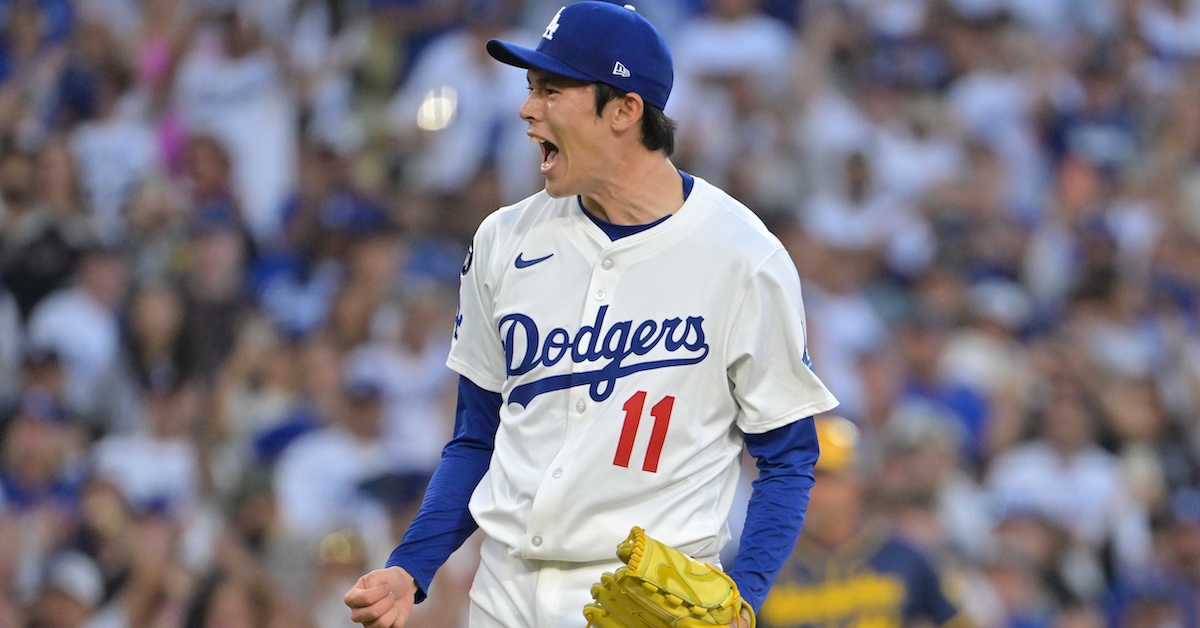
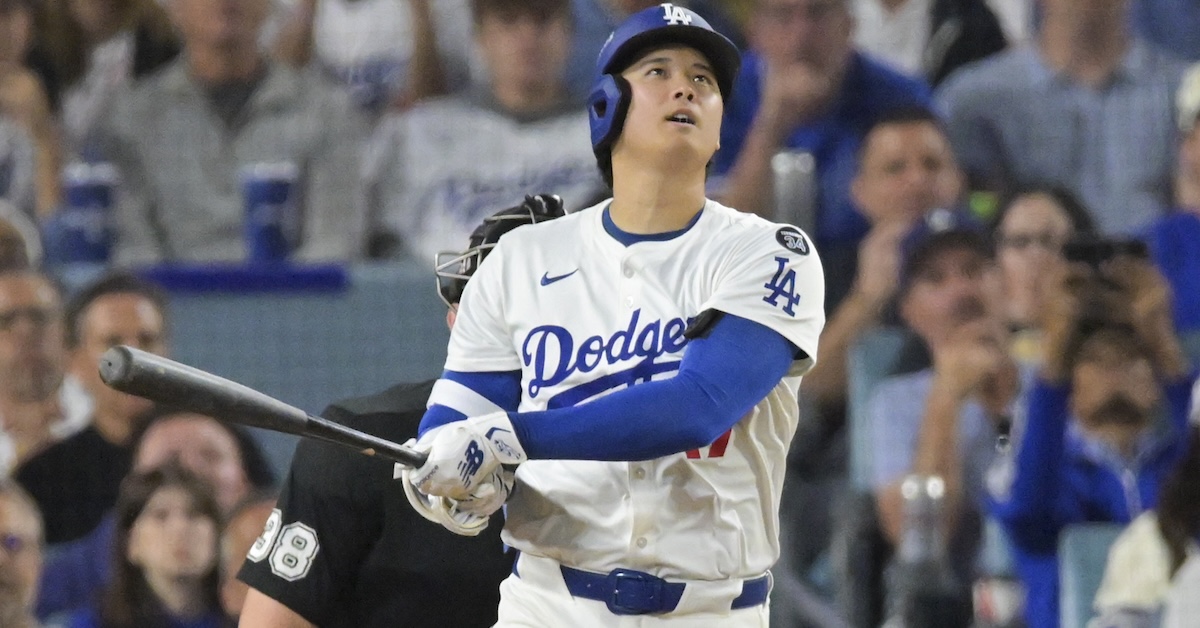
The Dodgers beat the Brewers by a final score of 5-1 on Friday night, securing a sweep of the NLCS and advancing to the World Series for the second consecutive year. If you just look at the scoreline and the sweep, you might think that this game was devoid of interest. I won’t lie to you – it was definitely not as dramatic as the wild Mariners-Blue Jays game from earlier in the night, and that series has had far more twists and turns than this one. But forget the lopsided final score, and forget the lopsided series. Friday night was a show – or, I should say, a Sho.

Shohei Ohtani made his second start on the mound of the playoffs, and after a leadoff walk to Brice Turang, he looked every bit the impossible, ace-plus-slugger hybrid we’ve come to expect. His stuff was sharp tonight, with his fastball scraping triple digits and his vicious sweeper up several ticks but maintaining its ludicrous movement. That leadoff walk didn’t even phase him; he took a deep breath, a few paces on the mound, and then turned Jackson Chourio into a cardboard cutout. Biting sweeper, two increasingly diving sliders, with Chourio taking an emergency hack to stay alive, and then a 100.3 mph fastball, pumped right through the zone, to remind everyone that, yeah, this Ohtani guy can spin it.

The next batter, Christian Yelich, got ahead in the count 2-0; Ohtani regrouped with an outrageous flotilla of sliders (90 mph), cutters (95), and fastballs (100) on the low-and-away corner that eventually flummoxed Yelich into a called strikeout. William Contreras? Thanks for entering the batter’s box, sir, better luck next time. Ohtani struck him out on three pitches, the last two of which were demonically breaking sweepers that weren’t even in the same zip code as Contreras’ bat. Then Ohtani sprinted off the mound and disappeared into the dugout. Read the rest of this entry »
With Two Homers in Game 5, Eugenio Suárez Slams Mariners to 3-2 ALCS Lead

Steven Bisig-Imagn Images

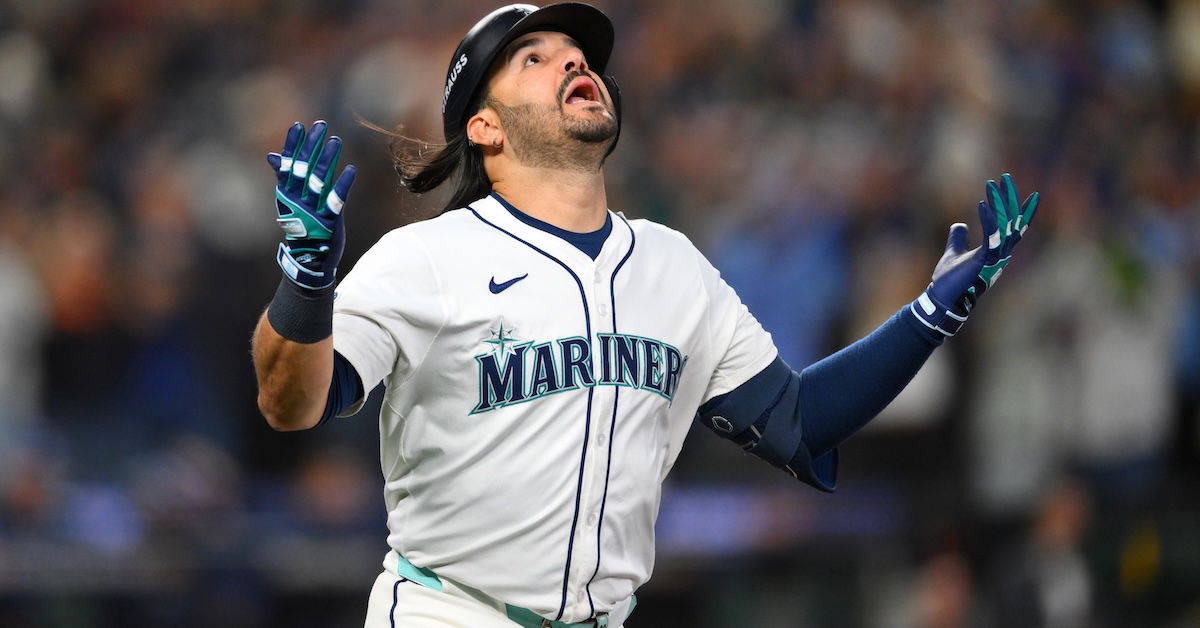
The Mariners and Blue Jays came into Game 5 of the American League Championship Series knowing a five-hour flight lay in their future. What they didn’t know was which team would have a happy flight from Seattle to Toronto and which team would spend the time in the air stewing. It took a long while to figure it out. It wasn’t until the eighth inning that Seattle third baseman Eugenio Suárez finally decided to take matters into his own hands. With a two-homer, five-RBI performance, including a go-ahead grand slam in that decisive frame, Suárez powered the Mariners to a 6-2 win. They now have a 3-2 lead in the series, leaving them one win from the first World Series appearance in franchise history. They will no doubt slumber peacefully as they wing their way to Toronto for Game 6 on Sunday.

Both managers were looking to mix things up on Friday. Toronto’s John Schneider mentioned in both the pregame and postgame press conferences that he wanted to avoid the familiarity penalty by making sure his relievers didn’t face the same batters over and over again. On the other side, Dan Wilson rejiggered his lineup with the goal of “just kind of jumbling it up and creating a different look.” He moved Julio Rodríguez into the leadoff spot, dropped the struggling Randy Arozarena to fifth, kept Cal Raleigh in the two-hole, and pushed Jorge Polanco and Josh Naylor up to third and fourth. Suárez, struggling just as badly as Arozarena with a .162 batting average in the postseason, stayed in the sixth spot.

Friday’s contest featured a pitching rematch of Game 1 between Kevin Gausman and Bryce Miller, when the two starters combined for just three earned runs over a combined 11 2/3 innings. They allowed even fewer runs on Friday. Their two approaches couldn’t have been different. Gausman avoided the top half of the zone at all costs, looking to induce chases on splitters that dived below the zone and earn called strikes on four-seamers that held their plane. Miller threw some splitters of his own, but he attacked with fastballs at and above the top of the zone. He also pitched with abandon. With ace Bryan Woo in the bullpen ready to pitch for the first time since September 19 due to pectoral inflammation, Miller emptied the tank. Both his fastballs averaged roughly 2 mph above their regular season marks. The starters picked up right where they left off in Game 1, facing four hitters apiece in the first inning and pitching around doubles to the opposing lineup’s big star. Miller touched 98 mph, struck out two and gave up a double to Vladimir Guerrero Jr., while Gausman rode his trademark splitter and allowed his own double to Raleigh. Read the rest of this entry »


Postseason Managerial Report Cards: Craig Counsell and Rob Thomson

Benny Sieu and Eric Hartline-Imagn Images

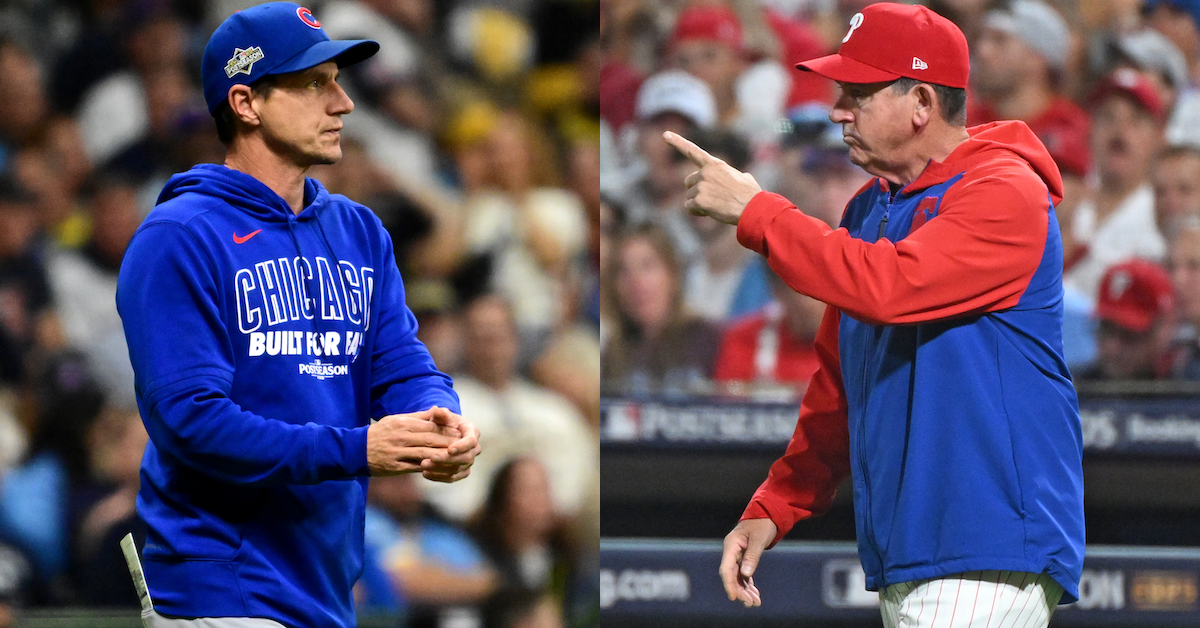
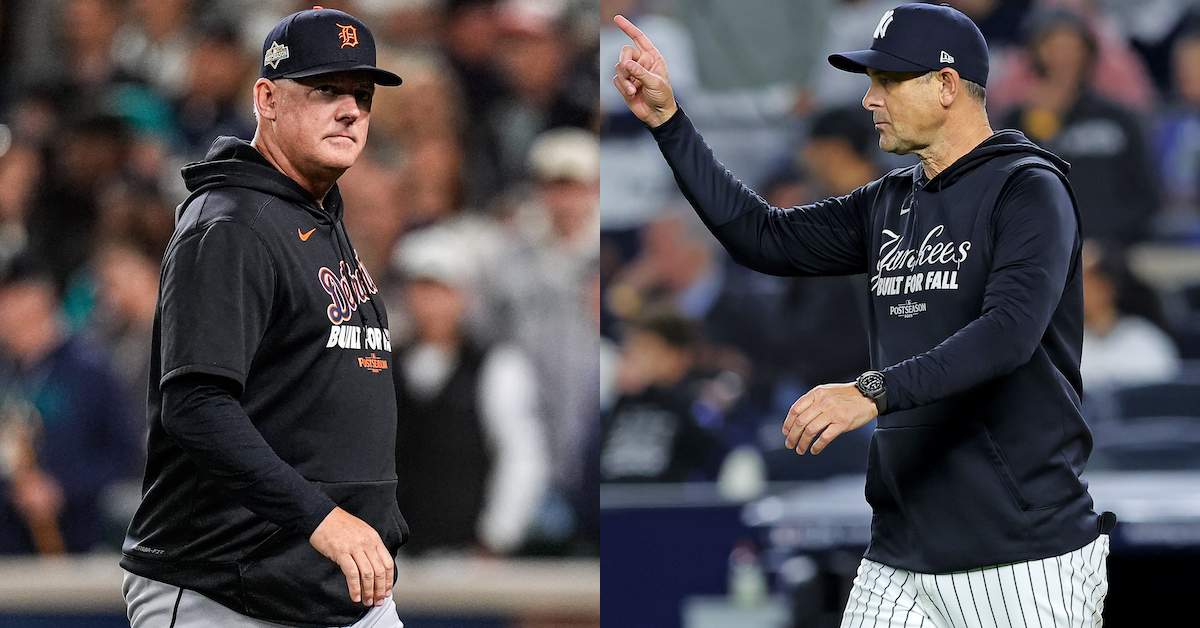
This postseason, I’m continuing my use of a new format for our managerial report cards. In the past, I went through every game from every manager, whether they played 22 games en route to winning the World Series or got swept out of the Wild Card round. To be honest, I hated writing those brief blurbs. No one is all that interested in the manager who ran out the same lineup twice, or saw his starters get trounced and used his best relievers anyway because the series was so short. This year, I’m skipping the first round, and grading only the managers who survived until at least the best-of-five series. Earlier this week, I graded Aaron Boone and A.J. Hinch. Today, we’ll continue with the two managers who lost in the National League Divisional Series, Craig Counsell and Rob Thomson.

My goal is to evaluate each manager in terms of process, not results. If you bring in your best pitcher to face their best hitter in a huge spot, that’s a good decision regardless of the outcome. Try a triple steal with the bases loaded only to have the other team make four throwing errors to score three runs? I’m probably going to call that a blunder even though it worked out. Managers do plenty of other things — getting team buy-in for new strategies or unconventional bullpen usage behind closed doors is a skill I find particularly valuable — but as I have no insight into how that’s accomplished or how each manager differs, I can’t exactly assign grades for it.

I’m also purposefully avoiding vague qualitative concerns like “trusting your veterans because they’ve been there before.” Playoff coverage lovingly focuses on clutch plays by proven performers, but Cam Schlittler and Michael Busch were also great this October. Forget trusting your veterans; the playoffs are about trusting your best players. Cristopher Sánchez is important because he’s great, not because of the number of playoff series he’s appeared in. There’s nothing inherently good about having been around a long time; when I’m evaluating decisions, “but he’s a veteran” just doesn’t enter my thought process.

I’m always looking for new analytical wrinkles in critiquing managerial decisions. For instance, I’ve increasingly come to view pitching decisions as a tradeoff between protecting your best relievers from overexposure and minimizing your starters’ weakest matchups, which means that I’m grading managers on multiple axes in every game. I think that almost no pitching decision is a no-brainer these days; there are just too many competing priorities to make anything totally obvious. That means I’m going to be less certain in my evaluation of pitching than of hitting, but I’ll try to make my confidence level clear in each case. Let’s get to it. Read the rest of this entry »

With the Return of Mad Max Scherzer, the Blue Jays Even the ALCS

Kevin Ng-Imagn Images

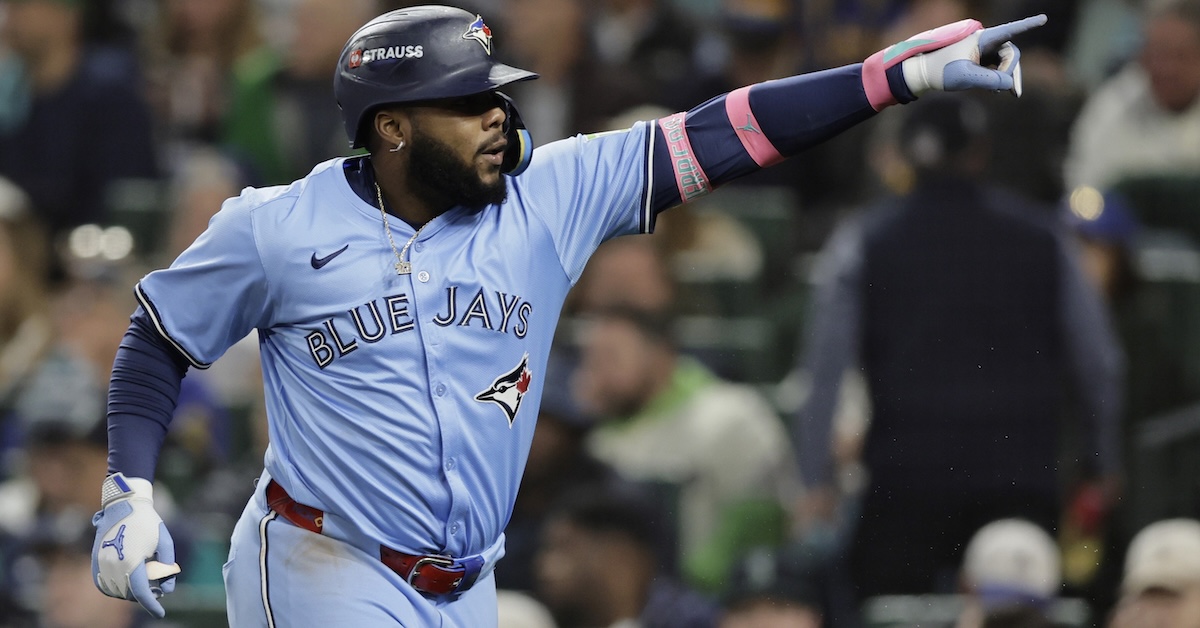
You could be forgiven for having thought that Max Scherzer had reached the end of the line. For the second season in a row, the three-time Cy Young winner and future Hall of Famer missed significant time due to injuries, and when he was available, he struggled like never before. The 41-year-old righty put up the majors’ highest ERA in the first inning (12.96), had issues with tipping pitches, and after allowing 25 runs in his final 25 innings, missed the cut for the Division Series roster. Yet on Thursday, with the Blue Jays trailing the Mariners two games to one in the ALCS, Scherzer turned back the clock, holding Seattle to just two runs over 5 2/3 innings while an aggressive offense chased Mariners starter Luis Castillo in the third inning. With Andrés Giménez and Vladimir Guerrero Jr. both homering for the second straight night, the Blue Jays won 8-2 to even the series.

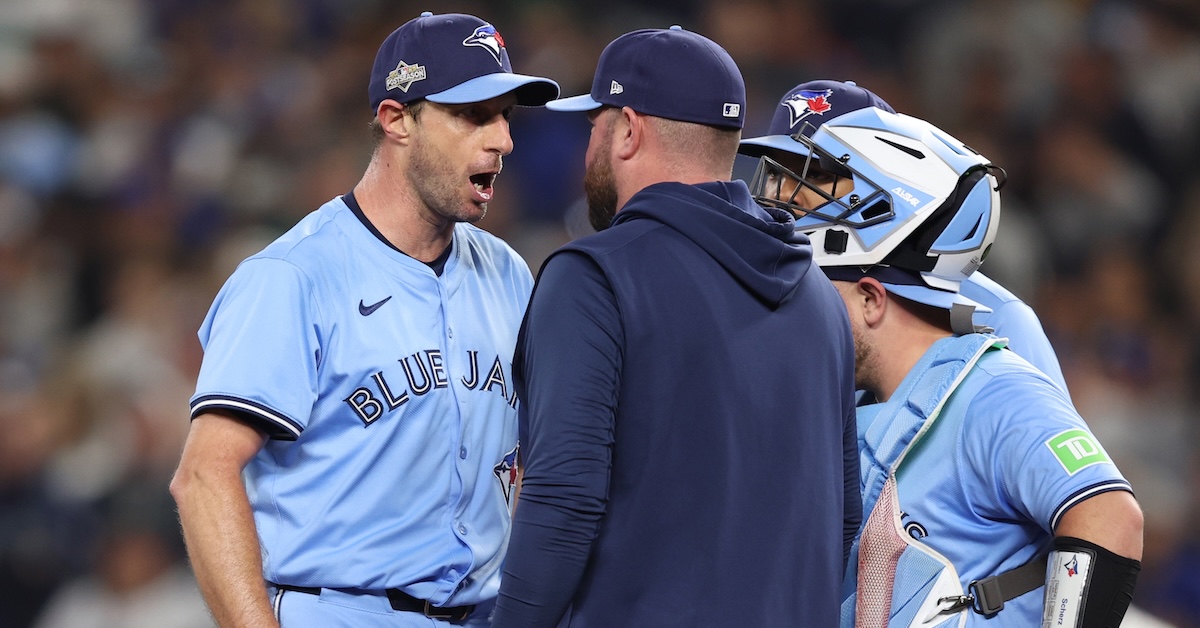
Scherzer, who had last pitched in a game on September 24, added to the Mad Max lore, displaying his legendarily competitive fire in the fifth inning. With two outs, a runner on first base and Toronto leading 5-1, manager John Schneider went to the mound to talk to Scherzer, who growled and chased the skipper away, struck out Randy Arozarena on a curveball in the dirt, then retired two batters in the sixth before finally getting the hook.

“I’ve been waiting for that all year, for Max to yell at me on the mound,” said Schneider afterwards. “It was awesome, I thought he was going to kill me.” Read the rest of this entry »


Dodgers Go up 3-0 as Search Parties Struggle To Locate Milwaukee Offense

Jayne Kamin-Oncea-Imagn Images

Well, that was fun while it lasted.

Home-field advantage has been a bit of a booby prize this postseason, with the home team losing all five LCS games heading into Thursday evening’s action. The Dodgers’ Game 3 starter, Tyler Glasnow, is arguably the closest thing this rotation has to a weak link. So maybe the Brewers weren’t as dead as the series standings made it seem. Win one and you’re back in it.

Unfortunately for the Brewers, and for neutrals hoping for this series to go six or seven exciting games, that wasn’t in the cards. The Dodgers put a run on the board within their first two batters of the game, and while Milwaukee tied it the next inning, Glasnow shut the door afterward. A couple singles, a walk, and a throwing error in the sixth inning were all the Dodgers needed to win the game, 3-1, and take a 3-0 lead in the series. You already know what the odds are at this point. Read the rest of this entry »

Enrique and Teoscar Hernández Have Hit the Reset Button in Timely Fashion

Jovanny Hernandez / Milwaukee Journal Sentinel-USA TODAY NETWORK via Imagn Images and Bill Streicher-Imagn Images

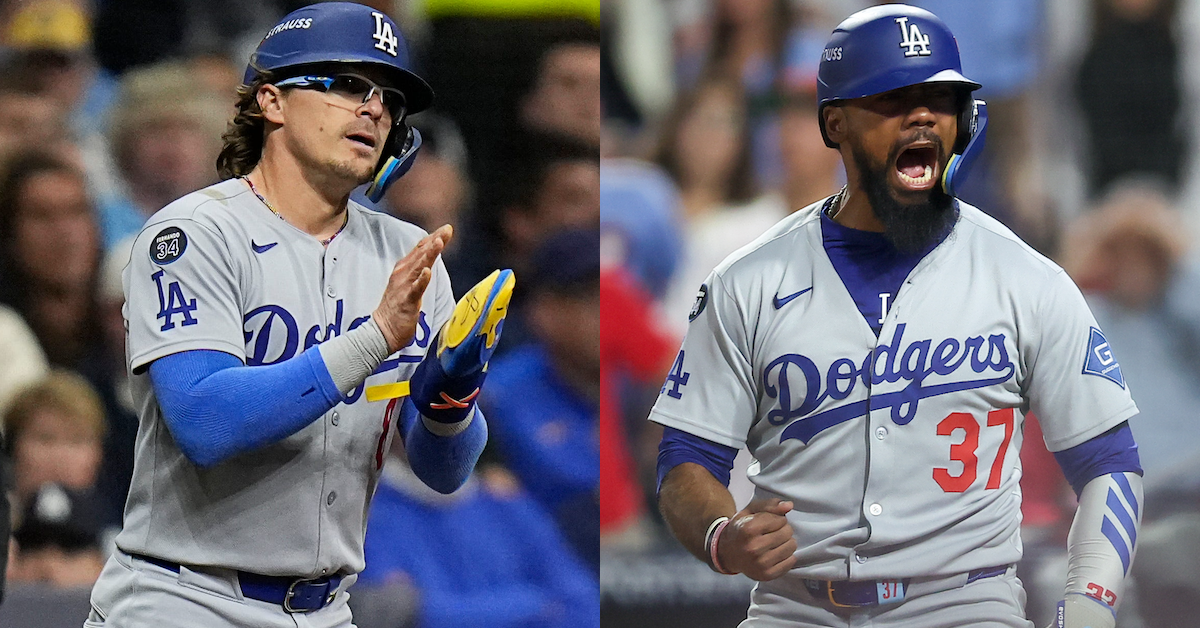
Unhittable starting pitching has carried the Dodgers through the Wild Card and Division Series and staked them to a 2-0 lead over the Brewers in the National League Championship Series. But as Blake Snell and Yoshinobu Yamamoto have made the the biggest headlines, some of their elite hitters such as Shohei Ohtani, Freddie Freeman, and Will Smith have scuffled. Meanwhile Enrique Hernández and Teoscar Hernández (no relation) have picked up the slack, recalling their contributions during last year’s championship run; their efforts even bookended the fateful game-tying five-run rally in the World Series clincher against the Yankees. After subpar regular seasons married by injuries, both have rediscovered their groove in October.

At American Family Field on Tuesday night, the dynamic duo shone once again during the Dodgers’ 5-1 victory in Game 2. With the team trailing 1-0 in the second inning following Jackson Chourio’s leadoff homer off Yamamoto, Teoscar got ahead 3-0 against Freddy Peralta, then pounced on the next pitch thrown in the zone, a 3-2 hanging curveball, and demolished it for a towering solo home run — 105.9 mph off the bat, with a 39-degree launch angle — to left field.

That was Teoscar’s fourth homer of the playoffs, tying Michael Busch for the postseason lead (Vladimir Guerrero Jr. joined them on Wednesday). Two batters and one out later, Enrique worked the count to 2-2, then ripped a middle-middle four-seamer for a 98-mph groundball single into center field. He scored the go-ahead run when Andy Pages doubled into the right field corner. Read the rest of this entry »

Nobody’s Stealing Bases in the Playoffs

Steven Bisig-Imagn Images

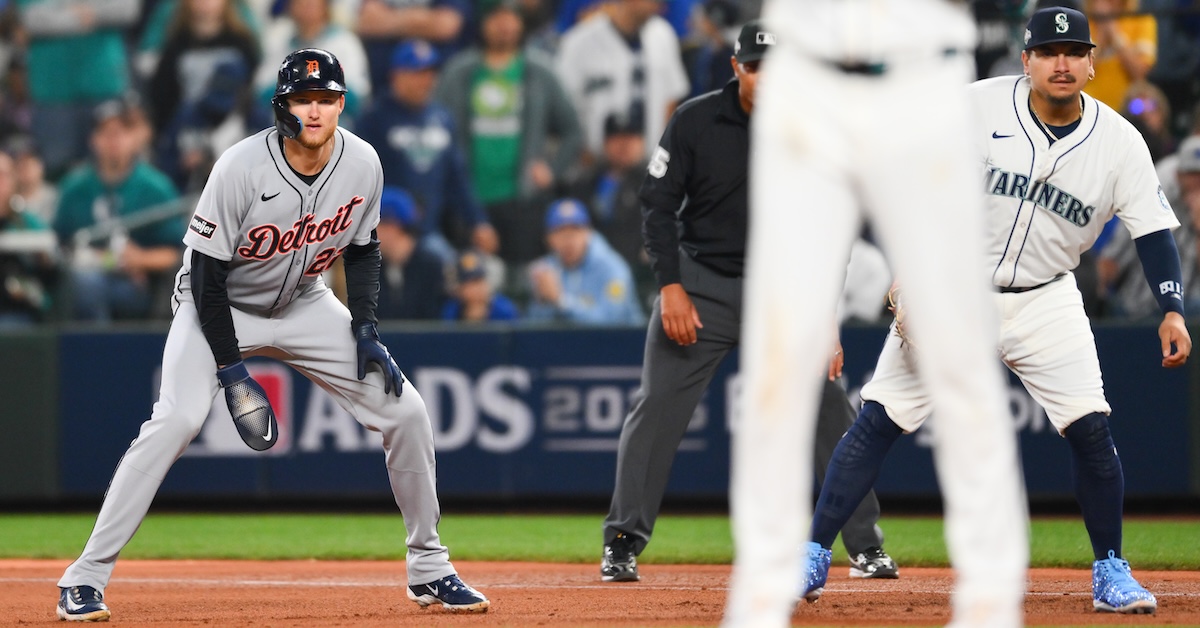
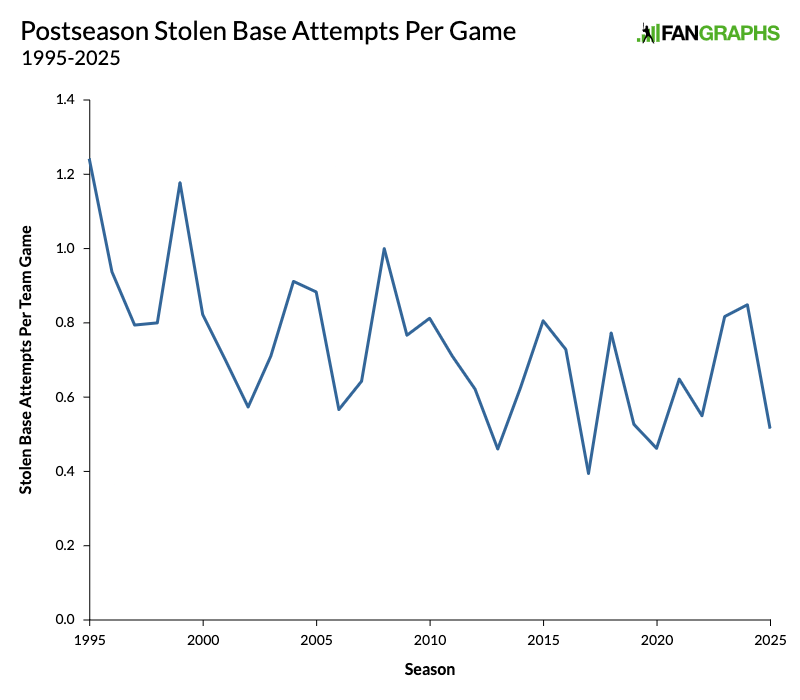
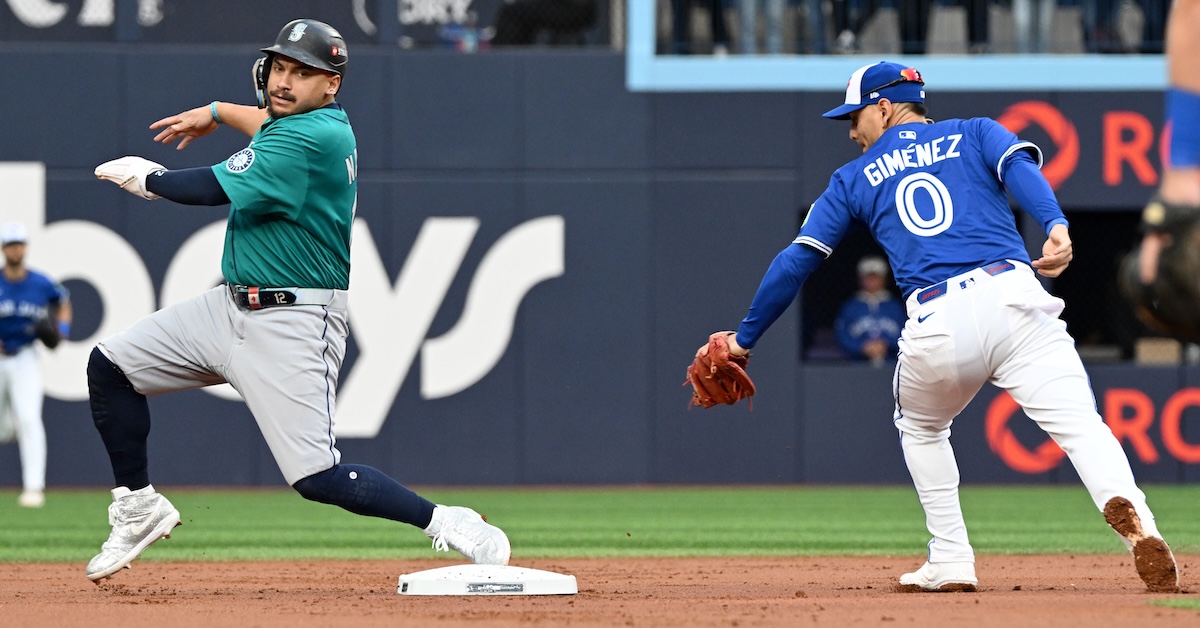
I’ve got some terrible news for you. The crime rate is way down. I know that sounds like it should be good news, but when it comes to baseball, it’s just boring. Nobody’s stealing any bases during the playoffs (except for Randy Arozarena and, of course, Josh Naylor). The 34 total playoff games have seen just 26 steals on 35 total attempts. That’s 0.51 attempts per team per game, a huge drop-off from a regular season that averaged 0.91. The Blue Jays and Dodgers have combined for just two steals on two attempts. Boring.

On its own, that doesn’t seem too surprising. This is the fourth year in a row that teams have attempted fewer steals per game in the playoffs than in the regular season. The reasons behind this are easy enough to understand. First, we have a logistical hurdle. Runs are harder to come by during the playoffs. This year, we’ve seen 4.45 runs per team game during the regular season and just 4.02 during the playoffs. On-base percentage is down 11 points, which means fewer baserunners and fewer stolen base opportunities to start with. Next, we’ve got the risk aversion angle. Those baserunners are a more precious commodity at a time when the stakes are at their highest. Running into an out on the bases is a very loud unforced error, the kind of thing you get roasted for in the papers the next morning. It’s a lot harder to see how much potential value you’re leaving on the table by just staying put. I feel confident that I’ve never read an article roasting a player for not trying to steal.

Read the rest of this entry »


Blue Jays Prove They Are George Kirby’s Nightmare Matchup in ALCS Game 3

John Froschauer-Imagn Images

SEATTLE — There’s an age-old question among pitching philosophers. Should an approach focus more on the pitcher’s strengths or the hitter’s weaknesses? In my experience, pitchers do not ask themselves this question, though. They almost always prefer to pitch to their own strengths. They might tweak their strategy if a hitter has an obvious and exploitable weakness that they feel comfortable attacking, but mostly they’d rather stick to what they do best.

But what happens when what a pitcher does best aligns perfectly with what his opponent does best? When it’s not just that he’s ignoring the hitter’s weakness, but that he’s also pitching to the hitter’s strength? Game 3 of the ALCS between the Mariners and the Blue Jays gave us a data point to consider when answering that question. Toronto walked away with a 13-4 victory in Seattle to cut the Mariners’ series lead to 2-1, and did so by sticking to its strengths in the batter’s box. Read the rest of this entry »


Postseason Managerial Report Cards: Aaron Boone and A.J. Hinch

Junfu Han-USA TODAY NETWORK via Imagn Images and Brad Penner-Imagn Images

I’m trying out a new format for our managerial report cards this postseason. In the past, I went through every game from every manager, whether they played 22 games en route to winning the World Series or got swept out of the wild card round. To be honest, I hated writing those brief blurbs. No one is all that interested in the manager who ran out the same lineup twice, or saw his starters get trounced and used his best relievers anyway because the series was so short. This year, I’m skipping the first round, and grading only the managers who survived until at least the best-of-five series. Today, we’ll start with the two managers who lost in the American League Divisional Series, Aaron Boone and A.J. Hinch.

My goal is to evaluate each manager in terms of process, not results. If you bring in your best pitcher to face their best hitter in a huge spot, that’s a good decision regardless of the outcome. Try a triple steal with the bases loaded only to have the other team make four throwing errors to score three runs? I’m probably going to call that a blunder even though it worked out. Managers do plenty of other things — getting team buy-in for new strategies or unconventional bullpen usage behind closed doors is a skill I find particularly valuable — but as I have no insight into how that’s accomplished or how each manager differs, I can’t exactly assign grades for it.

I’m also purposefully avoiding vague qualitative concerns like “trusting your veterans because they’ve been there before.” Playoff coverage lovingly focuses on clutch plays by proven performers, but Cam Schlittler and Michael Busch were also great this October. Forget trusting your veterans; the playoffs are about trusting your best players. Blake Snell is important because he’s great, not because of the number of playoff series he’s appeared in. There’s nothing inherently good about having been around a long time; when I’m evaluating decisions, “but he’s a veteran” just doesn’t enter my thought process.

I’m always looking for new analytical wrinkles in critiquing managerial decisions. I’m increasingly viewing pitching as a tradeoff between protecting your best relievers from overexposure and minimizing your starters’ weakest matchups, which means that I’m grading managers on multiple axes in every game. I think that almost no pitching decision is a no-brainer these days; there are just too many competing priorities to make anything totally obvious. That means I’m going to be less certain in my evaluation of pitching than of hitting, but I’ll try to make my confidence level clear in each case. Let’s get to it. Read the rest of this entry »


Josh Naylor Is Stealing the Spotlight

Dan Hamilton-Imagn Images

Until the Mariners traded for the Diamondbacks’ Josh Naylor on July 24, they had a first base problem. For the second season in a row, subpar first-half production from their first sackers threatened to derail their bid for a playoff spot, and while they hadn’t shied away from addressing the issue last summer, they ended up missing a Wild Card berth by a single win nonetheless. In his first big swing at upgrading their roster this summer, president of baseball operations Jerry Dipoto dealt for Naylor, and since then, he’s proven to be one of their most reliable players — not just at the plate, but on the bases and in the field as well. He’s shown off all facets of his game during this postseason, including in Monday night’s 10-3 ALCS Game 2 win over the Blue Jays, during which he notched his third three-hit effort in the past four games.

After collecting the hit that helped the Mariners clinch a playoff berth — a bases-loaded, eighth-inning double off the Rockies’ Victor Vodnik on September 23 — and closing the regular season with a 12-game hitting streak, Naylor’s October actually began inauspiciously. He went hitless in the Mariners’ first three Division Series games against the Tigers, with a first-inning walk against Game 1 starter Troy Melton his only positive result across a stretch of 14 plate appearances; he just missed hitting one out against Melton in the fourth inning of that game, a 108.2-mph drive hauled in just a few feet in front of the right-center field wall. Only once during the regular season had he gone hitless in three straight games, that from June 1–4 while a member of the Diamondbacks. One of the few highlights from his more recent dry spell was his unassisted double play to seal the Mariners’ Game 3 victory, when he speared a liner off the bat of Parker Meadows, then doubled Andy Ibáñez off first.

Naylor started filling in the hit column with a 3-for-4 afternoon in the Mariners’ 9-3 loss in Game 4, doubling off Casey Mize and scoring a run in the second inning, then singling off Tyler Holton and coming around to score in the fourth, at which point the Mariners led 2-0. He pulled off another unassisted double play in the fourth, this time off a Colt Keith one-hopper that caught Gleyber Torres retreating to first base. Alas, by the time Naylor led off the eighth with a single off Melton, Seattle trailed 8-3. Too little, too late. Read the rest of this entry »