Archive for 2025 Postseason

The Long and Short of It: A Look at This Year’s Postseason Starting Pitching
Michael McLoone-Imagn Images

At last, we’ve got a World Series matchup to wrap our heads around. Representing the American League are the Blue Jays, who are back in the Fall Classic — making it a truly international World Series — for the first time since 1993. They’ll face the Dodgers, who are vying to become the first back-to-back champions since the 1999–2000 Yankees. They’re the first defending champions to repeat as pennant winners since the 2009 Phillies, who lost that World Series to the Yankees. If that matchup feels like a long time ago, consider that it’s been twice as long since the Blue Jays were here.

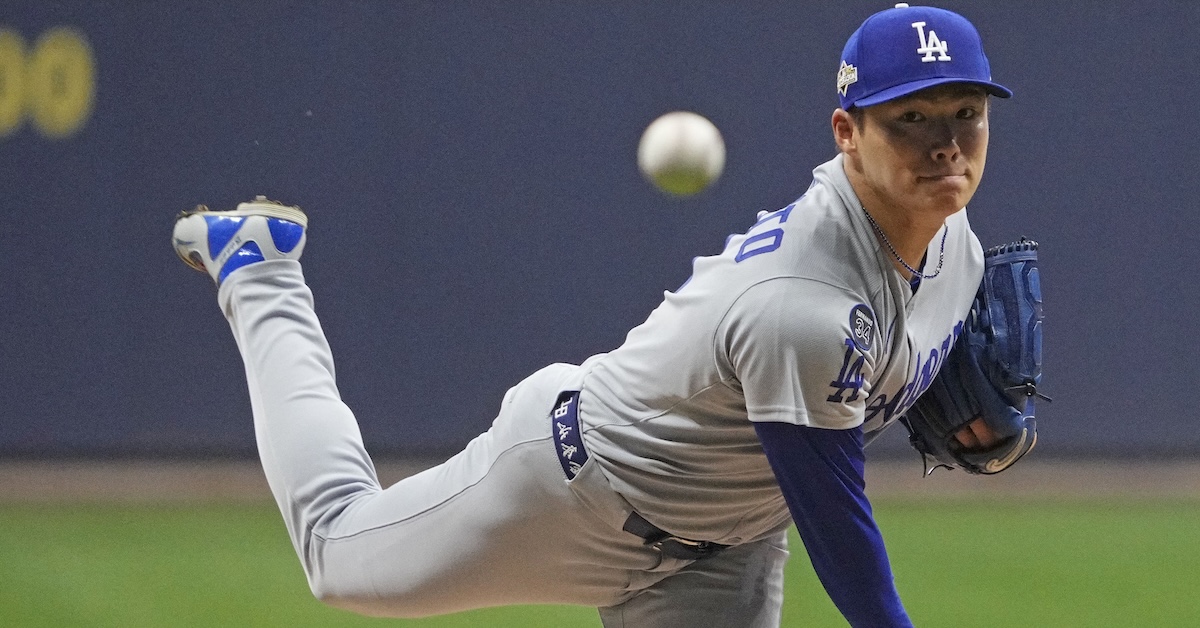
Though the core of the lineup is largely unchanged, this year’s Dodgers team differs from last year’s in that it has reached the World Series on the strength of its starting pitching rather than in spite of it. Due to a slew of injuries in the rotation last year, manager Dave Roberts resorted to using bullpen games four times to augment a rickety three-man staff consisting of Yoshinobu Yamamoto, Jack Flaherty, and Walker Buehler. Even as those starters (or “starters,” in some cases) put up a 5.25 ERA while averaging just 3.75 innings per turn, the bullpen and offense more than picked up the slack, and the Dodgers took home their second championship of the Roberts era.

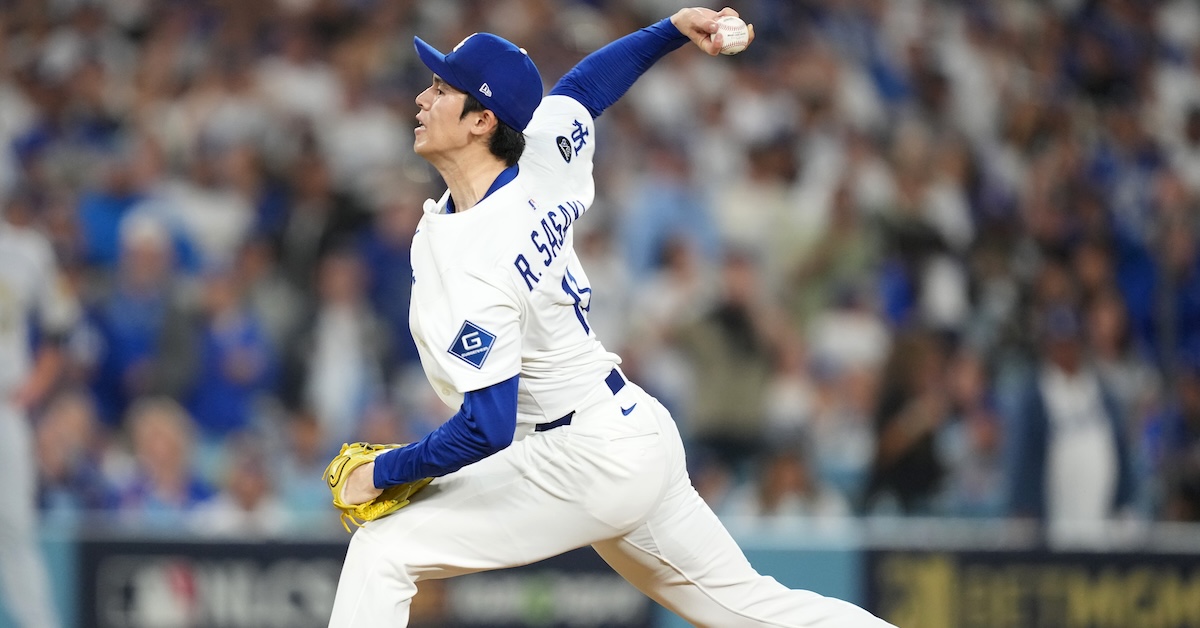
This time around, with Flaherty and Buehler elsewhere and Blake Snell, Tyler Glasnow, and Shohei Ohtani joining Yamamoto, Dodgers starters have been absolutely dominant, posting a microscopic 1.40 ERA while averaging 6.43 innings per turn through the first three rounds, helping the team to paper over a shaky bullpen. After Snell utterly dominated the Brewers, holding them to just one hit over eight innings while facing the minimum number of batters in Game 1 of the NLCS, Yamamoto followed with a three-hit, one-run masterpiece — the first complete game in the postseason since the Astros’ Justin Verlander went the distance against the Yankees in Game 2 of the 2017 ALCS. Glasnow, who began the postseason in the bullpen, allowed one run across 5 2/3 innings in Game 3 of the NLCS, while Ohtani backed his 10 strikeouts over six shutout innings in Game 4 with a three-homer game in what for my money stands as the greatest single-game postseason performance in baseball history. Read the rest of this entry »

Game 7 in Three Jumps

Dan Hamilton-Imagn Images

My job is to write about baseball, which means that in large part, my job is to generate novel circumlocutions for the word “jump.” How many times can you say that somebody’s exit velocity jumped, their whiff rate jumped, their outfield jump jumped into the 82nd percentile before your editor is tempted to bludgeon you with a thesaurus? I would prefer not to find out, as I bruise easily.

I would estimate that I write the word jump about 20 times more often than I actually jump. Nobody jumps all that much on any given day. Unless you’re at the gym, unless you’re playing sports, unless you’re a child, life just doesn’t involve much jumping. This is intentional. It is a result of the way we have structured our lives. We keep things in reach. We have downstairs neighbors. We wear complicated shoes. With the notable exception of the décor at Barnes & Noble, nearly every aspect of our lives encourages us to remain seated. Jumping in jeans is a rare occurrence. All in all, this seems like a bad thing.

Dan Hamilton-Imagn Images

Every once in a while, jumping is a matter of practicality. There’s no way I’m lugging the stepladder out from the laundry room just to get this stupid cake pan off the top shelf. I’m not tracking back five blocks just because a tiny part of this walkway is blocked by a low fence. I’ve been staring at the backs of various heads for this entire concert and I just want to get one good, unobstructed look at the band. It never occurs to us at that moment, jumping out of some mixture of desperation and exasperation, that what we’re doing could be beautiful, graceful. Read the rest of this entry »

Postseason Managerial Report Card: Pat Murphy

Benny Sieu-Imagn Images

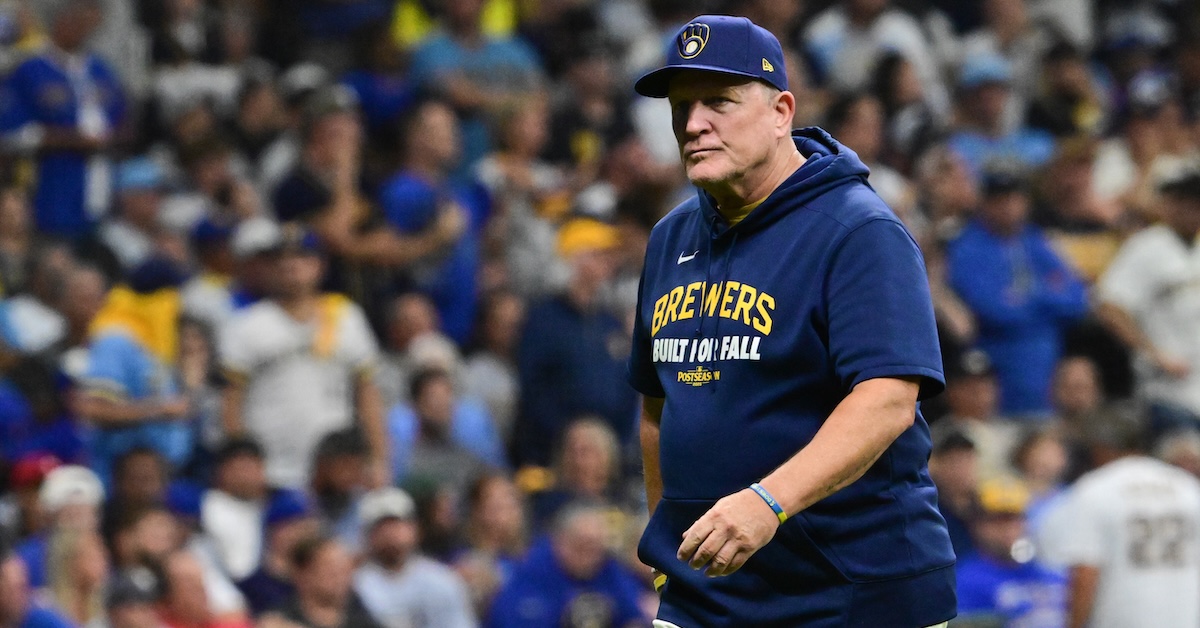
Hey kids, there’s a substitute teacher today! But I’ve been given the lesson plan, so we’re going to go ahead and talk about Milwaukee Brewers manager Pat Murphy — no spending the day watching old episodes of The Simpsons that I have on VHS, even though this classroom still has a functioning VCR for some reason. As your normal teacher, Mr. Clemens, would do, I’m going to grade Murphy based on his overall performance in the playoffs, rather than scrutinize every single micro decision made. If you’d like to see Mr. Clemens’ reports on the managers who lost in the various Division Series, you can find the American League write-up here, and the National League write-up here.

I find the Brewers fascinating, both because I’ve always appreciated them having the best logo in sports, and because I’m really bad at projecting them. While I had a better time of it than some others did this year, and at least only had them two wins short of the Cubs, the preseason ZiPS standings have repeatedly underestimated the Brew Crew. I’d love to be able to directly blame the computer for this phenomena, but ZiPS has actually done a solid job of projecting individual Milwaukee players. The problem is that when it comes time to guess exactly who will see the field, I’ve been giving them short shrift. In each of the last five seasons, if I had known precisely who would end up getting playing time, the preseason projections would have gone up by an average of just under four wins per year. It’s not simply that they’ve been healthier than expected, either; the Brewers tend to promote interesting players at a much faster pace than I expect them to, are very quick to understand what’s not working, and deploy role players extremely effectively.

OK, the bell rang, so let’s get going. Read the rest of this entry »

InstaGraphs: Intentionally Walking Cal Raleigh

John E. Sokolowski-Imagn Images

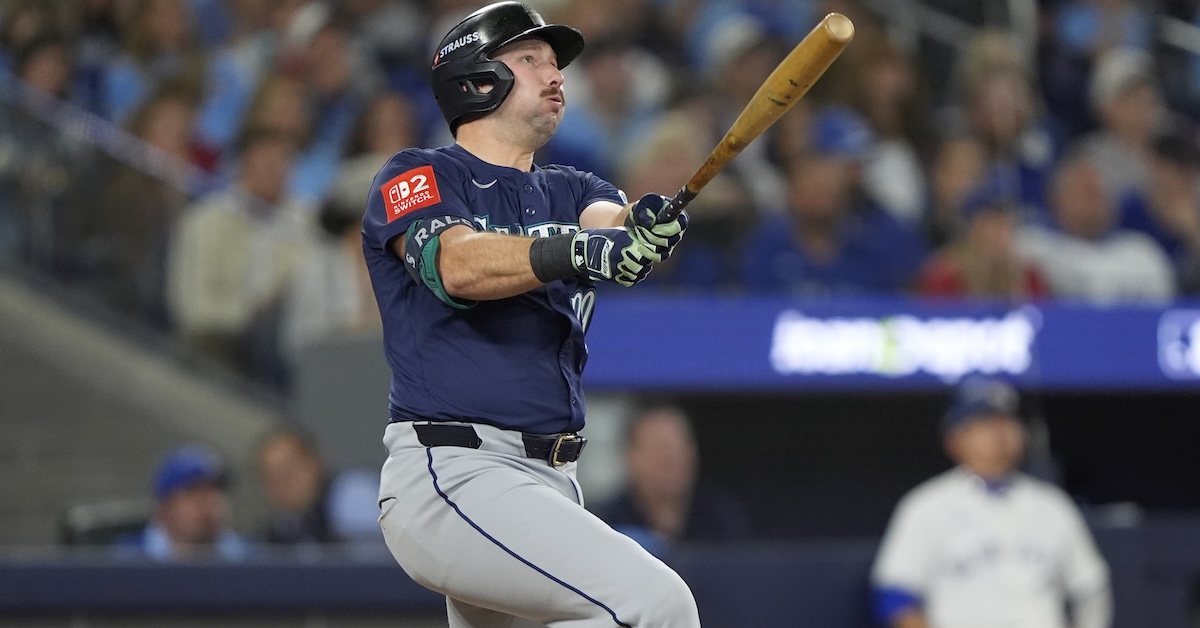
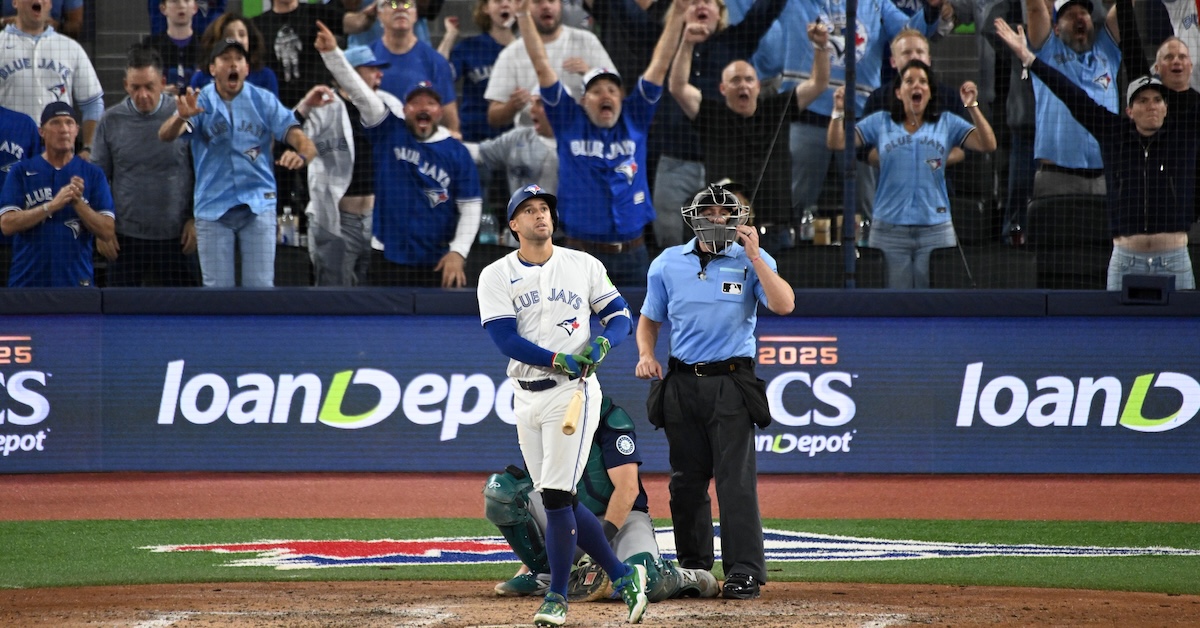
In Game 7 of the ALCS on Monday night, John Schneider’s Blue Jays pulled off a dramatic comeback in the bottom of the seventh inning that sent them to their first World Series in 32 years. The heroics came courtesy of George Springer, who hit a go-ahead three-run home run. But first, Schneider himself made a big decision in the top of the inning. With two outs and no one on base, Cal Raleigh stepped up. Two innings earlier, he had smashed a solo shot to give Seattle a 3-1 lead. Schneider wasn’t interested in facing him; he put up four fingers and called for the intentional walk.

Intentionally walking someone with the bases empty is a statement of strong fact: We absolutely cannot allow this person to hit a home run. To be fair, that’s definitely how Schneider felt in that moment; a home run would have been backbreaking for his team’s chances. Raleigh hit 60 of them in the regular season, so he’s obviously a pretty reasonable guy to fear when you’re specifically afraid of homers. But Josh Naylor, due up next, is a good hitter, too. And baserunners are bad in general. What did the math say about this move? Read the rest of this entry »

The Month of the Splitter

Kirby Lee-Imagn Images

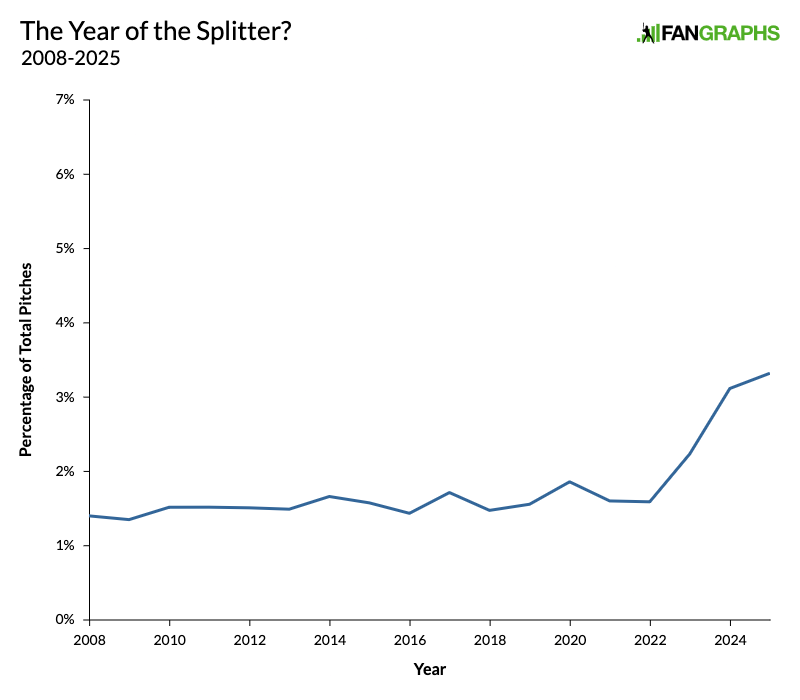
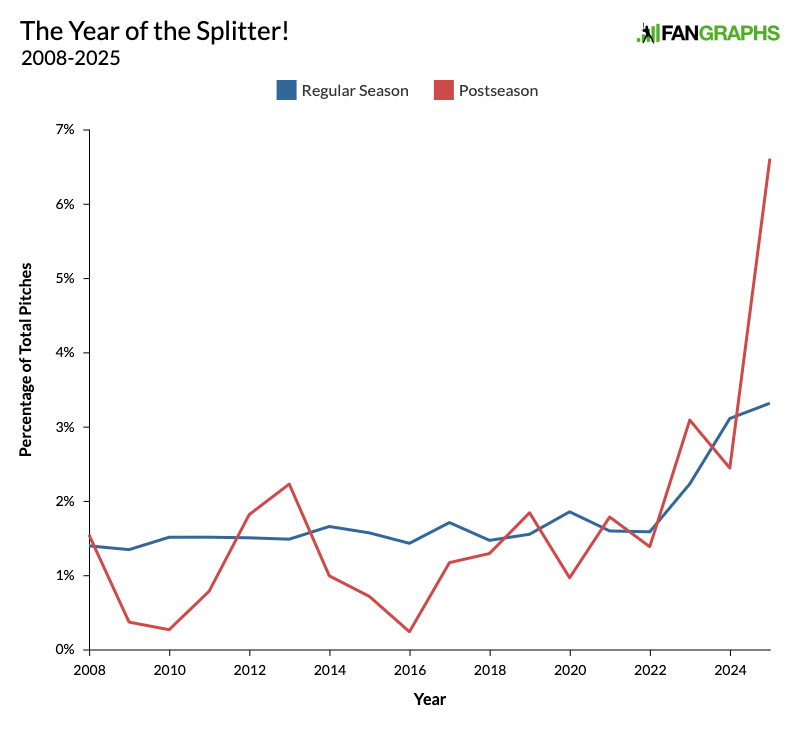
The year of the splitter has come and gone. Actually, those of us who follow these things closely know that both 2023 and 2024 were considered the years of the splitter, and then we established back in March that 2025 would be the year of the kick change. While major league pitchers ran a 3.3% splitter rate in 2025, the highest mark since the pitch tracking era started in 2008, that represented a jump of just 0.21 percentage points from 2024. It’s a difference of less than one splitter per team every three games. While the number is still going up, the big increases came in 2023 and 2024, and the pace fell off this year.

That graph makes it official. This isn’t the year of the splitter. But now let me add another line to that graph. That was the regular season. We’re in the thick of the playoffs, so let’s throw the postseason in the mix, too. If you saw that first graph and wondered why I left all that empty space at the top, well, now you know.

That’s more like it. October 2025 has seen a splitter explosion. The red line is always going to be more volatile than the blue line because the postseason is such a small sample, but even so, the playoffs have seen a 6.6% splitter rate. That’s not just the highest we’ve ever seen. It’s twice the rate for any regular season or postseason in the past 23 years. Maybe 2025 was the year of the kick change, but October 2025 is very definitely shaping up to be the month of the splitter. The playoffs aren’t even over, and we’ve already seen more splitters this October than in the postseasons of 2023 and 2024 combined. Read the rest of this entry »

FanGraphs Weekly Mailbag: October 21, 2025

John E. Sokolowski-Imagn Images

I have no idea what Dan Wilson was doing. With the Mariners clinging to a 3-1 lead in the seventh inning of Game 7 of the ALCS, their manager elected to bring in Eduard Bazardo, who’d just thrown two innings the night before, with two on and the top of the Blue Jays order coming up instead of going to his closer, Andrés Muñoz. It took two pitches for the decision to backfire. George Springer turned on the 1-0 pitch from Bazardo, a 96-mph thigh-high sinker over the inner third of the plate, and clobbered it over the left-center field wall. The three-run blast secured the Blue Jays their first American League pennant in 32 years. They’ll face the defending-champion Dodgers in the World Series, which begins on Friday at Rogers Centre.

I’m not going to get into all the chaos from last night’s decisive game here. For more on that, you should check out Eric Longenhagen’s recap. We’ve been covering both the Blue Jays and the Dodgers all postseason, and we’ll continue to do so during the World Series, so be sure to keep coming to FanGraphs throughout the Fall Classic.

A quick programming note before we continue: Our next mailbag will come out after the end of the World Series, whenever that may be. Also, this mailbag is exclusive to FanGraphs Members. If you aren’t yet a Member and would like to keep reading, you can sign up for a Membership here. It’s the best way to both experience the site and support our staff, and it comes with a bunch of other great benefits. Also, if you’d like to ask a question for an upcoming mailbag, send me an email at mailbag@fangraphs.com. Read the rest of this entry »

By George, They’ve Done It

Dan Hamilton-Imagn Images

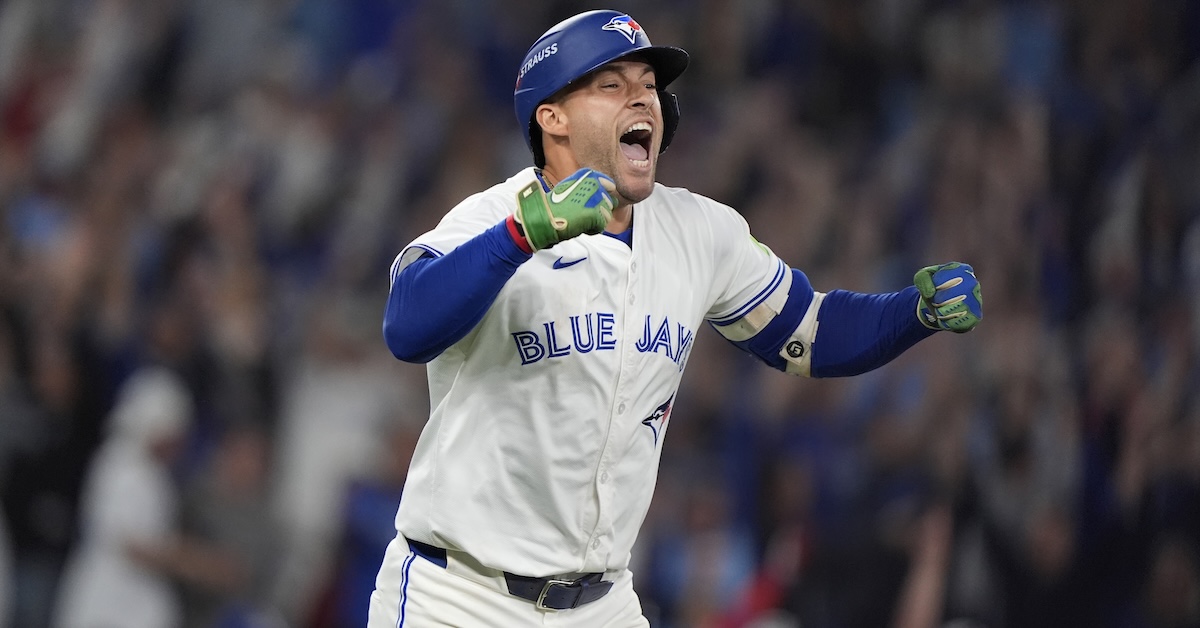
The Toronto Blue Jays are headed to their first World Series since 1993 after defeating the Seattle Mariners 4-3 in a tense seventh game, thanks largely to yet another seismic postseason moment forged by the bat of George Springer. Three nights after he was laying in a heap at home plate, having been kneecapped by an errant mid-90s fastball, Springer added to his already legendary postseason résumé with a three-run home run against, ironically, another fastball tailing in the direction of his knees. The blast was a microcosm not only of Springer’s season (by wRC+ he posted the lone below-average offensive season of his career in 2024, and then set a career-best in 2025) but also of Toronto’s as a group, as the Jays led the majors in comeback wins during the year.

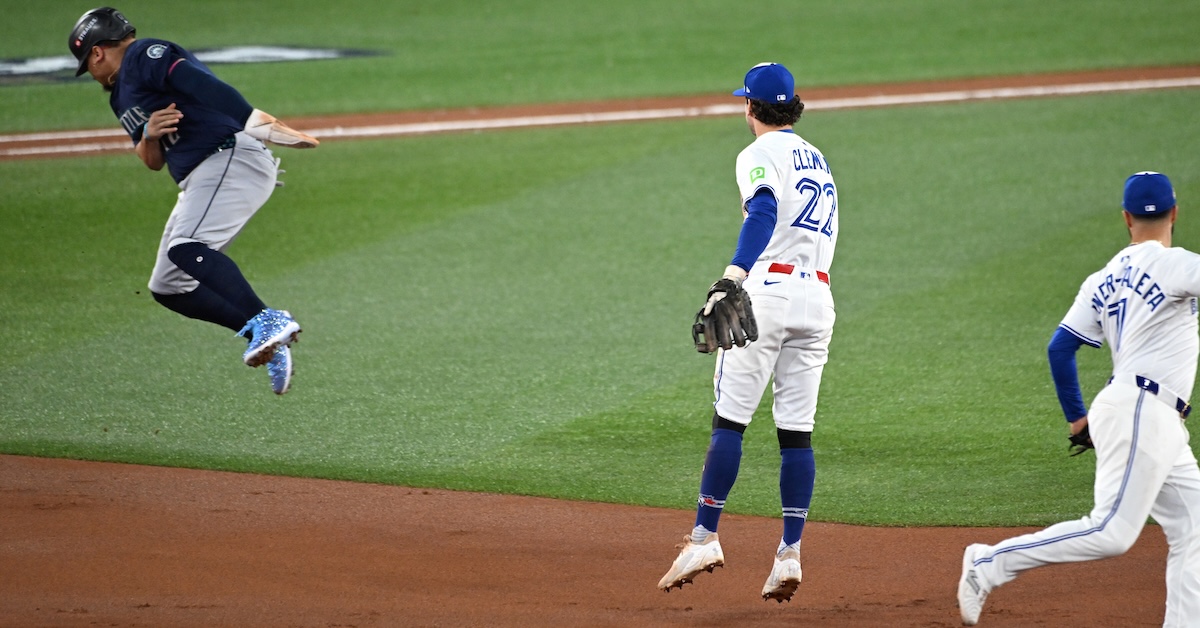
Julio Rodríguez cut the ribbon on Game 7 with a leadoff double, and came around to score a few batters later when Josh Naylor ripped a single just beyond the outstretched glove of a diving Vladimir Guerrero Jr. Thereafter, Seattle’s first-inning rally was stemmed by one of the weirder double plays you’ll ever see, as Naylor did a 180 leap into Ernie Clement’s throw to first base and, after discussion, the umpires decided to rule both runners out, Naylor on the force and batter Jorge Polanco via Naylor’s interference.

Toronto responded with a run of its own in the bottom of the first. A Springer leadoff walk and a Guerrero single (it was fortunate for the Mariners that Guerrero’s 110-mph hit was only a base hit) set the table for an eventual Daulton Varsho RBI knock, but after that, Seattle controlled most of the game. Read the rest of this entry »


Vladimir Guerrero Jr.’s Postseason for the Ages

Nick Turchiaro-Imagn Images

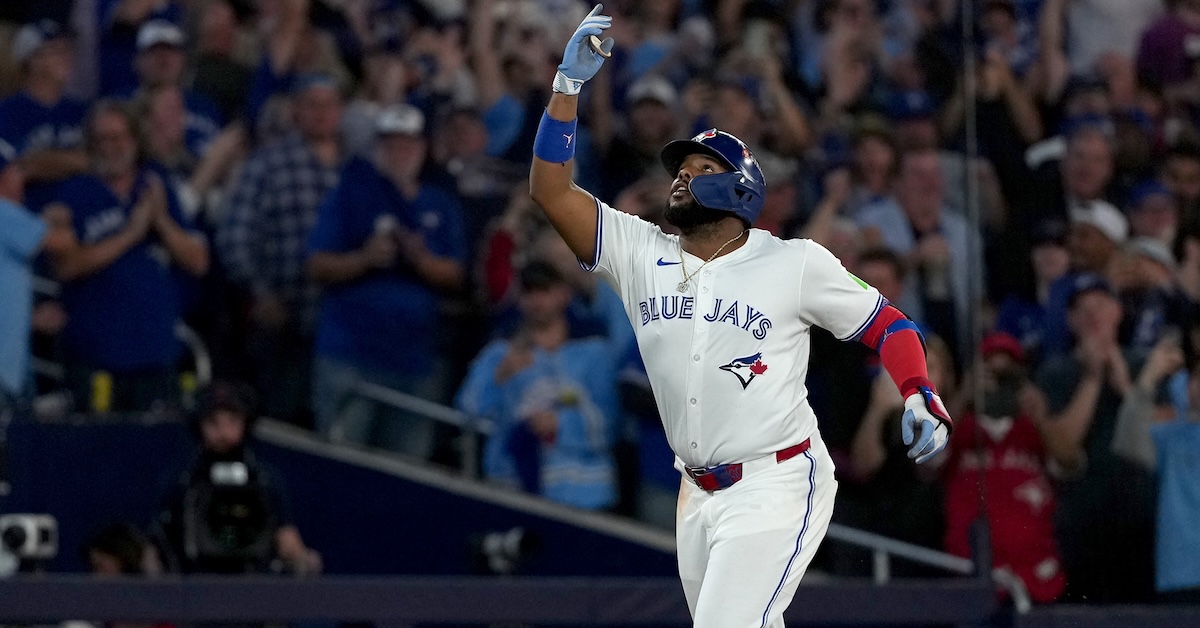
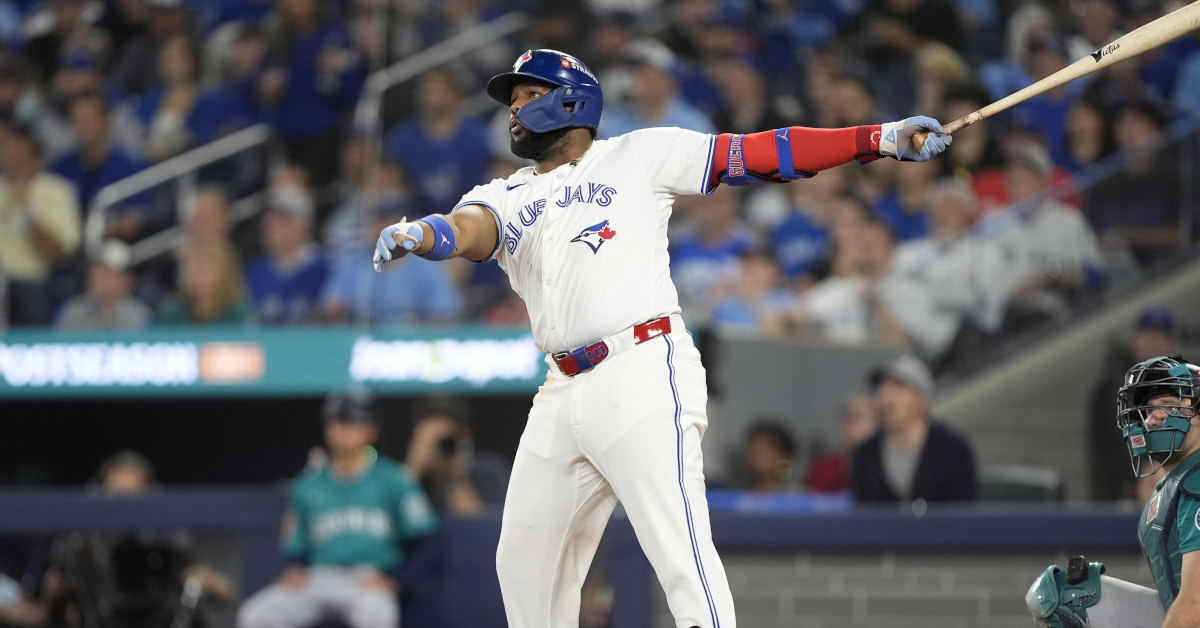
In his first postseason since signing a 14-year, $500 million extension, Vladimir Guerrero Jr. has powered the Blue Jays to within one win of their first trip to the World Series since 1993. The 26-year-old slugger continued his October heroics during Sunday night’s ALCS Game 6 in Toronto, helping the Blue Jays stave of elimination at the hands of the Mariners by clubbing his third home run of the series and sixth of the postseason while also displaying a key bit of baserunning savvy. Guerrero has rebounded from a season-ending slump to put up some absolutely astronomical numbers this fall.

Sunday night’s game didn’t start out that way for Guerrero. As they had done in Games 1 and 2 in Toronto, and Game 5 in Seattle, the Mariners kept him from doing major damage through his first two plate appearances against starter Logan Gilbert. In the first inning, with Nathan Lukes on first, Guerrero chased a low slider and grounded softly into a forceout. In the second, with the Blue Jays having rallied for two runs and with George Springer on first, he hit a scorching 116-mph grounder to the left side, where third baseman Eugenio Suárez made a diving stop, then threw to second from his knees to end the inning.

That 116-mph exit velocity was Guerrero’s hardest-hit ball of the postseason, and the eighth-hardest contact of any player this fall; the other seven, by the likes of Shohei Ohtani, Seiya Suzuki, Kyle Schwarber, Giancarlo Stanton, and Aaron Judge, all went for hits. No such luck for Vladito. Read the rest of this entry »


With a Quick One-Two Punch, Blue Jays Force Game 7

John E. Sokolowski-Imagn Images

Facing elimination in Game 6 of the ALCS, the Blue Jays were right where they wanted to be. Back in Rogers Centre, where they had the best home record in the majors during the regular season, the Jays defeated the Mariners 6-2 on Sunday night to force a decisive Game 7. On the other side, looking at an opportunity to advance to the World Series for the first time in franchise history, Seattle was wholly unprepared to meet the moment. The Mariners committed three errors, grounded into three inning-ending double plays, and just couldn’t keep up with Toronto’s relentless offense.

Trey Yesavage, making just his sixth start in the big leagues and second in this series, held the Mariners to two runs in 5 2/3 innings. His splitter was particularly nasty; he threw 31 on Sunday, the most he’s thrown in a big league start so far. He earned 10 whiffs on 17 swings (a 59% whiff rate) with that tumbling offspeed pitch and induced two critical double plays with it in back-to-back innings.

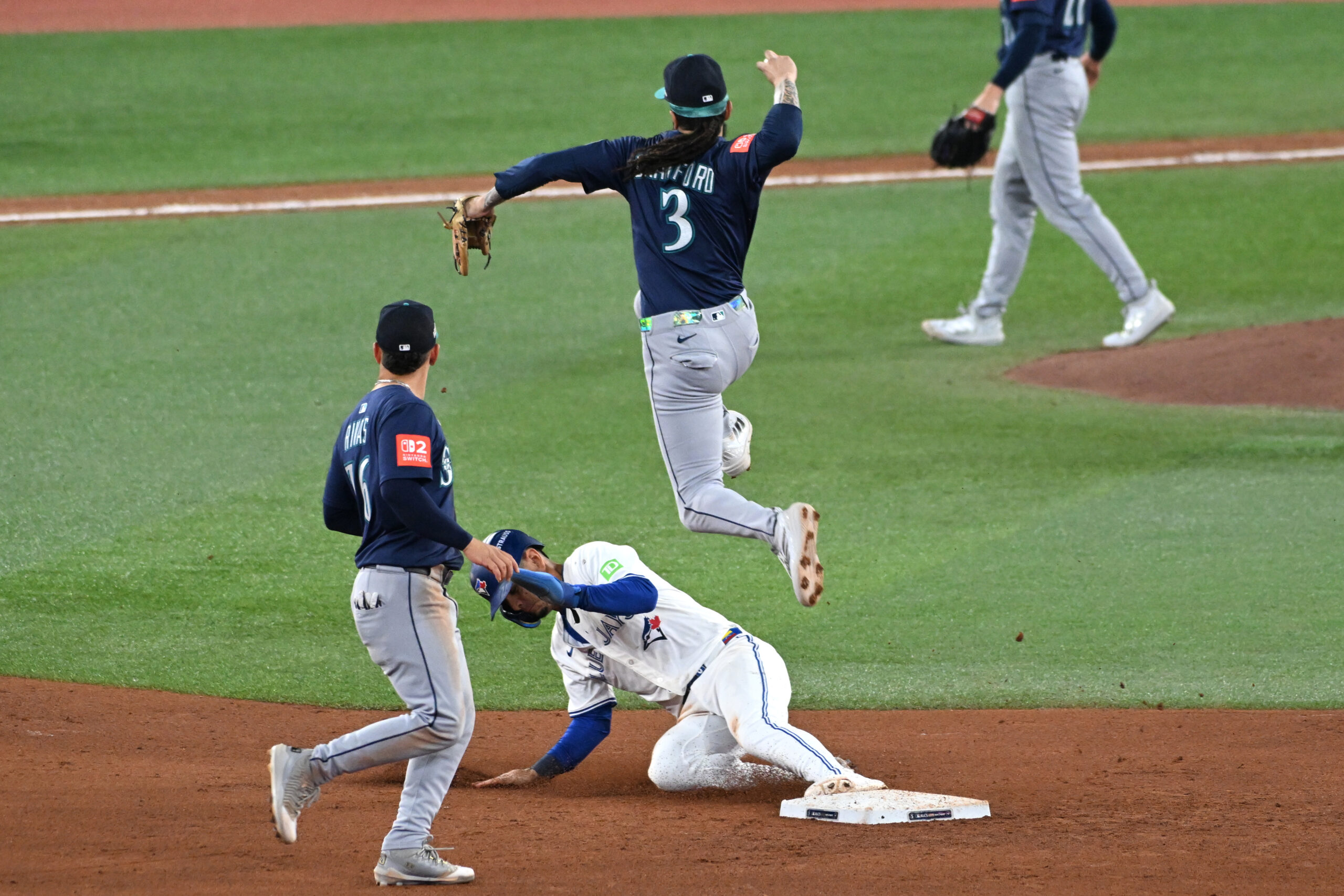
In the third inning, after the Jays had scored two, the Mariners quickly built an opportunity to strike back. J.P. Crawford walked to start the inning, and after Dominic Canzone struck out, Leo Rivas lofted a 360-foot single off the top of the right-center wall. Crawford misread the fly ball and remained too close to first base, so by the time center fielder Daulton Varsho played the carom and fired back into the infield, Crawford had only advanced to second base, meaning Rivas had to hold up at first. Instead of having two runners in scoring position with one out and the top of the order coming up, the bad baserunning had put the Mariners in a textbook double play situation. Nevertheless, after Julio Rodríguez walked to load the bases, it looked like Cal Raleigh, whose 57.7% fly ball rate was the highest in the majors this season, would at least be able to lift a sacrifice fly to get the Mariners on the board. But Yesavage buckled down, turned to his trusty splitter, and got Raleigh to ground into an inning-ending double play on the first pitch of the at-bat. Read the rest of this entry »


Shohei Ohtani Just Had the Best Playoff Game in Major League History

Kirby Lee-Imagn Images

Shohei Ohtani had quite a night, didn’t he?

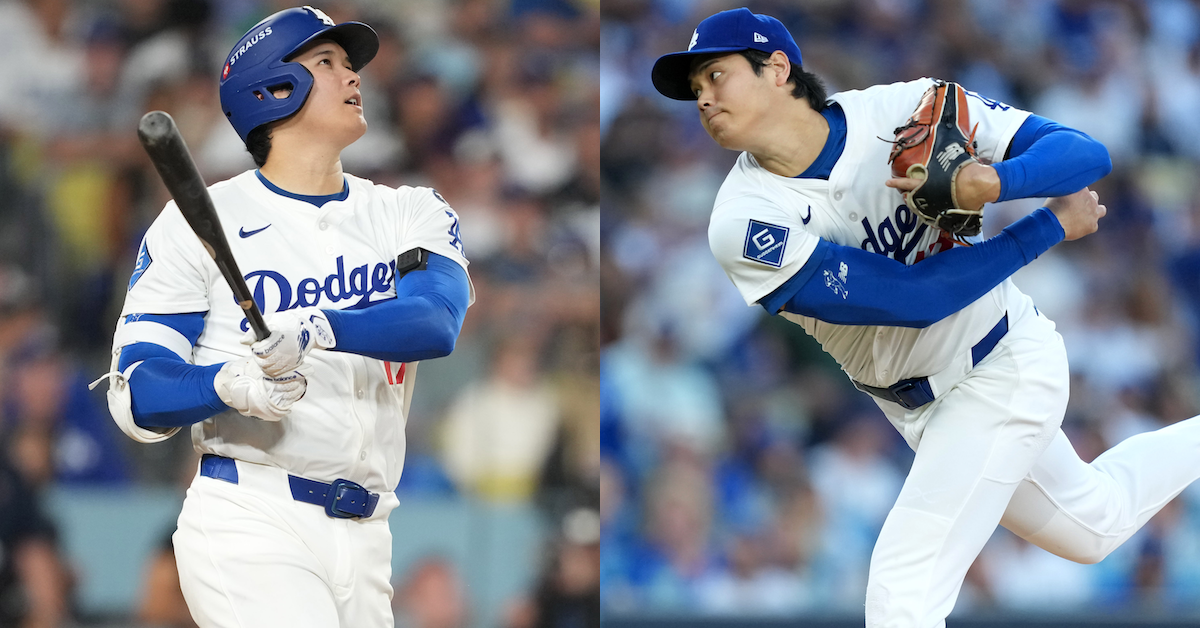
Let’s be more direct: Ohtani just had the greatest individual game in postseason history. On the mound, he threw six scoreless innings, allowing two hits and three walks while striking out 10. He got pulled after giving up two straight baserunners to start the seventh, which kind of mucked up his line, which is ironic, because that’s what the Dodgers offense has been doing to other starting pitchers over the past two weeks. Read the rest of this entry »