Archive for Astros

Which Teams Have Suffered the Most From Injuries?

David Frerker and Jerome Miron-Imagn Images

Major League Baseball’s injured list is the sport’s unofficial 31st team, one that never makes the playoffs but always plays spoiler. In the last week, 22 players were placed on the IL. The biggest name was Will Smith, who late last week landed on the IL with a bone bruise on his hand, courtesy of a rather rude foul tip off the bat of Nick Gonzales.

The Dodgers aren’t known for having a great deal of injury luck, but as injuries go, Smith’s appears to be far less consequential than it could have been. Smith’s tests revealed no fracture, minimizing the amount of time he’s expected to miss. The 30-year-old catcher is having the best offensive season of his career, with a .296/.404/.497 slash line and a 153 wRC+, all except slugging percentage representing career bests. He has played in fewer games than usual, but that’s largely due to the team’s roster construction; he started 39 games at designated hitter in 2022-2023, but Shohei Ohtani’s presence now makes it far more difficult to sneak him into the lineup here when he has a day off of catching. The injury would be a big deal… if it were a big deal, but Smith could return as early as this upcoming weekend. It could have been even sooner, but Smith’s start last Tuesday after missing five games meant that the retroactive IL date was later than September 3, when the Gonzales foul tip occurred.

Smith and the Dodgers seem to have gotten lucky, but the Astros and Yordan Alvarez may not see the same fortune. Less than a month after returning from a broken hand that had cost him more than half of the 2025 season, Alvarez turned his ankle while touching home plate in an awkward fashion that is only appropriate on your Stretch Armstrong doll. He has not yet been placed on the IL, and the exact consequences are still to be determined, but it’s all but official that he is going to miss some time. We’ll know more after his MRI on Tuesday. A serious injury to Alvarez could imperil the Astros in their tight playoff race and beyond if they make it to October.

Alvarez has already spent 115 days on the IL this season, and the Astros have certainly felt his absence, but how do their losses this season compare to those of other teams this season? More broadly, which team has lost the most production to the injured list? If you ask the fans of an underperforming team, the near-unanimous answer will be “us,” but I think we can do better than that! Read the rest of this entry »


Five Things I Liked (Or Didn’t Like) This Week, September 12

Daniel Kucin Jr.-Imagn Images

Welcome to another edition of Five Things I Liked (Or Didn’t Like) This Week. That title is quite a mouthful. Every time I submit it, our helpful back end interface informs me that it is “far too long.” You’re not wrong, WordPress. But I lifted the title and the inspiration for this column from Zach Lowe’s basketball feature of the same name, and every time I consider removing the parenthetical part of it, I remember that the frustrations and failures of the game are part of what makes baseball so compelling. If you never disliked anything about sports, they wouldn’t be so fun to follow. So while every item this week involves something I liked, they also all contain an element of something I didn’t care for. Missed plays, bobbled balls, artificially abbreviated outings, below-average defensive units, lengthy injury recoveries – there are things to dislike in each of these. They all brought me extreme joy anyway, though. Let’s get going.

1. Relatable Frustration
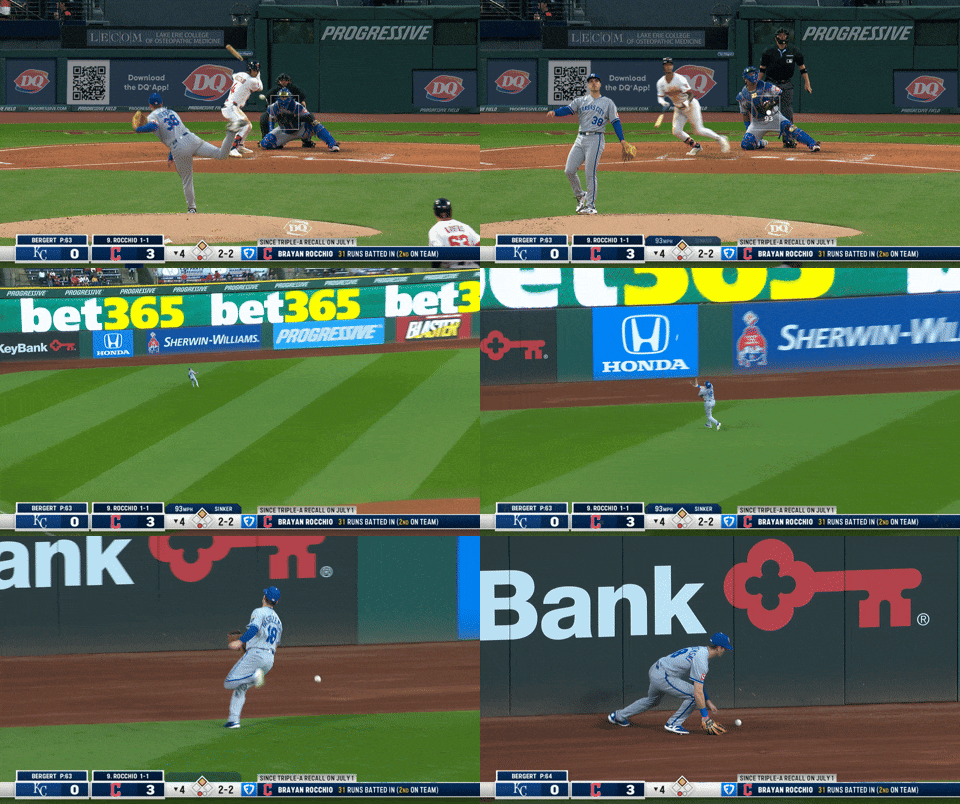
Mike Yastrzemski has been everything the Royals could have hoped for since he joined the team at the trade deadline. He leads off against righties, gets platooned against lefties, and plays his habitual right field. He’s been the team’s second-best hitter behind Bobby Witt Jr., a huge boon as they chase slim playoff odds. Also, when he goofs something up, his reactions are very relatable:

You can see what happened there right away. Yaz’s first step was in, but the ball was actually over his head, and tailing towards the foul line so strongly that he couldn’t reach it. Sure, it was only his second start of the year in left field. Sure, he hasn’t played left for more than a handful of games since 2019. And sure, the ball had plenty of slice on it. But he’d probably tell you the same thing you’re thinking: Major league outfielders, particularly solid ones like Yastrzemski, should make that play. Read the rest of this entry »

Cristian Javier Is Back, but at What Cost?

Mitch Stringer-Imagn Images

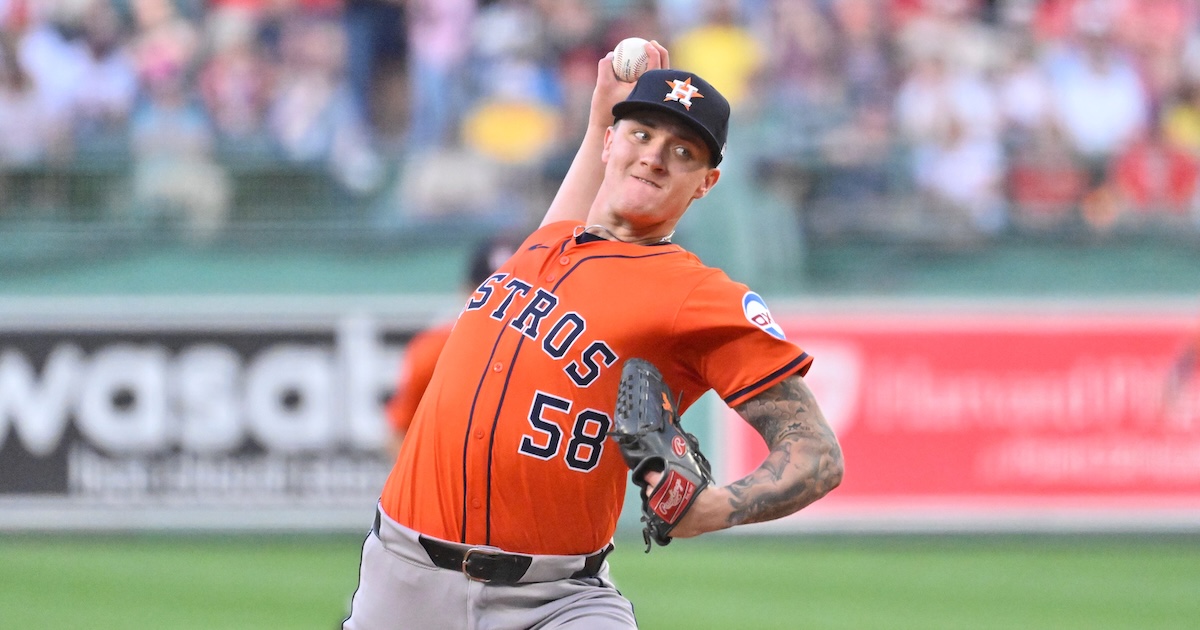
The Astros are almost definitely going to make the playoffs again. They have a four-game lead in the AL West with 22 games to play, which puts them at roughly 2-to-1 odds in favor of winning the division and 9-to-1 odds in favor of taking part in the postseason in some fashion. That would make nine playoff appearances in a row and 10 in 11 years for the Astros, across multiple roster makeovers, three front office regimes, and three managers. Same as it ever was.

What’s a little unusual about this Astros team is that the pitching staff is a bit unsettled. Not unheard of, to be sure; I remember that 2017 team with a pitching staff that destabilized to total entropy after Justin Verlander and Dallas Keuchel. But manager Joe Espada is going to have to do a little tinkering here to make sure the pieces all fit. Read the rest of this entry »


A Roundup of Recent Injuries Among the AL Contenders: The Appendix Appendix

Gary A. Vasquez, Jerome Miron, and Charles LeClaire – Imagn Images

The Rangers really can’t catch a break. Just after I wrote about Nathan Eovaldi’s sneaky great season, the 35-year-old righty briefly took over the official AL ERA lead. Before he could make another start, however, the Rangers announced that Eovaldi would likely miss the remainder of the season due to a rotator cuff strain. As if losing their most effective starting pitcher wasn’t enough, the Rangers also announced on Thursday that Corey Seager, their top hitter, had undergone an appendectomy, putting the rest of his season in doubt.

With his seven-inning, nine-strikeout, one-run effort against the Guardians last Friday, Eovaldi lowered his ERA to 1.73 in 130 innings, exactly enough to qualify based on the Rangers’ 130 games to that point. With that, he snuck ahead of Tarik Skubal (2.32), Hunter Brown (2.36) and Garrett Crochet (2.46) on the AL leaderboard, completing a game of catch-up caused primarily by his missing nearly all of June due to posterior elbow inflammation. Unfortunately, post-start soreness led Eovaldi to shut down his regularly scheduled bullpen session and get an MRI, which revealed a rotator cuff strain.

The 31-year-old Seager has hit .271/.373/.487 for a team-high 136 wRC+; his 21 homers and 3.9 WAR are also tops on the Rangers. He already made two trips to the injured list in April and May for a recurrent right hamstring strain and so has played just 102 games, that after being limited to 123 last year by a sports hernia and 119 in 2023 due to a left hamstring strain and a right thumb sprain. He’s been replaced on the roster by infielder Dylan Moore, who was recently released by the Mariners, but the likely replacement for him in the lineup is superutilityman Josh Smith, who has hit .256/.333/.378 (101 wRC+) while playing every position besides pitcher and catcher. Read the rest of this entry »


Injuries Put the Seasons of Zack Wheeler and Josh Hader in Doubt

Troy Taormina and Eric Hartline-Imagn Images

The Astros and Phillies sit atop their respective divisions despite weathering injuries to some of their top pitchers, and now both teams face the prospect of finishing out the regular season — or perhaps going even longer — without one of their best. On Tuesday, the Astros placed Josh Hader on the 15-day injured list with what was initially described as a shoulder strain; on Friday, they clarified that he has been diagnosed with a shoulder capsule sprain. On Saturday, the Phillies announced that Zack Wheeler had landed on the IL due to “a right upper extremity blood clot” near his shoulder.

The Wheeler injury is the more serious of the two, as blood clots can be life-threatening if untreated, and career-threatening even if they are. Fortunately, it sounds as though the Phillies’ medical team caught this one before it could become an even more serious situation. Wheeler had struggled to some degree since throwing a 108-pitch complete-game one-hitter on July 6 against the Reds, with his ERA and FIP rising as his velocity trended downward. His scheduled August 8 start against the Rangers was pushed back by two days due to shoulder soreness. An MRI taken at the time came back clean, but even so, he set season lows for the average velocity of all six of his offerings once he finally took the mound on August 10.

Both Wheeler and manager Rob Thomson downplayed concerns about Wheeler’s waning velocity at the time. While the 35-year-old righty’s velocity rebounded by 1-2 mph in his August 15 start against the Nationals, he struggled with his command and lasted just five innings for the second start in a row — the first time all season he’d failed to go longer than five in back-to-back starts. Afterwards, Wheeler reported feeling “a little heaviness” on his right shoulder, and an examination on Saturday revealed the blood clot. “Yesterday, some symptoms had changed,” said head athletic trainer Paul Buchheit on Saturday. “Doctors were great in helping to diagnose and expedite that diagnosis this morning.” Read the rest of this entry »


Catching Up With Houston’s Hunter Brown, Who Continues To Evolve

Eric Canha-Imagn Images

When Hunter Brown takes the mound tonight, he’ll do so with some of the best numbers in the junior circuit. Among qualified pitchers, the Houston Astros right-hander ranks third behind Tarik Skubal and Garrett Crochet in WAR, ERA, FIP, and strikeout rate. An All-Star for the first time this season, the 26-year-old Wayne State University product has established himself as a top-shelf starter.

When he was first featured here at FanGraphs in April 2021, Brown was still a prospect; our initial conversation centered around his background and repertoire. When I next caught up with him in August 2023 (Brown had made his major league debut in September 2022), we covered a recent change to his delivery.

What did we discuss when I sat down with Brown in Fenway Park’s visiting dugout during the Astros’ trip to Boston earlier this month? The answer lies below.

———

David Laurila: We last talked two summers ago. What has changed since then?

Hunter Brown: “Two years ago would have been before I started throwing a two-seam sinker and before I started throwing both cutters and sliders. That’s probably the biggest change.” Read the rest of this entry »


Sunday Notes: Jack Dreyer Is a Dodger With a Sneaky Heater and a “Bad Slider”

Jack Dreyer has been one of the top performers on a Los Angeles Dodgers pitching staff that includes no shortage of better-known hurlers. Amid relative obscurity, the 26-year-old rookie left-hander has logged a a 2.98 ERA and a 2.95 FIP over 46 appearances comprising 57-and-a-third innings. Moreover, only Yoshinobu Yamamoto has been worth more WAR (3.5) than has the 2021 non-drafted free agent out of the University of Iowa (1.3).

Our lead prospect analyst was early to the bandwagon. When our 2025 Dodgers Top Prospects list was published in late April, Eric Longenhagen described Dreyer as “incredibly deceptive,” adding that his whippy arm action delivers a fastball that has “20 inches of due north vertical break as it explodes toward the plate.”

The southpaw’s signature pitch wasn’t seen as plus during his injury-marred Iowa Hawkeyes days.

“In college, I was always told that I have average spin rate, so I can’t really throw my fastball at the top of the zone,” recalled Dreyer, who missed much of the 2019 season with a shoulder injury, then all of 2021 after undergoing Tommy John surgery. “I was told that I had a very average fastball. I kind of believed that, but then I got to the Dodgers and they were like, ‘No, actually, your stuff is really, really good. You can live at the top of the zone because of how your pitch moves.’ So, that’s kind of how I’ve adapted my pitching, using heaters at the top, which opens up my other pitches.”

Dreyer’s secondaries comprise a curveball that he’s thrown at a 10.8% clip this season, and a “bad slider” that he’s thrown far more frequently at 45.2%. More on the latter in a moment. Read the rest of this entry »


Five Things I Liked (Or Didn’t Like) This Week, August 8

Chadd Cady-Imagn Images

Welcome to another edition of Five Things I Liked (Or Didn’t Like) This Week. Between a vacation, the All-Star break, the Trade Value Series, and the trade deadline, Five Things has been on a bit of a summer hiatus. Baseball itself doesn’t stop, of course; weird and delightful things happen whether I’m documenting them or not. But I still couldn’t shake the feeling that this week had an extra helping of whimsy. Balls took funny hops. Good pitchers got shelled in unexpected ways. Balks took center stage. Leads changed hands late, defenders kicked things into high gear – there was so much delightful baseball this week that I struggled to narrow it down to five things. Seven things just doesn’t have the same ring to it, though, so let’s quickly nod to Zach Lowe of The Ringer for the column inspiration and get going.

1. The True King of Contact
Writing about Luis Arraez can be a bummer sometimes. Not because he’s bad – he’s emphatically not – but because merely mentioning his name reinvigorates the age-old argument between those who say there are too many strikeouts and those who insist that slug is in the air. Should everyone be doing what Arraez is doing? Is he an anachronism? Is he underrated? Overrated? He’s so good at what he does – and what he does is so different from what most good baseball players do – that these questions are frustratingly omnipresent in any discussion about Arraez.

That said, I think I found an Arraez play that won’t divide the audience. The key is for it not to involve a ball in play, a walk, or a strikeout. Take a look at this beauty:

Read the rest of this entry »


Jose Altuve Doesn’t Need Exit Velocity

Mark J. Rebilas-Imagn Images

Jose Altuve has been doing the same thing for a long time now. The 35-year-old Astro is closing in on 250 career home runs despite the fact that he’s never possessed the look, or even the swing, of a traditional slugger. Altuve has never hit the ball hard and has always chased a bit more than you’d like, but he’s excellent at making contact, which helps him avoid strikeouts, and he’s excellent at pulling the ball in the air, which helps him make the most of that contact. Altuve has ridden those pulled fly balls to a career 114 SLG+ and 101 ISO+. If we start in 2015, the beginning of the Statcast era and the year he really started to focus on lifting and pulling, those numbers are 119 and 113. This year, however, for the first time, I’m genuinely starting to wonder how Altuve is still doing it.

Altuve is running an average exit velocity of just 85 mph. Here’s what that looks like in the context of his career. It’s the lowest mark he’s ever put up by nearly a full mile per hour, and it’s 1.5 mph off the average he put up just last year:

Those numbers look even more stark when we put them in the context of the rest of the league. Altuve is running the second-lowest average exit velocity among all qualified batters. Think of any slap-happy contact hitter – Luis Arraez, Jacob Wilson, Sal Frelick, Geraldo Perdomo – Altuve has a lower average exit velocity than all of them. But like clockwork, Altuve is still running a 120 wRC+ and batting .280. With 19 home runs, he’s on pace for 27, the highest mark he’s put up since 2022. Altuve is still lifting and pulling, lifting and pulling, making contact, avoiding strikeouts, rinse and repeat, even though his contact quality has dropped to about as low as you can possibly imagine. Read the rest of this entry »


Player’s View: Pitchers Weigh in on Their Catch Play Partners (Some Are Nasty)

Vincent Carchietta-Imagn Images

Prior to batting practice, pitchers stroll onto the outfield grass to play catch with each other. Keeping their arms loose is a primary objective of what’s known as “catch play,” but there is more to it than just that. As a rule, the pitchers are throwing with purpose, both in terms of velocity and making sure that their mechanics are in order. At times they are also tinkering with grips, trying to find — or rediscover — desired movement on a specific pitch. And then there is long toss. While not all pitchers employ the practice, it is common to see crow-hop throws from foul line to deep center field. One thing you’ll rarely see is the casual tossing of a baseball back and forth.

How do pitchers get paired up for catch play? Does it differ for starters and relievers? What knowledge can be gleaned from these partnerships? Are there teammates you would rather not have as a throwing partner, because they’re especially challenging to catch?

With those questions in mind, I talked to three starters (Garrett Crochet, Seth Lugo, and Michael Wacha), two relievers (Liam Hendriks and Kirby Yates) a position player turned reliever (Lucas Erceg), a pitcher turned pitching coach (Mark Prior), a pair of pitchers turned broadcasters (Jeff Montgomery and Steve Sparks, and a longtime bullpen catcher (Javier Bracamonte).

———

Garrett Crochet, Boston Red Sox left-hander:

Greg Weissert is my catch partner right now. Honestly, it kind of happened out of necessity. It was Justin Slaten for awhile, but Slaten went down [with an injury]. I was playing catch with our bullpen catcher for awhile, but I prefer to throw with another pitcher. Typically, starters either play catch with each other or with a bullpen catcher. In Chicago [with the White Sox], it was mostly a bullpen catcher for me.

“When I was coming out of the bullpen in 2021, I was throwing with Michael Kopech and everything was just real hard and real scary. Sometimes with Weisert it gets that way, too, especially with the curveball he throws. It’s different for Greg and myself, too, because he has to be ready to pitch every day, whereas I don’t. I’m probably the one that he hates to catch. But no, he loves it. He’ll get down on one knee, use a catcher’s mitt, catch flat-grounds. It’s cool. I try to get after it as much as my body allows me to. Read the rest of this entry »