Archive for Daily Graphings

Contract Crowdsourcing: Carl Pavano

Because not everyone is interested in Giants-Braves or Rangers-Rays, we’ll mix in some other stuff during our playoff coverage this week as well. Today, we’ll attempt to estimate the contract that Carl Pavano will receive this winter. In order to give people some assurance that I’m not slanting the votes in any particular direction, I’ll save my commentary on Pavano for tomorrow’s recap of what you guys think he’ll end up with. For now, just the facts.

2010: 221 innings, 1.51 BB/9, 4.76 K/9, 51.2% GB%, 4.02 FIP, 4.01 xFIP, 3.75 ERA

2010 salary: $7 million – accepted arbitration last winter.

Compensation: Projected Type A free agent


2010 Disable List Spreadsheet and Team Information

Overview

I have finally gone through the MLB transaction data and have compiled a spreadsheet of the all of the trips to and from the disabled list for the 2010 season. Feel free to download the data and use it as you see fit. If you use the data in your own article/research there is no need to reference my work since the data can be obtained freely. I am just wanting to make it available for people to use. If you do plan on using it, here is an explanation and limitation of the data.

Explanations of the columns:

Team – The team that placed the player on DL.
Trans – The date that the official transaction occurred – This can be different than the official start date as some injuries occurred before the player was on the DL
POS – Position of the player
First – First name of the player
Last – Last name of the player
Started – When a player’s official DL time starts
StartedInSeason – Some players were placed on the DL in January. This date marks the date when the player actually begins to miss regular season games.
End – When the player’s official DL time ends. Many of these records are unknown right now because teams haven’t taken all their players off the DL yet.
EndedInSeason – Many players are still on the DL, even though the season has ended. This marks the date when the player no longer misses any regular season games.
TotalInSeasonDays – Total days missed during the 2010 season
Transferred to 60 day DL – Date the player was transferred to the 60 day DL (if applicable)
Disabled list – If the player was initially placed on the 15 or 60 DL.
Side – Side of the body (if given)
Location – Part of the body that the injury occurred. It will be filled out for each player.
Body Type – Body type (i.e. bone, ligament) injured. This was only filled out if listed in the transactions
Injury – Type of injury that occurred. If there was none listed, the vague term “injury” was used. I plan on looking these up on a later date. It will be filled out for each player.
Extent – Extent of injury, if given.
Surgery – Used if surgery was known. There are definitely more surgeries that happened, but these were the only ones listed in the transactions.
Surgery date – Date of the surgery.

Limitations

The data is probably only 90%-95% correct at this point. Going through the data, there was quite a bit of missing information, especially when it came to players going on the 60 DL or when a player was taken off the DL and then sent to the minors. If anyone sees an error, I will gladly fix the data and mark it in the versions at the bottom of the spreadsheet. You can email errors to me at wydiyd ~ hotmail ~ com

Well enough of background information, how about some graphs.

Team Data

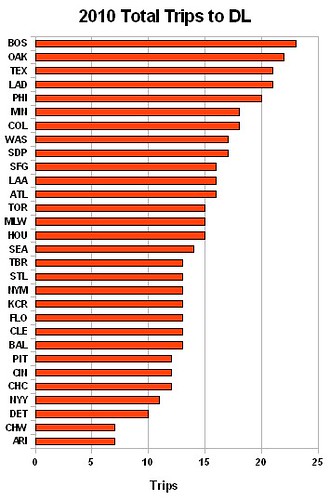
Here is how each team fared in the total number of trips to the DL:

2010Trips

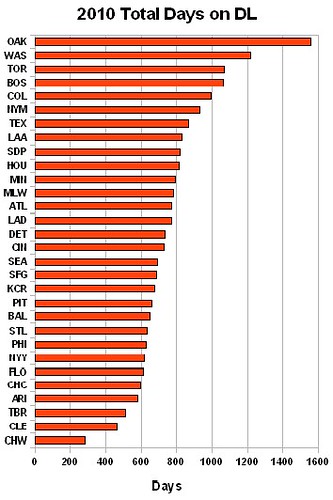
Here are the total days lost to the DL for each team:

2010days

No data really stick out to me, except for the huge discrepancies from the teams on extremes of days lost. The Oakland Athletics lost five time as many games to the DL than the Chicago White Sox . In the next day or so, I will be breaking down the data according to position.


NLDS Games Two and Three Review: Cincinnati

Due to various commitments, I saw very little baseball this weekend, including missing both of the final two Reds-Phillies match-ups. That makes writing up reviews of them a bit challenging, as I’m relegated to box scores, highlights, and scrolling through my twitter feed for at-the-time reactions to what was happening. Based on those three things, this is what I can basically surmise:

The Reds sucked at defense. Cole Hamels was excellent.

And that’s basically the story of the weekend. On Friday night, the Reds committed four critical errors which led to most of the Phillies offense. Back to back fifth inning botches by Brandon Phillips and Scott Rolen set up a base hit by Chase Utley to score two runs, and then the epic double error by Jay Bruce and Phillips gave up the lead for good.

On Sunday, another error by Orlando Cabrera gave the Phillies their first run, and the only one they would need, as Hamels did his best Roy Halladay impression, shutting the Reds down and giving his team a first round sweep.

Clearly, the Reds were just outplayed. They didn’t hit, they didn’t field, and while they pitched well, they didn’t pitch quite well enough. They managed to hold the Phillies to a .212/.301/.273 line for the series, but didn’t spread the baserunners out, so the Phillies were able to get 13 runs in three games out of a .574 OPS.

You could make some arguments that Dusty Baker made a few poor decisions and the umpiring wasn’t exactly stellar, but those things didn’t affect the outcome of the series. This series was decided by two excellent pitching performances and one terrible defensive performance. Everything else is just superfluous.

So now, the Phillies advance for a match-up with either San Francisco or Atlanta, where they will be large favorites again. The Reds head home and prepare for 2011, and while the season didn’t end the way they would have hoped, they have to be happy with the results overall. They have a lot of talent to build around and a winter to address some of the problems on the roster. Given a few days to get over their performance in the division series, they’ll look back and be proud of what they accomplished this year. And they should be.


NLDS Game Three Review: Atlanta

Here’s a quick summary. Johnathan Sanchez and Tim Hudson threw gems, with the only run of the first seven frames coming off a Braves error. The Atlanta offense sputtered until Eric Hinske dumped a two-run home run just over the right field fence. The Giants offense rallied with two outs to tie the game off fill-in Atlanta closer Craig Kimbrel, but it looked like the game would only be tied heading into the Braves’ half of the ninth. Instead, a grounder off the bat of Buster Posey found it’s way through the legs of Brooks Conrad – the second baseman’s third error of the day (videos here) – and the Giants took a 3-2 lead. They would not relinquish it, as Brian Wilson worked around a two out single to finish the game.

As much as the pitching performances and the clutch home run by Hinske are stories in themselves, the real story will be the terrible performance by Brooks Conrad. Conrad was 0-3 at the plate for a -.116 WPA, including a failed bunt attempt in the top of th 8th inning down by one run. His fielding performance, however will go down as historically bad, as two of his three errors were at least partially responsible for two of the three runs scored by San Francisco tonight.

The first error came in the first inning, as Conrad couldn’t handle a ball off the bat of Freddy Sanchez, resulting in two on and nobody out. We can’t assume the double play here, particularly because the runner on first, Andres Torres, was off with the pitch, but recording the out at first would’ve resulted on only the runner on second and one out instead. According to the WPA Inquirer – a tool that will be used throughout this post – that error cost the Braves 7.3% in terms of win expectancy, or a -.073 WPA for Conrad.

The second one wasn’t significantly more costly, but it did directly result in the first Giants run. In the second inning with none out and a runner on third, Conrad dropped a fly ball off the bat of Cody Ross, allowing Mike Fontenot to score and Ross to reach first base. According to the announcing crew, Fontenot hadn’t tagged up on the play, which would mean that the result of a catch would’ve been a runner on third, one out, and a tie game. That difference comes out to an 8.4% drop in win expectancy for the Braves – at third base and with only one out, there’s still a high probability that Fontenot would have scored. That puts Conrad’s total defensive WPA to this point at -.157, already an impressive total for a whole game, much less two innings.

The third one is the one that will stick in the minds of Braves fans and all others who watched this game unfold. The grounder off the bat of Posey found its way under Conrad, scoring Sanchez from second and allowing Aubrey Huff to go from first to third. If Conrad makes the play, then the inning is over and the game moves to the bottom of the ninth tied at two. It’s hard to overstate the importance of this play. If the out is made, the Braves carry a 62.6% win expectancy into the last half-inning. Instead, the Braves were down to a mere 14.7% win expectancy as Sanchez crossed the plate and with more threats on the bases. That expectancy, in reality, should be even lower due to the presence of Brian Wilson in the San Francisco bullpen. Lowering the run environment to three runs per nine innings results in an 11.8% win expectancy for Atlanta. Effectively, Conrad’s error lowered the Braves chances of winning from 5 in 8 to somewhere between 1 in 7 and 1 in 9.

Conrad’s total defensive WPA in this game comes in at a staggering -.635. That number, combined with his -.116 batting total, comes out to a total WPA of -.751. Brooks Conrad cost the Braves 75% of a postseason victory, one which would have put them one victory away from the next round of the playoffs. Conrad’s play tonight, particularly if the Braves don’t come back to win this series, will go down as one of the worst playoff performances of all time.


NLDS Game Three Review: San Francisco

Another Giants-Braves matchup, another one-run game. Unlike Friday’s splash hit special though, the drama ultimately went in San Francisco’s direction this time.

Through the seventh inning, I expected I’d mostly be writing about Jonathan Sanchez‘s terrific performance. Sanchez’s first seven innings were reminiscent of Tim Lincecum‘s outstanding series opener: he was a little shaky with his command in the first inning, but then settled into a groove and dominated. After a first inning walk to Derek Lee, he didn’t allow a hard-hit ball until Matt Diaz‘s flyout to right in the fifth, and didn’t allow a hit until Tim Hudson’s soft line drive single in the sixth. Along the way, Sanchez struck out 11 and had retired 14 consecutive batters at one point.

Meanwhile, back on offense, the Giants couldn’t manage much more than an assortment of walks and groundballs against Hudson. The lone run they provided in support of Sanchez came courtesy of two shadow-assisted dropped flyballs; one by the soon-to-be infamous Brooks Conrad, whom we’ll get to in a moment.

Then came the second thing I thought I’d be writing about, the Braves comeback in the bottom of the eight. With a runner on and 105 pitches on his arm, Bruce Bochy pulled Sanchez for Sergio Romo. Here are my notes from the inning:

bot 8
2nd hit for ATL, sharp liner by Gonzales
Conrad with a chance to be a hero flubs a bunt
Glaus hitting for Ankiel
Romo in for Jonathan; gutsy move by Boch
Hinske in for Glaus
Hinske HR
Braves lead 2-1

I heard someone on the radio this morning quote Bochy as saying he was going to play the matchups from the sixth inning onward today, and in this case it obviously backfired as Bobby Cox had an extra bat. I usually try not to second guess managers, but for me it was a questionable call at the time, as the Braves hadn’t done anything with Sanchez and Romo had a rough outing on Friday.

Bochy stuck with his guys in the ninth inning, and didn’t use a pinch hitter other than Travis Ishikawa in the pitcher’s spot, while Cox worked his way through three pitchers. The Giants managed to keep runners on base long enough for Buster Posey to find Conrad with a hard groundball. In what seemed like an act of destiny, Conrad let the ball sail through the five-hole, giving Freddy Sanchez plenty of time to score the eventual winning run from second.

Which brings us to the third thing I thought I’d be writing about: Conrad’s defense. I was fully prepared to stick up for Conrad a bit here, particularly over the dropped flyball, but that last error was really inexcusable for a major league player in the post-season. The ball was hit right to him and the game was on the line; if he had even kept the ball in the infield it would have likely been a different game.

All in all though, it was the the third great game of the series.


ALDS Game Three Review: Texas

The Rangers seemed like they were on their way to their first ever postseason series win, when Ian Kinsler homered in the 7th inning giving the Rangers a 2-1 lead. Once the Rangers got the lead, it looked like the game was in their hands because of the pitching staff’s performance so far in the series. The Rangers pitchers pitched amazingly for the first 25 innings of the first 3 games of the series allowing only 2 runs.

Then Tampa Bay’s offense then came around and put up 5 runs against the Ranger’s pen in the 8th and the 9th inning. In the first two previous games, Tampa had just 8 total hits. In the 8th and 9th alone, they got 6 hits including 2 home runs.

The main problem was that of the 6 relievers brought in by Texas in the game, 5 allowed a hit and 4 of them allowed a run to score. Besides Darren O’Day being brought in to just face (and strikeout) B.J. Upton in the 8th inning, not one reliever was able to shutdown the Rays while pitching. Here is how each of the other Texas relievers fared:

Derek Holland faced 3 batters allowing a hit and a walk.
Alexi Ogando faced 2 batters allowing a double.
Darren Oliver faced 7 batters allowing 2 doubles and a single.
Neftali Feliz faced 4 batters allowing a home run and a single and a walk
Dustin Nippert faced 5 batters a home run and a single.

Over the four innings of work, the relievers allowed a AVG/OBP/SLG slash line of: 0.474/0.525/0.843. Ouch.

The Rangers have two more chances to close out the series starting tomorrow. In order to get another win, they can not have anything close to the group effort blowup that the bullpen exhibited today.


Open Thread – October 9th, 2010

Because we can’t run chats everyday, feel free to use this thread to chat about today’s playoff games.

TB @ TEX – 5:00pm ET
MIN & NYY – 8:30pm ET


ALDS Game 3 Preview: Carson Cistulli’s Druthers

Starting Pitchers
Tampa Bay: Matt Garza (R)
204.2 IP, 6.60 K/9, 2.77 BB/9, .279 BABIP, 35.8 GB%, 10.0 HR/FB%, 4.51 xFIP.

Texas: Colby Lewis (R)
201.0 IP, 8.78 K/9, 2.91 BB/9, .292 BABIP, 37.9 GB%, 8.2 HR/FB%, 3.93 xFIP.

If Carson Cistulli Had His Druthers: A (Not-All-Inclusive) Retrospective
• April 28: “Colby Lewis would just get it over with, and admit to everyone that he’s the Son of Man … Colby Lewis would soar like an eagle — into my heart.”
• April 30: “Colby Lewis would steal fire from the gods and give it to humans … Colby Lewis would fashion all humankind from clay … Colby Lewis would continue to pitch out of his mind, thus validating my continued presence on this, the internet’s clearinghouse for baseball nerdom.”
• May 21: “Colby Lewis would found a fast-food chain … The featured item on menu of said chain would be sliders … Get it? Sliders!”
• August 13: “Someone would design a plane or something modeled after Colby Lewis’s dynamism.“
• September 27: “I’d write a “season with”-type book featuring Colby Lewis and Andres Torres and maybe Manny Parra … It’d mostly be about all of us playing volleyball together.”

Other Quotes Emphasized in Mr. Lewis’ Restraining Order Claim
• April 12: “I’ve been seduced by the righty’s optimistic CHONE projection and have heralded him — on this site, to my mother, wherever — as a Person of Interest for this here season.”
• May 5: “Even though it’ll probably seem like it most of the time, Colby Lewis will not, in fact, be the only guy on the field this afternoon in Oakland. In fact, there are a couple-few players who — despite lacking Lewis’s direct connection to the godhead — have actually managed to distinguish themselves as worthy of the baseballing enthusiast’s attention.”
• On May 21:

What You, the Reader, Are Saying to Me
Hey, Carson: did you ever consider for even one second in your life that maybe Colby Lewis isn’t some kind of deity?
What I Am Saying Right Back to You
Yeah, I actually did think that for a second, and it was the darkest, loneliest second of my life, you jerk nut.

• May 28: “Watch For: Colby Lewis, Duh.”
• June 18: “Colby Lewis is in my heart and he’s in my soul. Also, he’s probably gonna be my breath should I grow old. So, back off.”
• July 16: “To my sabremetric brothers and sisters, I’d like to inform you that the Most Reverend Colby Lewis will be preaching the Gospel of Joy tonight from the Fenway Park mound. Here’s what you can expect: lifted spirits, charismatic gifts, and a slightly regrettable soul patch.”
• August 13: “Colby Lewis is dynamic. That’s it: he’s just frigging dynamic.”
• August 19: “Colby Lewis is a Colby Lewis among men.”
• August 24: “And also, I SCREAM FOR COLBY LEWIS.”
• September 9: “Ask not what your Colby Lewis can do for you; ask what you can do for your Colby Lewis.”

Why I Didn’t Give You a Link to All These Articles
If you put “Colby Lewis” and “Carson Cistulli” into Google, you get 704 results. In fact, if you do it right now, you’ll probably get 705 results.

The Time Cistulli Offered Real, White-Hot Analysis: April 30
In the hours before Lewis’ first complete game shutout, and the months before they would become teammates, the prophetic Cistulli wrote this:

Five Bizarre Connections Between Colby Lewis and Cliff Lee
Put away those Ouija boards, kids, and prepare to get your minds freaked. Behold these five bizarre connections between tonight’s starters.

1. Both pitchers have two first names.
2. Both have the initials C.P.L. (Colby Preston Lewis, Clifton Phifer Lee.)
3. Both pitchers have pitched in the East: Lee in the NL East, Lewis in the Far.
4. Owing to the fact that they’re both so nasty, neither Lewis nor Lee has ever, in fact, kissed his mother with that mouth.
5. Lewis’s secretary was named Kennedy; Lee’s, Lincoln. Don’t even look it up, it’s true. You’ve got the Cistulli Guarantee on that.

Tonight’s ALDS Game 3 Preemptive Review

1. Josh Hamilton will mash a tater.

2. The tater will be cooked by Matt Garza.

3. Colby Lewis will throw stinky cheese on top of his sliders.

4. Other Rays players will be there tonight, too.

5. And all of them will probably strike out.

/Cistulli’d.


ALDS Game 3 Preview: Minnesota

Tomorrow night at Yankee Stadium, the Twins will face their first true must-win game of the season. It doesn’t matter what the pundits said during the regular season; it doesn’t matter who wrote an alarmist column after a losing streak. In the regular season, there was always a next game for the Minnesota Twins. If they come up short in New York on Saturday night, the next game for the Minnesota Twins Baseball Club will be on April 1st, 2011, and that will surely be a different team, with certain moving parts shuffled out and new acquisitions inserted. This is not a “must-win” game in terms of some sort of abstract momentum or for team morale. No, this is about survival, about an entity that will cease to exist if the game is lost.

The Twins will send relatively unknown lefty Brian Duensing to the mound. Despite a lack of exposure, Duensing has had a solid season. In only 130 innings, Duensing picked up 1.7 WAR, mostly thanks to great control but also an ability to keep the ball on the ground. Duensing doesn’t strike out many batters – only 5.4 per nine innings – but he walks fewer than 2.5 per nine and his 53% ground ball rate keeps the ball in the yard. Duensing has a pretty basic repertoire, using a low-90s fastball, a slider, a changeup, and, sparingly, a curveball, and according to our pitch type values, they were all relatively successful, at or above league average. Particularly deadly was the slider, which came in at a whopping 14.3 runs above average for the whole season and +3.9 runs per 100 thrown. The raw total is 13th among all MLB pitchers; among starters, only Mark Buehrle tops Duensing’s per-pitch mark.

The slider is typically a powerful pitch against same handed hitters, and so, unsurprisingly, Duensing does exhibit a marked platoon split. Lefties have only a .231 wOBA against a .327 wOBA for righties. This comes in only 243 and 651 batters faced respectively, and so we should expect a platoon split somewhere between the league average of 20 points and the nearly 100 points observed so far. Still, Duensing’s reliance on a nasty slider does suggest that he may be a lefty killer, and the fact that his slider wouldn’t work as well against right handed batters would support a large platoon split.

That means that neutralizing righties will likely be a key for Duensing, and that means neutralizing Derek Jeter, Mark Teixeira, Alex Rodriguez, Jorge Posada, Nick Swisher, and Marcus Thames.

With that kind of lineup, even though Duensing is talented, the Twins will have to score some runs. They finally will get a game against a right handed pitcher in Phil Hughes, which should help Joe Mauer, Jim Thome, Denard Span, and Jason Kubel. Of course, Hughes is a good pitcher himself, but the Twins lineup is designed to hit right handed pitchers, and at the New Yankees Stadium, it wouldn’t be surprising to see a home run or two from the Twins powerful lefties, particularly Thome.

The bullpen for Minnesota should be well rested. Nobody threw multiple innings on Thursday, and Brian Fuentes, who threw 1.2 IP on Wednesday, will have two full days of rest. Jon Rauch, Matt Capps, Matt Guerrier, Jose Mijares, and Fuentes – the key pieces of this Twins bullpen – should all be good to go tomorrow.


Scouting NLDS Game Two Starters

A look at the pitch selection and pitch outcomes of NLDS Game Two starters. See ALDS Game Two starters, ALDS Game One starters, and NLDS Game One starters.

CIN: Bronson Arroyo, RHP: 5.05 K/9, 2.73 BB/9, 1.21 HR/9, 3.88 ERA, 4.61 FIP

High-80s four-seam and sinker (39.5%)
Low-80s changeup (25.0%)
Low-70s curveball (14.6%)
Mid-70s hard slider (13.6%)
Mid-80s cutter (7.3%)

The right-handed Bronson Arroyo throws multiple pitches at varying speeds. He’s especially adept at throwing the curveball at different speeds, sometimes categorized as sliders. He uses his curveball against RHH and his sinker against LHH, both pitches that go sharply away from the batter. Arroyo doesn’t get too many swinging strikes, but when he does, it’s usually on the curveball to RHH, his best and most valuable pitch. His changeup is actually put in play the most.

In terms of batted ball outcomes, Arroyo’s curveball induces the most flies, while his changeup and cutter (used rarely) gets the most grounders. Finally, he’s ahead in the count on 30.0% of the time and behind in the count 25.2% of the time.

PHI: Roy Oswalt, RHP: 8.21 K/9, 2.34 BB/9, 0.81 HR/9, 2.76 ERA, 3.27 FIP

Mid-90s four-seamer and sinker (55.4%)
Low-80s changeup (15.0%)
Mid-80s slider (14.9%)
Low-70s curveball (14.8%)

The right-handed Roy Oswalt throws five main pitches, splitting up the use of the four-seam fastball and sinker evenly. Both Oswalt’s curveball and slider cave in on LHH, while his other pitches go toward RHH. Against RHH, Oswalt relies heavily on his four-seam fastball, throwing multiple fastballs in a row at some points, but mixes all of his pitches up (except the slider) against LHH. His curveball is better used to get swinging strikes against LHH, while his changeup fools RHH quite a bit, a pitch he just added and perfected this offseason.

Oswalt’s changeup induces the most grounders, even more than his sinker. One important split is that his curveball gets far more pop-ups off RHH than LHH (25.0% of curveballs put in play vs. 6.1%). Finally, Oswalt is ahead in the count (34.6%) a much higher percentage of the time than behind in the count (22.0%).

ATL: Tommy Hanson, RHP: 7.68 K/9, 2.49 BB/9, 0.62 HR/9, 3.33 ERA, 3.31 FIP

Mid-90s fastball (57.0%)
Mid-80s slider (28.0%)
Mid-70s curveball (12.3%)
Low-80s changeup (2.7%)

The right-handed Tommy Hanson throws four main pitches, of which his 12-6 curveball is one of the better ones in the game. Because of the major vertical break on this pitch that is different from sweeping curveballs, Hanson is able to use it frequently against LHH, actually more frequently than against RHH (16.1% and 8.9%). He uses the curveball and slider to get swinging strikes from RHH, but uses his changeup in addition to get the same result from LHH (he almost never uses the changeup against RHH).

For batted ball outcomes, RHH hit grounders at roughly the same percentage of the time against all pitch types. For LHH, grounders come off the slider, curveball, and changeup while flyballs come off the fastball. Sliders also get LHH (16.3% of sliders put in play) to pop-up more frequently than RHH (6.7%). Finally, Hanson has a slight advantage to the batter while working the count, getting ahead in the count 29.6% of the time and staying behind in the count 25.3% of the time.

SF: Matt Cain, RHP: 7.13 K/9, 2.46 BB/9, 0.89 HR/9, 3.14 ERA, 3.65 FIP

Mid-90s fastball (63.2%)
Mid-80s changeup (13.8%)
High-70s curveball (13.5%)
Mid-80s slider (9.5%)

The right-handed Matt Cain throws four distinct pitches and relies heavily on the fastball on over 60% of all pitches. His fastball and changeup go toward RHH, while his curveball and slider go toward LHH. Cain throws his curveball against both handed batters, but relies heavily on his slider as the additional breaking ball against RHH and changeup for LHH. For both batters, his slider and changeup induce the most whiffs of any other pitch, but his curveball is good at keeping the ball from coming in play.

Changeups result in grounders more than 50% of the time a changeup is put in play for both RHH and LHH. Pop-ups off fastballs occur occasionally, about 15% of fastballs put in play for both batters. Finally, Cain has an advantage of being ahead in the count (30.6%) more than he is behind in the count (26.3%).