Archive for Daily Graphings

NLDS Game Two Preview: Cincinnati

Tonight, the Reds try to do something they couldn’t do on Wednesday – get a base hit off a guy named Roy. This time they have to contend with Roy Oswalt, who is not quite as good as Roy Halladay, but is still no walk in the park. There’s nowhere to go but up from their Game One offensive performance, but even still, the Reds shouldn’t count on a scoring bonanza. In order to win this game, they likely need to hold the Phillies to three runs or less.

The man who begins the game with the pressure of stopping the Phillies? Bronson Arroyo, who besides having a “roy” in his last name is not really comparable to his counterpart. His 4.60 xFIP is a better representation of his abilities than his 3.88 ERA, and, well, that’s just not all that great. Especially concerning are his struggles against left-handers. Here are his career splits:

Vs RHB: 2.37 BB/9, 7.48 K/9, 0.87 HR/9 .278 BABIP, 3.64 FIP, 4.08 xFIP
Vs LHB: 2.87 BB/9, 4.56 K/9, 1.39 HR/9, .297 BABIP, 5.21 FIP, 4.95 xFIP

His line against lefties this year was right in line with his career numbers, so he hasn’t gotten any better at getting them out. And, of course, the Phillies line-up is going to be lefty heavy tonight. It’s not a good match-up for the Reds starter.

And so, just like with game one, I’d argue that the Reds best chances of winning tonight involve pulling Arroyo early. You’re tempting fate every time you ask him to get the Rollins-Victorino-Utley-Howard group out more than once. With Aroldis Chapman fresh and the day off tomorrow, I think the Reds should empty their bullpen tonight, regardless of what the score is early. Arroyo gets the first 11 batters and that’s it. If he gets 11 outs, great. If he only gets five or six, well, you live with it.

Once Utley comes to the plate a second time, I’d have Chapman on the mound. Yes, Utley is good against left-handed pitchers, but Chapman is not your average LHP, and the odds of him putting one over the wall are substantially higher against Arroyo. You’re going to want Chapman in against Howard and Ibanez anyway, so maximize the batters he faces by bringing him in to face Utley.

Even though he’s been used in shorter stints out of the bullpen, he’s clearly got the ability to go multiple innings, and I’d try to squeak nine outs out of him if I could. He’s probably the Reds best chance to put zeros on the board, and that’s what they need tonight.

If the Arroyo/Chapman combo gives the Reds five innings and keeps it close, they have a chance. They could then mix and match Homer Bailey, Bill Bray, Nick Masset, Arthur Rhodes, and Francisco Cordero to cover the final four innings, getting the platoon advantage in most situations and generally having pretty good relievers on the mound. But, those guys aren’t going to matter much if the Phillies are up by several runs before they even get to the bullpen.

Arroyo’s had a nice year for the Reds, but this isn’t a game where he should be asked to give you too much. If he can get through the line-up once, he’s done his job and should be congratulated. This isn’t a time to reward him for his regular season work, especially not with a bunch of guys who swing from the left side coming up.


ALDS Game Two Review: Yankees

You might have learned in your years as a schoolboy or schoolgirl that the earth’s tilted rotation around the sun causes seasonal changes in weather. Scientifically that might be true, but any baseball fan will tell you that the seasons follow the sport. As the winter frost thaws we’re instilled with a sense of hope — a feeling that this year could be the year. The warmer the weather gets the more drawn we are to even-keeled analysis. Why isn’t this player performing well? How did this move work out for that team? But when the weather starts its progression back toward winter, we shed our analytical hats and immerse ourselves in the drama that is the MLB postseason. For one month, what happened in the previous six don’t matter.

In the first half of 2010, Yankees fans found an easy whipping boy in Curtis Granderson. The team traded a top prospect to get him, and when that top prospect got off to a torrid start the criticism heightened. Granderson was not only a bum because he wasn’t producing, but because the player they traded for him, Austin Jackson, was off to one of the finest Aprils in the game. It took a few days off in August and a change in approach before fans even remotely warmed to Granderson. But in Game 1 of the ALDS all was forgotten. Granderson hit a go-ahead triple. Even if the Yankees get bounced before the World Series, the fans will remember that more than they do the regular season.

Granderson’s August resurgence left a void in Yankee fandom. Who would they criticize mercilessly? Who would represent the differences between the 2009 and the 2010 teams — the foil to Johnny Damon and Hideki Matsui? The answer was soon clear. Lance Berkman had a horrible start to his pinstriped tenure, and fans wasted no time in calling him a terrible acquisition. Even his explosive production upon returning from the DL, there was still a vocal sect of fans who proclaimed Berkman the worst acquisition ever. But in Game 2, all ill will was forgotten. It’s his big moments that we’ll remember.

The first came in the fifth inning, while the Yankees were still having problems hitting Carl Pavano. Alex Rodriguez tied the game with a sac fly in the previous inning, but that actually subtracted from the Yankees’ Win Expectancy. Making outs, even when it results in a run, just isn’t that productive. But an inning later Berkman got a hold of a Pavano sinker and sent it over the bullpen for the Yankees’ second run. Two innings later he again laid into a Pavano pitch, though this one didn’t quite have the distance. But it still went over Denard Span’s head and then caused more trouble when Span overpursued it. Jorge Posada scored all the way from first, which again gave the Yankees a lead- a lead they wouldn’t relinquish.

Berkman’s WPA on those two plays was .327, and even with his outs he ended with a .292 WPA, easily the best of the game. With a 3 for 4 day, tainted only by a sac bunt, Granderson added 11.8 percent to the WE. Brett Gardner and Mark Teixeira also ended in the positives.

On the pitching end, the Yankees had everything going for them. Despite a tighter strike zone (see below), Andy Pettitte held the Twins in check through seven innings. He made a mistake with a breaking ball to Orlando Hudson, but other than that he was settled into a zone by the third inning. The Twins had a few chances early, when Pettitte left pitches up in the zone, but later on it was too late. Everything was down, and it led to 11 straight outs before the Hudson homer. He then retired five of the next six batters before exiting the game. Kerry Wood then came on to strike out two in a flat-out dominant performance. Mariano Rivera did what he’s done for the past 15 years.

The Yankees leave Minnesota in the best of positions. They head home with a chance for a sweep; if that doesn’t work out on Saturday, they then have their ace ready for a potential Game 4 on Sunday.


Complaining about the umps is usually the territory of the losing team. Just look at the past few Yanks-Twins ALDS threads. Apparently the Yankees are running a scheme that makes the Black Sox Scandal look like amateur hour. They’re paying the umps to give them favorable calls, especially when it comes to the strike zone. It make perfect economic sense. They’ll make more money by winning the World Series than they’ll be paying out to the umps — they’d be stupid not to bribe them. It’s clear to anyone paying attention that’s what’s going on…

Back to reality, the strike zone was particularly horrible tonight. Yes, I noticed it because I root for the Yankees and noticed that Andy Pettitte wasn’t getting the same calls as Pavano. It was clear on the TBS Pitch Trax, and it was clear on PitchFX (though I’m not sure if the two are related). Here’s the strike zone Hunter Wendelstedt called for Pavano:

And here’s the one called for Pettitte:

It’s clear that some pitches called strikes for Pavano weren’t given the same benefit for Pettitte. This advantage didn’t end up helping the Twins, but on a different night it might have. This isn’t so much a complaint about the specific game as it is about the future. If Wendelstedt is allowed to call balls and strikes in future postseason games he’s apt to make the same mistakes. Apparently he has trouble discerning pitch location relative to pitcher handedness. This is what we’ve seen touted as the human element, but it’s nothing more than inaccuracy. I’m not sure what to do about it, but at the very least MLB shouldn’t allow Wendelstedt to continue umpiring postseason games. His zone was objectively inconsistent.


Is the Steroid Ban Responsible for the “Year of the Pitcher”? No, Say Freakonomics Writers

“Twice in the past decade, I have really tried to find evidence that say that steroids matter in baseball. And both times I invested a lot of effort, and ended up finding no evidence that steroids mattered.” — Steven Levitt, co-author of Freakonomics

Since the publication of Freakonomics in 2005, the book has become something of a franchise for co-authors Stephen Dubner and Arthur Steven Levitt: it led to a sequel (SuperFreakonomics), a New York Times blog, a podcast, a regular segment on NPR, and a just-released documentary film. Not bad for popular nonfiction.

On Tuesday, they trained their eyes on the so-called “Year of the Pitcher,” the 2010 season which has seen a significant decline in scoring and increase in no-hitters, and asked the question: is the steroid ban responsible? Twenty-four minutes later, and after interviewing Levitt, Mitchel Lichtman, Doug Glanville, and Padre manager Bud Black, Dubner concludes that… well, it’s hard to say, really, but maybe it has something to do with defense. That’s the same conclusion drawn on their blog by Hayes Davenport (a Comedy Central writer, on staff at Will Ferrell’s “Big Lake”). The 24-minute podcast was shrunk to a six-minute segment on NPR’s syndicated Marketplace program, alongside stories about the Nobel Prize in Economics and safety guidelines for the Boeing 787.

The research presented isn’t particularly eye-opening… but then, it’s being presented on NPR. This may have been the Year of the Pitcher, but in many ways it’s also been the year of the mainstreaming of advanced statistics. Fangraphs is on ESPN! Bill Simmons is a stat nerd! Dave Cameron is King of All Media! The kind of conversations taking place here, and at Insidethebook and Billjamesonline and Hardball Times and Baseball Prospectus and Athletics Nation and all the other pioneering stat sites, are expanding to latte-drinking radio listeners and Will Ferrell fans. Sabermetrics was a tiny subculture for so long that it can be hard to adjust to the fact that what used to be the bleeding edge is now the mainstream.

Welcome to the mainstream, fellow nerds!


NLDS Game One Review: Cincinnati

Sometimes, you lose. Other times, the opponent wins. Last night, Roy Halladay beat the Reds, and they should just tip their hat to him and say congratulations. He threw one of the great pitching performances in postseason history, and no one would have been able to muster any offense against him last night. It was an epic performance of which the Reds just happened to be the victims.

That said, on any other night, the Reds probably would have had a chance to win. Despite getting dominated at the plate, the distance between victory and defeat was pretty small.

1st inning: Shane Victorino doubles, steals third, scores on a sac fly.

Credit to Victorino, who had a great at-bat and a ballsy steal of third base to get himself in position to score on a fly ball. He had two really good plays in a row, and created that run by himself. But a better throw from Ramon Hernandez has a good chance at getting him. He bounced it in front of the base, and if the throw had been on target, the result might have been quite different.

2nd inning: Carlos Ruiz walks, Wilson Valdez “singles”, Roy Halladay “singles”.

No question, Volquez struggled to find his command yesterday, but the beginning of the big rally was pretty innocuous. He couldn’t find the strike zone to Ruiz, but with a bad hitter and the pitcher due up, that’s not the end of the world. Valdes then hit a soft bouncer up the middle that Orlando Cabrera misplayed. I don’t know if he could have gotten Valdes at first base, but Cabrera’s decision to flip to second was misguided even before he missed Brandon Phillips by a couple of feet.

Then, the big hit, which was only a hit because Jonny Gomes started in left field. Halladay hit a sinking line drive, but I’d venture to guess that almost every left fielder in baseball catches that ball – Jayson Werth made the play on a similar line drive by Travis Wood a few innings later, in fact. Gomes’s lack of athleticism turned an inning ending out into an RBI single, and forced Volquez to face the top of the Phillies order with men on base.

This isn’t to make excuses for Volquez, who had trouble putting the ball in the strike zone and was pitching behind in the count too frequently. But the only legitimate hit he gave up in the second inning was Victorino’s single, and even that was more of a blooper than a line drive. Cabrera and Gomes let him down on balls that could have easily ended the inning.

Those three plays – a bad throw on a steal of third, a poor decision by Cabrera, and a lack of ability from Gomes – are why the Phillies scored. They weren’t launching bombs and driving the ball all over the park. They didn’t tee off on Volquez. It was a couple of inches here, a snap judgment there. The Phillies won, but the Reds kept their offense in check, and they don’t have to face Roy Halladay again until Monday. Those two facts alone provide some reasons for optimism.


Scouting ALDS Game Two Starters

A look at the pitch selection and pitch outcomes of ALDS Game Two starters. See ALDS Game One starters and NLDS Game One starters.

TEX: C.J. Wilson, LHP: 7.50 K/9, 4.10 BB/9, 0.44 HR/9, 3.35 ERA, 3.56 FIP

The left-handed C.J. Wilson throws a low-90s four-seamer and two-seamer (combined 49.2%), a high-80s cutter (18.6%), a low-80s slider (12.1%), a low-80s changeup (11.7%), and a mid-70s curveball (8.5%). This is how the classification comes out, but reports say that Wilson claims to throw the gyroball, which in reality is probably a hybrid of some of the more common pitch types. His breaking balls move toward right-handed batters, while his two-seam fastball breaks toward left-handed batters sharply. As a result, Wilson uses his two-seamer much more frequently against LHH (44.8%) than against RHH (20.9%). The changeup is utilized more against RHH (14.5%) than LHH (3.4%).

LHH struggle mightily against Wilson, and part of that has to do with not being able to put the ball in play and whiffing. The slider and cutter are his most effective pitches at getting whiffs. The two-seamer induces groundballs when put into play (52.0% for RHH and 66.1% for LHH), while the cutter results in pop-ups when thrown to LHH (16.7% of pop-ups put in play). Finally, Wilson finds himself behind in the count (31.3% of pitches) more often than ahead in the count (25.6% of pitches).

TB: James Shields, RHP: 8.28 K/9, 2.26 BB/9, 1.50 HR/9, 5.18 ERA, 4.24 FIP

The right-handed James Shields throws a low-90s four-seam fastball and a high-80s two-seam fastball (combined 46.1%), a low-80s changeup (24.9%), a mid-80s cutter (15.5%), and a high-70s curveball (13.5%). His curveballs move down and toward left-handed hitters, while his fastballs and changeups have slight movement to right-handed hitters. His changeup is excellent at getting swinging strikes (27.1% of RHH and 17.4% of LHH), a pitch that RHH especially like to chase at.

A notable split is that his curveball is put in play by RHH (19.5%) more than LHH (13.5%). RHH hit line drives off 29.4% of curveballs put in play (31.4% for LHH), while they hit groundballs off 61.5% of changeups put in play (46.1% for LHH). Finally, Shields finds himself ahead in the count (28.8%) slightly more than he does behind in the count (26.5%).

NYY: Andy Pettitte, LHP: 7.05 K/9, 2.86 BB/9, 0.91 HR/9, 3.28 ERA, 3.85 FIP

The left-handed Andy Pettitte throws a low-90s four-seamer and a high-80s two-seamer (combined 57.0%), a mid-80s cutter (20.4%), a mid-70s curveball (15.4%), and a low-80s changeup (7.2%). His curveball has horizontal movement toward RHH, but is more of a 12-6 curveball, while his two-seamer and changeup can move horizontally in the other direction. Pettitte uses his standard fastballs the same way against both RHH and LHH, but uses far more changeups against RHH (9.6% vs. never) and more cutters against LHH (31.7% vs. 16.6%).

In terms of plate discipline, batters whiff the most on Pettitte’s cutters, especially LHH (whiff on 29.9% of cutters, 17.3% for RHH), which explains the cutter usage split. The changeup is usually a pitch that gets swinging strikes, but RHH put Pettitte’s changeup in play (26.6%) far more than they whiff (9.8%), suggesting that his changeup has not been particularly useful or is more of a setup pitch. When looking at the batted ball splits, curveballs stand out as they induce pop-ups frequently (20.7% of curveballs put in play for RHH, thrown rarely against LHH). The two-seam fastball also induces groundballs. Finally, same as Shields, Pettitte is ahead in the count (28.7% of pitches) slightly more often than behind in the count (26.9%).

MIN: Carl Pavano, RHP: 4.76 K/9, 1.51 BB/9, 0.98 HR/9, 3.75 ERA, 4.02 FIP

The right-handed Carl Pavano throws a low-90s sinker and four-seamer (combined 57.1%), a low-80s changeup (21.9%), and a mid-80s slider (20.5%). His sinker is his most used pitch of all, which breaks sharply toward right-handed batters. Pavano doesn’t own a pitch that has huge break in the other direction, nor does his slider have particularly large vertical movement.

Still, Pavano has enjoyed success this season, a lot of it due to his mix of sinkers and changeups. His changeup gets 15.7% of RHH and 16.1% of LHH to whiff, while his sinker is used to pitch to contact (28.4% of RHH and 24.1% of LHH put sinkers into play). 57.1% of sinkers put in play are groundballs for RHH (45.2% for LHH). But his changeup induces even more groundballs (59.2% for RHH, 66.7% for LHH). Not only does his changeup induce the most whiffs of any pitch, but when put in play, they are more often groundballs than any other batted ball type. Finally, the key to Pavano’s revived success this season, he has steered clear away from being behind in the count (22.5% of pitches), finding himself with an advantage ahead in the count (32.5%) much more often.


ALDS Game One Review: Minnesota

Francisco Liriano pitched like an ace and was in line for the win through five innings. Unfortunately for the Twins, there are nine innings in a baseball game, and after the sixth inning, things came unraveled and the New York Yankees took control.

Michael Cuddyer’s two run home run, a small-ball special run scored by Orlando Hudson, and Liriano’s five shutout innings left the Twins with an 85.1% win probability entering the sixth inning. The Twins slow and excruciating fall from grace came primarily on two pitches. The first came on a two out Curtis Granderson triple in that sixth inning which took nearly 30% off the Twins win probability, lowering it to 36.5%. The Twins managed to tie the game on possibly the unlikeliest bases-loaded walk in postseason history (Danny Valencia off CC Sabathia). The Twins bullpen couldn’t hold the tie, though, as Mark Teixeira deivered what would be the death blow in the 7th with a two-run, barely fair home run off Jesse Crain. The Yanks took a 6-4 lead and the Twins win expectancy was down to 21.5%. The Yankees bullpen proceeded to close the door on game one, primarily behind a four-out save from the legendary Mariano Rivera.

For the Twins, Liriano simply couldn’t get past the third time through the order. The first two times through, Liriano struck out five batters and allowed only four baserunners. The third time through – entirely in the sixth inning – the Yankees went 4-7 with a walk against Liriano and scored four runs.

At the plate, the Twins left handed batters were mostly neutralized. Denard Span, Joe Mauer, Jim Thome, and Jason Kubel combined to go 2-15 with three walks and a hit by pitch. The first three names in particular comprise much of the Twins offense, and even the solid performances from Michael Cuddyer (2-4, HR, +.153 WPA) and Danny Valencia (1-3, BB, +.219 WPA) couldn’t provide enough offense to top the Yankees. The Twins lefties missed chances in both the 7th and 8th to tie or take the lead. Both innings saw two runners on and two outs, but neither Jim Thome nor Denard Span could reach against the Yankees bullpen.

Outside of Crain, the bullpen was solid. Brian Fuentes, Jose Mijares, and Jon Rauch combined for three scoreless- and baserunner-free innings. Fuentes pitched 1.2 innings and may be unavailable for tomorrow’s game. None of the other pitchers threw more than an inning and should be ready for action tomorrow.

There has been a negative reaction regarding Ron Gardenhire’s decision to bunt with Orlando Hudson up and a runner on in the first inning. Indeed, the successful bunt resulted in -.018 WPA for the Twins and Sabathia managed to retire Joe Mauer and Delmon Young to end the inning without allowing a run. But Gardenhire would have to call for this move over 50 times for it to cost him a full win (admittedly, this is not outside the realm of possibility). Personally, I would’ve preferred the aggressive play in allowing Hudson to swing away, but we also can’t ignore the possibilities of results such as a bunt single or a reach on error. The bunt probably isn’t a good play there, but it hardly cost the Twins the game and it is a defensible call in a low run environment.

Finally, we close with…

THE CRAIG SAGER SUIT WATCH

Read the rest of this entry »


ALDS Game Two Preview: Texas

It was a nice win for the Rangers today and they look to go up 2-0 with another win tomorrow. The only major change from game one to game two is that James Shields and C.J. Wilson get the call as the starters.

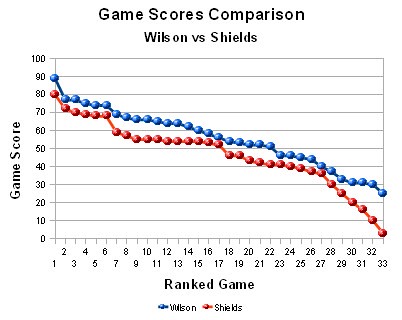
One knock against Shields is that he has been inconsistent this season. To see how consistent Shield’s and Wilson’s starts were across the season, I decided to graph both starter’s Game Scores from best to worst.

shieldWilsonGraph

Wilson has put up better Game Scores across the entire season when compared to Shield’s starts. Wilson had fifteen Game Scores over sixty, while Shields only put up six over sixty. Besides have more good games, Wilson’s bottom 5 performances don’t drop off like Shield’s bottom 5.

Each game that a starter does better, he gives he team a better chance of winning, no matter if he offically gets the win or the loss. Here are the team’s Win/Loss records when each pitcher pitched to a certain level of Game Score:

shieldWilsonGSchart

The pitcher’s team usually won when the pitcher was able to achieve a game score of 56 or higher. If Shields can post Game Scores like his regular season numbers, he has about a 25% chance of throwing a great game, 50% of the time the game will be a toss up and 25% of the time it will be clunker. Wilson on the other hand had 50% of his game great, 30% in the toss up range and 20% in the bottom range. Shields season was consistently inconsistent over the season, while Wilson was generally consistently good.

The chances for the Rangers to win tomorrow’s game look good considering the scheduled pitchers. The Rays need to hope the “Good” Shields shows up to have a chance to even up the series.


Congratulations, Doc

28 batters faced. 25 balls. No hits.

That was amazing. Thanks for one of the best games I’ve ever seen. This is why baseball is just so awesome.


Playoff Chat Extravaganza

What better way to celebrate roughly 11 hours of playoff baseball than by bringing back the all day chat session? None, I say, so that’s what we’re doing. Your favorite FanGraphs authors, and myself, will be hanging out, watching baseball, and talking about the goings on and happenings with you all. Festivities begin at 1:30 and end when our fingers hurt. Come hang with us. It will be fun.


ALDS Game One Review: Texas

Led by a typical Cliff Lee playoff pitching performance — 10 K’s, 12 retired in a row at one point — the Texas Rangers jumped off to a 1-0 series lead with James Shields and two home games still left to play. With just one run versus 10 strikeouts in seven innings, Lee helped avenge his 0-3 record against the Rays this year, including an August 16 loss in a match-up against David Price. The Rangers offense also had much more success than that night, as home runs by Ben Molina and Nelson Cruz, and a near-home run by Jeff Francoeur, fueled the Rangers offensive output.

In that August 16 start, the Rangers saw as David Price started the game with 18 fastballs in his first 19 pitches. The same formula was used today (with much less success), with Price using fastballs on all of his first 19 pitches. While they couldn’t use that advanced scouting to their advantage in the first inning, it paid off in the second, when Jeff Francoeur hit a bad first-pitch fastball off the centerfield wall to plate Ian Kinsler. Bengie Molina then muscled the third consecutive fastball he saw to right field, giving the Rangers a 2-0 lead. It was all they would need.

It didn’t feel that way early, as Cliff Lee came out firing almost exclusively fastballs, keeping his plus (or plus-plus) cutter, curve and change all in his back pocket. It almost back-fired in the first, as Lee loaded the bases with one out and Carlos Pena at the plate. After falling behind in the count 2-1, Lee threw an inside fastball up and in. Home plate umpire Tim Welke looked as if he was going to call the pitch a ball, but after Carlos Pena argued that the pitch hit him, Welke called a foul tip strike. Rather than plating the game’s first run or at least gaining a 3-1 count, Pena fell behind 2-2, and would strike out on the seventh pitch of the at-bat.

What followed was a Cliff Lee clinic, with 62 strikes in his last 83 pitches, and the use of all his pitches. Lee struck out Jason Bartlett to end the second inning on a vicious cutter, and caught Carlos Pena and Rocco Baldelli looking on a pair of nasty looping curveballs in the fourth inning. Lee didn’t have his usual plus-plus change today, but the curveball was good, and the command of his two-seam fastball was very good.

By the numbers, it would appear that Cliff Lee (76 strikes on 104 pitches) had equal control to David Price (77 strikes on 107 pitches) on the day. But, the Rangers had a lineup that came to Tampa ready to hack, bailing David Price out of any walks. This was also because Ron Washington granted the middle of his order a green light on 3-0 counts, a managerial decision that paid off in a big way. In the third inning, Nelson Cruz crushed a grooved 93 mph 3-0 pitch 430 first to centerfield, lowering the Rays win expectancy to just 23.8%. In the fifth inning, Vladimir Guerrero knocked home Josh Hamilton with a double to the center field warning track on another 3-0 fastball.

While Neftali Feliz gave reason for the Tampa crowd to get on their feet in the ninth inning, starting his inning with two walks, the combination of the Rangers fastball hitters and baseball’s best southpaw created too big a gap. Texas now stands in a great position to upset the Rays, with a favorable pitching match-up in Game 2, two games in Arlington, and another Lee appearance scheduled in a potential Game 5.