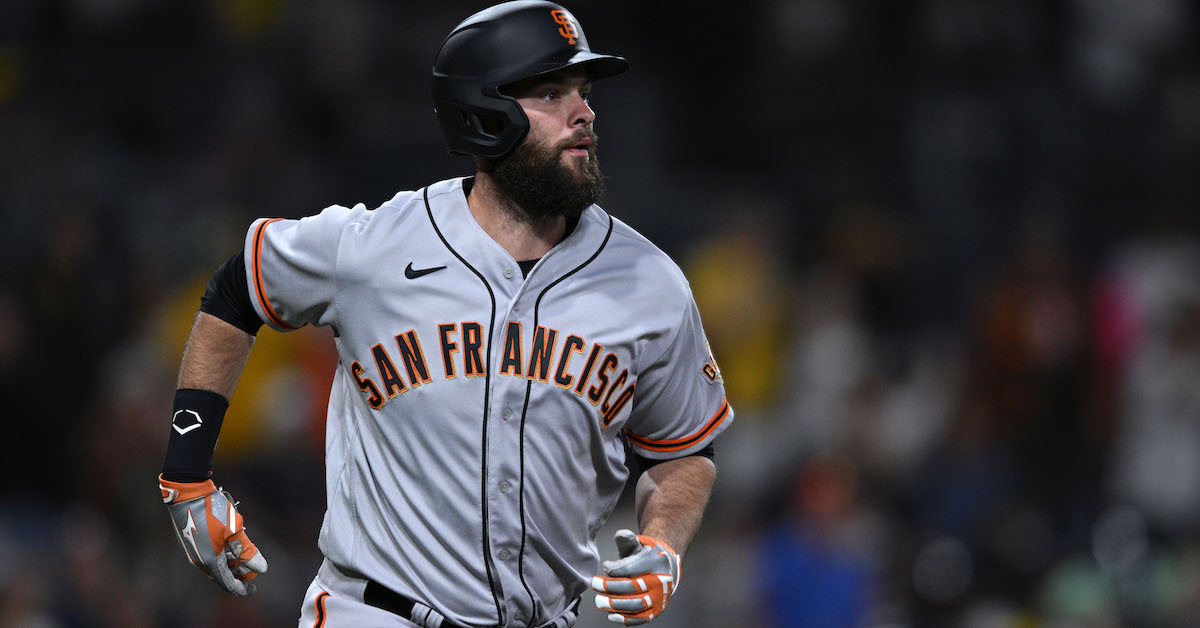
Before this year, it looked like Christian Walker might be washed up before he ever had a chance to shine, a player on the decline while breaking through. After a breakout 2019 that saw him finally step out of the shadow of the men he’d backed up (he was second in line behind Chris Davis, took a whirlwind tour through Cincinnati and Atlanta in a wild spring training of DFAs, and then landed behind Paul Goldschmidt), Walker’s career outlook appeared bright. But all that apprenticeship time hurt, and so did the pandemic-shortened 2020 season. Walker put together another promising year – .271/.333/.459 with a markedly improved strikeout rate – but time simply wasn’t on his side. 2021 was his age-30 season, and also his worst big league campaign yet. He posted a below-average hitting line, lost power while striking out more often, and generally regressed across the board.
Some version of that story happens frequently in baseball. The whims of fate are cruel: baseball isn’t exclusively a young man’s game, but you have to be a very good player to hold a starting role into your 30s. Find yourself in the wrong system, or miss some time with injury, and you can be 30 before you know it, with only three years of service time and a tenuous major league spot. Corner infielders with average bats abound; they make a good living playing baseball, but they mostly bop around from team to team as waiver wire fodder and up-and-down platoon pieces. Read the rest of this entry »
Though he’s not the only reason that the Orioles are above .500 and still have a non-zero chance of claiming an AL Wild Card spot, Adley Rutschman has been at the center of Baltimore’s return to relevance. The top pick in the 2019 draft and the top prospect in the game entering this season has been nothing less than the Orioles’ best player. He’s already staked his claim as one of the game’s top catchers and put himself among notable historical company.
After splitting last season between Double-A Bowie and Triple-A Norfolk, the 24-year-old Rutschman began this season at High-A Aberdeen, not for performance reasons but because he was rehabbing a right triceps strain that he suffered in mid-March. He played five games there, starting on April 26, then three games at Bowie and 12 at Norfolk before being called up to the majors on May 21.
At the time, the Orioles were just 16–24 for the AL’s third-worst record. They were already 13 games behind the Yankees in the AL East race and 5.5 games out of the third Wild Card spot; their Playoff Odds registered at zero. Since then, they’ve gone 57–43 for the AL’s fourth-best record behind the Astros (65–35), Mariners (62–38), and Blue Jays (58–43), and ahead of the Yankees (57–46), Guardians (57–46), and Rays (55–45) — right in the middle of the six teams that would qualify for the playoffs if they began today.
The Orioles Before and After Rutschman’s arrival
Period
W
L
W-L%
GB*
RS/G
RA/G
pythW-L%
WC%
Through May 20
16
24
.400
13
3.48
4.28
.406
0.0%
Since May 21
57
43
.570
0.5
4.44
4.11
.535
1.4%
SOURCE: Baseball-Reference
* Games Behind AL East leader over that span.
The Orioles have improved markedly on both sides of the ball since Rutschman’s debut. Not all of that can be attributed to him, but when it comes to the team’s catching situation, the bar for upgrades was particularly low. Consider that Robinson Chirinos and Anthony Bemboom combined to “hit” .125/.233/.211 for a 32 wRC+ through May 20; Rutschman has replaced that by hitting a robust .251/.358/.442 for a 131 wRC+. A quick back-of-the-envelope calculation suggests that the change in catchers alone (which includes Chirinos’ continued work as a backup) was worth about 0.44 runs per game on the offensive side: Chirinos and Bemboom combined to produce all of five Weighted Runs Created in 40 games (0.13 per game) where Rutschman and Chirinos have produced 51 in 90 games (0.57 per game). That’ll turn your season around.
Rutschman has been a boon on the defensive side as well. The framing-inclusive version of Defensive Runs Saved, which Baseball Reference publishes but does not use in its WAR calculations, credits the new guy with being 16 runs above average, second in the majors behind only Jose Trevino; Chirinos, at 10 runs below average, is third-worst (Bemboom is right at average). By Baseball Prospectus’ measure of catcher defense, Rutschman (7.3 runs) ranks 12th in the majors, and Chirinos (-15.0) is second-to-last, with Bemboom (0.1) right at average. FanGraphs’ measure of framing runs echos those two estimates: Rutschman fourth overall at 6.3 runs, Bemboom at 0.1, and Chirinos second-to-last at -12.8. Again using a back-of-the-envelope estimate, and assuming Chirinos has been uniformly subpar across the season (we don’t have defensive splits), the upgrade in catcher defense has been worth another 0.17 runs per game. That takes us to a swing of about a 0.61 runs per game by my admittedly rough estimate — and we haven’t even begun to discuss all of those Orioles pitchers outperforming their projections. That’s a story for another day.
Though he collected a triple in his major league debut and a single the next night, Rutschman started rather slowly, hitting just .143/.226/.196 (23 wRC+) though his first 15 games. He’s ramped up to .274/.384/.494 (152 wRC+) over the past three months, good enough to place in the majors’ top 20 in that admittedly arbitrary stretch of time.
Beyond his first few weeks in the majors, only twice has Rutschman failed to produce a 100 wRC+ over a 15-game span, and even then he wasn’t far off, with a 95 wRC+ around the 45-game mark and a 98 wRC+ at the 86-game mark. In an offense that can use all the help it can get, he’s been the team’s best hitter. Having said that, it’s worth noting that the 6-foot-2 switch-hitter has struggled mightily against lefties, hitting just .164/.303/.233 (64 wRC+) without a homer in 89 PA. Against righties, he’s raked at a .276/.375/.504 (152 wRC+) clip, with 10 homers in 288 PA. His platoon splits largely went unremarked upon as a prospect, probably because he hit .350/.439/.621 in 165 PA against lefties last year, though he fell to .169/.306/.225 in 108 PA this year before being called up. If there’s an area where he needs work, it’s this.
I’ll get back to the splits, but what stands out most on the offensive side is Rutschman’s exceptional command of the strike zone, with a 24.8% chase rate and 91.2% zone contact rate; those are in the 89th and 88th percentiles, respectively. His 6.4% swinging-strike rate, meanwhile, is in the 90th percentile. Overall, he’s walking 13.5% of the time and striking out just 17.8% of the time. On the other hand, Rutschman’s contact stats are less impressive, and rather anemic when he’s hitting righty:
Adley Rutschman Statcast Splits
Split
BBE
EV
Barrel%
HH%
AVG
xBA
SLG
xSLG
wOBA
xwOBA
LHB
201
87.8
9.0%
36.8%
.276
.268
.504
.461
.380
.364
RHB
54
88.6
7.4%
42.6%
.164
.200
.233
.319
.257
.299
Total
255
88.0
8.6%
38.0%
.251
.253
.442
.428
.351
.349
Percentile
30
55
35
83
SOURCE: Baseball Savant
Percentile-wise, only Rutschman’s barrel rate and xwOBA are above average, the latter thanks mainly to his plate discipline. One factor in those splits is that he pulls the ball quite a lot (46.3% overall) and has faced the shift on about 95% of his balls in play. He’s less pull-happy as a lefty, less prone to hitting the ball on the ground, and handles the shift pretty well. As a righty, that’s not the case:
Adley Rutschman Batted Ball Splits
Split
Pull%
GB/FB
GB%
AVG vs Shift
SLG vs Shift
wRC+ vs Shift
LHB
44.8%
0.83
33.8%
.287
.420
97
RHB
51.9%
1.37
48.1%
.179
.282
22
Given the coming rule change regarding defensive positioning, it will be interesting to see how much this affects Rutschman’s production; I don’t think he’ll bemoan the prohibition of infield shifts, to say the least.
With the caveat that the sample sizes for the bookend months are about half the size as the full ones even if I don’t split them by handedness, you can get an idea of Rutschman’s improvement against various pitch groups:
Rutschman struggled against fastballs initially but soon was managing an xwOBA in the neighborhood of .400 against them and lately has been even better. In all, he’s seven runs above average against four-seamers according to Statcast, and two above against sinkers. As he’s settled in, he’s improved considerably against offspeed stuff, though he’s been three runs below average against changeups overall. He’s had trouble with the curve (three runs below average) but not the slider (three above).
Even given his late arrival and the fact that there are still about three weeks to go in the season, Rutschman is third in WAR among catchers, behind only J.T. Realmuto (5.6 WAR) and Sean Murphy (4.6 WAR), and both of them have at least 100 more plate appearances. Meanwhile, he’s put together one of the great rookie seasons for a catcher:
I’ve highlighted the WARs of catchers for whom we have pitch-framing data (2008 onward), making it easier if you want to limit the comparison to more contemporary catchers. It’s worth noting that Baseball Prospectus’ framing data, which goes back further than ours using Max Marchi’s retroframing methodology, credits Mauer with an additional 13.2 framing runs in 2005 and Piazza with an additional 8.9 runs in 1993 — about an extra 1.3 WAR for the former and 0.9 for the latter. Rutschman isn’t in Piazza’s league as a rookie, but he’s dead even with Posey in less playing time and not that far behind the framing-inclusive measure of Mauer, who had about 47% more playing time. Piazza is already in Cooperstown, and the other two should be once they become eligible. I’m not suggesting that Rutschman — who’s about the same age as the rookie Piazza was (both were in their age-24 seasons), about a year older than Posey, and about two years older than Mauer — is headed to the Hall of Fame just yet, but as points of comparison go, he could hardly do better.
As for whether Rutschman will take home this year’s AL Rookie of the Year honors, he trails Julio Rodríguez in WAR (4.5 to 4.0), but the Mariners’ center fielder has about a 40% advantage in playing time and is going to wind up with more impressive offensive numbers; he already has 25 homers, 24 steals, and a 141 wRC+. I suspect he’ll take home the hardware, but given Rutschman’s impact on the Orioles’ season, they ought to be quite pleased with the way their top draft pick from three years ago is panning out.
With the new playoff format, the best teams in baseball are coasting into October, hoping to get healthy and stay sharp as the regular season winds down. For the teams whose postseason hopes are slim but still alive, it’s getting close to crunch time, as big division matchups dominate the rest of the schedule.
A reminder for how these rankings are calculated: first, we take the three most important components of a team — their offense (wRC+), and their starting rotation and bullpen (a 50/50 blend of FIP- and RA9-, weighted by IP share) — and combine them to create an overall team quality metric. New for this year, I’ve opted to include defense as a component, though it’s weighted less heavily than offense and pitching. Some element of team defense is captured by RA9-, but now that FanGraphs has Statcast’s OAA/RAA available on our leaderboards, I’ve chosen to include that as the defensive component for each team. I also add in a factor for “luck,” adjusting a team’s win percentage based on expected win-loss record. The result is a power ranking, which is then presented in tiers below.
Note: All stats are through Sunday, September 11.
Tier 1 – The Best of the Best
Team
Record
“Luck”
wRC+
SP-
RP-
RAA
Team Quality
Playoff Odds
Dodgers
96-43
-5
122
81
79
6
182
100.0%
Astros
90-50
0
112
85
78
20
182
100.0%
The Dodgers and Astros continue to glide toward the playoffs; both teams won four of their six games last week. The Dodgers clinched and then didn’t clinch their 10th straight postseason berth over the weekend, and should clinch the National League West division title sometime this week. The Astros could feasibly follow with a division-clinching of their own next week, as their magic number is down to 12. At this point, both teams should be focused on getting and keeping their rosters healthy and reaching the playoffs with everyone firing on all cylinders. For Houston, that means getting Justin Verlander back from his calf injury and up to a full workload. It would also be great if Jeremy Peña rediscovered the form that helped him jump out to an early American League Rookie of the Year lead before wilting this summer. With Dustin May back from his Tommy John surgery, the Dodgers don’t have as great a need in their rotation as Houston does, but getting Tony Gonsolin back in some capacity would certainly help their pitching depth.
Tier 2 – On the Cusp of Greatness
Team
Record
“Luck”
wRC+
SP-
RP-
RAA
Team Quality
Playoff Odds
Mets
89-52
4
113
87
95
8
166
100.0%
Yankees
85-56
-7
114
88
81
12
177
100.0%
The Mets briefly lost their hold on the NL East last week before regaining a 1.5-game lead over the weekend. They took the cautious route with Max Scherzer’s oblique injury, a move that could pay dividends come October. Obviously, clinching a first-round bye with a division title would allow their injured co-ace to heal up before being called on to carry a heavy load in the playoffs. With a lighter schedule than the Braves from here on out, New York is certainly the favorite to earn the second seed in the NL, though the three-game series in Atlanta during the final week of the season continues to loom exceedingly large.
The Yankees offense finally awoke from its summer slumber over the weekend, and with impeccable timing, too. With their division lead dwindling to just 3.5 games after their loss to the Rays on Friday, they scored 10 runs in back-to-back games to earn the series win against their closest division rival. That gives them a little more wiggle room as the season winds down, though they’ll need to continue to find new ways to score runs with a host of key offensive contributors still sidelined with minor injuries. Amazingly enough, Aaron Judge didn’t hit a home run over the weekend after launching one in four straight games to start last week; that seriously affects his chances of making home run history this season.
Tier 3 – Solid Contenders
Team
Record
“Luck”
wRC+
SP-
RP-
RAA
Team Quality
Playoff Odds
Braves
87-53
1
110
88
84
7
162
100.0%
Cardinals
83-58
-1
116
98
98
16
157
99.7%
Mariners
79-61
1
107
98
93
7
133
99.8%
Blue Jays
78-61
2
116
95
97
2
145
98.6%
Rays
78-60
2
104
91
100
4
127
98.0%
The Braves had an eight-game win streak snapped on Saturday and wound up dropping their weekend series against the Mariners after a wild walk-off loss on Sunday. Those two teams combined for 17 home runs in their three-game set, with two apiece in the ninth inning deciding the final game in the series. For their part, the Mariners looked up to the challenge presented by the defending champions, which has been one of the best teams in the NL this year. With a soft remaining schedule, this series against Atlanta was one of their last bellwethers to demonstrate they can compete with the best baseball has to offer. They showed exactly why they’ll be a force to be reckoned with come October.
Despite losing their weekend series in New York, the Rays have made an impressive run up the standings despite playing through a dizzying number of injuries. Wander Franco, Brandon Lowe, and Yonny Chirinos were all activated off the IL last week, and there’s a chance Nick Anderson and possibly even Tyler Glasnow could find their way back to the majors at some point during the season’s final weeks. Getting healthy now is critical because Tampa Bay and Toronto began a huge five-game series yesterday, and the Rays have six games against the Astros and four more against the Blue Jays still on the docket.
Tier 4 – The Melee
Team
Record
“Luck”
wRC+
SP-
RP-
RAA
Team Quality
Playoff Odds
Phillies
78-62
1
107
88
95
-28
121
91.2%
Padres
77-64
4
100
99
96
15
117
83.3%
Guardians
73-65
1
97
100
88
17
117
67.6%
Brewers
75-66
2
102
97
98
3
115
25.8%
The Phillies bounced back from a rough West Coast road trip to win five of six games last week. They’ve continued to hold their ground in the NL Wild Card race, and it’s looking increasingly likely they’ll join the Mariners in snapping an extended postseason drought this year. Somewhat quietly, Aaron Nola has led all pitchers with 4.6 WAR since mid-May. Philadelphia is still waiting to learn the status of Zack Wheeler, but it’s encouraging to know their playoff rotation will be anchored by Nola with some options behind him.
The Padres couldn’t handle the Dodgers over the weekend, losing two of three. They’re still two games up on the Brewers and remain within striking distance of the Phillies for the second Wild Card spot. Josh Hader’s struggles have received most of the headlines, but Juan Soto (119 wRC+ in San Diego), Josh Bell (88 wRC+), and Brandon Drury (88 wRC+) haven’t exactly excelled since being dealt at the trade deadline. Soto will be around longer than just this year, but Bell and Drury are rentals and just aren’t producing at their normal levels (and the latter is on the IL with a concussion). That’s a big problem for a team hoping to avoid another crash-and-burn ending to its season.
The Guardians made a big statement over the weekend, sweeping the Twins to push their lead in the AL Central to three games. After letting the Twins and White Sox get alarmingly close to taking the division lead, the Guardians finally put a little distance between themselves and their division rivals. Their schedule this week is pretty wild: They’ll play the Angels three times, the White Sox once in a rescheduled rainout game, and then the Twins five times in four days from Friday to Monday. That’s a pretty brutal docket and the AL Central standings could look completely different at the end of it.
Tier 5 – The Long Shots
Team
Record
“Luck”
wRC+
SP-
RP-
RAA
Team Quality
Playoff Odds
White Sox
72-69
3
102
99
101
-16
90
27.0%
Twins
69-70
-2
109
104
102
-5
103
7.4%
Orioles
73-67
3
97
107
91
0
84
1.6%
The White Sox aren’t going to go down without a fight. They won two of three in Seattle early last week and then won three of four in Oakland over the weekend. They’re still within striking distance of the Guardians in the AL Central and a long shot in the Wild Card race. The man leading the charge? Elvis Andrus! Since joining Chicago after getting dumped by the A’s in mid-August, he has posted a .293/.337/.511 slash line (141 wRC+) in 22 games and has buoyed the team in their most desperate hour.
The Orioles’ long-shot hopes took a beating last week. They lost three of four to the Blue Jays and then two of three to the Red Sox, and are now 5.5 games back in the Wild Card race. It’s looking more and more like they’ll have to settle for playing spoiler as this season winds down, though that should still provide some excitement and hope for their fans as they look to build on their late-season success next year.
Tier 6 – Spoiler Alert
Team
Record
“Luck”
wRC+
SP-
RP-
RAA
Team Quality
Playoff Odds
Diamondbacks
66-73
-2
95
101
109
26
92
0.0%
Red Sox
69-72
2
103
103
108
-4
92
0.1%
Giants
67-73
-4
100
91
107
-25
84
0.0%
Angels
61-79
-3
91
92
108
9
89
0.0%
Rangers
60-79
-8
100
111
100
-6
75
0.0%
Mike Trout hit a home run in his seventh consecutive game last night, perhaps giving fans in Los Angeles a glimpse at what could have been if he hadn’t slumped midseason or gotten injured for a month. Trout’s success is a small consolation for the Angels, who have been out of the playoff picture since their epic losing streak in May and June. And befitting Tungsten Arm O’Doyle, they’ve gone 3-4 during Trout’s homer streak.
Tier 7 – Hope Deferred
Team
Record
“Luck”
wRC+
SP-
RP-
RAA
Team Quality
Playoff Odds
Rockies
61-80
3
88
111
100
4
56
0.0%
Marlins
57-82
0
87
100
103
0
57
0.0%
Cubs
58-82
-1
97
108
109
-19
47
0.0%
Tigers
54-86
2
80
118
93
6
54
0.0%
Royals
57-84
2
93
117
117
7
49
0.0%
Reds
56-82
-3
88
112
106
-16
31
0.0%
Athletics
51-90
0
94
119
112
-2
38
0.0%
Nationals
49-92
-1
95
134
104
-37
33
0.0%
Pirates
51-88
4
81
112
111
-15
26
0.0%
There hasn’t been much movement in the race to the bottom. The same three teams hold the last three spots in the standings — and therefore the highest odds of receiving the first pick in the first MLB Draft lottery. The Tigers seem to be the only other team that could slip into one of those bottom three spots; they’re just 1.5 games ahead of the Pirates, and the Reds and Royals seem a little too far out at 4.5 games ahead.
The decision to change the closer is one of the most awkward a manager will face. Any other combination of bullpen arms can be shuffled around without most fans taking notice, but the save statistic and the entrance music make a closer highly conspicuous. Screw around with that guy, and it becomes a news story.
The Braves invested heavily in that position this winter, lavishing $16 million on 34-year-old Kenley Jansen. I’ll go to my grave believing this signing was at least partially about poaching a legendary Dodger the day after L.A. inked Freddie Freeman — you don’t want to go stag to prom when your ex has a date — but closers like Jansen don’t come along every day. The man pitched in three All-Star games and three World Series and entered the season with 350 career saves, more than Rollie Fingers, Robb Nen, or Bruce Sutter. Jansen had encountered some turbulence in the late 2010s and wasn’t putting up ERAs in the 1.00s anymore, but armed with a new sinker and slider, he’s still quite an effective closer.
Or, more accurately, he has been. In his past seven appearances dating back to August 27, Jansen has blown three saves in seven attempts, allowing 12 baserunners and three home runs in just 5.2 innings. On Sunday, the Braves launched a stirring five-run rally in the ninth to pull ahead of the Mariners, perhaps the only other team in all of baseball as hot as Atlanta. Jansen promptly surrendered two home runs and the lead. The second came on a 93-mph sinker right where Eugenio Suárez could 3-iron it into the Seattle bullpen. I had to look up what that pitch was, because the TV view bore little evidence of sink or cut.
The Texas Rangers made meaningful changes this summer when they parted ways with manager Chris Woodward — Tony Beasley is currently serving in an interim capacity — and subsequently replaced Jon Daniels with Chris Young as their top front office decision-maker. But a move that has been every bit as impactful was made 10 months ago. Last November — shortly before Baseball America named him their MLB Coach of the Year — Donnie Ecker was hired away from the San Francisco Giants and given the title of Bench Coach/Offensive Coordinator.
Ecker’s reputation as a tech-and-data-savvy hitting nerd is well-earned. Prior to the two seasons he spent as Gabe Kapler’s hitting coach in San Francisco, the 36-year-old Los Altos, California native built his bona fides as an assistant hitting coach with the Cincinnati Reds, and before that as a minor-league hitting instructor in the St. Louis Cardinals and Los Angeles Angels organizations.
Ecker, who is well-educated in biomechanics and analytics, discussed some of the philosophies and practices he brought with him to Texas when the Rangers visited Fenway Park earlier this month.
———
David Laurila: You spend a lot of time at the ballpark, often arriving by 9 AM for a seven o’clock game. What does your day typically look like?
Donnie Ecker: “It starts with understanding where all of our people are at, zooming in on our hitters first and looking at the things that we find valuable. How is their performance aligning with our North Stars and peripherals? As a department, we want to be on top of that day-to-day. Most times, that’s a process of going deep and bringing up simple and actionable items to the surface. Everything is from the inside out, leading to what we want our conversations and training to look and feel like that day for that player. Read the rest of this entry »
Back in April, 23 of our writers and contributors made predictions about the 2022 season. When guessing who would be the AL Rookie of the Year, nine different players were named, with Bobby Witt Jr. and Julio Rodríguez leading the pack. Not found among those nine names was the starting shortstop for the Astros, a rookie faced with the difficult task of replacing incumbent Carlos Correa, who had gone to the Twins. Jeremy Peña wasn’t pegged as a ROY frontrunner, but for much of the early season, he looked like a sudden superstar. However, he’s struggled offensively in recent months, raising some questions about whether the real Peña is the player with the .878 OPS through mid-May, the one with a .586 OPS since the All-Star Game, or somewhere in the middle.
Back in May, Witt, the preseason favorite, wasn’t even in the top 15; Rodríguez only put up a .544 OPS over April; and Adley Rutschman was days away from even debuting in the majors. While Peña wasn’t making Astros fans actually forget about Correa, he certainly did his best to alleviate any lingering worries about their former franchise building block heading to the AL Central. But since May 17, he has seen his control over the AL leaderboard disappear:
That’s not to say that Peña hasn’t continued to be a solid overall player, but his largest contributions in recent months have been with leather rather than wood. With his range measured at five runs above average at shortstop by Statcast’s RAA and a total of nine runs over all facets of defense by our estimate, he hasn’t disappointed defensively, which has enabled him to remain a legitimate starter even with his offense dropping to disappointing levels. But he’s a far more exciting player with his spring offense, so what went wrong there? Read the rest of this entry »
Friday night, umpire Ted Barrett got up close and personal with James Karinchak:
No, Barrett wasn’t looking for hair care tips, or acting out an Herbal Essences commercial. He was checking for foreign substances at the behest of Twins manager Rocco Baldelli. Though he ruffled around to the best of his ability, Barrett didn’t find anything definitive. Karinchak made it back to the dugout with a narrow lead and his pitching eligibility intact, though his dignity may have been affected.
Baldelli’s accusation wasn’t some off-the-cuff act of pettiness. Karinchak has been at the sticky center of controversy ever since the league cracked down on pine tar, Spider Tack, sunscreen/rosin blends, and whatever other tacky options players were using to increase spin. Stricter enforcement of existing rules started at the beginning of June last year; take a look at Karinchak’s spin-velocity ratio and raw fastball spin rate and you can clearly see when things changed:
Not coincidentally, Karinchak’s results slipped at the same time. He’d been an unhittable, fire-breathing, back-of-the-bullpen monster since reaching the majors. From June 1, 2021 onwards, however, he posted a 5.40 ERA and a 5.41 FIP, and got demoted to the minors at the end of August. The fall from grace was swift, and seemed obviously related to the change in foreign substance enforcement. Read the rest of this entry »
It’s been a strange season for Mike Trout, one that’s featured a hot start, an epic slump that accompanied the worst losing streak in franchise history, and a diagnosis of a long-term back injury followed by an absence of 30 games. The good news is that since returning to activity on August 19, he’s gradually recovered his form, and this past week he set a career best by homering in six straight games.
Trout began his streak on September 4 with an eighth-inning homer off the Astros’ Brandon Bielak — the only run the Angel scored in a 9-1 loss — but his next three came against the Tigers (Tyler Alexander, Eduardo Rodriguez, and Will Vest), all in wins. He continued the streak with a homer off the Astros’ Lance McCullers Jr. in a loss on Friday night, but his three-run second-inning shot off José Urquidy on Saturday helped power the Halos to a victory.
In the annals of Halos history, that last home run lifted Trout past Bobby Bonds, who homered in five straight games for the Angels from August 2–7, 1977. The streak additionally pushed Trout past the Rangers’ Corey Seager (July 8-12) for the longest of this year. Trout had already surpassed his personal best of homers in four straight games, set in 2017 (May 12–15) and matched in ’19 (April 4–7). Read the rest of this entry »
Last week, we at FanGraphs came up with a fun idea: we simulatedAaron Judge’s remaining games a million times to figure out if and when he’s likely to hit some milestone home runs: numbers 60, 61, and 62. At the time, the takeaway was clear: Judge was most likely to hit each of those milestone home runs during the Yankees’ series in Toronto on September 26–28.
Since that article was published, Judge has played six games and hit only one home run. That changed the odds significantly. More specifically, per my simulation, here are his odds of reaching at least 60, 61, or 62 homers, both now and six games ago:
After more than a century of a deistic laissez-faire attitude toward the sport, Major League Baseball made a remarkable announcement on Friday: Next year, for the first time, baseball will have a clock. The introduction of a pitch clock at the highest level of the game is merely one gourd in a cornucopia of rule changes approved late last week by the league’s competition committee, but it could revolutionize the sport. You can find the full list here, but rather than delve into the minutiae, I want to give a brief précis of the most important highlights and deliver a remarkable conclusion. Read the rest of this entry »