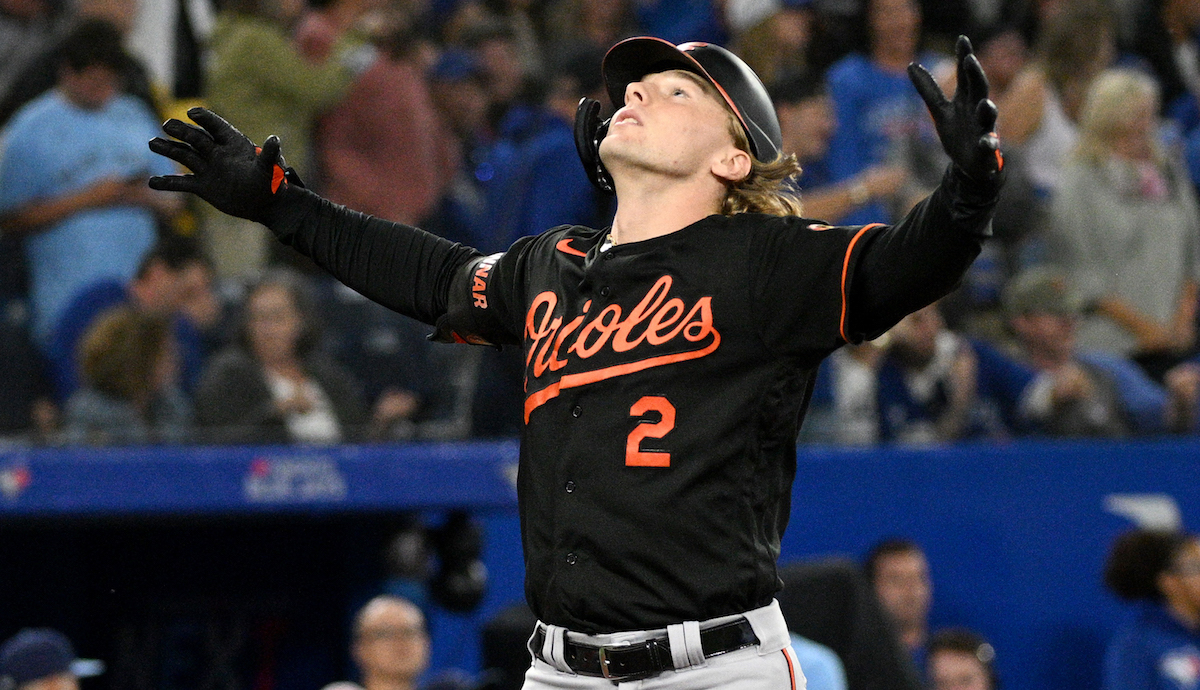
On September 1, one day after baseball’s no. 5 overall prospect made his major league debut, Dan Szymborski wrote that the Baltimore Orioles “showed mercy to minor league pitchers … officially calling up infielder Gunnar Henderson.” As my colleague pointed out, the 21-year-old left-handed hitter had slashed .297/.416/.531 with 19 home runs over 112 games between Double-A Bowie and Triple-A Norfolk. His wRC+ was a healthy 154.
Henderson has continued to impress at the big-league level. In 110 plate appearances with the O’s, the young slugger has punished pitchers to the tune of a 139 wRC+, with 12 of his 27 hits going for extra bases. He’s left the yard four times, with the latest of those blasts leaving his bat at 111.1 mph and traveling 428 feet into Fenway Park’s center field bleachers.
Henderson sat down to talk hitting on Tuesday, one day before he was named Baseball America’s Minor League Player of the Year.
———
David Laurila: Let’s start with your evolution as a hitter. What do you know now that you didn’t when you were drafted by the Orioles [42nd overall in 2019 out of Selma, Alabama’s John T. Morgan Academy]?
Gunnar Henderson: “I would say that it’s the number of good pitches you get to hit. In high school, you’ll get multiple pitches to hit within an at-bat, and then as you progress, at each and every level, it’s less and less. Especially here in the big leagues. You really have to take your walks and not give in to what the pitcher wants you to do. You’ve got to hunt for that one pitch, because you might only get one, maybe two, a game.”
Tuesday night, I watched Ryan Helsley face the middle of the Brewers order in the bottom of the eighth inning. It went roughly how you’d expect – strikeout, groundout, strikeout. He came back out for the ninth, and after an inning-opening walk, closed out the frame with another two strikeouts and a groundout. It didn’t feel surprising; that’s just what great relievers do at the end of games.
That wasn’t always the case. The game has changed over the years. Relievers are pitching fewer innings per appearance, and doing so in better-defined roles. Strikeouts are up everywhere. Velocity is up everywhere. Individual reliever workloads are down, which means higher effort in a given appearance despite bullpens covering more aggregate innings. I’m not trying to say that the current crop of relievers doesn’t have structural tailwinds helping them excel. But seriously – top relievers now are so good.
Look at the top of this year’s WAR leaderboard for relievers – either RA9-WAR or FIP-based WAR will do – and you’ll see a veritable wall of strikeouts. Edwin Díaz, Devin Williams, A.J. Minter, Helsley, and Andrés Muñoz are all in the top 10 and all run preposterous strikeout rates. They’re good in an in-your-face way. Since I’ve watched baseball, dominant late-inning relievers have succeeded by striking batters out, but that trend has accelerated in the past decade or so. Here, take a look at the strikeout rate of the 10 top relievers in baseball, as determined by fWAR, every year since integration:
But how do we know if these performances are sustainable? Story never reached those heights again but he still became an excellent big leaguer. Kwan is a Rookie of the Year candidate, but his teammate Owen Miller has fallen off after hitting .400 in April. Joe, meanwhile, has had a pedestrian .230/.334/.323 slash line since the beginning of May. We know that stats like OPS can take nearly a full season to stabilize, so how can we separate the Millers from the Kwans?
This is where plate discipline metrics come in. Because the average batter sees nearly four pitches per plate appearance, plate discipline stats reach a reliable sample size much more quickly than the surface-level stats that are tracked on a plate appearance basis. The primary plate discipline stat we’ll be examining here is chase rate (listed as O-Swing% on the site). To my mind, chase rate is probably the best single stat to use when assessing a hitter’s swing decisions. Some hitters have outlier levels of plate coverage that allow them to do damage on pitches in specific spots out of the zone, but in general, chasing less is almost always better than chasing more. A quick glance at the relevant metrics will show you exactly why:
Batter Results on Pitches In and Out of Zone
Avg. Exit Velocity
Slugging
Whiff Rate
In Zone
90.7 mph
0.564
17.8%
Out of Zone
80.5 mph
0.215
42.6%
For a variety of reasons, swing decisions are quite difficult to improve at the major league level. The average hitter’s plate discipline metrics don’t change by more than a few percentage points over the course of their career. Still, many of the most patient hitters in baseball have managed to make improvements. Mike Trout’s evolution from young phenom to the best hitter of his generation involved a steady drop in his chase rate throughout his mid-20s, while others make adjustments during their time in the minors that enable their breakouts as big leaguers.
When we see a player go ballistic during the first couple months of a season, it’s exciting. But when these big performances are backed by noticeable improvements in the player’s swing decisions, they have much greater potential to be sustainable. So who were the biggest early-season plate discipline improvers of 2022? To answer this, I looked at every hitter with at least 200 plate appearances in 2021 and compared their chase rates that season to their chase rates through the end of May this season. The biggest improvers can be seen below:
Min. 200 PA in 2021, min. 100 PA in 2022 through 5/31.
Despite his excellent 24.7% chase rate through the end of May, you won’t see the aforementioned Steven Kwan here, as he debuted in the majors this season. Because minor league pitch data is largely unavailable for most players, we’ll solely be analyzing players who made swing decision improvements compared to previous major league seasons. There’s a wide variety of players on this list, but something they all have in common is that even when we look at a larger sample over the full season, they all have lower chase rates in 2022 than they did in ’21. Let’s take a look at a few of these players to see how their plate discipline development has impacted their overall results.
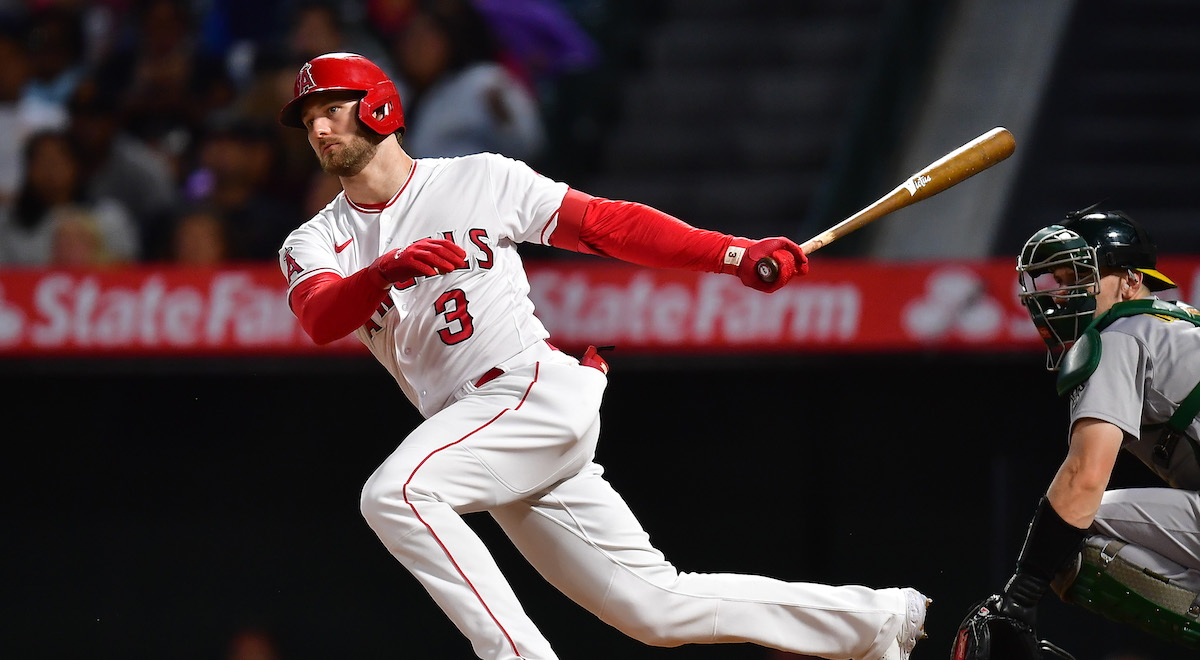
One player who made Herculean improvements to his plate discipline was Taylor Ward. Ward was one of the biggest stories of the early season, putting up a Barry Bonds-like slash line of .384/.505/.744 with eight homers through his first 25 games. Equally impressive, though, was the fact that he walked just as much as he struck out; his chase rate of 17.9% ranked first among all hitters with at least 100 plate appearances over that stretch. ZiPS absolutely bought into the breakout, forecasting a 20-point increase in projected wRC+ as compared to previous seasons. And while his 1.249 OPS in the early season (aided by a .439 BABIP) didn’t last, he’s still kept up an excellent level of production in his first season as an everyday player. He has a 131 wRC+ with a very reasonable .318 BABIP, and at 3.2 WAR, he’s surpassed his ZiPS projection for the year.
More importantly, Ward’s elite plate discipline gains have been sustained over the full season. He’s walked in 11.2% of plate appearances, and his career-best 23.4% chase rate ranks in the 93rd percentile of all hitters. According to Statcast’s swing/take leaderboard, Ward has created 23 runs by laying off pitches in the “chase” zone, pitches that are out of the zone but still close enough to make hitters swing often. Tied with Ward near the top of the leaderboard is fellow plate discipline improver Christian Walker, whose combination of swing decisions and raw power have led to his best season on record.
Taylor Ward started the season with less than a full season’s worth of major league playing time under his belt; by making the necessary adjustments to his approach, he’s locked down a roster spot for the foreseeable future. But what about players who have been everyday big leaguers for the better part of a decade? Are they also capable of significantly slashing their chase rates? In the case of White Sox first baseman José Abreu, the answer here is yes. In his age-35 season, Abreu has the fewest home runs of any season in his career (including 2020) while posting a career-low isolated power. However, he’s on pace to post his best wRC+ in a full season since 2017. Abreu came into the majors in 2014 after lighting up the Cuban National Series (seriously, just look at his stats). In his early days with the White Sox, he was known as a free swinger with huge pop, clubbing 36 homers and finishing second in the league in OPS, while swinging at 41% of pitches out of the zone. Since then, he’s spent most years in the mid-30% range, including a chase rate of 36.4% in 2020, when he won American League MVP. After nearly a decade of big league experience, it was surprising to see Abreu’s chase rate go down to just 30% through May of this season. His current rate sits at 33.6%, the second-lowest chase rate of his career, while his 0.56 BB/K ratio is the best he’s ever posted. So how do we know these late-career gains are real? Let’s take a look at how he’s been pitched to this year as compared to previous ones:
José Abreu Statcast Location Zones
Heart
Shadow
Chase
Waste
2015-2021
24.8%
40.6%
23.3%
10.5%
2022
25.8%
42%
22.6%
9.5%
SOURCE: Baseball Savant
It’s easy to hypothesize that Abreu has just been getting more pitches in the dirt (which are far easier to lay off of), but it turns out the opposite is true. Statcast’s attack zones were created to understand how hitters make swing decisions in four discrete regions, ranging from down the middle (heart) to nowhere near the zone (waste). Abreu has been seeing a lower proportion of pitches in the waste zone, but a similar number of pitches in the shadow and chase zones, where out-of-zone swings can realistically occur. All of this is to say that these improvements are no fluke. Abreu isn’t being pitched differently, he’s simply improved his swing decisions and is likely to finish the season with career-best strikeout and walk rates. Making these changes has proven to be especially helpful at Abreu’s age. We know that a hitter’s offensive production tends to crater when they enter their mid-30s, and many superstars have quickly become mere mortals after losing some of their speed, barrel control, and bat speed (see: Albert Pujols). Abreu’s 43 plate appearances per home run is the worst of his career (by a lot), but despite this, his overall production is even better than it was last year when he hit twice as many homers. Becoming a free agent going into their age-36 season is scary for many players, but Abreu’s improvements in the approach department may significantly lengthen his career.
What about players who significantly worsened their chase rate in the first couple months of the season? Using the same method as before, let’s look at the players who swing at far more bad pitches than last season:
min. 200 PA in 2021, min. 100 PA in 2022 through 5/31
There are many interesting players to analyze among this bunch, including Bryce Harper, whose newfound aggression at the plate may actually be beneficial, but there’s one guy I want to look at specifically because swing decisions are such a huge part of his profile – Joey Gallo.
The quintessential Three True Outcomes player, Gallo has walked, struck out, or hit a long ball in over half his plate appearances every year of his career. As a hitter who puts few balls in play, Gallo’s ability to succeed offensively relies strongly on his ability to demonstrate patience at the plate. Last season with the Rangers and Yankees, Gallo had his best full season with a 122 wRC+ and a career-high 4.2 WAR despite hitting below the Mendoza line. His elite 18% walk rate was supported by a 22.1% chase rate, seventh-best among qualified hitters. In 2019, Gallo missed half the season but had a 144 wRC+ when healthy, and swung at just 24.2% of pitches outside of the zone. In the first two months of 2022, that number ballooned to 33%, near the league average rather than elite. As a result, his walk and barrel rates fell while his strikeout rate rose compared to his career averages. Gallo’s performance this year has significantly declined from last, slashing .166/.288/.364 while maintaining this elevated chase rate all year long.
Going back to Statcast’s swing/take runs, there’s one key area where Gallo made a noticeable change. Last year, Gallo swung at 44% of pitches in the shadow of the zone, a region containing pitches within a few inches of the edge of the plate. This season, that rate has jumped to 55%. While this isn’t necessarily bad for all hitters, Gallo’s elevated whiff rate hurts him when he swings at borderline pitches. While the league as a whole comes up empty on 26.4% of their swings in the shadow area, Gallo whiffs 48.5% of the time. As a result, his chase rate has climbed without him doing any additional damage to pitches in the zone.
These are just a few of the many players whose changes in production this year have been caused by an improvement or decline in their swing decisions. Whether conscious or not, changes in a player’s approach can often have career-altering effects. In Taylor Ward’s case, we’ve seen how a leap forward in approach turned a bench outfielder on the fringes of the roster into an above-average everyday regular, while José Abreu has used his newfound skills to prolong an already sensational career. The fact that sustained reductions in chase rates are so uncommon makes the stories of players whose careers were made or revitalized from swing decision improvements all the more interesting. While we like to imagine what many players would be like if they could make the right adjustments, only a select few can actually do it.
Mike Trout has as many MVP awards (three) as he has career playoff games, a fact that can haunt those of us who long to see generational stars get their chances in the brightest spotlights. It is an unfortunate side effect of the otherwise redeemable fact that in baseball, somewhat uniquely, no individual player has so much of an impact on his team’s performance as to secure them a playoff spot. Even the combination of Trout and fellow MVP Shohei Ohtanihasn’t been enough to nab the Angels so much as a Wild Card since 2014, instead playing out as a sort of macro Tungsten Arm O’Doyle scenario.
This year, Trout and Ohtani will once again be watching from home, the Angels having guaranteed a seventh straight season under .500. But them aside, the 2022 postseason is poised to be what it has failed to be in seasons past: a true showcase of the league’s finest offensive talent.
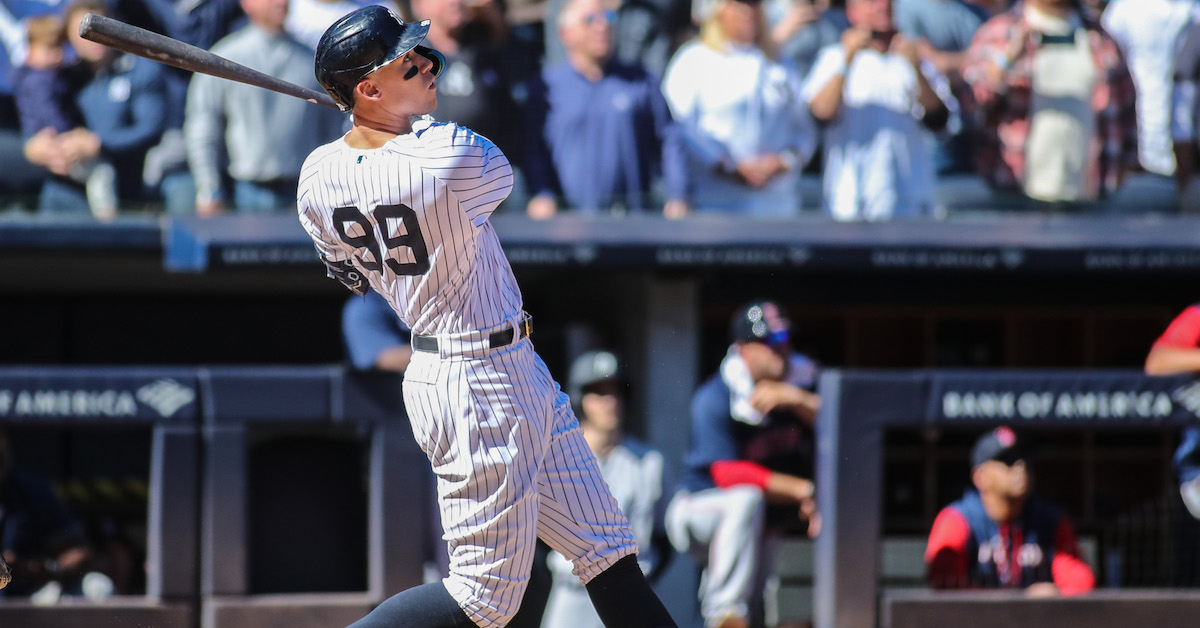
As it stood Wednesday, each of the league’s top 13 hitters by WAR are headed for postseason play, an entirely unprecedented level of October-bound talent at the top of the league. Led by Aaron Judge’s historic 10.9 WAR and a slew of NL MVP contenders, the top 13 represent nine of the 12 playoff teams, including each division winner. In fact, if the season ended today, 21 of the top 23 offensive players by WAR — all but Boston’s Xander Bogaerts and Trout, who, to be fair, both could have found themselves in the top 13 were it not for injuries — would qualify. Read the rest of this entry »
Nick Frasso has a high-octane heater and an intriguing ceiling. Acquired by the Los Angeles Dodgers from the Toronto Blue Jays at this summer’s trade deadline, the 23-year-old right-hander was described by Eric Longenhagen prior to the season as “an uncommon sort of prospect,” a projectable hurler who’d had a velocity spike before undergoing Tommy John surgery shortly after being selected 106th overall in the 2020 draft.
Loyola Marymount University product has only elevated his profile since returning to the mound in mid-May. Featuring a fastball with more juice than the one he displayed pre-injury, he logged a 1.83 ERA with 76 strikeouts and just 33 hits allowed in 54 innings. Moreover, he did so while climbing from Low-A to Double-A in three months time.
Frasso — No. 20 on our Dodgers prospect rankings, with a 40+ FV — sat down to discuss his repertoire, and recent change of scenery, following an August outing with the High-A Great Lakes Loons.
———
David Laurila: Let’s start with your early-career development. What do you know now that you didn’t when you signed your first professional contract?
Nick Frasso: “My last year in college is when we finally got a TrackMan at our school and as that was the COVID year, I didn’t even get to use it a ton. It wasn’t until I jumped into pro ball that I really got access to all the analytical stuff — the metrics that allowed me to see what my pitches do, what works better in certain situations, and stuff like that. I’ve kind of gone from there.”
Laurila: I was at last night’s [August 16] game and saw you hit triple digits a couple of times. How does your fastball profile outside of the velocity? Read the rest of this entry »
It doesn’t take a keen eye for analysis to watch a baseball game and guess which player is the slowest. You could grab a stopwatch and time them running to first, or you could just take a look at the short and stout guy crouching all game and wearing body armor. I’m not breaking any ground when I tell you that catchers are the slowest major leaguers.
A less settled question: why are they so slow? Is it the armor? Is it the short and stout part? Is it the deleterious effect of crouching all day? We have eight years of sprint speed data, so I decided to dig into it and look for an answer.
First things first: I constructed a sprint speed aging curve. To do that, I took every player-season with at least 10 competitive runs starting in 2015. For each player-season, I noted their age, position, sprint speed in year one, and change in sprint speed in the subsequent year (assuming they made at least 10 competitive runs). For example, Byron Buxton was 21 in 2015 and posted an average sprint speed of 30.9 ft/sec on competitive runs while playing center field. The next year, he again posted an average sprint speed of 30.9 ft/sec. Thus, I recorded 21, CF, 30.9, and 0 (change). Read the rest of this entry »
At the trade deadline, the Nationals shipped out their franchise player, Juan Soto, to the Padres in return for an admittedly impressive array of prospects. Losing him, along with first baseman Josh Bell, removed the last two dynamic hitters from one of the worst offenses in baseball this side of the Tigers. Replacing your best offensive player, especially one as talented as Soto, isn’t an easy tax, though it’s one the Nats managed to do last time when the Bryce Harper era smoothly gave way to the Childish Bambino one. And for the very short term, at least, Washington has pulled this trick for a second time.
No, the Nats haven’t found another phenom to succeed Soto, but instead, they went with journeyman minor league outfielder Joey Meneses. He isn’t a prospect of any type, or even a young player; he’s older than not only Soto but also Harper. But what Meneses has done in defying expectations is impressive, with his 158 wRC+ in more than 200 plate appearances actually besting Soto’s pre-trade wRC+ of 152. I’m not going to suggest that Meneses is actually able to replace Soto, but it is extremely cool to see a minor leaguer be able to capitalize on such a rare opportunity.
For the background on Meneses, I urge you to check out the piece written by our friend Ben Lindbergh over at the Ringer earlier this month, for which I supplied a ZiPS minor league translation for Meneses’ 2022 season, which came out as a useful but un-enthralling .260/.303/.430 line and a 110 OPS+. Yet the supposedly imminent Cinderella-esque pumpkinification has yet to happen, and Meneses has continued to hit in September, with a .324/.364/.560 line and six homers. After a couple hundred visits to the plate, it becomes harder to dismiss performances like this, so I thought I’d jump in and take a more detailed look at the future of Meneses. Read the rest of this entry »
In 2018, a Philadelphia Phillies team made up mostly of homegrown players ran out of gas down the stretch. Rookie manager Gabe Kapler’s club held first place into the second week of August, then (to use the scientific term) crapped the bed. After an 8-20 September, Philadelphia ended the season in third place, two games under .500 and 10 games adrift of the first-place Braves.
So they went out that offseason and got some reinforcements: Bryce Harper, obviously, but also one Jacob Tyler “J.T.” Realmuto, one of the best catchers in baseball. The same thing happened in 2019, so the Phillies cashiered Kapler and replaced him with Joe Girardi, and lavished a nine-figure contract on Zack Wheeler. In 2020, they once again fumbled an easy path to the playoffs, so ownership cleared out the front office. In 2021 it happened once more: Hot start, followed by months of stepping on banana peels, and wobbling to a record in the neighborhood of .500.
The Phillies, despite not having made the playoffs in a decade, have been in win-now mode for four or five years, and with each brigade of reinforcements (most recently Kyle Schwarber and Nick Castellanos), Realmuto gets taken more and more for granted. He’s now one of six Phillies on a contract worth $70 million or more, and just another foot soldier in a lineup that features the reigning National League MVP, this year’s NL home run leader, and two recent first-round picks.
But Realmuto is the primary reason the great annual bed-encrappening has not befallen Philadelphia this year. Read the rest of this entry »
I remember the first time I heard Marcus Semien talk about hitting. Coming off a fantastic season with the Blue Jays, he was a finalist for the AL MVP award along with teammate Vladimir Guerrero Jr. and the eventual winner, Shohei Ohtani. Not many likely paid him much attention during his interviews on MLB Network’s award show; as you would expect, everybody was patiently waiting for Ohtani to talk about his historic season on a national stage. But in every Semien soundbite during his interview with Greg Amsinger, there was a fascinating tidbit about hitting and progressing through a season. Since then, I have looked at his at-bats differently.
That’s what made watching Semien in the first two months of the season mind-boggling. He was one of the worst hitters in baseball, with a 55 wRC+, and couldn’t keep the ball off the ground. I’m a big fan and supporter of his swing, but that performance had me doubting what his future would be. But the Rangers’ second baseman got hot in the early summer, posting a 137 wRC+ over June and July, and after an average August, his September has been one of the best months of his career, with a .337/.388/.589 line and a 177 wRC+.
Through all that, Semien’s hard-hit rate stayed consistent, including his awful start and two great months in June and July, but since hard-hit rate is strictly a measurement of exit velocity, that isn’t all that surprising. What is a shocker is how he’s nearly doubled that same rate month over month.
Hard Hit Rate By Month
Month
Hard%
Mar/Apr
23.9%
May
27.0%
Jun
25.3%
Jul
30.3%
Aug
24.5%
Sept/Oct
45.8%
On the year, Semien ranks 95th in all of baseball in hard-hit rate, but in September, he has ascended to 15th among all qualified hitters. That type of jump is sticky and often indicative of a concrete swing adjustment. In other words, you don’t luck yourself into hitting rockets for this long. So let’s find out what that change was. Read the rest of this entry »
The Mets are the current World Series favorites, with 17.7% odds of winning a championship, according to ZiPS. They have a 76.4% chance of earning a first-round bye through capturing the NL East and a starting rotation fronted by Max Scherzer and Jacob deGrom. In an ideal world, Scherzer and deGrom would pitch every postseason inning, with the occasional Edwin Díaz appearance sprinkled in, because that song with the trumpet is quite a lot of fun.
Unfortunately, people are frail. They’re full of oddly shaped parts that break and swell and stiffen and rupture. Starting pitchers are more susceptible than most. They’re the four-note motif at the beginning of Beethoven’s Fifth Symphony: They come out guns blazing and then need a nice, long break before they’re ready to think about doing it again. Read the rest of this entry »