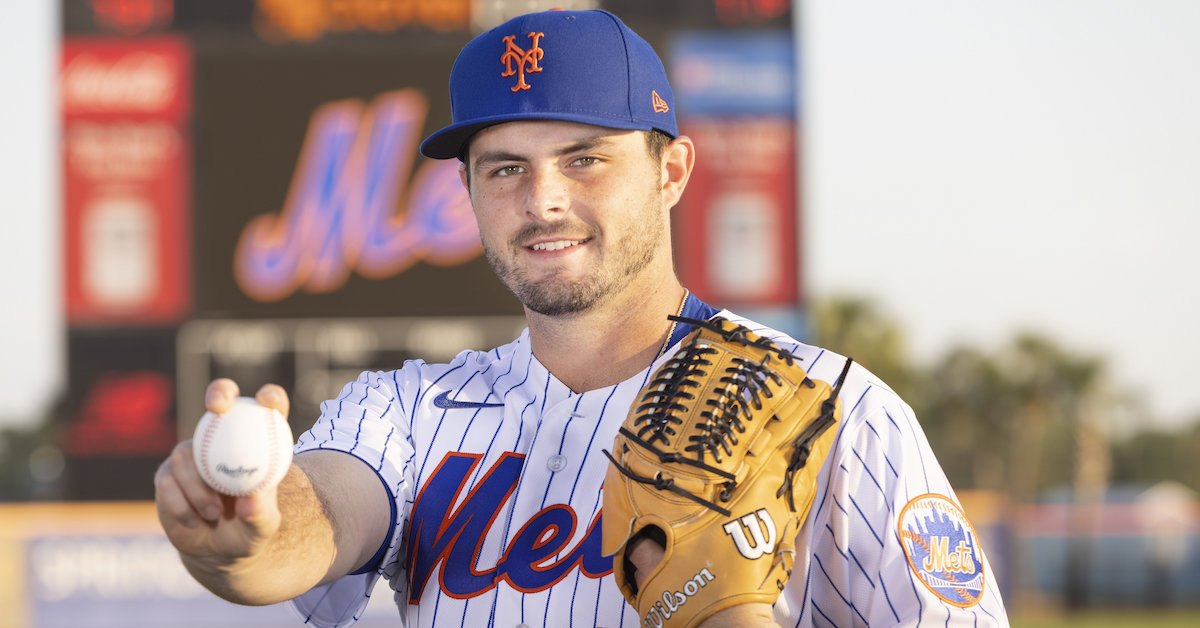
Grant Hartwig is one of the most promising under-the-radar prospects in the New York Mets system. Moreover, he has one of the more unusual profiles in professional baseball. Signed as an undrafted free agent in 2021, the 25-year-old right-hander has a degree in microbiology and premedical studies from Oxford, Ohio’s Miami University, and he has worked as a medical assistant in a Detroit-area cardiovascular clinic. He also excels on the mound. Pitching at four levels last year in his first full professional season, Hartwig logged a 1.75 ERA with 13 saves and 83 strikeouts in 56-and-two-thirds innings.
Hartwig discussed his Craig Breslow-like background, as well as the movement profiles of his primary pitches, late last season.
———
David Laurila: Your path to pro ball was atypical. Tell me about it.
Grant Hartwig: “Out of high school, I was just planning to go to college, which I did, and after graduation I was planning on going to medical school. I went to my teammate’s draft party — Sam Bachman went ninth overall to the Angels — and I remember going home ready to move on. But later that week, I was in the middle of an MCAT practice exam — I was about five hours in — and got a call from a random number. I muted it. Then I got a call from my pitching coach, which surprised me because I was done with school and had talked to him two weeks earlier. He told me that I was going to be offered a contract to play baseball. I told him, ‘Hey, I think I just got that call, and I hung up on them.’ Read the rest of this entry »
Triston McKenzie recorded double-digit strikeouts three times last season. That puts him in some good company — other pitchers who did so include Framber Valdez, Taijuan Walker, and Shane Bieber — but hardly elite territory. Carlos Rodón led the way with 11 double-digit strikeout games, and 19 different pitchers had at least four such outings.
Now let’s bump up the strikeout threshold. McKenzie recorded at least 11 strikeouts in a game three times last season. This feat was a little more unusual; other starters with three 11-strikeout games were breakout star Nestor Cortes and Cy Young winner Sandy Alcantara. Only nine pitchers had four or more appearances with 11-plus strikeouts. Shohei Ohtani led the way with seven such starts.
Let’s keep going. McKenzie recorded at least 12 strikeouts in a game three times last season. No pitcher in baseball had more such starts. The only pitchers to match his total were Ohtani, Rodón, Gerrit Cole, and Spencer Strider. That’s a damn good group to be a part of:
A Damn Good Group To Be a Part Of
Pitcher
IP
K/9
ERA
FIP
xFIP
Shohei Ohtani
166.0
11.87
2.33
2.40
2.65
Carlos Rodón
178.0
11.98
2.88
2.25
2.91
Gerrit Cole
200.2
11.53
3.50
3.47
2.77
Spencer Strider
131.2
13.81
2.67
1.83
2.30
Triston McKenzie
191.1
8.94
2.96
3.59
3.77
Hopefully, you’re starting to pick up on something atypical about McKenzie. He had three games with 12 or more strikeouts but never topped eight in his 28 other outings. He was one of only six pitchers to twirl a 14-strikeout game, yet he averaged seven strikeouts per start with a median of six. His name and numbers look wildly out of place in the company of Ohtani, Rodón, Cole, and Strider. Read the rest of this entry »
In the wake of a free agent exodus that included shortstop Trea Turner and third baseman Justin Turner, the Dodgers entered the spring with a new-look infield that offered considerable uncertainty relative to the previously star-studded unit. Now the team will have to adjust its plans, because on Monday, Gavin Lux, who was slated to be the starting shortstop, tore the anterior cruciate ligament of his right knee, which will require surgery that is expected to sideline him for the entire season.
During the sixth inning of an exhibition game against the Padres in Peoria, Arizona, the 25-year-old Lux began running from second to third base on an infield grounder to third baseman Jantzen Witte. In ducking to avoid Witte’s throw to second base, Lux lost his balance, first stumbling and then tumbling into third as his right leg bent awkwardly. Upon crash-landing at the base, he clutched his right knee, clearly in pain, and could not leave the field under his own power, so the Dodgers called for the trainers’ cart. The video is here, but it’s not for the faint of heart. Read the rest of this entry »
This is the story of two games that both took place on the evening of April 27, 2022. In an inland Los Angeles suburb, the Rancho Cucamonga Quakes and Visalia Rawhide took part in an early-season battle under the shadow of the San Bernadino Mountains. The Quakes, a Dodgers affiliate, were on their A-game that night. 2021 fifth-round pick Ben Casparius and 21-year old lefty Benony Robles were dominant in a tandem start, combining to strike out a dozen batters while allowing just three to reach base. Tommy Kahnle faced one batter in a rehab appearance, and the Quakes shut out their opposition. Meanwhile, the Rawhide, a Diamondbacks affiliate, didn’t have the evening they wanted. Their four arms combined to walk nine hitters and the defense behind them didn’t help, committing three errors (including one each by highly ranked prospects Jordan Lawlar and Deyvison De Los Santos). In total, 21 Quakes reached base, and Rancho Cucamonga cruised to an 8-0 victory.
A few hundred miles north at Oracle Park, the A’s and Giants played a crosstown matchup. Fresh off the IL, Chad Pinder took a 2-2 changeup from Sam Long into the left field seats for a homer to lead things off. Then neither team scored for the rest of the game. The Giants’ pitching quickly stabilized, with piggyback man Jakob Junis contributing five scoreless on an efficient 64 pitches, while Paul Blackburn and his bullpen combined to blank San Francisco’s bats. But while this low-scoring affair took three hours to complete (just shy of the nine-inning average of 3:03), Visalia’s comedy of errors and walks was over in just 2:15. Read the rest of this entry »
To put it charitably, it’s been a rough 18 months for fans of the Reds. Finding themselves surprisingly in the wild card race in July 2021, the team’s front office bravely ran away at the trade deadline, choosing only to improve the bullpen depth slightly. The downhill slope has only grown steeper since then, as the organization chose to go into full fire sale mode, trading practically every player with a significant contract who drew interest from another team. The exodus of talent had immediate results in Cincy: the team lost 100 games for the first time since 1982, when Reds GM Dick Wagner conducted his own fire sale on the dried-up husk of the Big Red Machine.
For anyone who may have thought that Cincinnati’s suddenly hard-line approach to spending was a temporary rebuilding strategy, ownership has done its best to disabuse fans off the notion. Bob Castellini was reportedly one of the owners who didn’t want to raise the luxury tax threshold at all, and he’s spoken repeatedly about the team’s finances. Club president Phil Castellini, during a lunch with a Reds booster group, gave a confusing presentation about how awful it was to own a baseball team, complete with a bizarre presentation that either made myriad mistakes or simply made up playoff projections from this very site. Most prognostications have the Reds challenging the Pirates for fourth place in the NL Central in 2023.
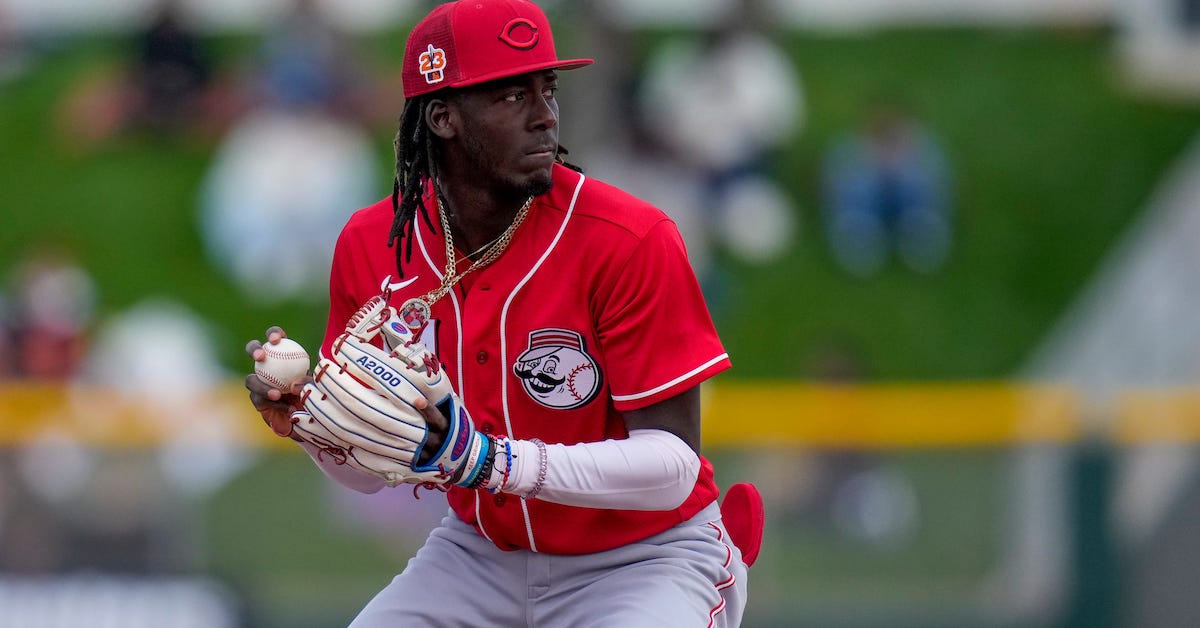
Against this backdrop, not all is doom and gloom. Despite the disappearance of talent at the major league level, there are a lot of interesting players in the minors. The farm system improved to eighth in the league in our late 2022 rankings, and five prospects made our recently released Top 100 Prospects list. The 2023 ZiPS projections for the Reds are bleak, but it’s more optimistic about the state of the farm system, ranking seven Cincinnati prospects in its Top 100. Overall, 11 players made the Top 200 in the ZiPS prospect list, including a ludicrous numbers of shortstops (five).
There’s not a whole lot of pitching on this list, but the good news is that the Reds already have some promising arms on their roster. ZiPS thinks that the three front-end starters — Hunter Greene, Graham Ashcraft, and Nick Lodolo — will all make positive contributions in 2023, and odds are they’ll be even better come ’25 or ’26. Before and after a shoulder strain that cost most of his August, Greene was dominant in his 35 1/3 second-half innings, with a 1.02 ERA, 1.70 FIP, 13 strikeouts per game, and a walk rate cut in half from before the All-Star break. The last may be the most important; it doesn’t take a whole lot of innings to establish an improved (or worsened) walk rate. Lodolo, meanwhile, barely needed a half-season to put up 2 WAR, and Ashcraft and his high-90s fastball ought to have some strikeout upside.
If we construct a roster based on who is under contract or team control, you can cobble together most of a pretty interesting 2025 roster. Now, not all of these players will actually be on the roster in two years; the idea is to get the baseline for a team with the players the Reds currently have.
C Tyler Stephenson
1B Christian Encarnacion-Strand
2B Jonathan India
3B Noelvi Marte
SS Elly de la Cruz
LF Spencer Steer
CF Matt McLain
RF Allan Cerda
DH Jake Fraley
C Mat Nelson
IF Edwin Arroyo
OF Michael Siani
OF Stuart Fairchild
SP Hunter Greene
SP Nick Lodolo
SP Graham Ashcraft
SP Andrew Abbott
SP Connor Phillips
You can no doubt quibble with any of these choices, because this is highly speculative. Maybe the shortstops sort themselves out in a different way, assuming that some aren’t directly traded for outfield help. Perhaps the Reds stick with Nick Senzel through his free-agent season, but I personally feel that he’s a prime suspect to be non-tendered after 2023. There are myriad choices that can be made differently, but generally speaking, if you can only make the 2025 Reds using in-organization players, the basic framework is likely to be something in this ballpark.
I did this with the Pirates last week (and the rest of the league), and I only got the Bucs to 76 wins in 2025. But the Reds have a sunnier baseline; with all teams under the same constraints, they “start” 2025 with a baseline projection of 85 wins. That’s not to say that will be the projection, only where the team stands in talent in 2025 compared to the rest of the league. And an 84-win team in the NL Central is a contender, unless someone decides to go all-in, Padres-style, in the next couple years.
This is where Cincinnati hits an important decision point. If a team like this looks to be a contender in 2025, would there actually be investment in the roster in free agency to get it over the top? The lack of this was the crucial element that doomed the good 2010s Pirates teams. Will the Castellinis, if they’re still the owners, stick to their financial guns when there’s a real chance at playoff contention? It doesn’t really make sense to spend a lot on the Reds as they’re currently constructed, but what happens when there’s a compelling reason to? I don’t know the answer to that question, though I’m cautiously pessimistic.
There’s a lot to not like about the Reds right now. But there’s a lot to like about their future, if ownership is willing to allow that future to fully bear fruit.
The speculation about Padres third baseman Manny Machado exercising his opt-out clause after the 2023 season came to a stunning conclusion over the weekend, as club and superstar agreed to an 11-year, $350 million contract. The new deal rips up the final six years of the contract that Machado signed before the 2019 season.
If nothing else, tally one team that is apparently not concerned with the short-term hiccups in baseball’s revenues due to the Bally/Diamond bankruptcy; the Padres are one of the teams with a regional sports network (RSN) that is affected. If revenues are up in the air, they have made sure that third base certainly is not, following an extension that will also keep Yu Darvish in town for all or most of the rest of his career. The Padres aren’t trying to be the Rays, the scrappy underdogs that hunt very large game with a sharpened stick; they’re trying to go toe-to-toe with the Dodgers at their own game. This is less David versus Goliath and more M. Bison versus palette-swapped M. Bison in “Street Fighter II.”
My colleague Jay Jaffe covered a lot of the particulars about the Manny situation in San Diego last week, so I’m going to skip the exposition. I think Jay and I both underestimated just how motivated the Padres were to ensure Machado stayed in mustard-and-brown for a long time. We had a ZiPS projection in that piece, but now that we know where he will play and for how long, I ran a new projection.
ZiPS Projection – Manny Machado
Year
BA
OBP
SLG
AB
R
H
2B
3B
HR
RBI
BB
SO
SB
OPS+
DR
WAR
2023
.266
.338
.469
561
87
149
28
1
28
95
62
119
8
125
2
4.8
2024
.262
.336
.460
541
82
142
27
1
26
89
61
115
7
123
1
4.3
2025
.254
.328
.438
520
76
132
25
1
23
81
58
112
6
115
1
3.5
2026
.249
.323
.422
490
69
122
23
1
20
73
54
106
5
109
0
2.8
2027
.245
.320
.408
453
61
111
21
1
17
63
50
100
4
105
-1
2.2
2028
.237
.311
.388
410
53
97
18
1
14
54
44
93
3
97
-2
1.4
2029
.234
.308
.376
359
44
84
16
1
11
46
38
83
2
93
-2
0.9
2030
.230
.303
.362
304
37
70
13
0
9
37
32
71
2
88
-3
0.5
2031
.226
.297
.347
265
30
60
11
0
7
31
27
62
1
82
-3
0.2
2032
.225
.296
.348
178
20
40
7
0
5
20
18
43
1
82
-3
0.1
2033
.220
.289
.339
109
12
24
4
0
3
12
11
26
0
78
-2
-0.1
Let’s just say that ZiPS isn’t overly enthusiastic about the contract, valuing Machado’s future services at $181 million over 11 years. He is a superstar, but there’s a big difference between signing a player before their age-26 season and their age-30 season. Just to illustrate, here’s the projection a second time, but with Machado the age he was when he signed his initial deal with the Friars.
ZiPS Projection – Manny Machado (Four Years Younger)
Year
BA
OBP
SLG
AB
R
H
2B
3B
HR
RBI
BB
SO
SB
OPS+
DR
WAR
2023
.269
.343
.481
572
91
154
29
1
30
102
65
118
9
130
2
5.2
2024
.270
.344
.487
571
92
154
29
1
31
101
66
116
8
132
2
5.4
2025
.265
.343
.476
569
91
151
28
1
30
99
68
114
7
129
3
5.2
2026
.260
.338
.466
569
89
148
28
1
29
97
68
114
7
125
2
4.8
2027
.259
.337
.461
557
86
144
27
1
28
93
67
112
6
123
1
4.5
2028
.251
.331
.441
537
80
135
25
1
25
86
65
109
5
116
0
3.7
2029
.252
.332
.443
515
77
130
24
1
24
81
62
105
4
117
0
3.5
2030
.249
.328
.434
486
71
121
22
1
22
75
58
100
4
114
-1
3.0
2031
.248
.327
.427
487
69
121
22
1
21
73
57
101
3
112
-2
2.7
2032
.247
.326
.422
453
63
112
20
1
19
67
53
95
3
110
-3
2.3
2033
.243
.321
.407
420
56
102
19
1
16
60
48
89
2
105
-4
1.8
That’s a valuation over $400 million, a notable difference! The sad truth is that even for superstars, the 30s are more often than not a tale of significant decline. Just to illustrate, here are all non-active position players worth between 41–51 WAR through age 29 (Machado is at 46.6) and how they fared in their 30s.
ZiPS actually has Machado aging slightly better than the average player in this group, with an additional three WAR over about 1,000 more plate appearances. The three active players at the end of their careers that I chopped off wouldn’t make this any sunnier a list; none of Miguel Cabrera, Evan Longoria, or Andrew McCutchen have aged particularly well.
Some of the decreased projection is due to the fact that Machado is no longer a defensive star at third base as he was earlier in his career. Defense doesn’t decline as rapidly as people think at the non-speed positions, and the fact that Nolan Arenado’s glove has stayed quite steady gives him kind of a fallback position if his bat declines. Machado no longer has that luxury.
Despite my grumpiness as an analyst who inevitably has to play devil’s advocate, let me emphasize that I’m certainly not shedding any tears for the pocketbooks of team ownership. While speculating what the Padres’ analytics gang has for Machado over the next 11 years would be a wild-ass guess, I know enough to know that ZiPS does not generally give projections that are grossly different from ones that teams run internally. The team’s ownership group, led by Peter Seidler, was no doubt given all the information the team had internally of this type and is also aware of the revenue situation, his personal net worth, and the fact that the big jump in baseball’s luxury tax threshold from 2021 to ’22 is much, much smaller in subsequent seasons of the CBA. They take this risk with the eyes wide open.
Even as a risk, it’s hard to dislike this signing as a fan of baseball. It’s refreshing to see owners who want to keep their teams together, who prioritize putting the best team on the field right now, and who directly challenge another of baseball’s elite franchises. Baseball’s system of playoffs and revenue sharing incentivizes just sneaking into the postseason every year, and if I worked for a team, I’d recommend the same cynical view that is prevalent among franchises. So it’s nice to see a team with a little more ambition, one willing to be happy with the increases in team value rather than also requiring a healthy profit every season to boot.
There remains a big unanswered question in the form of Juan Soto. Keeping him may cost $40 million a year, and I now have to wonder just how far San Diego’s willingness to spend will stretch. Are the Padres really willing to already be at $200 million for 2025–27 with two starting pitchers under contract? The farm system has nowhere near the depth that it had a few years ago, after all; ZiPS had no Padres prospects in its Top 100. While our prospect team placed two, the farm system ranked 26th at the end of last year, and though the new rankings aren’t out yet, I can’t imagine they’ve moved up a ton. But we’ll worry about Soto later.
By signing Machado, the Padres have signaled that they’re here to win now, and that the current aggressive spending isn’t just the apogee between the fire sales that have peppered San Diego’s franchise history. They’re going after the Dodgers on their own turf, and that’s pretty cool. Now the win now team just has to do the hard part and actually win now.
Joey Votto has yet to play a spring training game, and he probably won’t for at least a little while longer as he recuperates from the surgery on his left shoulder that ended his 2022 season. That hasn’t stopped the 39-year-old future Hall of Famer from filling reporters’ notebooks now that camp has opened, particularly as he heads into the final year of his 10-year contract and perhaps his final year in the majors.
Votto hit just .205/.319/.370 with 11 homers in 376 plate appearances last year; all of those slash stats were career lows, as were his 92 wRC+ and -0.9 WAR. His performance was particularly dismaying given his 2021 resurgence. Reversing a 2019-20 skid during which he had managed just a 101 wRC+, 26 homers, and 1.1 WAR, he hit .266/.375/.563 (139 wRC+) with 36 homers in 533 PA; all told, it was his best season since 2017.
That made the sudden arrival of Votto’s worst season all the more jarring, even though we’ve all become accustomed to seeing even great players in their late 30s fall apart. Last week, Votto offered an eye-catching, blunt assessment of his season:
Joey Votto said he felt like he was getting better last year after he ditched his "bullshit bat" and "greedy" approach. "But again, maybe I played like shit because I’m not good anymore, we’ll see. I doubt that, but we’ll see. I’m excited about the challenge."
Gavin Cross loves to hit, and he does so, figuratively speaking, with his feet planted firmly on the ground. The son of a former minor leaguer who went on to become a scout and a coach, the sweet-swinging 22-year-old outfielder was drafted ninth overall last year out of Virginia Tech and is now one of the top prospects in the Kansas City Royals organization. His smooth left-handed stroke is a big reason why. Cross logged a 1.071 OPS in his final collegiate season, and he essentially matched that number in his first taste of pro ball. Playing all but three of his games with Low-A Columbia, he put up a 1.070 OPS over 135 plate appearances.
Cross talked about his development as a hitter, and his ability to stay in the moment, last week.
———
David Laurila: How would you define yourself as a hitter, and how have you evolved?
Gavin Cross: “My dad played, and from a young age I was taught to be a hitter first. I was really conventional with my setup all the way until college, and was always trying to hit line drives to left-center. My freshman year — that was the COVID year — I had 24 hits, and 23 were singles. But I was second on our team in exit velo, so I was hitting the ball hard. I just wasn’t really hitting it in the air [and] splitting the gaps. Read the rest of this entry »
Earlier this month, I wrote about the improvements that umpires have made in calling balls and strikes according to the rulebook strike zone. Today, I’d like to focus on the other side of that equation: pitch framing. The consensus around baseball is that pitch framing’s story has followed a very familiar arc. Call it the Competitive Advantage Life Cycle:
Teams realize the immense value of a skill.
An arms race ensues as they scramble to cultivate it.
The skill becomes widespread across the league.
Since the skill is more evenly distributed, it loses much of its value.
Once everybody got good at pitch framing, nobody was great at it. As Rob Arthur has put it, “Catcher framing felt like it was disappearing almost as soon as it was discovered.” I even have fun graphs to drive the point home. There are definitely more useful ways of presenting the data, but I like how these ones let you watch the entropy dissipate over time in open defiance of the second law of thermodynamics:
Harry Ford is one of the top prospects in the Seattle Mariners organization, and he is also unique among his peers. Born Harrison Michael Ford, in Atlanta, 20 years ago this week, the right-handed-hitting catcher is the son of English immigrants. His mother spent her childhood in London, while his father — “a real Brit; he still has an accent”— came to the U.S. a little over two decades ago from Oxford. Moreover, his multi-national upbringing included his family’s having hosted exchange students from Argentina, Brazil, and Germany.
If the above list of countries has you wondering if football — soccer to us here in the States — has been a part of his life, the answer is yes. Ford’s father is a huge Arsenal fan who used to play in a competitive men’s league, while the youngster impressed on the pitch in his schoolboy days before turning his full attention to baseball. Given that Ford is a muscular 5-foot-10, 200-pounds and has been called a unicorn due to the speed that augments his frame, how good might he have been had he pursued his father’s favorite sport rather than America’s national pastime?
“I think I’d go crazy in soccer!” was Ford’s fun-loving (and quite possibly accurate) response to that question, meaning that he would excel. Instead he is excelling on the diamond, and he’s doing so at a position that belies his athleticism. How he found himself wearing the tools of ignorance was a matter of happenstance.
“I was always a third baseman, but when I was eight or 10 we needed someone to play catcher,” explained Ford, whom the Mariners took 12th overall in the 2021 draft. “I remember that there was this royal blue, really ugly gear, and I was like, ‘I’ll try it. Why not? ‘I got back there and liked it, and haven’t left it since.”
As uncommon as it is for elite athletes to end up behind the plate, it has been an even less common destination for African Americans. Black catchers have been few and far between in MLB history. To Ford’s mind, “It will be cool to change that stigma.” Read the rest of this entry »