It has been a pretty quiet offseason in Seattle. The Mariners got things moving fairly quickly, trading for Teoscar Hernández and Kolten Wong to cover the holes left by a couple of departing free agents, but things slowed down after that. They’ve brought in a couple of veterans to provide a bit of depth, but are otherwise largely banking on a repeat of their success last year and some continued growth from their young core. They made one more last minute addition yesterday, signing Kole Calhoun to a minor league contract with an invitation to spring training.
Bringing in an 11-year veteran like Calhoun is the type of move that plenty of teams make during the spring, but they rarely work out for the player involved. Most ball clubs are content to roll out whatever internal depth they already have instead of clearing a 40-man roster spot to add a player on a minor league deal. But every once in a while, a veteran will show that he has just enough left in the tank during spring training to break camp on the Opening Day roster.
If you squint, you can see how Calhoun could be primed for a bounce back season in 2023. A long-time Angel, he really started to struggle during his final seasons in Anaheim. From 2017–19, he put up a 94 wRC+ and accumulated 3.5 WAR, with a career-high 33 home runs in his final season for Los Angeles. He joined the Diamondbacks in free agency the following year and produced a career-high 125 wRC+ and 1.5 WAR during the shortened season. The last two years haven’t been kind to him, however. A recurring hamstring injury cut short most of his 2021 season and his production cratered last year after signing a one-year deal with the Rangers, with his wRC+ falling to a career-low 67. Read the rest of this entry »
As an East Coast dweller with a habit of watching West Coast broadcasts (and particularly Dodgers games) after the work is done and the kiddo tucked in, I’m well aware of Kenley Jansen’s evolution toward what we might politely call a more deliberate approach to pitching. Indeed, over the course of his 13-year major league career, he has evolved into one of the majors’ slowest workers on the mound. With this year’s introduction of a pitch clock, he spent the offseason working to adjust his delivery and is facing as much pressure as any pitcher to adapt to the new rules, though he’s hardly alone.
On Thursday, The Athletic’s Andy McCullough and Jen McCaffrey had some choice quotes from Jansen, who joined the Red Sox this year via a two-year, $32 million deal, on the subject of his tempo. Last year, while a member of the Braves, he saw his name atop an MLB Network graphic of the slowest-working pitchers. “I was so embarrassed,” he toldThe Athletic. “Like, dude, you’ve got to clean it up.”
“It drives me crazy,” he added. “Because I’m like, when did I get this slow?”
The topic is particularly relevant because Major League Baseball is adding a pitch clock this year, one that gives pitchers 15 seconds to begin their deliveries with the bases empty and 20 to do so with men on. MLB is also planning strict enforcement of the balk rule, because the aforementioned times require clarity on when a pitcher’s delivery starts, thus presenting an additional problem for Jansen.
The 35-year-old righty believes that the addition of a double swivel of his left (front) hip to start his delivery may have slowed his delivery down even as its addition catalyzed his resurgence. Stung by his reduced role in the 2020 postseason as the Dodgers finally won that elusive championship and hoping to regain velocity and command, he added the move in April ’21. By repeating a hip swivel that he’d previously introduced at the start of his delivery, he improved his balance, avoided drifting toward third base, and lengthened his delivery toward home plate. His results certainly improved: his average cutter velocity increased from 90.9 mph to 92.5, and his ERA fell from 3.33 to 2.22 (though his FIP and xERA barely budged). Last year, Jansen’s cutter averaged 92.2 mph, still faster than his 2018–20 velocities.
As you can see from the video above, the hip swivel is pretty subtle when viewed from the center field angle via which we typically watch pitchers, but the batter and umpire have a better view. That little movement matters because under the new rule, the clock stops at the start of the delivery, but what Jansen’s doing is a false start that can disrupt a hitter’s timing. Now in addition to speeding up his internal clock, he has to work on simplifying his delivery so as not to commit a balk.
While his hip swivel helps at least somewhat in explaining Jansen’s rebound in performance — mixing in his sinker and slider have helped as well — the data tell us he’s been throwing the brakes on his pace of work more or less since he assumed closer duties for the Dodgers in 2012, just three years after switching from catching to pitching and two years after reaching the majors. Last year, Statcast began publishing Pitch Tempo data, which measures the median time between pitch releases; not every pitch is accounted for, only those that were called strikes or balls. The Statcast measure differs from our lost-and-found Pace metric, which divides the time difference between the PITCHf/x timestamps of the first and last pitches of a plate appearance by the number of pitches in the PA minus one. Statcast also splits the data into into times with the bases empty and with men on base. Here’s what the data looks like for Jansen; by happy coincidence, the start of Statcast’s data coverage is the same year as his major league debut.
Jansen’s delivery times have generally been on the rise since he began pitching, with 2012, ’16, and last year standing out as points where he went from slow to slower to slowest. Pitchers as a group have been taking even longer between pitches over the same timespan, with the average with nobody on base increasing from 15.8 seconds in 2010 to 18.1 seconds in ’22, and from 22.2 seconds with nobody on in ’10 to 23.3 in ’22. Taking a page from contributor Chris Gilligan’s big-picture look at the attempts to improve the pace of play, here’s how the leaguewide tempo data looks alongside pace and time of game over the span of Jansen’s career:
Pace of Play Metrics
Season
Avg Empty
Avg Men On
Pace
Time of Game
2010
15.8
22.2
21.0
2:50
2011
15.8
22.2
20.9
2:51
2012
16.3
22.7
21.4
2:55
2013
16.7
23.1
21.9
2:58
2014
17.2
23.5
22.2
3:02
2015
17.6
24.2
23.2
2:56
2016
17.8
24.4
23.3
3:00
2017
17.3
23.5
22.7
3:05
2018
17.2
23.3
22.5
3:00
2019
17.7
23.9
22.9
3:05
2020
18.0
23.9
23.2
3:07
2021
18.3
24.3
23.7
3:10
2022
18.1
23.3
23.1
3:03
Note that last year reversed a years-long trend; the average time between pitches decreased relative to 2021, as did the length of the average nine-inning game. Those improvements have largely been attributed to the PitchCom signaling system, though two-year declines in strikeout and walk rates have helped as well.
While I could give you a pair of graphs comparing Jansen’s splits to the league averages, I chose attempt to index his splits (pitcher tempo divided by league tempo times 100) into what I’ll call Tempo+, which I think similarly gets the point across:
From 2012 to ’21, Jansen was around 30% above average with the bases empty and about 17% above average with men on, but last year he set highs in both categories, climbing to 42% above average with the bases empty and 35% above average with men on. Good thing he moved out of the Pacific time zone, or I’d have been even more sleep-deprived.
Anyway, among pitchers with at least qualifying 100 pitches with the bases empty in 2022, Jansen actually had only the third-longest time between pitches:
Jansen did edge Loáisiga for the highest percentage of slow pitches, with 22.3% of his offerings with the bases empty taking at least 30 seconds, compared to 21.2% for Loáisiga. Meanwhile, with men on base, Jansen took over the major league lead in average time…
… but took a backseat to Gallegos in percentage of slow pitches, 58.2% to 57.4%; Williams (54.6%) and Colomé (51.7%) were the only other pitchers who topped 50% under those conditions. Gallegos might be the heavyweight champion of dawdlers, as his 33.8 seconds with men on in 2021 is the highest mark of the past seven seasons, and his 26.5 seconds with the bases empty that same year ranks third behind only Rafael Dolis (27.2 seconds in 2020) and Chapman (26.9 seconds in 2021). Jansen’s former teammate, the infamously slow Pedro Báez, has the second-longest split with men on, 32.9 seconds in 2015, and shaved just one second off that the following year.
if I had six months to live, I'd spend it watching Pedro Baez throw an inning because it would feel like eternity
It’s important to point out that Pitch Tempo doesn’t directly line up with the new pitch timer, which starts when the pitcher receives the return throw from the catcher and ends once he begins his delivery. Statcast publishes a Timer Equivalent that just subtracts six seconds from the tempo measure. Jansen’s Timer Equivalent measures of 19.6 seconds with the bases empty and 25.6 seconds with men on base would both constitute what former teammate Clayton Kershaw cheekily called “a shot clock violation” given the new regulations.
In terms of cleaning it up, Jansen is hardly alone. Using 100-pitch cutoffs for each split, last year 81 out of 523 qualifiers (15.4%) had timer equivalent averages over 15 seconds with the bases empty, and 56 out of 467 (12.3%) had averages over 20 seconds with men on. In both categories, the vast majority of the pitchers above those thresholds were relievers. In fact, only five pitchers who made at least half a dozen starts last year had timer equivalents greater than 15 seconds with the bases empty: Shohei Ohtani (15.7), Tylor Megill (15.3), JP Sears, Corbin Burnes, and Michael Kopech (15.1 apiece). Meanwhile, 16 starters had timer equivalents of at least 20 seconds with men on base, led by Montas, the only pitcher who cracked the tables above:
In an odd coincidence, not only is Montas here but also Sears, one of the pitchers he was traded for last August, and just missing the cut with an average right at 20 seconds is another, Ken Waldichuk. To be fair, Montas was bothered by shoulder problems that sent him to the injured list late last year and resulted in surgery earlier this week; his 28.0-second tempo average with men on base was 1.5 seconds higher than in ’21, suggesting he might have been trying to give himself a little extra time to recharge between pitches.
Indeed, that’s the general theory for the increased time between pitches, particularly for relievers; they’re throwing short stints at maximum effort and so need a bit of extra time to get that velocity to where it can have the greatest effect. FiveThrityEight’s Rob Arthur previously found that every second of delay adds .02 mph to average fastball velocity, which is to say that waiting 10 seconds can add 0.2 mph. Earlier this week at Baseball Prospectus, Darius Austin took a deeper look at the tempo-velocity link in light of the rule change, particularly searching for pitchers able to avoid losing velocity while improving their tempo from beyond the new clock limits to more acceptable times:
[P]itchers in the slower tempo group were 32 percent more likely to have increased their velocity with runners on. It’s the bases empty comparison that shows the notable difference here, though: only 24.3% (17 of 70) pitcher seasons saw an increase in average fastball velocity accompanying a reduction in time between pitches. By contrast, 41.4% of the pitchers who took more time on the mound added something to their fastball, making it over 70% more likely that fastball velocity increased relative to those who sped up between deliveries.
Particularly as he’s now 35 years old, Jansen is at least well aware of the continuous work it takes to adjust, but maintaining his effectiveness while adhering to the new rules is as big a challenge as he’s faced on the field. Here’s hoping he can get time on his side.
With players and team personnel reporting to their spring camps, the 2023 season is almost upon us, with 30 teams set to play over 2,000 games in an effort to qualify just for a chance to reach the ultimate goal of a World Series. It’s a marathon of unparalleled scale in American professional sports, and when all is said and done, some of those teams may be separated by as little as one or two wins — or, though it hasn’t happened since the tragic assassination of Game 163 last winter, any of a series of tiebreakers buried somewhere in the season standings.
That such a long race can come down to the final days is part of what makes our sport brilliant, like some amplified version of Monday’s UAE Tour cycling photo finish my colleague Michael Baumann shared on Twitter. It is part of what makes us all tune in so faithfully for this marathon; over a long summer, the margins between the playoff-bound and the homebound can be paper thin. Just ask last year’s 87-win Phillies and 86-win Brewers, who finished their seasons with extremely different tastes in their mouths.
All this to say: competitive balance is, well, a delicate balance, and with the debut of our 2023 playoff odds last week, there’s no time like the present to evaluate the state of the league from a parity perspective. Competitive parity in MLB has been a hot topic for the better part of a decade as we’ve started to see megateams like the Dodgers and Astros routinely eclipsing 100 wins, and others getting more comfortable with finishing somewhere around 60. In the five full seasons since 2017, 17 teams have reached 100 victories; just five did so in the previous 11 years. On the other side of the standings, prior to 2019, there had been just one season in which as many as four teams lost 100 games; then four clubs did so in each of the 2019, ’21, and ’22 seasons. With that in mind, here’s a look at the disparity in team winning percentage at the end of each season since 1960:
A few things are clear: measures of parity are pretty susceptible to swings in either direction, and as for right now, we are playing through a particularly disparate era. After a seven-year low in 2014, disparity spiked over the next five years to a peak standard deviation of .098 in 2019 before effectively leveling out around .090 in the last three. Left unchecked, this could pose a risk to the delicate balance of maintaining an exciting and marketable 162-game regular season. A wider spread means fewer tight playoff races and more teams with known playoff fates in the latter months of the regular season. Read the rest of this entry »
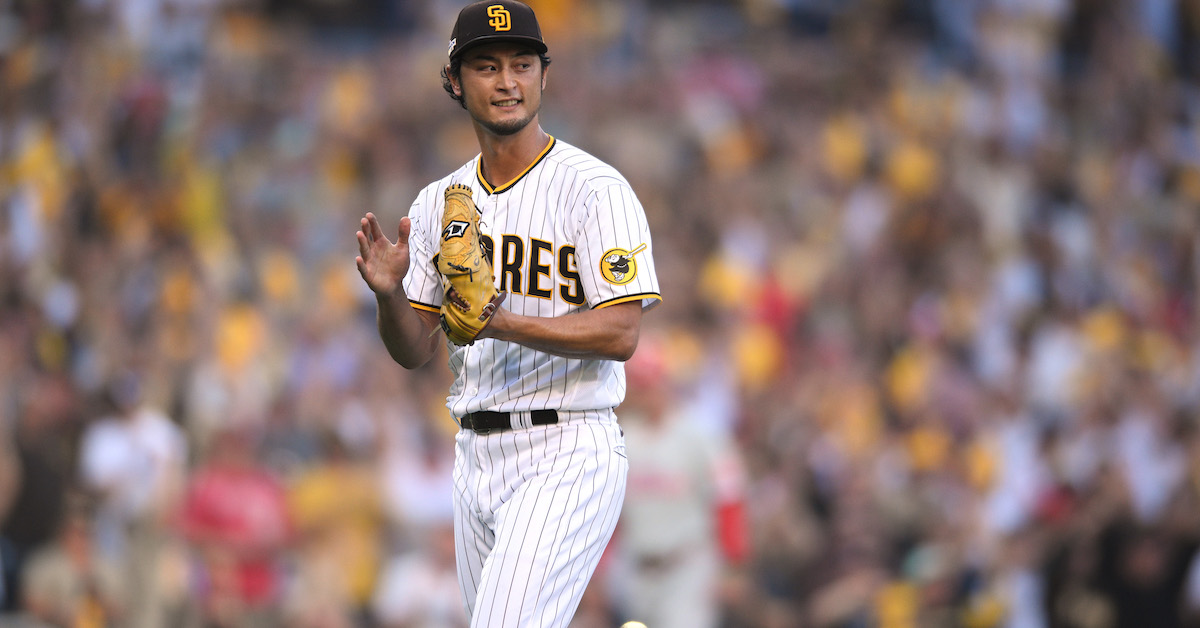
Yu Darvish’s six-year, $108 million extension with the Padres looks innocuous enough. Darvish is absolutely essential to the Padres’ success, and he’s now one of those rare MLB players who’s signed multiple $100 million deals, despite not having reached free agency the first time until his age-31 season.
If anyone can pitch until he’s 42, it’s Darvish, the man who’s got more pitches than can fit in Mary Poppins’ carpetbag. This extension actually has me looking forward to watching Darvish once he gets into his latter-day Zack Greinke era. No, the interesting thing about this contract is not who’s getting paid, who’s doing the paying, or how much money is set to change hands. It’s when. Read the rest of this entry »
Last week, we published our playoff odds for the 2023 season. Those odds contain a ton of interesting bells and whistles, from win distributions to chances of receiving a playoff bye. At their core, however, they’re based on one number: win totals. Win totals determine who makes the playoffs, so our projections, at their core, are a machine for spitting out win totals and then assigning playoff spots from there.
We’ve been making these projections since 2014, so I thought it would be interesting to see how our win total projections have matched up with reality. After all, win total projections are only useful if they do an acceptable job of anticipating what happens during the season. If we simply projected 113 wins for the Royals every year, to pick a random example, the model wouldn’t be very useful. The Royals have won anywhere from 58 to 95 games in that span.
I’m not exactly sure what data is most useful about our projections, so I decided to run a bunch of different tests. That way, whatever description of them best helps you understand their volatility, you can simply listen to that one and ignore everything else I presented. Or, you know, consider a bunch of them. It’s your brain, after all.
Before I get started on these, I’d like to point out that I’ve already given our playoff odds estimates a similar test in these twoarticles. If you’re looking for a tl;dr summary of it, I’d go with this: our odds are pretty good, largely because they converge on which teams are either very likely or very unlikely to make the playoffs quickly. The odds are probably a touch too pessimistic on teams at the 5–10% playoff odds part of the distribution, though that’s more observational than provable through data. For the most part, what you see is what you get: projections do a good job of separating the wheat from the chaff.
With that out of the way, let’s get back to projected win totals. Here’s the base level: the average error of our win total projections is 7.5 wins, and the median error is 6.5 wins. In other words, if we say that we think your team is going to win 85.5 games, that means that half the time, they’ll win between 79 and 92 games. Past performance is not a guarantee of future results, but for what it’s worth, that error has been consistent over time. In standard deviation terms, that’s around 9.5 wins. Read the rest of this entry »
On the heels of what was arguably the best season of his career — one in which he set career highs in wRC+ (152) and WAR (7.4), helped the Padres to the NLCS for the first time in 24 years, and finished second in the NL MVP voting — Manny Machado has informed the Padres that he intends to exercise the opt-out in his $300 million contract after this season and test free agency again.
Last Friday, at the Padres’ spring training site in Peoria, Arizona, the All-Star third baseman confirmed that in December prior to the Winter Meetings, agent Dan Lozano gave the Padres a February 16 deadline to reach agreement on extending the 10-year, $300 million contract Machado signed in February 2019. According to a report by the San Diego Union-Tribune’s Kevin Acee, the Padres made just one offer after hearing from Lozano; two days before the deadline, they offered to add five years and $21 million per year ($105 million total) to the five years and $150 million that will remain on his deal after this year. The proposed package of 10 years and $255 million wasn’t enough to satisfy Machado, and so with the deadline having passed, he told reporters that now that he’s in camp he wants to focus on the upcoming season rather than on contract negotiations. Read the rest of this entry »
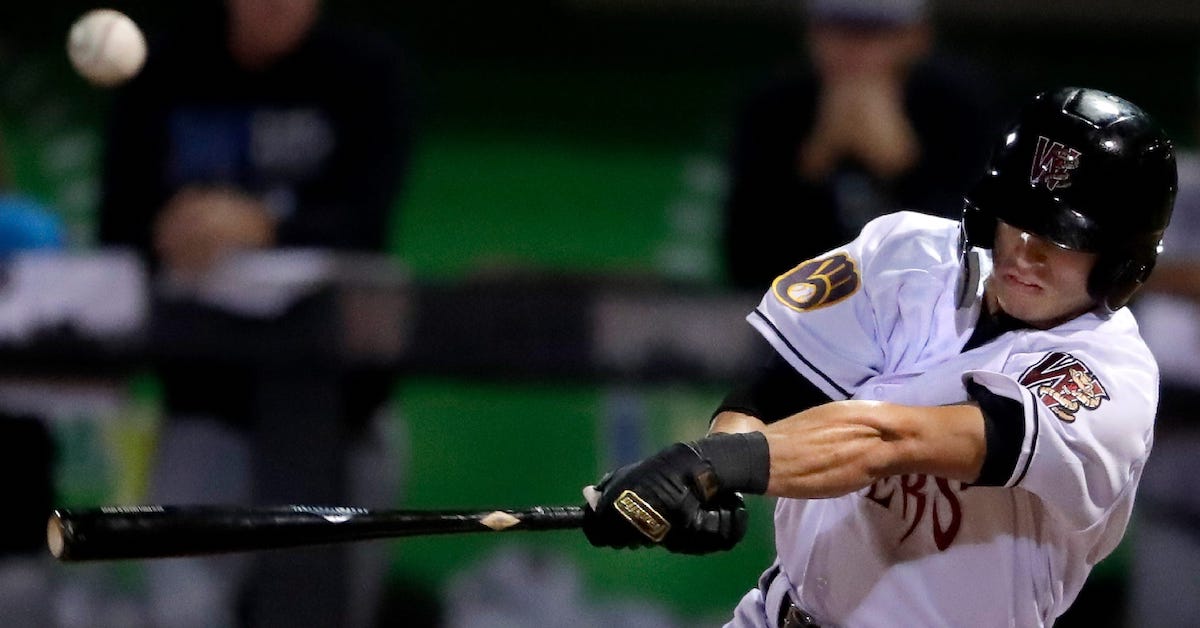
Sal Frelick is a pure hitter from a cold weather climate. He is also one of the top prospects in the Brewers’ system and ranks 68th overall on our recently released Top 100. A Massachusetts native who was drafted 15th overall in 2021 out of Boston College, the 22-year-old outfielder is coming off of a first full professional season in which he slashed .331/.403/.480 with 11 home runs between three levels. Moreover, he fanned just 63 times in 562 plate appearances and spent the final two months with Triple-A Nashville. Assigned a 50 FV by our lead prospect analyst Eric Longenhagen, the 5-foot-9-and-a-half, 184-pound left-handed hitter doesn’t project to hit for much power, but his elite contact skills make him one of the more intriguing position player prospects in the National League.
Frelick discussed his line-drive approach and his ascent to pro ball prior to the start of spring training.
———
David Laurila: You’re obviously a very good hitter. Where did you learn to hit?
Sal Frelick: “I don’t know if I ever learned from anybody, For as long as I can remember, the only thing I’ve tried to do is not strike out. I’ve wanted to put the ball in play, and over time, with that being the number one priority for me, it’s kind of how the swing I have now developed.”
Laurila: Is it basically the same swing you had as a kid?
Frelick: “Just about. It’s obviously gotten a little cleaner mechanically, but for the most part it’s been just short and compact. It’s not the prettiest thing you’ll ever see, but it gets the job done.”
Laurila: What’s not pretty about it?
Frelick: “If you look at your average lefty, sweet-swinging [Robinson] Canó-type of player, they have these nice long swings. Because I’ve always been trying to stay as short as possible, trying not to swing and miss, it’s just kind of compact.” Read the rest of this entry »
Despite three seasons until he hits free agency, the Pirates find themselves at a crossroads with Bryan Reynolds. Pittsburgh shipping out veterans as they approach lucrative paydays is a 30-year-old story, and as the team’s young(ish) star with the most service time, it’s no surprise that Reynolds would be the subject of constant, swirling rumors. He and the Pirates talked about an extension, but nothing came of it; seeking a little more clarity, the 2021 All-Star requested a trade. Luckily, unlike the Gerrit Cole situation, there hasn’t been a decisive break between player and organization, and Reynolds is still open to discussing an extension. But what kind of extension is realistic for Reynolds, and will the Pirates be able to field a contender while they have him?
Per The Athletic, the Pirates and Reynolds were about $50 million apart in their extension talks. Given that this $50 million isn’t, say, the difference between $300 and $350 million, it’s a notable separation. Pittsburgh’s offer was six years and $75 million, covering a few years of free agency; that would be the largest contract in team history, but that mostly reflects the ultra-thrifty approach of the Bucs, not some surfeit of munificence on their part. Compared to the eight-year, $70 million contract that Ke’Bryan Hayes signed, it seems downright miserly, given how far away Hayes was even from arbitration at the time.
Reynolds had a notable dropoff in play from 2021 to ’22, going from .302/.390/.522, 6.1 WAR to .262/.345/.461, 2.9 WAR, but a large chunk of that dropoff was to be expected given the pattern of what happens to players after career-best seasons. And in any case, there was never a chance the Pirates were actually going to offer him a contract consistent with the notion that he was a six-win player, because then you’re getting into Juan Soto territory. But as a three- or four-win player with a few years of arbitration remaining, it’s close enough for a deal to be plausible.
So let’s run the numbers. The current contract, a two-year deal to avoid arbitration, already covers the 2023 season, so we’ll focus the projection as an extension past this season. Read the rest of this entry »
In the first game of the 2021 ALDS between the Rays and Red Sox, Randy Arozarena stole home. With two outs, two strikes, and a dangerous left-handed hitter at the plate, the defense wasn’t worried about the runner at third. Arozarena took advantage, sprinting for home as southpaw Josh Taylor began his methodical windup. The speedy rookie timed it perfectly, taking off as soon as Taylor turned around and launching into his slide by the time the ball left the pitcher’s hand.
It was the first straight steal of home in the playoffs since Jackie Robinson accomplished the feat in 1955. Arozarena also made history by becoming the first player to ever homer and steal home in the same postseason game. But his stolen base wasn’t just historic in and of itself, and his jump wasn’t the only thing he timed perfectly. By stealing home that October, he tied a beautiful bow atop one of the most impressive league-wide seasons in the history of stealing home plate. Read the rest of this entry »
It’s always nice to feel welcome. After excelling for the White Sox as a stopgap shortstop in 2022, Elvis Andrus will return to Chicago in 2023, this time as the team’s starting second baseman. Toward the end of the 2022 season, he made clear to reporters that he would welcome a return engagement and was open to shifting positions if need be. Apparently Rick Hahn was listening. The deal, pending a physical, is for a reported one year and $3 million. ESPN‘s Jeff Passan and USA Today’s Bob Nightengale first reported the deal and terms, respectively. Amazingly, after 14 years in the big leagues, this was the first time Andrus had ever been a free agent.
Although Andrus didn’t make our Top 50 Free Agents list, he accrued more WAR in 2022 than 37 players who did, and he has, in my opinion, the greatest surname in all of baseball. Our crowdsourced predictions pegged him for two years and $20 million, so if one year and $3 million sounds like a lot less to you, then your math is spot on. According to MLB Trade Rumors, the only other teams reported to have interest in Andrus were the Red Sox and Angels. Read the rest of this entry »