Archive for Daily Graphings

The Diamondbacks and Mariners Combine on One-for-One Swap

© Lindsey Wasson-USA TODAY Sports

Mini trade alert! Yesterday, the Seattle Mariners sent outfielder Kyle Lewis to the Arizona Diamondbacks in exchange for outfielder/catcher Cooper Hummel. That’s the entire exchange – no other players, no cash, just a one-for-one swap. It’s not terribly exciting, but its simplicity makes it easier to break down. Shall we?

Two years ago isn’t a lot, but considering all the ruckus that has occurred between then and now – and I’ll spare you the loathsome, often non-baseball-related details – it might as well be forever. That’s also when Lewis won American League Rookie of the Year. After a lengthy detour caused by persistent knee injuries, Lewis seemed on a sure path to becoming an integral part of an up-and-coming Mariners core. But the hardship continued into his sophomore season due to another tear to the same knee that had been bothering him for years; he played just 36 games in 2021. And if that wasn’t enough, the already battered Lewis, who began his 2022 on the injured list, was hit by a pitch a mere week after being called up in May. He recovered, but struggled immensely at the plate. Eventually, the Mariners sent him back down to Triple-A Tacoma, where he wrapped up a grueling season.

Laid in front of us are four fragmented seasons, including a cup of coffee in 2019, from which to evaluate Lewis. The truth is, it’s a tricky task. When samples are small and distant from one another, distinguishing the effects of injury from random variance and a possible decline in skill is about as productive as imagining “what could have been.” But from a projection system’s perspective, a short resume actually paints Lewis in a positive light. Steamer, for example, forecasts a .240/.323/.426 slashline and a 110 wRC+ for 2023, likely because of his recent minor league output and the fact that most of his major league experience comes from an award-winning rookie season. The ceiling of an everyday center fielder still exists, and a 116 wRC+ in Triple-A last season that wasn’t BABIP-driven is reason for optimism. Read the rest of this entry »


Boston’s Thad Ward Should Draw Interest in the Rule 5 Draft

© Kim Klement-USA TODAY Sports

Thad Ward should be of interest to several teams come next month’s Rule 5 draft. Currently no. 15 on our Boston Red Sox prospect rankings with a 40+ FV, the 25-year-old right-hander wasn’t added to the club’s 40-man roster — a decision that left Eric Longenhagen “a tad surprised.” Our lead prospect analyst explained that Ward “looked good in the Arizona Fall League, locating 92-94 mph fastballs while mixing in two above-average breaking balls… [and] looks like a possible bulk relief fit right now.”

Three years ago, Ward looked to be well on his way to securing a spot in Boston’s starting rotation. When he was featured at FanGraphs in October 2019, the 2018 fifth-rounder out of the University of South Florida had recently been honored as the organization’s Minor League Pitcher of the Year. According to then-Red Sox pitching analyst Brian Bannister, Ward was in possession of “a Chris Sale slider.”

But fate had its say. The 2020 minor league season was canceled due to the pandemic, and the following year, Ward underwent Tommy John surgery after making just two starts with Double-A Portland. By the time he returned to action this past July, he had essentially missed two-plus seasons. But while taking the mound again didn’t feel akin to jumping back on a bicycle for the righty, he did pitch well. In 51-and-a-third innings spread across four levels, Ward fanned 66 batters and allowed just 40 hits while logging a 2.88 ERA.

Ward discussed his comeback, including how his stuff compares to what it was pre-injury, during his stint in the Arizona Fall League.

———

David Laurila: You came back from Tommy John this year. Are you the same pitcher now that you were before going under the knife?

Thad Ward: “In some ways, yes. In some ways, no. I’ve matured a lot in terms of stuff I can’t control. I don’t get as upset over mistakes. That’s not to say my competitive edge has gone away, it’s more that I feel I’m channeling it in a better direction.” Read the rest of this entry »

Mookie Betts Did It All in 2022 (Except Win the MVP Award)

Mookie Betts
Mark J. Rebilas-USA TODAY Sports

Last week, I wrote about the overcrowded NL MVP ballot. Eight different position players finished within 1.0 WAR of the top spot on our leaderboard, more than in any other year since WAR was introduced. The MVP nearly always goes to one of the top position players by FanGraphs WAR. Thus, this past year presented us with one of the most hotly-contested MVP races in recent memory, regardless of how voters ultimately cast their ballots.

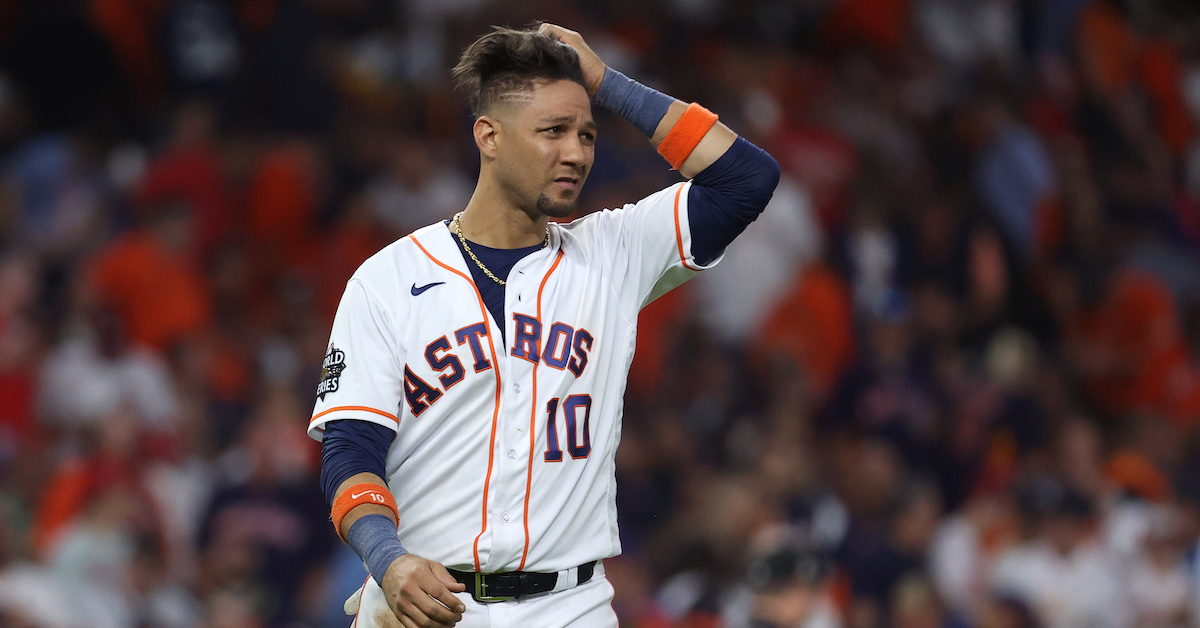
To have so many worthy choices for the award is exciting, even if we already know that Paul Goldschmidt emerged as the winner, with Manny Machado and Nolan Arenado placing second and third, respectively. As I wrote last Friday, “such a close race between so many contenders compels us to look beyond the go-to methods we might normally rely on to pick a winner. It allows us to think about how we measure value. It’s a chance to get creative.” I don’t know about you, but that sounds like a fun challenge to me. Now, from the headline and the image at the top of this piece, you can already guess who I would’ve picked. But indulge me for just a moment longer so I can explain how I came to that decision. On a ballot full of deserving choices, how was I to single out one name as the most deserving of all? Read the rest of this entry »


Pitchers Hitting Is Dead, Long Live Pitchers Hitting

David Robertson
Charles LeClaire-USA TODAY Sports

Over the years, plenty of FanGraphs articles have started out with a writer clicking around on the leaderboards looking for something interesting. Only the truly great articles, however, come about when the writer distractedly clicks on the wrong leaderboard because they’re busy baking adorable miniature cakes. With that auspicious beginning, let’s talk about pitchers hitting in the era of the universal designated hitter.

We’ll start with a simple question: Who was the best hitting pitcher in 2022?

Did you think it was Shohei Ohtani? Oh sweet, naïve reader. You make me laugh. It wasn’t Ohtani. That would’ve been the right answer if the question had been, “Who was the best hitting pitcher in 2022 (minimum two plate appearances)?” But that wasn’t the question, and you have fallen right into my trap. (Don’t worry; nothing bad happens if you fall into the trap. In fact, there’s candy down there.) Read the rest of this entry »


40-Man Roster Deadline Analysis: NL East

© Mark J. Rebilas-USA TODAY Sports

Tuesday’s 40-man roster deadline led to the usual squall of transaction activity, with teams turning over portions of their rosters in an effort to make room for the incoming crop of young rookies. Often, teams with an overflow of viable big leaguers will try to get back what they can for some of those players via trade, but because we’re talking about guys straddling the line between major league viability and Triple-A, those trades tend not to be big enough to warrant an entire post. Over the next few days, I’ll endeavor to cover and analyze the moves made by each team, division by division. Readers can view this as the start of list season, as the players covered in this miniseries tend to be prospects who will get big league time in the next year. I’ll spend more time discussing players who I think need scouting updates or who I haven’t written about in the past. If you want additional detail on some of the more famous names you find below, pop over to The Board for a more thorough report.

The Future Value grades littered throughout these posts may be different than those on the 2022 in-season prospect lists on The Board to reflect my updated opinions, and may be subject to change during the offseason. New to my thinking on this subject and wondering what the FVs mean? Here’s a quick rundown. Note that because we’re talking about close-to-the-majors prospects across this entire exercise, the time and risk component is less present here and these FVs are what I think the players are right now. Read the rest of this entry »


Xander Bogaerts’ Defensive Bogeyman

Xander Bogaerts
Paul Rutherford-USA TODAY Sports

It’s either a great or a terrible winter to be a shortstop. On the one hand, four shortstops – Carlos Correa, Trea Turner, Xander Bogaerts, and Dansby Swanson – figure to be among the offseason’s top free agent earners, making up half of the top eight in FanGraphs’ 2023 Top 50. On the other hand, those four have each other as competition, and differentiating oneself among the All-Star shortstops of four of the last six World Series champions can’t be easy. All four showed just what they’re capable of in 2022. Turner, Bogaerts, and Swanson each finished in the top 15 in position player WAR, separated by a grand total of 0.3, and Correa – if he raised any doubts by getting off to a slow start in Minnesota – slashed .370/.419/.613 over his last 29 games to finish first among all shortstops with a 140 wRC+. These players aren’t interchangeable by any means, and Swanson doesn’t have the offensive pedigree of the other three, but the teams showing interest in one are more than likely to at least take a look at the others. A year after Corey Seager, Trevor Story, Javier Báez, and Correa were among the top free agents available, this winter’s shortstop class is even more loaded.

2023 Free Agent Shortstops in 2022
Name Team G HR wOBA wRC+ Off Def WAR
Xander Bogaerts BOS 150 15 .363 134 28.6 9.0 6.1
Carlos Correa MIN 136 22 .362 140 20.7 2.0 4.4
Trea Turner LAD 160 21 .350 128 29.5 7.1 6.3
Dansby Swanson ATL 162 25 .337 116 15.7 21.4 6.4

Read the rest of this entry »


Twins Prospect Edouard Julien’s Bat Is Almost Ready for the Majors

© Mark J. Rebilas-USA TODAY Sports

When he was first featured at FanGraphs in October of last year, Edouard Julien was described as having a unique profile and a potentially bright future. A native of Quebec City whom the Minnesota Twins had taken in the 18th round of the 2019 draft out of Auburn University, the left-handed-hitting second baseman was coming off a season in which he led the minors with 110 walks while logging a .434 OBP. Augmenting his patient approach with promising power, he’d homered 18 times between the two A-ball levels.

An adjustment was nonetheless needed. Julien’s batting average had been a middling .267, and his 144 strikeouts and 28% K-rate were suggestive of a hitter who’d been guilty of taking too many hittable pitches. Eric Longenhagen addressed the issue this past March. Describing the now-23-year-old, our lead prospect analyst wrote: “Patient bordering on passive, Julien’s bat is what will carry him to the big leagues.” Read the rest of this entry »


For Sale: Catcher’s Gear, Lightly Used

Sean Murphy
D. Ross Cameron-USA TODAY Sports

It can be difficult to find the thing you didn’t realize you needed until you didn’t have it when it counted, or to offload it when you realized you had more of it than you could use. That thing, in this case: production from the catcher position.

Catchers are unlike infielders or outfielders, in that you can only one can play at a time. Or rather, two catchers can play at once, if one slides over to first base or DH, in which case the thing that makes them so special — the ability to slap on some plastic padding and soak up foul tips and 58-foot curveballs five nights a week — essentially goes to waste.

Consider Oakland’s situation; after developing Sean Murphy into one of the top catchers in the game, the A’s landed former top-10 pick Shea Langeliers in the Matt Olson trade. Langeliers reached the majors this year and hit fairly well, but not so well that he’s an ideal DH, which is where he made most of his starts on account of being blocked by Murphy.

Or how about the Blue Jays, who have not one but three starter-quality catchers? Alejandro Kirk emerged as a star in 2022, and Danny Jansen put up 2.6 WAR and a 140 wRC+ in just 72 games. That left Gabriel Moreno, one of the top prospects in baseball, even more blocked than Langeliers when he emerged as big league-ready late this season.

It makes sense, therefore, that trade rumors swirl around both Oakland and Toronto, as both teams could stand to cash in their surfeit of backstops for help elsewhere. Read the rest of this entry »


What if Pitching Were a Carnival Game?

© Brad Penner-USA TODAY Sports

One of my favorite things about baseball is the sheer number of mind games going on before every pitch. Will the batter sit on a fastball? Will the pitcher give in to the count and throw that fastball the batter is sitting on? The batter is weak against changeups, but the pitcher’s best secondary is a slider – what does that mean for each of their mindsets? First base is open, but the next batter up is strong – what does that mean? The permutations and counters are endless.

It doesn’t stop with the batter-pitcher confrontation. What if there’s a pickoff called? The defense is back and shifted – would a bunt make sense here? Does the count matter for the defense? What about the score? You can spin endlessly around these decisions, and it’s wonderful. I spend plenty of time watching the game and daydreaming about which tactics each team might employ.

That’s all awesome, and a great part of baseball. This article is very much not about those mind games. There’s another part of baseball that I also enjoy – watching phenomenal athletes at the top of their craft. Forget the game theory and levels of counter-play – the physical skill on display in a random baseball game is immense. Read the rest of this entry »


Blue Jays Send Teoscar Hernández to Seattle in Three-Player Trade

Teoscar Hernández
John E. Sokolowski-USA TODAY Sports

The Blue Jays and Mariners have swung the biggest trade of the young offseason so far, as Seattle has acquired Teoscar Hernández from Toronto in exchange for reliever Erik Swanson and pitching prospect, Adam Macko.

For the Mariners, the calculus for this trade is simple: immediate improvement on the offensive side of things by adding one of the 30 best hitters in baseball. The table below shows hitters with at least 1,000 plate appearances since the start of the 2020 season, ranked by wRC+:

wRC+ Ranking Since 2020
Name Tm PA wRC+ Ranking
Aaron Judge NYY 1443 176 1
Juan Soto 2 Tms 1514 160 2
Yordan Alvarez HOU 1168 160 3
Bryce Harper PHI 1269 156 4
Paul Goldschmidt STL 1561 155 5
Freddie Freeman 2 Tms 1665 153 6
Vladimir Guerrero TOR 1647 143 7
Jose Ramirez CLE 1575 143 8
Mookie Betts LAD 1435 139 9
Manny Machado SDP 1538 139 10
Trea Turner 2 Tms 1613 139 11
Shohei Ohtani LAA 1480 138 12
Brandon Nimmo NYM 1284 138 13
José Abreu CHW 1600 137 14
George Springer 2 Tms 1145 137 15
Ronald Acuña Jr. ATL 1095 136 16
Pete Alonso NYM 1561 135 17
Jose Altuve HOU 1492 135 18
Kyle Tucker HOU 1404 135 19
Austin Riley ATL 1561 132 20
Teoscar Hernandez TOR 1336 132 21
Will Smith LAD 1216 132 22
Rafael Devers BOS 1526 132 23
Brandon Lowe TBR 1105 132 24
Corey Seager 2 Tms 1304 132 25
Xander Bogaerts BOS 1459 131 26
Yandy Díaz TBR 1237 130 27
Carlos Correa 2 Tms 1450 130 28
Starling Marte 4 Tms 1281 130 29
Randy Arozarena TBR 1325 129 30

That 132 wRC+ comes with a 26.7% strikeout rate and 6.3% walk rate. That shaky plate discipline and a BABIP that ran well above average (.345) made it unclear whether Hernández could sustain this success. But changes to his stance and leg lift unlocked a part of his swing that allowed him to make hard contact in the air more consistently. Once a hitter figures out how to do that and has a 96th percentile average exit velocity like he does, the odds are in their favor.

This trade signals a few things from the Mariners. The first is that long-time outfielder Mitch Haniger is unlikely to return. That’s not shocking, given that he wasn’t extended a qualifying offer and that he seems to have already hit his offensive peak. The second is that they are going all in to try to catch the defending World Series champion Astros. Hernández is not a long-term addition; he’s under contract for just the 2023 season. This is, essentially, a one-year rental to goose the offense.

Shipping Swanson away isn’t ideal for Seattle, given his fantastic performance this season: a 1.85 FIP in 53.2 innings. But the team’s usage of him in the postseason — he only threw one inning in five games of play — suggests that he’s seen as expendable, making him an easy choice to include in a trade for a top-30 hitter. After all, even if the Mariners love Swanson’s pedigree and stuff, it’s always worth trading middle relievers for productive hitters, even if they have only one more year of team control.

That said, I’m a firm believer in Swanson. His whiff rates on his four-seamer and splitter are both well above average, and he seems to have perfected how to use them to go with his above-average extension and straight over the top delivery. The Jays’ most glaring weakness was their bullpen, so if their goal was to improve it, then they have succeeded.

The bigger question mark in the deal is Macko. He topped out this year with 38.1 innings in High A, striking out just under 36% of the hitters he faced, but he also walked 12% of them. He was solid with a 3.77 FIP and 3.21 xFIP as well. That’s all well and good, but with minor league pitchers, it’s always important to get to the good stuff — literally. So I asked Eric Longenhagen, who is constantly sourced for information, for the goods on Macko, and lucky for us, Eric got a few looks at him in the Arizona Fall League. Check out the video below to get a better look of Macko’s stuff and mechanics.

Per Eric, Macko had some Jekyll and Hyde characteristics in Arizona, with his secondaries and command coming and going depending on the outing. That makes sense, given his walk rates. When he was on, his stuff was interesting. He has two breaking balls: a curve of the loopy ilk that comes in at the low-70s, and a slider that’s more of a mid-80s gyro spin-dominant kind. Macko tended to pitch backwards in the AFL with those two pitches, adding a running four-seamer at 93–94 mph and topping at 96 to finish hitters off in the top of the zone.

To me, the most interesting tidbit was that Macko has rather short arms and as a result can get down the mound to a low release point. That’s ideal for getting whiffs and popups on fastballs at the top of the zone. By the looks of it, the spin is pretty true as well. It might not be perfect, but Macko’s fingers stay over the ball very well, which goes right in line with the pitch playing up the zone. The curveball might not have great specs on its own, but when paired with this deceptive fastball, hitters struggle to hit it. It’s the classic pairing of high four-seamers and big depth curveballs below the zone.

When Macko has command of the slider, it flashes plus. During the regular season, he used that pitch nearly a quarter of the time, and the fastball just about half the time. The curve had about a 15% usage; he also featured a changeup sparingly. Per Eric, that pitch also flashed plus when he used it. I know this all sounds exciting, but it’s always important to remind yourself that the saying of “if the command is there” needs to be at the forefront of your mind. This big “if” is enough to put Macko in the 45+ FV tier, rather than at 50 or above. But given that the Jays’ system isn’t too deep anymore, that will put him easily in their top 10 when Eric updates it.

To recap, the Mariners get a fantastic hitter to slot right into the middle of their lineup, and the Jays get a quality reliever and intriguing pitching prospect. This trade is likely only a prelude to more moves from the Jays, though; there are rumblings all around suggesting that George Springer’s time in center field will soon come to a close, and it seems like there is another play to be made there. After all, you can’t move a 130 wRC+ hitter for only a middle reliever and expect your team to improve. This is all speculation, but there is almost certainly more to come.