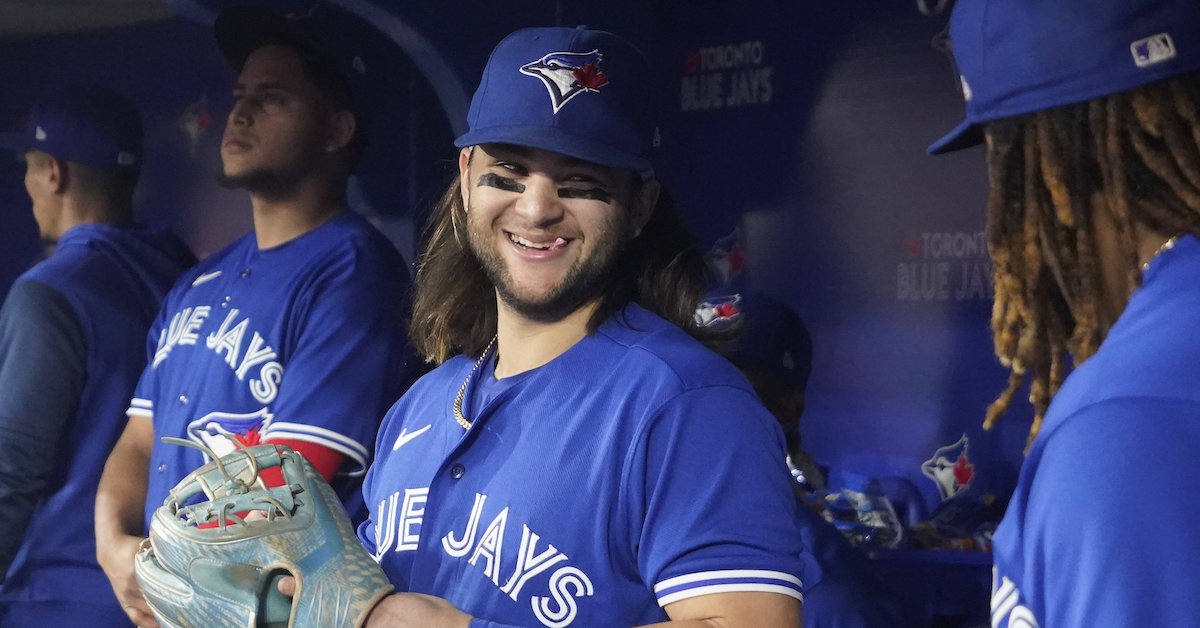
When Juan Soto was announced as a finalist for the Gold Glove this year, I was perplexed. To say that the right fielder struggled with his defense this season would be an understatement. As recently as Game 2 of the NLCS, he was still making (or, failing to make) plays like this:
So I turned to Rawlings’ official website to get a better understanding of how Gold Gloves are won. In order to qualify for a Gold Glove, infielders and outfielders must have played in the field for at least 698 innings through their teams’ first 138 games. Maybe Soto grades out better in this subsample. In the absence of custom date ranges for advanced fielding statistics, I compared Soto to the 76 other players who were in the outfield for at least 698 innings on the season. Here is where he ranked:
Sorry for the Shakespearean title; the playoffs make me feel overly dramatic every year. This time, I was inspired by the markedly different approaches of the San Diego Padres and Philadelphia Phillies, who traded blows for five exciting games. The Padres (avatar: Juan Soto) work the count and take walks. The Phillies (avatars: Nick Castellanos and Bryce Harper) sit dead red and swing from the heels. Styles make fights, to borrow a saying from a dying sport, and this one was dramatic.
It got me to wondering: how different were these two approaches, really? It certainly felt like the Padres were watching plenty of hittable first pitches fly by while the Phillies swung at breaking balls in the dirt, but that’s based on my sentiment while watching the game, sentiment that was surely informed by both my pre-existing biases and the broadcasters repeatedly mentioning the disparity throughout the series. Read the rest of this entry »
When the Padres shake off the hurt from their NLCS loss, they’ll have plenty of reasons to look back on this season as a success in its own right and a springboard to more and better in 2023. They won 89 games and advanced further into the playoffs than they had in 24 years. Along the way they knocked off not one but two 100-win teams, including the hated Dodgers. Their top three starting pitchers are coming back, as are at least six starters of the remaining eight defensive positions. Oh yeah, and they’ll have a full season of Josh Hader and Juan Soto to look forward to.
Here’s the best news: At some point this postseason, you probably looked at Ha-Seong Kim and thought, “Was he always their shortstop? Didn’t they used to have this other guy? Tall fella, Freddie something?”
Fernando Tatis Jr.’s 2022 campaign was about as bad as his teammates’ season was good. Not only did he fail to play a single competitive game, but he also missed the season for pretty embarrassing reasons. First, he broke his wrist in a motorcycle accident — apparently one of several he suffered during the offseason — and thanks to the lockout the team didn’t find out the extent of his injuries until he arrived in camp in March. Then, just as his return seemed imminent, he tested positive for clostebol, an anabolic steroid, which cost him the rest of the year. As reasons for missing an entire season go, a careless and avoidable injury followed by a careless and avoidable suspension are not ideal.
But he’s coming back next year. After being suspended the last 48 games of the regular season, plus 12 more in the playoffs, his return date should be April 20 against Arizona, barring unexpected setbacks from a second wrist surgery last week.
A lot of the talk around Tatis’ reintegration has centered on winning his teammates and Padres management back over. (My advice: A sincere and concise apology, follow-up conversations with individuals as needed, perhaps followed by a small gift to show contrition and re-establish an atmosphere of collegiality. I hear athletes send each other protein powder in lieu of flowers.) But that’s between him and his team, and besides, forgiveness is easy to come by when you’re a shortstop with a 153 career wRC+. Read the rest of this entry »
With a routine 73-mph comebacker off the bat of Aaron Judge, the Yankees’ season ended not with a bang but a whimper as the Astros completed their ALCS sweep to advance to the World Series for the second straight season, their third out of the last four, and their fourth out of six. Though two of this year’s ALCS games were decided by one run and another by two, the final result — the Yankees’ first time being swept out of a series since the 2012 ALCS — was a lopsided one, and it had an all-too-familiar feel.
Indeed, the Yankees have set a record by losing in five straight ALCS appearances (2010 by the Rangers, ’12 by the Tigers, ’17, ’19 and this year by the Astros). Including their 2015 AL Wild Card Game loss to the Astros, they’ve been bounced by Houston in four straight postseason meetings, an imbalance not unlike their own recent dominance of the A’s and Twins:
most consecutive times eliminating single opp in head-to-head playoff series:
2003-19 NYY over MIN: 6** 1923-62 NYY over NYG/SF: 5* 1941-53 NYY over BRO: 5 2015-22 HOU over NYY: 4** 1981-2018 NYY over OAK: 4** 1986-2008 BOS over LAA: 4
Back in July, Yankees manager Aaron Boonespoke of the need for his team to surmount the Astros, saying, “Ultimately, we may have to slay the dragon, right?… The narrative’s not to going to change until you beat them in the playoffs, if that day comes.” But with another series loss, their season has ended in disappointment. Even if it’s by way of a short series — one of just four (out of 10) in which the team with the better regular season record triumphed — it’s a blow that has sent the Yankees reeling. Read the rest of this entry »
Runs have been hard to come by this postseason. Through Sunday’s games, pitchers have done an extremely effective job of limiting opposing offenses, holding hitters to a collective .213/.279/.361 batting line and a .283 wOBA. They’ve struck out 26.7% of batters faced, which would rank as the highest postseason rate of this strikeout-friendly era despite regular-season rates dropping nearly a full percentage point this year. The expected stats back up the offensive struggles – or, perhaps more appropriately, the pitching achievements — of playoff teams so far. Batters’ .220 xBA, .287 xOBP, .372 xSLG, and .292 xwOBA would all be the lowest of the Statcast era. Pitching staffs have managed to limit home runs to 3.1% of plate appearances – the lowest rate since 2018 – and held run production to 3.72 runs per team-game, over half a run lower than in the regular season. It remains incredibly difficult to hit a baseball.
And yet despite that harsh run environment, the Houston Astros have thrived, sweeping the Mariners and the Yankees en route to their fourth World Series appearance in six years. All but one of their wins have been by a margin of one or two runs, but as close as they might have come, Houston’s opponents have yet to figure out how to beat a team that seems to be doing just about everything right. Since Justin Verlander allowed six runs over four innings in an uncharacteristically bad ALDS Game 1 start, the Astros pitching staff has allowed just nine earned runs in 68.0 innings (a 1.19 ERA), while their offense has outscored their opponents 31-18 through seven games. Read the rest of this entry »
Adley Rutschman batted .304 with a .581 slugging percentage against four-seam fastballs this season, and learning how to handle heaters up in the zone played a big part in that success. Prior to being drafted first overall by the Baltimore Orioles in 2019 out of Oregon State University, the 24-year-old catcher wasn’t used to being attacked with elevated offerings. That changed when he entered pro ball. As a result, Rutschman found himself having to make both mental and mechanical tweaks as a hitter, and he’s done so with aplomb. The switch-hitting catcher is coming off a rookie season during which he logged a 133 wRC+ with 49 extra-base hits in 470 plate appearances.
Rutschman discussed his up-in-the-zone approach when the Orioles visited Fenway Park in late September.
———
On adjusting to professional pitchers:
“Comparing the pitching styles of college versus pro ball, one of the biggest changes I’ve seen is guys pitching up in the zone. Another is that, analytically, teams are more so taking into account what guys do well and working off of those strengths. In college, I feel like how teams pitched was very program-dependent.
“Up here, if guys have a good four-seam fastball, they’re usually pitching up in the zone. If they’ve got a good two-seam fastball, they’re attacking you horizontally. That was a big adjustment, learning to cover top to bottom instead of just in and out. Not that guys here don’t ever thrown in and out. They will, so there’s more variation. Read the rest of this entry »
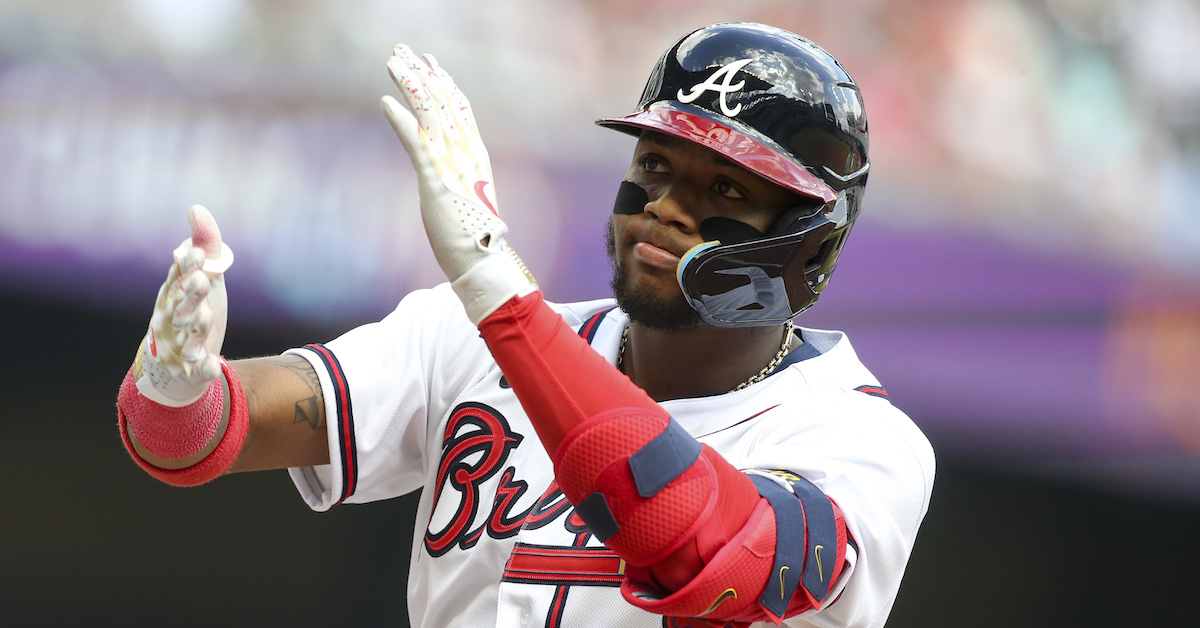
Some are calling it a legacy at-bat. I think it’s one of the most impressive displays of pitch-to-pitch adjustments I’ve ever seen in a postseason game. Whatever way you want to describe it, all that matters is Bryce Harpersent his team to the World Series after five games of leading the Phillies’ offense with fantastic, historic hitting. If he hadn’t already proved the worth of his contract with an MVP performance in 2021, he did in this series, chewing up Padres pitching with eight hits in 20 at-bats, including two home runs, three doubles, and five RBI.
I can go on about Harper’s postseason hitting forever, but for this piece, I want to focus on his at-bat against Robert Suarez that gave Philadelphia the lead in the bottom of the eighth inning of the series-clinching victory. Nobody was better suited for that moment than the reigning MVP; after each pitch, you could see him processing his swings, which he took a lot of, in preparation for the next one. If there is one thing a hitter needs in the postseason when facing elite pitching, it’s pitch-to-pitch adjustments. Allow me to guide you through how Harper made his. Read the rest of this entry »
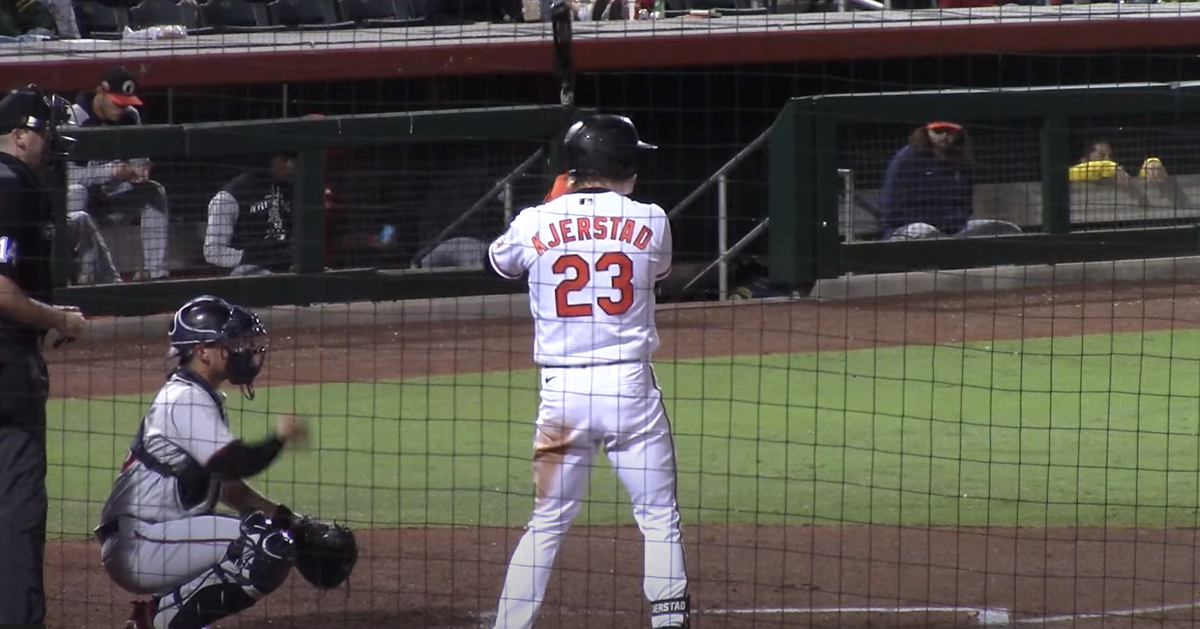
Matt Mervis didn’t get a ton of opportunities to hit at Duke University. He hit a ton this summer in his second full season of pro ball. Signed by the Chicago Cubs as a non-drafted free agent in 2020, the 24-year-old first baseman went deep 36 times across three levels — 15 of his dingers came in Triple-A — while slashing a robust .309/.379/.606. Currently competing in the Arizona Fall League, he has four home runs to go with an 1.103 OPS in 36 plate appearances with the Mesa Solar Sox.
Mervis’s ability to clear fences is his calling card, but that’s not how he views himself as a hitter.
“I have power, but I wouldn’t call myself a power hitter,” said Mervis, who went into yesterday as the AFL’s co-leader in home runs along with Heston Kjerstad. “I like to be a hitter. I hit for average and hate striking out. I try to move the ball, and if it turns into a double or a home run that’s great. I’m a big guy and hit the ball hard naturally, so it was really just simplifying my swing that led me to driving the ball more this year.”
Mervis does recognize that extra-base power is a big part of what will get him to the big leagues. At 6-foot-4, 230 pounds, slashing singles would be a path to nowhere.
“I’m a left-handed-hitting first baseman and it’s what we’re supposed to do in a lineup,” acknowledged Mervis. “That was the case long before the game turned to home runs and strikeouts. I grew up watching guys like David Ortiz, Prince Fielder, and Anthony Rizzo, a bunch of left handed hitters with a bunch of power. I don’t put pressure on myself to do that, but I obviously want to hit home runs and help us win.” Read the rest of this entry »
Framber Valdez threw a spectacular game last night. For seven innings, he bewitched, hoodwinked, and otherwise bamboozled the Yankee offense. As Alex Eisert noted, he notched a career high in swinging strikes en route to a whopping nine strikeouts.
How did he manage it? As best as I can tell, he made one key adjustment: he used his wipeout curveball to start at-bats and ended up with 16 first-pitch strikes out of 27 batters faced, plus a weak grounder that turned into slapstick comedy:
It’s particularly impressive when you consider the beginning of his outing: he started six of his first eight batters faced with a ball and looked like he might struggle to find the zone. But he stuck to his plan, and the Yankees, who had taken the first eight pitches they saw, started swinging aggressively the rest of the night. Read the rest of this entry »
Last week, when I wrote about some of the league’s strongest throwers, I ended up exclusively featuring outfielders. The nature of the position is more suited to making full capacity throws than in the infield, and as a result, only outfielders ended up on the list. Because of that, I feel obligated to acknowledge and highlight some of the strongest throwers in the infield. On average, these throws won’t be quite as fast. The footwork and time required to throw the ball is one reason for that, and that will be the focus of this piece.
Similar to last time, we’ll have to sort through some qualifications on how I came up with this short list of names. The first is at least 100 throws in the infield. One thing I ran into when sorting through the leaderboard was that several players near the top were utility players, rather than just strictly infielders. That led me to using the 2B/SS/3B filter and sorting the list by the overall throws at those positions only. See the full leaderboard here.
After working that out, I wanted to select plays where a player needed their plus arm strength to get an out. For example, a shortstop and/or third baseman needs to fire a rocket when moving multiple steps to use their backhand. A second baseman needs to have the correct footwork to fire a ball when ranging up the middle or quickly spinning a double play. Those are the types of plays I’m looking for, but they were harder to find than you would expect, given how so many plays in the infield are routine. I started with about 15 players from the top 20 on the list and worked my way down to a representative sample of five. Now, let’s get into it. Read the rest of this entry »