Jayne Kamin-Oncea-USA TODAY SportsI have a baseball pet peeve. It’s not the ongoing lockout, though that’s annoying. It’s not batters who endlessly step out of the box to adjust the velcro on their batting gloves. It’s not even my team failing to get a run home from third with less than two outs. My pet peeve is when broadcasts come up with team record statistics that are less than useless.
Today, I’m doing my part to fight back. This article isn’t about analyzing which of those stats are real and which aren’t; it isn’t even about analysis at all. It’s just some dumb statistics of my own that I made up to counter that trope that annoys me more than anything else: “When (basically any event in baseball) happens, the team has an incredible record!” I’ll also give you a baseline, so that when you hear one of these cherry-picked statistics in the future, you can put it into context. Let’s start with home runs. Read the rest of this entry »
Before the lockout froze the offseason, the Rangers were in the middle of an incredibly active winter. They signed Corey Seager and Marcus Semien to massive contracts, and added Jon Gray and Kole Calhoun as well. That was a good start to addressing the needs of a team that lost 102 games in 2021, but per Dan Szymborski’s mid-lockout ZiPS projections, those moves only got Texas to around 73 wins. If the Rangers have designs on competing for a playoff spot in 2022, they’ll need to continue adding to their roster once the owner’s lockout is lifted.
One of those potential additions could come via trade. Back in September, the Rangers were one of the many teams that checked in with the Oakland A’s about a potential deal involving Matt Olson. The Athletics seem likely to tear down their current roster at some point in the near future, possibly as soon as teams are able to trade with each other again. Just last week, Evan Grant of the Dallas Morning Newswrote that the Rangers were “absolutely” planning on revisiting their earlier talks with Oakland.
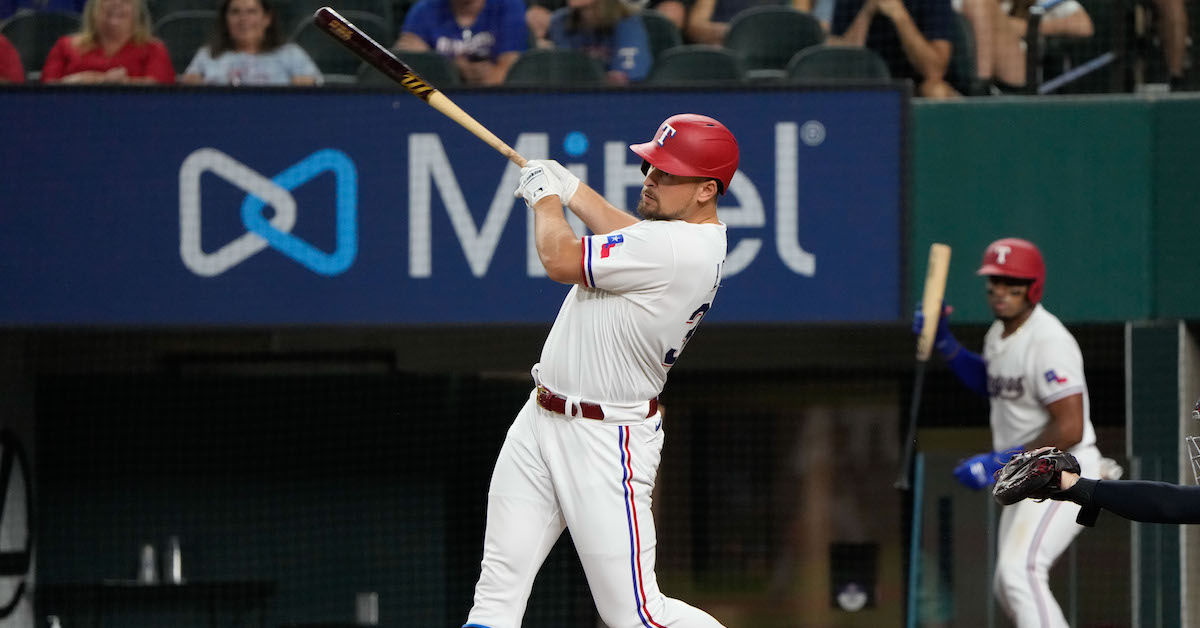
Olson would be a massive addition to Texas’s roster, as he’s coming off a year in which he set career bests in strikeout rate, home runs, wRC+, WAR, and a number of other offensive categories. Of course, the Rangers already have an incumbent first baseman whom they traded for just a year ago. If it came down to it, though, Nathaniel Lowe shouldn’t be much of a barrier to adding Olson to their lineup; Olson is one of the premiere first basemen in the game and only has a year and change on Lowe age-wise. But the Rangers shouldn’t write off Lowe just yet either. He had his ups and downs during his first full season in the majors, but he showed some promise as a potential middle-of-the-order bat in 2021. Read the rest of this entry »
Kody Clemens’s game is built around pop. Playing almost exclusively with Triple-A Toledo, the 25-year-old second baseman went deep 18 times last year in just 424 plate appearances. He knows what he brings to the table. Asked for a self-scouting report, Clemens began by saying he’s “grown to learn that a good part of my game is power.”
Born to a baseball family — his father is the seven-time Cy Young Award winner who shares his surname — Clemens grew up swinging from the left side. That was a matter of happenstance, not of design.
“It just came out that way,” explained Clemens, who is No. 21 on our Detroit Tigers Top Prospects list. “When I was young, my dad put a little bat in my hand and said, ‘Hey, hit the ball.’ I guess I stood up from the left side of the plate. It felt comfortable, so I kept swinging that way.”
The tutelage that followed was predictably based on the perspective of a pitcher. “The Rocket” primarily taught his three sons — Kacy and Koby have also played professionally — about attack plans and how to approach at bats. Mechanics were never much of a focus. Read the rest of this entry »
Our story so far: At the end of every Hall of Fame election cycle, I have a set of spreadsheets that I update that help me track voting patterns and other long-term trends, as well as some demographics regarding any honorees. Because the 2021 election cycle yielded no honorees — BBWAA voters pitched a shutout, and the two Era Committee votes were postponed — I realized while going through this year’s post-election exercise that I had yet to reckon with the impact of Major League Baseball’s 2020 decision to recognize seven Negro Leagues that operated from 1920 to ’48 as major leagues. Not that I haven’t coveredvariousangles of that decision, particularly as they pertain to the Hall; just that my tools of the trade haven’t kept pace.
I concluded my previous installment with a timeline illustrating the number of active Hall of Famers per team per season, using the Hall’s definition of one game being enough to represent one season played. It’s a display that illustrates the saturation of the immediate pre-World War II era via a very generous Veterans Committee and the extent to which voters haven’t kept pace with the later waves of expansion.
As previously noted, the above version does not include the 28 Hall of Famers elected for their playing careers in the Negro Leagues, a few of whom (Willard Brown, Monte Irvin, and Satchel Paige) had stints in the American and/or National League once they integrated, but not the 10 years needed to wind up on a BBWAA ballot. Adding those players compresses the pre-war peak, quite noticeably:
The scales are the same on the two graphs, but the broad peak in the middle is lower, with the space in the 2.5–3.0 range nearly empty. I did away with the BBWAA/committee distinction on this one, because I can’t stack the values if the denominators are different; the white Hall of Famers are coming from one player pool that for the 1920–48 period was constant at 32 teams, and the Negro Leagues Hall of Famers are coming from another that for the period in question ranged between six and 19 teams.
(Note that I’ve counted every team, even though some were very short-lived, loosely affiliated, and/or lacking in data that’s up to the Seamheads/Baseball Reference standard. I did draw the line by excluding the 1933 Cleveland Giants, who have data for just Negro National League games on B-Ref; they were apparently the replacement for the Columbus Blue Birds, who dropped out, and all 10 of their players appeared with other teams in the league during the same year, so leaving them out seems appropriate. Within the 49 Negro League-seasons now counted as majors, there might be a few other such instances of teams that shouldn’t be double-counted for the purposes of this exercise, but that will require closer study.) Read the rest of this entry »
Remember that one time Lance McCullers Jr. threw 24 curveballs in a row? It was great, and it’s part of Astros (and Lance McCullers Jr.) lore. You’re supposed to intersperse breaking balls with fastballs, to make each play off of the other. Going against that – throwing the same thing over and over again and daring the other team to hit it – is delightful.
What’s so delightful about it? Throwing the same pitch a ton of times isn’t really it. Would you care if peak Mariano Rivera threw 24 cutters in a row, or Jake McGee threw 24 fastballs in a row? Probably not. Fastballs – and for this article, I’m treating a cutter as a fastball – are the default pitch, and if batters aren’t hitting them, why throw something else?
I’d argue that when you’re feeling it, curves and sliders can behave similarly, at least when it comes to the feasibility of throwing them over and over again. McCullers didn’t bounce 24 curves in a row – he commanded plenty of them in the strike zone. His curve isn’t just hard to hit because batters are looking for a sinker. It’s hard to hit because it moves like a hummingbird hunting nectar. It’s definitely cool seeing all those curveballs in a row, but it’s not as though he was relying on the deception of curveball versus fastball to sneak it past batters. They knew what was coming; they just couldn’t do anything with it.
That’s fine, I guess, if you’re into excellent, borderline-unhittable pitches. For truly impressive streaks of identical pitches, though, I’m partial to changeups. The reason for the pitch is right in the name – it’s a change from what the batter is expecting. In Spanish, it’s even more straightforward: cambio. There’s something magical about seeing a batter gear up for a fastball, only to flail awkwardly at something 10 mph slower.
Do it twice, and you’re using the hitter’s expectations against them in a different way, betting that with the changeup out of the way, they’ll go back and look for a fastball. Do it three times, and I’m not sure what you’re looking for. In unrelated news, let’s talk about César Valdez. Read the rest of this entry »
At the end of every Hall of Fame election cycle, I take an evening or two to sit down and perform what I call “The Ceremonial Updating of the Spreadsheets,” where I gather data from the ballot results so as to track long-term trends as well as some demographic information regarding any honorees. The dirty little secret is that there’s no ceremony involved except perhaps the cracking of a beer, but I’ve spent 20 years building these spreadsheets, which fuel my coverage and occasionally inspire new ideas, and I take satisfaction in maintaining them, even if they are messy around the margins. You have your tools of the trade, I have mine.
It struck me while preparing a post-election follow-up on S-JAWS (my experimental version of starting pitcher JAWS) that it would probably be worth sharing some of that information — bigger-picture stuff — with readers, as it has an influence on how I see the Hall of Fame and approach my coverage. While I make reference to that information during the election cycle, I don’t always find time to share it amid the crunch of candidate evaluations.
It further struck me that the last time I presented some of this data publicly, in my 2017 book The Cooperstown Casebook, Major League Baseball had not yet recognized seven Negro Leagues from 1920-48 as major leagues, and that thus my accounting and the terminology I used to describe it was due for an overhaul. Some of this remains a work in progress, specifically when it comes to JAWS; while Baseball Reference presents WAR, WAR7 (seven-year peak), and JAWS data in addition to WAR for players in the aforementioned Negro Leagues, those figures have not been incorporated into the positional standards because of the significantly shorter season lengths and the fact that several Hall of Famers have only the tail ends of their careers in the major Negro Leagues, having peaked long before 1920. Quite honestly I have not yet figured out a satisfactory way to get around this, but that’s a problem for another day. Read the rest of this entry »
Samad Taylor stepped up his game last year. After at times disappointing at the dish in his early seasons of professional baseball, the 23-year-old infielder/outfielder broke out to the tune of a .294/.385/.503 slash line with Double-A New Hampshire. Moreover, he showed surprising pop for a player who profiles as more of a table-setter than a middle-of-the-order masher. Carrying 170 pounds on his 5-foot-10 frame, Taylor left the yard 16 times in 374 plate appearances. He also swiped 30 bases.
The Corona, California native came to Toronto via trade. Cleveland’s 10th-round pick in the 2016 draft, Taylor changed organizations the ensuing summer in the deal that sent sidearmer Joe Smith to the shores of Lake Erie. First featured here at FanGraphs following a statistically-poor 2018 season, Taylor proceeded to scuffle again in 2019, then miss an entire season, as did his minor-league brethren, due to the pandemic. As evidenced by his 2021 output, the changes he began making over the COVID shutdown — mental and physical alike — proved a panacea.
David Laurila: This past year was by far your best in pro ball. What changed?
Samad Taylor: “It was just understanding myself as a ballplayer, understanding what my approach is. In previous years, I was in the box trying to do too much. I would come up in certain situations and try to be the hero, when in reality, being a hero wasn’t necessary. I didn’t understand that. I didn’t understand myself as a hitter. Read the rest of this entry »
This would be one of the top few rotations in baseball. Nola might be slightly short of the average “top starter on a playoff team,” but it’s close. Webb turned unhittable last year. You can take your pick between Urías and Eovaldi as your third starter; I’m significantly higher on Urías than our Depth Charts projections. Manaea is wildly overqualified as a fifth starter.
Okay, so the bar is pretty high. What about rotation number two?
Burnes is one of the best five starters in baseball; maybe three teams wouldn’t plug him in atop their rotation, though he has some volume concerns. Snell is a risk as well, but one with a tremendously high ceiling. McCullers and Valdez as your third and fourth starters is an appetizing proposition, and Manoah provides yet more upside. This one projects for less WAR than the first rotation, but in fewer innings; it might tax your bullpen more, but in exchange you’re getting some top-shelf arms. I’d prefer rotation number one, but I think it’s quite close, and I wouldn’t fault you for picking number two.
Is that it? Are we just playing “pick your favorite fantasy team” here at FanGraphs? Don’t rule it out if the lockout keeps going, but no, I picked these groups to illustrate a point. The first group of starters? They were all among the top 15 pitchers in the majors last year at one particular skill: throwing first-pitch strikes. The second group? They finished in the bottom 15. Read the rest of this entry »
Colton Cowser didn’t exactly crush pitchers in his first half-season of professional baseball; his left-handed stroke produced just two home runs in 149 plate appearances after he was drafted fifth overall by the Baltimore Orioles out of Sam Houston State University. What the 21-year-old outfielder did do is square up a lot of baseballs. Playing primarily with the Low-A Delmarva Shorebirds, he slashed .375/.490/.492, and just as he did at the collegiate level, he walked more times than he struck out. Displaying the plate discipline and contact skills that helped make him a first-round pick, Cowser drew 25 free passes and went down by way of the K just 23 times.
The extent to which the Cypress, Texas native can grow his power game will go a long way toward determining his big-league future. Will he be more of a table-setter, or will he establish himself as an impact bat in the middle of the Orioles’ lineup? There is reason to believe it will be the latter. He currently packs 215 pounds on his 6-foot-3 frame, and he entered pro ball having left the yard 16 times in his junior season as a Bearkat. Both his home run total and his 1.170 OPS were tied for tops in the Southland Conference.
Cowser — No. 4 on our newly-released Orioles Top Prospects list — discussed his hitting approach, and his early-career developmental goals, over the phone in late January.
———
David Laurila: When Baseball America wrote you up for their 2022 Prospect Handbook, they cited your impressive walk-to-strikeout ratio. They also wrote that your swing path is “presently more geared toward contact versus power.” Do you feel that’s accurate?
Colton Cowser: “I think so. But I’m not necessarily focused on my swing path resulting in more contact or power; I mostly just try to go up there with the same swing. Home runs come from timing. Even so, I have started to understand some of those things a little bit more. The Orioles have kind of brought that to my eyes with some of the developmental stuff they have.”
Laurila: I was planning to ask you about that. Hitting analytics have presumably become a bigger part of your baseball life since you signed. Read the rest of this entry »
Today, I’m looking into something that doesn’t require much explaining. Well, that’s not quite accurate. I’m looking into a situation that’s so good for the pitching team that in our minds, we go ahead and write it off. That doesn’t mean it’s not interesting, though; it can just be hard to see why it’s interesting, which is why I’m writing about it. That’s right: let’s talk about when Jacob deGrom gets ahead in the count.
When the best pitcher in baseball has the advantage on a hitter, that hitter doesn’t do well – a real shocker, that one. With two strikes, deGrom turned batters into sub-pitcher-hitting-level zeroes in 2021:
Jacob deGrom in Two-Strike Counts, 2021
Count
wOBA
K%
BB%
0-2
.129
72.1%
1.0%
1-2
.084
72.1%
1.0%
2-2
.131
65.3%
1.4%
Those aren’t typos. When deGrom hit two strikes before three balls, he struck out roughly three-quarters of the batters he faced and walked almost none. Survive until 3-2, and you stood a chance – he had a 12% walk rate and a mere 52% strikeout rate after 3-2 counts – but for the most part, facing deGrom with two strikes is a one-way ticket back to the bench. Read the rest of this entry »