Archive for Daily Graphings

The Four-Man Outfield and Position-Less Baseball

One could argue that the first great, widespread data-based departure from tradition this century was the infield defensive shift. Based upon opponents’ batted-ball tendencies, teams more and more began to align their infielders where opposing hitters directed baseballs.

And while one defensive alignment trend, infield shifts, might have peaked, another radical alignment phenomenon seems poised to be adopted more widely.

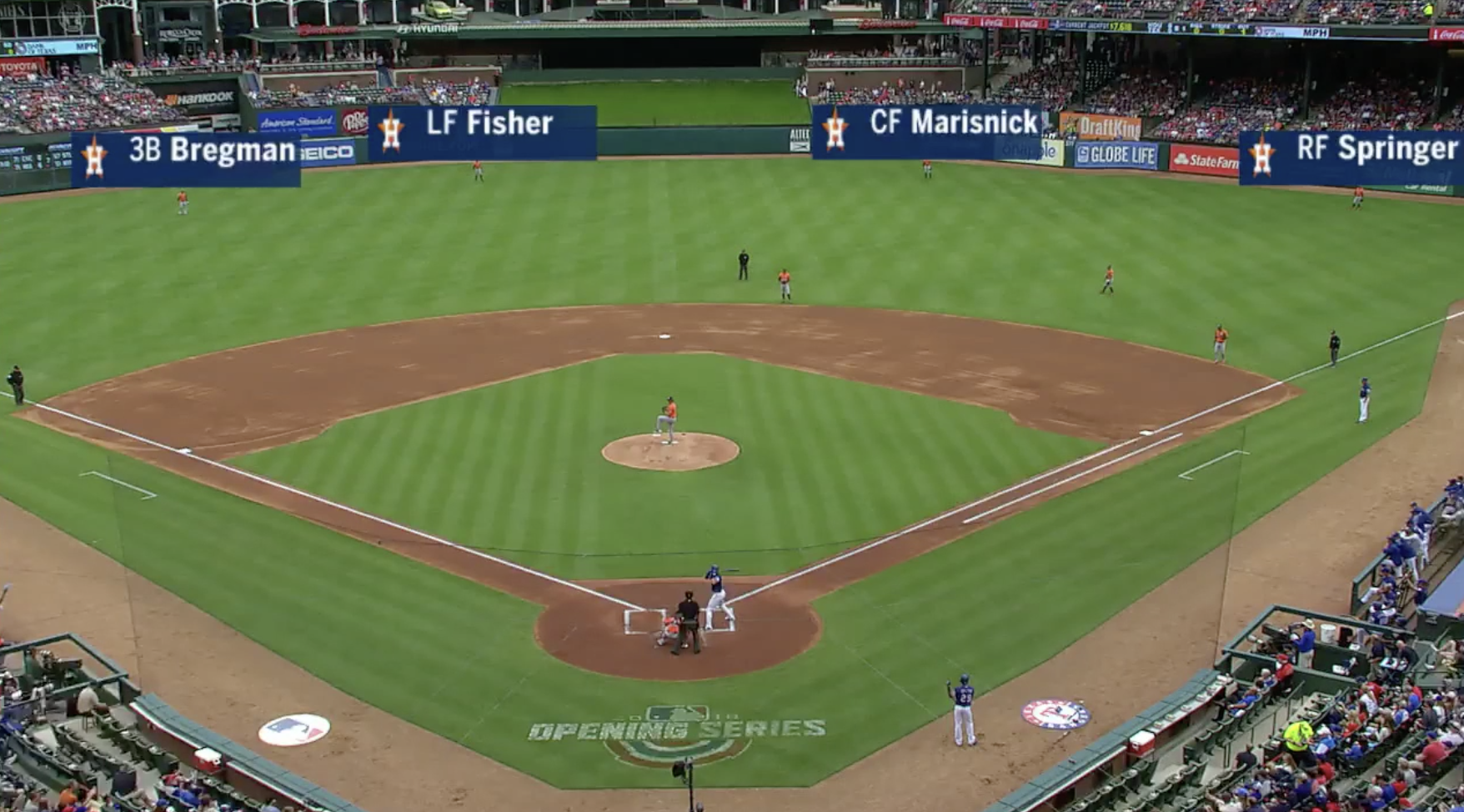
During the opening week, we saw the Astros give us this alignment versus Joey Gallo:

Over the last decade, we’ve seen four-man outfields on a rare occasion. But I’m not sure there has ever been a defensive alignment where only one non-pitcher or non-catcher was standing on the infield dirt. Only Astros first baseman Marwin Gonzalez had his cleats in the Arlington, Texas infield skin. Now that’s extreme.

Read the rest of this entry »


Jordan Hicks Is the Hardest-Throwing Pitcher in Baseball

Before we begin in earnest, here is a table showing the hardest thrown pitches of this young baseball season through Sunday’s games.

Hardest-Thrown Pitches in 2018
Player Pitch Velocity (mph) Date
Jordan Hicks 101.6 3/29
Jordan Hicks 101.0 4/1
Jordan Hicks 100.9 4/1
Jordan Hicks 100.9 3/29
Jordan Hicks 100.8 3/29
Aroldis Chapman 100.8 3/30
Aroldis Chapman 100.5 3/30
Tayron Guerrero 100.3 4/1
Jordan Hicks 100.3 3/29
Aroldis Chapman 100.3 3/30
Aroldis Chapman 100.2 3/30
Tayron Guerrero 100.2 4/1
Aroldis Chapman 100.2 3/29
Luis Severino 100.2 3/29
Luis Severino 100.1 3/29
SOURCE: Baseball Savant

Right now, St. Louis right-hander Jordan Hicks is throwing harder than Aroldis Chapman. When he did it the first time, it drew some attention, but he repeated that performance on Sunday.

His hold on the title might not last, of course: Chapman could begin throwing harder, and Hicks might not be able to maintain this level of velocity all season. For example, the 21-year-old righty averaged only 98 mph on his fastball in his performance yesterday, getting four outs in what was the first appearance of his professional career without a day of rest.

Hicks was a starter throughout the minors, during which he recorded only 165.1 innings and never worked above High-A. There were indications during spring training that he might have the talent to deal with major-league hitters, but the team sent him to the minors after some issues with tardiness. Despite that, he made his way back to major-league camp and was added to the Opening Day roster even though it required the Cardinals to place Josh Lucas on waivers. Jeff Zimmerman discussed Hicks’ talent and scouting reports after Hicks made the team. We are beginning to see why the Cardinals believed he could impact the club at the highest level in potentially important spots.

Read the rest of this entry »


Let’s Talk About the Jays’ Promising Projection

The 2017 season was a disheartening one for the Blue Jays. After back-to-back trips to the ALCS in 2015-16 — their first two postseason appearances since 1993 — they faceplanted out of the gate, losing 11 of their first 13 games. They never reached .500, going an improbable, Sisyphean 0-8 in games that would have evened their record. Amid injuries to Josh Donaldson, Russell Martin, Aaron Sanchez, Troy Tulowitzki and others, not to mention the collapse of Jose Bautista, they finished fourth in the AL East with a 76-86 record, their worst showing since 2013. This winter, they stayed out of the deep end of the free-agent pool, making a few low-cost additions plus a handful of trades that hardly qualified as blockbusters. Yet as of Opening Day, they were projected for 84 wins, the league’s fifth-highest total. What in the name of Cito Gaston is going on?

To these eyes, the Blue Jays’ projection is like the flip side of the Brewers’ one that raised my eyebrows a few weeks ago. Recall that the Brew Crew quickly turned around from their rebuilding effort and won 86 games last year while remaining in the NL Wild Card hunt until the season’s final weekend. They added Lorenzo Cain and Christian Yelich over the winter, and didn’t lose anyone of importance save August acquisition Neil Walker, yet their projection called for just 78 wins.

As for the Blue Jays, when one considers that they had the majors’ oldest lineup (weighted average age of 30.9 years according to Baseball-Reference), and that even with the jettisoning of Bautista, all of this year’s projected regulars save two are on the wrong side of 30, it’s at least worth wondering why our projection system (which is driven by Steamer and ZiPS but with manual judgment in terms of distributing playing time) is so keen on them.

As I did for the Brewers, here’s a position-by-position comparison between our Depth Charts (as of March 29, Opening Day) and last year’s splits. All rankings are AL-only:

Blue Jays, 2017 vs. 2018
Position 2017 WAR AL Rk 2018 WAR AL Rk Dif
C 0.3 15 2.7 4 2.4
1B 3.1 6 2.3 5 -0.8
2B 0.3 12 2.4 8 2.1
SS -0.4 15 2.2 9 2.6
3B 4.9 1 6.2 1 1.3
LF 0.3 13 1.5 8 1.2
CF 2.0 10 2.9 6 0.9
RF 0.2 14 1.9 6 1.7
DH -0.6 7 0.9 10 1.5
SP 10.7 7 13.4 6 2.7
RP 5.8 5 3.3 7 -2.5
Total 26.6 39.7 13.1
2017 data is actual splits by position, 2018 is depth chart estimates as of March 29.

The first thing to note is how distressingly godawful the Jays were at so many positions last year. In terms of WAR, they ranked among the league’s bottom four teams at five positions, including dead last at catcher and shortstop, and received 0.5 WAR or less from six different positions including DH, with a net of 0.1 WAR for those half-dozen spots. Only at first base (Justin Smoak) and third base (Donaldson) did they receive significantly above-average work; in the latter case, that was despite the majors’ top third baseman playing just 104 games at the position due to a calf strain. Thankfully, they also received above-average production from their pitching staff, without which they might have been relegated to the independent Canadian-American League.

Read the rest of this entry »


The Good and Bad of Shohei Ohtani’s Pitching Debut

I’m writing this about 24 hours after Shohei Ohtani pitched in his first ever major-league game. Certain things, I probably don’t even need to tell you. Maybe you made a point of watching the game live. Maybe you made a point of watching some of the highlights. Maybe you made a point of reading about Ohtani in other places today. Whatever the case, I imagine many of you know what happened. Ohtani lasted six innings, and the Angels beat the A’s. The outing was good, without being spotless.

Ohtani’s game has been written about dozens of times. Every one of his starts is going to be written about dozens of times. We can’t really worry about that, though. FanGraphs needs its own Ohtani coverage. Which is why I’m here to talk about his pitching debut. We can’t yet say much of anything about Ohtani’s bat. We don’t have the information. And, truth be told, we can’t yet say much of anything about Ohtani’s arm. In time, his numbers will reflect his ability. For now, we can only observe and extrapolate. And looking over Ohtani’s six frames, there was a whole lot of good, and some things that were less good. The Angels, I assume, are generally pleased.

Read the rest of this entry »


The Law of the Basebrawler

Rougned Odor is the second baseman for the Texas Rangers. You read FanGraphs, you know that. Odor has good power, plays decent defense, and really ought to learn to take a walk.

Rougned Odor also has a mean right hook.

The man on the receiving end of Odor’s punching prowess, Jose Bautista, is currently out of work. That means he needs something to do. And since idle hands are the devil’s playground, let’s give Jose that something.

Let’s have Jose Bautista sue Rougned Odor for battery.

Now, we already know what battery is from our discussion of beanballs, but let’s refresh our memories just to make sure. Battery is a (1) harmful bodily contact, (2) with intent to cause that bodily contact, and (3) without consent. Assault is apprehension of that intentional harmful bodily contact. In other words, actual physical contact isn’t necessary for an assault charge, whereas it is necessary to qualify as battery. Some people just call assault “attempted battery,” but that’s not exactly right; it’s a little more complicated than that. Assault and battery vary a bit from state to state and are creatures of state law like this one.

Read the rest of this entry »


Yasmany Tomas Is the Most Expensive Minor Leaguer

Once regarded as a possible third-base option for Arizona, Tomas has been a defensive liability.
(Photo: Keith Allison)

Don’t expect to see Yasmany Tomas at Chase Field anytime soon. The 27-year-old Cuban slugger was placed on outright waivers on Saturday, removing him from the Diamondbacks’ 40-man roster even as starting right fielder Steven Souza Jr. is sidelined for at least the first month of the season. The waiver move only further underscores the mistake the Diamondbacks made in signing Tomas to a six-year, $68.5 million contract in December 2014, a deal that has cost the team far more than money. He’s become the opposite of the gift that keeps on giving.

Tomas played in just 47 games for the Diamondbacks last year, hitting .241/.294/.464 with eight homers, an 89 wRC+, and 0.1 WAR before being sidelined by a groin injury that eventually required two surgeries, first in August and again in December. The additions of Souza via trade and Jarrod Dyson via free agency made clear at the outset of spring training that Tomas wasn’t guaranteed a starting job. Even with Souza’s pectoral strain, the Diamondbacks optioned Tomas to Triple-A Reno on March 25, and Sunday’s move now allows them to put that 40-man spot to better use. Given that he’s owed around $46 million through 2020, Tomas is unlikely to be claimed on waivers. Refusing an outright assignment and opting for free agency would void the remainder of his deal.

With the move, Tomas has become the game’s most expensive minor leaguer, making $10 million in salary plus another $3.5 million in the final installment of his signing bonus. You don’t see that every day, and for evidence how far out of sight and out of mind such a player can become, one need look only to the man he supplanted for that dubious title, countryman Rusney Castillo. The Red Sox signed Castillo to a seven-year, $72.5 million contract in August 2014. He recorded just an 83 wRC+ in 337 plate appearances spread over 2014-16 before the Sox outrighted him off their 40-man roster in June 2016. Now he’s buried in Triple-A — in part because adding him back would push them even further over the luxury-tax threshold. The Diamondbacks don’t have to worry about going over the $197 million threshold, but their $131.5 million Opening Day payroll nonetheless set a franchise record.

Read the rest of this entry »


The Pirates’ Way in the Era of Launch

BRADENTON, Fla. — The first pitch of the 2018 season was a home run. More and more hitters seem to have the intent to get the ball in the air. We’ve heard about more and more swing-change stories this spring. What can pitchers do to counteract the movement? I know many pitchers and coaches are thinking about that question.

I traveled to Pirates camp late this spring because in part because I am still familiar with a number of people within the club from my time on the beat in Pittsburgh, but also because so much has changed in the game — and in their clubhouse — since the last time I covered a Pirates’ game in September of 2016.

Pittsburgh, of course, made three consecutive playoff appearances from 2013 to -15. While those clubs featured a collection of talented players, the teams was also notable for its run-prevention plan. In each of those three seasons, the team led the majors in ground-ball rate, compiling a three-year mark of 51.5%. They allowed the fewest home runs (339) over that three-year period, as well.

The Pirates made a point either of acquiring pitchers with quality sinking fastballs or developing those sinkers internally. The club led baseball in sinker usage during that three-year span, targeting the lower part of the zone. The Pirates had built a philosophy around the pitch: to pound batters inside to create discomfort and weaker swings. The Pirates executed their philosophy well: they led baseball in hit batters (233), collateral damage from pitching inside.

Buc-ing the Trends
Season GB% HR ERA- HR/FB
2013 52.5% 101 91 8.9%
2014 50.5% 128 99 10.3%
2015 50.4% 110 84 9.4%
2016 46.9% 180 103 13.0%
2017 45.2% 182 99 12.9%

Of course, much has changed — and changed quickly — since that three-year window.

Read the rest of this entry »


MLB Opening Day Payrolls Down from 2017

Now that real baseball has finally started, we are very likely going to spend a lot more time here at FanGraphs discussing the game on the field. That’s a very good thing for all of us who love the sport. Before wading too deeply into the new season, however, let’s take one more look at how this offseason affected payrolls.

This past winter was an unusual one, with a number of free agents receiving significantly less than expected, and players and teams holding out for contracts all the way until the season’s start. Most of our pieces contained a general caveat that we would need to wait until all players had signed to really determine the effects of this offseason. I even spent some time wondering if we would have to wait until after next offseason to determine the longer-term effects of this past winter.

As we have now reached Opening Day, we have the opportunity to look at current payrolls and compare them to the same point last year. Here’s where we sit on Opening Day, per Cot’s Contracts.

The Boston Red Sox are well out in front of all teams, followed by the San Francisco Giants, Los Angeles Dodgers, Chicago Cubs, and Washington Nationals. Notable by their omission, the New York Yankees don’t appear among the top five. This is notable for several reasons.

  • The Yankees haven’t placed outside the top three in MLB payroll since 1992, the year Marlins owner Derek Jeter was drafted. Melido Perez and Danny Tartabull were the team’s top-two players.
  • The Yankees haven’t been outside the top two in MLB payroll since 1994, the last time a baseball season ended without a World Series.
  • The last time the franchise had an Opening Day payroll lower than $167 million before this season was 2003, before Alex Rodriguez had ever played a game for the club.

Read the rest of this entry »


Sunday Notes: Ian Happ Had to Adjust to High Heat

Ian Happ had a solid rookie season with the Chicago Cubs in 2017. The switch-hitting outfielder slashed .253/.328/.514 and went deep 24 times in 413 plate appearances. He learned a lot of lessons along the way, and they began early with an influx of high heaters.

“I was pretty successful in the first week or two,” said Happ, who logged 10 hits in his first 28 big-league at bats. “Then I started seeing a lot of elevated four-seamers. It took me a long time to figure out how to hit that pitch.”

The method he adopted was antithetical to the launch-angle swing.

“Belt-high four-seam fastballs, especially when guys have ride, or something that looks like it’s jumping at you… that’s a pitch where you need to be able to adjust your swing plane in oder to handle it,” explained Happ. “You have to be flatter. You almost have to be above the baseball and attacking with a downward plane. That’s the only way to be direct and get on that pitch, which is different than hitting an off-speed pitch or something low in the zone where you can kind of create a little more lift.” Read the rest of this entry »


The Great Australian Home-Run Spike, Part 3

This is Alexis Brudnicki’s fifth piece as part of her March residency at FanGraphs. Alexis is the Director of Baseball Information for the Great Lake Canadians, an elite amateur baseball program in London, Ontario, Canada. She has written for various publications including Baseball America, Canadian Baseball Network, Sportsnet, The Hardball Times, and Prep Baseball report. She won a 2016 SABR Analytics Conference Research Award for Contemporary Baseball Commentary. She can also be found on Twitter (@baseballexis). She’ll be contributing here this month.

This is also the third installment of a three-part series exploring whether the Australian Baseball League is in the midst of their own juiced ball and bat controversy. In this installment, league officials and the equipment manufacturers respond. You can find Part 1 and Part 2 here.

The Response

Increasingly aware of the way the numbers were adding up throughout the season, the Australian Baseball League’s general manager, Ben Foster, understands the natural inclination for players, fans, and others to draw their own conclusions about what led to the spike in home runs and the offense on a whole.

“One of the great entitlements for sports fans is their right to speculate and to try and figure out why something as unpredictable as sport always surprises us,” Foster said. “As a fan myself, I love to speculate on things like, ‘Will this player or that player have a great year?’ Or, ‘Why did he go to the bullpen in that situation?’ So I do think it is natural for people to speculate about every aspect of the game when they see unexpected results.”

But the league’s GM does not believe that the numbers point to any one thing in particular. Acknowledging that equipment might have been a part of the equation, he does suspect that the standard of baseballs used during the recent season were of superior quality to those used previously.

“I cannot rule out that equipment played a part, too,” Foster said. “But I think it’s an oversimplification of just the baseballs. In conversations I had with players and coaches, many commented on the improved quality of the bats we supplied this season.

Read the rest of this entry »