Archive for Daily Graphings

Greg Bird Looks Good Again

Last night, Greg Bird played the hero, launching a home run off Andrew Miller for the only run of the game. For a lefty, just getting on base against Miller is a success, but going deep is pretty remarkable; it was only the second home run a left-hander hit off Miller this year.

But perhaps we shouldn’t be too surprised, because since coming back off the disabled list, Bird has been hitting bombs with regularity. His overall season line of .190/.288/.422 isn’t much to write home about, but his early-season numbers came when he probably shouldn’t have been playing, given his foot issues. If we combine his post-DL with his postseason performance to date, this is the line that Healthy Greg Bird has put up in 2017.

Bird, Since Coming off DL
Bird PA BA OBP SLG wOBA wRC+
2nd Half 98 0.253 0.316 0.575 0.365 128
Postseason 17 0.308 0.471 0.769 0.501 221
Total 115 0.261 0.339 0.604 0.385 142

The underlying numbers show significant improvement as well. In his pre-DL performance, Bird averaged 87.7 mph exit velocity on his batted balls, but since returning, that mark has jumped to 91.1 mph. For reference, only 13 hitters with at least 100 batted balls averaged 91 mph in exit velocity this year.

And in the postseason, against one of the best pitching staffs we’ve ever seen, Bird’s been crushing the ball at a level not unlike his most monstrous teammate. Here are Bird’s batted balls in this series against Cleveland so far.

Batted Balls in ALDS
Opposing Pitcher Exit Velocity Outcome
Trevor Bauer 85 Fly Out
Corey Kluber 101 Reach on Error
Corey Kluber 109 Single
Mike Clevinger 102 Home Run
Andrew Miller 72 Line Out
Andrew Miller 107 Home Run

Bird’s six batted balls in this series have averaged 94.4 mph, while facing the best left-handed reliever in baseball twice, a top-5 starter twice, and two above average right-handers.

As a pull-heavy left-hander who also strikes out and hits his share of infield flies, Bird is probably never going to be a high average hitter, but the power he’s shown since coming off the DL is a carrying tool, and Bird is showing why the Yankees line-up is scarier right now than their overall season numbers might make it appear.


The Case for Starting Chris Sale

Yesterday, the Red Sox offense finally woke up, rallying from an early deficit to score 10 unanswered runs, keeping their division series going for at least one more game. Thanks to the bats of Hanley Ramirez and Rafael Devers, David Price’s four brilliant innings of relief work weren’t wasted this time, and now the Sox live to fight another day.

That day is today, and with the season on the line again, John Farrell will hand the ball to Rick Porcello, saving Chris Sale for a potential Game 5 rematch with Justin Verlander. And the logic behind that decision is pretty straight forward.

The Red Sox have to win both of the next two games to move on to the ALCS. Chris Sale can only pitch in one of those two games. Since they have to win both, their odds of advancing don’t increase by simply changing the date of the game he pitches, and in fact, their odds might very well go down if they move him up. Sale has started on three days’ rest just once in his career, back in 2012, and he wasn’t very good in that outing. Pitchers generally perform worse on short rest, even the great ones. And over his last six starts, Sale has allowed 12 home runs, so his most recent performances have created a bit more concern than the Red Sox would like to have about their ace right now.

So, yeah, throwing Rick Porcello for a few innings on Monday and saving Sale until Wednesday makes plenty of sense. However, I think the way the series has played out has created a specific set of circumstances that could make Sale-on-short-rest the right call anyway.

The Weather

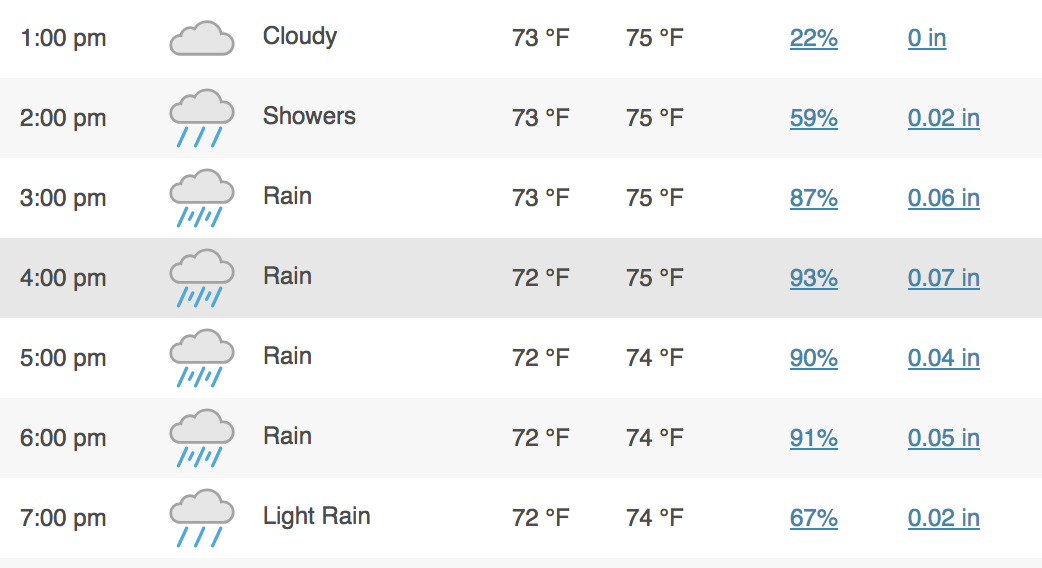
Any discussion about Game 4 strategy has to begin with the weather, because, well, this is the Weather Underground forecast for Fenway Park today, beginning at the scheduled time of first pitch.

It might not be raining when the game begins, but barring a significant change in the forecast, everyone should expect to get rained on at some point this afternoon. And the later the game goes, the more confident the meteorologists are that things will be falling out of the sky. There’s a pretty decent chance that Game 4 involves some kind of rain delay, or at least messy conditions while everyone tries to get this thing in the books before a delay is necessary.

Read the rest of this entry »


Sunday Notes: The Astros Changed Alex Bregman for the Good

Alex Bregman slashed .337/.409/.514 in three seasons at Louisiana State University, twice earning All-American honors. Displaying outstanding bat-to-ball skills, he fanned just 68 times in 786 collegiate at bats. The Houston Astros rewarded his efforts by selecting him second overall in the 2015 draft.

And then they asked him to change.

“A ton,” answered Bregman, when asked how much he’s evolved as a hitter since signing. “In college, I tried to hit the ball on the ground and low line drives. Up here, there aren’t a lot of hits on the ground with guys like Carlos Correa and Andrelton Simmons playing shortstop. Now I try to not hit ground balls.”

The ink had barely dried on his contract when he was told to alter his approach. Organizations typically let first-year players finish the season before suggesting changes, but Bregman was told “right away” that something else was expected. Before he could get his feet wet at the professional level, he had to “learn on the fly how to drive a baseball.”

He proved to be a quick study. Two short years later, in his first full big-league season, the 23-year-old infielder put up a .284/.352/.475 slash line, and his 63 extra-base hits included 19 home runs. He strikes out more often than he used to — “I never used to swing and miss, and now I do occasionally” — but it’s not as though he’s become all or nothing. His K-rate was a wholly acceptable 15.5%.

The adjustments he made were both mental and mechanical in nature. Read the rest of this entry »


So Lonnie Chisenhall Was Probably Out

I don’t know if this is ultimately going to matter much. As I write this, the Yankees are still leading the Indians by a run, and they only need to get six more outs. The odds are in the Yankees’ favor. But, not long ago, the odds were even more in the Yankees’ favor. Then we had controversy. Controversy! Our first controversy of the 2017 postseason, as far as I can tell. The scene: the bottom of the sixth, with two on and two out in an 8-3 game. It’s Chad Green, and it’s Lonnie Chisenhall, and the count is 0-and-2.

That’s not where that pitch was supposed to go. The result: the dreaded 0-and-2 HBP. You’d expect better of Green, and he certainly knew right away he didn’t execute like he wanted to, but if you watch that clip over and over, you might notice something. As the umpire signals for Chisenhall to take his base, Chisenhall appears to be surprised. Not that he was going to turn down the opportunity, but he didn’t respond like someone who’d been hit by a pitch in the body. Gary Sanchez immediately thought that something was wrong. Sanchez thought the ball hit the knob of the bat. Upon super-slow-motion instant replay, it looks like the ball did hit the knob of the bat.

And then the ball went into Sanchez’s glove! Which would make it, technically, a foul tip, which would lead to a strikeout. If the ball hit the bat, then Chisenhall should’ve been out, and that would’ve been the end of it. I’m not saying the instant replay makes it 100% incontestable, but it looks a lot more like bat than hand. And as you probably know, these plays are reviewable. Seems like that should’ve come in handy for the Yankees. They could get the umpires to take a look. They…didn’t. I have no idea why. Something tells me it’s going to come up later on. Sanchez thought Chisenhall was hit in the bat, not the hand, and he gestured toward his own dugout. No review was requested. Within seconds, this would loom awfully large.

Instead of 8-3 in the seventh, it became 8-7 in the sixth. Instead of the Indians’ win expectancy being about 3%, it was about 33%. Now, that’s not all on the call. Even after Chisenhall went to first, the Indians’ odds of winning stood at about 8%, and then Francisco Lindor had to do what he did to Chad Green’s delivery. Green, for his part, should’ve made better pitches. But in our sixth playoff game, we have our first real issue related to a call on the field — and instant replay — and now that I check back in, oh, look at that, the Indians have tied the game up. I’m sure Joe Girardi is looking forward to his presser. I can’t imagine what he’s going to be asked.


Has the Era of the Super Team Arrived?

There’s been some discussion in recent years about the prospect of super teams in the game, about the ingredients necessary for their development and the respective ETAs of certain specific super teams. The Cubs of 2016 created a road map for others to follow: begin with a collection of young talent, wait for it to arrive in the majors, and supplement it with big-ticket free-agency items. The Cubs are a big-market club that maximized its smarts and financial might. The result? A World Series championship.

I think just about everyone has speculated about whom the Yankees might add in the historic 2018-19 free-agency class, one that will permit them to add to their already impressive collection of young talent. The Yankees have perhaps arrived ahead of schedule, although Indians manager Terry Francona suspects the Yankees themselves don’t believe they’ve arrived ahead of schedule given the contract they handed to Aroldis Chapman this past offseason.

The Astros voluntarily elected to become the DisAstros, tanking with mediocre rosters to collect premium picks and young assets, then rising to become one of the preeminent teams in the game. It was an NBA-type model, this idea that the easiest, most predictable path to becoming really good is first to become really bad, to acquire premium picks and create financial flexibility. This plan has apparently inspired other teams in the game to actively pursue failure.

Read the rest of this entry »


The Cubs Survived the World Series Hangover

Tonight, the Chicago Cubs begin their attempt to become the first team to repeat as champions since the New York Yankees won three in a row from 1998 to 2000. Since free agency really took hold about 40 years ago, the only other team to win consecutive titles has been Toronto in 1992 and 1993. Since integration, the A’s, Blue Jays, Reds, and Yankees are the only franchises to repeat — and the runs by Cincinnati, Oakland, and (in one case) New York all occurred in the 1970s. While parity seemingly drives the game, a repeat isn’t impossible, and the Cubs have passed the all-important first step of making the playoffs.

That’s not to say it was easy. The Cubs dug themselves a hole early this season, going 43-45 before the All-Star break, about eight wins shy of where the projections thought they’d be at that point. In the second half, however, they produced a 49-25 record, about six wins better than the projections called for. In the end, the club fell just a few games short of their preseason forecasts and made the playoffs without much trouble.

As I wrote in September, it’s hard to characterize this Cubs team as one that’s underachieved. While some have attributed the club’s early-season difficulties to a “hangover” effect from last year’s championship, there’s not much evidence that the club actually underperformed reasonable expectations, receiving strong campaigns from a number of their stars and good production from unexpected sources. There’s also little evidence that World Series hangovers exist in the first place.

More on that second point in a moment. First, let’s consider the team’s most important players. We begin with Kris Bryant. The Cubs’ third baseman might not be clutch, but he recorded his third consecutive season of six wins or better, finishing sixth in the majors by WAR. And about his clutch performance: while it might be fair to say he hasn’t been clutch, that’s obvious different than being clutch. Keep in mind that the 150 wRC+ Bryant has recorded in low- and medium-leverage situations has occurred over 1,801 plate appearances; the 87 wRC+ he’s produced in high-leverage situations, meanwhile, is the result of just 213 plate appearances.

A sample of 213 PAs is obviously subject to considerable variation. For example, did you notice when, in the 197 regular-season plate appearances between September 2 of last year and April 23 of this one, that Bryant recorded an 82 wRC+? Probably not. (Especially since he recorded a 148 wRC+ in the middle of it during last year’s postseason.) Those 197 PA where Bryant wasn’t so good obviously don’t represent his real talent level. They occurred over an interval of two different seasons and he actually played well in the middle of that span. So naturally, if those somehwat disjointed 200-or-so plate appearances don’t reflect the real Bryant, it’s possible that the other 200-or-so high-leverage plate appearances — spread out over three years and inclusive only of regular-season play — likely don’t, either. Probably best not to make a big deal over them.

Read the rest of this entry »


Trevor Bauer’s Dominating Curveball

Yesterday, I wrote about how Jon Gray’s curveball didn’t work in the NL Wild Card game. Gray hung a bunch of poorly-located curves that the Diamondbacks crushed, and he was chased from the game in the second inning. Last night, though, Trevor Bauer showed what a good curveball in the postseason looks like.

Trevor Bauer’s Curves
Thrown Ball Called Strike Whiff Foul In Play
35 12 8 4 4 7

With only four whiffs, you might not think the pitch was particularly dominant, but Bauer’s curveball was his best pitch of the night. Because, unlike Gray, he was able to keep it down.

Instead of just relying on whiffs, Bauer also managed to freeze hitters with curves in the zone, like he did to Aaron Judge here.

Eight times, Bauer froze a Yankee hitter with a curveball in the zone, including Aaron Judge twice for strike three. And when the Yankees did swing, it didn’t go much better for them.

15 times, a New York hitter went after Bauer’s curveball. Only seven of those 15 swings resulted in a ball in play. Here is what they did with those seven balls in play.

Trevor Bauer’s Curves in Play
Batter Exit Velocity Result
Brett Gardner 65 Pop Out
Chase Headley 89 Fly Out
Brett Gardner 84 Groundout
Gary Sanchez 70 Doulble Play
Aaron Hicks 100 Double
Brett Gardner 83 Groundout
Gary Sanchez 75 Groundout

Hicks rocked a poorly located curve, but besides that, this is as weak as contact gets. With Sanchez’s double play, he still managed to rack up seven outs on the seven balls in play. Combined with the four strikeouts, Bauer got a total of 11 outs out of his 35 curveballs. Not bad indeed.

Bauer’s curve has always been his best pitch, and it’s probably not a coincidence that he’s had his best season while throwing his pitch more frequently than ever before. Bauer threw his curve 30% of the time in the regular season, and upped that to 36% last night. He’s not quite Rich Hill yet, but given what Bauer did to the Yankees with his breaking ball last night, they probably should expect a healthy dose of them if he gets into another game this series.

Of course, with Corey Kluber going today and Carlos Carrasco in Game Three, the Yankees might not see Bauer again this season.


Jose Altuve’s Evolution to MVP Candidate

Perhaps we ought to have have written more about Jose Altuve at FanGraphs this season.

The last, and only, FanGraphs post dedicated solely to Altuve this year was published on Aug. 4, when the excellent Craig Edwards documented Altuve’s historic July and his MVP momentum.

Perhaps part of the reason there hasn’t been an avalanche of Altuve content is this: what more is there to say? Altuve is really good. We know he’s really good. One thing that has remained constant in this rapidly changing world is the sight of Altuve spraying line drives all over major-league outfields. He remains one of the best pure hitters in the sport, one who added power to his game beginning in 2015 and whose power spiked again in 2016 and 2017. Altuve is going to get his 200 hits, he’s going to make contact at an elite rate, and he’s going to defy the expectations created by his small stature.

Altuve has become so good, so steady, we — or, at least this author — generally turn our attention elsewhere to new trends, pop-up players, air-ball revolutionaries, etc.

But Altuve himself is evolving. He’s making gains as a power hitter (as you’re probably aware) and in other areas that are perhaps less obvious. And Altuve demanded our attention on Thursday afternoon in the Astros’ ALDS opener, recording three home runs, including two off of Chris Sale.

While the Astros and Altuve will obviously take the performance, it’s the kind of day that could have perhaps swayed MVP voters had it occurred a week earlier. It’s remarkable that the game’s largest man, Aaron Judge, and smallest, Altuve, are the AL MVP frontrunners and have produced nearly the same value despite occupying completely opposite ends of the physical spectrum.

Read the rest of this entry »


Michael Brantley’s Return Leaves Questions for the Indians

The recent history of players returning from injury to the postseason isn’t great. (Photo: Keith Allison)

On Tuesday, a couple of days ahead of the deadline, Cleveland Indians manager Terry Francona announced the Division Series roster that would take on either (at the time) the New York Yankees or Minnesota Twins. While the most surprising development was probably Francona’s choice to start Trevor Bauer in Game 1, there were plenty of other questions to ask. Should the team be worried about its bullpen after leaving three key relievers off the roster? Are six outfielders too many and 11 pitchers too few? And is carrying outfielder Michael Brantley so soon after his return from injury a good idea?

Michael Brantley has always offered a maddening combination of considerable talent and questionable durability. Selected in the seventh round of the 2005 draft by the Brewers, Brantley was sent to Cleveland as the player to be named later in the 2007 deal for CC Sabathia. After 2009, Baseball America ranked him fifth among the prospects in the Cleveland system, lauding his hit tool and control of the strike zone. After five poor-to-middling seasons to begin his career, Brantley broke out in 2014 with a six-win campaign, his first All-Star appearance, and a third-place finish in the MVP voting.

Despite his offensive outbursts, Brantley has spent a significant amount of time on the disabled list. In 2011, he missed the final month of the season with a wrist injury. The 2016 campaign saw him miss time due to his shoulder. This year, he lost nearly two months to a sprained ankle. With 274 days spent on the disabled list since the start of the 2016 season, Brantley’s availability seems to consistently be an open question.

Given his talents, the Indians clearly would like Brantley around. Moreover, teammates have described him as one of the team’s leaders. However, despite the progress Brantley has made in recovery and his miraculous at-bat this past Saturday, the playoff performances of players returning from injury should curb expectations for the club’s Opening Day left-fielder.

The most recent case of a player returning from injury for the playoffs came against these same Indians last year. Kyle Schwarber, who tore his ACL and LCL in the second game of the 2016 season, returned in the World Series to absolutely mash, slashing .412/.500/.471 in 20 plate appearances — including a key three singles in five at-bats in Game 7. While Schwarber was obviously integral to Chicago’s championship run, other players who’ve returned from injury to appear in the postseason have done so less successfully.

Since 2009, there have been 15 hitters who’ve resumed play in the last half of September from the disabled list and appeared in at least one playoff series. Some of their injuries were more serious than Brantley’s sprained ankle, others much less so; however, the performance of these players can best described, at best, as “middling.”

Players Returning from Injury for Postseason: 2009-2016
Year Player Team Regular Season PA Regular Season Postseason PA Postseason
2009 Greg Dobbs Philadelphia 169 .247/.296/.383 4 .000/.000/.000
2010 Laynce Nix Cincinnati 182 .291/.350/.455 3 .000/.000/.000
2012 Jim Thome Baltimore 163 .252/.344/.442 15 .133/.188/.133
2012 Brett Gardner New York (A) 37 .323/.417.387 8 .000/.000/.000
2013 Jason Heyward Atlanta 440 .254/.349/.420 18 .167/.167/.333
2014 Ryan Zimmerman Washington 240 .280/.342/.449 4 .250/.250/.250
2015 Jorge Soler Chicago (N) 404 .262/.324/.399 25 .474/.600/1.105
2015 Jason Castro Houston 375 .211/.283/.365 18 .063/.166/.063
2015 Kiké Hernandez Los Angeles (N) 218 .307/.346/.490 15 .308/.400/.308
2015 Howie Kendrick Los Angeles (N) 495 .295/.336/.409 22 .273/.273/.455
2015 Yasiel Puig Los Angeles (N) 368 .263/.323/.416 6 .000/.000/.000
2016 Kyle Schwarber Chicago (N) 5 .000/.000/.000 20 .412/.500/.471
2016 Yan Gomes Cleveland 264 .167/.201/.327 4 .000/.000/.000
2016 Gregor Blanco San Francisco 274 .224/.309/.311 10 .125/.222/.250
2016 Shin-Soo Choo Texas 210 .242/.357/.399 3 .000/.000/.000

Now, of course, the posteseason is a place of impossibly small sample sizes, making any resulting lines incredibly variable. That aside, a third of the players here performed poorly in their very few trips to the plate, many in the pinch-hitting role that Brantley is expected to assume. A little under a third performed well, some very much so. This is, of course, the best case for Brantley, and he clearly has the talent to do so. The remaining players fell well short of their season performance and have also tended to strike out at a higher rate than normal. Maybe their timing has been off from their missed time? That’s merely a guess, though. Even accounting for small sample sizes and the increased quality of playoff pitching and competition, something is still lacking in their performance.

Brantley’s inclusion creates further complications for the Indians beyond performance questions. Even with Brantley’s progress in playing the field, he will be unlikely to play anything other than pinch- or designated hitter, forcing the Indians to carry five additional outfielders. As a result, the pitching staff is limited to 11 pitchers, which may be a little short if they weren’t maybe the best pitching staff ever. However, the lack of flexibility created by including Brantley may make the Indians miss hitters such as Yandy Diaz or pitchers such Dan Otero and Nick Goody.

It’s important to remember that the Indians are clearly a better team with a healthy Brantley. However, Brantley’s presence isn’t essential, either: the Indians did go on possibly the most impressive streak in baseball history, becoming the hot team going into the postseason and passing the Dodgers as the Vegas favorite to win the World Series. It’s understandable that the Indians want their one of their leaders back, but the performance of players returning from an injury to the postseason with the added roster flexibility questions makes Brantley’s inclusion a risky one. They might indeed be good enough to overcome a lesser Brantley performance, but Terry Francona and the rest of Cleveland’s decision-makers are certainly hoping that this decision doesn’t come back to haunt them.

Archie Bradley’s Triple Was More Improbable Than You Think

Technically, in Wednesday’s NL wild-card game, the lead never changed hands. The Diamondbacks went up 3-0 on Paul Goldschmidt‘s early homer, and they won by an identical margin. Yet it still felt like something of a roller coaster, because the Rockies refused to go away. A 6-0 game narrowed to 6-5. An 8-5 game narrowed to 8-7. Even Fernando Rodney’s ninth inning wasn’t clean, as the Rockies attempted to rally. The game, overall, delivered on its promise. We didn’t end up with a wild-card clunker.

It’s always fun to break these games down in retrospect. I like to take the win-expectancy angle. The game’s third-most important event was A.J. Pollock‘s triple in the bottom of the eighth. It moved the win expectancy by 11 percentage points. The game’s second-most important event was the first-inning Goldschmidt homer. It moved the win expectancy by 13 percentage points. And the game’s single most important event was Archie Bradley’s triple in the bottom of the seventh. It moved the win expectancy by 16 percentage points. Bradley is a pitcher. Bradley is a relief pitcher.

Read the rest of this entry »
