Archive for Daily Graphings

The Dark Horse Dominant Bullpen

Just today we kicked off our annual Positional Power Rankings series, which means that, before too long, we’ll get a couple of posts about individual bullpens, looking at every single group. I’ll even be responsible for writing one of those posts, meaning maybe it works to our disadvantage to put this post up now, focusing on one bullpen in particular. But I’ve had a note here for a while, and I’m not one to let a topic go uncovered. The Rockies bullpen is of particular interest, especially at a time when the larger narrative around the team has responded negatively to recent news.

Let’s rewind. Yes, the last week or two have not been kind to the Rockies organization. The outlook for the season ahead has certainly gotten worse. Yet going back to last season, you know which team’s bullpen had — easily — the league’s worst WPA? That would be the Rockies, who made even the Reds feel proud of themselves. Although the Rockies finished at 75-87, their BaseRuns record was a more decent 80-82. With a stronger bullpen, last year’s Rockies would’ve been an average team. Their bullpen this year has the potential to be unusually dominant.

Read the rest of this entry »


2017 Positional Power Rankings: Catcher

Welcome back to our annual positional power rankings, which Dave Cameron kicked off this morning with his introductory post. You’re probably familiar with these rankings and series of posts, but if you’re a first-timer, we endeavor to take you through the projected strength of each position in the majors by team — ranking each club from No. 1 to 30 — based upon FanGraphs WAR forecasts. We also provide commentary that hopefully provides some invaluable insights and light-hearted moments. We begin with the catching position.

As you can see in the chart above, the Giants, perhaps unsurprisingly, again pace the field in WAR thanks to Buster Posey. And that advantage is not insignificant in what is again projected to be the weakest position in the major leagues. Major-league catchers combined to slash .242/.310/.391 last season with a wRC+ of 87. So if your team has a Posey, if Gary Sanchez’s second half is indicative of who he might be for 2017, then those players stake their respective teams to significant relative advantages. Only five teams — the Giants, Rangers, Yankees, Dodgers and Astros — project to earn three wins or better from the position, though it is important to remember pitch framing isn’t factored into FanGraphs’ WAR formula.

There isn’t expected to be much change in relative power: the Giants, Nationals, Rangers, and Yankees comprised four of the top-six teams last year. Still, there are players like Travis d’Arnaud, Austin Hedges, and Mike Zunino who contain upside and could perhaps reach new levels of performance. As for an addition of new, young, star power, only two catchers — and Jorge Alfaro at No. 32 and Francisco Mejia at No. 37 — ranked in top 50 of Eric Longenhagen’s top 100 prospects. Mejia is not expected to contribute at the major-league level. So, let’s rank some catching depth charts, shall we?

Name PA AVG OBP SLG wOBA Bat BsR Fld WAR
Buster Posey 499 .297 .365 .459 .351 14.1 -1.4 5.6 4.5
Nick Hundley 109 .242 .292 .378 .288 -2.6 -0.3 -1.1 0.2
Trevor Brown 32 .236 .283 .330 .269 -1.3 0.0 -0.1 0.0
Total 640 .284 .348 .438 .336 10.3 -1.7 4.4 4.7

There are some whispers that Buster Posey’s best days are behind him. Yes, his isolated slugging diminished for a second consecutive season. Yes, he posted his lowest wRC+ (116) in a full season. Yes, he’s logged a lot of innings behind the plate. Yes, he’s going to turn 30 years of age on March 27. But Posey’s average exit velocity was actually up last season (91.2 mph) from 2015 (89.6), his walk rate increased, and his elite bat-to-ball skills remained in place. He ranked as the game’s best framer, according to Baseball Prospectus, and he matched a career best by throwing out 37% of base-stealers. So, Posey should be just fine in 2017. Even if we’ve already witnessed peak Posey, he stands a good chance to again be the game’s most valuable catcher.

Read the rest of this entry »


Travis Sawchik FanGraphs Chat

12:01
Travis Sawchik: Howdy

12:01
Travis Sawchik: Let’s chat …

12:01
Mariner Moose: Any chance the WBC will be broadcast on network TV in the future?

12:03
Travis Sawchik: The chances have perhaps increased with the ratings increase this go-around. I think if nothing else the WBC has shown us it deserves to continue to exist. Lots of compelling stuff happening on the field. And apparently its something like a national holiday/festival in Japan. … I still think the WBC deserves a new place on the calendar as conflicting with the first weekend of the NCAA Tournament isn’t a great place to reside as a sporting event

12:04
Sravis Tawchik: Bullish or bearish on Strasburg this season?

12:06
Travis Sawchik: Lots of people seem down on Strasburg. Part of that is he’s not a good bet to reach 200 innings. Part of it is the expectations he will always have to deal with given his prospect pedigree. But few pitchers are better bets to give 150 ace-quality innings. For me, I’d value him like a right-handed Rich Hill. So what I’m saying is, I like him quite a bit.

Read the rest of this entry »


Sunday Notes: Melvin’s Dialogue, Cecchini’s Failed Launch, Hickey, Hill, more

Bob Melvin is up to date on advanced stats and baseball’s technological advancements. As the manager of the Oakland A’s, he has to be. The game’s original Moneyball club is in much the same position they were when Kevin Youkilis was being dubbed “The Greek God of Walks” — monetarily challenged, they need to be as progressive as possible to compete.

When it comes to communicating ideas with his players, Melvin is careful not to introduce sensory overload. After all, not everyone on the roster is a Brandon McCarthy or a Jed Lowrie.

“It’s our job, as a staff, to be able to reach the players who want this type of information,” said Melvin. “Some can handle it, while for others it might be a distraction. Certain guys need information in layman’s terms. You have to take the principles and present them in a language they can grasp, because when you’re in a game, you can’t have too much clutter in the your brain.

“We’re a cutting edge organization that is always looking for advantages. With things like exit velocities and spin rates… we hire people to look at that. The people above me — David (Forst) and Billy (Beane) and these guys — do a good job of helping spoon-feed it down to the people we feel can handle it, and benefit by it.”

According to Melvin, more than aptitude is at play. Read the rest of this entry »


Sean Burnett Tried to Break UCL, Is Trying Now to Blaze Trail

TAMPA, Fla. – Most pitchers try to avoid having Tommy John surgery at all. Sean Burnett wanted it a second time.

The former Pirates first-round pick went to see Dr. James Andrews again after he dealt with elbow pain early in 2013, nearly 10 years after the first surgery on his left elbow. Said Burnett to Ryan Lawrence of PhillyVoice:

“They went in to fix the flexor tendon and Dr. Andrews said it was the ligament. It wasn’t torn, but it was completely stretched out and looked pretty beat up. It was 10-years old (from the first surgery). He wasn’t going fix it, hoping that the surgery for the flexor issue would do something, but the first day I threw after four months I knew it was still a problem.”

Burnett knew his left UCL wasn’t right so he did something you hear few, if any, pitchers attempting to accomplish: he tried to tear it. He went back to the Legacy Golf Club room at which he was staying while rehabbing in Tempe, Arizona, stacked pillows up against his bed’s headboard, and started throwing baseballs with as much violence and velocity as he could into them. I asked Burnett about this bizarre strategy earlier this week.

“I needed to pop it until he would fix it, so I tried to pop it in the hotel room each night,” Burnett said. “It didn’t work but maybe it sped up the process a little bit.”

Did he disturb any neighbors?

“I don’t throw hard enough,” Burnett said. “I had enough pillows up there.”

In May of 2013, Burnett “finally” felt his ligament “pop” in an outing against Seattle.

Read the rest of this entry »


The Best One-Two Punch in Baseball

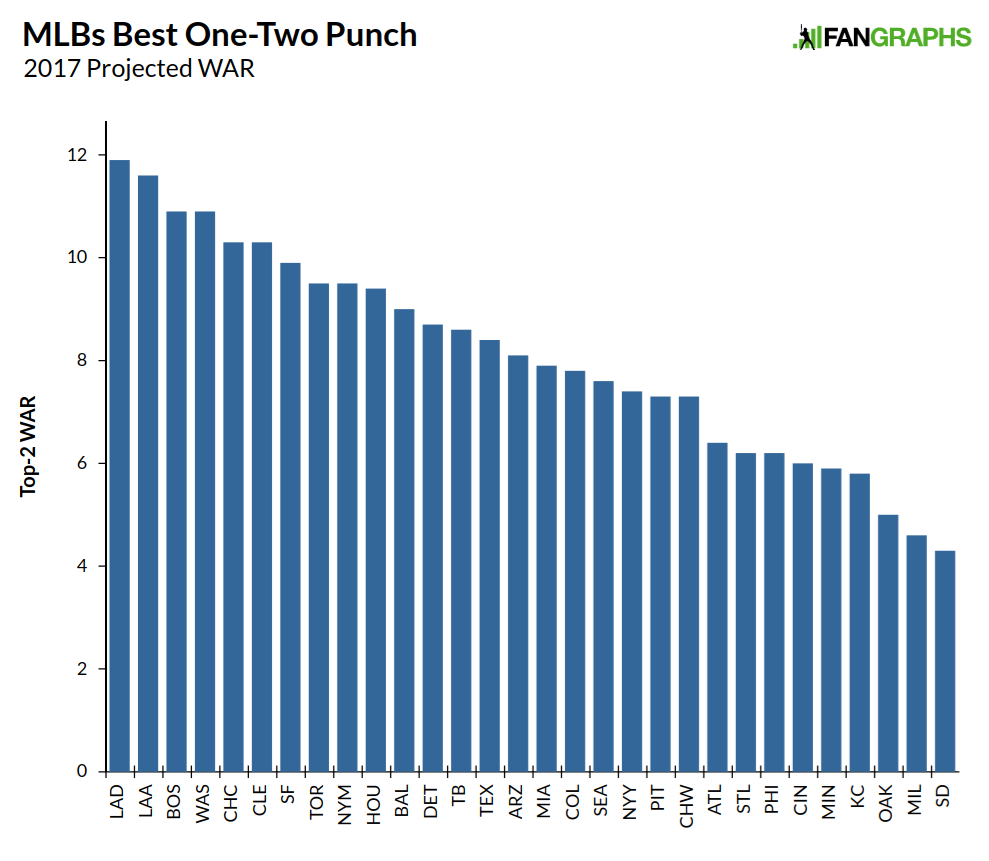
Mike Trout plus almost anybody else seems like a fair answer to the question of which team has the best 1-2 punch in baseball. I probably wouldn’t fault anyone who was willing to trade their best two players for just one Mike Trout, even if it was just for this season. Looking at the question a little more objectively, however — with this year’s projections — reveals that Mike Trout plus nobody would rank (a) in the top half of major-league teams’ best duos, but also (b) nowhere near the top. Also Trout doesn’t play with nobody, as the Angels have a few other decent players and might contend for a playoff spot if things break right.

As for the best one-two combo in terms of combined WAR, a reasonable person could make a few other reasonable guesses. Kris Bryant and Anthony Rizzo form an impressive pair. Mookie Betts and Chris Sale are fantastic for the Red Sox. And then there’s Bryce Harper and Max Scherzer, Madison Bumgarner and Buster Posey, Jose Altuve and Carlos Correa. All of those are good guesses, but it’s actually the Dodgers who occupy the top spot, with Clayton Kershaw and Corey Seager barely edging Mike Trout and the still very good Andrelton Simmons.

As great as Mike Trout is, Clayton Kershaw’s 7.4 projected WAR is less than a win from Trout’s 8.2. While the Angels’ shortstop has a good 3.4 projected WAR, Corey Seager’s 4.5 WAR makes up for the difference between Kershaw and Trout.

Read the rest of this entry »


Let’s Build a Searchable Baseball-Text Archive

Baseball provides its audience with great data. We’re blessed with a large number of observations and very high-quality record keeping. Even before MLB announced a radar and video tracking system designed to capture seven terabytes of data per game, we had box scores going back a century and 40 years of play-by-play logs. Thanks to organizations like Retrosheet, SABR, and Baseball-Reference, baseball’s data is also very accessible.

Unsurprisingly, baseball fans are excited about the full implementation of Statcast because the system brings with it the promise of new and exciting data. Exit velocity! Time to the plate! Route tracking! While I share some of that excitement, Statcast has my attention because of something else it promises to offer: completeness.

Read the rest of this entry »


Adam Eaton’s Defensive Numbers Keep Getting Even Crazier

In 2017, I am probably more interested in Adam Eaton than I am any other player in baseball. As the centerpiece of a controversial blockbuster, coming off a monster season where a lot of his value was tied a huge swing in his defensive value, Eaton was always going to be a fascinating experiment for paying a perceived premium price for outfield defense. But it gets even more interesting, because the Nationals are switching him from right field back to center field, so we throw a position switch in the mix as well, and get another data point on whether his weird splits between RF and CF actually mean anything.

So when the MLBAM guys released their outfield catch probability leaderboard last weekend, Eaton was naturally one of the first players to examine. And when Jeff took an early look at the published 2015-2016 data, he found that Eaton ranked seventh in Catch+, or whatever we might want to call plays made above the averages of the buckets they had opportunities in. And when he looked at the catch data relative to the range portions of UZR and DRS, he actually found that the Statcast data showed that Eaton had the largest positive difference, suggesting that, by hang time and distance traveled variables, Eaton may have been even better defensively than the public defensive metrics thought.

So yeah, Eaton is really interesting. But the more I dig into Eaton’s defensive data, the more remarkable it all gets.

Read the rest of this entry »


Imagining the New Matt Harvey

Remember Vintage Matt Harvey? He sat 96 and didn’t walk anyone and could go to any of three plus secondary pitches. Sigh. That Matt Harvey was sweet. And it was only 2015 when we last saw him. We all had hope that thoracic-outlet surgery would bring that Matt Harvey back, but we’re hearing some bad news on that front recently.

“Harvey’s velocity hovered in the 92-mph range — just as it has in all three of his spring starts — as he got roughed up in a 6-2 loss to the Marlins,” wrote Marc Carig on Wednesday before a grumpy Harvey did his best to assuage concerns with the press afterwards. Given his rough season last year, however — when he was down to 94 from 96 the years before — those fears are justified.

“It’s going to be there or it’s not, and I have to go out and pitch,” Harvey told Carig. “And I think after today I feel really confident going into my next outing and moving forward.” He’s right to assert that he has to pitch with whatever he has, and the underlying assumption, that others have been fine at similar velocities, is also correct. But will this righty, with this fastball, be just as well off as, say, two other righties who averaged 92 on their fastballs last year like a Tanner Roark or an Ian Kennedy? What will his work look like if he’s healthy all year?

Read the rest of this entry »


A Lot Will Depend on Sandy Leon

Sandy Leon was one of the more remarkable stories last season. As Jeff chronicled back in August, Leon took over for the Sox when they really needed a hero. He was that hero, at least for a brief time. He was nothing if not fresh — although that was mostly the result of not having played much at the major-league level previously. Now, he might be one of the most important members of the 2017 Red Sox team.

There are a couple of reasons Leon has become so important. The first and most important is that he has one of the highest (if not the highest) betas on his probable outcomes this season. Is Leon the guy who ran a 158 wRC+ from June to August, or the guy who ran a 44 wRC+ in September (and a 53 wRC+ over the first 107 plate appearances of his career, from 2012 to 2014)? The consensus seems to be something in between, but toward the lower end of that range. ZiPS has him pegged for a 78 wRC+; Steamer, a 74 wRC+ mark. Our depth charts split the difference at 76. The FANS projections are usually wildly optimistic, and that can be useful for players who have odd or small samples or some other manner of extenuating circumstance that might throw off those mean old algorithms. But even the FANS aren’t that optimistic: they have Leon down for just an 80 wRC+.

On the other hand, Leon told Evan Drellich of the Boston Herald recently that when he was signed as a professional, he was signed “because I could hit.” He said that defense was the thing on which he needed to work the most. It’s probably fair to say that, when he was signed, he needed to work on everything. Neither Baseball America nor John Sickels placed Leon among their top-10 Nationals prospect for 2008 — Sickels didn’t have him in his top 20. (Leon signed in 2007, but after both had compiled their Washington lists.) The same was true for the 2009 lists, and by that time, Derek Norris and Adrian Nieto were popping up on the Nats’ lists, so we can’t say that Leon was even the most highly rated catcher in the system.

Read the rest of this entry »