Archive for Featured Prospects

Top 35 Prospects: Los Angeles Dodgers

Below is an analysis of the prospects in the farm system of the Los Angeles Dodgers. Scouting reports are compiled with information provided by industry sources as well as from our own (both Eric Longenhagen’s and Kiley McDaniel’s) observations. For more information on the 20-80 scouting scale by which all of our prospect content is governed you can click here. For further explanation of the merits and drawbacks of Future Value, read this.

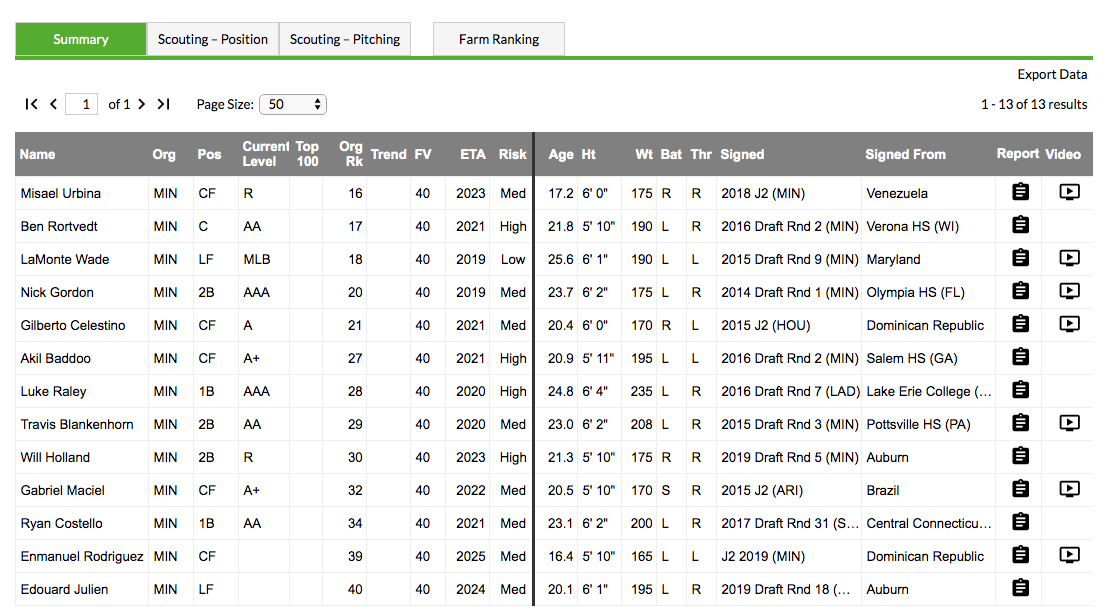
All of the numbered prospects here also appear on The Board, a new feature at the site that offers sortable scouting information for every organization. That can be found here.

Dodgers Top Prospects
Rk Name Age Highest Level Position ETA FV
1 Keibert Ruiz 20.8 AA C 2020 60
2 Dustin May 21.7 AA RHP 2020 55
3 Gavin Lux 21.4 AA 2B 2021 55
4 Will Smith 24.1 AAA C 2019 50
5 Alex Verdugo 23.0 MLB RF 2019 50
6 Tony Gonsolin 25.0 AAA RHP 2019 45+
7 Jeter Downs 20.8 A+ 2B 2021 45+
8 Josiah Gray 21.4 A RHP 2021 45
9 Omar Estevez 21.2 AA 2B 2020 45
10 DJ Peters 23.4 AA CF 2020 45
11 Diego Cartaya 17.6 R C 2023 40+
12 Dennis Santana 23.0 MLB RHP 2019 40+
13 Connor Wong 22.9 A+ C 2020 40+
14 Jacob Amaya 20.7 A SS 2022 40+
15 Jeren Kendall 23.2 A+ CF 2021 40+
16 Mitchell White 24.3 AA RHP 2019 40
17 Cristian Santana 22.2 A 3B 2021 40
18 Michael Grove 22.4 A+ RHP 2022 40
19 Edwin Rios 25.0 AAA 1B 2019 40
20 Matt Beaty 26.0 MLB 1B 2019 40
21 Yadier Alvarez 23.1 AA RHP 2020 40
22 Gerardo Carrillo 20.6 A+ RHP 2022 40
23 Jordan Sheffield 23.9 A+ RHP 2019 40
24 Miguel Vargas 19.5 A 3B 2022 40
25 Carlos Rincon 21.5 A+ RF 2021 40
26 Carlos Duran 17.7 R RHP 2024 40
27 Robinson Ortiz 19.3 R LHP 2023 40
28 Josh Sborz 25.4 AAA RHP 2019 40
29 Andy Pages 18.4 R RF 2023 35+
30 Zach Willeman 23.1 A RHP 2022 35+
31 Cody Thomas 24.6 AA OF 2021 35+
32 Leonel Valera 19.8 A SS 2023 35+
33 John Rooney 22.3 A LHP 2020 35+
34 Jerming Rosario 17.0 R RHP 2024 35+
35 Drew Jackson 25.8 MLB SS 2019 35+
Reading Options
Detail Level
Data Only
Full
Position Filter
All

60 FV Prospects

Signed: July 2nd Period, 2014 from Venezuela (LAD)
Age 20.8 Height 6′ 0″ Weight 200 Bat / Thr S / R FV 60
Tool Grades (Present/Future)
Hit Raw Power Game Power Run Fielding Throw
55/70 50/50 30/40 30/20 50/60 55/55

Watching Ruiz catch is like watching video of Alan Shepard play golf on the moon. Things seem to be moving at a different pace for Keibert, especially on defense. He has a thick, unimpressive build and is a mediocre athlete, but almost all of his baseball skills are elite. He’s one of the better receivers in the minors and is a better ball blocker than one would expect given his lack of athleticism, as if he has wild pitch precognition. Despite average pure arm strength, Ruiz is going to snipe a lot of would-be base-stealers because his throws are almost always right on the bag.

The skills-over-tools coloration of Ruiz’s profile continues on offense, where his hand-eye coordination and bat control make him extraordinarily hard to strike out. He struck out in just 8% of his plate appearances last year as a 19/20-year-old at Double-A Tulsa. Because Ruiz can make contact with just about anything, he tries to, and his lack of selectivity will likely limit his big league power output and perhaps his ability to reach base. But he has a very rare skillset for a catcher and a good chance to be an All-Star.

55 FV Prospects

2. Dustin May, RHP
Drafted: 3rd Round, 2016 from Northwest HS (TX) (LAD)
Age 21.7 Height 6′ 6″ Weight 180 Bat / Thr R / R FV 55
Tool Grades (Present/Future)
Fastball Slider Changeup Cutter Command Sits/Tops
55/60 60/70 45/50 50/60 45/60 93-96 / 98

May’s flamboyant ginger curls and Bronson Arroyo-esque leg kick are maybe the third and fourth most visually captivating aspects of his on-mound presence once you’ve gotten a look at his stuff. His mid-90s fastball plays up due to great extension, and further incorporation of a running two-seamer has given May’s heater enough tail to miss bats in the strike zone. His vertically-breaking slider (May calls it a slider, but it has curveball shape) has one of the better spin rates in the minors and enough vertical depth to miss bats against both left and right-handed hitters. It’s May’s out pitch, but he also has a developing cutter and its movement is a great foil for his two-seamer. After trying several different changeup grips in 2017, it seems like May is still searching for a good cambio, but his fastball and breaking ball command should suffice against lefties for now.

The leg kick makes May slow to home and he may be vulnerable to the stolen base because of it, which forces him to vary his cadence home in an attempt to stymie runners. Now at Double-A, what was once a prospect with mid-rotation upside has become one with mid-rotation likelihood.

3. Gavin Lux, 2B
Drafted: 1st Round, 2016 from Indian Trail Academy HS (WI) (LAD)
Age 21.4 Height 6′ 2″ Weight 190 Bat / Thr L / R FV 55
Tool Grades (Present/Future)
Hit Raw Power Game Power Run Fielding Throw
35/55 55/60 40/55 55/55 50/55 45/45

Lux has become almost the inverse of what he was in high school. Drafted as a glove-first shortstop, he has developed throwing issues that we believe will push him to second base. His early-season onslaught at Rancho Cucamonga could have been interpreted as a Cal League mirage, but Lux continued to hit and hit for power at Double-A Tulsa after promotion and scouts have future plus grades on his raw power.

Now much more physical and strong than he was when he was drafted, Lux is the latest Dodgers player to enjoy a beneficial swing change. His hands have become more active before they fire, and his swing has more lift now, resulting in a ground ball rate that fell from 52% in 2017 to 42% in 2018. His bat is quick enough to catch velocity up in the zone and Lux is strong enough to punish it. The changes haven’t had a negative impact on his feel for contact and he remains a selective hitter, as well. We’re somewhat concerned about the throwing issues but there’s middle infield speed and athletic ability here, and we hope those get ironed out because if they do, Lux could be an All-Star.

50 FV Prospects

Drafted: 1st Round, 2016 from Louisville (LAD)
Age 24.1 Height 6′ 0″ Weight 192 Bat / Thr R / R FV 50
Tool Grades (Present/Future)
Hit Raw Power Game Power Run Fielding Throw
35/40 55/55 40/55 55/50 50/55 60/60

In the 2016 draft, Smith was a scout’s favorite on a loaded Louisville club that had eventual top-10 overall picks Corey Ray and Brendan McKay as the headliners. At that point, he was a 55 runner with a 55 glove behind the plate and a plus arm, but didn’t offer much offensive impact due to a gap-to-gap approach. He made a late charge and rose from a third round pick to eventually being taken by the Dodgers in the compensation round.

In the pros, the Dodgers did with Smith what they’ve done with many other hitters, teaching him how to properly lift the ball and be aggressive in his swing mechanics. This agreed with Smith, unlocking dormant raw and game power while lifting the ball much more often. His contact rate was about the same until a late 2018 promotion to Triple-A, where he was exposed a bit. Scouts think there’s an exploitable hole in his swing and that he’s more of a .240-type hitter if he wants to keep hitting for power in games. He’s still the same runner, defender, and thrower, and can reasonably play almost any position on the field, so even .240 with 20 homers would be a very valuable piece to a contending team, even more so than Austin Barnes.

Drafted: 2nd Round, 2014 from Sahuaro HS (AZ) (LAD)
Age 23.0 Height 6′ 0″ Weight 205 Bat / Thr L / L FV 50
Tool Grades (Present/Future)
Hit Raw Power Game Power Run Fielding Throw
55/60 55/55 40/45 45/40 50/50 60/60

Verdugo has spent the bulk of each of the last two seasons at Triple-A, a victim of the Dodgers terrific outfield depth. So excellent is his natural feel to hit that it’s amazing many scouts preferred him on the mound while Verdugo was in high school. He’s a career 12% strikeout hitter, whose rates haven’t really moved even as the Dodgers have altered his swing to make it more explosive and try to get Verdugo to hit for more power. His stance is super wide open, the way Justin Turner’s is, before Verdugo takes a long, slow stride toward the pitcher, leading with his heel, and then uncorks a max-effort hack that sometimes sends him reeling into the ground.

It’s incredible that Verdugo is athletic enough to make so much contact with this swing, but he still doesn’t lift the ball very much, and probably maxes out with doubles power. We don’t think he fits in center field, and the lack of power is largely why he’s down here, though it also sounds like part of the reason teams have been asking for other Dodgers prospects in trades is due to some past off-field stuff.

45+ FV Prospects

6. Tony Gonsolin, RHP
Drafted: 9th Round, 2016 from St. Mary’s (LAD)
Age 25.0 Height 6′ 2″ Weight 180 Bat / Thr R / R FV 45+
Tool Grades (Present/Future)
Fastball Slider Curveball Splitter Command Sits/Tops
60/60 45/45 50/50 55/55 45/45 91-95 / 98

A two-way college player, Gonsolin was a ninth round senior sign whose velocity spiked in pro ball when he focused on pitching, moved to the bullpen (he has since moved back into the rotation, after he was yo-yo’d back and forth in college), and was touched by the Dodgers excellent player dev group. At times his fastball has been in the upper-90s, cresting 100, but it was in the low-90s this spring and he was placed on he injured list thereafter with an oblique issue.

Gonsolin’s four-pitch mix looks like it was designed in a lab and considering the way his stuff works together, it may have been. He’s an extreme overhand, backspinning four-seam guy, and he works up at the letters with it. It’s complemented by a deep-diving, 12-6 curveball. He’ll also work a slider to his glove side and it has shocking, horizontal length considering Gonsonlin’s arm slot. But the headline offering here is the changeup, a split-action cambio that bottoms out as it reaches the plate. Gonsolin uses it against both left and right-handed hitters and it’s one of the best changeups in the minors. It’s a non-traditional style of pitching for a starter, so some eyeball scouts think he ends up in the bullpen. If so, it’s probably in a valuable multi-inning role. Age and some relief risk just barely kept him off our top 100.

Drafted: 1st Round, 2017 from Monsignor Pace HS (FL) (CIN)
Age 20.8 Height 5′ 11″ Weight 180 Bat / Thr R / R FV 45+
Tool Grades (Present/Future)
Hit Raw Power Game Power Run Fielding Throw
25/55 45/50 20/50 45/40 40/50 55/55

He was just 19 for most of the season, but Downs had a strong 2018 at Low-A Dayton, where he hit .257/.351/.402 with 37 steals (a 78% success rate) and 35 extra-base hits. He’s a bat-first middle infielder who has a non-zero chance to stick at shortstop, and he’s likely to continue to see time there until he reaches the upper levels of the minors, at which point the Dodgers will make a decision as to where he fits best. Scouts in other orgs think it will be second base or the outfield. Most of Downs’ physical abilities hover near average but he does a little bit of everything, which, so long as he stays on the middle infield, gives him a good chance to be an average everyday player.

45 FV Prospects

8. Josiah Gray, RHP
Drafted: 2nd Round, 2018 from LeMoyne (CIN)
Age 21.4 Height 6′ 1″ Weight 210 Bat / Thr R / R FV 45
Tool Grades (Present/Future)
Fastball Slider Changeup Command Sits/Tops
55/60 50/55 40/50 40/50 92-95 / 96

Gray is an athletic, undersized conversion arm with big time arm-acceleration. His arm action is a little stiff, but it’s fast, and generates a fastball in the 92-96 mph range (mostly 3s and 4s) with riding life. Gray’s size and the drop and drive nature of his delivery combine to create flat plane that plays well up in the zone. He’ll miss bats at the letters with his heater. Thanks to his athleticism, Gray repeats, and throws more strikes than is typical for someone fairly new to pitching who has this kind of stuff, with a notable proclivity for locating his fastball to his arm side.

The slider can slurve out and even get kind of short and cuttery at times, but when it’s well-located and Gray is on top of the ball, it’s a plus pitch. His changeup, which he seldom uses at the moment, is easy to identify out of the hand due to arm deceleration, and is comfortably below average.

Because of the strike throwing, fastball efficacy, and ability to spin the breaking ball give him a good shot to play a big league role, and we’ve moved Gray up beyond where we had him pre-draft. The athleticism, small school pedigree, and position player conversion aspect of the profile indicates there’s significant potential for growth as Gray gets on-mound experience. He projects as No. 4 starter, with a chance to be more because of his late-bloomer qualities.

9. Omar Estevez, 2B
Signed: July 2nd Period, 2015 from Cuba (LAD)
Age 21.2 Height 5′ 10″ Weight 185 Bat / Thr R / R FV 45
Tool Grades (Present/Future)
Hit Raw Power Game Power Run Fielding Throw
35/55 45/50 40/50 45/40 40/45 50/50

Estevez was a resounding success repeating Hi-A while still just 20, and coupled it with moments of brilliance with the big league club during the spring of 2019. He continues to split time at both middle infield spots and he’s fine at both positions, but what’s exciting about Estevez is the bat. He’s very short to the ball, but his swing still has natural lift to his pull side, and he can pull most anything because of how short the swing is. He’s probably going to get to his raw power in games because of this, which makes him a potential everyday middle infielder despite a lack of physical explosiveness in other areas.

10. DJ Peters, CF
Drafted: 4th Round, 2014 from Western Nevada (LAD)
Age 23.4 Height 6′ 6″ Weight 225 Bat / Thr R / R FV 45
Tool Grades (Present/Future)
Hit Raw Power Game Power Run Fielding Throw
30/35 65/70 45/55 60/50 45/50 60/60

It’s rare for a player with this toolset to fall to the fourth round, even if it is a junior college hitter with strikeout issues. Peters has continued to perform amid his swing and miss red flags. He’s homered 28 times on average during each of his full seasons despite striking out in roughly a third of his at-bats. There’s little precedent for hitters who K this much to have consistent success in the big leagues. Michael Taylor, Keon Broxton, Lewis Brinson, and Ian Happ are some examples of center fielders with power who strike out about that much, and they’ve had periods of ineffectiveness.

Of course, Peters’ upside is enticing if he gets to his mammoth raw power anyway, which to this point, he has. This is predicated on him playing center field, which considering Peters is built like a young Adam Dunn, is no guarantee. He’s a plus runner underway but it takes a while for him to reach top speed. Right now, that is more detrimental from home to first than it is roaming the outfield, but it’s likely that a frame like this moves to a corner eventually. The Dodgers, who love Peters’ work ethic, sent him back to Double-A for the second straight year. He may have hot stretches where he hits for tons of power, and ice ages when he strikes out a ton. We think it’s a high-variance profile with a shot to make some All-Star teams while other years will be lean, and closer to replacement level.

40+ FV Prospects

11. Diego Cartaya, C
Signed: July 2nd Period, 2018 from Venezuela (LAD)
Age 17.6 Height 6′ 2″ Weight 200 Bat / Thr R / R FV 40+
Tool Grades (Present/Future)
Hit Raw Power Game Power Run Fielding Throw
25/50 45/55 20/45 40/30 40/55 60/60

This is a very physical teenager with some of the best present raw power in his signing class and a good chance to play a premium defensive position at catcher. Cartaya has a strong, physically mature build that inspires Salvador Perez comparisons. He has excellent lateral mobility despite his size, and his receiving was alright, but not great, when he caught pro-quality stuff at showcases.

He checks all the other beloved catcher skillset boxes: Cartaya is poised and engaged with his pitchers, he has a great arm, he looks built to meet the position’s physical demands, and makes an attempt to frame pitches when he can. There’s a chance he outgrows the position but he’s deceptively athletic for his size, and we’d call it unlikely. There’s not as much room for power projection here as there is for most others this age, but there’s enough to profile at catcher. Cartaya’s approach is geared for well-timed, pull-side gap contact. He’s a potential regular who’ll likely spend his first pro season in Arizona, as he’s too physical for the DSL.

12. Dennis Santana, RHP
Signed: July 2nd Period, 2012 from Dominican Republic (LAD)
Age 23.0 Height 6′ 2″ Weight 160 Bat / Thr R / R FV 40+
Tool Grades (Present/Future)
Fastball Curveball Changeup Command Sits/Tops
55/55 60/60 50/50 45/50 90-94 / 96

A conversion arm whose command took a significant step forward in 2017, his fourth year devoted to pitching, Santana made his major league debut in 2018 before succumbing to a rotator cuff injury for the rest of the season. He began 2019 in the bullpen, throwing about 45 pitches per outing, but his last two appearances were starts.

His changeup and command have developed enough to consider him a long-term starter but the power curveball, which suffered a stark downtick in spin rate before he was shut down last year, is his best pitch. The shoulder stuff, a short stride, and early-season deployment in the bullpen have us somewhat concerned about Santana’s long term health and role, but on stuff he’s a potential No. 4 starter.

13. Connor Wong, C
Drafted: 3rd Round, 2017 from Houston (LAD)
Age 22.9 Height 6′ 1″ Weight 180 Bat / Thr R / R FV 40+
Tool Grades (Present/Future)
Hit Raw Power Game Power Run Fielding Throw
35/40 50/50 40/45 55/50 45/50 50/50

An athletic, multi-positional player who spent his early college career at shortstop, Wong now sees time behind the plate, as he did throughout most of college, and at second and third base. Like most of the hitters in this org, he hits the ball in the air a lot and strikes out at a concerning rate. That, along with a few defensive flaws that may still be corrected with time, especially as he learns to handle upper-level stuff in the dirt, probably limit Wong to a unique kind of utility role or a backup catcher and infielder role similar to Austin Barnes’, which is a bit better than just a flat 40 FV prospect.

14. Jacob Amaya, SS
Drafted: 11th Round, 2017 from South Hills HS (CA) (LAD)
Age 20.7 Height 6′ 0″ Weight 180 Bat / Thr R / R FV 40+
Tool Grades (Present/Future)
Hit Raw Power Game Power Run Fielding Throw
35/55 40/45 30/40 55/55 45/55 50/50

A $250,000 11th rounder from a high school east of Los Angeles, Amaya is a diminutive infielder with excellent secondary skills and sneaky power for his size. Though not especially rangy at shortstop, Amaya has plus hands and actions and enough arm strength to stay on the left side of the infield. A lack of power and physical projection makes him appear, on the surface, like he’ll max out as a utility guy, but he makes up some offensive ground because his eye for the strike zone is so good. Instinctive and fundamentally sound, even if Amaya is only a utility type, his chances of getting there are high, and if his secondary skills hold water into the upper levels of the minors perhaps he’ll be more than that.

Drafted: 1st Round, 2017 from Vanderbilt (LAD)
Age 23.2 Height 6′ 0″ Weight 190 Bat / Thr L / R FV 40+
Tool Grades (Present/Future)
Hit Raw Power Game Power Run Fielding Throw
30/40 55/55 40/50 70/70 50/60 50/50

Wielding uncommon tools for a college prospect, perhaps the most explosive since George Springer was at UConn, Kendall was on the short list of 2017 1-1 candidates when his college season began. Then he didn’t hit during his junior year and slid toward the back half of the first round, where the Dodgers couldn’t pass on his tools. Badly in need of a swing change, Kendall’s cut still isn’t quite dialed in and he’s struggling to make contact at Hi-A. He’s a high-risk, high-variance prospect, the kind who might have a 4 WAR season in him because of the power and speed, but not be playable at other times. 2019 is a big year for Kendall and his stock, and it is off to an inauspicious start.

40 FV Prospects

Drafted: 2nd Round, 2016 from Santa Clara (LAD)
Age 24.3 Height 6′ 4″ Weight 207 Bat / Thr R / R FV 40
Tool Grades (Present/Future)
Fastball Curveball Changeup Cutter Command Sits/Tops
55/55 55/55 40/40 55/60 45/45 93-95 / 97

Injured (Tommy John) and in the bullpen for much of college, several teams were out on White when the Dodgers made him a 2016 second rounder. He has had fits and starts of injury in pro ball, and his velocity has waxed and waned. It was back up this spring, in the 93-95 range, but the lost reps have robbed White of changeup and command refinement. His stuff is good, though. The cutter/slider and curveball are both impact pitches, and just on stuff White belongs a half grade higher on this list, because he has No. 4/5 starter or high-leverage relief stuff. But the injury history and velo fluctuation are bothersome, and so too is the way White’s strike-throwing has plateaued. He may have some years as a high-leverage reliever or mid-rotation starter, but there’s a good chance for some leaner years, as well.

Signed: July 2nd Period, 2016 from Dominican Republic (LAD)
Age 22.2 Height 6′ 2″ Weight 190 Bat / Thr R / R FV 40
Tool Grades (Present/Future)
Hit Raw Power Game Power Run Fielding Throw
30/45 60/65 40/55 40/40 45/50 60/60

Several of the next few hitters on this list are talented, if flawed, corner infield bats. Santana’s flaw is his approach, as he’s posting near bottom-of-the-scale walk rates of about 3%. There’s little to no recent precedent for a third baseman who is this aggressive having sustained success as a regular unless they have elite bat-to-ball skills, and while Santana has big time bat speed, he’s not a contact savant. He has shown some ability to make mechanical adjustments, though, much to the chagrin of those entertained by his former cut, which looked like a Vaudeville comedian was miming a baseball swing.

Santana has started to see time at first base and he profiles as a corner bench bat or platoon partner. He’s ahead of Rios and Beaty because he’s a good deal younger and has the best glove of the three, but if you think handedness is of more significant importance, then you could argue Santana should be at the back of the group.

18. Michael Grove, RHP
Drafted: 2nd Round, 2018 from West Virginia (LAD)
Age 22.4 Height 6′ 3″ Weight 200 Bat / Thr R / R FV 40
Tool Grades (Present/Future)
Fastball Curveball Changeup Command Sits/Tops
50/55 50/55 40/45 40/50 90-93 / 95

Grove was working 92-96 with a good slider when he blew out his elbow two months into his sophomore season at West Virginia. He didn’t pitch as a junior, but clearly the Dodgers stayed on him, scouted the bullpen sessions he threw as the draft approached, and liked what they saw; they popped him in the second round. He spent the rest of the year finishing rehab and working on a changeup in the bullpen.

Back in games this spring, Grove has been 93-95, up to 96.6, with a 12:30 spin axis, which teams like LA and Houston seem to prefer, as 12:30 is almost pure backspin, a component of fastball rise. Grove has two different breaking balls, a low-80s curveball and an upper-80s slider, but it’s clear changeup development is the priority right now. The Dodgers sent Grove straight to Hi-A and it appears he’ll be on an innings limit and throw shorter outings so he can pitch all year rather than go six or seven innings at a shot and be shut down sometime during the summer. He’s well-built, athletic, throws hard, and has good measurable spin, and the Dodgers have a pretty good track record of developing arms, including several with college injuries. Though scouts we spoke with who saw Grove this spring thought he lacked feel, that could be chalked up to rust, and we like Grove as a riser.

19. Edwin Rios, 1B
Drafted: 6th Round, 2015 from Florida International (LAD)
Age 25.0 Height 6′ 3″ Weight 230 Bat / Thr L / R FV 40
Tool Grades (Present/Future)
Hit Raw Power Game Power Run Fielding Throw
40/40 70/70 55/60 20/20 40/40 60/60

At a hulking 6-foot-3, Rios body comps better to taller NFL running backs like Eddie George than your typical baseball player. He has arguably the most raw power in this system but has struggled to get to it in games because his swing is grooved and he’s a bit of a free swinger. Of this little corner bat triumvirate, Rios has the most concerning peripherals, but he also has the most power and experience at multiple positions as he’s played first, third and both corner outfield spots. 2019 is his first option year, and he’ll be a powerful bench bat/corner depth option for the next half decade but likely won’t hit enough to be a regular.

20. Matt Beaty, 1B
Drafted: 12th Round, 2015 from Belmont (LAD)
Age 26.0 Height 6′ 0″ Weight 210 Bat / Thr L / R FV 40
Tool Grades (Present/Future)
Hit Raw Power Game Power Run Fielding Throw
50/55 55/55 45/50 40/40 40/40 50/50

Coming off a strong 2017 during which he was named Texas League Player of the Year, Beaty only played 34 games in 2018 due to a torn thumb ligament that required surgery. Of this 3B/1B group, Beaty has the most modest physical ability but the best feel fo hit. His lateral mobility issues arguably limit him to first base alone, but he continues to get reps at third and in left field. He’s a swing change candidate who might benefit from more lift but, at age 26, that seems unlikely. He’s a lefty bench bat option.

Signed: July 2nd Period, 2015 from Cuba (LAD)
Age 23.1 Height 6′ 3″ Weight 175 Bat / Thr R / R FV 40
Tool Grades (Present/Future)
Fastball Slider Curveball Changeup Command Sits/Tops
65/65 55/55 55/60 40/40 30/35 94-97 / 99

The first draft of this list left Alvarez off entirely until we sourced Trackman data for this org and felt compelled to reinsert him in a prominent spot. The World Team starter in the 2017 Futures Game (and the owner of some of the most dastardly stuff in the minors, which he generates with absurd ease), Alvarez spent 2018 injured, disgruntled, and ineffective. He walked nearly a batter per inning. His 2019 still hasn’t really gotten off the ground. He was added to the 40-man in November but had arm soreness in the spring and didn’t pitch in a big league spring game while he worked on his mechanics in minor league camp. His first start of the year was a disaster, and he was shut down and put on the IL immediately after. This situation is officially mess, but a supremely talented one.

Signed: July 2nd Period, 2016 from Mexico (LAD)
Age 20.6 Height 6′ 0″ Weight 160 Bat / Thr R / R FV 40
Tool Grades (Present/Future)
Fastball Slider Curveball Changeup Command Sits/Tops
55/55 50/55 55/60 30/40 30/45 93-96 / 97

Carrillo generated a lot of scout interest around the trade deadline, with some of his starts on the Arizona backfields very well-attended at the end of July. He was maintaining velocity deep into games and has nasty breaking stuff. He’s physically mature, a little bit stiff, and struggled with fastball control this spring. There’s relief risk here, but Carrillo’s stuff is essentially what Grove’s was when he was the same age, so he’s tracking like a second round college arm.

Drafted: 1st Round, 2016 from Vanderbilt (LAD)
Age 23.9 Height 5′ 10″ Weight 190 Bat / Thr R / R FV 40
Tool Grades (Present/Future)
Fastball Curveball Changeup Cutter Command Sits/Tops
60/60 60/60 45/45 50/55 40/40 90-96 / 97

A biceps strain limited Sheffield to just 34 innings in Rancho Cucamonga and another nine in the Fall League, so he’s back in Hi-A as a 23-year-old, and officially in the bullpen. But the stuff is good. It seems as though the upper-90s velocity is gone, but it’s still plenty hard and Sheffield has three quality pitches, even if the changeup just acts as a ground ball inducer. He could be a late-inning guy, and pretty quickly now.

24. Miguel Vargas, 3B
Signed: July 2nd Period, 2017 from Cuba (LAD)
Age 19.5 Height 6′ 3″ Weight 200 Bat / Thr R / R FV 40
Tool Grades (Present/Future)
Hit Raw Power Game Power Run Fielding Throw
25/55 50/55 30/45 45/40 40/45 55/55

So conservative was Vargas’ swing when he first arrived in the states that Dodgers coaches were trying to make adjustments to his lower-half use in the middle of games in the hopes that it would unlock power that was clearly dormant in his hands. He has good control of the strike zone and feel to hit for a teenager but despite playing some second and third, he may ultimately wind up at first base. If that’s the case, a change that enables the power is necessary.

25. Carlos Rincon, RF
(LAD)
Age 21.5 Height 6′ 3″ Weight 190 Bat / Thr R / R FV 40
Tool Grades (Present/Future)
Hit Raw Power Game Power Run Fielding Throw
30/40 60/65 40/55 40/40 40/45 45/45

After posting an uninspiring line over three months of Midwest League play, Rincon went to the Cal League for the season’s final month and went nuts. He hit 15 homers in just 29 games, slugging .818 during that span. The hitting environment in California caricatured his pop, but there’s impact power here if Rincon can get to enough of it to profile in right. He’s posted above-average walk rates over his last 600 plate appearances, which takes some pressure off the hit tool. This is a traditional, power/whiff right field profile who is starting to prove he has an approach.

26. Carlos Duran, RHP
Signed: July 2nd Period, 2017 from Dominican Republic (LAD)
Age 17.7 Height 6′ 7″ Weight 250 Bat / Thr R / R FV 40
Tool Grades (Present/Future)
Fastball Curveball Changeup Command Sits/Tops
50/55 50/55 40/50 45/55 90-94 / 96

A teenage leviathan, Duran has present arm strength (he’ll bump 96) and spins the occasional plus curveball. His arm slot creates movement on his fastball, which should pair well with his sinking change once it becomes more consistent. Duran threw a lot of strikes last year and only walked three hitters in 42 innings. His body, even at 6-foot-7, is already maxed out and he may not grow into more velocity, but his secondary stuff and control are already fairly well in place. The fastball plane doesn’t pair well with Duran’s breaking ball, but he otherwise has pretty safe starter traits.

Signed: July 2nd Period, 2016 from Dominican Republic (LAD)
Age 19.3 Height 6′ 0″ Weight 180 Bat / Thr L / L FV 40
Tool Grades (Present/Future)
Fastball Curveball Changeup Command Sits/Tops
45/50 45/55 45/50 40/50 89-94 / 96

Ortiz didn’t make a leap in 2018. His arm swing sometimes causes his fastballs to sail or makes it tough for him to get on top of his curveball, but there’s a fairly advanced three-pitch mix on a teenage lefty here. He is not all that physically projectable, so don’t anticipate him adding significant zip on his fastball. Command and secondary pitch refinement are likely to dictate his ceiling.

28. Josh Sborz, RHP
Drafted: 2nd Round, 2015 from Virginia (LAD)
Age 25.4 Height 6′ 3″ Weight 225 Bat / Thr R / R FV 40
Tool Grades (Present/Future)
Fastball Slider Command Sits/Tops
55/55 55/55 50/50 92-95 / 96

Sborz is your typical middle relief prospect. He sits in mid-90s and benefits from mechanical deception. His breaking ball doesn’t spin a lot but it’s spin-efficient and has depth and effectual movement. Sborz has better control than most relievers and spent time developing as a starter.

35+ FV Prospects

29. Andy Pages, RF
Signed: July 2nd Period, 2017 from Dominican Republic (LAD)
Age 18.4 Height 6′ 1″ Weight 180 Bat / Thr R / R FV 35+

Signed late during the 2017-2018 international amateur calendar year, Pages hit for power in the DSL, came to the states toward the end of the summer, and stood out to scouts. He does indeed have impressive raw power for his age and size and, for whatever it’s worth, his early-career peripherals are strong. The defensive limitations will make it a tough profile but Pages’ career is off to a good start considering he’s not physically remarkable.

30. Zach Willeman, RHP
Drafted: 19th Round, 2017 from Kent State (LAD)
Age 23.1 Height 6′ 2″ Weight 175 Bat / Thr R / R FV 35+

Walker Buehler is the most prominent example of a Dodgers prospect throwing harder upon returning from Tommy John surgery but Willeman is the latest, as he was sitting 95 or better when he finally threw pro innings in 2018. His repertoire is pretty deep but his pitch quality is inconsistent, a bi-product of two college seasons in the bullpen and time lost due to surgery. He has a cutter, curveball, and changeup and the latter two could each be above-average at peak. Willeman is stocky and his delivery has some effort. He stayed back in extended to start 2019 and is a 23-year-old with just 19 affiliated pro innings, so he belongs in a FV tier below other, similarly-aged, relief prospects.

31. Cody Thomas, OF
Drafted: 13th Round, 2016 from Oklahoma null
Age 24.6 Height 6′ 4″ Weight 215 Bat / Thr L / R FV 35+

A two-sport athlete in college, Thomas has really only been playing baseball full time since 2016, so while he’s advanced in age he isn’t in experience. With that in mind, Thomas’ 20 annual homers despite sky-high strikeout rates are pretty impressive. He has power, he runs well, he throws well. It’s a traditional right field profile on its face, just one that is behind the developmental curve and of high risk because of the strikeouts. Thomas has to be added to the 40-man this offseason or risk being Rule 5 eligible, making him a trade candidate if a team likes his physical tools and has the 40-man space to let him simmer at Triple-A for another year or so.

32. Leonel Valera, SS
Signed: July 2nd Period, 2015 from Venezuela (LAD)
Age 19.8 Height 6′ 1″ Weight 165 Bat / Thr R / R FV 35+

An atypical Venezuelan shortstop prospect, Valera has a big, projectable frame, plus bat speed, and a laser arm. His feel to hit is lacking in a way that may be fatal to his profile, but he has the physical tools to be an everyday player if it develops.

33. John Rooney, LHP
Drafted: 3rd Round, 2018 from Hofstra (LAD)
Age 22.3 Height 6′ 5″ Weight 235 Bat / Thr R / L FV 35+

It’ll be interesting to see what the Dodgers player dev staff molds Rooney into, because there is indeed interesting raw material to work with. Rooney doesn’t throw all that hard, but his fastball plays up a bit thanks to good angle and extension, he has impressive changeup feel (and an incredible pickoff move) for a cold-weather, small school prospect. His curveball is hard, has good shape, but lacks bite and raw spin. On stuff, he looks like a depth arm, but there are some late-bloomer traits here. Realistically, he could grow into a backend starter.

34. Jerming Rosario, RHP
Signed: July 2nd Period, 2018 from Dominican Republic (LAD)
Age 17.0 Height 6′ 1″ Weight 175 Bat / Thr R / R FV 35+

A very young righty who signed for $600,000 last July, Rosario has a fastball in the 88-91 range and spins a good breaking ball on occasion. He’s mechanically inconsistent, which impacts his fastball command and causes the shape of his curveball to vary, but Rosario is the age of a high school junior and it’s unreasonable to expect more polish at this time. There’s debate about whether or not his frame is actually projectable as, while his measurables indicate that it is, he’s slight of build.

35. Drew Jackson, SS
Drafted: 5th Round, 2015 from Stanford (SEA)
Age 25.8 Height 6′ 2″ Weight 200 Bat / Thr R / R FV 35+
Tool Grades (Present/Future)
Hit Raw Power Game Power Run Fielding Throw
35/40 30/40 50/50 60/60 45/50 70/70

Jackson has plenty in the way of pure tools: he’s a plus runner with a plus-plus arm who’s average defensively at shortstop. He can play all over and has some raw power and lift to his swing, which the Dodgers added over the past few seasons. There isn’t a ton of feel to hit and scouts who were betting that getting away from Stanford, combined with his athleticism, would unlock more offensive potential are running out of time to be proven right, but Jackson is still a useful 25th man type of ballplayer.

Other Prospects of Note

Grouped by type and listed in order of preference within each category.

Some More Pitching Depth
Jeronimo Castro, RHP
Juan Morillo, RHP
Marshall Kasowski, RHP
Jamie Schultz, RHP
Shea Spitzbarth, RHP
Guillermo Zuniga, RHP
Braydon Fisher, RHP
Morgan Cooper, RHP
Riley Otteson, RHP
Orlandy Navarro, LHP
Stetson Allie, RHP

Castro throws hard, gets great extension, and he hides the ball really well. His changeup has movement and his slider plays up because of the deception. He’s got some helium. Morillo is a standard fastball/slider projection arm. He has average stuff but is 20, the age of a college sophomore. There’s disagreement about Kasowski, who struck out 111 in 64 innings last year. He sits 92-93 with life/rise and misses bats with the fastball, but some teams think that’s it, and that the secondaries are just okay. He’s 24 and did most of his damage at Low-A last year. Schultz is a fine big league middle reliever with three pitches — 95-97, plus curveball, and hard slider. He’s 27. Spitzbarth is a plus athlete with a plus changeup. The fastball plays a little better than its velo and he’ll probably be a solid middle reliever. Zuniga was throwing really hard last year, at times up to 99. He also has a monster curveball and some feel, but he’s a thick, 3 athlete, and his velo is down this spring. Fisher, Cooper, and Otteson all have good stuff but have dealt with injuries. Fisher had Tommy John within the last two weeks, so we won’t see him until late next year. Cooper still hasn’t pitched in pro ball and Otteson has been very wild when he has. Navarro has a below average fastball but a good split and curveball. Allie throws really hard and is still quite wild.

Hitters
Connor Joe, OF/3B
Sauryn Lao, 3B
Marcus Chiu, INF
Starling Heredia, OF
Jared Walker, 1B
Niko Hulsizer, OF

Joe has bounced around after being a Rule 5 selection, but is back with LA. He made substantive changes to his swing while there originally, and is a viable bench bat without a real position. Lao has power and somehow makes quality contact even when he takes awkward swings. His future position is also unclear but he has a shot to stay at third. Chiu has tumbled down the defensive spectrum a bit and is seeing time at first and third rather than the middle infield, but he has some pop, too. Heredia is tooled up but is striking out almost 50% of the time. Walker and Hulsizer have goofy, strength-driven power.

System Overview

You can’t talk about this system without talking about player development, which has not only helped prospects you knew about turn into stars, but also contributed to breakouts from late-blooming big leaguers like Chris Taylor, Justin Turner, and Max Muncy. Driveline Baseball recently attempted to quantify the effectiveness of player development. The Dodgers are at the top of their list, and we’d have guessed they were at or near it (the same goes for most of the teams in the black).

The type of hitter in this system is fairly monochromatic — they all have big power, lift the ball consistently, and strike out a lot — which is a sign that the player dev group is successfully installing what it wants to, since most of the big league Dodgers look like that as well. Might there one day be a biodiversity problem in LA’s hitting population that enables opposing pitching staffs to solve all their bats? People with teams we’d consider to be at the forefront of understanding the interaction between hitters and pitchers as it’s currently constituted don’t think so.

How about all the injured college arms? Walker Buehler, Jose De Leon, Morgan Cooper, Michael Grove, Mitchell White, Zach Willeman, and Jordan Sheffield all had stock-altering injuries as amateurs but were good values where they were drafted if you just care about stuff. You could argue only Buehler has become anything from that group, but binary, pass/fail thinking is too narrow when considering this stuff.

The discourse surrounding the club’s 2015 International signing class — and that general era of Dodgers international scouting — haunts LA in several ways. Yes, some of the names are ugly. Alex Guerrero, Erisbel Arruebarrena, Hector Olivera, Yaisel Sierra, Yadier Alvarez, and Starling Heredia have fallen short. But Ronny Brito, Yusniel Diaz, and Oneil Cruz fetched something in trade and Sauryn Lao, Carlos Rincon, and Omar Estevez are still around and of note. The top international brass from this era is gone (more on that in a second) and the new group (Dave Finley, Ismael Cruz, Francisco Camps, etc.) has started to get their feet in the major markets (the late signings of Pages, Duran, Vargas in 2017, Cartaya in 2018) while continuing to do well in Mexico.

Let’s talk about the timeline of the DOJ’s investigation. Andrew Friedman was brought on as the Dodgers’ president of ops in the fall of 2014, when most of the 2015 July 2 agreements had likely already been agreed upon by the international scouting staff Friedman inherited. Shortly after the Dodgers spent all that money on players like Alvarez, they let go of many of those international scouts. Who knew what, when they knew it, and what they did once they became aware of potential illegal activity during that 10 month span could be a problem for individuals who weren’t involved in the initial dirt.


Mock Draft 1.0: The Top Ten

The June draft order, slot values, and total pool amounts are here on the site for your reference, and our ever-updating draft rankings on THE BOARD now have 314 names for this draft class, which means it’s time for our first 2019 top 10 mock draft. I think you know how this goes, but I’ll reiterate: I’m projecting what I think will happen after consulting with dozens of industry sources, not ranking these players on talent, as THE BOARD does that.

1. Orioles – Adley Rutschman, C, Oregon State
Rutschman still has a good lead here. It sounds like he had a shoulder injury in high school from football contact, but he hasn’t missed any time in college and clubs have mostly decided that even a worst case scenario for this issue still makes him the best prospect in the draft. There’s chatter Baltimore has made calls to explore backup options/bulk approach like new GM Mike Elias did while running the draft in Houston, but that’s seen as a long shot at this point. It’s also worth noting Baltimore’s history of whacking players’ medicals, but it’s unclear if the regime change alters that propensity.

2. Royals – Bobby Witt, Jr., SS, Coleyville Heritage HS (TX)
Two weeks ago, I mentioned that the early buzz was that Andrew Vaughn had the lead for this pick. Late last spring, GM Dayton Moore saw amateur games for the first time in awhile and Kansas City’s first 11 selections were college picks. This came on the heels of four of their previous six first round picks coming from the prep ranks, with their draft philosophy leaning that way as a whole.

It seemed like a philosophical shift at the beginning of a rebuild, but I’ve talked to about four times as many sources on this topic in the last two weeks as I did before, and almost everyone since then is insistent that Witt is the pick here. Vaughn and possibly Hunter Bishop have been mentioned as backup plans, but the top three picks are thought to be pretty locked in at this juncture, with a couple scouting directors guessing it’s about 90% certain to go the way I’ve outlined here.

3. White Sox – Andrew Vaughn, 1B, Cal
With a recent run in the past three drafts of safer-skewing, college hitters in Chicago’s top three round picks (Nick Madrigal, Steele Walker, Jake Burger, Gavin Sheets, Luis Gonzalez, Zack Collins, Alex Call), and a rebuild reaching the critical stages, a quick-to-the-majors prospect makes the most sense here. With Jose Abreu on the downside of his career, Vaughn even fills a need: exactly what the White Sox are looking for here. Nick Lodolo sounds like the most likely backup option if Vaughn and Rutschman go first and second. GM Rick Hahn has seen C.J. Abrams this spring and some teams think the Sox would take Witt if he slides, but none of those alternate scenarios seem likely, with almost everyone in the industry saying Chicago wants a collegiate player here and covet Vaughn.

4. Marlins – C.J. Abrams, SS, Blessed Trinity HS (GA)
This is where things start to get a little tricky. After NHSI, where new scouting director D.J. Svihlik and VP Gary Denbo were locked in on Abrams and seemingly uninterested in Riley Greene on an adjacent field, industry rumors intensified that Abrams was the preference. Earlier in the spring, most believed there was a preference for a college player here, with Lodolo the most common connection. Svihlik used to be on staff at Vanderbilt and some think J.J. Bleday also makes sense here. I’ll go with Abrams for now, but it’s pretty close between these three options and I get the impression this decision is far from made, anyway. Denbo has also seen Witt a few times.

5. Tigers – Riley Greene, RF, Hagerty HS (FL)
The Tigers have been all over Greene all spring, and one of their scouts has a child that goes to Greene’s high school. He’s struggled a bit lately (his swing was too big when I saw him a few weeks ago and he performed just okay at NHSI) but was a strong performer all summer, so most don’t consider it a long-term concern. There isn’t much consensus on whom else Detroit would consider here as another option, though Witt has been mentioned in the event he slides. Power arms and SEC performers are historically the Tigers’ type, so Bleday and his nation-leading 20 homers also makes some sense, but Greene appears to be their preference and he’s almost certain to be available.

6. Padres – Nick Lodolo, LHP, TCU
The Padres has been heavy on Bleday and Lodolo, appearing to lean to college both because that’s what’s here and because it fits their new competitive window. Bishop just got a long look from the decision makers and appears also to be entering their mix, but is believed to be more of a third option at this point. Given GM A.J. Preller’s past decisions, this would also appear to be a spot where a sliding Witt or Abrams could get snapped up. Kentucky lefty Zack Thompson also seems to be in the mix.

7. Reds – J.J. Bleday, RF, Vanderbilt
It sounds like the Reds are on Greene, Abrams, and Lodolo, who are all gone in this scenario. Bleday (video) is the consensus best guy on the board and sources have indicated the preference here is college, with last year’s pick of Jonathan India serving as a template for new scouting director Brad Meador. Cincy still needs pitching and seems the most aggressive on junior college righty Jackson Rutledge, though he fits more as an overslot second pick than underslot first pick.

8. Rangers – Alek Manoah, RHP, West Virginia
Texas is the toughest club to peg in this mock. It sounds like they aren’t excited about what they think will be available to them, and clubs picking around here also don’t have much feel for where Texas leans. This appears to be the floor for Abrams and Witt if they slide, but they’re unlikely to get here. Manoah and Bishop both make sense, but the most common rumor is that the Rangers go below slot for a pitcher to set up an overslot choice with their second pick. Manoah is perceived to be an easier sign than some other options with a cleaner medical than late-rising Kentucky LHP Zack Thompson.

9. Braves – Hunter Bishop, LF, Arizona State
This pick is compensation for not signing Carter Stewart last year, and he projects to go much later this year, so the Braves appear to have come out ahead in the exchange. This pick also isn’t protected if Atlanta doesn’t sign whoever they take, so a tough sign likely isn’t an option. It appears Atlanta would take Abrams or Witt if they get here, and they’ve been scouting Lodolo, Bleday, and Bishop as primary options, with a good chance one of them gets to this pick. It’s unclear if the other prospects on the board at this point excite them, in the event that Texas takes Bishop and all the players Atlanta has been tied to are off the board.

10. Giants – Bryson Stott, SS, UNLV
This weekend, the Giants sent in their heavy hitters to see Missouri RF Kameron Misner at Georgia (his swing still needs some work). He may have the most upside on the board, but he hasn’t been good in SEC play and lacks a summer track record to fall back on. Stott could be another Brandon Crawford, though it’s unclear how the new regime will make high-profile decisions like these. The rumor is that this is another pick that will go college, and likely a college hitter, with new Giants GM Farhan Zaidi having prized versatility and defensive value when building the Dodgers.

Kentucky LHP Zack Thompson has been closing hard lately (while Lodolo has just been okay the last few weeks), so he could jump into the top 10, but some clubs are concerned about his elbow long-term, so that keeps him just out of this projection. Washington prep CF Corbin Carroll is the other prospect who has been mentioned at more than a few top 10 slots, but more as another player in the mix than a primary target. With picks 6-10 leaning college, and three prep bats in the top five, he slides just out of this projection, but could easily jump in future versions. The next two college bats (North Carolina 1B Michael Busch (vide0) and Texas Tech 3B Josh Jung) would also figure to go quickly if we had continued this exercise, but unfortunately, the information gets much spottier at this juncture of the draft.


Top 41 Prospects: Minnesota Twins

Below is an analysis of the prospects in the farm system of the Minnesota Twins. Scouting reports are compiled with information provided by industry sources as well as from our own (both Eric Longenhagen’s and Kiley McDaniel’s) observations. For more information on the 20-80 scouting scale by which all of our prospect content is governed you can click here. For further explanation of the merits and drawbacks of Future Value, read this.

All of the numbered prospects here also appear on The Board, a new feature at the site that offers sortable scouting information for every organization. That can be found here.

Twins Top Prospects
Rk Name Age Highest Level Position ETA FV
1 Royce Lewis 19.9 A+ SS 2020 65
2 Alex Kirilloff 21.5 A+ RF 2020 60
3 Brusdar Graterol 20.7 AA RHP 2021 50
4 Trevor Larnach 22.2 A+ RF 2020 50
5 Wander Javier 20.3 R SS 2022 45+
6 Jhoan Duran 21.3 A+ RHP 2022 45
7 Jose Miranda 20.8 A+ 2B 2022 45
8 Yunior Severino 19.6 A 2B 2023 45
9 Brent Rooker 24.5 AAA 1B 2019 40+
10 Ryan Jeffers 22.1 A+ C 2021 40+
11 Willians Astudillo 27.5 MLB 1B 2019 40+
12 Luis Arraez 22.0 AA 2B 2019 40+
13 Lewis Thorpe 23.4 AAA LHP 2019 40
14 Misael Urbina 17.0 R CF 2023 40
15 Jordan Balazovic 20.6 A RHP 2020 40
16 LaMonte Wade Jr 25.3 AAA LF 2019 40
17 Ben Rortvedt 21.6 A+ C 2021 40
18 Luis Rijo 20.6 A+ RHP 2022 40
19 Nick Gordon 23.5 AAA 2B 2019 40
20 Gilberto Celestino 20.2 AA CF 2021 40
21 Jovani Moran 22.0 AA LHP 2019 40
22 Devin Smeltzer 23.6 AA LHP 2019 40
23 Blayne Enlow 20.1 A RHP 2022 40
24 Akil Baddoo 20.7 A+ CF 2021 40
25 Luke Raley 24.6 AAA 1B 2020 40
26 Jorge Alcala 23.7 AA RHP 2020 40
27 Gabriel Maciel 20.3 A CF 2022 40
28 Prelander Berroa 19.0 R RHP 2022 40
29 Cole Sands 21.8 A RHP 2021 40
30 Travis Blankenhorn 22.7 A+ 2B 2020 40
31 Stephen Gonsalves 24.8 MLB LHP 2019 40
32 Kai-Wei Teng 20.4 R RHP 2023 40
33 Ryan Costello 22.9 A+ 1B 2021 40
34 Landon Leach 19.8 R RHP 2023 40
35 Griffin Jax 24.4 AA RHP 2020 40
36 Carlos Aguiar 17.6 R OF 2023 35+
37 Johan Quezada 24.7 A+ RHP 2020 35+
38 DaShawn Keirsey 21.9 A CF 2022 35+
39 Charles Mack 19.4 R 2B 2023 35+
40 Michael Helman 22.9 A+ 2B 2022 35+
41 Lewin Diaz 22.4 A+ 1B 2021 35+
Reading Options
Detail Level
Data Only
Full
Position Filter
All

65 FV Prospects

Drafted: 1st Round, 2017 from JSerra HS (CA) (MIN)
Age 19.9 Height 6′ 2″ Weight 188 Bat / Thr R / R FV 65
Tool Grades (Present/Future)
Hit Raw Power Game Power Run Fielding Throw
35/60 50/55 40/50 60/60 40/50 55/55

Lewis was on the scouting radar early in his high school career in southern California, starring for one of the top programs in the country and showing above average tools at an early stage. Toward the end of showcase season, scouts started throwing around Derek Jeter comparisons, saying that Lewis had a similar frame with chance for a 70 bat, 55 raw power, and the possibility to stick at shortstop with some work. Others saw closer to a 50 or 55 bat and a center fielder, and his draft spring was up-and-down, with scouts that charted all of his games reporting his hitting stats were not strong, though the tools were all still present.

The Twins took him first overall and cut a below slot deal, as Lewis was seen as one of five options in a top tier of talent without a clear top prospect. Things have gone even better than expected for Lewis in pro ball, and he’s hit above league average at every stop and reached High-A at age 19 while improving defensively at shortstop. Most scouts think he can stick there, which was not the case even a year ago, and one long-time scout even said Lewis is ahead of where Jeter was defensively at the same stage. We’ll call it a 60 bat with 50 game power and 50 defense, but there’s ceiling for more in here.

60 FV Prospects

Drafted: 1st Round, 2016 from Plum HS (PA) (MIN)
Age 21.5 Height 6′ 2″ Weight 195 Bat / Thr L / L FV 60
Tool Grades (Present/Future)
Hit Raw Power Game Power Run Fielding Throw
35/60 55/60 35/55 50/45 45/50 60/60

Kirilloff comes from the Pittsburgh area, hardly a hotbed for talent, but he distinguished himself in the summer before his draft year despite a slightly quirky uppercut swing. By the end of the summer, scouts had seen enough from Kiriloff and Bo Bichette to convince them that these swings could work, and that Kirilloff and Bichette belonged in the top few rounds, with both continuing to exceedexpectations. Kirilloff went in the middle of the first round in 2016, and missed time immediately after playing his first 55 pro games with Tommy John surgery.

He came back for his first full season in 2018 and dominated both Low-A and High-A, hitting over .330 at both stops with 20 homers on the season and strikeout rates below league average. There’s some chance he is even more than just a 60 hitter with 55 or 60 power, which is what most scouts are projecting right now, with something like a 15-20% chance that Kirilloff turns into the next Joey Votto. There’s some disagreement about whether his 2018 season was him dominating pitching that didn’t challenge him, or if he has an approach that’s a little too aggressive and he just got away with it in 2018. Kirilloff is a fringy runner who’s an average defender in right field and has a plus arm, but he may bulk up and move to first base down the line, which would likely come with more power as well.

50 FV Prospects

Signed: July 2nd Period, 2014 from Venezuela (MIN)
Age 20.7 Height 6′ 1″ Weight 180 Bat / Thr R / R FV 50
Tool Grades (Present/Future)
Fastball Slider Changeup Command Sits/Tops
60/65 50/60 45/55 40/50 96-99 / 100

Graterol signed for $150,000 in 2014 out of Venezuela, got Tommy John surgery within a year, then got on the scouting radar a couple years later, when he was hitting the high-90s on the backfields in Ft. Myers, eventually hitting 100 mph. Before 2018, he had only made a handful of appearances outside of the DSL and GCL. His 2018 included eight sterling starts in Low-A and 11 very solid starts in Hi-A, all as a teenager.

Graterol has the making of a frontline starter, sitting 96-99 and hitting 100 mph often, mixing in a plus-flashing slider and a changeup that’s above average at its best. He’s a short strider and a bit of a dart-thrower, which is unusual for a pitcher that hits 100, but it helps Graterol throw more strikes than you would assume from a teenager hitting this kind of heat with an arm surgery in his past. The poor extension makes his velocity play lower than the radar gun readings, but with some incremental improvements in pitch execution and command, Graterol could shoot up our overall list, as he does more things like Sixto Sanchez than anyone else in the minors.

Drafted: 1st Round, 2018 from Oregon State (MIN)
Age 22.2 Height 6′ 4″ Weight 215 Bat / Thr L / R FV 50
Tool Grades (Present/Future)
Hit Raw Power Game Power Run Fielding Throw
35/50 65/65 35/60 45/45 40/45 55/55

Larnach hit several balls in excess of 110 mph during Oregon State’s opening weekend of his draft season, and he ended up slugging .652 that year. We were all-in despite scout concerns about his lack of range in the outfield and fear that he might just be a DH. The gap between where we had Larnach on our pre-draft board (12) and where he went (20) was large enough that we wondered if we were too high. Then Larnach hit .303/.390/.500 in pro ball during the rest of the summer, and we could sleep again. He has huge raw power and doesn’t swing with violence or effort to generate it; it’s just there. We’re very optimistic about him hitting enough to profile in an outfield corner.

45+ FV Prospects

Signed: July 2nd Period, 2015 from Dominican Republic (MIN)
Age 20.3 Height 6′ 1″ Weight 165 Bat / Thr R / R FV 45+
Tool Grades (Present/Future)
Hit Raw Power Game Power Run Fielding Throw
30/50 45/55 20/45 55/50 45/55 60/60

Signed for an IFA franchise record $4 million, Javier was a “This is What They Look Like” amateur prospect, the skinny, athletically graceful, broad-shouldered teenager. Sometimes those players fill out too much to stay at shortstop, and end up as power-hitting third basemen; sometimes they don’t, and become starting shortstops with modest offensive ability. And sometimes, they develop in the Goldilocks Zone, stay at short, and make a big offensive impact. That last outcome’s existence, unlikely as it may be, puts prospects like Javier in a kind of rarified air, even when they haven’t yet done anything.

And Javier hasn’t. When should we start to worry about all the injuries? Since signing in 2015, Javier has played in just 50 games while dealing with various maladies. He was in street clothes during part of 2015 instructs for reasons unknown to us, he played in just nine games in 2016 due to a hamstring strain, was healthy in 2017, then missed all of 2018 with a torn labrum in his non-throwing shoulder. This spring, he strained his quad and did not break camp with an affiliate. His frame has filled out and looked explosive, and during the spring, he was noticeably stronger and more powerful than he was when he signed. Javier’s body, bat speed, swing foundation, and defensive fit is the stuff of stardom, but we have little-to-no data on important things like plate discipline and feel for contact, and the injury history has been troubling.

45 FV Prospects

6. Jhoan Duran, RHP
Signed: July 2nd Period, 2014 from Dominican Republic (ARI)
Age 21.3 Height 6′ 5″ Weight 230 Bat / Thr R / R FV 45
Tool Grades (Present/Future)
Fastball Slider Changeup Command Sits/Tops
55/60 45/50 50/60 40/50 93-96 / 98

Duran seemingly drew lots of trade interest while with Arizona. Loose, lean, and wielding premium stuff, his name was rumored to be on some PTBNL lists before he was ultimately traded to Minnesota as part of the Eduardo Escobar deal in 2018. During his first few pro seasons, Duran’s velocity yo-yo’d a bit; he was in the upper-90s at times, while more 91-95 at others. He was also demoted from the Northwest League back to the AZL in 2017 for reasons seemingly unrelated to performance. The following spring, not only was Duran’s velocity more stable — in the 93-96 range — but he was throwing strikes and had more consistent secondary stuff.

While he can spin a good breaking ball, Duran’s best secondary pitch is his changeup, which he sells with electric arm speed. He worked with better angle after the Twins acquired him last summer, a change that improved the playability of his breaking ball without taking away from his changeup’s movement. Now a physically mature, 230-pound 21-year-old, Duran seems poised to take a bit of a leap and perhaps reach the Florida State League later in the year. He may end up with three impact pitches if his secondaries have yet another gear of quality left to claim, which makes him a threat for the top 100 list either later this year or next.

7. Jose Miranda, 2B
Drafted: 2nd Round, 2016 from Leadership Christian HS (PR) (MIN)
Age 20.8 Height 6′ 2″ Weight 180 Bat / Thr R / R FV 45
Tool Grades (Present/Future)
Hit Raw Power Game Power Run Fielding Throw
35/55 45/50 35/50 50/45 45/50 55/55

Miranda is a strong-bodied, multi-positional infielder with advanced feel for contact. He’ll be 20 for the first half of the season and has already reached Hi-A, leaving comically low strikeout rates in his wake as he has climbed the minor league ladder. His strikeout rate has hovered around 10% throughout his career despite Miranda having been about a year and a half younger than the average player at each minor league stop.

He may start trading some contact for power (his early-season strikeout and fly ball rates would seem to indicate this might be happening) but that may require more selectivity to work. Miranda’s swing is currently bottom-hand heavy and he doesn’t rip the bat through contact the way most power hitters do. He’s been fine putting quality, low-lying contact into play to his pull side so far, but may be best served to hit for more power, especially if he eventually moves off short. He’s a version of the bat control/up the middle types we so love here at FanGraphs, if a slightly lesser version right now due to his quieter results to date and his mature physicality.

Signed: July 2nd Period, 2016 from Dominican Republic (MIN)
Age 19.6 Height 6′ 1″ Weight 180 Bat / Thr S / R FV 45
Tool Grades (Present/Future)
Hit Raw Power Game Power Run Fielding Throw
20/40 55/60 30/50 50/50 40/50 50/50

A thoroughly modern hitter, Severino has above-average ball/strike recognition for his age, and everything about his swing is geared for power. While he takes the occasional, gorgeous uppercut rip, it’s clear his feel for contact is undercooked from both sides of the plate, something that won’t be helped by a recent thumb fracture and ligament tear that may cost him most of this season. He’s increasingly likely to max out as a 40 hitter, or thereabouts, which makes it imperative that Severino learn to attack pitches he can drive and take his share of walks.

An amateur shortstop — he signed for $1.9 million with the Braves in their deep 2016 July 2nd class but was declared a free agent due to the Braves’ violations in the international realm, then signed for an additional $2.5 million bonus with Minnesota — Severino made all of seven 2019 starts at second base before hurting his thumb, and should settle in there. He could be a three true outcomes middle infielder à la Rickie Weeks, or peak Mark Bellhorn and Dan Uggla.

40+ FV Prospects

9. Brent Rooker, 1B
Drafted: 1st Round, 2017 from Mississippi State (MIN)
Age 24.5 Height 6′ 3″ Weight 215 Bat / Thr R / R FV 40+
Tool Grades (Present/Future)
Hit Raw Power Game Power Run Fielding Throw
30/40 65/65 45/60 40/40 40/45 40/40

As a draft-eligible redshirt sophomore, Rooker hit .324/.376/.528 with 11 homers at Mississippi State. The Twins drafted him in the 38th round. He didn’t sign, returned to school, hit .287/.496/.810 with 23 homers, stole 18 bases, and was drafted 35th overall. Nobody was totally sure what to make of such remarkable improvement, and Rooker lives in the dreaded right/right 1B/DH bucket for most evaluators, but he had among the best raw power in his draft class and emphatically torched the best conference in college baseball.

Since entering pro ball, Rooker has performed and moved quickly, slugging 22 homers at Double-A in his first full pro season. His breaking ball recognition is questionable, and may be exposed more this year at Triple-A Rochester. The swing and miss issues combined with the defensive limitations are a bit of a problem, but Rooker has more power and is more athletic than most other hitters of this statistical ilk (like the Trey Mancinis and C.J. Crons of the world), so we like his chances of being a major league contributor fairly soon. We just doubt that he’s an average or better everyday first baseman, and instead think he’s a corner platoon bat.

10. Ryan Jeffers, C
Drafted: 2nd Round, 2018 from UNC Wilmington (MIN)
Age 22.1 Height 6′ 4″ Weight 225 Bat / Thr R / R FV 40+
Tool Grades (Present/Future)
Hit Raw Power Game Power Run Fielding Throw
30/45 55/55 35/50 40/40 40/50 55/55

Jeffers emerged from relative obscurity in 2018 at UNC Wilmington to climb into the first day of the draft with a strong spring. He has 55 raw power and arm strength, carrying tools that allow him to punish mistakes at the plate and throw out runners from behind it. His receiving skills will be a 45 or 50, so he likely can stick at catcher, while his contact skills are a notch below that. Jeffers has a strength-based, power-focused swing, and catchers will often lose some of their athleticism more quickly than guys at other positions, so we don’t see him contributing a big batting average or on-base percentage, but there is low-end regular upside.

Signed: July 2nd Period, 2008 from Venezuela (PHI)
Age 27.5 Height 5′ 9″ Weight 225 Bat / Thr R / R FV 40+
Tool Grades (Present/Future)
Hit Raw Power Game Power Run Fielding Throw
80/80 40/40 45/45 20/20 40/40 50/50

Yes, Astudillo is still rookie-eligible even though he’s been part of the internet baseball zeitgeist for so long, the face of a movement that enjoys a certain of baseball’s many aesthetics. For our purposes, Astudillo forces us to consider how we define the hit tool without letting other skills bleed in, which leads us to all kinds of existential questions about traditional tool classifications. Eventually, your tools just are what your performance is, and Astudillo has accumulated about a month’s worth of freakish data that’s impossible to ignore. He has been, and this has been true his entire pro career, an elite K% (3%) and in-zone contact rate (96%) hitter, and were we to make a hierarchy of individual stats that indicate ability to hit, those would be at the top.

This thinking could be considered flawed. Jose Iglesias has had plus-plus contact rates throughout his career, but hits just .265 because he lacks strength. That’s a lack of power bleeding in to how the hit tool plays, but in his case we’d say the hit tool is still good. You could argue that, similar to power, we should have Raw Hit and Game Hit split into two tools. In that vein, Astudillo is again exemplary in the way his tools/skills interact, as his game power plays beneath his raw, because he can’t help himself but swing so damn much, and often the contact is sub-optimal. The Fat Ichiro moniker was bestowed upon Brett Wallace too soon; this is the genuine article.

Correctly dubbed “positionless” as a young prospect, Astudillo has ended up a passable glove at several of the places minor league managers tried to hide him in his early 20s. Minnesota has played him all over the field — catcher, first base, second base, third base, left field — and he’s okay everywhere. He had average catcher pop times in the big leagues last year. The “role” to expect here is that of a versatile corner bench bat. It’s just the strangest version of that, a husky super utility man, with maybe the best hand-eye coordination on the planet.

12. Luis Arraez, 2B
Signed: July 2nd Period, 2013 from Venezuela (MIN)
Age 22.0 Height 5′ 10″ Weight 155 Bat / Thr L / R FV 40+
Tool Grades (Present/Future)
Hit Raw Power Game Power Run Fielding Throw
45/60 45/45 20/30 50/50 45/50 40/40

Back from a 2017 ACL tear, Arraez hit for characteristically high rates of contact in 2018. He’s a career .328 hitter in the minors and has carried high averages to the upper levels, as he now has about half a season of Double-A at-bats under his belt. The type of contact Arraez makes is unique. He employs a punchy, minimalist swing, and just kind of throws the bat head at the baseball, leading to lots of opposite field contact. It’s worked so far, and Arraez has hit for enough contact to outweigh the total lack of game power that results from this kind of approach. It’s unlikely that this is an Altuveian situation where all of a sudden there’s power, because Altuve was pulling the ball in the minors.

Mostly because his actions are quite good, Arraez fits fine at second base. He’s a thicker guy and has begun to see more time at other positions (mostly other infield spots), and versatility will enable a team to roster him even if the lack of power turns out to be a problem. He likely projects as a bat-first utility guy, but there’s a chance he makes sufficient contact to be a regular at second.

40 FV Prospects

13. Lewis Thorpe, LHP
Signed: July 2nd Period, 2012 from Australia (MIN)
Age 23.4 Height 6′ 1″ Weight 160 Bat / Thr R / L FV 40
Tool Grades (Present/Future)
Fastball Slider Curveball Changeup Command Sits/Tops
50/50 50/50 60/60 45/50 45/50 90-94 / 95

Two consecutive seasons lost to a combination of Tommy John rehab and mononucleosis highlight a robust, early-career injury history for Thorpe, who has been encouragingly healthy for the last two years. He works at the top of the zone with a low-90s fastball, and beneath it with a big, breaking 12-to-6 curveball used against left and right-handed hitters, and he bisects the plate horizontally with a cutter/slider and changeup. A 6% walk rate in 2018 was comfortably Thorpe’s career best, which may be real development or just something that will regress to Thorpe’s career mean. It’s No. 4 or 5 starter stuff from an arm whose injury history, which one could argue should soon be expunged, moves him toward the back of that FV group. He’s at Triple-A and may see the big leagues this year.

14. Misael Urbina, CF
Signed: July 2nd Period, 2018 from Venezuela (MIN)
Age 17.0 Height 6′ 0″ Weight 175 Bat / Thr R / R FV 40
Tool Grades (Present/Future)
Hit Raw Power Game Power Run Fielding Throw
25/55 45/50 25/50 55/50 40/50 40/45

Urbina was one of the more advanced bats in his July 2 signing class from both a bat control and physical development perspective. He was also one of the youngest. Currently an above-average runner, there’s a fair chance he ends up in left field due to a lack of top-end speed, though it might depend on how his body develops. Urbina’s power projection is somewhat limited by his size, which may be an issue if he does eventually move to a corner. It would mean he would have to be a high-end contact hitter to profile as an impact big leaguer, but that seems like it’s in play because Urbina has so many promising bat-to-ball traits — timing, hand-eye coordination, all-fields feel — at such a young age.

Drafted: 5th Round, 2016 from St. Martin HS (CAN) (MIN)
Age 20.6 Height 6′ 4″ Weight 175 Bat / Thr R / R FV 40
Tool Grades (Present/Future)
Fastball Slider Changeup Command Sits/Tops
50/55 55/60 45/50 40/50 91-94 / 96

After two years in the GCL (another Canadian high schooler further down this list was developed the same way), Balazovic spent the spring of 2018 in Extended and then skipped the Appy League and went right to Low-A. He dominated there, striking out 78 in 61.2 innings while walking just 18. He throws an unusually high number of strikes for such a lanky, young, cold-weather arm with a somewhat violent delivery, and he gets nasty vertical action on his breaking ball despite a mediocre spin rate.

There’s still some visual discomfort with Balazovic’s mechanics, but he’s throwing strikes early in his career and hasn’t been injured. He’ll move up this list with a full year of innings at his 2018 level of performance. For now he at least projects as a reliever, but has a puncher’s chance to be a No. 4 starter.

Drafted: 9th Round, 2015 from Maryland (MIN)
Age 25.3 Height 6′ 1″ Weight 190 Bat / Thr L / L FV 40
Tool Grades (Present/Future)
Hit Raw Power Game Power Run Fielding Throw
45/45 45/45 30/35 50/50 55/55 40/40

Wade intrigues as the larger half of a corner outfield platoon. He’s not exactly tooled up, but he walks a lot — more than he strikes out against right-handed pitchers, in fact — and he’ll make up for some of what he lacks in power with rangy, corner outfield defense. It’s not spectacular, but there’s a clear role here. And with Wade at Triple-A and on the 40-man, he may get his first big league opportunity this season.

17. Ben Rortvedt, C
Drafted: 2nd Round, 2016 from Verona HS (WI) (MIN)
Age 21.6 Height 5′ 10″ Weight 190 Bat / Thr L / R FV 40
Tool Grades (Present/Future)
Hit Raw Power Game Power Run Fielding Throw
30/45 50/50 30/40 40/30 40/45 55/55

The beefcake Wisconsinite was sent back to the Midwest League to start 2018, thrived for six weeks there, then was promoted to Hi-A for the rest of the year. An improved receiver with a good arm, Rortvedt now projects as a passable catcher after looking kind of rough back there as an amateur and young pro. He has raw power befitting one of baseball’s more impressive physiques (Yandy Diaz is a good body comp) but hasn’t been able to get to it in games. A more pull-happy approach may unlock dormant game power, and the start of Rortvedt’s 2019 indicates it might be coming. He projects as a backup for now, with a chance the batted ball profile changes in a relevant way.

18. Luis Rijo, RHP
Signed: July 2nd Period, 2015 from Venezuela (NYY)
Age 20.6 Height 6′ 1″ Weight 200 Bat / Thr R / R FV 40
Tool Grades (Present/Future)
Fastball Curveball Changeup Command Sits/Tops
45/50 55/60 45/50 45/60 90-94 / 95

Part of Minnesota’s return from New York for Lance Lynn, Rijo is a hyper-efficient strike thrower whose curveball moves like a Wiffle ball, seemingly floating as it approaches the plate before it begins to bend and dive away from right-handed hitters. Because it’s a slower, loopy pitch, it may not miss bats against upper-level hitters, but it’s hard to square up because of how much depth it has, and Rijo locates it where he wants. So, too, can he spot his low-90s fastball where his catcher asks for it, working up at the letters and to both corners of the plate at will. His ceiling will likely be limited by stuff quality — though only 20, Rijo is physically mature and unlikely to grow into much more velocity — but the command makes him a high-probability starter and one who could move quickly.

19. Nick Gordon, 2B
Drafted: 1st Round, 2014 from Olympia HS (FL) (MIN)
Age 23.5 Height 6′ 2″ Weight 175 Bat / Thr L / R FV 40
Tool Grades (Present/Future)
Hit Raw Power Game Power Run Fielding Throw
40/45 50/50 30/45 55/55 45/50 55/55

Seen as a lock to stick at shortstop while he was an amateur, Gordon has been error-prone there for several years and saw more time at second in 2018. He projects there for most scouts. The movement in his batted ball profile has plateaued (Gordon began his career as an all-fields, groundball hitter but began pulling and lifting the ball more starting in 2016), but might still produce more power than is usual at second base right now, even if it’s generally middling. (Gordon raps on the side under the alter ego “G Cinco,” which is also the name of an ASU-educated “Artist Entrepreneur,” so one of the two of them may have a copyright issue on their hands.) Gordon’s star seems to have fallen quite a bit, and instead of projecting as a shortstop with some pop, he’ll now need to hit enough to play second everyday or risk being squeezed out of a roster spot. He began 2019 on the IL with a digestive issue.

Signed: July 2nd Period, 2015 from Dominican Republic (HOU)
Age 20.2 Height 6′ 0″ Weight 170 Bat / Thr R / L FV 40
Tool Grades (Present/Future)
Hit Raw Power Game Power Run Fielding Throw
30/55 35/40 20/30 60/60 45/60 60/60

International scouts billed Celestino’s defense and contact skills as advanced, and Houston handled promoting him as if that were true before trading him to Minnesota as part of the Ryan Pressly deal. He spent the last few weeks of his first pro season up from the DSL, but was liberated from the complex the following summer and sent right to the Appy League at 18, then the Penn League the following year, before the trade. And Celestino has hit during that time, just not usually for power, as he didn’t add much raw strength during his late teens. He’s only 20 but has a modest, tweener frame and probably needs to develop into a special defender, a special hitter, or both, in order to profile everyday.

21. Jovani Moran, LHP
Drafted: 7th Round, 2015 from Carlos Beltran Academy (PR) (MIN)
Age 22.0 Height 6′ 1″ Weight 170 Bat / Thr L / L FV 40
Tool Grades (Present/Future)
Fastball Slider Changeup Command Sits/Tops
55/55 45/50 55/60 40/45 90-93 / 94

Drafted as an arm action/athleticism project out of Puerto Rico, Moran’s velocity has grown significantly since his high school days; he’s developed a plus, maybe plus-plus changeup that has about 15 mph of velocity difference off his fastball. He’s amassed 174 strikeouts in 123 pro innings, mostly via multi-inning relief outings. Lefties with changeups are well-positioned for when three-batter minimums are put in place for relievers. Now at Double-A, Moran might factor into the Twins’ bullpen picture this year. He projects as a middle reliever.

Drafted: 5th Round, 2016 from San Jacinto JC (TX) (LAD)
Age 23.6 Height 6′ 3″ Weight 195 Bat / Thr R / L FV 40
Tool Grades (Present/Future)
Fastball Slider Curveball Changeup Command Sits/Tops
45/45 45/50 55/60 55/60 50/55 87-91 / 92

Most pitchers tuck their gloves in by their ribs when they disconnect and begin to clear their front sides; Smeltzer’s glove extends way out away from his body, the start of one of baseball’s funkiest deliveries. Repertoire depth, plus fastball and breaking ball spin, and efficient strike-throwing all mix with the mechanical deception to enable Smeltzer’s success despite a lack of velocity. He’s long been projected as a reliever but continues to start in the minors, and he’s had some dominant outings in addition to the low walk rates, and his spin rate has ticked up pretty significantly each of the last two seasons, which is rare. He may end up in a multi-inning role of some kind, as his strange mechanics would certainly give hitters a weird look one time through the lineup.

Smeltzer was struck in the head by a comeback in mid-April. He walked off the field under his own power but it’s unclear what his timetable for return is at list publication.

23. Blayne Enlow, RHP
Drafted: 3rd Round, 2017 from St. Amat HS (LA) (MIN)
Age 20.1 Height 6′ 3″ Weight 170 Bat / Thr R / R FV 40
Tool Grades (Present/Future)
Fastball Slider Changeup Command Sits/Tops
50/55 50/60 40/50 40/50 90-94 / 96

Your standard high school projection arm with a breaking ball, Enlow is back at Low-A to start 2019. Like most pitchers of this ilk, fastball command and the development of a third pitch stand between Enlow and industry confidence that he’s a starter. That stuff hasn’t developed just yet, but Enlow is still just 20. If that doesn’t happen, he’s likely to be a fine reliever.

24. Akil Baddoo, CF
Drafted: 2nd Round, 2016 from Salem HS (GA) (MIN)
Age 20.7 Height 5′ 11″ Weight 195 Bat / Thr L / L FV 40
Tool Grades (Present/Future)
Hit Raw Power Game Power Run Fielding Throw
30/40 50/50 30/45 60/60 40/50 40/40

Baddoo has some promising physical ingredients — speed, raw power — and three consecutive seasons of plus walk rates. For a player who was considered raw coming out of high school, his numbers at his age and level combination are compelling, and he’ll be a 20 year old at Hi-A all year. Visual evaluations of his feel to hit temper enthusiasm for his overall profile, as the game power manifests itself in a niche, dead-pull manner that upper-level pitching should be able to avoid. Scouts think he’s more of a platoon or fourth outfielder, while we think it’s likely that teams using a pro model will like him more than that because of his age and peripherals.

25. Luke Raley, 1B
Drafted: 7th Round, 2016 from Lake Erie College (OH) (LAD)
Age 24.6 Height 6′ 4″ Weight 235 Bat / Thr L / R FV 40
Tool Grades (Present/Future)
Hit Raw Power Game Power Run Fielding Throw
35/40 60/60 40/45 55/50 45/50 60/60

Raley is plus runner underway despite his size, and has big raw power that the Dodgers did well to tease out of him in games before trading him to Minnesota as part of the Brian Dozier deal last year. The small-school pedigree helps balance skepticism surrounding Raley’s performance (20 Double-A homers at age 23 last year) due to his age, and he projects to be a player quite similar to Daniel Palka or Scott Schebler.

26. Jorge Alcala, RHP
Signed: July 2nd Period, 2014 from Dominican Republic (HOU)
Age 23.7 Height 6′ 3″ Weight 180 Bat / Thr R / R FV 40
Tool Grades (Present/Future)
Fastball Slider Changeup Command Sits/Tops
70/70 50/55 40/45 40/40 93-96 / 98

Acquired from Houston as part of the Ryan Pressly trade, Alcala has reached Double-A as a starter despite having been projected as a reliever for almost his entire pro career. Fastball control and a viable changeup have both been elusive, and you could argue Alcala’s issues repeating/locating also impact the way his slider plays, though it does have nasty late bite. He throws really hard — typically in the mid-90s, peaking above that — and has a great build. It makes sense to give him starter reps until he’s needed in the majors, since it means more chances for him to refine his secondary stuff and control. He’s a high-probability middle reliever, but he has a set-up man’s arm strength.

Signed: July 2nd Period, 2015 from Brazil (ARI)
Age 20.3 Height 5′ 10″ Weight 170 Bat / Thr S / R FV 40
Tool Grades (Present/Future)
Hit Raw Power Game Power Run Fielding Throw
30/55 30/30 20/20 70/70 45/55 50/50

A tiny speedster, Maciel’s build is relatively unprojectable, but one can still project on most of his skills because he was only taught baseball’s basics while growing up in Brazil, and hasn’t been switch-hitting for very long. His game has some coherent small-ball elements already, as he took quickly to bunting and putting awkward contact into play, which, because of his speed, enables him to reach against bad, low-level defenses.

There’s so little power here that Maciel likely projects as a fourth outfielder, but his feel for contact is impressive for someone of his background and seemingly insufficient physicality, and if he ends up with a 6 or 7 bat, we might be talking about a regular.

Signed: July 2nd Period, 2016 from Dominican Republic (MIN)
Age 19.0 Height 5′ 11″ Weight 170 Bat / Thr R / R FV 40
Tool Grades (Present/Future)
Fastball Slider Changeup Command Sits/Tops
55/60 45/50 45/55 35/45 92-94 / 96

Tilt Berroa’s cap another 15 degrees and he’s a dead on-mound ringer for Fernando Rodney. Right now, he just throws tailing heat past hitters, but he has some nascent changeup feel and his arm speed and loose, rhythmic delivery makes one comfortable projecting on the changeup. His breaking ball is good enough to miss bats when it’s located. Berroa hasn’t harnessed his limbs or his release point yet, so you have to project pretty heavily on his command to buy that the slider will play one day, and that he’ll throw enough strikes to start. If that happens, he could be a No. 4 starter. If it doesn’t, a bullpen role will be determined by his changeup quality.

29. Cole Sands, RHP
Drafted: 5th Round, 2018 from Florida State (MIN)
Age 21.8 Height 6′ 3″ Weight 220 Bat / Thr R / R FV 40
Tool Grades (Present/Future)
Fastball Slider Changeup Command Sits/Tops
50/55 50/55 50/55 35/45 91-93 / 95

Sands’ older brother Carson was a high pick by the Cubs, and prep teammate Cole Ragans was a high pick by Texas from a historically-strong prep pitching staff. The younger Sands had a similar profile as a prep prospect as he did coming out of Florida State: above average stuff and average command that varied by the day more than scouts wanted, with no true plus pitch. Sands had biceps tendonitis just before the draft, which created some uncertainty and ultimately appears to have pushed him down a bit on draft day; he signed for third round money in the fifth round. He projects as a fourth starter type.

Drafted: 3rd Round, 2015 from Pottsville HS (PA) (MIN)
Age 22.7 Height 6′ 2″ Weight 208 Bat / Thr L / R FV 40
Tool Grades (Present/Future)
Hit Raw Power Game Power Run Fielding Throw
30/50 55/55 30/45 40/40 40/40 50/50

Though he’s gotten thick and stiff as his body has matured, the Twins continue to run Blankenhorn out at second and third base in addition to left field. He’s a 40 infield defender but as the club has shown with Astudillo, there are ways of hiding players like this in order to shoehorn their bat into the lineup. His swing is a bit grooved but Blankenhorn’s hands work well, and he has strength-driven doubles power. It’s not enough to profile everyday at one of the positions Blankenhorn is capable of playing regularly, but he should turn into a role-playing lefty bench bat.

Drafted: 4th Round, 2013 from Cathedral Catholic HS (CA) (MIN)
Age 24.8 Height 6′ 5″ Weight 213 Bat / Thr L / L FV 40
Tool Grades (Present/Future)
Fastball Slider Curveball Changeup Command Sits/Tops
45/45 50/50 45/45 55/55 45/45 87-90 / 92

Gonsalves cruised through the lower levels of the minors with three quality secondary offerings and a fastball that played above its velocity due to deception and a helpful spin axis. As he reached the upper levels, his ability to locate plateaued, and some would say it’s just gone backwards. His upper-80s fastball is vulnerable when it’s not in the right places, so Gonsalves has become a little walk-prone and gives up loud contact when he makes mistakes in the zone. Unless he can reclaim an ability to locate his fastball where it plays best (up near the letters), he’ll need to work heavily off his bevy of quality secondary offerings to get through a lineup multiple times. He’s on the IL to start the year (forearm) and looks like a No. 5 starter or low-leverage long reliever.

32. Kai-Wei Teng, RHP
Signed: July 2nd Period, 2017 from Taiwan (MIN)
Age 20.4 Height 6′ 4″ Weight 260 Bat / Thr R / R FV 40
Tool Grades (Present/Future)
Fastball Curveball Changeup Command Sits/Tops
45/50 45/55 45/55 35/45 90-93 / 95

Of the $3 million in bonus pool money the Twins suddenly had lying around after they voided Jelfy Marte’s deal due to vision issues, they spent $2.5 million on Yunior Severino and $500,000 on Teng, who pitched at an athletics high school in Taiwan. His arm action is a little rough, and Teng’s lower slot makes it hard for him to get on top of his curveball consistently, but he’s very well balanced over his blocking leg and otherwise has a smooth delivery. At this age and size, it’s possible no more than the low-90s velo will come, but that might be enough if that curveball matures, because Teng’s changeup is also very good. His timeline to the bigs has more to do with Minnesota’s need to add him to the 40-man, which means we probably won’t see him in the big leagues until Teng is comfortably in his mid-20s, even if he makes progress. But he might be a No. 4 or 5 starter one day.

33. Ryan Costello, 1B
Drafted: 31th Round, 2017 from Central Connecticut State (SEA)
Age 22.9 Height 6′ 2″ Weight 200 Bat / Thr L / R FV 40
Tool Grades (Present/Future)
Hit Raw Power Game Power Run Fielding Throw
35/50 30/50 50/50 40/40 50/55 50/50

A great small-school find by Seattle, Costello had a strong junior year after doing nothing as an underclassman, in part due to injury. Three strong months into his first full pro season, Costello had more than 40 extra-base hits and a 12% walk rate and had become of interest to eyeball scouts. A year after he was a 31st round pick, Seattle traded him in the Zach Duke deal. The Twins pushed him to a more age-apprpriate level immediately. He’s now an interesting sleeper 1B/3B bat, one who could at least play a corner utility/pinch hitting role.

34. Landon Leach, RHP
Drafted: 2nd Round, 2017 from Pickering HS (CAN) (MIN)
Age 19.8 Height 6′ 4″ Weight 220 Bat / Thr R / R FV 40
Tool Grades (Present/Future)
Fastball Slider Changeup Command Sits/Tops
50/60 40/50 40/50 40/50 91-93 / 94

The assumption that Leach, a giant Canadian kid who was still just 17 on draft day, would take a while to develop was correct. He repeated the GCL last year, missed some time with injury, and is back in Fort Myers for Extended again this spring. He’s a low-90s sinker baller with middling secondary stuff, but he repeats his delivery and remains a teenage developmental project from a cold climate. He has depth starter stuff right now and you have to project heavily on the change and command to see more than a backend starter, but it’s possible.

35. Griffin Jax, RHP
Drafted: 3rd Round, 2016 from Air Force (MIN)
Age 24.4 Height 6′ 2″ Weight 195 Bat / Thr R / R FV 40
Tool Grades (Present/Future)
Fastball Slider Changeup Command Sits/Tops
45/45 50/50 50/55 40/50 90-93 / 95

It seemed like the runway was clear for Jax to begin a pro career after graduating from Air Force. But about a month before he walked, the Department of Defense began once again requiring at least two years of active duty before graduates could apply to serve out their time in reserve status for the purpose of playing pro sports. Then baseball was reinstated as an Olympic sport, and Jax found an avenue to pro ball through the World Class Athlete Program, a military unit focused on training for the Games in the two years leading up to competition. So Jax, having sorted out some arcane rules about Air Force personnel being unable to have second streams of income, is technically an Air Force lieutenant training for the 2020 Olympics, while the Twins pay for his development, but don’t pay him.

Jax was 89-94 throughout the 2018 Fall League, with his secondary stuff about average, flashing above (especially the change). He could be a fifth starter, but if his fastball ticks up in short relief, he’ll fit in a mid-inning bullpen role. It’s unclear what happens to Jax and his military commitment after the 2020 games conclude.

35+ FV Prospects

36. Carlos Aguiar, OF
Signed: July 2nd Period, 2017 from Venezuela (MIN)
Age 17.6 Height 6′ 2″ Weight 175 Bat / Thr L / L FV 35+

A body-beautiful outfielder with as good-looking a swing, Aguiar played all last year as a 16-year-old in the DSL. The best of his sweet, uppercut swings have flourishes of Ken Griffey, Jr.’s beautiful finish. The cement is drier on Aguiar’s body than is typical for a prospect this age, but he has some pop, feel for lifting the ball, and he held his head above water despite being one of the younger guys in the DSL last year. He’s an interesting, long-term corner outfield project.

37. Johan Quezada, RHP
Signed: July 2nd Period, 2012 from Dominican Republic (MIN)
Age 24.7 Height 6′ 6″ Weight 200 Bat / Thr R / R FV 35+
Tool Grades (Present/Future)
Fastball Slider Command Sits/Tops
60/60 45/50 40/45 94 / 0

After parts of five seasons in rookie or short-season ball, and one on the shelf for a shoulder surgery, Quezada finally made his full-season debut in 2018, just a few days shy of his 24th birthday. He came back throwing fire, sitting comfortably in the 94-98 range. An imposing mound presence at a towering 6-foot-6, Quezada creates extreme downhill plane on his fastball and vertical action on his slider, which aids its vertical depth in spite of a paltry spin rate. He’s understandably behind due to his limited pro workload, but he’s a candidate for quick promotion before he breaks again, and seems like a potential set-up type if the slider improves now that Quezada is finally pitching and developing again.

Drafted: 4th Round, 2018 from Utah (MIN)
Age 21.9 Height 6′ 2″ Weight 195 Bat / Thr L / L FV 35+
Tool Grades (Present/Future)
Hit Raw Power Game Power Run Fielding Throw
30/50 30/45 55/55 60/60 45/50 45/45

Toward the end of the 2017 college season, Keirsey chased a Hunter Bishop flyball to the warning track and collided at high speed with the center field wall, fracturing and dislocating his hip. He couldn’t run for four months. It meant no Cape Cod League the summer before his draft year, and uncertainty that his best physical attribute — his speed — was gone. Though he didn’t look quite as explosive early the following year, Keirsey played his entire junior season and led the Pac-12 in doubles before signing as a slightly over slot fourth rounder. He currently projects as a bench outfielder whose medical might be grisly, but if more of his explosiveness returns, he could climb this list.

39. Charles Mack, 2B
Drafted: 6th Round, 2018 from Williamsville East HS (NY) (MIN)
Age 19.4 Height 5′ 11″ Weight 190 Bat / Thr L / R FV 35+
Tool Grades (Present/Future)
Hit Raw Power Game Power Run Fielding Throw
25/50 20/45 45/50 50/50 40/50 40/40

After the Twins got slightly under slot deals done with a two early college draftees, they were free to spread over slot money throughout the rest of their draft, which included a $500,000 bonus for Mack in the sixth round. A Northeast prep bat with a stiff, but well-timed uppercut swing, Mack has a good chance to hit for gap power and stay on the infield somewhere. He’s relatively mature physically, but already has good power for his age. He didn’t hit well after signing, but the leap from New York high school to pro ball is a doozy.

Drafted: 11th Round, 2018 from Texas A&M (MIN)
Age 22.9 Height 6′ 1″ Weight 195 Bat / Thr R / R FV 35+

Helman’s cacophonous post-draft summer — .361/.409/.510 — caused some re-evaluation after he had just gotten about $200,000 as an 11th rounder a few months earlier. We’re still not all-in. His 2018 line included a .386 BABIP against competition beneath what he faced in college, he didn’t walk much, and visual evaluations yielded mixed feelings about his ability to sustain anything approaching that kind of game power. Helman is remarkably short to the baseball and tough to beat with velocity because his hands work in such a tight little circle. A more athletic, full-bodied swing may yield more pop, which, if it doesn’t take too much from his ability to make contact, would be a meaningful improvement. Realistically, he might be a utility infielder with bat and speed. He’s at Hi-A and soon turns 23.

41. Lewin Diaz, 1B
Signed: July 2nd Period, 2013 from Dominican Republic (MIN)
Age 22.4 Height 6′ 4″ Weight 225 Bat / Thr L / L FV 35+
Tool Grades (Present/Future)
Hit Raw Power Game Power Run Fielding Throw
40/55 30/50 60/60 45/40 45/50 50/50

Diaz didn’t perform in his first try at the Florida State League, reaching base at just a .255 clip before his season ended with a thumb fracture, which required surgery. Don’t be fooled by his unconventional swing; he has feel to hit and feel for lifting the ball in the air regularly. But too often, Diaz swings at whatever he’s offered, limiting the quality of his contact and his ability to reach base. At first base, that might be a problem. Scouts have mixed opinions about his body and how it projects into his mid-to-late-20s, which is when Diaz will likely be on the 40-man fringe, perhaps a fit for some clubs in need of, or with room for, a big-bodied masher on their 40-man. The raw power and feel for lift/contact are enticing, but a more sentient approach would be nice.

Other Prospects of Note

Grouped by type and listed in order of preference within each category.

Upper-level Depth
Zack Littell, RHP
Jake Reed, RHP
Alex Robinson, LHP
Kohl Stewart, RHP
Andrew Vasquez, LHP
Tyler Jay, LHP

Several members of this group will likely help Minnesota this year, as most teams need about 20 pitchers to get through a season. Littell saw some big league time last year. He’s 23, has a low-90s fastball, and an average cutter, curveball, and change. He projects as a No. 5/6 starter. Reed is a three-pitch reliever with a funky delivery who has calmed down significantly since college. Robinson throws in the upper-90s when healthy. He and Reed are middle relief types. Stewart throws in the mid-90s but has below-average command and fringe secondary stuff, except for his breaking ball, which is average. Vasquez throws a ton of curveballs and is a fringe 40-man lefty. Jay’s stuff hasn’t quite returned since his many injuries, but he’s still a multi-pitch lefty with average stuff, and that seems rosterable.

Sleeper Arms
Edwar Colina, RHP
Dakota Chalmers, RHP
Ryley Widell, LHP
Regi Grace, RHP
Josh Winder, RHP

Colina is a thick 21-year-old with below-average command. He’ll touch 96 and has an average four-pitch mix. After a strong second half of 2018, he’s hurt to start this year. Chalmers has been 93-96 with a plus change and curveball in the past, but he’s had severe strike-throwing issues and isn’t on an affiliate roster right now. Widell is a lefty with three average pitches. Grace was one of two Mississippi high school kids signed to overslot deals in the top 10 rounds. His delivery is kind of rough, but he’ll show you 90-93 with feel for spin. Winder is a spin efficient righty with average stuff that plays up.

Sleeper Bats
Jeferson Morales, C
Willie Joe Garry, Jr., OF

Morales is currently dealing with a left knee injury of unknown severity, but he’s an athletic catcher with plate discipline and speed. Garry was the second of the two overslot high schoolers taken late on Day 2 last year. He’s a lefty outfield bat with some power and a good frame.

System Overview

This is clearly one of the deeper systems in baseball, and has a few potential stars at the very top including a recent No. 1 overall pick, and yet it’s not discussed as often as the other great systems in the game. Perhaps this is because the big league team has a chance to compete, which makes us collectively fixate on the Twins’ October chances, compared to other clubs with good systems that have either pointed toward their coherent rebuild rather than dwell on a bad big league roster (San Diego), or “need” the farm to constantly feed cost-controlled players up the ladder (Tampa Bay). It might also just be media neglect.

It’s incredible the system is as good as it is considering how little the Twins have done in the Dominican Republic over the last several years. Only two of the 40 FV or better players on here are original Twins signees from the DR. Indeed, they’ve done much better in odd places like Australia or Eastern Asia than in the Dominican. That may change now that they’ve made some personnel changes in International Scouting. They’ve also done very well in Venezuela despite abandoning their complex in 2016 due to the country’s ongoing turmoil.

Let’s watch the next Twins draft to see if their 2018 strategy (two underslot college mashers early, then a bunch of overslot picks throughout the rest of the draft’s first two days) becomes a multi-year ideology.


Top 27 Prospects: Kansas City Royals

Below is an analysis of the prospects in the farm system of the Kansas City Royals. Scouting reports are compiled with information provided by industry sources as well as from our own (both Eric Longenhagen’s and Kiley McDaniel’s) observations. For more information on the 20-80 scouting scale by which all of our prospect content is governed you can click here. For further explanation of the merits and drawbacks of Future Value, read this.

All of the numbered prospects here also appear on The Board, a new feature at the site that offers sortable scouting information for every organization. That can be found here.

Royals Top Prospects
Rk Name Age Highest Level Position ETA FV
1 Seuly Matias 20.6 A+ RF 2022 45+
2 Brady Singer 22.7 A+ RHP 2020 45+
3 Daniel Lynch 22.4 A+ LHP 2021 45+
4 MJ Melendez 20.4 A+ C 2022 45
5 Nick Pratto 20.5 A+ 1B 2022 45
6 Khalil Lee 20.8 AA RF 2020 45
7 Nicky Lopez 24.1 AAA SS 2019 45
8 Jackson Kowar 22.5 A+ RHP 2021 45
9 Kris Bubic 21.7 A LHP 2021 40+
10 Kyle Isbel 22.1 A+ RF 2021 40+
11 Richard Lovelady 23.8 MLB LHP 2019 40+
12 Meibrys Viloria 22.2 MLB C 2019 40
13 Daniel Tillo 22.8 A+ LHP 2021 40
14 Scott Blewett 23.0 AAA RHP 2020 40
15 Yefri Del Rosario 19.6 A RHP 2021 40
16 Kelvin Gutierrez 24.6 AAA 3B 2019 40
17 Emmanuel Rivera 22.8 AA 3B 2021 40
18 Foster Griffin 23.7 AAA LHP 2019 40
19 Gerson Garabito 23.7 AA RHP 2020 40
20 Carlos Hernandez 22.1 A RHP 2022 40
21 Yohanse Morel 18.6 R RHP 2024 35+
22 Austin Cox 22.0 A LHP 2020 35+
23 Brewer Hicklen 23.2 A+ CF 2021 35+
24 Omar Florentino 17.5 R SS 2024 35+
25 D.J. Burt 23.5 AA 2B 2020 35+
26 Josh Staumont 25.3 AAA RHP 2019 35+
27 Janser Lara 22.7 A RHP 2021 35+
Reading Options
Detail Level
Data Only
Full
Position Filter
All

45+ FV Prospects

Signed: July 2nd Period, 2015 from Dominican Republic (KCR)
Age 20.6 Height 6′ 3″ Weight 200 Bat / Thr R / R FV 45+
Tool Grades (Present/Future)
Hit Raw Power Game Power Run Fielding Throw
30/40 70/70 40/60 50/40 40/45 70/70

With few exceptions (Joey Gallo is one) even the most whiff-prone big leaguers struck out less than Matias (34% career K%) when they were in the minors. But Matias’ physicality and bat speed are so supreme, the gap between his talent and that of most players so obvious, that there’s a chance he can be one of those exceptions, even if it’s in a streaky, inconsistent manner like Domingo Santana or Carlos Gomez. As a teen, Seuly was already posting exit velocities on par with burly, Quad-A type hitters. We hope he learns to take a walk, but “Randal Grichuk with more raw power” is a good player, so we’re cautiously optimistic that the Royals at least have a contributing big leaguer here, and a potential superstar if there’s contact/approach refinement, which is admittedly easier said than done.

Drafted: 1st Round, 2018 from Florida (KCR)
Age 22.7 Height 6′ 5″ Weight 180 Bat / Thr R / R FV 45+
Tool Grades (Present/Future)
Fastball Curveball Changeup Command Sits/Tops
50/55 45/50 45/50 50/60 91-94 / 95

Well-regarded in high school in part because of his very loose, athletic, albeit somewhat unusual delivery, the Blue Jays drafted Singer in the 2015 second round. Negotiations broke down and Singer went to Florida. After an uneven but promising freshman year in the bullpen, Singer’s command improved and he carved up SEC lineups for the next two years. There’s plenty to pick apart here if you want to: Singer’s stuff still isn’t loud, he doesn’t get many whiffs from pro level hitters, his delivery turns off some scouts, and his breaking ball often lacks bite.

Even scouts who like Singer think he has limited upside, but the results he got in the SEC and his long track record of durability are compelling. He has great feel for pitching and, we think, future plus command. Singer sneers and goes right at hitters, he’s really competitive, and is likely to move up the pro ladder quickly. On talent, he’s a No. 4 or No. 4/5 type of starter, but the potential to eat tons of innings, and therefore be more valuable than that, seems higher than usual here, too.

Drafted: 1st Round, 2018 from Virginia (KCR)
Age 22.4 Height 6′ 4″ Weight 195 Bat / Thr L / L FV 45+
Tool Grades (Present/Future)
Fastball Slider Curveball Changeup Cutter Command Sits/Tops
55/55 50/55 50/50 45/50 45/50 45/55 91-95 / 97

On the Cape and in the first half of his junior spring, Lynch looked like a solid third round prospect, a pitchability lefty sitting 88-92 mph with mostly average stuff, and above-average feel and command. In the month or so leading up to the draft, Lynch’s velo ticked up, and down the stretch he sat 92-94, touching 95 mph deep into starts, with an assortment of offspeed pitches that all flashed above-average. The track record of Virginia arms is concerning, but Lynch seemed less beholden to the issues traditionally associated with their prospects, with some scouts considering him endearingly rebellious.

He throws a cutter, slider, curveball, and changeup that all flash above-average, with the slider occasionally flashing plus. He was 93-95 this spring, so the velo uptick has held for nearly a year now. He’s a potential No. 4 if this continues, maybe more if it’s just the start of something.

45 FV Prospects

Drafted: 2nd Round, 2017 from Westminster Christian HS (FL) (KCR)
Age 20.4 Height 6′ 1″ Weight 185 Bat / Thr L / L FV 45
Tool Grades (Present/Future)
Hit Raw Power Game Power Run Fielding Throw
30/40 55/60 30/45 45/40 45/55 60/60

Opinions regarding Melendez’s defense have been surprisingly mixed considering he was an adolescent catching prodigy. Team framing metrics have him graded as an average receiver, and he’s added mass since high school, when he was lean and lithe, so he is no longer quite as twitchy, but he’s not really a risk to move off the position. Instead, where it once seemed like Melendez might turn into an elite defender, it now appears he’ll merely be good.

That mass has added power, though, the kind of power that would certainly profile everyday were Melendez able to get to it in games. He strikes out a lot, enough that teams are concerned about it. He was on early drafts of our Top 100 but was one of the prospects we were most often told to move down when we sourced teams for feedback. He could be an everyday catcher with power, but there’s bust risk because of the contact issues, to say nothing of the grisly recent history of teenage catching prospects going bust.

Drafted: 1st Round, 2017 from Huntington Beach HS (CA) (KCR)
Age 20.5 Height 6′ 1″ Weight 195 Bat / Thr L / L FV 45
Tool Grades (Present/Future)
Hit Raw Power Game Power Run Fielding Throw
35/55 55/55 30/50 40/40 50/60 60/60

Pratto went from two-way duty as a high school senior, to Low-A teenager in his first full pro season, and he performed admirably. Pratto hit .280/.343/.443 with 14 homers at Lexington, largely thanks to a hot August. He also stole a surprising 22 bases, but based on how thick and muscular he looked during 2019 spring training, that seems unlikely to continue.

Some of the pre-draft notions that Pratto had elite plate discipline (part of why he generated some irresponsible Joey Votto comps at the time) seem false now that we have a larger sample of data to look at. It makes it more important that Pratto get to all his power so he can profile at first, something made even more imperative by his mediocre, early-career contact rates. We like his chances of doing that and becoming a fine everyday first baseman who adds value on defense.

6. Khalil Lee, RF
Drafted: 3rd Round, 2016 from Flint Hill HS (VA) (KCR)
Age 20.8 Height 5′ 10″ Weight 190 Bat / Thr L / L FV 45
Tool Grades (Present/Future)
Hit Raw Power Game Power Run Fielding Throw
30/45 55/60 35/50 55/50 45/50 60/60

Lee’s 2018 Fall League showing was so poor that it forced us to consider a serious re-evaluation, even though we often toss out bad AFL looks because of how fatigued some of the players are. The quality of his at-bats and the senselessly aggressive hacks Lee would take were not traits of physical exhaustion. Ultimately, we left Lee where we had him since he suddenly grew into power during his senior year of high school.

Once a little two-way LHP/CF prospect, he’s now a right fielder with power, who walks and is currently stealing bases. A 40 runner from home to first, Lee runs better than that under way but was too brazen a thief early in his career and made too many outs on the bases. He got better at picking his spots last year. His contact rates are concerning, but they’re offset by the walks and thump enough that we think he projects as a solid-average regular in right field.

Drafted: 5th Round, 2016 from Creighton (KCR)
Age 24.1 Height 5′ 11″ Weight 175 Bat / Thr L / L FV 45
Tool Grades (Present/Future)
Hit Raw Power Game Power Run Fielding Throw
45/50 40/40 20/30 55/55 50/55 55/55

Lopez is a slick defensive shortstop who walked more than he struck out at Double- and Triple-A last year. Those traits make him very interesting and perhaps someone we aren’t properly enthused about. He’s small and has very little raw power, but Lopez’s feel for contact is so good that he ends up with sneaky, in-game doubles pop. His three-year ZiPS projections have him at nearly two annual WAR, which means he arguably belongs on our Top 100 list. His realistic ceiling is that of an average regular, something that may be harder to accomplish if Adalberto Mondesi‘s presence forces him to second base, where the offensive bar is higher.

Drafted: 1st Round, 2018 from Florida (KCR)
Age 22.5 Height 6′ 5″ Weight 180 Bat / Thr R / R FV 45
Tool Grades (Present/Future)
Fastball Curveball Changeup Command Sits/Tops
55/55 40/50 55/60 40/50 93-96 / 98

Kowar had a seven-figure asking price coming out of high school, which was just out of reach of what clubs were willing to commit from their spending pools. He was set to head to Clemson until a late coaching change caused him to reconsider his commitment, and the Tigers ultimately lost him to Florida (and Cal Raleigh to Florida State). Kowar’s velocity ticked up before he even played in an official game for the Gators, sitting 93-95 and hitting 97 mph in preseason scrimmages before his freshman year. He kept that velocity throughout his college career and developed a plus changeup.

The two issues for Kowar are his very short stride, which causes his velocity to play down, and his breaking ball, which is not great. It’s still most often a below average pitch, with curveball velocity and three-quarters slider shape. Cogent pitch design may help the pitch, or indicate the Royals should just scrap it altogether and try something like a cutter or slider. These issues are almost identical to Luke Weaver’s coming out of Florida State; he’s appeared to have solved those at times, though not at others.

40+ FV Prospects

9. Kris Bubic, LHP
Drafted: 1st Round, 2018 from Stanford (KCR)
Age 21.7 Height 6′ 3″ Weight 220 Bat / Thr L / L FV 40+
Tool Grades (Present/Future)
Fastball Curveball Changeup Command Sits/Tops
50/50 45/50 55/60 40/50 89-92 / 94

A dominant junior year would have had Bubic in the late first round mix, but his control backed up, especially late in the year. Though he only throws 87-91, his fastball plays well in the zone as his delivery (which is similar to Clayton Kershaw‘s) creates tough angle on the pitch. Bubic’s best pitch is his changeup and it’s most effective when he’s gotten ahead of hitters, which he often did not last year. When he’s throwing strikes, Bubic looks like a solid No. 4 or 5 big league starter. He began the year at Low-A Lexington, and seems a likely mid-year promotion candidate if he pitches well there.

10. Kyle Isbel, RF
Drafted: 2nd Round, 2018 from UNLV (KCR)
Age 22.1 Height 5′ 11″ Weight 190 Bat / Thr L / R FV 40+
Tool Grades (Present/Future)
Hit Raw Power Game Power Run Fielding Throw
30/50 50/50 30/50 50/50 45/55 50/50

Isbel hit .319 and .290 as a freshman and sophomore, respectively, and then grew into a new grade of power in his junior year while maintaining his contact skills and taking advantage of pitchers’ newfound hesitance to attack him in the zone. None of his tools are especially loud, but Isbel does several things fairly well and he has a slight chance to play a passable big league center field. If he moves to a corner, he might need a plus bat to profile, but that seems possible given how good his feel to hit was as an amateur. He could be a well-rounded everyday outfielder even without a plus tool.

Drafted: 10th Round, 2016 from Kennesaw State (KCR)
Age 23.8 Height 6′ 0″ Weight 175 Bat / Thr L / L FV 40+
Tool Grades (Present/Future)
Fastball Slider Changeup Command Sits/Tops
60/60 55/60 40/40 50/55 91-95 / 96

Surface-level evaluations of Lovelady’s stuff show two above-average pitches in a mid-90s fastball and long-arcing slider, but those grow into true plus offerings once you factor in some of his mechanical traits. His lower arm slot, a release point approaching Josh Hader’s unique spot, creates very odd angle on his stuff. It’s especially tough on lefties, who have a .224 OBP against Lovelady each of the last two years. Lovelady also has better command, especially breaking ball command, than most relievers. He’ll be able to get swings and misses from righties by way of back foot sliders, and he can beat them in the zone with his heater.

We put 40 FVs on two-pitch, upper-level relievers like this, but the seemingly significant impact of Lovelady’s delivery, combined with what looks like will be multi-inning usage, gives him a chance to be one of the more valuable relievers in baseball.

40 FV Prospects

Signed: July 2nd Period, 2013 from Colombia (KCR)
Age 22.2 Height 5′ 11″ Weight 200 Bat / Thr L / R FV 40
Tool Grades (Present/Future)
Hit Raw Power Game Power Run Fielding Throw
30/45 50/50 30/45 20/20 40/45 70/70

The Salvador Perez injury makes it much more likely that we get an extended look at Viloria with the big club this year after he was given a 10-game sip last September. There’s some power here, but Viloria has to sell out to get to it in games because his swing’s not naturally geared for lift. Instead, he leans into a contact-oriented approach, and generates his power through strength in his hands.

On defense, Viloria has one hell of an arm, but the rest of his catching traits are only okay. He falls a little short of what it would take to consider him a regular due to issues on both sides of the ball, but he’s still only 22 and we think he’s at least a high-probability backup.

13. Daniel Tillo, LHP
Drafted: 3rd Round, 2017 from Iowa Western JC (KCR)
Age 22.8 Height 6′ 5″ Weight 215 Bat / Thr L / L FV 40
Tool Grades (Present/Future)
Fastball Slider Changeup Command Sits/Tops
55/55 50/55 40/50 40/50 92-95 / 97

Tillo is a recent velo spike guy who has been up to 97 this spring, but he was often into the mid-90s last summer. Both of his secondaries are capable of missing bats, but he has to locate his slider for that pitch to be effective, and his general feel for the craft is lacking, so that may never happen consistently. Despite his long arm action, Tillo also has a diving changeup that hitters will swing over the top of, or make awkward contact with. It’s No. 4 starter stuff, but we think Tillo’s control means he’ll likely move to the bullpen eventually.

14. Scott Blewett, RHP
Drafted: 2nd Round, 2014 from Baker HS (NY) (KCR)
Age 23.0 Height 6′ 6″ Weight 210 Bat / Thr R / R FV 40
Tool Grades (Present/Future)
Fastball Curveball Changeup Command Sits/Tops
55/60 50/55 40/45 45/55 91-94 / 96

Huge extension adds about 2 mph of perceived velocity to Blewett’s fastball, and he leans on it heavily. Blewett was a cold weather prep arm who needed a lot of grooming and though none of his pitches are plus, he’s developed enough to be considered a high-probability backend rotation piece. He’s going to throw a lot of strikes and locate his breaking ball in spots that hitters can’t do much with. His big, sturdy frame might eat a ton of innings while Kansas City rebuilds.

Signed: July 2nd Period, 2016 from Dominican Republic (ATL)
Age 19.6 Height 6′ 2″ Weight 180 Bat / Thr R / R FV 40
Tool Grades (Present/Future)
Fastball Curveball Changeup Command Sits/Tops
50/55 50/55 40/50 35/50 91-94 / 96

One of the more talented prospects cut loose by the Braves during their international scandal, Del Rosario’s fastball creeps into the mid-90s, and he has a good curveball and a sturdy build that is admittedly less projectable than is typical for a 19-year-old. His strike-throwing took a step forward in 2018, but his profile includes fairly significant relief risk. He spent all of 2018 at Low-A Lexington but has dealt with a biceps issue this spring, and isn’t currently at an affiliate. He’s in that No. 4 or 5 starter/potential late-inning reliever area as far as stuff goes, and is probably several years away from the majors.

Signed: July 2nd Period, 2012 from Dominican Republic (WAS)
Age 24.6 Height 6′ 3″ Weight 185 Bat / Thr R / R FV 40
Tool Grades (Present/Future)
Hit Raw Power Game Power Run Fielding Throw
45/55 50/50 35/40 40/40 50/55 60/60

The Royals lauded Gutierrez’s glove after acquiring him, going so far as to say that they think he could handle shortstop if they needed him to. At least in our longest stretch of in-person evaluation of Gutierrez, he has looked just okay at third base, and saw time at first.

The bat-to-ball skills are real. He’s a career .286 hitter in the minors and has reached base at a .346 clip. A lack of game power probably means Gutierrez fits better in a multi-positional reserve role than as a regular at third or first base. He appears athletic enough to handle the corner outfield spots, and it makes sense to give him time there in the near future.

Drafted: 19th Round, 2015 from Universidad Interamericana HS (PR) (KCR)
Age 22.8 Height 6′ 2″ Weight 195 Bat / Thr R / R FV 40
Tool Grades (Present/Future)
Hit Raw Power Game Power Run Fielding Throw
35/50 50/50 30/45 45/45 45/50 55/55

We’re proponents of Rivera’s bat; his swing is compact, he has barrel control, and he is very difficult to beat on the inner half. He’s not a very good defensive infielder, however, and doesn’t have the power to profile at places further down the defensive spectrum. It’s natural to wonder if he can catch, and Rivera has a catcherly build, but we just don’t know if he can, and his arm strength isn’t a obvious fit for the position. He may end up playing a corner bench role, basically the one we have projected for Gutierrez one spot ahead of him in this system, but we’d have to see him play other positions before feeling confident in that projection. He only really does one thing, but it’s the thing we think is most important.

18. Foster Griffin, LHP
Drafted: 1st Round, 2014 from First Academy HS (FL) (KCR)
Age 23.7 Height 6′ 3″ Weight 200 Bat / Thr R / L FV 40
Tool Grades (Present/Future)
Fastball Curveball Changeup Command Sits/Tops
40/40 55/55 50/55 50/55 87-91 / 93

There have been stretches during Griffin’s pro career when either his command or velocity have slipped a tad, and he’s been knocked around during those stretches. When both are fine, he’s a good pitchability lefty who feeds hitters a steady diet of secondary pitches. Often, this type of hurler becomes Tommy Milone, but Griffin’s curveball is a little better than that (though, Milone has a good cutter), so we like his chances of playing a No. 5 starter role soon.

19. Gerson Garabito, RHP
Signed: July 2nd Period, 2012 from Dominican Republic (KCR)
Age 23.7 Height 6′ 0″ Weight 180 Bat / Thr R / R FV 40
Tool Grades (Present/Future)
Fastball Curveball Changeup Command Sits/Tops
45/45 55/60 45/50 45/50 90-93 / 94

He doesn’t throw all that hard, but Garabito has an impact breaking ball and, other than in 2018, a history of throwing lots of strikes. Other than his plunging 12-6 curveball, Garabito’s stuff is very average and his fastball may be vulnerable once hitters have seen it a few times. It might make him more viable in a multi-inning relief role where he can throw the curveball a ton and use the fastball as a change of pace pitch.

Signed: July 2nd Period, 2016 from Venezuela (KCR)
Age 22.1 Height 6′ 4″ Weight 175 Bat / Thr R / R FV 40
Tool Grades (Present/Future)
Fastball Slider Changeup Command Sits/Tops
60/60 45/45 50/55 40/45 93-95 / 97

Hernandez is a high-probability fifth starter/middle reliever depending on how his breaking ball develops. He throws hard, he has a good change up, and he’s an inelegant, but relatively efficient, strike thrower. We tend to think he’ll just end up blowing heat past people in relief, but Hernandez is still only 22 and it makes sense to let him work on his breaking stuff on a starter’s pitch count in the hope that something improves.

35+ FV Prospects

21. Yohanse Morel, RHP
Signed: July 2nd Period, 2017 from Dominican Republic (WAS)
Age 18.6 Height 6′ 0″ Weight 170 Bat / Thr R / R FV 35+

Morel had just arrived in the U.S. last year when the Nationals sent him to Kansas City as part of the Kelvin Herrera trade. At age 17, Morel performed against older competition while being asked to adjust to a new country and parent organization at the same time. His stuff was still strong in the fall, where he was 90-94 with a mid-80s, split-action changeup that was often plus. He’s not physically projectable, but he’s athletic and has some traits typical of sinker/changeup-centric rotation pieces.

22. Austin Cox, LHP
Drafted: 5th Round, 2018 from Mercer (KCR)
Age 22.0 Height 6′ 4″ Weight 185 Bat / Thr L / L FV 35+

Cox is a small school lefty with low-90s heat (he’ll touch 94 but sit 88-91 later in starts) and a breaking ball with bat-missing vertical action. His high slot might make it hard for Cox to command his stuff to all quadrants of the strike zone, and his lack of present changeup is concerning, but if he can back foot his breaking ball, he’ll have a way to deal with righties. He needs a third pitch, change or not, but should otherwise end up as a good lefty reliever.

Drafted: 7th Round, 2017 from UAB (KCR)
Age 23.2 Height 6′ 2″ Weight 208 Bat / Thr R / R FV 35+

Hicklen went to UAB planning to play both football and baseball, but the school’s football program was shut down when he got to campus, and he was drafted and signed by Kansas City before it was reborn. He practiced with the team, but never suited up for the gridiron.

2018 was his first year of full-time baseball and he hit .307/.378/.552 with 17 homers and 29 steals, albeit as a 22-year-old at Low-A. His strength/raw power and straight-line speed are what you’d probably expect from a college wide receiver, but Hicklen’s compact, in-game swing prioritizes contact. He’s predictably raw and somewhat stiff rather than graceful and coordinated but he has physical ability, he plays really hard, and there’s a chance some of the skill-based parts of the game come to him in his mid-20s.

24. Omar Florentino, SS
Signed: July 2nd Period, 2018 from Dominican Republic (KCR)
Age 17.5 Height 5′ 9″ Weight 135 Bat / Thr S / R FV 35+

Signed for $750,000, Florentino is a little spark plug with elite short-area quickness and transfer. His defensive range will play on the middle infield, though his arm might fit better at second. While Florentino has viable swings from both sides of the plate, his raw power projection is limited by his size.

25. D.J. Burt, 2B
Drafted: 4th Round, 2014 from Fuquay-Varina HS (NC) (KCR)
Age 23.5 Height 5′ 9″ Weight 160 Bat / Thr R / R FV 35+

Burt began playing all over the field in 2018 and is intriguing as a speedy utility guy who takes good at-bats. He has almost no playable power, so there’s a chance his offensive skills don’t hold water at the upper levels (pitchers may just attack him because of the lack of power, deadening the impact of his patience), and he’s just an org guy, but he’s a sleeper utility man who may get a shot sometime during this Royals rebuild.

26. Josh Staumont, RHP
Drafted: 2nd Round, 2015 from Azusa Pacific (KCR)
Age 25.3 Height 6′ 3″ Weight 200 Bat / Thr R / R FV 35+

Staumont would sit 99-99 and touch 101 or 102 in college and also has a dastardly curveball, but he’s a 6 or 7 walks per nine guy, and hasn’t been able to make headway in the control/command realm as a pro. He’s 25 now, and will probably get some exposure to the big leagues just to see what happens, but he would seem to be on the 40-man fringe.

27. Janser Lara, RHP
Signed: July 2nd Period, 2015 from Dominican Republic (KCR)
Age 22.7 Height 6′ 0″ Weight 170 Bat / Thr R / R FV 35+

Lara throws really hard and his breaking ball has plus raw spin, though visual evaluations of that pitch are not as strong as the spin rates suggest. He may benefit from a release or grip adjustment because his fastball movement is wildly inconsistent. So, too, is his control, and Lara will likely end up in a bullpen. It’ll take plenty of polish to make something of him, but there’s late-inning stuff here.

Other Prospects of Note

Grouped by type and listed in order of preference within each category.

Young Guys Who Might Pop
Rylan Kaufman, LHP
Wilmin Candelario, SS
Jeison Guzman, SS
Maikel Garcia, SS
Raymond Lopez, CF
Anderson Paulino, RHP
Rubendy Jaquez, 3B

Kaufman was a $722,000 JuCo 12th rounder who can really spin a curveball (2750 rpm average in pro ball). He’s still just 19, has a lanky frame, and already bumps 92, 93 on occasion. Candelario is a balletic defensive shortstop who adds little flourishes to just about everything he does. The entire offensive package is below-average right now, but we’ll see what happens with the frame. Speaking of waiting on the frame, Guzman is now 20 and has finally started to fill out in a positive way. He’s going to strike out a lot, but has a chance to rise into the main portion of the list this year. Garcia is a smooth, rangy defender and has a good frame but he’s very weak with the bat right now. Lopez looked intriguing (above average runner, gap pop, feel for center field) before he was seriously injured in 2017, and then he had a bad 2018. He’s a bounce back candidate. Paulino is a strong-bodied 20-year-old who sits 93-97. His upper-80s slider has vertical break, but it’s blunt and lacks that bat-missing bite. Realistically, he’s a developmental bullpen piece, but there are some late-inning components in place if that slider gets tighter. Jaquez is 20 and has above-average bat speed.

Potential Role-Playing Arms
Jonathan Bowlan, RHP
Zach Haake, RHP
Arnaldo Hernandez, RHP
Andres Machado, RHP

Bowlan’s stuff has been all over the place, sometimes even during the same start. He was 89-95 during his first outing and could be a sinker/slider reliever, but the Royals have done fairly well with sinkerballers lately. Haake will show plus stuff for an inning or two before his command starts to waivers. He could be a mid-90s, plus slider reliever. Hernandez is 23 and could be a changeup-centric reliever if his fastball ticks up in relief. Machado is a mid-90s/cutter reliever without a pitch that will obviously miss bats.

Bench Types
Michael Gigliotti, OF
Gabriel Cancel, 2B
Bubba Starling, CF
Blake Perkins, CF
Kort Peterson, 1B
Juan Carlos Negret, RF
Cristian Perez, SS

Gigliotti was a plus runner with feel for the zone who was a 40 runner this spring, his first back from an ACL tear. If the speed returns, he’s a likely bench outfielder. Cancel is a career .265 hitter, is at Double-A, and could be an infield utility bat. We still think Bubba Starling, who runs well and plays a fine center field but has never found a good swing foundation, plays in the big leagues. Perkins is now 23 and still lacks physicality, but he can really run and play center. Peterson is a corner guy with some contact skills. Negret has plus power but little feel for contact. Perez is an instinctive defender with some feel to hit.

System Overview

We spent a lot of effort trying to discern what the Royals were trying to do with their 2018 draft bonus pool, which was the biggest in baseball last year, because it was going to have such a profound impact on the rest of the draft. They ended up with all college value picks (and, eventually, Rylan Kaufman), which tasted disappointingly vanilla at the time, but now looks like a clear-headed approach as it yielded five of the org’s top 10 prospects and several other interesting ones, our Bowlan skepticism be damned.

This is a top-to-bottom reset, with maybe four or five players on the big league roster who are realistic parts of the next competitive Royals team, at the same that there aren’t any top 100 prospects currently in the system. The big wave of talent that represents the crest of the rebuilding wave is at Hi-A Wilmington right now, and whomever becomes the second pick in the upcoming draft (be it Adley Rutchsmann or Andrew Vaughn, the two players we think are the most likely to go first or second based on talent) should be advanced enough to join them pretty quickly, so long as the Royals don’t take a high schooler. Whoever the pick, barring a sizable leap from one of the 45 FV players on this list, the new 2019 draftee will immediately be the club’s No. 1 prospect. Perhaps, if enough of that wave actually pans out, they’ll be good again sooner than the overall quality of the farm indicates.

We also have them linked to outfielder Erick Pena, who is No. 4 among our 2019 July 2 prospects at the time of publication. So there’s some more exciting talent coming. But right now, the most important parts of the org are the amateur scouting and player dev staff who might help Kansas City create tradable big leaguers.


Top 30 Prospects: Cleveland Indians

Below is an analysis of the prospects in the farm system of the Cleveland Indians. Scouting reports are compiled with information provided by industry sources as well as from our own (both Eric Longenhagen’s and Kiley McDaniel’s) observations. For more information on the 20-80 scouting scale by which all of our prospect content is governed you can click here. For further explanation of the merits and drawbacks of Future Value, read this.

All of the numbered prospects here also appear on The Board, a new feature at the site that offers sortable scouting information for every organization. That can be found here.

Indians Top Prospects
Rk Name Age Highest Level Position ETA FV
1 Nolan Jones 20.9 A+ 3B 2021 50
2 Triston McKenzie 21.7 AA RHP 2020 50
3 Yu Chang 23.6 AAA SS 2019 50
4 Brayan Rocchio 18.2 R SS 2022 50
5 George Valera 18.4 R LF 2021 50
6 Bo Naylor 19.1 A C 2022 45+
7 Lenny Torres 18.5 R RHP 2023 45
8 Luis Oviedo 19.9 A RHP 2022 45
9 Tyler Freeman 19.9 A SS 2022 45
10 Sam Hentges 22.7 AA LHP 2021 45
11 Carlos Vargas 19.5 R RHP 2023 45
12 Oscar Mercado 24.3 AAA CF 2019 45
13 Junior Sanquintin 17.2 R SS 2023 40+
14 Gabriel Rodriguez 17.1 R SS 2023 40+
15 Ethan Hankins 18.9 R RHP 2023 40+
16 Aaron Bracho 18.0 R SS 2023 40
17 Will Benson 20.8 A RF 2022 40
18 Richard Palacios 21.9 A 2B 2021 40
19 Jean Carlos Mejia 22.6 A+ RHP 2019 40
20 Bobby Bradley 22.9 AAA 1B 2019 40
21 Daniel Johnson 23.7 AA CF 2020 40
22 Aaron Civale 23.8 AA RHP 2020 40
23 Nick Sandlin 22.2 AA RHP 2020 40
24 Ernie Clement 23.0 AA SS 2020 40
25 Eli Morgan 22.9 A+ RHP 2021 40
26 Alexfri Planez 17.6 R RF 2024 35+
27 Quentin Holmes 19.8 A CF 2023 35+
28 Jonathan Lopez 19.7 R 3B 2023 35+
29 Jose Tena 18.0 R SS 2024 35+
30 Johnathan Rodriguez 19.4 R CF 2023 35+
Reading Options
Detail Level
Data Only
Full
Position Filter
All

50 FV Prospects

Drafted: 2nd Round, 2016 from Holy Ghost Prep HS (PA) (CLE)
Age 20.9 Height 6′ 4″ Weight 220 Bat / Thr L / R FV 50
Tool Grades (Present/Future)
Hit Raw Power Game Power Run Fielding Throw
20/40 55/60 55/60 30/30 40/45 60/60

Scouts’ opinions about where on the defensive spectrum Jones will end up are all over the map. He got quite big not long after he was drafted and seemed destined for first base, and while there’s still a chance he ends up there eventually, he looked leaner last year and has a better chance of staying at third for a while. Some clubs think he’ll move to right field, and the contact issues Jones has had due to his lever length are problematic if he doesn’t stay at third.

We’re intrigued by the three-true outcomes possibilities here, as Jones already has huge power and might grow into more, and he’s also had some of the higher walk rates in all of the minor leagues. Opposing pitchers are going to have to be careful with him or risk paying a 400 foot price, so we expect his on base ability to hold water at the upper levels. He could reach Double-A Akron as a 21-year-old later in the year if he performs during the spring.

Drafted: 1st Round, 2015 from Royal Palm Beach HS (FL) (CLE)
Age 21.7 Height 6′ 5″ Weight 160 Bat / Thr R / R FV 50
Tool Grades (Present/Future)
Fastball Curveball Changeup Command Sits/Tops
55/60 55/60 40/45 50/60 90-93 / 95

McKenzie was a high-profile prep pitcher in south Florida before the 2015 draft, and the main question about him focused on his rail-thin 6-foot-5, 160 pound frame. If you thought he would put on a good bit of weight, then you could see him adding velocity to his 88-92 mph heater. But the question was whether he would have enough stuff and durability to start if he stayed about the same size. He’s filled out some since the Indians took him in the comp round in 2015, but it looks like he’s always going to be very thin.

His velocity has crept up a bit to 90-93, hitting 95 mph, but the life, plane, deception, extension, and command combine to make the fastball an above average pitch now. The additional arm speed has helped his breaker improve; it flashes plus at times. And he’s kept the positive attributes scouts originally noticed in his delivery and the athleticism, so the command may also end up being plus. The changeup is a 45, so his curve, pitchability, and deception are the carrying tools we think will turn him into a league average starter. McKenzie also had his first pro injury in 2018, and his strikeout rate was down in his first taste of Double-A, before he had upper back issues that have him on the shelf to start 2019. So long as his stuff in intact upon return, we think he’s a No. 4 starter with a chance to be a No. 3.

3. Yu Chang, SS
Signed: July 2nd Period, 2012 from Taiwan (CLE)
Age 23.6 Height 6′ 1″ Weight 175 Bat / Thr R / R FV 50
Tool Grades (Present/Future)
Hit Raw Power Game Power Run Fielding Throw
35/45 45/55 55/55 50/50 45/50 50/50

Teams have likely already studied this, but during our in-person looks at Chang, which date back to 2014, he seems to generate top spin on batted balls with more regularity than is typical for hitters. That’s not a good thing, as the same way a curveball does, it causes Chang’s fly balls to sink and die at a lesser distance than they should. We have no idea if the ability to hit balls with no spin (which is ideal) is a skill hitters have, but if it is, Chang probably isn’t one of them. He does have power though, and he’s a viable defensive third baseman who’d be capable of moonlighting at short or second base if Cleveland needed him to. We like him as a versatile, bat-first prospect who can play all over the place.

Signed: July 2nd Period, 2017 from Venezuela (CLE)
Age 18.2 Height 5′ 10″ Weight 150 Bat / Thr S / R FV 50
Tool Grades (Present/Future)
Hit Raw Power Game Power Run Fielding Throw
25/60 20/40 40/45 60/60 45/55 50/50

After a month and a half of DSL games, Cleveland decided to push little Brayan Rocchio to the AZL for the season’s final month, and his numbers there were almost exactly the same. He was the most naturally-gifted hitter in the AZL last year, a switch-hitter with sublime bat control and more power than one would expect a 150-pound 17-year-old to possess. He’s going to stay up the middle, either at shortstop or second base, and while he’s not an obviously desirable teenage prospect like most big-framed, 6-foot-3 types with power would be, this is exactly the kind of profile we’re seeking to identify earlier in the process. This is what several of the little middle infielders in our top 50 looked like at this age; they hit and played good defense somewhere important, but were literally overlooked because they were small.

Signed: July 2nd Period, 2017 from Dominican Republic (CLE)
Age 18.4 Height 6′ 0″ Weight 190 Bat / Thr L / L FV 50
Tool Grades (Present/Future)
Hit Raw Power Game Power Run Fielding Throw
25/60 20/60 45/55 50/45 40/50 40/45

Born and raised to the brink of adolescence in New York, Valera’s family moved to the Dominican Republic when he was 13. Injuries sustained in a car accident necessitated that metal rods be inserted in Valera’s father’s limbs, and the move was a way of providing him physical comfort in a warmer climate. It also meant Valera became an international prospect rather than an American high school draftee, and when he was eligible, he signed with Cleveland for $1.3 million.

He is polished for his age, not only in the batter’s box but in center field, where he’s very comfortable going back on balls. His frame is not especially projectable but Valera’s swing has natural lift and he has good feel for contact. He’s likely to get to whatever raw power he ends up growing into as he matures, and he may stay in center field for a while. A broken hamate limited his reps last year, but he may be ready for the New York-Penn League this season anyway.

45+ FV Prospects

Drafted: 1st Round, 2018 from St. Joan of Arc HS (CAN) (CLE)
Age 19.1 Height 6′ 0″ Weight 205 Bat / Thr L / R FV 45+
Tool Grades (Present/Future)
Hit Raw Power Game Power Run Fielding Throw
25/55 55/60 30/50 50/40 40/50 55/55

The younger brother of Padres prospect Josh Naylor, Bo is a better athlete with similar feel to hit, but less raw power. He has the necessary twitch (some teams liked him at third base pre-draft) and just enough pure arm strength to catch as long as his throws become more consistently accurate. His defense was baptized by fire in the AZL as Naylor had to catch guys with huge stuff like Lenny Torres and Carlos Vargas, among others. If his offensive ability can withstand the developmental burdens and physical grind of catching, he could be a middle-of-the-order bat, too. Even if Naylor’s in-game power manifests itself as doubles, he profiles at catcher and Cleveland’s recent, brief experimentation with Francisco Mejia at third base provides some precedent for what may happen should Naylor prove unable to catch or if Cleveland thinks moving him will get his bat to the majors more quickly.

45 FV Prospects

Drafted: 1st Round, 2018 from Beacon HS (NY) (CLE)
Age 18.5 Height 6′ 2″ Weight 190 Bat / Thr R / R FV 45
Tool Grades (Present/Future)
Fastball Slider Changeup Command Sits/Tops
60/60 50/60 40/50 40/50 92-95 / 97

Torres checked a lot of amateur scouting boxes — the body, athleticism, stuff, and makeup were all lauded — and was a model-friendly prospect due to his age, so while issues with fastball command caused some clubs to project him in relief, he was still a clear top two round talent. Perhaps Torres’ control is behind because, as a cold-weather amateur prospect, he hasn’t pitched all that much. He only threw around 40 innings during his senior spring, and bad suburban high school hitters in New York couldn’t catch his fastball. As a result, Torres had little cause to use his changeup during varsity play — some national evaluators would go whole starts without seeing it — but it flashed 55 or 60 during his showcase summer and was easy to dream on.

Perhaps the most striking aspect of Torres’ post-draft performance was how regularly he located his slider down and to his glove side. He has mid-rotation components if you’re willing to dream and — based on his athleticism, age, and geographic background — we are.

8. Luis Oviedo, RHP
Signed: July 2nd Period, 2015 from Venezuela (CLE)
Age 19.9 Height 6′ 4″ Weight 200 Bat / Thr R / R FV 45
Tool Grades (Present/Future)
Fastball Slider Curveball Changeup Command Sits/Tops
50/55 45/50 50/50 45/55 45/55 90-94 / 97

Oviedo dominated the New York-Penn League, a league full of college hitters, as an 19-year-old in 2018, striking out 61 and walking just 10 in 48 innings. He’s less projectable than his age indicates because his body is already sturdy and mature, and so too is his ability to throw strikes with any of his four quality pitches. He was shut down with a lower back injury late in 2018, but was fine this spring, and will pitch at Low-A Lake County to start the year, while still 19 for several weeks. We have him projected as an innings-eating fourth starter.

Drafted: 2nd Round, 2017 from Etiwanda HS (CA) (CLE)
Age 19.9 Height 6′ 0″ Weight 170 Bat / Thr R / R FV 45
Tool Grades (Present/Future)
Hit Raw Power Game Power Run Fielding Throw
25/55 40/45 30/45 55/50 40/50 45/45

A young, polished, but relatively unexplosive high schooler, Freeman was a bit of a surprise second rounder in 2017 but has quickly become much more interesting thanks to a sterling 2018 season with Mahoning Valley. As a 19-year-old, he hit .352/.405/.511 for the Scrappers, torching even the loftiest of expectations set by scouts who saw him during extended spring training and mostly considered Freeman a future utility man. Fundamentally sound at short, he lacks the explosiveness and big arm strength scouts look for at the position, and we wonder if Freeman will hit for enough power to be an impact player at any other position.

His early career strikeout rate (7.5% in about 450 PA) suggests his bat-to-ball skills are even more promising than amateur scouts anticipated, though he’s also an aggressive swinger who has been hit by nearly twice as many pitches as he has walks so far. When scouts talk about a player having “feel, polish, instincts” and the like, and the player has numbers like Freeman’s contact rates, we typically round up on that guy. In Freeman’s case, we remain cautious because the eyeball scouts are so resolute in their skepticism of the power projection.

10. Sam Hentges, LHP
Drafted: 4th Round, 2014 from Mounds View HS (MN) (CLE)
Age 22.7 Height 6′ 6″ Weight 245 Bat / Thr L / L FV 45
Tool Grades (Present/Future)
Fastball Curveball Changeup Command Sits/Tops
50/55 50/55 45/50 40/50 91-95 / 96

Some projection-friendly traits for pitchers include: a young age, size/frame, and a cold-weather background (they’re raw, but also fresh from limited reps). Hentges, a 6-foot-6 Minnesota high school prospect, who was 17 on his draft day, has all of these, and also missed a whole year of innings rehabbing from Tommy John. And yet, still just 22, Hentges is in Double-A and on the doorstep of the big leagues.

His size and arm slot create tough angle on his fastball and vertical depth on his curveball. One should feel free to project on the changeup and the still-lacking fastball control into Hentges’ mid-20s because of the aforementioned traits and the TJ. So while there’s a chance Hentges winds up in the bullpen (where he could be a good multi-inning option), he also has realistic No. 4 starter upside. He was into the mid-90s with his fastball this spring and has a chance to debut this year if Cleveland is competitive and think he’s one of the 12 best arms in the org.

11. Carlos Vargas, RHP
Signed: July 2nd Period, 2016 from Dominican Republic (CLE)
Age 19.5 Height 6′ 3″ Weight 180 Bat / Thr R / R FV 45
Tool Grades (Present/Future)
Fastball Slider Changeup Command Sits/Tops
60/60 55/60 40/50 30/45 94-97 / 99

Line up all the teenage arms on the planet and few of them have stuff as hellacious as Vargas’, who had moments of being a dominant force of nature in last year’s AZL. At times, Vargas would sit 93-96; at others, his fastball would crest 100 and he’d break off the occasional plus-plus breaking ball. He also has long stretches where he’s wild, erratic, and visibly flustered on the mound. There’s much to be desired from a poise/mound-presence standpoint here, but that’s okay for now considering his age. He has a deep, plunging arm action similar to that of Domingo German and Jonathan Loaisiga, who have each had injury issues (as has Vargas), and he might end up a reliever, but we currently have him evaluated the way we would a late first round arm.

Drafted: 2nd Round, 2013 from Gaither HS (FL) (STL)
Age 24.3 Height 6′ 2″ Weight 175 Bat / Thr R / R FV 45
Tool Grades (Present/Future)
Hit Raw Power Game Power Run Fielding Throw
50/55 45/45 35/40 55/55 50/55 50/50

One of the questions we ask ourselves as we line players up is, “Would you trade Player A for Player B?” Sometimes the answer to that question depends significantly on which team would be making the decision, and perhaps was no recent trade a better example of this than Cleveland’s acquisition of Mercado. In anticipation of a short-term need for outfielders, Cleveland traded teenage beast Jhon Torres for Mercado, a low-ceiling lock to contribute to the big league team at some point soon.

Once a prep infield prospect, Mercado moved to the outfield after a few uninspiring statistical years with St. Louis, started to hit, became a plus outfield defender, and was part of a log jammed upper-level Cardinals outfield picture. The swap made sense for both teams. Cleveland got a potential everyday center fielder (Mercado won’t hit for much power but might be a 6 glove and 55 bat, which is playable everyday in center) and St. Louis diffused some 40-man pressure in exchange for a great, long-term prospect. Cleveland’s outfield situation may change depending on performance, and Mercado may be thrust into an everyday role at some point in 2019. He’s at least a good long-term fourth outfielder, but has a chance to provide everyday value.

40+ FV Prospects

13. Junior Sanquintin, SS
Signed: July 2nd Period, 2018 from Dominican (CLE)
Age 17.2 Height 6′ 0″ Weight 180 Bat / Thr S / R FV 40+
Tool Grades (Present/Future)
Hit Raw Power Game Power Run Fielding Throw
25/50 45/55 25/50 55/50 40/50 55/60

Cleveland has done a remarkable job of finding international prospects with both advanced bat-to-ball skills and interesting physicality. The stocky, 6-foot-1 Sanquintin is the latest. Scouts don’t typically project bodies like this to stay at short but Sanquintin’s explosive first step allays some of those concerns. His hands are fine, he has a strong arm, and we think he has a good chance to stick at short.

Sanquintin had one of the more advanced bats in his international class and has some present pop due to his physicality, with room for a little more. He has much better feel to hit from the right side of the plate but there’s enticing lift and whip from both sides. He has the tools of a switch-hitting shortstop with power assuming the left-handed bat control improves with time.

14. Gabriel Rodriguez, SS
Signed: July 2nd Period, 2018 from Venezuela (CLE)
Age 17.1 Height 6′ 2″ Weight 175 Bat / Thr R / R FV 40+
Tool Grades (Present/Future)
Hit Raw Power Game Power Run Fielding Throw
25/50 45/50 20/45 50/45 40/50 50/55

He didn’t put on much of a show during MLB’s big winter showcase but as we approach extended spring, there’s palpable buzz surrounding Rodriguez, who signed for about $2 million last July. Though heavy-footed when Kiley saw him last February, Rodriguez has good infield hands and actions, and is a good bet to stay on the middle infield. He has mature feel for contact but his swing is currently pretty conservative, and Rodriguez likely won’t hit for power without an approach or mechanical adjustment. He’s a bat-first shortstop prospect and could soon be where Tyler Freeman is on this list.

15. Ethan Hankins, RHP
Drafted: 1st Round, 2018 from Forsyth Central HS (GA) (CLE)
Age 18.9 Height 6′ 6″ Weight 200 Bat / Thr R / R FV 40+
Tool Grades (Present/Future)
Fastball Slider Changeup Command Sits/Tops
50/55 45/50 45/50 40/50 92-95 / 97

Hankins was the consensus top prep arm in the class during his pre-draft summer and was a dominant part of Team USA in the fall. At that point, Hankins was commanding a lively 93-96 mph heater, a new, but already plus slider, and an at least average changeup that he didn’t need to use much. He looked a little rusty early during his senior spring, then walked off the mound with tightness in a shoulder muscle tied behind the joint. He returned over a month later and threw hard down the stretch, peaking at 97 mph in multiple open workouts for scouts after his school was eliminated from the playoffs.

He still hasn’t shown the promise from the summer, as he’s completely lost feel for his slider. He only threw the pitch in games last spring a handful of times and scouts speculated it made his arm hurt, but he threw it in some of the postseason workouts and simply had no feel for it anymore. At various points Hankins has utilized either a slider or curveball, and each looks good a few times a start but not often enough to project it as an impact pitch. He was noticeably thicker during the 2018 summer and continued having issues throwing quality breaking balls. Once a likely top 10 pick, he’s now a bounce back hopeful.

40 FV Prospects

16. Aaron Bracho, SS
Signed: July 2nd Period, 2017 from Venezuela (CLE)
Age 18.0 Height 5′ 11″ Weight 175 Bat / Thr S / R FV 40
Tool Grades (Present/Future)
Hit Raw Power Game Power Run Fielding Throw
25/55 45/50 20/45 55/50 40/45 50/50

A broken arm shelved Bracho for all of 2018, save for a sliver of extended spring training, but he has been heavily scouted since age 14, when he impressed at the 2016 PG World Showcase in the states, so scouts are well acquainted with him even though he’s never played an official pro game. The totality of his defensive abilities (his hands, actions, arm strength) all likely push him to second base, and the presence of Rocchio, Sanquintin, and Rodriguez make that future even more likely.

But several promising offensive traits — a swing with natural loft, plus bat speed, precocious barrel control that is better from the left side — excite us. He’s an up-the-middle prospect with a well-rounded offensive skillset. We’re unsure how Cleveland will resolve their lower-level logjam of middle infielders but the fact that they’re poised to have two AZL teams for the second year in a row should open up sufficient at-bats for everyone including Bracho, if they feel his lost year means he should stay in Arizona for the summer.

17. Will Benson, RF
Drafted: 1st Round, 2016 from Westminster Schools HS (GA) (CLE)
Age 20.8 Height 6′ 5″ Weight 225 Bat / Thr L / L FV 40
Tool Grades (Present/Future)
Hit Raw Power Game Power Run Fielding Throw
30/40 70/70 40/60 55/50 45/50 80/80

It might shock you to learn that Benson’s 2018 line of .180/.324/.370 was a hair above the average Midwest League batting line. In high school, he was your standard high risk, high reward corner power projection bat. A monstrous and athletic 6-foot-5 (there’s a rumor Coach K offered him a hoops walk-on opportunity in an effort to get him to campus), Benson drew body and swing comps to Jason Heyward.

But as he has accumulated statistics in pro ball, he looks much more unique than his profile’s bird’s eye view would indicate. He strikes out 30% of the time, which is fairly common for prospects like this. But he incredibly only slugged .370 last year while still managing to homer 22 times, and Benson’s ground ball rate is a minuscule 28%. He walked at an encouraging 16% clip last year. Still just 20, Benson remains a tooled up project with a huge red flag, but now has several underlying statistical traits of interest. He’d be higher on most other teams’ prospect lists; we just prefer the ultra-young, up-the-middle guys in this system to a profile like Benson’s, and Cleveland has lots of those.

Drafted: 3rd Round, 2018 from Towson (CLE)
Age 21.9 Height 5′ 9″ Weight 160 Bat / Thr L / R FV 40
Tool Grades (Present/Future)
Hit Raw Power Game Power Run Fielding Throw
35/55 40/40 30/40 65/65 45/50 50/50

It’s uncommon for a college hitter to have more walks than strikeouts during his career but Palacios’ ratio during his junior season at Towson was exceptional. He walked 52 times and struck out just 16 while also swiping an ultra-efficient 25 bases in 26 attempts. He’s a nearly plus-plus runner and capable middle infield defender (probably at second) with premium hand-eye coordination and bat control. There was some concern that Palacios beat up on small conference pitching his entire career and might not replicate that performance against pro pitching, but we’re buying it. Once poised to perhaps move quickly through the system, Palacios had posterior labrum surgery in late-March and will miss much of the season.

Signed: July 2nd Period, 2013 from Dominican Republic (CLE)
Age 22.6 Height 6′ 4″ Weight 240 Bat / Thr R / R FV 40
Tool Grades (Present/Future)
Fastball Slider Changeup Command Sits/Tops
50/55 50/55 45/50 50/55 90-94 / 95

We’re mindful of the need to identify pitchers whose fastballs play like impact pitches despite mediocre velocity, and Mejia appears to be one. He only throws in the low-90s but competes for swinging strikes in the zone, we think, due to big extension and effectual plane. He also has fantastic slider command, perhaps because his front foot lands so open, enabling Mejia to clear his front side consistently and preventing him from hanging sliders in the zone. He throws a lot of strikes and keeps the ball on the ground. We’ve warmed to the upper-level viability of his stuff and think he could be up at some point this year and become a No. 4 or 5 starter long-term.

Drafted: 3rd Round, 2014 from Harrion Central HS (MS) (CLE)
Age 22.9 Height 6′ 1″ Weight 225 Bat / Thr L / R FV 40
Tool Grades (Present/Future)
Hit Raw Power Game Power Run Fielding Throw
30/35 65/60 50/55 20/20 40/45 50/50

Stung by bad BABIP luck in 2018 (.226), Bradley’s repeat tour of Double-A Akron looked discouraging on paper. He still managed to pound out 27 homers, though, and he remains a strong power/lift/plate discipline prospect who could perform at the big league level soon. Players like this sometimes have seasons in excess of 2 WAR but are generally the type who bounce around the fringes of active rosters, like C.J. Cron or Matt Adams.

Drafted: 5th Round, 2016 from New Mexico State (WAS)
Age 23.7 Height 5′ 10″ Weight 185 Bat / Thr L / L FV 40
Tool Grades (Present/Future)
Hit Raw Power Game Power Run Fielding Throw
40/50 55/55 35/45 70/70 40/50 80/80

So prodigious is Johnson’s laser arm that some amateur scouts wanted to see him on the mound in pro ball. He has some of the louder tertiary tools in the minors but limited bat control keeps some of them, especially his sizable raw power, from actualizing in games. Tools like this typically find their way onto a big league roster in some capacity, even if offensive issues exist. He’ll tantalize with the occasional all-world highlight à la Franchy Cordero, but Johnson realistically profiles as a platoon outfielder.

22. Aaron Civale, RHP
Drafted: 3rd Round, 2016 from Northeastern (CLE)
Age 23.8 Height 6′ 2″ Weight 215 Bat / Thr R / R FV 40
Tool Grades (Present/Future)
Fastball Slider Curveball Changeup Cutter Command Sits/Tops
40/40 55/60 55/60 45/50 45/50 50/60 88-93 / 94

Civale does not miss many bats because he has limited fastball velocity, but he’s a high-volume strike thrower with excellent secondary stuff, including one of the best curveball spin rates in the minors. He draws from a spacious bag of tricks to get hitters out, and has now had success at the upper levels of the minors with limited velo, so we’re buying that he can make things work as a fifth starter.

23. Nick Sandlin, RHP
Drafted: 2nd Round, 2018 from Southern Mississippi (CLE)
Age 22.2 Height 5′ 11″ Weight 170 Bat / Thr R / R FV 40
Tool Grades (Present/Future)
Fastball Slider Changeup Command Sits/Tops
45/45 55/60 45/50 45/60 90-94 / 94

Sandlin’s junior stats at Southern Miss read like he was playing MVP Baseball on the rookie difficulty setting. It was his first year as a starter and he struck out 144 hitters in 102 innings while walking just 18. He’s a side-armer with a running, low-90s fastball and above-average slider. Both pitches play up because of Sandlin’s command, and at times his stuff is so well-located that it’s unhittable. He was our favorite to be the first from the 2018 draft class to reach the big leagues but a 2019 spring forearm injury might delay his arrival.

24. Ernie Clement, SS
Drafted: 4th Round, 2017 from Virginia (CLE)
Age 23.0 Height 5′ 10″ Weight 160 Bat / Thr R / R FV 40
Tool Grades (Present/Future)
Hit Raw Power Game Power Run Fielding Throw
45/55 40/40 30/35 70/70 40/45 50/50

Another in the long line of University of Virginia hitters with micro strikeout rates, Clement K’d just seven times during his entire junior season. He’s carried that contact ability into pro ball, where he struck out just 8.5% of the time at Low-A in his first full season before moving on to Hi- and Double-A late in the year.

We’re skeptical of his ability to play shortstop due to below-average hands and actions, and think he probably fits best in center field due to his speed, but Cleveland played him exclusively at short last year. The lack of power likely means he maxes out as a utility man, so it makes sense to hand Clement a ton of reps at shortstop to see if he can improve, since ideally he’d be able to play there on occasion. He spent a lot of time with the big league club during 2019 spring training and made characteristically high rates of contact. The bat and his speed should carry him to some kind of lesser major league role, with his defensive development determining if it’s of the super utility variety or a limited runner/bench bat gig.

25. Eli Morgan, RHP
Drafted: 8th Round, 2017 from Gonzaga (CLE)
Age 22.9 Height 5′ 10″ Weight 190 Bat / Thr R / R FV 40
Tool Grades (Present/Future)
Fastball Slider Curveball Changeup Command Sits/Tops
40/40 45/45 45/50 60/70 45/55 86-91 / 92

Morgan’s velo was down a bit last year and at times his fastball sat in the mid-80s instead of the upper-80s and low-90s like it had the year before. He’s on this list because he has one of the better changeups in the minors and throws a lot of strikes, but he’ll need to exhibit a velocity bounce back this year to remain here, or else show that he has traits that make his fastball playable despite the lackluster velo.

35+ FV Prospects

Signed: July 2nd Period, 2017 from Venezuela (CLE)
Age 17.6 Height 6′ 2″ Weight 180 Bat / Thr R / R FV 35+

Planez has big time pull-side lift in his swing, already has 45 raw power at age 17, and has a fairly projectable 6-foot-2 frame that portends more. He’ll reach down and barrel balls near his shoe tops and also crush mistakes. He’s too aggressive right now and probably has to move to a corner eventually, so our early assessment of the profile is that it’s very risky. But as far as teenage power projection bats go, this is a good one.

Drafted: 2nd Round, 2016 from McClancy HS (NY) (CLE)
Age 19.8 Height 6′ 3″ Weight 175 Bat / Thr R / R FV 35+

Holmes is a high-end athlete with elite makeup and speed. He’s sushi-raw, in part because he was one of the younger hitters in his draft class and in part because he’s a bat from upstate New York, and missed reps he desperately needed in 2018 due to a hamstring injury. The bat needs to develop a lot for Holmes to be an everyday player but his speed should at least make him a bench outfielder. If you buy into the notion that athleticism and makeup drive development, then we’re low on Holmes.

Signed: July 2nd Period, 2016 from Dominican Republic (CLE)
Age 19.7 Height 6′ 2″ Weight 175 Bat / Thr S / R FV 35+

Somewhat lost in the shuffle of intriguing AZL prospects, Lopez is a switch-hitting third baseman with a good-looking swing and feel for the strike zone. He’s a little less physically projectable than is ideal, so it’s unclear how much power he’ll have at peak, but if he stays at third and ends up with a plus bat, it won’t matter.

29. Jose Tena, SS
Signed: July 2nd Period, 2017 from Dominican Republic (CLE)
Age 18.0 Height 5′ 9″ Weight 160 Bat / Thr L / R FV 35+

Tena spent 2018 in the DSL and should come stateside in 2019. Short but good-framed, he has plus hands, good infield footwork, and will probably grow into enough arm for the left side of the infield. His swing is a little long right now but he’s athletic, wings harder than is typical for a teenager this size, and has plenty of time for mechanical tweaks. He’s an interesting, long-term shortstop prospect.

Drafted: 3rd Round, 2017 from Carlos Beltran Academy HS (PR) (CLE)
Age 19.4 Height 6′ 3″ Weight 180 Bat / Thr S / R FV 35+

All sorts of traits indicate Rodriguez will need to barbecue in the lower minors for several years. He’s already spent two in rookie ball and is poised to spend early 2019 in extended spring training. He’s a long-limbed, switch-hitting outfielder who is still just 19 even though he was drafted two years ago. His early-career walk rates are promising, and so too are his fairly reasonable strikeout numbers. He’s an athletic ball of clay for player dev to mold, a quintessential high-variance prospect.

Other Prospects of Note

Grouped by type and listed in order of preference within each category.

Some More Really Young Guys
Raynel Delgado, SS
Marcos Gonzalez, SS
Korey Holland, OF

Delgado just turned 19. He’s a patient, switch-hitting infielder with some low-ball ability from the left side, though his swing can get long. Marcos Gonzalez will be 19 all year and was assigned to full-season ball. He’s a polished defender with a small but well-proportioned frame, and average bat speed, but limited bat control. Holland will also be 19 all year. He’s a plus runner with some feel to hit but came to pro ball with a poor swing foundation, so he’s a bit of a project.

Catching
Eric Haase, C
Sicnarf Loopstok, C
Logan Ice, C

Haase has power, he strikes out, and he’s not a great defender. It’s an Evan Gattis-ish profile. Eli Ben-Porat identified Loopstok as an elite receiver, something corroborated to me by an office source. He’s also performed on paper the last two years. He might factor into the 40-man catching picture soon. Ice’s numbers were bad last year but he’s still a fine defender and hits the ball in the air a ton.

Power Relief Arms
Juan Mota, RHP
James Karinchak, RHP

Mota’s fastball doesn’t have great angle, but it’s hard and moves. His slider is just average but when he locates it, it gets swings and misses. Karinchek throws in the mid-90s and has a unique, over-the-top delivery.

Upper-Level Outfielders
Oscar Gonzalez, OF
Andrew Calica, OF
Alex Call, OF
Mitch Longo, OF

Gonzalez, 21, is an old school, gloveless free-swinger who takes big hacks at everything. Calica had a great sophomore year at UCSB, then fell off as a junior. He’s fast and makes contact, and could be a fourth outfielder. Call has more power, but it’s doubles thump, and he doesn’t run quite as well as Calica. Longo seemed to be a 2018 swing changer and does a little of both.

Changeup Artists
Chih-Wei Hu, RHP
Raymond Burgos, LHP
Zach Plesac, RHP
Eli Lingos, LHP
Ben Krauth, LHP

Hu has been developed as a kitchen sink starter and is probably rotation depth for now, but ultimately, he’ll likely stick in someone’s bullpen with a more limited repertoire. Burgos has a low three-quarters slot, and sits 91-94, with the cambio. Plesac is coming off of Tommy John. He has the hardest fastball among the non-Hus in this category, but also has the worst command. Krauth throws harder than Lingos, but Lingos is a few years younger and doesn’t need to be on the 40-man for a while.

Can Spin It
Jerson Ramirez, RHP
Kyle Nelson, LHP
Kirk McCarty, LHP

Ramirez is only 20 but throws in the low-90s and averaged 2700 rpm on his curveball last year. Nelson can really pitch and carved up Low-A in 2018. He sits 88-91 but beats hitters with it anyway, and his good slider has bat-missing vertical action. McCarty’s release point clearly makes lefties uncomfortable and he has a good two-plane breaker.

System Overview

Cleveland seems to be one of the game’s more rational actors. Well aware of their competitive window, the team moved several young players in exchange for players who, while perhaps possessing less upside, are more likely to help them soon. Tahnaj Thomas for Jordan Luplow. Jhon Torres for Oscar Mercado. Gionti Turner for Chih-Wei Hu. Ignacio Feliz for Walker Lockett. These are moves designed to create depth behind the talented and competitive big league roster as other teams need to shed 40-man weight. Nash Equilibrium and all that. It’s team building on a budget, a front office making do with what ownership seems willing to spend.

We’ve talked about this here before, but Cleveland executes their draft strategy so well that it’s easy to see what it is. They almost always end up with some of the youngest high school players in the draft, and they often seem to end up with players who had strong sophomore college seasons, but down junior years, or high school players who were great during the previous summer but fell during their senior spring. It suggests they more evenly weigh multiple years of performance, perhaps consciously avoiding recency bias in places where other teams and individuals see progress.


We Analyzed the Value of International Signing Bonus Money

FanGraphs has obtained bonus figures for over 90% of all the international signings in baseball history. We have all of the most significant bonuses, every big leaguer, notable current prospects, and everything in the mid-six figure range and above, along with many years for which we have every single signing.

This provides us with a pretty complete picture of the distribution and trends of these bonuses, also allowing us to estimate how many players we’re missing. Those players are overwhelmingly names you wouldn’t recognize, guys who played for a couple of years before being released, signing as filler for a five-figure bonus.

We’ve taken out all of the major league deals (think older, high profile Japanese and Cuban players), and we have incomplete data for all of the Mexican players, as MLB notes all of them as receiving a $0 bonus (it’s an easy workaround for a convoluted system that’s mostly cleaned up now). We’ve filled in correct bonuses for players where we have it, mostly among the high profile Mexican signings, like Luis Urias and Julio Urias (no relation).

We could do a lot of things with this data — and we will, including listing it on the player pages and THE BOARD — but the thing that interests me today is combining this bonus data with our asset value research, and the dollars-per-WAR framework to get a better idea of what a dollar invested in an international amateur player returns. We’ll start with some of the meta data:

MLB International Bonuses
Signing Period Players Signed Bonuses Spent
2017 800 $148,540,500
2016 804 $210,356,500
2015 797 $174,537,500
2014 799 $158,928,470
2013 811 $93,906,900
2012 739 $80,762,800
2011 767 $96,603,000
2010 735 $71,383,100
2009 835 $78,751,751
2008 714 $67,641,750
2007 812 $54,658,250
2006 857 $45,318,750
2005 743 $29,177,600
2004 714 $22,662,000
2003 694 $20,784,200
2002 725 $22,276,250
2001 732 $27,548,750
2000 774 $29,755,999
1999 835 $33,971,565
1998 781 $22,811,650
1997 859 $15,424,512
1996 851 $18,473,491
1995 642 $9,349,750
1994 568 $5,062,300
1993 520 $4,946,250
1992 503 $2,863,899
1991 556 $2,180,710
1990 426 $1,873,550
1989 429 $1,434,350
1988 338 $1,252,800
1987 344 $974,850

2017 was the first season of hard-capped bonus pools, which explains why bonuses declined and also why they spiked the year prior. These figures don’t include the pool overage payments made to MLB from 2013 to 2016. We estimate those figures to add up to about $250 million over those four years, with about $100 million paid to MLB in 2016 alone. (The CBA says that this money was to be spent on international operations and initiatives.)

Since the international market changes and matures so rapidly, it makes sense to start with the early 2000s signing classes as a baseline for a similar era to today. Most of the players who signed 15 years ago are now in their early 30s and have either played out their entire careers or are into their seventh year of major league service time. We can grab the dollar-per-WAR figures from the years that spanned their controlled years and turn that historical WAR into a dollar amount of value created. I used seven seasons since we don’t have comprehensive service time data, which, from some spot-checking, appears to do the trick. We have the FV of the most recent signings that are current prospect on THE BOARD, which maps to an asset value.

The most interesting players to analyze signed in the last 5-10 years, are in the big leagues, and are in the middle of their control years, so I had to do some work to peg their value. I quantified what they’ve already produced the same way I did with the older players, then estimated or figured out by hand their current service time situation. I then used our various projections to fill in what those players are expected to produce in the rest of their controlled years.

In short, it’s not perfect, but as with filling in the holes in the bonus data, it’s fairly accurate and any mistakes appear to cancel each other out in the aggregate. There’s some noise in the data year-to-year, but it appears that right around 2004, the market improved its output and has held mostly steady to today. Here’s the production (a combination of produced WAR, projected WAR, and minor league asset values) over this period:

MLB International Bonuses & Value
Signing Period Bonuses Spent Value Created
2017 $148,540,500 $332,700,000
2016 $210,356,500 $471,000,000
2015 $174,537,500 $1,050,844,096
2014 $158,928,470 $973,478,546
2013 $93,906,900 $996,100,634
2012 $80,762,800 $726,692,526
2011 $96,603,000 $1,522,760,170
2010 $71,383,100 $993,880,384
2009 $78,751,751 $1,788,125,002
2008 $67,641,750 $1,071,117,094
2007 $54,658,250 $1,098,835,664
2006 $45,318,750 $1,397,277,617
2005 $29,177,600 $761,251,602
2004 $22,662,000 $1,100,746,973

I included up to the 2017 class, but it would appear that we need three full seasons in the system — with players having signed on July 2, 2015, and played in 2016, 2017, 2018 — before the class as a whole has developed enough to reveal how much value it could create. As such, a dozen years (2004-2015) appears to be our usable sample.

We could use the above figures to create a simple return on investment calculation, but a true ROI would compute what a team is making on the average dollar spent, so we also have to consider the expense to operate the department that signs the players. Building or renting an academy, feeding and housing the players, running a DSL team, paying coaches, trainers, scouts, and administration and travel expenses are all facets of an international operation that are essential to signing and developing these players, so they have to be considered alongside the bonus expenditures. After consulting with some international directors, I’ve estimated those costs for all 30 teams combined and added that to the bonuses, before arriving at an ROI figure that represents something close to what MLB clubs can expect a bonus pool dollar to return. I used a rolling figure to smooth out any noise in the yearly results.

ROI on International Spending
Period Bonuses Overages Expenses Value Rolling ROI
2015 $174,537,500 $60,000,000 $77,581,720 $1,050,844,096 307%
2014 $158,928,470 $65,000,000 $73,702,634 $973,478,546 328%
2013 $93,906,900 $15,000,000 $70,017,503 $996,100,634 433%
2012 $80,762,800 $66,516,627 $726,692,526 517%
2011 $96,603,000 $63,190,796 $1,522,760,170 715%
2010 $71,383,100 $60,031,256 $993,880,384 780%
2009 $78,751,751 $57,029,693 $1,788,125,002 888%
2008 $67,641,750 $54,178,209 $1,071,117,094 994%
2007 $54,658,250 $51,469,298 $1,098,835,664 1044%
2006 $45,318,750 $48,895,833 $1,397,277,617 1110%
2005 $29,177,600 $46,451,042 $761,251,602 1193%
2004 $22,662,000 $44,128,490 $1,100,746,973 1279%

This gives us an idea of what a club’s accounting department would say their ROI was running an international operation in these years. There are a couple of other ways to look at this data. Going forward, we know that overages won’t exist. We also know the maximum that can be spent with hard caps in place. If we were to take the historic spending of 2016 and keep those signing rules, while also imagining that the talent of 2018 demanded the same outlay in bonuses and overages as the group in 2016, we could compare the two realities owners were considering in the most recent completed CBA negotiations:

Alternate Reality 2018 vs. Actual 2018
Period Bonuses Overages Expenses Value ROI
Projected Actual ’18 $150,000,000 $0 $90,487,500 $1,125,000,000 368%
’16 Rules/Talent in ’18 $210,000,000 $105,000,000 $90,487,500 $1,125,000,000 177%

You can see that there’s still a solid positive return even with historic spending levels, but owners negotiated to add a hard bonus cap to the international market, essentially doubling their ROI. The 2016 class was unique in that clubs were motivated to spend wildly in anticipation of the caps and because of that, a great class of Cuban players that couldn’t be duplicated today (four of our top 132 prospects are Cuban players from this class) drove much of that spending. That roughly $315 million expenditure may be the closest figure we’ll get to what clubs think the true value of a historically-talented class is in an open market with multiple motivated bidders. The market is now capped at half that figure.

We can also answer the question of what an international pool dollar is worth going forward. If we assume that the overhead of running a department is fixed, how should clubs think about the value of each additional dollar added to their bonus pool? We could take the table just above this one and use the projected actual 2018 row to figure out the ROI from $150 million in bonuses and the estimated $1.125 billion in value that will be created by the signees. The result is a staggering 650%. It appears that it takes about three years for the an investment in the international market to mostly mature in terms of trade value, though there’s a way to read this data where there’s further value gained in a 5-7 year horizon for full maturity.

This sort of analysis can get too close to quantifying the worth of humans in purely dollar terms, although going through the exercise in this way also helps to define what a fair market price is for someone’s service. 650% is a pretty abstract number to consider, so let’s compare it to an standard investment for wealthy individuals such as baseball club owners: investing in the stock market. An owner can invest roughly $5 million into international market each year and expect a median return of 650% after three years, while a strong 10% yearly compounded return in the stock market over that period would return a 35% return. That sort of return makes clear both the appeal for ownership of signing international players, and capping their bonuses. It also points to how wide a gap exists between the value these players generate for their clubs and their compensation relative to that value.

In the next part of this series, I’ll take a look at some of the best and worst signing classes, if we were to grade out every club’s international signing class over the last 30 years using the framework rolled out today.


2019 MLB Draft Signing Bonus Pool and Pick Values

We got a hold of the bonus slot values and, it follows, each team’s total pool amount for the upcoming 2019 MLB Draft. The PDF we acquired from an industry source was missing Washington’s comp pick for Bryce Harper at 138 overall, so we added that and manually recalculated each team’s pool total (which were incorrect on the PDF because of this missing pick).

(Update: After receiving additional clarification, it appears that Washington will not receive a comp pick for Harper; the pick that would have received as Harper compensation became the pick they gave up to sign Patrick Corbin.)

What follows is, first, the total draft bonus pool amounts for all thirty teams, followed by the individual slot values for each pick in the first ten rounds of the draft. Picks labeled “COMP” are compensatory selections for players lost via free agency or from last year’s unsigned draft picks. Picks labeled “CBA” or “CBB” are competitive balance picks (rounds A and B) allocated to teams in the spirit of parity. These can be traded, and several have been. In both the compensatory and traded competitive balance picks, we note the players for which the picks were received. The tables here will be updated if competitive balance picks change hands or if teams receive comp for a yet-to-sign free agent who received a qualifying offer, like Dallas Keuchel or Craig Kimbrel.

2019 Draft Bonus Pools
Team Aggregate Bonus Pool
ARI $16,093,700
BAL $13,821,300
KC $13,108,000
MIA $13,045,000
CWS $11,565,500
ATL $11,532,200
TEX $11,023,100
SD $10,758,900
DET $10,402,500
TB $10,333,800
PIT $9,944,000
MIN $9,905,800
CIN $9,528,600
SF $8,714,500
TOR $8,463,300
NYM $8,224,600
LAD $8,069,100
LAA $7,608,700
SEA $7,559,000
NYY $7,455,300
COL $7,092,300
STL $6,903,500
PHI $6,475,800
CLE $6,148,100
WSH $5,979,600
CHI $5,826,900
OAK $5,605,900
HOU $5,355,100
MIL $5,148,200
BOS $4,788,100

2019 Draft Signing Bonus Slot Values
Overall Pick Round Team Slot Amount
1 1 BAL $8,415,300
2 1 KC $7,789,900
3 1 CWS $7,221,200
4 1 MIA $6,664,000
5 1 DET $6,180,700
6 1 SD $5,742,900
7 1 CIN $5,432,400
8 1 TEX $5,176,900
9 COMP (Carter Stewart) ATL $4,949,100
10 1 SF $4,739,900
11 1 TOR $4,547,500
12 1 NYM $4,366,400
13 1 MIN $4,197,300
14 1 PHI $4,036,800
15 1 LAA $3,885,800
16 1 ARI $3,745,500
17 1 WSH $3,609,700
18 1 PIT $3,481,300
19 1 STL $3,359,000
20 1 SEA $3,242,900
21 1 ATL $3,132,300
22 1 TB $3,027,000
23 1 COL $2,926,800
24 1 CLE $2,831,300
25 1 LAD $2,740,300
26 COMP (Matt McLain) ARI $2,653,400
27 1 CHI $2,570,100
28 1 MIL $2,493,900
29 1 OAK $2,424,600
30 1 NYY $2,365,500
31 COMP (J.T. Ginn) LAD $2,312,000
32 1 HOU $2,257,300
33 COMP (Patrick Corbin) ARI $2,202,200
34 COMP (A.J. Pollock) ARI $2,148,100
35 CBA MIA $2,095,800
36 CBA TB $2,045,400
37 COMP (Gunnar Hoglund) PIT $1,999,300
38 CBA (via CIN, Sonny Gray trade) NYY $1,952,300
39 CBA MIN $1,906,800
40 CBA (via OAK, Jurikson Profar trade) TB $1,856,700
41 CBA (via MIL, Alex Claudio trade) TEX $1,813,500
42 2 BAL $1,771,100
43 1 (tax threshold penalty) BOS $1,729,800
44 2 KC $1,689,500
45 2 CWS $1,650,200
46 2 MIA $1,617,400
47 2 DET $1,580,200
48 2 SD $1,543,600
49 2 CIN $1,507,600
50 2 TEX $1,469,900
51 2 SF $1,436,900
52 2 TOR $1,403,200
53 2 NYM $1,370,400
54 2 MIN $1,338,500
55 2 LAA $1,307,000
56 2 ARI $1,276,400
57 2 PIT $1,243,600
58 2 STL $1,214,300
59 2 SEA $1,185,500
60 2 ATL $1,157,400
61 2 TB $1,129,700
62 2 COL $1,102,700
63 2 CLE $1,076,300
64 2 CHI $1,050,300
65 2 MIL $1,025,100
66 2 OAK $1,003,300
67 2 NYY $976,700
68 2 HOU $953,100
69 2 BOS $929,800
70 CBB KC $906,800
71 CBB BAL $884,200
72 CBB PIT $870,700
73 CBB SD $857,400
74 CBB ARI $844,200
75 CBB (via STL, Paul Goldschmidt trade) ARI $831,100
76 CBB (via CLE, Carlos Santana trade) SEA $818,200
77 CBB COL $805,600
78 COMP (Yasmani Grandal) LAD $793,000
79 3 BAL $780,400
80 3 KC $767,800
81 3 CWS $755,300
82 3 MIA $744,200
83 3 DET $733,100
84 3 SD $721,900
85 3 CIN $710,700
86 3 TEX $699,700
87 3 SF $689,300
88 3 TOR $678,600
89 3 NYM $667,900
90 3 MIN $657,600
91 3 PHI $647,300
92 3 LAA $637,600
93 3 ARI $627,900
94 3 WSH $618,200
95 3 PIT $610,800
96 3 STL $604,800
97 3 SEA $599,100
98 3 ATL $593,100
99 3 TB $587,400
100 3 COL $581,600
101 3 CLE $577,000
102 3 LAD $571,400
103 3 CHI $565,600
104 3 OAK $560,000
105 3 NYY $554,300
106 3 HOU $549,000
107 3 BOS $543,500
108 4 BAL $538,200
109 4 KC $533,000
110 4 CWS $527,800
111 4 MIA $522,600
112 4 DET $517,400
113 4 SD $512,400
114 4 CIN $507,400
115 4 TEX $502,300
116 4 SF $497,500
117 4 TOR $492,700
118 4 NYM $487,900
119 4 MIN $483,000
120 4 PHI $478,300
121 4 LAA $473,700
122 4 ARI $469,000
123 4 WSH $464,500
124 4 PIT $460,000
125 4 STL $455,600
126 4 SEA $451,800
127 4 ATL $447,400
128 4 TB $442,900
129 4 COL $438,700
130 4 CLE $434,300
131 4 LAD $430,800
132 4 CHI $426,600
133 4 MIL $422,300
134 4 OAK $418,200
135 4 NYY $414,000
136 4 HOU $410,100
137 4 BOS $406,000
138 5 BAL $402,000
139 5 KC $398,000
140 5 CWS $394,300
141 5 MIA $390,400
142 5 DET $386,600
143 5 SD $382,700
144 5 CIN $379,000
145 5 TEX $375,200
146 5 SF $371,600
147 5 TOR $367,900
148 5 NYM $364,400
149 5 MIN $360,800
150 5 PHI $357,100
151 5 LAA $353,700
152 5 ARI $350,300
153 5 WSH $346,800
154 5 PIT $343,400
155 5 STL $340,000
156 5 SEA $336,600
157 5 ATL $333,300
158 5 TB $330,100
159 5 COL $327,200
160 5 CLE $324,100
161 5 LAD $321,100
162 5 CHI $318,200
163 5 MIL $315,400
164 5 OAK $312,400
165 5 NYY $309,500
166 5 HOU $306,800
167 5 BOS $304,200
168 6 BAL $301,600
169 6 KC $299,000
170 6 CWS $296,400
171 6 MIA $293,800
172 6 DET $291,400
173 6 SD $289,000
174 6 CIN $286,500
175 6 TEX $284,200
176 6 SF $281,800
177 6 TOR $279,500
178 6 NYM $277,100
179 6 MIN $274,800
180 6 PHI $272,500
181 6 LAA $270,300
182 6 ARI $268,200
183 6 WSH $266,000
184 6 PIT $263,700
185 6 STL $261,600
186 6 SEA $259,400
187 6 ATL $257,400
188 6 TB $255,300
189 6 COL $253,300
190 6 CLE $251,100
191 6 LAD $249,000
192 6 CHI $247,000
193 6 MIL $244,900
194 6 OAK $243,000
195 6 NYY $241,000
196 6 HOU $239,000
197 6 BOS $237,000
198 7 BAL $235,100
199 7 KC $233,000
200 7 CWS $231,100
201 7 MIA $229,700
202 7 DET $227,700
203 7 SD $225,800
204 7 CIN $224,000
205 7 TEX $222,100
206 7 SF $220,200
207 7 TOR $218,500
208 7 NYM $216,600
209 7 MIN $214,900
210 7 PHI $213,300
211 7 LAA $211,500
212 7 ARI $209,800
213 7 WSH $208,200
214 7 PIT $206,500
215 7 STL $204,800
216 7 SEA $203,400
217 7 ATL $201,600
218 7 TB $200,100
219 7 COL $198,500
220 7 CLE $197,300
221 7 LAD $195,700
222 7 CHI $194,400
223 7 MIL $192,900
224 7 OAK $191,500
225 7 NYY $190,100
226 7 HOU $188,900
227 7 BOS $187,700
228 8 BAL $186,300
229 8 KC $184,700
230 8 CWS $183,700
231 8 MIA $182,300
232 8 DET $181,200
233 8 SD $179,800
234 8 CIN $178,600
235 8 TEX $177,400
236 8 SF $176,300
237 8 TOR $175,000
238 8 NYM $174,000
239 8 MIN $173,000
240 8 PHI $172,100
241 8 LAA $171,200
242 8 ARI $170,300
243 8 WSH $169,500
244 8 PIT $168,500
245 8 STL $167,800
246 8 SEA $167,000
247 8 ATL $166,100
248 8 TB $165,400
249 8 COL $164,700
250 8 CLE $163,900
251 8 LAD $163,400
252 8 CHI $162,700
253 8 MIL $162,000
254 8 OAK $161,400
255 8 NYY $160,800
256 8 HOU $160,300
257 8 BOS $159,700
258 9 BAL $159,200
259 9 KC $158,600
260 9 CWS $158,100
261 9 MIA $157,600
262 9 DET $157,200
263 9 SD $156,600
264 9 CIN $156,100
265 9 TEX $155,800
266 9 SF $155,300
267 9 TOR $154,900
268 9 NYM $154,600
269 9 MIN $154,100
270 9 PHI $153,600
271 9 LAA $153,300
272 9 ARI $152,900
273 9 WSH $152,600
274 9 PIT $152,300
275 9 STL $152,000
276 9 SEA $151,600
277 9 ATL $151,300
278 9 TB $150,800
279 9 COL $150,500
280 9 CLE $150,300
281 9 LAD $150,100
282 9 CHI $149,800
283 9 MIL $149,500
284 9 OAK $149,300
285 9 NYY $148,900
286 9 HOU $148,400
287 9 BOS $148,200
288 10 BAL $147,900
289 10 KC $147,700
290 10 CWS $147,400
291 10 MIA $147,200
292 10 DET $147,000
293 10 SD $146,800
294 10 CIN $146,300
295 10 TEX $146,100
296 10 SF $145,700
297 10 TOR $145,500
298 10 NYM $145,300
299 10 MIN $145,000
300 10 PHI $144,800
301 10 LAA $144,600
302 10 ARI $144,400
303 10 WSH $144,100
304 10 PIT $143,900
305 10 STL $143,600
306 10 SEA $143,500
307 10 ATL $143,200
308 10 TB $143,000
309 10 COL $142,700
310 10 CLE $142,500
311 10 LAD $142,300
312 10 CHI $142,200
313 10 MIL $142,200
314 10 OAK $142,200
315 10 NYY $142,200
316 10 HOU $142,200
317 10 BOS $142,200

Top 30 Prospects: Chicago White Sox

Below is an analysis of the prospects in the farm system of the Chicago White Sox. Scouting reports are compiled with information provided by industry sources as well as from our own (both Eric Longenhagen’s and Kiley McDaniel’s) observations. For more information on the 20-80 scouting scale by which all of our prospect content is governed you can click here. For further explanation of the merits and drawbacks of Future Value, read this.

All of the numbered prospects here also appear on The Board, a new feature at the site that offers sortable scouting information for every organization. That can be found here.

White Sox Top Prospects
Rk Name Age Highest Level Position ETA FV
1 Eloy Jimenez 22.3 MLB RF 2019 60
2 Michael Kopech 22.9 MLB RHP 2019 55
3 Nick Madrigal 22.0 A+ 2B 2020 55
4 Luis Robert 21.7 A+ CF 2020 55
5 Dylan Cease 23.3 AA RHP 2019 50
6 Dane Dunning 24.3 AA RHP 2021 50
7 Micker Adolfo 22.6 A+ RF 2021 45
8 Luis Alexander Basabe 22.6 AA CF 2019 45
9 Blake Rutherford 21.9 A+ LF 2020 45
10 Luis Gonzalez 23.6 A+ RF 2020 45
11 Zack Collins 24.2 AA 1B 2019 45
12 Jake Burger 23.0 A 3B 2021 40+
13 Steele Walker 22.7 A LF 2022 40+
14 Jimmy Lambert 24.4 AA RHP 2020 40
15 Seby Zavala 25.6 AAA C 2019 40
16 Tyler Johnson 23.6 A+ RHP 2020 40
17 Gavin Sheets 22.9 A+ 1B 2020 40
18 Jordan Stephens 26.6 AAA RHP 2019 40
19 Konnor Pilkington 21.6 R LHP 2021 40
20 Alec Hansen 24.5 AA RHP 2020 40
21 Zack Burdi 24.1 AAA RHP 2019 40
22 Luis Mieses 18.8 R CF 2022 40
23 Codi Heuer 22.7 R RHP 2021 40
24 Zach Thompson 25.4 AA RHP 2020 35+
25 Bernardo Flores 23.6 AA LHP 2020 35+
26 Danny Mendick 25.5 AAA SS 2019 35+
27 Bryce Bush 19.3 R RF 2022 35+
28 Lenyn Sosa 19.2 R SS 2022 35+
29 Ryan Burr 24.8 MLB RHP 2019 35+
30 Ian Hamilton 23.8 MLB RHP 2019 35+
Reading Options
Detail Level
Data Only
Full
Position Filter
All

60 FV Prospects

Signed: July 2nd Period, 2013 from Dominican Republic (CHC)
Age 22.3 Height 6′ 4″ Weight 225 Bat / Thr R / R FV 60
Tool Grades (Present/Future)
Hit Raw Power Game Power Run Fielding Throw
50/55 70/80 60/70 40/40 45/50 60/60

Even before the White Sox acquired Jimenez from the Cubs in the Jose Quintana trade, he had dealt with a multitude of injuries. Hamstring and shoulder issues plagued him while he was still with the Cubs, and limited him to DH duty, or forced him to sit out for a few days at a time, or altogether kept rehabbing him on the Mesa backfields. He has continued to have various issues since the South Siders acquired him. In 2018 alone, Jimenez dealt with patella tendinitis during the early part of spring training, then was left back in extended due to a strained pec. He suffered a strained left adductor in July, and finally a quad strain this winter, which ended his Dominican Winter League season.

But while Eloy has missed considerable time with injuries and sometimes played through them, he has mashed like few other players in the minors. He split 2018 between Double-A Birmingham and Triple-A Charlotte, slashing .337/.384/.577, his strikeout rate plummeting to 13% at the latter stop. Despite his limited speed and at-bats, he somehow managed to net 53 extra-base hits and seemed ready for a big league cup of coffee in September. The White Sox refused to brew him one, and Eloy’s agent threatened to file a grievance against the club, an issue that was resolved during 2019 spring training with a record contract extension. He’ll likely be up all year, and while we think there’s a chance injury or a lack of mobility limit Eloy’s ceiling the way flaws have similarly limited some of Chicago’s other recent prospect graduates, we still think he’ll hit enough to be a star.

55 FV Prospects

Drafted: 1st Round, 2014 from Mt. Pleasant HS (TX) (BOS)
Age 22.9 Height 6′ 3″ Weight 195 Bat / Thr R / R FV 55
Tool Grades (Present/Future)
Fastball Slider Changeup Command Sits/Tops
70/70 50/60 45/55 40/45 94-98 / 101

Just as Kopech seemed to be harnessing his hellacious stuff, he blew out. In the seven minor league starts before his big league debut, Kopech walked just four batters, and he was similarly efficient in his first few big league outings. His velocity was down and the Tigers shelled him in his final start, and an MRI revealed Kopech would need Tommy John. The timing was particularly cruel, not just because things had started to click, but also because late-season TJs usually cost the pitcher all of the next year; Kopech isn’t expected to be back until 2020.

His stuff is great, headlined by a mid-90s fastball that often crests 100 mph. The command inroads Kopech made late in 2018 are especially important for his ability to deal with lefties, because his changeup feel is not very good. He’ll need to mix his two breaking balls together to deal with them, and his slider feel is way ahead of the curveball. So long as Kopech’s stuff returns, he has No. 3 starter ceiling if the command comes with it, and high-leverage relief ability if the latter does not.

Drafted: 1st Round, 2018 from Oregon State (CHW)
Age 22.0 Height 5′ 7″ Weight 160 Bat / Thr R / R FV 55
Tool Grades (Present/Future)
Hit Raw Power Game Power Run Fielding Throw
40/70 45/45 40/45 70/70 55/60 50/50

When Madrigal fractured his wrist during Oregon State’s second series of the year, he was hitting .560 (14-for-25) with two doubles, two homers, and three steals in three attempts. For two long weekends in Arizona, he did everything. He crushed balls in all parts of the strike zone, ran plus-plus times to first base, and made several highlight reel defensive plays at second base. The wrist fracture kept him out for the rest of February, all of March, and most of April. When he returned, Madrigal kept hitting, but not for power, which is consistent with what plagues hitters for several months after they’ve had a break in the hand/wrist area.

That trend continued through his first pro summer, which was interrupted by a hamstring issue, as Madrigal struggled to pull and/or lift the ball at all. He had a downward, slashing swing instead of the dynamic and athletic cut he’d had early in the year, when he could scoop and lift stuff at the bottom of the zone. But he kept making contact. It was a month before a pro pitcher was able to strike Madrigal, who only K’d in 3% of his pro plate appearances last year, out.

It’s fair to make a distinction between prospects who are small, and ones who are just short. Jose Altuve is short, but is built like a little tank. Madrigal is small, a diminutive 5-foot-7, 165 pounds, and this, combined with his total lack of post-draft power, has the pro side of scouting very concerned. He looked tired and sluggish during instructional league, though it wasn’t as if he’d played a whole year and was an obvious candidate to be run down, furthering concerns that his size will be an issue. We’re inclined to believe there’s a substantial bounce-back on the horizon. He was the best draft-eligible hitter we saw last year, a complete player with few, if any, flaws.

Signed: July 2nd Period, 2017 from Cuba (CHW)
Age 21.7 Height 6′ 3″ Weight 185 Bat / Thr R / R FV 55
Tool Grades (Present/Future)
Hit Raw Power Game Power Run Fielding Throw
30/45 65/65 30/55 60/60 50/55 60/60

More than a full year removed from all that intrigue and we still know relatively little about Luis Robert, largely due to a thumb ligament sprain LouBob dealt with throughout 2018. His signing with Chicago marked the end of a more lucrative era for young international players who are now subject to more tight-fisted rules capping bonus amounts. Despite a limited market due to the timing of his deal, Robert signed for $26 million thanks to his all-world physical gifts. The raw power and top-end speed were obvious in workouts, but unless teams scouted him in Series Nacional or during the Cuban National team’s annual CanAm League tour, little was known about his ability to hit big league-quality pitching, or what his instincts were like in center field.

Because his thumb cost him April, May, and July (he re-aggravated it), it was hard to get extended looks during 2018 until Robert’s six-week stint in the Arizona Fall League (which was also interrupted by a hamstring issue). LouBob’s AFL stats were fine, but his swing path left him vulnerable to velocity on the inner half, and he too often expanded the zone. There’s doubt that he’ll get to all of his raw power in games, both due to the swing path and lack of plate discipline, but it isn’t as if he’s had time to make proper adjustments yet, and the pitching he saw in Arizona was the best he’s seen in his life. The ceiling is the same as it was purported to be before he signed: power, speed, offensive performance similar to Carlos Gomez’s best years. There’s just more risk that Robert doesn’t get there.

50 FV Prospects

5. Dylan Cease, RHP
Drafted: 6th Round, 2014 from Milton HS (GA) (CHC)
Age 23.3 Height 6′ 2″ Weight 190 Bat / Thr R / R FV 50
Tool Grades (Present/Future)
Fastball Curveball Changeup Command Sits/Tops
70/70 55/60 45/50 40/45 95-98 / 101

Cease burst onto the scouting scene in 2013 when, as a junior in high school, he hit 96 mph and flashed an above average curveball at the heavily-scouted NHSI tournament in Cary, NC. He mostly held serve in his senior year, occasionally touching a tick or two higher or flashing 60 with his curveball, but was still a stuff over command type. The Cubs went well overslot to get Cease in the sixth round with a $1 million bonus, below what his talent was worth, but appropriate since clubs knew he needed Tommy John surgery right after he signed.

He’s slowly made progress in terms of starter traits during his pro career, while his velocity has increased to where he sits 95-98 mph now. In 2018, he took the biggest step forward, dominating High-A and Double-A at age 22, and some scouts are now projecting him as a No. 2 or 3 starter. We still aren’t completely convinced, as Cease is still control over command, and may fit best in a multi-inning relief role, or as a starter who doesn’t face any hitters a third time.

6. Dane Dunning, RHP
Drafted: 1st Round, 2016 from Florida (WAS)
Age 24.3 Height 6′ 4″ Weight 200 Bat / Thr R / R FV 50
Tool Grades (Present/Future)
Fastball Slider Changeup Command Sits/Tops
45/45 55/60 50/55 50/55 90-93 / 94

Dunning was an intriguing projection arm in high school who flashed average stuff and had some athleticism. Then he took a big step forward in his freshman year at Florida. At his best, Dunning has three pitches that flash plus at times and starter command, but most often has above average stuff and good control, consistent with a No. 4 starter look. The Nationals took him in the late first round in 2016 despite him being the bullpen/midweek/spot starting utility knife on a loaded staff. He was in the Adam Eaton deal in 2018 and missed the second half of 2018 with an elbow strain, before tearing his UCL and having Tommy John during 2019 spring training. He’ll be back midway through 2020 and is likely to be pushed quickly to the big leagues if his stuff is back.

45 FV Prospects

Signed: July 2nd Period, 2013 from Dominican Republic (CHW)
Age 22.6 Height 6′ 3″ Weight 200 Bat / Thr R / R FV 45
Tool Grades (Present/Future)
Hit Raw Power Game Power Run Fielding Throw
30/40 65/65 40/55 50/45 40/40 50/50

When Micker Adolfo (often referred to by scouts as Micker Zapata while he was an amateur) was 14 years old, he moved from the Virgin Islands to the Dominican Republic to train for his future baseball career. Mostly due to his huge raw power, he signed for what was then a franchise IFA-record $1.6 million, a mark that has since been shattered by Luis Robert. Adolfo’s early career was mired in strikeouts and injury. He struck out at a 43% clip in his first season, missed most of 2015 due to a gruesome leg fracture, and then broke his hamate a month into 2016 and hit for no power after he returned.

While he continues to strike out at a somewhat troubling rate (30% combined over the last two seasons), Adolfo has performed each of the last two years despite playing through an elbow injury that required Tommy John in 2018. He’s grown into the power expected of him as an amateur and has slugged just shy of .460 as an age-appropriate regular at Low- and Hi-A. Back from Tommy John during the Spring of 2019, Adolfo looked buff, but stiff. The power is still there, but so too is the risk he ends up as a DH. One has to wonder if, through no fault of his own, the large swaths of inactivity throughout his career have led to an early tumble down the defensive spectrum. We still really like that power potential and are encouraged by the last two years of output. At this point, Adolfo’s tools probably are what they are (though perhaps some arm comes back further removed from surgery) and his statistical performance will drive his stock.

Signed: July 2nd Period, 2012 from Venezuela (BOS)
Age 22.6 Height 6′ 0″ Weight 170 Bat / Thr S / R FV 45
Tool Grades (Present/Future)
Hit Raw Power Game Power Run Fielding Throw
30/40 50/50 45/50 60/60 40/45 60/60

Basabe shredded the Carolina League for the first two and a half months of 2018 — hitting .266/.370/.502 — then had one of the year’s most impressive feats of strength when he turned around a 102 mph Hunter Greene fastball at the Futures Game, and deposited it 10 rows deep to right-center field. His second half with Double-A Birmingham was less successful, and just as Basabe appeared to be adjusting to the better pitching in August, he would again struggle in the Arizona Fall League. Perhaps the most notable takeaway from the AFL is that Basabe’s instincts in center field are not great, and he may be better suited for a corner despite his speed. If that’s the case (it’d be fair to assume Basabe was gassed during the AFL and to just exclude that look from consideration) then the swing and miss aspect of the profile (27% K% last year) becomes a little scary. But Basabe has a potent collection of physical tools, he’s walked at an above-average clip, his modest power plays in games because he lifts the ball, and all of that should enable him to be a second division regular.

Drafted: 1st Round, 2016 from Chaminade Prep HS (CA) (NYY)
Age 21.9 Height 6′ 3″ Weight 195 Bat / Thr L / R FV 45
Tool Grades (Present/Future)
Hit Raw Power Game Power Run Fielding Throw
30/50 50/50 30/45 50/45 40/50 45/45

Famous since his days as a high school underclassman, Rutherford was a likely over-slot target of teams picking early in round two of the 2016 draft, but the Yankees took him 18th overall and signed him for about $800,000 over slot. He had a strong track record of performance in high school, but concerns about his power projection arose during Rutherford’s first full season, when he slugged just .348. One could point to his age (Rutherford was as old as a junior college prospect on draft day) as an indicator that should have been tempered our expectations of his power growth in the first place. But really, Rutherford’s swing, while picturesque, is just geared for all-fields doubles. He has some low-ball, home run power to his pull side, but otherwise does damage peppering the gaps and third baseline. Half of his 2018 doubles were struck to left of center field. It’s not an ideal profile for a corner outfielder, but Rutherford is a likely big leaguer. We have him projected as a low-end regular.

Drafted: 3rd Round, 2017 from New Mexico (CHW)
Age 23.6 Height 6′ 1″ Weight 185 Bat / Thr L / L FV 45
Tool Grades (Present/Future)
Hit Raw Power Game Power Run Fielding Throw
35/55 50/50 30/45 50/50 45/50 50/50

The quick-batted Gonzalez had a breakout 2018, with a 140 wRC+ during half seasons at Low- and Hi-A. He stands way off the dish, which creates some quality-of-contact limitations on pitches away from him in exchange for an ability to open up and turn on inside pitches with authority. It’s an approach that’s typically shiftable, but Gonzalez is also a good bunter and runs well to combat this. Like Rutherford ahead of him, it’s tough to project corner outfielders with middling power as average or better regulars. Rutherford is younger and perhaps has a better shot to grow into more, while Gonzalez has the superior feel for contact and might end up a 6 bat who doesn’t need to hit for power to profile. The two are pretty interchangeable depending on your preference.

Drafted: 1st Round, 2016 from Miami (CHW)
Age 24.2 Height 6′ 3″ Weight 220 Bat / Thr L / R FV 45
Tool Grades (Present/Future)
Hit Raw Power Game Power Run Fielding Throw
30/40 70/70 45/50 20/20 40/40 50/50

We suppose Collins could catch on occasion, but he probably shouldn’t be back there every day due to issues with receiving and mobility. Despite only fitting at 1B/DH, Collins’ combination of power and on base ability make it likely that he finds his way into regular big league at-bats somewhere, especially if the DH is instituted in the National League. His 19% walk rate was among the best in the minors last year, and just 33% of Collins’ balls in play are on the ground. He’s a pretty good three true outcomes prospect, a bat-only 1-2 WAR player à la Josh Bell or Justin Bour, who we’ll likely see in the big leagues by 2020.

40+ FV Prospects

12. Jake Burger, 3B
Drafted: 1st Round, 2017 from Missouri State (CHW)
Age 23.0 Height 6′ 2″ Weight 210 Bat / Thr R / R FV 40+
Tool Grades (Present/Future)
Hit Raw Power Game Power Run Fielding Throw
35/50 60/60 40/55 45/30 40/45 60/60

Thick and tightly wound, Burger was already a tenuous bet to stay at third base for very long before he twice ruptured his Achilles tendon, once during a spring training game and again while rehabbing in late May. The 12 month timetable for return from Achilles tears was reset, and puts Burger on track to come back sometime in June. While there are questions about his defense, Burger was one of the top college bats in the 2017 class. He has quick, explosive hands that generate big bat speed, and he has unusual bat control for someone who swings as hard as he does. He has sizable ceiling, especially if he can find a way to stay at third base, but we just won’t know what kind of toll the injuries have taken until Burger starts playing games again. He’s a good bet to see time in the 2019 Arizona Fall League.

Drafted: 2nd Round, 2018 from Oklahoma (CHW)
Age 22.7 Height 5′ 11″ Weight 190 Bat / Thr L / L FV 40+
Tool Grades (Present/Future)
Hit Raw Power Game Power Run Fielding Throw
30/40 60/60 30/50 50/45 45/50 45/45

It’s rare for there to be a college hitter with this kind of scintillating, violent bat speed, let alone one who’s overshadowed by an even toolsier teammate the way Walker was by Kyler Murray. Perhaps it was concerns about strikeouts, or the vague and mysterious injury bug that bit Walker during the Big 12 tournament, that caused him to fall out of the first round despite hitting .352/.441/.606 in a large conference. He’s an athletic swinger with a natural uppercut swing that seemed likely to help him lift the ball regularly, and the little bit of batted ball data we have from after Walker signed suggests that notion is correct. We’re doubtful that he stays in center field long term, but it’s hard to say that definitively because Walker lost reps there to Murray in college, and may yet develop better feel. He’s likely a big league regular if he can either stay in center or avoid perilously high strikeout rates, a star if he does both, and a corner platoon bat if he does neither.

40 FV Prospects

14. Jimmy Lambert, RHP
Drafted: 5th Round, 2016 from Fresno State (CHW)
Age 24.4 Height 6′ 2″ Weight 170 Bat / Thr R / R FV 40
Tool Grades (Present/Future)
Fastball Slider Curveball Changeup Command Sits/Tops
45/50 50/55 50/55 50/55 45/50 91-94 / 95

Lambert’s strikeout rate exploded from 16% in 2017 to nearly 29% in 2018. The cause? A slight uptick in velocity paired with an arm slot change that has Lambert coming straight over the top, creating more life on his heater. It also creates more vertical action on his breaking stuff. This delivery appears tough to maintain, as Lambert has to contort his body to get to that slot, but he hasn’t been wild since making the change. His well-rounded collection of stuff plays much better like this, and Lambert now projects as a No. 4 or 5 starter.

Drafted: 12th Round, 2015 from San Diego State (CHW)
Age 25.6 Height 6′ 0″ Weight 215 Bat / Thr R / R FV 40
Tool Grades (Present/Future)
Hit Raw Power Game Power Run Fielding Throw
35/40 60/60 40/45 30/30 45/45 50/50

Likely a long-time bat first, backup catcher, Zavala has some power, an average arm, and has worked hard to become a viable defensive catcher. Lauded for his makeup, Zavala got big and strong after he was drafted but appeared more lean and lithe this spring. He could get his first taste of the majors in 2019.

16. Tyler Johnson, RHP
Drafted: 5th Round, 2017 from South Carolina (CHW)
Age 23.6 Height 6′ 3″ Weight 205 Bat / Thr R / R FV 40
Tool Grades (Present/Future)
Fastball Slider Changeup Command Sits/Tops
60/60 50/55 40/45 45/50 93-95 / 97

Yet another South Carolina Gamecock having success in pro ball, Johnson is a physical beast with big velocity. He struck out nearly 40% of opposing hitters in 2018 by relying heavily on the heater. Both his slider and changeup are serviceable, and Johnson projects in a middle relief role.

17. Gavin Sheets, 1B
Drafted: 2nd Round, 2017 from Wake Forest (CHW)
Age 22.9 Height 6′ 4″ Weight 230 Bat / Thr L / L FV 40
Tool Grades (Present/Future)
Hit Raw Power Game Power Run Fielding Throw
30/50 70/70 40/50 30/30 40/50 50/50

Likely in need of a swing change to profile at first, Sheets’ cut too often slices down at the baseball, and he can only get to his considerable raw power in certain parts of the strike zone. He has good bat control and makes mid-flight adjustments to breaking balls, which he has the raw strength to punish even if the timing of his lower half has been compromised. He’s a good hitter, just one we’re skeptical will clear the offensive bar at first base without trading some contact for power. Sheets is also another example of why we should be skeptical of hitters’ power numbers at Wake Forest.

Drafted: 5th Round, 2015 from Rice (CHW)
Age 26.6 Height 6′ 1″ Weight 185 Bat / Thr R / R FV 40
Tool Grades (Present/Future)
Fastball Curveball Changeup Cutter Command Sits/Tops
45/50 55/60 40/45 50/55 45/50 89-93 / 95

In a starter/reliever grey area, Stephens doesn’t have the changeup quality typically desired from a starter, but he can back foot his breaking balls and work cut in on the hands of lefties, so the lack of change may not matter. His curveball, typically in the upper-70s, has premium raw spin; that pitch should alone carry him to a role on a big league staff. He spent 2018 with Triple-A Charlotte and is a strong multi-inning relief candidate.

Drafted: 3rd Round, 2018 from Mississippi State (CHW)
Age 21.6 Height 6′ 3″ Weight 228 Bat / Thr L / L FV 40
Tool Grades (Present/Future)
Fastball Curveball Changeup Command Sits/Tops
45/45 50/50 45/50 45/55 87-91 / 92

Pilkington missed an SEC bat per inning during his stay at Mississippi State, and seemed like a potentially quick-moving, low-variance backend starter prospect when the White Sox made him their third round pick last year. Physically mature and wielding vanilla stuff, Pilkington’s upside is limited, and most of his draft value was in perceived certainty. His stuff was sometimes down in the mid-80s during the 2019 spring, though. Ideally, he’ll move to the upper levels pretty quickly, assuming his velocity rebounds.

20. Alec Hansen, RHP
Drafted: 2nd Round, 2016 from Oklahoma (CHW)
Age 24.5 Height 6′ 7″ Weight 240 Bat / Thr R / R FV 40
Tool Grades (Present/Future)
Fastball Slider Curveball Changeup Command Sits/Tops
60/60 45/50 60/60 40/45 40/40 90-95 / 97

What a roller coaster of a career it has already been for Hansen, who looked like a possible top three pick as a college sophomore, faltered as a junior, appeared reborn once free of seemingly poor college instruction, then collapsed again in 2018 when he was hurt for a time (forearm) and had more walks than innings pitched.

At his best, Hansen will sit 94-97 early in starts and both his breaking balls will be plus. Last year his velo was down, sometimes into the upper-80s. Hansen is built like an Andean Condor, and it’s fair to anticipate mechanical consistency arriving late for an athlete built like that. But he turns 25 this year and even if his stuff bounces back, we think he’ll just end up in a relief role.

21. Zack Burdi, RHP
Drafted: 1st Round, 2016 from Louisville (CHW)
Age 24.1 Height 6′ 3″ Weight 210 Bat / Thr R / R FV 40
Tool Grades (Present/Future)
Fastball Slider Changeup Command Sits/Tops
50/55 45/45 50/50 40/45 92-96 / 101

Burdi’s stuff was way down when he returned from Tommy John last year. He was 97-101 with a plus slider and changeup prior to his injury and at his ranking peak, was one of the few relief-only prospects who we considered a 50 FV prospect. During his AZL rehab outings and in the AFL, Burdi was often throwing just 92-94 and his slider’s spin rate dropped to 2200 rpm after spiraling in at 2700 rpm when he was healthy. He had to be shut down during the spring of 2019 spring and while we’re hopeful for an eventual bounce-back, Burdi’s future is murky.

22. Luis Mieses, CF
Signed: July 2nd Period, 2016 from Dominican Republic (CHW)
Age 18.8 Height 6′ 3″ Weight 180 Bat / Thr L / L FV 40
Tool Grades (Present/Future)
Hit Raw Power Game Power Run Fielding Throw
25/55 50/50 20/50 45/40 45/45 45/45

An 18-year-old leviathan, Mieses is much more physical than his listed 180 pounds, and it’s shocking to watch him use his instincts and first step to close on balls in center field, even though he likely won’t play there for very long. He has exceptional hand-eye coordination and finds all sorts of ways to put the bat head on the ball but too often, he offers at pitcher’s pitches and settles for sub-optimal contact. He has a gorgeous, low-ball left-handed swing that could produce power if Miesis learned to attack the right pitches. The near bottom-of-the-scale walk rates each of his first two years are certainly a red flag, but Mieses’ size and hitting ability make him an intriguing, high-ceiling flier.

23. Codi Heuer, RHP
Drafted: 6th Round, 2018 from Wichita State (CHW)
Age 22.7 Height 6′ 5″ Weight 195 Bat / Thr R / R FV 40
Tool Grades (Present/Future)
Fastball Slider Changeup Cutter Command Sits/Tops
55/55 40/45 50/55 50/55 45/55 92-95 / 96

Heuer spent his first two college seasons in the Wichita State bullpen but was frequently seen by draft room decision makers as a junior because they were in to see Alec Bohm and Greyson Jenista. His arm slot and spotty college fastball command made a bullpen projection popular, but because Heuer is a big-framed, cold weather (Colorado) high schooler who threw limited innings for two years in college, we’re a little more optimistic about him improving. He had a strong fall instructional league during which his mid-90s sinker worked as an effective precursor for a good changeup. He doesn’t have great breaking ball spin but at times his fastballs cut on him, and there might be a viable third pitch here that simply isn’t a traditional breaking ball. He’s likely a two-pitch reliever but in our estimation, there’s room for growth because of the background. He could be a workhorse backend starter.

35+ FV Prospects

24. Zach Thompson, RHP
Drafted: 5th Round, 2014 from Texas-Arlington (CHW)
Age 25.4 Height 6′ 7″ Weight 230 Bat / Thr R / R FV 35+

You could argue Thompson belongs up with Jordan Stephens on this list, especially because Thompson doesn’t yet need to occupy a 40-man spot the way Stephens does, but even though they’re each likely to end up in the bullpen, Thompson is the one who has already moved. He sits 92-95 and has an above-average curveball, a pretty standard two-pitch middle relief mix.

Drafted: 7th Round, 2016 from USC (CHW)
Age 23.6 Height 6′ 3″ Weight 170 Bat / Thr L / L FV 35+

It seems that, after his velocity yo-yo’d throughout college (probably due to inconsistent usage) and early as a pro, Flores’ fastball has settled in 89-92 range. It just means he’ll have to pitch off of his secondaries more, the best of which is a tilting, 2-to-7 curveball that spins in at about 2750 rpm. Flores will throw the curve in the zone for strikes or bounce it in the dirt to his glove side. He can also create good angle in on righties with what looks like a cutter. He’s at least strong rotation depth, if not just a good No. 5 starter.

Drafted: 22th Round, 2015 from UMass Lowell (CHW)
Age 25.5 Height 5′ 10″ Weight 190 Bat / Thr R / R FV 35+

There’s warranted age-based skepticism of Mendick’s numbers at Hi- and Double-A each of the last two years, but it’s encouraging that he had such a strong 2018 after a bad month and a half at Birmingham the year prior. He was similarly excellent during 2019 spring training, though most of his at-bats came against late-inning reserve arms. But as a versatile infielder with terrific control of the strike zone, Mendick is a very rosterable big leaguer who should give you good at-bats off the bench. His career peripherals are strong and may be an indication that we’re sleeping on him a bit because of his age.

27. Bryce Bush, RF
Drafted: 33th Round, 2018 from De La Salle Collegiate HS (MI) (CHW)
Age 19.3 Height 6′ 0″ Weight 200 Bat / Thr R / R FV 35+

A late-round, cold-weather high school flier who signed for $290,000, Bush played in some of the big prep showcases during his final amateur summer, and was clearly overmatched against the better pitching. But he put on an absolute show during batting practice and has one of the best raw power projections among potential future Sox. He had a strong pro debut on paper and continued to look good with the bat during the spring of 2019. The general scouting consensus is that Bush will not stay at his current third base and will have to move to an outfield corner or first, which immediately makes Bush’s high school whiffs troublesome. He’s a high-risk, long-term developmental prospect with some of the louder offensive tools in the system.

28. Lenyn Sosa, SS
Signed: July 2nd Period, 2016 from Venezuela (CHW)
Age 19.2 Height 6′ 0″ Weight 180 Bat / Thr R / R FV 35+

While initial impressions of Sosa were that he had a shot to hit his way to an everyday gig at second base, continued evaluations indicate he may have sufficient instincts and footwork to remain at short despite limited straight-line speed. The bat control required for him to clear the middle infield offensive bar is there, but he’s not physically projectable, and needs to be more selective at the dish.

29. Ryan Burr, RHP
Drafted: 5th Round, 2015 from Arizona State (ARI)
Age 24.8 Height 6′ 4″ Weight 225 Bat / Thr R / R FV 35+

Burr is Arizona State’s all-time saves leader. He was 93-96 with an above-average slider almost every time out as a Sun Devil, but began experiencing wild fluctuations in velocity during his early time in pro ball. But in 2017, his stuff returned to its collegiate form; the Dbacks traded him for International bonus space, and Burr sped to the majors. He profiles as a standard, two-pitch reliever, but the velo fluctuation and 2016 injury dilute his FV a tad.

30. Ian Hamilton, RHP
Drafted: 11th Round, 2016 from Washington State (CHW)
Age 23.8 Height 6′ 0″ Weight 200 Bat / Thr R / R FV 35+

Hamilton has thrown very hard dating back to college and has maintained that kind of velo despite having one of the longer arm actions in baseball. His upper-80s slider is a gravity ball that spins at just 1600 rpm. It seems to work as long as Hamilton locates it, but his delivery is pretty hard to repeat. He profiles in middle relief as long as that weird slider plays against big league hitters.

Other Prospects of Note

Grouped by type and listed in order of preference within each category.

Youth with Some Helium
Amado Nunez, 2B
Cabera Weaver, OF
Anderson Comas, OF
Lency Delgado, 3B
Josue Guerrero, OF

This is the most important group of the Others because any of them might be on the main section of the list by mid-season. Nunez can hit but will be limited to second base and his body is maxed out. He’ll need to develop a 6 bat, but he has a shot to get there. Weaver is a skinny 19-year-old with speed. He needs to get stronger. Comas has a big frame, and good hand-eye and bat control, but his swing is disconcertingly long. Delgado is built like a fullback and has some pop and a shot to stay at third base. Guerrero’s body has gone backwards since his amateur days but he’s still very young and was an interesting $1 million power projection signee not long ago.

A Carrying Tool
Laz Rivera, SS
Jameson Fisher, 1B/LF
Corey Zangari, 1B

Some teams like Rivera at shortstop and he can really swing it, but he’s too aggressive and probably maxes out as a utility guy. Fisher has great feel to hit but the college injury that contributed to his moving out from behind the plate turned out to be significant. Zangari has huge power but hasn’t played much in two years due to Tommy John.

Just a Bunch of Pitchers
Kodi Medeiros, LHP
A.J. Puckett, RHP
Luis Ledo, RHP
Jason Bilous, RHP
Lincoln Henzman, RHP

Medeiros is a low slot lefty with a good slider. That may not be enough once new pitcher usage rules are implemented next year. Puckett has backend stuff but is 24 and had TJ this spring. Ledo has been into the mid-90s and flashes a plus split. Bilous would do that in college but has been more 90-92 as a pro. Henzman could have a 55 slider at maturity and pitch in a bullpen.

System Overview

This system has dealt with an unusual number of severe injuries — with several TJs, including two to positions players, plus Burger’s Achilles and Luis Robert’s thumb injuries — but it’s hard not to note that most of the name prospects the Sox have acquired have fallen a little short of expectations. Most of them are still very young, but Moncada’s contact issues are concerning, Lucas Giolito’s stuff has been all over the place, Reynaldo Lopez has been erratic, and several of the pitchers are throwing a little less hard now than they were in prior years.

That reads like finger pointing at player dev, but Chris Getz has only been running that department since the fall of 2016 and if we don’t count the guys who have been hurt badly during his tenure, there are more stock up players during that span (Lambert for sure, plus Zavala, and we’d say Gonzalez though it seems like he was in some teams’ late first round mix and it’s possible we were just light on him as an amateur) than there are instances of frustration (Sheets would ideally have more lift, and spring looks at Pilkington indicate he may have backed up). With that in mind, the players to watch are the 2017 July 2 signees and the 2018 high schoolers (Mieses, Bush, Delgado, Cabrera, Comas), since it’s the first talent Getz and Co. will get to mold from such an age, as Chicago has been college-heavy in recent drafts.

This system is top-heavy, with potential stars leading the way and very little in the way of depth beyond those few names, though the group of recent high school selections in the 35+ FV tier and Others of Note should yield a gem or two. The third overall pick in the draft will help replace some of the clout lost when Eloy graduates, and it’s possible that some of the veterans on expiring deals (Jose Abreu, Ivan Nova, Yonder Alonso, Welington Castillo) could net something at the trade deadline.


Top 26 Prospects: Detroit Tigers

Below is an analysis of the prospects in the farm system of the Detroit Tigers. Scouting reports are compiled with information provided by industry sources as well as from our own (both Eric Longenhagen’s and Kiley McDaniel’s) observations. For more information on the 20-80 scouting scale by which all of our prospect content is governed you can click here. For further explanation of the merits and drawbacks of Future Value, read this.

All of the numbered prospects here also appear on The Board, a new feature at the site that offers sortable scouting information for every organization. That can be found here.

Tigers Top Prospects
Rk Name Age Highest Level Position ETA FV
1 Casey Mize 21.9 A+ RHP 2019 55
2 Matt Manning 21.2 AA RHP 2021 50
3 Daz Cameron 22.2 AAA CF 2020 50
4 Isaac Paredes 20.1 AA 3B 2021 50
5 Franklin Perez 21.3 AA RHP 2021 45+
6 Christin Stewart 25.3 MLB DH 2019 45
7 Willi Castro 21.9 AAA SS 2020 45
8 Wenceel Perez 19.4 A SS 2023 45
9 Beau Burrows 22.5 AA RHP 2019 45
10 Parker Meadows 19.4 A- CF 2022 40+
11 Kyle Funkhouser 25.0 AAA RHP 2019 40
12 Jake Rogers 23.9 AA C 2020 40
13 Elvin Rodriguez 21.0 A RHP 2021 40
14 Carlos Guzman 20.9 A+ RHP 2022 40
15 Alex Faedo 23.4 AA RHP 2020 40
16 Sergio Alcantara 22.7 AA SS 2019 40
17 Kody Clemens 22.9 A+ 2B 2021 40
18 Spencer Turnbull 26.6 MLB RHP 2019 40
19 Anthony Castro 24.0 AA RHP 2020 40
20 Bryan Garcia 23.9 AAA RHP 2020 40
21 Adinso Reyes 17.4 R 3B 2024 40
22 Derek Hill 23.2 A+ CF 2021 40
23 Reed Garrett 26.2 AAA RHP 2019 40
24 Dawel Lugo 24.2 MLB 2B 2019 35+
25 Matt Hall 25.7 MLB LHP 2019 35+
26 Gregory Soto 24.1 A+ LHP 2021 35+
Reading Options
Detail Level
Data Only
Full
Position Filter
All

55 FV Prospects

1. Casey Mize, RHP
Drafted: 1st Round, 2018 from Auburn (DET)
Age 21.9 Height 6′ 3″ Weight 208 Bat / Thr R / R FV 55
Tool Grades (Present/Future)
Fastball Slider Splitter Cutter Command Sits/Tops
60/60 50/55 55/60 60/65 50/55 92-96 / 97

Mize was a midrange projection arm in high school and broke out on the Cape after his freshman year at Auburn. He looked like a mid-first rounder after his sophomore year and subsequent summer with collegiate Team USA, then took a giant leap forward in his draft spring, which led to Detroit taking him first overall. His command improved and he added an 87-90 mph cutter that quickly became a plus pitch, to pair with his mid-90’s fastball, above average slider, and plus splitter. After pitching for Team USA the summer before the draft, Mize got a PRP injection in his pitching elbow. Some teams had concerns about his shoulder in high school, and he also missed time a sophomore at Auburn with forearm tightness.

Mize has some violence to his delivery and isn’t the prototypical projectable plus athlete you normally see at the top of the draft. There’s also some anecdotal evidence suggesting heavy cutter usage leads to diminished velocity. These are all things to make you wonder how Mize projects, but right now he may be able to pitch in the big leagues, with some mentioning Aaron Nola as the type of pitcher he could become. He’s already made an adjustment to his slider that has given the pitch more verticle depth, like a slurve, which adds a new movement wrinkle to his mix. He doesn’t really fit Detroit’s timeline for contention, and may not be as good in his sixth year of control as he’ll be in his second, so many have openly wondered if Mize becomes a trade chip once he succeeds in the big leagues. That’s a good problem to have for a big league club in need of top shelf talent; Mize may give them that as soon as 2019.

50 FV Prospects

Drafted: 1st Round, 2016 from Sheldon HS (CA) (DET)
Age 21.2 Height 6′ 6″ Weight 190 Bat / Thr R / R FV 50
Tool Grades (Present/Future)
Fastball Curveball Changeup Command Sits/Tops
60/60 55/60 40/50 40/45 93-97 / 98

Manning entered his senior year of high school as a talented two-sport project with a, having size and arm speed, but inconsistent command, offspeed stuff, and somewhat strange east/west elements to his delivery. His superior athleticism shone through in the spring, along with improved direction to the plate, and the Tigers popped him ninth overall in 2016 with an eye toward Manning becoming a frontline starter.

Early in pro ball, Manning had some real trouble with strike-throwing, then slowly settled in. He has two easy plus pitches in his fastball and curveball, but his changeup is almost always below average, and his command comes and goes. His fastball plays up due to his excellent extension, but he gets so much extension that he overstrides and it reduces the amount of feel he has, both in his changeup and command. If Manning can dial down the aggression in his delivery a bit, the starter traits should come to the forefront and give the Tigers a No. 2 or 3 starter.

Drafted: 1st Round, 2015 from Eagle’s Landing Christian HS (GA) (HOU)
Age 22.2 Height 6′ 2″ Weight 195 Bat / Thr R / R FV 50
Tool Grades (Present/Future)
Hit Raw Power Game Power Run Fielding Throw
35/55 50/50 40/45 50/55 50/55 50/50

Cameron stood out as one of the top players in his class as early as a freshman in high school, and the fact that he’s the son of Mike Cameron didn’t hurt, either. Daz was an elite talent early on in his own right, but the rest of his draft class slowly caught up and by his draft year, he was one of the top dozen or so prep bats, rather than the clear top talent. The questions then are still largely the questions now: he’s a plus runner who can play a solid center field with average raw power, but scouts question how much offensive impact there will be. Cameron has already surpassed the expectations that pessimistic scouts had for him as an amateur, but even scouts that like him now say he’s a potential low-end regular, possibly in the Keon Broxton mold, or even a poor man’s version of his father. He just turned 22 and will likely spend 2019 in the upper levels with an eye toward sticking in the big leagues in 2020.

Signed: July 2nd Period, 2015 from Mexico (CHC)
Age 20.1 Height 5′ 11″ Weight 225 Bat / Thr R / R FV 50
Tool Grades (Present/Future)
Hit Raw Power Game Power Run Fielding Throw
45/60 50/50 45/50 40/30 40/45 55/55

It’s hard to quibble with Paredes’ stellar 2018. He hit .278/.359/.456 across two levels, and reached and performed at Double-A Erie as a 19-year-old. He’s been drawing trade interest since the moment he set foot on the Cubs complex in 2016 due to his very mature feel to hit, which belies his age. Despite this, there are concerns about Paredes. He already has a catcherly build as a teenager and though he has spent the bulk of his pro innings at shortstop, he’s not going to stay there and probably won’t end up on the middle infield at all. He may eventually have to try to catch (which would slow his development, or the grind may dilute his offensive production) or move to first base, where he saw some reps in the Mexican League this offseason. The instability on defense is concerning even though everyone loves Paredes’ bat. We think he’ll be an average everyday player for a while but aren’t sure about his longevity.

45+ FV Prospects

Signed: July 2nd Period, 2014 from Venezuela (HOU)
Age 21.3 Height 6′ 3″ Weight 197 Bat / Thr R / R FV 45+
Tool Grades (Present/Future)
Fastball Slider Curveball Changeup Command Sits/Tops
60/60 50/60 45/50 55/60 40/50 93-96 / 97

Perez’s first few pro seasons were notable because of how quickly Houston pushed him through the minors. A polished strike-thrower with four good pitches, he reached Double-A as a 19-year-old back in 2017 before he became the centerpiece of the Justin Verlander deal. Advanced though he was, various injuries have robbed Perez of innings. He has yet to throw more than 86 frames in an entire season, so while he may be fairly advanced for someone his age, and definitely for someone who has pitched so little, the industry has yet to see his stuff hold up for a whole summer of starter’s innings.

In 2016, he had knee trouble; in 2018, it was a lat strain, then shoulder inflammation. An ominous trap issue popped up during the early parts of 2019 spring training but Perez was back on the mound quickly and sitting his usual 93-96 into late-March. A strong-bodied 21-year-old, the cement is likely dry on Perez’s stuff. His high three-quarters slot creates ride to his fastball as well as downward vertical action on his curveball, and those two traits typically pair well together. While Perez’s curveball is his prettiest pitch, his best secondary offering is the changeup. There are times when Perez will come across the baseball and create screwball action on the change, and it runs, sometimes unhittably, onto the glove side corner of the plate. But mostly, it’s used as a swing-and-miss pitch that bottoms out beneath the strike zone just as it reaches the plate. Perez has mid-rotation stuff and strike-throwing ability, but needs a fully healthy season to be valued at that level across the league.

45 FV Prospects

Drafted: 1st Round, 2015 from Tennessee (DET)
Age 25.3 Height 6′ 0″ Weight 205 Bat / Thr L / R FV 45
Tool Grades (Present/Future)
Hit Raw Power Game Power Run Fielding Throw
45/45 65/65 55/60 40/40 30/30 40/40

Stewart has now hit for big power and walked at an above-average clip for five consecutive years, dating back to his junior season at Tennessee. He’s averaged 25 homers annually during that span and there’s lots of other evidence — signs like a consistently low ground ball rate and the raw thump he shows in BP — supporting what seems to be a safe, pretty impactful offensive profile. Stewart will most certainly give back some value on defense as he’s not a good defensive outfielder and probably belongs at DH. The predicament in Detroit is that so too do many of their other hitters, even though Victor Martinez has retired. And so Stewart will likely slowly prowl left field early in his career, and perhaps move to DH once Miguel Cabrera and Nick Castellanos move on. He’s already 25, so while we think Stewart will hit like a good team’s 4-, 5- or 6-hole hitter for a while, this type of profile typically doesn’t age well, which, along with the defensive limitations, had us round down our projections a little bit.

Signed: July 2nd Period, 2013 from Dominican Republic (CLE)
Age 21.9 Height 6′ 1″ Weight 165 Bat / Thr S / R FV 45
Tool Grades (Present/Future)
Hit Raw Power Game Power Run Fielding Throw
40/50 45/45 20/45 55/55 50/55 55/55

Francisco Lindor’s presence in Cleveland made the fast-approaching Castro expendable in trade, and Cleveland sent him to Detroit for Leonys Martin at the 2018 deadline. A 2017 breakout that saw Castro slug .424 at Hi-A Lynchburg seemed to be a mirage when he hit just .245/.303/.350 for three months at Double-A Akron (that power output is closer to career norms), but after the trade Castro slugged .562 and his ground ball rate dropped from 44% to 33% in about a 100 balls-in-play sample, which should be fairly stable. If there’s suddenly more lift here then Castro could be a top 100 prospect by mid year. He’s going to stay at short (plus range, average hands, above-average arm) but the average big league shortstop had a 95 wRC+ last year and Castro is a very aggressive hitter likely to run below-average OBPs. If there’s been a swing change (his swing with Cleveland was not conducive of power) then extra pop might propel Castro toward regular playing time. If not, he’s a low-end everyday player or utility man.

Signed: July 2nd Period, 2016 from Dominican Republic (DET)
Age 19.4 Height 5′ 11″ Weight 170 Bat / Thr S / R FV 45
Tool Grades (Present/Future)
Hit Raw Power Game Power Run Fielding Throw
35/55 40/45 20/40 60/60 40/50 50/55

Perez signed for $550,000 in 2016 and fits the Detroit mold of international signings: shortstops signed for middle-tier bonuses with a tool or two and feel for the game. He had a breakout in 2018 as he gained strength, and it allowed his offensive game to be more well-rounded without costing him a step of speed. He isn’t a slam dunk to stick at shortstop, but will be solid at second base if it doesn’t work out. The upside isn’t enormous as it’s a contact profile with below average power, some speed, and a middle infield position, but those types turn into a 60 PV/FV every now and then (and Jose Ramirez sometimes, too), so we sit up in our chairs when we see a young hitter with this profile. Detroit doesn’t look scared to promote Perez aggressively, so he may play at both A-Ball levels at age 19 with a strong 2019 campaign.

Drafted: 1st Round, 2015 from Weatherford HS (TX) (DET)
Age 22.5 Height 6′ 2″ Weight 200 Bat / Thr R / R FV 45
Tool Grades (Present/Future)
Fastball Slider Curveball Changeup Command Sits/Tops
50/55 45/50 45/50 50/55 45/50 91-94 / 96

Burrows was on the scouting radar early in his prep career when he was hitting the mid-90s at tournaments after his sophomore year of high school. He had an extreme spine tilt at this point, bending his upper body at an almost 45-degree angle toward first base when he released the ball, but his breaking ball was above average and his strike-throwing wasn’t bad. As he entered pro ball, the Tigers worked on fixing this posture issue as they saw their first rounder as a potential mid-rotation starter. Since then, his stuff has ranged from being flat to regressing a bit. We can’t say the lower effort is directly leading to the stuff not holding, but some pitchers have to dial things back a bit to pitch like a starter needs to and Burrows appears to be one of them.

As many power prep arms learning to become starters do, Burrows’ breaker has become closer to average while his changeup is now the superior pitch (Ian Anderson is another example) and the upside is now more of a fourth starter. The just-okay numbers in Double-A indicate that Burrows either shouldn’t be working at the top of the zone or doesn’t yet have the combination of command and sequencing to make it work.

40+ FV Prospects

Drafted: 2nd Round, 2018 from Grayson HS (GA) (DET)
Age 19.4 Height 6′ 4″ Weight 195 Bat / Thr L / R FV 40+
Tool Grades (Present/Future)
Hit Raw Power Game Power Run Fielding Throw
20/45 55/60 20/50 70/65 45/55 55/55

The younger brother of Rays outfielder Austin Meadows, Parker has some similarities to his big league sibling, but his tools are actually compared more often to those of Indians center fielder Bradley Zimmer. Zimmer and the younger Meadows both have deceptively easy speed due to their long frames, each has a plus arm, plus raw power, and long limbs that create contact issues at the plate. Meadows had some track record of hitting elite prep pitching over the summer months of the scouting calendar, but some amateur departments were turned off by his lack of rhythm in the batter’s box, and he slipped to round two on draft day even though he was in the mix for some teams picking in the 20s. He’s a typical high risk/high reward high school prospect, with even more upside than his brother, now a major leaguer.

40 FV Prospects

Drafted: 4th Round, 2016 from Louisville (DET)
Age 25.0 Height 6′ 2″ Weight 220 Bat / Thr R / R FV 40
Tool Grades (Present/Future)
Fastball Slider Changeup Command Sits/Tops
55/55 55/55 45/50 40/50 92-94 / 97

Funkhouser was a classic Louisville recruit who wasn’t touted much at a Midwestern high school, then stood out immediately on campus as an early-round pick. He didn’t sign as a first rounder in 2015, then had a down season and signed as a fourth rounder in 2016. At his best, Funkhouser shows a 55 or 60 fastball and curveball along with an average changeup and command, for a No. 3 or 4 starter type profile. He did that for most of 2015, which led to being a first round pick, then was less consistent from that point forward. We think he’s about as good as Spencer Turnbull, as a stuff-first righty who’s close to the majors and either a depth starter, multi-inning reliever, or high leverage piece, but more a role player piece than a core starter type.

12. Jake Rogers, C
Drafted: 3rd Round, 2016 from Tulane (HOU)
Age 23.9 Height 6′ 1″ Weight 190 Bat / Thr R / R FV 40
Tool Grades (Present/Future)
Hit Raw Power Game Power Run Fielding Throw
30/40 50/50 40/50 40/40 55/60 60/60

A polished receiver and cat-like ball-blocker with a laser arm, Rogers was one of this century’s best defensive amateur backstops while at Tulane. He fell to round three of his draft because of concerns about his bat, concerns that turned out to be well-founded, as Rogers had stark contact issues last year when he was tested at Double-A and the Fall League. A pairing of patience and pull power probably provides Rogers with a shot to approach the low offensive bar at the catcher position. He might hit .220 but still yank out 15 annual homers, walk a bunch, and end up hitting well-enough to play every day for someone. His glove alone makes him a high-probability big leaguer, at least as an uber-gloved backup.

13. Elvin Rodriguez, RHP
Signed: July 2nd Period, 2014 from Dominican Republic (LAA)
Age 21.0 Height 6′ 3″ Weight 160 Bat / Thr R / R FV 40
Tool Grades (Present/Future)
Fastball Curveball Changeup Command Sits/Tops
45/55 50/55 45/55 40/50 89-92 / 94

Acquired in the Justin Upton swap, the wispy Rodriguez has three average pitches that could continue to improve either through reps and improved feel (the changeup), or mature physicality (the fastball). His 11-7 curveball has good shape, depth, and bite, his delivery is graceful, smooth, and repeatable. Stagnant development likely leaves Rodriguez with a collection of 50-grade pitches and command, relegating him to the No. 5 starter realm. But while you can quibble about which areas he’s most likely to improve (at age 21, the body and velocity may be done growing), it seems likely that some of the stuff will due to the frame, delivery, and athleticism.

14. Carlos Guzman, RHP
Signed: July 2nd Period, 2014 from Venezuela (DET)
Age 20.9 Height 6′ 0″ Weight 170 Bat / Thr R / R FV 40
Tool Grades (Present/Future)
Fastball Curveball Changeup Command Sits/Tops
50/55 40/50 50/60 35/50 91-95 / 97

Guzman spent his first two pro seasons hitting .144 before the Tigers decided to move him from the infield to the mound, a decision that now looks brilliant after Guzman’s breakout 2018. With just 25 innings of affiliate experience to his name, Guzman went to the college prospect-laden New York-Penn League as a 20-year-old and struck out a batter per inning over 12 starts, while walking just 14 hitters all summer.

He is an exceptional on-mound athlete, who quickly took to an impact, low-80s changeup, which has bat-missing tail. A narrow, smallish frame and Guzman’s tendency to baby his offspeed stuff into the zone are present issues, but the latter of these should be remedied with time and experience. Guzman has a bad breaking ball, and while breaking ball quality typically isn’t something that improves very much over time, Guzman is so new to pitching that he may not yet have the right feel/grip on his breaker. The spin rate on his low-80s slider is beneath that of his fastball. Typically the inverse is true, and it’s a sign that there’s probably a grip issue, something that can be remedied. We’ll see how the body and stuff develop, but Guzman is pretty exciting and has a shot to eventually be a No. 4 starter if you’re willing to project lots of late-arriving attributes because of his athleticism and background.

15. Alex Faedo, RHP
Drafted: 1st Round, 2017 from Florida (DET)
Age 23.4 Height 6′ 5″ Weight 230 Bat / Thr R / R FV 40
Tool Grades (Present/Future)
Fastball Slider Changeup Command Sits/Tops
45/45 55/55 40/45 50/55 89-92 / 94

While his fastball has bounced back into the low-90s after sitting in the upper-80s at times last year, we still have concerns about how it’s going to play against big league hitters because Faedo is such a short strider. He only gets about five feet worth of extension on all his pitches, impacting his fastball’s perceived velocity quite significantly. There’s a chance it plays like a 40 fastball, even though its velo has rebounded some. Faedo’s funky low slot may flummox hitters enough to counterbalance his lack of extension somewhat, and it no doubt helps him create bat-missing action on his slider, which is excellent. He had several years of success against SEC hitting, and is a crafty sequencer. There are things to like, and some teams think Faedo is a high probability No. 4 or 5 starter, but we consider the velo fluctuation, lack of extension, and Faedo’s multiple knee surgeries, to be long term concerns.

Signed: July 2nd Period, 2012 from Dominican Republic (ARI)
Age 22.7 Height 5′ 9″ Weight 170 Bat / Thr S / R FV 40
Tool Grades (Present/Future)
Hit Raw Power Game Power Run Fielding Throw
35/55 30/30 20/30 50/50 50/60 70/70

It’s easy to fall in love with Alcantara after just watching him take infield. Not only is he coordinated and acrobatic, but his throws to first sizzle through the air, even with just a flick of his wrist. He has one of the best infield arms in the minors and should be an above-average defender at maturity. At the plate, he lacks even a modicum of strength and has near bottom-of-the-scale power from both sides of the plate. He’s a competent slash and dash hitter, but that’s becoming less common, even at shortstop. Tigers fans who visit this site are likely acquainted with Jose Iglesias‘ player page. Iglesias was a better defender than Alcantara (and, well, just about everybody) and had better feel for contact with similar power, and is someone we’d ideally have as a 45 or 50 on prospect lists based on his’ WAR production. Logically, Alcantara needs to be beneath those tiers. He could be a speedy, versatile bench infielder for a long time, though.

17. Kody Clemens, 2B
Drafted: 3rd Round, 2018 from Texas (DET)
Age 22.9 Height 6′ 1″ Weight 170 Bat / Thr L / R FV 40
Tool Grades (Present/Future)
Hit Raw Power Game Power Run Fielding Throw
30/45 50/50 30/50 45/45 40/45 50/50

Clemens got white-hot during the Longhorns 2018 postseason run and hit .419/.536/1.000 in the team’s eight NCAA tournament games, boosting his junior-year line to .351/.444/.726 with 24 homers, which ranked second in the country. The Tigers made him the top pick on Day Two of the 2018 draft and he finished the year with a strong month and a half at Low-A, often against pitching worse than what he faced in college.

He has a very pretty left-handed swing and can move the bat head around the zone, but Clemens doesn’t always track or diagnose pitches well. He may be a swing-and-miss risk against better pro pitching, but what he does may still be enough at second base, assuming Clemens can stay there. At best, teams think he’ll be an inoffensive second baseman, with some projecting Clemens to third base or an outfield corner. One source compared him to current 50 FV prospect Shed Long. That type of outcome — a compact body with power, some issues against breaking stuff, below average defense but at a premium position — would be a good outcome for a third rounder.

Drafted: 2nd Round, 2014 from Alabama (DET)
Age 26.6 Height 6′ 3″ Weight 215 Bat / Thr R / R FV 40
Tool Grades (Present/Future)
Fastball Slider Changeup Cutter Command Sits/Tops
60/60 55/55 45/50 55/60 40/45 93-95 / 97

Turnbull has always thrown hard, been more stuff than command, and had a sturdy workhorse type build. Like Sean Newcomb, his delivery is easy but the command has never quite been there to project as a long-term starter. He’ll start the year in the Tigers rotation, but we think he’ll end up being better suited to a multi-inning or high leverage relief role in the end. Turnbull works in the mid-90s with sink, and his slider and cutter are both above average to plus. But the changeup and command are both average at best, along with a show-me curveball. He’s likely to return some cost-effective value in the next few seasons for the rebuilding Tigers, but we’d expect the contributions of a role player more than those of a potential building block.

19. Anthony Castro, RHP
Signed: July 2nd Period, 2011 from Venezuela (DET)
Age 24.0 Height 6′ 2″ Weight 180 Bat / Thr R / R FV 40
Tool Grades (Present/Future)
Fastball Slider Changeup Splitter Command Sits/Tops
60/65 55/60 40/45 45/55 40/45 91-95 / 98

Castro signed in 2011 but didn’t make his full-season debut until 2017, after a 2015 Tommy John surgery. He’s been a starter that whole time, but it sounds like he’ll move to relief this year, which has always seemed like the best use of his ability. In shorter stints, he sits 95-98 and hits 99 mph with a breaking ball that flashes 60. His changeup will flash 50 at times but it’s too firm and inconsistent. Castro tinkered with a splitter that flashed 55, but he isn’t confident in his feel for it yet and it’ll always be a third pitch, which he may need only occasionally in relief.

20. Bryan Garcia, RHP
Drafted: 6th Round, 2016 from Miami (DET)
Age 23.9 Height 6′ 1″ Weight 203 Bat / Thr R / R FV 40
Tool Grades (Present/Future)
Fastball Slider Changeup Command Sits/Tops
60/60 55/60 50/55 40/45 92-95 / 98

The career saves leader at Miami, Garcia tore through the minors and pitched across four levels, all the way to Triple-A, in his first full pro season. Then he blew out during the spring of 2018 and likely won’t be back on any mound, let alone a big league one, until the middle of 2019. A three-quarters slinger with mid-90s heat, Garcia also has a plus slider, and we think the movement profile on the fastball mimics his changeup in such a way that the cambio will be serviceable, as well. He could be a late-inning, three-pitch reliever, assuming his stuff comes back after the surgery.

21. Adinso Reyes, 3B
Signed: July 2nd Period, 2018 from Dominican Republic (DET)
Age 17.4 Height 6′ 1″ Weight 195 Bat / Thr R / R FV 40
Tool Grades (Present/Future)
Hit Raw Power Game Power Run Fielding Throw
20/50 50/55 20/50 50/45 40/50 50/50

Signed for just shy of $1.5 million in July of 2018, Reyes is a physical projection third base prospect. Of all the players from the 2018 July 2 class who will almost certainly end up in a corner, Reyes was our highest ranked. He has an athletic, rotational swing, plus bat speed, his bat path has some natural lift, and he has a frame that appears destined to add considerable mass and strength. Arm accuracy and mobility issues, especially as he gets bigger, could move Reyes down the defensive spectrum, but he could end up with above or plus hit and power tools.

22. Derek Hill, CF
Drafted: 1st Round, 2014 from Elk Grove HS (CA) (DET)
Age 23.2 Height 6′ 2″ Weight 190 Bat / Thr R / R FV 40
Tool Grades (Present/Future)
Hit Raw Power Game Power Run Fielding Throw
35/45 50/50 20/45 70/70 50/55 50/50

Despite the small balls-in-play sample, Hill’s stark drop in groundball rate from 2016 to 2017 gave us great hope for his offensive potential and had us buying in to his short-lived power output. While he continued to lift the ball more in 2018, the game power returned to career norms, way down in the .079 ISO, .318 SLG area. Hill remains fleet of foot and is a reputable defensive center fielder. That alone should earn him a big league bench outfield role at some point (he’s not on the 40-man yet), but we got ahead of ourselves last year with regards to his bat, which is likely too light for Hill to be an everyday player.

23. Reed Garrett, RHP
Drafted: 16th Round, 2014 from Virginia Military Institute (TEX)
Age 26.2 Height 6′ 2″ Weight 210 Bat / Thr R / R FV 40
Tool Grades (Present/Future)
Fastball Slider Changeup Command Sits/Tops
60/60 60/60 40/45 45/45 95-97 / 98

The team’s Rule 5 pick, Garrett made the club out of spring training and has pretty traditional middle relief stuff. He sits in the mid-90s, has an above-average slider that has vertical depth despite being in the mid-80s, and he spent the last two seasons closing for Texas’ Double and Triple-A clubs. He has erratic fastball command, which might undercut stuff that would otherwise fit in a set-up role, but that stuff might improve with a change of scenery.

35+ FV Prospects

24. Dawel Lugo, 2B
Signed: July 2nd Period, 2011 from Dominican Republic (ARI)
Age 24.2 Height 6′ 0″ Weight 190 Bat / Thr R / R FV 35+

Lugo’s blend of bat speed and bat control has long made him a prospect of note, and at times he’s looked like a future high-contact, multi-positional role player. But at age 24, Lugo’s willingness to swing at most of what he sees is still a problem impacting his ability to reach base, as well as the quality of his contact. He struggles to lay off of breaking balls, he ends up topping pitches into the ground, and the bat control alone may not be sufficient to keep Lugo afloat at second or third. But you also can’t teach this kind of feel for contact, and perhaps a swing change that moves the game power is still a possibility, though the arrow is clearly pointing down.

25. Matt Hall, LHP
Drafted: 6th Round, 2015 from Missouri State (DET)
Age 25.7 Height 6′ 0″ Weight 200 Bat / Thr L / L FV 35+

Hall has a dandy 12-6 breaking ball that spin in at an average of 2850 rpm and while he only throws 88-91, he gets good extension and his fastball plays up enough to be viable. He’s going to pitch heavily off of that plus curveball and likely fit in a middle relief role, though breaking ball-only lefties are an endangered species.

26. Gregory Soto, LHP
Signed: July 2nd Period, 2012 from Dominican Republic (DET)
Age 24.1 Height 6′ 1″ Weight 240 Bat / Thr L / L FV 35+

Three-pitch lefties with mid-90s heat always have a shot, so while Soto’s walk rate remains a disconcerting 13%, the fact that he showed 96 with an occasionally good changeup and breaking ball means he’s still pretty interesting. His arm action is so long that it needs to be split into two movies and while that is probably part of why he so badly struggles to throw strikes, it also makes him really tough on left-handed hitters. The existence of three pitches (the fastball, an upper-80s change, low-80s slurve) better positions Soto for the three-batter minimum rule, but he still needs to throw more strikes or he’s just upper-level depth.

Other Prospects of Note

Grouped by type and listed in order of preference within each category.

Bench Outfield Types
Kingston Liniak, CF
Dustin Peterson, LF
Brock Deatherage, CF
Jacob Robson, CF
Danny Woodrow, CF
Troy Montgomery, CF

Most of these guys can run. Liniak is the youngest and has the best chance to grow into some power. Peterson could impact the big league club this year and might hit enough to be a right-handed bench piece for a while. Deatherage was a college draftee who put up huge numbers in rookie ball, but struck out 25% of the time as a 22-year-old and is due for a huge BABIP regression, so we’re skeptical of his hot pro start. Plate discipline (Robson), speed (Woodrow), and sneaky pop (Montgomery) could propel any of the others into a bench outfield role.

Recent July Twos
Alvaro Gonzalez, SS
Jose De La Cruz, RF

Gonzalez signed in 2017 and is a natural shortstop who likely needs to grow into some offensive ability to profile. De La Cruz is a corner outfield projection bat who makes up for limited athleticism with advanced feel to hit.

Starters
Wilkel Hernandez, RHP
Logan Shore, RHP
Tyler Alexander, LHP
Adam Wolf, LHP

Wilkel came over from the Angels in the Ian Kinsler deal. He’s a somewhat projectable 20-year old with a chance for fifth starter stuff. His curveball has good shape but needs more power. Shore is a changeup artist with a 4 fastball. Alexander throws strikes and eats innings and is a good bet to at least be a sixth starter type of depth arm. A similar role likely awaits Wolf, whose best pitch is a cutter.

Relievers
Jason Foley, RHP
Nolan Blackwood, RHP
Eduardo Jimenez, RHP
Zac Houston, RHP
Sandy Baez, RHP
Gerson Moreno, RHP
Wladimir Pinto, RHP
Tarik Skubal, LHP

Foley is coming back from TJ, and would flash upper-90s heat and a good changeup before his injury. He’s still just 23. Blackwood is a sinkerballing submariner. Jimenez, Houston, and Baez are all possible 55 fastball, 55 slider middle relief fits. Moreno, too, but he’s coming off TJ. Pinto throws really hard — in the mid-90s — but that’s about it right now. Skubal was hurt for his junior year at Seattle University and looked good in bullpens before the draft but nobody would meet his ask. He went back to school and was very wild, then dominated in pro ball after signing by throwing about 80% fastballs. He’s a ground-up rebuild who had third round stuff at his best in college.

System Overview

The Tigers have shifted in recent years from a win-now, trade prospects and spend money approach, to an asset collection, hold prospects, and save money approach. The shift from trading many of their top homegrown talents to keeping them could change the fortunes of the farm eventually, but it hasn’t quite done that yet. Casey Mize will likely get to the big leagues soon, so he’s likely be on this list one more time at most. Matt Manning hasn’t had his breakthrough yet, most industry opinions have Daz Cameron as a low-end regular, and there are still plenty of questions about the ultimate upside of Isaac Paredes and the health of Franklin Perez. For the top of the system of a rebuilding club, that isn’t a particularly strong top of the list. The depth is fine, but depth doesn’t really matter when the first priority is creating the core of your future playoff team.

The fifth and 47th picks in this year’s draft will be nice assets to add, but the big league club isn’t overflowing with core talent, either. Michael Fulmer looked like he could be one, but he’s down for the year with elbow surgery. Nick Castellanos is likely to be traded if and when he performs well. There are some solid complementary pieces in Jeimer Candelario, Matt Boyd, Joe Jimenez and Shane Greene, but the focus here needs to be both adding to the talent base and developing the existing talent better. Clubs like the Dodgers, Brewers, and Yankees seem to be creating contributors out of thin air and those are increasingly the table stakes in player development, with many other teams spending resources to join those leaders. The Tigers appear to be more on the traditional end of things in most departments — not wrong, just more traditional — and the rebuild will need player procurement and development to both take a step forward.


Top 38 Prospects: Texas Rangers

Below is an analysis of the prospects in the farm system of the Texas Rangers. Scouting reports are compiled with information provided by industry sources as well as from our own (both Eric Longenhagen’s and Kiley McDaniel’s) observations. For more information on the 20-80 scouting scale by which all of our prospect content is governed you can click here. For further explanation of the merits and drawbacks of Future Value, read this.

All of the numbered prospects here also appear on The Board, a new feature at the site that offers sortable scouting information for every organization. That can be found here.

Rangers Top Prospects
Rk Name Age Highest Level Position ETA FV
1 Cole Winn 19.3 R RHP 2021 50
2 Leody Taveras 20.5 A+ CF 2020 50
3 Bubba Thompson 20.8 A CF 2022 50
4 Anderson Tejeda 20.9 A+ SS 2021 45+
5 Hans Crouse 20.5 A RHP 2021 45
6 Joe Palumbo 24.4 AA LHP 2020 45
7 Cole Ragans 21.3 A- LHP 2021 45
8 Owen White 19.6 R RHP 2022 45
9 Taylor Hearn 24.6 AA LHP 2019 45
10 Julio Pablo Martinez 23.0 A- CF 2021 45
11 Jonathan Ornelas 18.8 R SS 2022 40+
12 Chris Seise 20.2 A- SS 2022 40+
13 Sherten Apostel 20.0 A- 3B 2022 40+
14 Yerry Rodriguez 21.4 A- RHP 2022 40+
15 Keithron Moss 17.6 R SS 2023 40+
16 Brock Burke 22.6 AA LHP 2020 40+
17 Tyler Phillips 21.4 A+ RHP 2021 40+
18 Pedro Gonzalez 21.4 A CF 2022 40
19 Jonathan Hernandez 22.7 AA RHP 2020 40
20 Ronny Henriquez 18.8 R RHP 2023 40
21 Emmanuel Clase 21.0 A- RHP 2020 40
22 C.D. Pelham 24.1 MLB LHP 2019 40
23 A.J. Alexy 20.9 A RHP 2022 40
24 Eli White 24.7 AA UTIL 2020 40
25 Brett Martin 23.9 AA LHP 2019 40
26 Brendon Davis 21.7 A+ 3B 2021 40
27 David Garcia 19.1 R C 2022 40
28 Demarcus Evans 22.4 A RHP 2020 40
29 Jeffrey Springs 26.5 MLB LHP 2019 40
30 Alex Speas 21.1 A RHP 2022 40
31 Kyle Cody 24.6 A+ RHP 2020 40
32 Diosbel Arias 22.7 A- UTIL 2021 35+
33 Michael Matuella 24.8 A+ RHP 2019 35+
34 Jayce Easley 19.6 R SS 2023 35+
35 Frainyer Chavez 19.8 R SS 2021 35+
36 Yohander Mendez 24.2 MLB LHP 2019 35+
37 Yohel Pozo 21.8 A C 2021 35+
38 Jose Rodriguez 17.5 R C 2024 35+
Reading Options
Detail Level
Data Only
Full
Position Filter
All

50 FV Prospects

1. Cole Winn, RHP
Drafted: 1st Round, 2018 from Orange Lutheran HS (CA) (TEX)
Age 19.3 Height 6′ 2″ Weight 195 Bat / Thr R / R FV 50
Tool Grades (Present/Future)
Fastball Slider Curveball Changeup Command Sits/Tops
50/60 45/50 50/60 45/50 45/55 92-95 / 97

Before his senior year in high school, Winn moved from Colorado to Orange Lutheran, a powerhouse program in southern California. He steadily crept up boards in the spring as his stuff and command kept impressing, overriding concerns that he didn’t have much projection or plus athleticism.

Winn works 92-95, and hits 97 mph, with a flat-planed, rising fastball that fits well up in the strike zone and he mixes in a plus-flashing curveball that pairs well with it down in the strike zone. He also has an average slider and changeup, though there’s a chance the change grows into a plus offering at some point. His command projects to be above average, as he already uses his smooth delivery to deliver pitches to fine locations rather than just over the plate. He was largely seen as the safest pick amongst the 2018 prep pitchers, a notoriously risky demographic. Texas has a deliberate approach to developing prep pitching with an onboarding process that includes a pro debut in instructional league, so Winn’s actual regular season pro debut will come in 2019. He was throwing hard in the fall and could move quickly through the minors.

Signed: July 2nd Period, 2015 from Dominican Republic (TEX)
Age 20.5 Height 6′ 1″ Weight 170 Bat / Thr S / R FV 50
Tool Grades (Present/Future)
Hit Raw Power Game Power Run Fielding Throw
35/60 50/55 30/40 60/60 45/55 55/55

It’s growing more difficult to reconcile Taveras’ obvious physical tool with his complete lack of performance, even though he has been young for his level since his pro debut. He put on a show during Futures Game BP (though, somewhat suspiciously, everyone did), he has visually evident feel for contact supported by his lower strikeout rates, he runs well-enough to stay in center field. But in three pro seasons now he’s hitting a collective .253/.315/.351 and it’s starting to make teams antsy. When we passed around initial drafts of our Top 100, all but one source providing feedback on Taveras’ ranking told us to move him down, some indicating he should be off, entirely. We still think he’d go somewhere in the first round were he draft eligible and that he has everyday tools, but so far as his stock throughout the industry is concerned, the clock is certainly ticking.

Drafted: 1st Round, 2017 from McGill-Toolen HS (AL) (TEX)
Age 20.8 Height 6′ 2″ Weight 180 Bat / Thr R / R FV 50
Tool Grades (Present/Future)
Hit Raw Power Game Power Run Fielding Throw
30/45 50/55 30/50 70/70 45/55 50/50

Thompson played through some nagging lower body issues during his pro debut, which somewhat masked the physical tools that had so enamored amateur scouts during the spring. He got to camp early the following spring. It was assumed that Thompson, who was a pretty raw baseball player due to his two-sport high school background, would stay in Arizona during extended spring training, then head to an advanced rookie affiliate in the Northwest League. Instead, Texas sent him to Low-A and he had a surprisingly strong statistical year (.289/.344/.446) with an unsurprisingly high strikeout rate (29%).

Like many of the power/speed center fielders on this list, Thompson is a high-risk prospect with big upside if he hits enough. Unlike several of them, he has a good statistical season on his resume.

45+ FV Prospects

Signed: July 2nd Period, 2014 from Dominican Republic (TEX)
Age 20.9 Height 5′ 11″ Weight 160 Bat / Thr S / R FV 45+
Tool Grades (Present/Future)
Hit Raw Power Game Power Run Fielding Throw
30/40 55/60 40/55 55/55 45/50 60/60

It’s helpful to use the draft as a way of gauging where pro prospects fall on the FV continuum, and it’s easier to do that when the player in question is of the appropriate age. On the brink of 21, Tejeda is the age of draftable college players. Coincidentally, this year’s draft has a similar type of talent who is similarly aged in UNC-Wilmington shortstop, Greg Jones. Both Tejeda and Jones are speedy shortstops with rare power for the position who also have issues making contact. Tejeda is rangy and athletic, and has good defensive footwork and plenty of arm for the infield’s left side. His hands are just okay, so evaluations of his defense can vary depending on what individual scouts think is important to play the position, and some teams want to see him tried in center field.

Tejeda has plus-plus bat speed and his hands work in a tight, lift-friendly circle, but he’s so explosive that at times he’s out of control (this is where the strikeouts come from). He managed to get to the power at Hi-A in 2018, when he homered 19 times, and if he can stay at shortstop and continue to mash like that in games, he’ll be a good everyday player. We have Greg Jones in the 45 FV tier of the 2019 draft, which puts him in the mid-to-late first round; we like Tejeda a bit more than that and think he’d be in the 10-15 range on a draft board. He’ll move into the top 100 with continued statistical success at Double-A.

45 FV Prospects

5. Hans Crouse, RHP
Drafted: 2nd Round, 2017 from Dana Hills HS (CA) (TEX)
Age 20.5 Height 6′ 4″ Weight 180 Bat / Thr L / R FV 45
Tool Grades (Present/Future)
Fastball Curveball Changeup Command Sits/Tops
60/60 60/70 45/55 40/45 94-97 / 102

Slowed by biceps tendinitis in the spring, Crouse’s stuff was fine when he returned. He was touching 99 while throwing live BP, and sitting 92-96 during his starts in extended spring training. His 13-start Northwest/Sally League tour, during which he walked just 19 in 54 innings, was the first step toward quelling concerns about his viability as a starter, though we’re still somewhat apprehensive here at FanGraphs.

Crouse’s repertoire depth is not the issue. Based on his pitch usage during instructional league, his changeup seemed to be a developmental priority, and he has indeed made progress with it. It now comfortably projects to average, while Crouse’s fastball/breaking ball combination has been excellent since he was a high school underclassman. He incorporates all kinds of crafty veteran wrinkles into his delivery’s cadence on occasion. An extra shoulder wiggle, a Travoltaian gyration of the hips, the occasional quick-pitch — all sorts of things designed to take hitters by surprise. Scouts often sentence quirky, visibly fiery and emotional hurlers to late-inning duty, and we do think Crouse would thrive in such a role, but view these traits as positives. Crouse has a unique build and delivery, and is a very short strider whose 5-foot-4 extension sucks some of the perceived velo out of his fastball. This, plus the lower slot, might make him unusually vulnerable to lefties despite his velocity. This, his brief injury history, and still fringy command all contribute to a bundle of relief risk in our opinion.

6. Joe Palumbo, LHP
Drafted: 30th Round, 2014 from St. John The Baptist HS (NY) (TEX)
Age 24.4 Height 6′ 1″ Weight 168 Bat / Thr L / L FV 45
Tool Grades (Present/Future)
Fastball Curveball Changeup Command Sits/Tops
60/60 55/60 50/55 40/45 92-95 / 97

The start of Palumbo’s 2017 season sounded the alarm of re-evaluation as he struck out 22 hitters and walked four in his first 13.2 innings. Then he blew out his elbow and was on the shelf until the summer of 2018 to rehab from Tommy John.

When he returned, his stuff was back. His fastball sat 92-95 for most of his outings, dipping into the low end of that range later during his starts. It has some wiggle, as does a solid changeup that could be above-average with increased reps. But Palumbo’s curveball is his best pitch. It’s a timeless, rainbow curveball that arcs in at about 80 mph. It freezes hitters and garners swings and misses in the dirt to Palumbo’s glove side. He has No. 3 or 4 starter stuff, we just haven’t seen him hold it for a full season yet, and Palumbo is a 24-year-old with a surgery on his resume. There’s a chance he’s up at some point this year, but an innings limit might push his debut to 2020.

7. Cole Ragans, LHP
Drafted: 1st Round, 2016 from North Florida Christian HS (FL) (TEX)
Age 21.3 Height 6′ 3″ Weight 190 Bat / Thr L / L FV 45
Tool Grades (Present/Future)
Fastball Curveball Changeup Command Sits/Tops
45/50 40/50 60/65 40/50 91-94 / 96

After an uncharacteristically wild 2017, Ragans tore his UCL during the spring of 2018 and, though he’s thrown off a mound as this list goes to press, he likely won’t be back in game action until the middle of 2019.

Assuming his stuff returns, Ragans projects as a changeup/command lefty in the mold of young Cole Hamels. His low-90s fastball has bat-missing angle in the zone and he perfectly mimics his fastball’s arm speed when he throws the changeup, which was already consistently plus before he got hurt. Ragans’ curveball is not good, but there are several instances of pitchers having success with a playable fastball, elite changeup, and command of both, with Chris Paddack ascending for those reasons as we speak. Ragans projected as a No. 4 starter prior to the injury and is now just a little bit behind the developmental curve because of it.

8. Owen White, RHP
Drafted: 2nd Round, 2018 from Carson HS (NC) (TEX)
Age 19.6 Height 6′ 3″ Weight 175 Bat / Thr R / R FV 45
Tool Grades (Present/Future)
Fastball Curveball Changeup Command Sits/Tops
50/55 55/60 45/50 40/55 92-95 / 96

Texas’ new approach to pitching development shelves their recent draftees for the summer, which is why White still hasn’t played an affiliated game yet. He did throw during instructional league in the fall and looked fantastic, sitting 93-95 with his fastball, locating a consistently above-average curveball, and displaying nascent feel for a mid-80s changeup. He has a big, projectable frame, is an above-average on-mound athlete, and his arm action is loose and mechanically efficient. There are several significant components already in place (velocity, fastball movement, breaking ball quality) and White’s other traits (changeup proclivity, athleticism, and feel for location) indicate he’s poised to grow and develop into a well-rounded arm. He’s a mid-rotation pitching prospect who is likely several years from the majors.

Drafted: 5th Round, 2015 from Oklahoma Baptist (WAS)
Age 24.6 Height 6′ 5″ Weight 210 Bat / Thr L / L FV 45
Tool Grades (Present/Future)
Fastball Curveball Changeup Command Sits/Tops
60/60 50/50 50/55 40/45 93-96 / 98

Hearn has been part of two very strong prospect return packages for relievers. First, he and Felipe Vasquez were sent from Washington to Pittsburgh for Mark Melancon. Then he and Sherten Apostel were traded to Texas for Keone Kela last year.

After dealing with severe injury issues as an amateur — he suffered from a strained UCL in high school and had a screw put in his elbow as a college freshman after suffering two humeral fractures — as well as more minor maladies as a pro, Hearn was healthy for all of 2018 and threw more innings in a single season than at any point in his career. He struck out 140 hitters in 129 innings at Double-A. He remains a fairly spotty strike-thrower, but his three-pitch mix should enable him to continue to start, though probably as a 120 or 130-inning type rather than a true workhorse, which also makes sense considering Hearn’s health history. He has rare lefty starter velocity and generally sits 93-96. A 95 mph average fastball would rank third among southpaw starters in baseball, just behind James Paxton and Blake Snell. Hearn can dump in his average curveball for strikes and his changeup has slowly turned into an average pitch, too. The cambio may yet have some developing to do as Hearn worked more heavily off his breaking ball early in his career and has lost a lot of reps due to injury. He profiles as a fastball-centric No. 4 or 5 starter for us, though there’s a large subset of teams who think he ends up in the bullpen.

Signed: July 2nd Period, 2017 from Cuba (TEX)
Age 23.0 Height 5′ 11″ Weight 190 Bat / Thr L / L FV 45
Tool Grades (Present/Future)
Hit Raw Power Game Power Run Fielding Throw
30/45 50/50 35/40 60/60 45/50 50/50

The timing of Martinez’s exit from Cuba led to a fairly limited market for his services since most teams had already spent their international bonus space on other players. He became the fallback option for clubs who were in pursuit of Shohei Ohtani, one of which was Texas, and he signed for $2.8 million in early-March of 2018. The timing of the deal, Martinez’s age relative to other first-year prospects, and the lack of game action he had seen since defecting made his early-2018 developmental path tough to anticipate. The Rangers ended up starting him in the DSL (government processes and paperwork probably had something to do with that) and then skipped him over the AZL and sent him to the Northwest League for the final two months of the summer.

His Fall League stint, though, was more telling. At that point, he had played enough to be sharp again, but not so much as to be gassed, and the opposing pitching in Arizona was an age-appropriate challenge while the NWL was arguably not. And Martinez’s showing in the AFL was fine. He has all sorts of tricks for trying to reach base; he’ll bunt for hits, he’ll show bunt and then try to poke liners over the heads of approaching infielders, he’ll occasionally walk toward the front of the batter’s box during the pitcher’s delivery and try to slash awkward contact somewhere while giving himself a head start down the line. Martinez’s bat head drags into the zone a little bit and while he can adjust his lower half to alter the vertical placement of his barrel, he can also get tied up by velo inside. He projects as a middling offensive player with plus speed, and a capable defender in center. He may be a second division regular but is probably a platoon or fourth outfielder on a contending team. He’ll get his first taste of full-season ball in 2019.

40+ FV Prospects

Drafted: 3rd Round, 2018 from Kellis HS (AZ) (TEX)
Age 18.8 Height 6′ 0″ Weight 170 Bat / Thr R / R FV 40+
Tool Grades (Present/Future)
Hit Raw Power Game Power Run Fielding Throw
20/50 45/50 30/50 55/50 45/50 55/55

Ornelas’ age on draft day likely buoyed his stock among teams that rely heavily on models to build their draft board, as models tend to move younger players up the pref list. Not only was Johnny O younger than most of his high school prospect peers, but potential shortstops with plus bat speed aren’t often available past the draft’s first few picks. Though his swing — both the bat path and his footwork — may need tweaks in pro ball, Ornelas is capable of clearing his hips and unloading on pitches on the inner half. He struggles to make impact contact on pitches in other parts of the strike zone, but his hands have promising explosion and could yield all-fields doubles power with refinement. On defense, Ornelas has plus infield actions, he’s a 55 runner with sufficient middle infield range, and he has a chance to be a 50 glove at shortstop. His bat would play everyday at second and short if the Rangers get the swing dialed in. If they don’t, he profiles as a good utility infielder.

12. Chris Seise, SS
Drafted: 1st Round, 2017 from West Orange HS (FL) (TEX)
Age 20.2 Height 6′ 2″ Weight 175 Bat / Thr R / R FV 40+
Tool Grades (Present/Future)
Hit Raw Power Game Power Run Fielding Throw
30/40 50/60 30/55 50/45 40/50 55/60

The Rangers backfields are full of big, projectable frames. Seise is a 6-foot-2 scale model of Carlos Correa’s build, with square shoulders wide enough to use as a field goal crossbar. He missed all of 2018 due to rotator cuff surgery but was taking healthy hacks during 2019 spring training. Seise has power and he’ll occasionally show it to the opposite field in games, though his feel to hit is generally a little raw.

He’s a plus runner underway, but it takes him a few strides to really get going, and that lack of first-step quickness is also why some teams think he’ll move off short, though players like this are more frequently staying there. Assuming it’s fine returning from the surgery, Seise has the arm for anywhere on the infield. Staying at short takes some pressure off of what might be a suspect contact profile, as the power gives Seise a great chance of playing there everyday even if he whiffs a lot. Of course, if all of his issues are remedied then the ceiling is enormous, but until there’s evidence of that, Seise is a risky tools/frame bet coming off a serious injury.

Signed: July 2nd Period, 2015 from Curacao (PIT)
Age 20.0 Height 6′ 4″ Weight 213 Bat / Thr R / R FV 40+
Tool Grades (Present/Future)
Hit Raw Power Game Power Run Fielding Throw
30/40 40/60 35/60 40/30 40/45 70/70

Apostel was pilfered from Pittsburgh as the PTBNL in the 2018 Keone Kela trade. Though he is a big-framed guy who has already begun to see time at first base, he’s athletic for his size and should remain at third — for a while, at least. The likelihood of this is bolstered by the polished nature of Apostel’s bat. His feel for the strike zone and his timing are both impressive for his age, and he is adept at attacking early-count pitches he can drive, while taking tough strikes. It helps him run deep counts and walk as well as hit for power. These traits are conducive to quick development, which means Apostel has a better chance of reaching the majors while he’s still limber enough to play third for much of his first six big league seasons.

He could end up with a 50 bat, 60 power, high OBPs, and fine third base defense, which would make him a solid-average regular.

Signed: July 2nd Period, 2015 from Dominican Republic (TEX)
Age 21.4 Height 6′ 2″ Weight 180 Bat / Thr R / R FV 40+
Tool Grades (Present/Future)
Fastball Curveball Changeup Command Sits/Tops
55/55 45/55 55/60 45/60 91-95 / 96

Rodriguez has a swing-and-miss heater that plays in the strike zone because of its spin and weird plane, plane caused by Rodriguez’s lowish arm slot. His breaking ball is blunt, but it has good pure spin, he commands it, and it plays up against righties because of his slot. The changeup is Rodriguez’s best secondary, and projects to plus, as does Rodriguez’s command, which is already advanced. The fastball/changeup/command concoction was poisonous to rookie-level hitters in 2018; Rodriguez struck out 82 and walked just eight in 63 innings of AZL and Northwest League ball.

The lack of a visibly excellent breaking ball causes some apprehension, but if everything else is a 60 or better at maturity, Rodriguez could be a good mid-rotation starter.

Signed: July 2nd Period, 2017 from Bahamas (TEX)
Age 17.6 Height 5′ 11″ Weight 165 Bat / Thr S / R FV 40+
Tool Grades (Present/Future)
Hit Raw Power Game Power Run Fielding Throw
20/50 40/50 20/45 60/60 40/50 50/50

Moss was 16 years old for all but the final few weeks of the 2018 DSL season and he likely stayed down there due to some combination of immature physicality and the presence of Jayce Easley and Frainyer Chavez on the AZL roster. Moss is the most impressive athlete of the three, a compact little bundle of lightning with surprising power from both sides of the plate, and a good chance of playing defense up the middle somewhere, largely due to his speed.

Though both of Moss’ swings are fairly inconsistent (which should be expected for a switch-hitter this age), he’ll show you feel for both lift and contact at times, and he gets the most out of his little body without losing control of it. While there’s a large developmental gap between where Moss is as a defender right now and where he’ll need to be in order to stay on the infield, he’s a very athletic, very young player with tons of time to improve those things, and his physical gifts are so prominent that we anticipate he will. Up the middle switch-hitters with some pop, even if it’s just doubles power, are very valuable big leaguers, and not many prospects have a chance to become that kind of player. So while we acknowledge that Moss is very risky (he struck out 30% of the time in the DSL and any number of issues might befall him during his half-decade long trudge to the big leagues) there just aren’t many players in this system with that kind of ceiling.

16. Brock Burke, LHP
Drafted: 3rd Round, 2014 from Evergreen HS (CO) (TBR)
Age 22.6 Height 6′ 4″ Weight 200 Bat / Thr L / L FV 40+
Tool Grades (Present/Future)
Fastball Curveball Changeup Cutter Command Sits/Tops
55/55 50/55 45/50 45/50 40/45 92-95 / 96

Burke got on a weighted ball program before the 2017 season and, perhaps more as a result of the physical conditioning aspect of the program, began improving. His ascent continued, and accelerated, during a 2018 that ended with a dynamite month and a half at Double-A Montgomery, during which he struck out 71 hitters in 55 innings.

Burke’s fastball plays up because he gets way down the mound and generates a lot of backspin on the ball, creating perceived rise. Changeup development seemed to occur in 2018, as the pitch was much different last year (82-85 mph, at times with cut) than it was in 2017 (78-80 mph), and it’s fair to speculate that something like a grip change took place here. Burke has two breaking balls that are both about average, though he uses the curveball pretty sparingly. Glove-side command of his cutter/slider makes him tough on righties. One source considers Burke’s delivery fairly easy to time because of its pacing, so maybe we need to see more curveballs as a way of disrupting timing. He projects as a No. 4 or 5 starter.

Drafted: 16th Round, 2015 from Bishop Eustace HS (NJ) (TEX)
Age 21.4 Height 6′ 5″ Weight 200 Bat / Thr R / R FV 40+
Tool Grades (Present/Future)
Fastball Curveball Changeup Command Sits/Tops
50/50 50/50 55/60 45/55 90-93 / 96

Phillips walked a minuscule 2.7% of opposing Low-A hitters in 2018, and did so as a 20-year-old just a few years removed from New Jersey high school ball. His fastball approaches the plate at an awkward angle, enabling it to play in the strike zone despite fringe velocity. He throws a lot of right-on-right changeups — it’s his best put away offering, and also helps induce grounders due to its sink. While Phillips’ slurvy breaking ball is generic, he typically locates it off the plate where it can’t get hammered. On stuff, Phillips looks like a backend starter, but the ultra-efficient strike throwing could mean he has sneaky ceiling, even if the value comes from innings volume.

40 FV Prospects

Signed: July 2nd Period, 2014 from Dominican Republic (COL)
Age 21.4 Height 6′ 5″ Weight 190 Bat / Thr R / R FV 40
Tool Grades (Present/Future)
Hit Raw Power Game Power Run Fielding Throw
30/40 55/60 30/55 50/45 40/45 55/55

Signed as a shortstop by Colorado, Gonzalez kept growing and growing and eventually became a lean, long-striding 6-foot-5, and was moved to the outfield. He’s grown into much more power than he had as an amateur and there’s still room on his frame for another 20 pounds or so, and with it might come monstrous power. That growth potential also creates risk that Gonzalez will eventually move to an outfield corner, which would make it imperative that his current strikeout issues, which stem from lever length, be remedied.

Even as a below-average runner from home to first, Gonzalez’s long, bounding strides enable him to cover lots of ground in the outfield, and there’s a chance his instincts still improve out there since he hasn’t played those positions for all that long. After it appeared things were starting to click for PGon during 2017 instructs, his 2018 season was discouraging. He’s only 21, so we’re hopeful that the bat improves enough for him to be quite good, though those chances seem smaller than they did last year.

Signed: July 2nd Period, 2012 from Dominican Republic (TEX)
Age 22.7 Height 6′ 1″ Weight 175 Bat / Thr R / R FV 40
Tool Grades (Present/Future)
Fastball Slider Curveball Changeup Command Sits/Tops
60/60 60/60 50/50 40/45 40/40 93-97 / 99

Hernandez has not, as of yet, corralled the velocity he suddenly found a few years ago. When he first arrived in the U.S., he was an interesting pitchability sleeper, but he later found a lot more heat and will now touch 99. His delivery is violent and tough to repeat and his changeup is still a bit behind the rest of the repertoire, so there’s sizable risk Hernandez ends up in the bullpen, but sizable ceiling if he can refurbish his early-career command. The changeup doesn’t even really need to improve so long as Hernandez is locating his breaking balls to lefties. 2019 is his second option year.

20. Ronny Henriquez, RHP
Signed: July 2nd Period, 2017 from Dominican Republic (TEX)
Age 18.8 Height 5′ 10″ Weight 155 Bat / Thr R / R FV 40
Tool Grades (Present/Future)
Fastball Slider Splitter Command Sits/Tops
50/60 45/55 45/55 40/50 90-95 / 97

There are always a few little toy cannon hurlers with light speed arm actions floating around, and Henriquez, who spent 2018 in the DSL, is the latest. Despite measuring in at maybe, maybe 5-foot-10 (maybe), his arm generates mid-90s velocity that he has relatively advanced command of. He’s not a touch and feel strike-thrower, but he comes right after hitters at the letters, and instructional league opponents couldn’t help themselves but swing at his fastball up there. He also has great feel for spin, his split/change has natural tumble, and he’s so athletic and well-balanced throughout his delivery that you can kind of go nuts projecting on everything. You could argue that Henriquez is a right-handed Tim Collins, and that we’re too aggressive with his placement in this system, but he has a special arm and body control, and a better chance to start than lots of the more established pitching prospects in this org.

Signed: July 2nd Period, 2014 from Dominican Republic (SDP)
Age 21.0 Height 6′ 2″ Weight 206 Bat / Thr R / R FV 40
Tool Grades (Present/Future)
Fastball Slider Cutter Command Sits/Tops
65/65 50/55 55/55 40/40 96-99 / 100

Acquired from San Diego for catcher Brett Nicholas, Clase was throwing very hard late in the year, sitting 96-99 during fall instructional league. His fastball has nasty natural cut action, especially when he’s working to his glove side, and at times his upper-80s slider has bat-missing vertical action. It often does not, and he throws a lot of 40-grade sliders. Kenley Jansen dominated for years with a naturally cutting fastball. It’s overzealous to assume that future for Clase, but cutters this hard don’t exist often. If he develops a more consistent slider, he could be a set-up type of reliever, a least. He’s Rule 5 eligible after this year.

22. C.D. Pelham, LHP
Drafted: 33th Round, 2015 from Spartanburg Methodist JC (SC) (TEX)
Age 24.1 Height 6′ 6″ Weight 235 Bat / Thr L / L FV 40
Tool Grades (Present/Future)
Fastball Cutter Command Sits/Tops
70/70 60/60 40/40 94-98 / 99

There’s still hope that Pelham develops an extra grade of command in his mid-20s because he only began pitching as a senior in high school and was pragmatically moved to the bullpen in just his second full pro season, limiting his reps.

If he does develop an improved ability to locate, he could be one of the better left-handed relievers in baseball because he has such a dominant fastball. Not only does Pelham throw really hard, at times sitting 97-99, but his size, arm slot, and cross-bodied delivery create unique angle on his fastball, and hitters struggle to square it up. In a small big league sample last year, 77% of Pelham’s pitches were fastballs, which would rank 13th among qualified relievers. His upper-80s cutter/slider doesn’t have significant length to it, and it also needs improved location if it’s going to miss bats. Once in a while, elite relievers with a single, tyrannical pitch emerge. It’s possible Pelham is one of those, but it’s more likely his issues limit him to single, middle-inning bullpen work.

23. A.J. Alexy, RHP
Drafted: 11th Round, 2016 from Twin Valley HS (PA) (LAD)
Age 20.9 Height 6′ 4″ Weight 195 Bat / Thr R / R FV 40
Tool Grades (Present/Future)
Fastball Curveball Changeup Command Sits/Tops
55/55 55/60 40/45 40/45 93-97 / 99

One of the prospects acquired from Los Angeles in the 2017 Yu Darvish deal, Alexy has had two consecutive years of velo increase and now has a three-pitch mix, led by a mid-90s fastball and a good curveball. He has a grip-and-rip style of pitching that somewhat detracts from his command and creates a good amount of relief risk, but Alexy is working in the mid-90s as a starter and could have a monster fastball if he’s ever moved to the bullpen. He likely profiles as a three-pitch reliever, but he’s barely 21 and sometimes Northeast prep arms develop later, and there’s still changeup/command refinement to come here.

24. Eli White, UTIL
Drafted: 11th Round, 2016 from Clemson (TEX)
Age 24.7 Height 6′ 2″ Weight 175 Bat / Thr R / R FV 40
Tool Grades (Present/Future)
Hit Raw Power Game Power Run Fielding Throw
50/55 45/45 30/35 60/60 50/50 50/50

White hit .270 with a .340 OBP during each of his first two seasons, but hit for no power. Then he had a breakout 2018 (albeit at age 24), and hit .306/.388/.450 at Double-A Midland. He then went to the Arizona Fall League and hit well there while the industry properly evaluated his power. It’s below average, but White’s blend of bat control, hand-eye, feel to hit, and speed all make for a very favorable contact profile.

White had really only played shortstop until last year, when he began seeing time at second and third base. He fits best at second, but is fine at all three spots, and his plus speed might enable him to one day run down balls in the outfield as well. He’s a near-ready, multi-positional utility man who should provide the kind of defensive flexibility teams are starting to prioritize.

25. Brett Martin, LHP
Drafted: 4th Round, 2014 from Walters State JC (TN) (TEX)
Age 23.9 Height 6′ 4″ Weight 190 Bat / Thr L / L FV 40
Tool Grades (Present/Future)
Fastball Curveball Changeup Cutter Command Sits/Tops
50/50 50/50 45/50 45/45 45/50 90-93 / 95

Martin’s 2018 was his first injury-free full season as a pro, but he was used out of the bullpen in health-friendly two and three-inning stints separated by several days of rest. He was also crushed underneath a landslide .443 BABIP and had a 7.28 ERA at Double-A.

He has back-end starter stuff but was part of the Rangers lefty bullpen competition during the spring. During that time, Martin worked in the 91-94 range; he can spot cutting and breaking stuff to his glove side, and his changeup is suitable for light usage versus righties. We still like him as a No. 4 or 5 starter type, though we could see justifying a bullpen move if the Rangers thought it was why Martin stayed healthy all last year. He seems likely to be a competent part of a pitching staff in some form, and had a good showing with the 2019 big club during spring training before being sent back to Double-A in late-March.

Drafted: 5th Round, 2015 from Lakewood HS (CA) (LAD)
Age 21.7 Height 6′ 5″ Weight 185 Bat / Thr R / R FV 40
Tool Grades (Present/Future)
Hit Raw Power Game Power Run Fielding Throw
30/40 45/55 30/50 50/40 45/50 55/60

Davis had a mediocre statistical 2018, his first full year with Texas after being part of the prospect package Los Angeles sent in the Yu Darvish trade. But Davis and the Rangers seemed to be tinkering with his swing since his acquisition and by 2018 instructional league, his stance had closed significantly and Davis had changed the way his hands set up. The drop in his ground ball rate since coming over from LA — 38% with Texas, after close to 50% with the Dodgers — seems to corroborate the visual evidence of tweaks, so there’s a chance Davis’ 2018 was just the product of developmental growing pains.

Even at 21, Davis remains physically projectable and is likely to add more and more mass and strength to his giant frame as he enters his mid-20s. The lift and rotation in his swing appear suited for power production that might arrive in games when new muscle arrives on the body. Davis doesn’t track pitches well and he often appears imbalanced at the plate. We have him projected as a strikeout-prone third baseman who sells out for big power. He’ll need to improve a bit on defense to stay on the infield, but it’s unreasonable to expect most athletes this size to have total control of their bodies at this age anyway, so there’s cause for optimism on that end.

We’re still on Davis despite a bad 2018, and think he has some dormant thump that will make him relevant eventually.

Signed: July 2nd Period, 2016 from Venezuela (TEX)
Age 19.1 Height 5′ 11″ Weight 170 Bat / Thr S / R FV 40
Tool Grades (Present/Future)
Hit Raw Power Game Power Run Fielding Throw
25/50 40/45 20/40 40/30 40/50 50/55

Signed for $800,000, Garcia was a good catch-and-throw prospect with some feel to hit from both sides of the plate, but he was so physically immature early in his career that he struggled to catch pro-quality stuff. As such, he was handled pretty conservatively throughout his first two pro seasons despite his many polished attributes. He has thickened up a bit and made solid line drive contact from both sides of the plate last year, while appearing more able to deal with the physical grind of catching. He appears to be a promising backup catching prospect for now, though as he grows into his early 20s he may end up with some power, or such a strong hit tool that he profiles as an everyday player without it.

Drafted: 25th Round, 2015 from Petal HS (MS) (TEX)
Age 22.4 Height 6′ 5″ Weight 275 Bat / Thr R / R FV 40
Tool Grades (Present/Future)
Fastball Curveball Command Sits/Tops
60/60 60/60 35/40 92-96 / 98

Evans has 40+ FV tier stuff and 35 FV tier control. He pumps easy mid-90s gas, his fastball has tough-to-hit, downward angle, and his breaking ball has vertical action, depth, and is consistently plus. When dialed in, Evans looks like an unhittable, high-leverage relief prospect, and he struck out a ludicrous 46% of his 2018 foes — nearly two batters per inning — last year. He’s a short strider who sometimes fails to clear his front side, causing his pitches to sail. His 2018 was much better from a strike-throwing perspective than 2017, but he still walked 12% of hitters faced, and he’s very fly ball prone due to where his fastball lives in the hitting zone. There’s some headwind, but also, utterly dominant stuff. Evans is a good bet to be a 40-man add after the 2019 season, so there’s about an 18-month window for player dev to impact him before he debuts.

29. Jeffrey Springs, LHP
Drafted: 30th Round, 2015 from Appalachian State (TEX)
Age 26.5 Height 6′ 3″ Weight 180 Bat / Thr L / L FV 40
Tool Grades (Present/Future)
Fastball Slider Changeup Command Sits/Tops
50/50 45/50 55/60 45/50 90-92 / 94

Springs is a changeup-heavy lefty reliever with a very average fastball/slider combo that plays against lefties due to his lower arm slot. Springs’ changeup’s spin rate is way down in the 1400 rpm range, creating bat-missing sink that enabled his change to have a 45% whiff rate last year. He was developed as a starter for a long time and only moved to the bullpen last season, when he broke out. He may be a candidate to be stretched out as a starter or multi-inning reliever during Texas’ rebuild.

30. Alex Speas, RHP
Drafted: 2nd Round, 2016 from McEachern HS (GA) (TEX)
Age 21.1 Height 6′ 4″ Weight 180 Bat / Thr R / R FV 40
Tool Grades (Present/Future)
Fastball Curveball Changeup Command Sits/Tops
60/70 55/60 40/45 30/40 94-97 / 99

In high school, Speas was getting body and arm speed comp’d to Dwight Gooden. He would routinely work 93-97 and break off several plus breaking balls, so while most of the amateur side of the industry acknowledged that Speas’ wildness meant there was a strong chance he’d be a pro reliever, his perceived ceiling, were things suddenly to click, was enormous. The Rangers quickly moved Speas to the bullpen and he dealt with fastball inaccuracy for two years before succumbing to a torn UCL. He may be back for 2019 instructional league and is a long-term, high-leverage bullpen prospect.

31. Kyle Cody, RHP
Drafted: 6th Round, 2016 from Kentucky (TEX)
Age 24.6 Height 6′ 7″ Weight 245 Bat / Thr R / R FV 40
Tool Grades (Present/Future)
Fastball Slider Curveball Command Sits/Tops
60/60 55/60 55/60 40/45 93-96 / 98

Cody had a rocky career at Kentucky, always tantalizing scouts with stuff but struggling with health and control. The Twins made Cody their 2015 second rounder, but he didn’t sign and fell to the sixth round as a 2016 senior. Texas simplified his delivery in 2017, which probably contributed to a breakout year. He seemed likely to spend most of 2018 at Double-A and perhaps reach the majors in 2019, but he had elbow issues during the spring and didn’t break camp with an affiliate. His Arizona rehab was successful enough for Cody to get on a mound in games for a bit, but he felt continued discomfort and needed Tommy John. The mid-summer timing of the surgery means he’ll likely miss all of 2019, which means he’ll be back when he’s a few months shy of 26. The time crunch alone makes it likely that he ends up in relief, though Cody could move quickly and be a strong, late-inning piece when he returns.

35+ FV Prospects

32. Diosbel Arias, UTIL
Signed: July 2nd Period, 2017 from Cuba (TEX)
Age 22.7 Height 6′ 2″ Weight 190 Bat / Thr R / R FV 35+

Arias signed as an under-the-radar, 21-year-old Cuban defector in July of 2017. The 2018 season was Arias’ first full year of baseball since the 2014-15 Cuban Series Nacional because his defection, international signing rules, and the 2017 offseason led to an eon between actual games for him. He was a college-aged player in the Northwest League in 2018 and had a mandatorily strong statistical season, hitting .366/.451/.548 with Spokane. He continued a strong bat-to-ball showing during instructional league, looked good at several different defensive positions, and was then firmly on the pro scouting radar. He got some reps with the big league team during ’19 spring training.

For now, he looks like a possible infield utility piece with some contact skills, but it might behoove Texas to hit the gas on his development and promotion to see if there could be more here.

Drafted: 3rd Round, 2015 from Duke (TEX)
Age 24.8 Height 6′ 6″ Weight 220 Bat / Thr R / R FV 35+

Injuries have plagued Matuella since college. His back, his elbow, a Tommy John, more back, the shoulder, more elbow. The Rangers pared down his repertoire and transitioned him into a multi-inning relief role fairly early in 2018. He was shut down with injury in July. In the fall, his velocity was back in the mid-90s but his secondary stuff wasn’t as crisp. Betwixt injured list stints early in his career, Matuella would flash No. 3 starter stuff. There’s a chance that comes back, but the injury history is suppressing how he’s viewed compared to other prospects and will likely impact the way Texas develops him, as evidenced by the 2018 bullpen move.

Drafted: 5th Round, 2018 from O’Connor HS (AZ) (TEX)
Age 19.6 Height 5′ 10″ Weight 150 Bat / Thr S / R FV 35+

The middle infield exodus at Oregon State (Nick Madrigal and Cadyn Grenier were both going to be drafted high) made it seem logical that were Easley to matriculate to Corvallis, he’d start as a freshman. Because he lacks prototypical size, he’s exactly the type of prospect who teams would prefer goes to school and performs, to increase their collective confidence that he’s actually good. That Easley seemed likely to have the opportunity to do just that, and perhaps raise his draft profile considerably while in college, made it seem more likely that he would go. But, perhaps because he was seen so much by high-profile, draft-influencing executives due to high school teammate Nolan Gorman, teams felt strongly enough to pursue him now, and Easley signed as a fifth rounder. He’s a plus runner with a plus arm, he’s going to stay on the middle infield, he has fair feel to hit from both sides of the plate, and a little room for muscle on his frame. We have him just ahead of Chavez because Jayce has a little more room for physical growth, but they’re very similar.

Drafted: 22th Round, 2018 from Midland JC (TX) (TEX)
Age 19.8 Height 5′ 10″ Weight 170 Bat / Thr S / R FV 35+

Chavez’s family fled Venezuela when he was an adolescent and ended up in Texas, where Chavez went to high school and junior college. He was a late-round pick in 2018 and immediately became of interest to pro scouts covering Texas’ AZL club thanks to his advanced switch-hitting prowess and fundamentally sound infield actions. A shortstop as an amateur, Chavez saw time all over the infield last summer and looked comfortable at each spot. His frame limits his power projection and makes it less likely that he does sufficient offensive damage to profile as a regular, but he looks like a potentially valuable, switch-hitting bench piece, which would be a great outcome for a 22nd round junior college draftee.

Signed: July 2nd Period, 2011 from Venezuela (TEX)
Age 24.2 Height 6′ 5″ Weight 200 Bat / Thr L / L FV 35+

At his peak, Mendez had mid-rotation stuff. He was sitting 94-97 at times during the spring of 2015, his changeup was plus, and his slurvy breaking ball was at least average. Since then his health and stuff have waxed and waned. In 2018, his stuff looked more like that of a fifth starter. Then he suffered a UCL strain during 2019 spring training. He’s now an oft-injured 24-year-old backend starter prospect who may benefit from a change of scenery.

37. Yohel Pozo, C
Signed: July 2nd Period, 2013 from Venezuela (TEX)
Age 21.8 Height 6′ 0″ Weight 220 Bat / Thr R / R FV 35+

There’s a whiff of Willians Astudillo to Pozo, who is also a big-bodied catcher who rarely walks or strikes out. While his peripherals aren’t quite as extreme as Astudillo’s (6% career walk rate, 8% strikeouts), Pozo has a better chance at actually catching. There’s also some off-field stink surrounding him, as Pozo was involved in the Rangers grotesque 2016 sexual assault/hazing scandal, which you should not search for if you’re reading this list at work or school. Dominican authorities and MLB investigated the incident, and Pozo was one of several players who were suspended for it. He may understandably be considered unacquirable by some teams for this reason, but this is where he falls in the system based solely on talent.

38. Jose Rodriguez, C
Signed: July 2nd Period, 2018 from Venezuela (TEX)
Age 17.5 Height 6′ 0″ Weight 185 Bat / Thr L / R FV 35+

Rodriguez signed for $2 million during the 2018 IFA signing period. He’s a loose, rotational, left-hitting catcher with the agility and hands to catch, though he needs some technical refinement to shave a few tenth off his pop time. The attrition rate for teenage catching is very high, but Rodriguez is a strong, long term developmental project.

Other Prospects of Note

Grouped by type and listed in order of preference within each category.

Catching Depth
Jose Trevino, C
Matt Whatley, C
Josh Morgan, C/INF

Trevino and Whatley have big league gloves and leadership qualities but their bats might relegate them to third catcher duty. Whatley also has a hose. Morgan is a multi-positional player with some feel for contact and might be a bench contributor.

First Base Mashers
Sam Huff, 1B/C
Tyreque Reed, 1B
Curtis Terry, 1B
Andretty Cordero, 1B
Stanley Martinez, 1B

Huff has 70 raw power and blasts balls out to all fields. We doubt he catches, but the Rangers should keep trying. The rest of these guys are R/R profiles and need to mash. Reed and Terry are both about 260 pounds and have big power, but strike out. Reed leapt over Terry last year and had a good year at Low-A. Cordero and Martinez are more balanced, average hit/power types who have a better chance than the other two at playing some other positions. Cordero has seen time in the outfield corners, Martinez at third base. They could be bench contributors.

Bench Outfield Types
Zack Granite, CF
Miguel Aparicio, OF

Granite was DFA’d by the Twins and acquired via trade. He’s an 80 runner with contact skills, his instincts in center field are not great, and he has to compensate for lack of strength in the batter’s box by using a very conservative swing. Aparicio has feel to hit and is fine in center field. His size and lack of power projection make a fourth outfielder ceiling a reasonable outcome, but probably not for a few years yet.

Younger Bats
Osleivis Basabe, SS
Yenci Pena, 3B
Keyber Rodriguez, SS
Randy Florentino, C/1B

Basabe was a 70 runner in the fall and he might grow into some pop, but he is concerningly raw with the bat. Pena might turn into a utility infielder with some pop if he can become a 45 middle infield defender. He fits best at third. Rodriguez is a switch-hitting middle infielder with fringe bat speed. Florentino is a pretty projectable catcher and first baseman who has a nice swing and who walked a lot in the DSL last year.

Close Relief Types
Kyle Bird, LHP
Reid Anderson, RHP
Yoel Espinal. RHP
Jairo Beras, RHP

Bird sits 90-92, has two good breaking balls, and 40 control. He could be a middle relief piece. Anderson was a shrewd pick out of Millersville University in PA. He was 95-97 during instructs and has an average breaking ball. Espinal sits 94-95 and has a power sinking changeup in the upper-80s. Beras is a conversion arm with plus-plus velo and little else, but it’s still fairly early in his on-mound dev.

Deep Sleeper Arms
Mason Englert, RHP
Destin Dotson, LHP
Leury Tejada, RHP
John King, LHP
Hever Bueno, RHP
Tyree Thompson, RHP

Englert is a kind of funky 3/4s righty whose low-90s fastball has some tail. He has a fringe four-pitch mix. Dotson is a big, projectable lefty with an arm slot conducive to vertical movement. Tejeda was a 10th rounder from the Bronx. He has big arm speed but is very wild. Those three are all teenagers. King is 24, his delivery is weird, he throws 93-95 with tough angle, and has a good curveball. Hever Bueno has an 80-grade pitcher’s name. While he was at ASU, he was 93-96 with a plus slider at times and hurt at others. He’s had a TJ and is perhaps a bounce-back sleeper. Thompson is purely a physical projection bet with fringe everything at present.

System Overview

How long might this Ranger rebuild take? There’s a fairly young contingent of quality role players who will either arrive shortly or be around for a while. Rougie Odor is under contract through 2022 or 2023 depending on whether the team picks up his option, Nomar Mazara’s arbitration years run through 2021, and Joey Gallo, Isiah Kiner-Falefa, and Ronald Guzman won’t reach free agency for four or five years. Most of the 22 through 24-year-olds on this list are likely role players who will be up during that window.

But is there a tent pole star or two among them? Perhaps Gallo’s peak years will be of the four-plus WAR variety, but even the oldest among the potential homegrown stars — Taveras, Thompson, Tejeda, Seise — are probably a few years away, and not all of them are going to turn into that kind of player. The big league overlap of the short-term contributors and potential long-term stars may be fleeting.

Should Texas be proactive about choosing a competitive timeline and if so, how proactive? They could use the younger layers of talent to trade for big names who fit into the current 24ish-years-old core, especially if the front office feels pressure to win sooner than later. That means holding on to most of the players on the big league roster who have real trade value, and also that any influx of minor league talent (aside from what veteran reclamation projects like Drew Smyly can fetch in trade if they play well) may need to come from the amateur scouting arm of the org.

It also puts pressure on the new player dev group — Matt Blood, once the head of the 18U Team USA program, is the new Director of Player Development — to make what it can of the deep but somewhat homogeneous group above.