Archive for Featured

How To Pull the Ball to the Opposite Field

Steven Bisig-Imagn Images

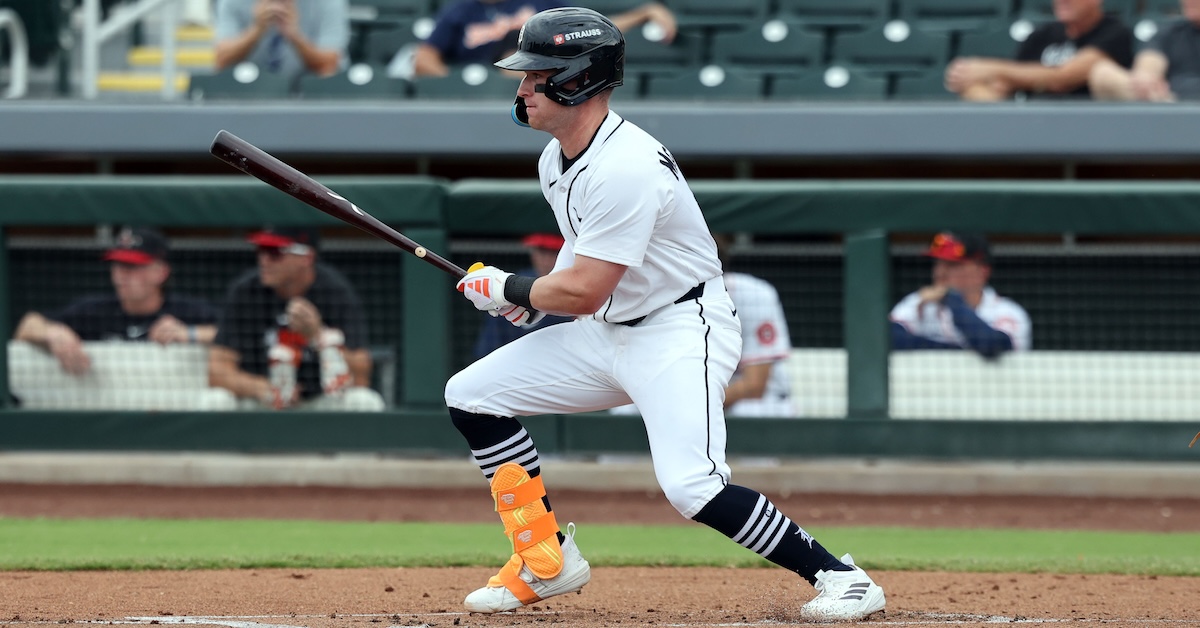
Yesterday, I wrote an introduction to Statcast’s latest round of bat tracking metrics. MLB.com’s Mike Petriello wrote a real primer, so I tried to build on that by analyzing how the different metrics work together using a couple common pitch types. We’re still figuring out how to use these new toys, but today I’d like to explain how my first dive into the bat tracking metrics led me to one particular player who is doing something weird, which led me to learn something small about the way swings work. After all, that’s why we’re here exploring all these strange new numbers in the first place.

In my first shot at playing with the metrics, I tried to establish something simple. I pulled the overall bat tracking data for all qualified players, and I focused on Attack Direction, which tells you the horizontal angle of the bat at the moment of contact (or, in the case of a whiff, at the moment when the bat is closest to the ball). That seemed pretty straightforward to me. As with most bat tracking metrics, it’s also a timing and location metric. You generally need to meet inside pitches further out in front of home plate. If you’re behind the pitch, your bat will be angled toward the opposite field, and you won’t pull the ball. If you’re out in front of the pitch, your bat will be angled toward the pull side, and you’ll pull it. A player’s average Attack Direction should correlate pretty well with their pull rate, and the numbers pretty much bear that out. Attack Direction and pull rate have a .60 correlation coefficient:

Most of the dots are clustered around that very clear trendline. Players who pull the ball more tend to have their bats angled toward the pull side just as you’d expect. What interested me was that green dot way at the bottom. It belongs to Leody Taveras. I guess it is Leody Taveras, if we really believe in our graphs, which we probably should at this particular website.

Taveras has a moderately low Attack Direction, four degrees to the pull side, but he’s got the third-lowest pull rate of any player on this chart. I couldn’t help wondering how exactly he was doing that. Before I dug into it too deeply, I was reminded that the fact that he’s a switch-hitter might have something to do with it. So I pulled the data again, this time separating out all players by handedness. On the chart below, switch-hitters will appear twice:

The correlation isn’t quite as strong, because switch-hitters are now broken into two different players with two smaller samples (that’s how small-sample right-handed Patrick Bailey got way down at the bottom). But there are two green dots now! And they’re both Leody Taveras! From both sides of the plate, Taveras looks like he should have a pull rate that’s a bit above average, and instead has one of the very lowest pull rates in the game. At this point, I was officially curious, so I started poking around.

First, I specifically looked at Attack Direction on balls hit to the opposite field. Since the start of bat tracking midway through the 2023 season, when Taveras hits the ball the other way, his average Attack Direction is three degrees toward the opposite field. Only four players in baseball have an average Attack Direction that’s less oriented toward the opposite field. Oddly, they’re all sluggers. Salvador Perez, Yordan Alvarez, Aaron Judge, and José Ramírez are all at two degrees toward the opposite field, and Austin Riley is tied with Taveras at three degrees. Taveras is definitely not a slugger. He could not be more different from these five guys. So not only is he doing something way different from most hitters when he goes the opposite way, but the only players out on that ledge with him have completely different swings than he does. There really is something weird about him.

Next, I tried looking specifically for balls hit to the opposite field even though the bat was angled toward the pull side at the moment. Just 21% of balls hit to the opposite field have the bat angled toward the pull side at all. I ran a Baseball Savant search, setting the minimum Attack Direction at seven degrees toward the pull side. Since bat tracking started, 5.5% of Taveras’s batted balls have fallen into this category. Among the 375 players with at least 200 BIP over that period, that’s the 11th-highest rate. Elehuris Montero is the champion at a shocking 10.5%, but no player who has put as many balls in play as Taveras has run as high a rate as he has.

At that point, I decided to look at individual balls that fell into this category: balls that go to the opposite field even though the bat is angled toward the pull side at contact. How exactly does this happen? Try to picture it in your mind. If the bat is angled toward the pull side, and it’s being swung in that direction anyway, how does the ball end up going in the opposite direction? There are two main answers. Here’s the less common way:

That’s Taveras way, way out in front of a curveball, hitting it off the very end of his bat. He cued it up so perfectly that if the end of his bat were cupped, the ball might have just gotten stuck in there. So that’s one way to do it. In fact, 21% of the balls we’re looking at, hit to the opposite field even though the Attack Direction is seven or more degrees to the pull side, are squibbers hit off the end of the bat below 80 mph. That’s one way to do it.

The other way is much more common, and it looks like this:

Of those same balls, hit to the opposite field even though the Attack Direction is seven or more degrees to the pull side, 50% are classified as popups, and 65% have a launch angle above 38 degrees. Basically, when you hit a ball in that weird manner, it’s almost always going to be either a cue shot or a popup. Leody Taveras taught me that.

This has a lot to do with Attack Angle. If your bat were perfectly parallel to the ground, but angled toward the pull side, it would be pretty much impossible to hit the ball the other way. But when you pop the ball up, you’re not hitting it flush. You’re getting under it. And regardless of the situation, your bat is almost never parallel to the ground. According to Statcast, the bat is angled downward on more than 80% of swings. If you just look at popups, that number is up above 90%. About half of popups come on four-seamers and cutters, where the batter has trouble catching up and swings just under the pitch. The rest come on softer stuff, and those pitches are usually low in the zone. I need you to do some 3D visualization in your head here, because my diagram is not very good:

On the left is a perfectly level bat, parallel with the front of the plate. Now imagine you’re angling your bat downward and you get just underneath the ball. If your bat is angled toward the opposite field or, as in the middle example, straight toward center field, you’ll likely just foul the ball off behind you or into the opposite field stands. Once you angle it toward the pull side, however, it can stay fair, bouncing up and toward the opposite field. Please imagine that the bat on the right looks so funky because it’s foreshortened, pointed out toward the first baseman. Taveras can show us what that looks like in the real world:

If his Attack Direction were zero, he would’ve fouled the ball up and into the stands down the third base line. He only kept it fair because of his Attack Direction of 18 degrees.

Look, I don’t have a big takeaway here. I just think this interesting. I think it highlights the way that the angle of the bat informs even the most mundane batted balls. If you’d asked me yesterday whether it’s possible to go the opposite way while your bat was angled toward the pull side, I would’ve had to think about it, but my first reaction would’ve been to say no. The bat and ball move through space so quickly that they can be hard to track, but the bat tracking metrics help explain why exactly Taveras pops out so very, very often, and how it’s even possible to hit a ball like that in the first place.


Introducing NOLA: A Metric for Starting Pitcher Consistency

Jeff Curry-Imagn Images

Aaron Nola is having a truly awful season: Through nine starts, he’s 1-7 with a 6.16 ERA, which is bad for any pitcher. For the putative no. 2 starter on a big-market team whose fans are getting pretty tetchy about not having won a World Series in a while, it’s disastrous. Especially when said pitcher is in year two of a seven-year, $172 million contract. In fact, you’d have to say Nola has been surpassed in the pecking order by Cristopher Sánchez at the very least, and possibly by newcomer Jesús Luzardo.

Everyone’s got their theories as to what’s gone wrong. Davy Andrews tried to figure out Nola’s deal last month. Timothy Jackson of Baseball Prospectus speculated earlier this week that there’s something off with his fastball, and that lefty-heavy opposing lineups might be to blame. The Phillies, for their part, just put Nola on the (non-COVID) IL for the first time in almost eight years. The stated reason is an ankle injury Nola says is messing up his mechanics, but a player in a slump this bad can almost always use some time off to clear his head as well. Read the rest of this entry »


Cleveland Guardians Top 48 Prospects

Travis Bazzana Photo by: Phil Masturzo/USA TODAY NETWORK via Imagn Images

Below is an analysis of the prospects in the farm system of the Cleveland Guardians. Scouting reports were compiled with information provided by industry sources as well as my own observations. This is the fifth year we’re delineating between two anticipated relief roles, the abbreviations for which you’ll see in the “position” column below: MIRP for multi-inning relief pitchers, and SIRP for single-inning relief pitchers. The ETAs listed generally correspond to the year a player has to be added to the 40-man roster to avoid being made eligible for the Rule 5 draft. Manual adjustments are made where they seem appropriate, but we use that as a rule of thumb.

A quick overview of what FV (Future Value) means can be found here. A much deeper overview can be found here.

All of the ranked prospects below also appear on The Board, a resource the site offers featuring sortable scouting information for every organization. It has more details (and updated TrackMan data from various sources) than this article and integrates every team’s list so readers can compare prospects across farm systems. It can be found here. Read the rest of this entry »


Which Hitters Have Seen Their 2026 Projections Change the Most?

Vincent Carchietta and Jerome Miron-Imagn Images

I spend a lot of time saying the word “April.” It’s a convenient excuse to wave away any notion of changing my mind drastically on a player after two or three weeks of the season. But April isn’t actually meaningless, and as we head toward June, we’re already nearly a third of the way through the season. A lot of the stuff we’ve seen isn’t just a rough patch or a freak BABIP, but career trajectories changing, and that has consequences for the players and their teams. One of the most common questions about players I get in chats is some variation of “What does ZiPS think now?” I can’t answer them all, mainly because “doughy middle-aged nerd talks to his magical baseball box for an hour” sounds like the worst episode of Black Mirror ever. That said, because I do full in-season runs of ZiPS in the middle of every month, now seems like a good time to get some projectionist changes of heart for the overachieving and underperforming players.

So whose changing fortunes are most likely to lead to changed destinies? Well, to get an idea of which trajectories have changed the most, I took the current 2026 projected numbers for each player and compared them to the 2026 ZiPS projections from before this season began. We’ll start with the good news, because I’m a Baltimore native and an Orioles fan, so I need something sunny first. These are park-neutral projections, and I eliminated anyone who is projected as below replacement level, since we’re focusing on major league-relevant players. Today, we’ll cover the position players before moving on to the pitchers tomorrow.

Here are the players whose 2026 ZiPS projections have improved the most since the beginning of this season, sorted by the greatest gains in projected WAR: Read the rest of this entry »


The 2025 FanGraphs Fan Exchange Program: Introduction and Entrance Survey

Tim Heitman-USA TODAY Sports

As we get further and further into the month of May, signs of summer are popping up all around us. Allergies are flaring, you can start to trust the major league stat leaderboards, and colleges across the country are wrapping up their spring semesters.

That last point is important, because summer is the season of study abroad. Every year around this time, thousands of American undergraduates get on planes, learn to navigate a foreign country, meet new people, and discover that their Spanish gets way better after three or four beers. It’s a marvelous experience, and I want to bring it to you, the FanGraphs readers.

Welcome to the 2025 FanGraphs Fan Exchange Program.

For one week, I want you to put your favorite team on the shelf and follow a different one. Do whatever you do in the normal course of being a fan, but do it for another ballclub. Read the rest of this entry »


Catchers Are Finally Joining in on the Fun at the Plate

Kirby Lee-Imagn Images

I sometimes worry about overusing the words “for a catcher” in my writing. I don’t like overusing words. Case in point, I hate that I have already overused the word “overusing” (and the word “words”) in the first two sentences of this piece. Yet the “for a catcher” qualifier is often necessary. Catchers aren’t as fast as other position players. He runs well… for a catcher. They aren’t as agile as other position players. He’s athletic… for a catcher. They need more time off than other position players. He plays a lot… for a catcher. Above all else, they tend not to hit as well as other position players. Say it with me now: He hits well… for a catcher.

Catcher is the most demanding defensive position, and as a result, offensive standards for backstops are lower. The average wRC+ at catcher is typically about 10% worse than the big league average. That means that a team whose catchers produce a 100 wRC+ will usually rank among the majors’ top third, even though you wouldn’t want to see those catchers batting higher than the bottom third of the order. This is so often the case that most of us take it for granted. For instance, if I were chatting in a sports bar instead of writing for FanGraphs, I might say that Austin Wells (101 wRC+), Bo Naylor (99 wRC+), or J.T. Realmuto (102 wRC+) has hit “pretty well for a catcher” this year, without even bothering to check how well the average catcher has actually performed. Unfortunately for those guys, I’m far more comfortable sitting behind a computer than sitting in a bar, so I did look into how well catchers have hit in 2025. What I discovered is that, at least for now, I’m at no risk of overusing the phrase “for a catcher” after all. Just past the quarter mark of the 2025 season, catchers have a 101 wRC+.

With a .246/.318/.396 slash line, catchers are slightly outperforming the league average in all three triple slash categories. If they can keep this up, the 2025 season will be the first since at least 2002 (as far back as our positional splits go) in which catchers outperformed the league average in any one of the triple slash statistics, let alone all three. Read the rest of this entry »


Which Batter Hits the Ball to Their Own Position Most Often?

Jesse Johnson-USA TODAY Sports

Which players most often hit the ball to the positions that they themselves play when they’re in the field? It’s a simple question, but it also begs larger, murkier philosophical questions. Is hitting the ball to your own position the height of baseball narcissism? Or is it that hitting the ball to your special spot just feels right? Maybe the batter just stands at the plate, surveys the great green-and-brown expanse before them and gets overwhelmed. “What shall I do?” they ask themselves as the pitch clock ticks down and the hot dog vendors emit their indecipherable warblings. Then they see an oasis of familiarity, the one patch of earth that has welcomed them through a lifetime of baseball-related activities. Hitting the ball there just might feel like coming home. “I know just what I’ll do,” they think, twisting their gloved hands against the handle of the bat. It is their pen, and with it they will write what they know.

So who does that the most? Before I dug into the numbers, I put the question to my colleagues. None of us got it right. I thought I was pretty clever by picking Steven Kwan. He’s a contact maven who specializes in dumping the ball into left field, a position famously played by none other than multiple Gold Glove winner Steven Kwan. I felt all the more clever when Ben Clemens picked Kwan, too. We were wrong. So were Jon Becker, who picked Bo Bichette, Jay Jaffe, who picked Luis Rengifo, and Jake Mailhot, who picked Nico Hoerner. None of the players we picked was even at the top in his respective position, either on a counting basis or a rate basis. Read the rest of this entry »


Sunday Notes: Mason Fluharty Is an Ascending Blue Jay Flying Under The Radar

Mason Fluharty is flying under the radar as one of baseball’s most effective lefty relievers. Since making his major league debut with the Toronto Blue Jays on April Fools Day, the 23-year-old southpaw has a 1.96 ERA and a 2.94 FIP over 18 appearances. Moreover, he’s allowed just seven hits in his 18-and-third innings, and prior to surrendering a solo home run to former Jay Danny Jansen this past Tuesday he’d retired 21 consecutive batters. All three of his decisions are in the win column.

His initial two outings were especially challenging. The first batter Fluharty faced in the bigs was Washington Nationals 2024 All-Star CJ Abrams, who lined a run-scoring double. Three days later, the first batter in his second outing was Juan Soto; the New York Mets superstar also stroked a run-scoring double.

I asked the 2022 fifth-round pick out of Liberty University about those welcome-to-the-big-leagues ABs prior to his third appearance.

“Get put into the fire and see what happens,” said Fluharty, who later that same day faced Rafael Devers [E-6], Alex Bregman [K], and Rob Refsnyder [DP]. “I’m glad they have faith in me. While I obviously would have preferred better outcomes in those first outings, it’s all about adjusting. This game is hard.”

The pitches that were turned around for two-baggers? Read the rest of this entry »


Nathan Eovaldi Is Making Delicious Lemonade

Lon Horwedel-Imagn Images

If motor preferences were the final word on pitcher performance, Nathan Eovaldi would be sitting on a beach somewhere.

Eovaldi throws from a low slot, releasing his pitches from an average arm angle of 30 degrees. (Zero degrees is fully sidearm; 90 degrees is straight over the top.) Many low-slot pitchers have a supination bias. There are downsides to being a supinator — their preference for cutting the baseball tends to produce crummy four-seam fastballs — but they usually have no trouble throwing hard breaking balls; they can also more easily harness seam-shifted wake to throw sinkers, sweepers, or kick-changes. Low-slot supinators, like Seth Lugo, can basically throw every pitch in the book. High-slot pronators like Ryan Pepiot or Lucas Giolito don’t have that sort of range, but make up for it with excellent changeups and high-carry fastballs.

Eovaldi is, tragically, a low-slot pronator. Not many low-slot pronators make it to the big leagues. The pronation bias blunts their ability to throw hard glove-side breakers, and the low arm angle obviates the pronator’s nominal advantage, killing the carry on their fastball. As Tyler Zombro of Tread Athletics (now a special assistant of pitching for the Cubs) said in his primer video on motor preferences, “I know in stuff models and just off of Trackman alone, this arsenal with this slot is not that attractive.” Read the rest of this entry »


There’s More to the Citi Field Raccoon Story

SNY

On Wednesday, the Rocket City Trash Pandas shut out Pensacola, 9-0, in the Southern League. In the Midwest League, the Quad Cities River Bandits eked out a 7-6 win over the Dayton Dragons. And in the big leagues, television cameras captured an enormous raccoon traipsing through the Citi Field seats during the seventh inning of the Mets-Pirates game. It was a good day for raccoons at the ballpark.

The major league raccoon went down one row of seats in center field, then back across the next row up, looking for all the world like it was just searching for its seat. “I’m scared of raccoons,” said SNY broadcaster Ron Darling, stammering slightly. The brief clip makes it look like the Citi Field raccoon was simply out for a late-night stroll, not bothering anybody. It turns out there’s more to the story. Read the rest of this entry »